

|
시장보고서
상품코드
2063822
히트펌프 건조기 : 시장 점유율 분석, 업계 동향 및 통계, 성장 예측(2026-2031년)Heat Pump Dryer - Market Share Analysis, Industry Trends & Statistics, Growth Forecasts (2026 - 2031) |
||||||
 Mordor Intelligence
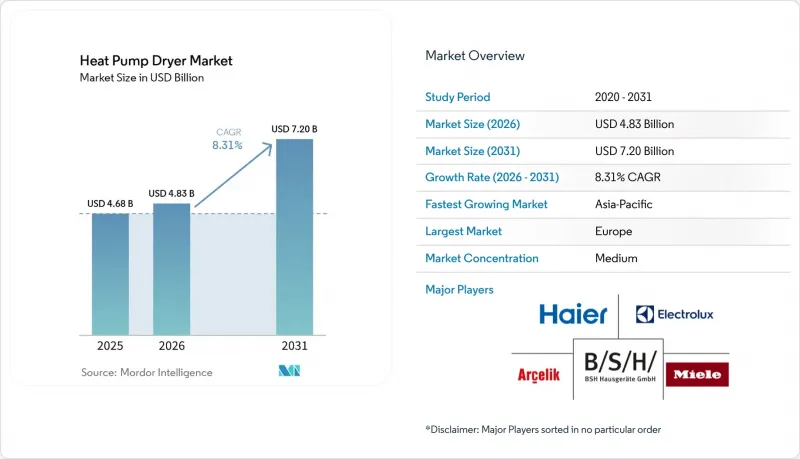
Mordor Intelligence에 의하면, 세계의 히트펌프 건조기 시장 규모는 2025년 46억 8,000만 달러로 평가되었습니다. 2026년에는 48억 3,000만 달러로 확대되어 2031년까지 72억 달러에 이를 것으로 예측되며, 2026년부터 2031년에 걸쳐 CAGR 8.31%로 성장할 전망입니다.
본 보고서는 제품 유형(커패시터식, 통기식, 일체형), 용량(8kg 이하, 9-10kg, 11kg 이상), 최종 사용자(주거용, 상업용, 산업용), 유통 채널(B2C/소매, B2B/직접 판매), 지역(북미, 남미, 유럽, 아시아태평양, 중동 및 아프리카)별로 분류되어 있습니다. 시장 전망치는 금액(달러) 단위로 제시되어 있습니다.
세계의 히트펌프 건조기 시장 동향 및 분석
효율 기준과 표시 의무가 히트 펌프의 보급을 가속화
2025년 7월 1일 이후로는 열펌프 기술을 채택한 드럼 건조기만 EU 시장에 출시될 수 있게 되며, 배기식 전기 건조기나 저항 가열식 커패시터 건조기는 시장에서 퇴출될 것이며, 연구 개발은 고효율 폐쇄 루프 건조 시스템의 설계로 방향을 전환하게 될 것입니다. 또한 EU는 라벨 등급을 A-G 범위로 재조합하여 가장 효율이 높은 모델에 상위 등급을 부여함으로써 소비자의 기대치를 재설정하는 한편, 세계의 히트펌프 건조기 시장 전반에 걸쳐 판매 시점의 정보 전달을 개선했습니다. 미국에서는 에너지부의 직접 최종 규정에 따라 2028년 3월 1일을 준수 기한으로 설정하고, 종합 에너지 효율(CEF) 기준을 도입했습니다. 이를 통해 기준을 충족하지 못하는 기존의 전기식 모델이나 소형 배기 불필요형 모델을 히트펌프식 또는 하이브리드 구성으로 전환함으로써, 제품군 전체의 저탄소화를 지원합니다. ENERGY STAR 사양 초안 버전 2.0에서는 DOE의 최저 기준을 상회하는 CEF(종합 에너지 효율) 기준치와 사이클 시간 상한이 제안되어 있으며, 이를 통해 높은 CEF와 뛰어난 에너지 효율을 갖춘 건조기 플랫폼이 프리미엄 라벨 획득 및 소매점 내 눈에 띄는 진열을 실현할 수 있는 확실한 길이 될 것입니다. IEC 60335-2-11 : 2024 안전 기준은 가연성 냉매를 사용하는 가전제품에 대한 요구 사항을 정의하고 있으며, 감지, 기밀성 및 원격 조작에 관한 규정을 포함하고 있습니다. 이를 통해 세계의 히트펌프 건조기 시장에서 가정 환경을 보호하면서 R290의 더 광범위한 사용이 가능해집니다.
유틸리티자의 리베이트와 인센티브가 투자 회수 기간을 단축
ENERGY STAR 인증 히트펌프식 의류 건조기에 대한 판매 시점 리베이트는 회계 처리 시 직접 할인이 적용되므로, 구매 장벽을 낮추고 세계의 히트펌프 건조기 시장의 다양한 가구에 있어 장기적인 절약 효과를 즉각적인 가격 경쟁력으로 전환합니다. 전기식에서 전기식으로 교체할 때 DIY 설치를 허용하는 주 정부 프로그램은 적용 범위를 확대하고 인건비를 절감함으로써, 건물의 조건이 허용하는 한 배기가 필요 없는 방식의 편의성을 더욱 널리 보급할 것입니다. 조지아주의 프로그램에서는 DIY(직접 설치) 옵션 외에도 배선 및 분전반 설치 비용 지원이 마련되어 있어, 이를 통해 전기 설비가 노후된 가구도 인센티브 적용 후의 가격대로 에너지 효율이 높은 건조기를 도입할 수 있게 됩니다. 미네소타 파워(Minnesota Power)나 DTE 에너지(DTE Energy) 등 전력 회사가 제공하는 리베이트는 연방 정부의 지원금과 중복 수령이 가능하며, 이를 통해 총 지원 금액이 증가함에 따라 세계의 히트펌프 건조기 시장에서 예산 부담을 느끼지 않고 열펌프 방식으로 전환할 수 있는 구매자층이 확대될 것입니다. SMUD의 가스식에서 전기식으로의 전환 인센티브 등, 공동주택을 대상으로 한 프로그램은 공용 세탁실이나 부동산 포트폴리오를 직접 대상으로 하며, 기관 투자자들이 친환경 기술을 표준화하고 운영 비용을 절감할 수 있도록 지원하고 있습니다.
통기식/커패시터식 유닛의 높은 초기 비용
통기식 또는 저항 가열식 커패시터 건조기에 비해 높은 초기 가격은 비용에 민감한 가구에게 여전히 장벽으로 작용하고 있습니다. 그러나 수명 주기 비용 절감과 리베이트 덕분에 세계의 히트펌프 건조기 시장의 많은 지역에서 그 격차는 점차 좁혀지고 있습니다. 연방 프로그램과 병행하여 이용할 수 있는 판매 시점 리베이트나 유틸리티자의 인센티브는 대상 구매자에게 장기적인 비용 절감을 즉각적인 할인으로 전환해 주어, 에너지 효율이 높은 건조기 도입 대상층을 확대합니다. 법인 고객들 역시 설비 투자 예산이나 처리 능력에 대한 수요와 운영 비용 절감 효과를 비교 검토하고 있으며, 이로 인해 예산 사정에 맞추어 교체 시기를 미루는 사례가 나타나고 있습니다. 핵심 효율성은 유지하면서 불필요한 기능을 줄여 가성비가 뛰어난 구성을 제공하는 브랜드가 늘어나면서 가격 차이는 더욱 좁혀지고 있으며, 세계의 히트펌프 건조기 시장에서 모든 소득 계층에 걸쳐 도입이 확대되고 있습니다.
부문별 분석
2025년, 커패시터식 히트펌프 건조기는 세계의 히트펌프 건조기 시장 점유율의 76.91%를 차지했으며, 이 부문은 개조 공정을 간소화하고 다양한 주택에서 배기구가 필요 없는 편의성을 지원하는 폐쇄형 건조 시스템 덕분에 계속해서 주도적인 위치를 유지하고 있습니다. 현재, 히트펌프 기술은 유럽연합(EU)에서는 규제 기준으로 자리 잡았고, 북미에서는 명확한 프리미엄화 전략으로 자리 잡고 있는 만큼, 주요 브랜드들은 자동 세척 커패시터, 인버터 압축기, 앱 연동 제어 기능을 기본 사양으로 탑재하고 있으며, 이는 에너지 효율이 높은 건조기에 대한 기대에 부응하는 것입니다. 주요 지역의 에너지 라벨 및 건축 관행이 폐쇄형 시스템의 효율성과 응축 성능을 평가하고 있기 때문에 배기식 히트펌프 모델은 여전히 틈새 시장에 머물러 있으며, 판매 공간과 인센티브는 커패시터식 구성에 중점을 두고 있습니다.
2031년까지 가장 빠르게 성장하고 있는 유형은 빌트인형입니다. 프리미엄층 구매자들이 미관을 해치지 않으면서 성능을 향상시키는 센서 기반 건조 기능, 습도 센서, 하이브리드 건조 시스템에 주목하고 있어, 빌트인형은 연평균 성장률(CAGR) 8.72%로 성장할 것으로 전망됩니다. 세계의 히트펌프 건조기 시장은 제품 라인 통합이 진행되고 있으며, 커패시터식과 일체형 모델에서 압축기, 센서, 제어 기판을 공유하는 한편, 차별화의 초점은 마감 품질, 설치의 복잡성 및 소음 성능에 맞추어져 있습니다. 유럽연합(EU)의 라벨은 명확한 기준을 제시하고 있으며, ENERGY STAR의 제안된 기준은 미국의 프리미엄 기준을 한층 더 세분화하고 있습니다. 이를 통해 소매점 및 온라인에서 효율성 향상의 성과가 가시화되고 있습니다. 그 결과, 세계의 히트펌프 건조기 시장에서는 핵심인 효율성이라는 장점을 넘어 차별화를 꾀하기 위해 사용자 경험, 의류 보호, 라이프사이클 서비스 역량에 대한 의존도가 높아지고 있습니다.
2025년, 9-10kg 용량 대는 세계의 히트펌프 건조기 시장의 42.83%를 차지했습니다. 이는 환기구가 필요 없습니다는 편의성을 바탕으로, 일반 가정의 세탁물 양에 대응하는 표준적인 틈새 설치, 균형 잡힌 처리 능력, 그리고 의류 보호에 대한 핵심적인 요구를 반영하고 있습니다. 유럽연합(EU)의 A-G 등급 에너지 효율 라벨 및 북미의 ENERGY STAR 인증 제품 점유율 확대에 따라, 이 용량대는 공간이나 전력 부담을 주지 않으면서 최고 수준의 성능을 발휘하는 경우가 많아, 그 결과 세계의 히트펌프 건조기 시장 전체에서 중심적인 역할을 유지하고 있습니다. 8kg 이하의 소형 건조기나 세탁·건조 일체형 제품은 최대 용량보다는 120V 전압에서의 작동이나 설치 면적이 작은 점이 중요시되는 아파트나 별장에서 중요한 역할을 하고 있습니다. 모든 사이즈에서 AI 제어 및 하이브리드 건조 시스템을 통해 온도 범위를 안정적으로 유지하면서 건조 주기를 단축함으로써, 의류를 손상시키지 않고 실제 사용 만족도를 높이고 있습니다.
11kg 이상의 대용량 모델은 가장 빠르게 성장하고 있는 용량 그룹으로, 연평균 성장률(CAGR) 8.41%를 나타낼 것으로 전망됩니다. 이는 북미의 일반 가정이나 소규모 상업 이용자들이 작업 시간을 늘리지 않고도 부피가 큰 침구나 대량의 혼합 세탁물을 처리하고 싶어 하기 때문입니다. 인버터 속도 제어를 통해 예열 시 시간 손실을 줄일 수 있으며, 강화된 수분 센서는 드럼의 충전량이 변동하는 경우에도 과도한 건조를 방지하는 데 도움이 되어, 효율성과 원단 보호를 지원합니다. 9-10kg 용량대는 최고 수준의 성능과 설치 공간 제약 간의 균형이 잘 잡혀 있어, 세계의 히트펌프 건조기 시장의 중심을 계속 차지하고 있습니다. 한편, 소형 모델은 대형 기종의 설치 공간이나 전원 변경을 수용할 수 없는 건물에서 여전히 널리 사용되고 있습니다. 이 3가지 용량 대역으로 구성된 구조가 2031년까지 세계의 히트펌프 건조기 시장의 꾸준한 성장을 뒷받침하고 있습니다.
지역별 분석
2025년, 유럽은 전 세계 매출의 44.93%를 차지하며, 세계 히트펌프 건조기 시장의 제품 구성을 A등급 및 폐쇄형 건조 시스템 설계로 이끄는 에코디자인 및 라벨 표시 규정의 선구자로서 이 지역의 역할을 부각시켰습니다. 2025년 7월 1일부터 발효되는 유럽연합(EU) 규정 2023/2533 및 재설정된 A-G 등급은 명확한 최저 기준과 소비자가 이해하기 쉬운 지표를 규정하고 있으며, 이에 따라 소매점 및 전자상거래 사이트에서 고효율 건조기 제품 시장 점유율이 확대되고 있습니다. 국제전기표준회의(IEC) 60335-2-11 : 2024에 따른 규격 조화를 통해 R290의 채택이 가능해졌으며, 감지 및 기밀성 요건이 명확해짐에 따라 유럽 제조업체들은 저탄소화를 추구하면서도 안전성을 고려한 냉매 선택을 하고 있습니다.
아시아태평양은 가장 빠르게 성장하고 있는 지역으로, 연평균 성장률(CAGR)은 9.57%로 전망됩니다. 이는 세계의 히트펌프 건조기 시장에서 정책적 틀과 도시 지역의 주거 여건이, 콤팩트하고 배기가 필요 없는 편의성이 높은 플랫폼으로 수렴되고 있기 때문입니다. 일본의 ‘탑러너’ 제도와 한국의 에너지 절약 제도는 국내 주요 제조업체들이 고성능 센서식 건조 제품을 출시하도록 지속적으로 장려하고 있으며, 대부분의 경우 광범위한 시장 진출에 앞서 국내에서 먼저 출시되고 있습니다. 중국의 수직 통합은 비용 곡선의 개선을 가속화하고, 에너지 효율이 높은 건조기 선택의 폭을 넓히는 데 기여하고 있으며, 이는 전 세계적인 가격 책정 및 기능에 대한 기대에 영향을 미치고 있습니다. 도시의 인구 밀도가 설치 공간의 기준과 소비자의 기대를 형성하는 가운데, 7-10kg급 용량과 첨단 습도 센서의 조합을 통해 아시아태평양의 구매자들은 세계의 히트펌프 건조기 시장에서 제한된 공간에서도 의류를 보호할 수 있게 되었습니다.
북미의 성장 경로는 2028년 3월 1일까지 연방 기준의 통일, 120V 및 콤보 플랫폼의 보급 확대, 그리고 세계의 히트펌프 건조기 시장에서 대상 가구를 대상으로 에너지 효율형 건조기 모델의 가격을 동일하게 맞추기 위한 복합적인 인센티브 프로그램의 시행을 통해 정의됩니다. ENERGY STAR의 제안된 기준은 포인트제를 적용받는 구매자들을 사이클 시간 상한이 설정된 높은 CEF(종합 에너지 효율) 제품으로 유도하며, 이는 소매점의 재고 관리 및 온라인 판매 전략의 지침이 됩니다. 판매 시점 리베이트나 전기식에서 전기식으로 교체하기 위한 DIY 옵션을 제공하는 주 정부 프로그램은 배전반의 전면적인 개조가 필요 없는 오래된 주택으로 보급 범위를 넓혔으며, 컴팩트한 콤보형은 많은 아파트의 실내 세탁실에서 사용할 수 있게 해줍니다. 이러한 요소들은 예측 기간 동안 세계의 히트펌프 건조기 시장의 지속적인 성장을 이끄는 원동력이 될 것입니다.
기타 혜택 :
- 엑셀 형식 시장 예측(ME) 시트
- 3개월간의 애널리스트 지원
자주 묻는 질문
목차
제1장 서론
제2장 조사 방법
제3장 주요 요약
제4장 시장 구도
제5장 시장 규모 및 성장 예측
제6장 경쟁 구도
제7장 시장 기회 및 향후 전망
KTH 26.06.26According to Mordor Intelligence, the global heat pump dryer market size is expected to increase from USD 4.68 billion in 2025 to USD 4.83 billion in 2026 and reach USD 7.20 billion by 2031, growing at a CAGR of 8.31% over 2026-2031.
This report is Segmented by Product Type (Condenser, Vented, Integrated), Capacity (≤8 Kg, 9-10 Kg, ≥11 Kg), End User (Residential, Commercial, Industrial), Distribution Channel (B2C/Retail, B2B/Direct), and Geography (North America, South America, Europe, Asia-Pacific, Middle East and Africa). Market Forecasts are Provided in Value (USD).
Global Heat Pump Dryer Market Trends and Insights
Efficiency Mandates and Labeling Accelerate Heat-Pump Adoption
From July 1, 2025, only tumble dryers using heat pump technology may be placed on the EU market, eliminating vented electric and resistance-heated condenser alternatives and channeling R&D toward high-efficiency, closed-loop drying system designs. The EU also rescaled labels to an A-G range that preserves the top classes for the most efficient models, resets shopper expectations, and improves signaling at the point of sale across the global heat pump dryer market. In the United States, the Department of Energy's direct final rule sets a March 1, 2028, compliance date with combined energy factor thresholds that pull lagging standard electric and compact ventless models toward heat pump or hybrid configurations, thereby supporting a low-carbon footprint at fleet scale. ENERGY STAR's draft version 2.0 specification proposes CEF thresholds above DOE minimums and a cycle time cap, making high-CEF, Energy-efficient dryer platforms the credible path to premium labeling and retailer prominence. Safety standards in IEC 60335-2-11:2024 define requirements for appliances using flammable refrigerants, including detection, tightness, and remote operation provisions, enabling broader use of R290 while protecting household environments in the global heat pump dryer market.
Utility Rebates and Incentives Shorten Payback
Point-of-sale rebates for ENERGY STAR-certified heat pump clothes dryers apply discounts directly at checkout, reducing decision friction and turning long-run savings into immediate price parity for a wide range of households in the global heat pump dryer market. State programs that permit do-it-yourself installation for electric-to-electric replacements expand eligibility and cut labor overhead, speeding adoption of ventless convenience where building conditions allow. Georgia's program adds a DIY pathway and wiring or panel allowances, which helps households with older electrical infrastructure reach energy-efficient dryer price points after incentives. Utility rebates from providers like Minnesota Power and DTE Energy stack with federal benefits, raising the combined value and broadening the pool of buyers who can switch to heat pumps without budget tension in the global heat pump dryer market. Multifamily-oriented programs, such as SMUD's incentives for gas-to-electric conversions, directly target shared laundry rooms and property portfolios, helping institutional owners standardize green technology and reduce operating costs.
Higher Upfront Price Versus Vented/Condenser Units
Initial price premiums versus vented or resistance-heated condenser dryers remain a barrier for cost-sensitive households, even as lifecycle savings and rebates narrow gaps in many regions of the global heat pump dryer market. Point-of-sale rebates and utility incentives that stack with federal programs convert long-term savings into on-receipt discounts for qualifying buyers, which raises the addressable base for Energy-efficient dryer adoption. Commercial buyers also weigh capital budgets and throughput needs against operating savings, which can defer replacements to coordinated budget windows. As more brands deliver value configurations that preserve core efficiency while trimming extras, the premium narrows further, and adoption improves across income tiers in the global heat pump dryer market.
Other drivers and restraints analyzed in the detailed report include:
- Urban Multifamily Housing Constraints Favor Ventless Dryers
- OEM Innovation Improves Cycle Time, Noise, and Reliability
- Longer Average Cycle Times in Certain Conditions
For complete list of drivers and restraints, kindly check the Table Of Contents.
Segment Analysis
Condenser heat pump dryers held 76.91% of the global heat pump dryer market share in 2025, and the segment continues to lead due to a closed-loop drying system that simplifies retrofits and supports ventless convenience in a wide range of dwellings. With heat pump technology now the regulatory baseline in the European Union and the clear premium pathway in North America, leading brands feature auto-cleaning condensers, inverter compressors, and app-connected controls as standard, which aligns with Energy-efficient dryer expectations. Vented heat pump models remain a niche as energy labels and building practices across major regions reward closed-loop efficiency and condensation performance, directing shelf space and incentives toward condenser configurations.
Integrated (built-in) models are the fastest-growing type through 2031. They are projected to grow at a 8.72% CAGR as premium buyers align around sensor-based drying, moisture sensors, and hybrid drying systems that improve performance without compromising aesthetics. The global heat pump dryer market is moving toward portfolio convergence, with condenser and integrated lines sharing compressors, sensors, and control boards, while differentiation centers on finish quality, installation complexity, and acoustic targets. European Union labels set a clear bar, and ENERGY STAR's proposed criteria refine the United States' premium thresholds, together making efficiency achievements visible at retail and online. As a result, the global heat pump dryer market relies more on user experience, Fabric protection, and lifecycle service capabilities to differentiate beyond core efficiency claims.
The 9-10 kg bracket captured 42.83% of the global heat pump dryer market in 2025, reflecting the core demand for standard alcove fit, balanced throughput, and fabric protection for typical household loads under ventless convenience. With A-G labeling in the European Union and a rising share of ENERGY STAR-certified products in North America, this capacity range often delivers top performance without imposing space or power burdens, thereby sustaining its central role across the global heat pump dryer market. Compact ≤8 kg dryers and washer dryer combos play a key role in apartments and secondary units where 120V operation and small footprints outweigh maximum capacity. Across sizes, AI controls, and Hybrid Drying Systems are compressing cycles while keeping temperature envelopes gentle, preserving textiles, and increasing real-world satisfaction.
Large-format units rated ≥11 kg are the fastest-growing capacity group, projected to grow at a 8.41% CAGR, as North American households and light commercial users aim to process bulky bedding and high-volume mixed loads without extending total time on task. Inverter speed control reduces the warm-up penalty, and enhanced Moisture Sensors help prevent over-drying even when drum fullness varies, supporting efficiency and fabric protection. The 9-10 kg range remains the center of gravity for the global heat pump dryer market because it pairs top label outcomes with available space constraints, while compact models sustain penetration in buildings that cannot accommodate larger cutouts or power changes. This three-lane capacity structure underpins steady growth in the global heat pump dryer market through 2031.
Geography Analysis
Europe accounted for 44.93% of global revenues in 2025, underscoring the region's role as an early mover on ecodesign and labeling rules that direct the product mix of the global heat pump dryer market toward A-class, closed-loop drying System designs. Regulation (European Union) 2023/2533 and the rescaled A-G label, effective July 1, 2025, set explicit floors and clear consumer cues, which lift the share of energy-efficient dryer products on retail floors and e-commerce listings. With standards harmonization under International Electrotechnical Commission (IEC) 60335 2 11:2024 enabling R290 adoption and clarifying detection and tightness requirements, European manufacturers align refrigerant choices with safety while pursuing a low carbon footprint.
Asia-Pacific is the fastest-growing region, with a projected 9.57% CAGR, as policy frameworks and urban housing realities converge on compact, ventless convenience platforms across the global heat pump dryer market. Japan's TopRunner approach and South Korea's efficiency schemes continue to push domestic champions to release high-performing, Sensor-Based Drying products, often debuting domestically before wider rollout. Vertical integration in China speeds cost curve improvements and supports broader access to Energy-efficient dryer options, which then influence global pricing and feature expectations. With urban density shaping alcove standards and consumer expectations, capacities in the 7-10 kilogram band coupled with advanced moisture sensors help Asia-Pacific buyers match fabric protection to smaller spaces in the global heat pump dryer market.
North America's growth path is defined by the harmonization of federal standards by March 1, 2028, expanding availability of 120V and combo platforms, and the execution of stacked incentive programs that bring energy-efficient dryer models to price parity for qualifying households in the global heat pump dryer market. ENERGY STAR's proposed criteria point premium buyers to high-Combined Energy Factor (CEF) products with cycle time caps, which guides retail stocking and online merchandising. State programs with point-of-sale rebates and DIY options for electric-to-electric swaps increase reach in older housing without full panel work, and compact combos unlock in unit laundry for many apartments. These elements provide durable catalysts for the global heat pump dryer market over the forecast window.
- BSH Hausgerate GmbH (Bosch, Siemens)
- Electrolux Group (Electrolux, AEG, Zanussi)
- Haier Smart Home (Haier, Candy, Hoover, GE Appliances)
- LG Electronics
- Samsung Electronics
- Whirlpool Corporation (incl. Indesit, Maytag, Hotpoint brands where applicable)
- Miele & Cie. KG
- Beko (Arcelik A.S.) / Grundig
- Gorenje (Hisense Europe) / Hisense
- Fisher & Paykel
- ASKO Appliances
- GE Appliances
- Electrolux Professional
- Alliance Laundry Systems (Speed Queen, Huebsch)
- Girbau
- Panasonic
- Vestel (selected OEM/brands)
- Smeg S.p.A.
- Candy Hoover Group S.r.l.
- Midea Group
Additional Benefits:
- The market estimate (ME) sheet in Excel format
- 3 months of analyst support
TABLE OF CONTENTS
1 Introduction
- 1.1 Study Assumptions & Market Definition
- 1.2 Scope of the Study
2 Research Methodology
3 Executive Summary
4 Market Landscape
- 4.1 Market Overview
- 4.2 Market Drivers
- 4.2.1 Efficiency mandates and labeling accelerate heat-pump adoption
- 4.2.2 Utility rebates and incentives shorten payback
- 4.2.3 Urban multifamily housing constraints favor ventless dryers
- 4.2.4 OEM innovation improves cycle time, noise, and reliability
- 4.2.5 Premium-to-mid price migration expands addressable base
- 4.2.6 Commercial laundry electrification and ESG targets
- 4.3 Market Restraints
- 4.3.1 Higher upfront price versus vented/condenser units
- 4.3.2 Longer average cycle times in certain conditions
- 4.3.3 Refrigerant transition (R290) adds redesign/certification burden
- 4.3.4 Electrical capacity limits in older buildings slow retrofits
- 4.4 Industry Value Chain Analysis
- 4.5 Porter's Five Forces
- 4.5.1 Threat of New Entrants
- 4.5.2 Bargaining Power of Suppliers
- 4.5.3 Bargaining Power of Buyers
- 4.5.4 Threat of Substitutes
- 4.5.5 Industry Rivalry
- 4.6 Insights Into The Latest Trends And Innovations in the Industry
- 4.7 Insights On Recent Developments (New Product Launches, Strategic Initiatives, Investments, Partnerships, JVs, Expansion, M&As, Etc.) In The Industry
- 4.8 Insights on Regulatory Framework and Energy-Efficiency Standards in Key Geographies
5 Market Size & Growth Forecasts
- 5.1 By Product Type
- 5.1.1 Condenser Heat Pump Dryers
- 5.1.2 Vented Heat Pump Dryers
- 5.1.3 Integrated (Built-in) Heat Pump Dryers
- 5.2 By Capacity
- 5.2.1 <= 8 kg
- 5.2.2 9-10 kg
- 5.2.3 >= 11 kg
- 5.3 By End User
- 5.3.1 Residential
- 5.3.2 Commercial (Laundromats, Hospitality, Healthcare, Multi-housing)
- 5.3.3 Industrial (Light-Duty Laundry/Process Where Applicable)
- 5.4 By Distribution Channel
- 5.4.1 B2C/Retail Channels
- 5.4.1.1 Multi-brand Stores
- 5.4.1.2 Exclusive Brand Outlets
- 5.4.1.3 Online
- 5.4.1.4 Other Distribution Channels
- 5.4.2 B2B/Direct Sales
- 5.4.1 B2C/Retail Channels
- 5.5 By Geography
- 5.5.1 North America
- 5.5.1.1 United States
- 5.5.1.2 Canada
- 5.5.1.3 Mexico
- 5.5.2 South America
- 5.5.2.1 Brazil
- 5.5.2.2 Peru
- 5.5.2.3 Chile
- 5.5.2.4 Argentina
- 5.5.2.5 Rest of South America
- 5.5.3 Europe
- 5.5.3.1 United Kingdom
- 5.5.3.2 Germany
- 5.5.3.3 France
- 5.5.3.4 Spain
- 5.5.3.5 Italy
- 5.5.3.6 BENELUX (Belgium, Netherlands, and Luxembourg)
- 5.5.3.7 NORDICS (Denmark, Finland, Iceland, Norway, and Sweden)
- 5.5.3.8 Rest of Europe
- 5.5.4 Asia-Pacific
- 5.5.4.1 India
- 5.5.4.2 China
- 5.5.4.3 Japan
- 5.5.4.4 Australia
- 5.5.4.5 South Korea
- 5.5.4.6 South East Asia (Singapore, Malaysia, Thailand, Indonesia, Vietnam, and Philippines)
- 5.5.4.7 Rest of Asia-Pacific
- 5.5.5 Middle East And Africa
- 5.5.5.1 United Arab Emirates
- 5.5.5.2 Saudi Arabia
- 5.5.5.3 South Africa
- 5.5.5.4 Rest of Middle East And Africa
- 5.5.1 North America
6 Competitive Landscape
- 6.1 Market Concentration
- 6.2 Strategic Moves
- 6.3 Market Share Analysis
- 6.4 Company Profiles {(includes Global level Overview, Market level overview, Core Segments, Financials as available, Strategic Information, Market Rank/Share for key companies, Products & Services, and Recent Developments)}
- 6.4.1 BSH Hausgerate GmbH (Bosch, Siemens)
- 6.4.2 Electrolux Group (Electrolux, AEG, Zanussi)
- 6.4.3 Haier Smart Home (Haier, Candy, Hoover, GE Appliances)
- 6.4.4 LG Electronics
- 6.4.5 Samsung Electronics
- 6.4.6 Whirlpool Corporation (incl. Indesit, Maytag, Hotpoint brands where applicable)
- 6.4.7 Miele & Cie. KG
- 6.4.8 Beko (Arcelik A.S.) / Grundig
- 6.4.9 Gorenje (Hisense Europe) / Hisense
- 6.4.10 Fisher & Paykel
- 6.4.11 ASKO Appliances
- 6.4.12 GE Appliances
- 6.4.13 Electrolux Professional
- 6.4.14 Alliance Laundry Systems (Speed Queen, Huebsch)
- 6.4.15 Girbau
- 6.4.16 Panasonic
- 6.4.17 Vestel (selected OEM/brands)
- 6.4.18 Smeg S.p.A.
- 6.4.19 Candy Hoover Group S.r.l.
- 6.4.20 Midea Group
7 Market Opportunities & Future Outlook
- 7.1 120V compact heat-pump dryers for North American retrofits (no panel upgrade)
- 7.2 Commercial heat-pump retrofits in multi-housing and hospitality with utility co-financing


