|
시장보고서
상품코드
2061913
연삭기 : 시장 점유율 분석, 업계 동향 및 통계, 성장 예측(2026-2031년)Grinding Machines - Market Share Analysis, Industry Trends & Statistics, Growth Forecasts (2026 - 2031) |
||||||
 Mordor Intelligence
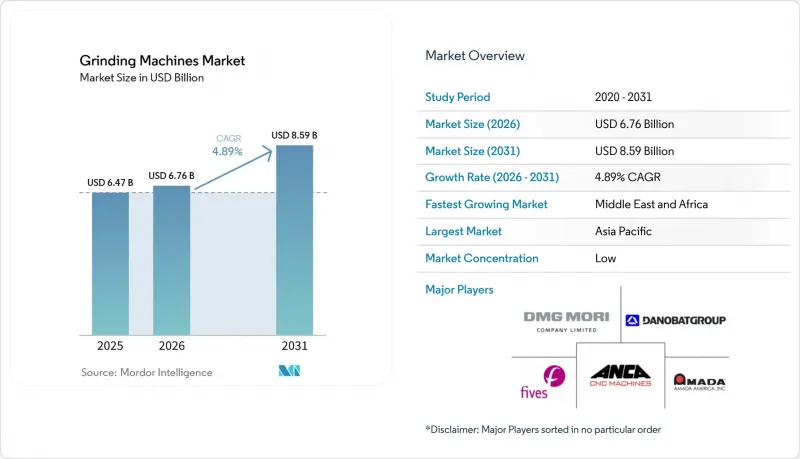
Mordor Intelligence에 의하면, 연삭기 시장 규모는 2025년 64억 7,000만 달러로 평가되었습니다. 2026년에는 67억 6,000만 달러로 확대되어 2031년까지 85억 9,000만 달러에 이를 것으로 예측됩니다. 2026년부터 2031년에 걸쳐 CAGR은 4.89%를 나타낼 전망입니다.
본 보고서는 제품 유형(평면 연삭기, 원통 연삭기, 센터리스 연삭기, 기어 연삭기, 공구·커터 연삭기, 기타), 제어 방식(CNC, 수동), 최종 사용자 산업(자동차, 항공우주, 일반 기계, 전자, 에너지, 의료, 기타), 지역(북미, 유럽, 아시아태평양, 중동, 남미)별로 분류되어 있습니다. 시장 전망은 금액(10억 달러)으로 제시되어 있습니다.
세계의 연삭기 시장 동향과 인사이트
업계 전반에 걸친 고정밀 부품에 대한 수요 증가
각 제조업체는 항공우주 분야의 AS9100이나 자동차 분야의 IATF 16949와 같은 세계 품질 프레임워크를 충족하기 위해 치수 및 형상 정밀도를 높이고 있으며, 이에 따라 고성능 원통 연삭에 대한 수요가 증가하고 있습니다. 원통 연삭 플랫폼은 일반적으로 직경 공차를 ±1 마이크로미터 수준으로, 진원도를 1자리 수 초반의 마이크로미터 단위로 실현하고 있으며, 이를 통해 2차 마무리 공정을 생략함으로써 대량 생산 시 공정 능력을 향상시킵니다. 반도체 제조 장비의 경우, 정밀 연삭 공정이 스핀들의 정밀도와 안정적인 진동을 보장하는 한편, 지속가능성 프로그램에서는 내재된 배출량 감축을 추진하고 있습니다. 예를 들어, TSMC가 도입한 냉각수 재활용 시스템은 중요한 스핀들에서 3마이크로미터 미만의 원형 정밀도를 유지하면서 이산화탄소 배출량을 줄였습니다. 2025년에 보고된 미국 제조업의 생산성 향상은 기계 설비의 지속적인 현대화를 반영한 것으로, 여기에는 스크랩을 줄이고 사이클 타임을 안정화시키는 CNC 연삭 셀이 포함됩니다. 기계 제조업체들은 빈번한 작업자 개입 없이 공차 범위를 유지하기 위해 공정 내 측정 및 적응형 제어를 도입하고 있으며, 이는 더욱 엄격해진 고객 감사 하에서 편차를 줄이려는 공장의 노력과 일치합니다.
자동차 엔진 및 변속기 생산 확대
미국의 자동차 조립은 2026년 초까지 견조한 추세를 보였으며, 이는 내연기관(ICE) 및 전동화 플랫폼 모두에서 NVH(소음·진동·거칠기) 기준을 관리하기 위해 연삭 공정이 필요한 크랭크샤프트, 캠샤프트 및 정밀 기어에 대한 수요를 뒷받침했습니다. 독일에서는 2026년 2월 승용차 생산 대수가 전년 동월 대비 1% 증가했으며, 배터리식 전기차 등록 대수는 4만 6,300대에 달했습니다. 이로 인해 구동계의 내구성 목표를 달성하기 위해, 더욱 엄격한 톱니면 형상과 고속 기어 정밀 가공의 필요성이 더욱 커졌습니다. VDA. EV 아키텍처는 회전 속도와 적층 공차를 향상시켰으며, 이에 따라 CBN 휠과 정밀한 드레싱을 활용한 생성 연삭 및 성형 연삭으로의 기어 마무리 작업 전환이 진행되고 있습니다. 에너지 효율 목표와 수명 주기 비용 관리를 철저히 함으로써, 현장 차원의 목표를 달성하기 위해 부품당 에너지 소비량을 모니터링하는 고효율 스핀들 및 최신 제어 시스템의 도입이 촉진되고 있습니다. 연삭 공정에 센싱 및 분석 기술을 도입한 CNC 기반 워크플로는 유연한 생산 체제를 위해 라인 설계를 재검토하고 있는 1차 공급업체들 사이에서 점차 확산되고 있습니다.
막대한 규모의 설비 및 인프라 투자
산업용 CNC 연삭기의 설비 투자액은 일반적으로 1대당 8만 달러에서 50만 달러 사이이지만, 자동화, 측정 기능, 5축 가공 기능을 갖춘 구성의 경우 그 비용이 더 높아질 수 있습니다. 소유 비용은 기계 본체뿐만 아니라 CAD 및 CAM 라이선스, 설치 및 시운전, 정밀 기초, 3상 전원, 공기 시스템 등이 포함될 수 있어, 소규모 공장에게는 장벽이 될 수 있습니다. 공공 부문 구매자들은 장기적으로 측정 가능한 비용 절감 효과를 가져오는 효율적인 설비를 우선시하는 수명 주기 비용 분석을 채택하고 있으며, 이에 따라 문서화된 에너지 성능 및 예측 유지보수에 대한 수요가 증가하고 있습니다. 신흥 시장의 자금 사정은 기계, 소프트웨어 및 보조 시스템 일체에 대한 자금 조달에 어려움을 겪는 중소 제조업체들의 현대화 계획을 지연시킬 가능성이 있습니다. 자동화 및 계측 장비 도입을 단계적으로 진행하는 구매자는 리스크 관리가 개선되는 경향이 있지만, 투자 회수 기간이 다소 길어질 수 있다는 점을 각오해야 합니다. 연삭기 시장에서는 이러한 현실이, 수요가 부진한 시기에는 구매 결정이 미뤄지고, 미결 주문량이나 가동률이 상승하면 구매가 가속화되는 형태로 나타나고 있습니다.
부문별 분석
2025년 기준으로 원통 연삭기는 연삭기 시장 점유율의 28.21%를 차지했으며, 이는 샤프트, 베어링 레이스, 정밀 핀의 외경(OD) 및 내경(ID) 정삭 가공에서 이 기계가 수행하는 폭넓은 역할을 반영했습니다. STUDER S31과 같은 플랫폼은 광범위한 가공 길이에 대응하는 열적 안정성과 모듈식 구성을 특징으로 하며, 이러한 기능 덕분에 장시간 연속 가공 시에도 재현성이 높은 정밀도를 유지할 수 있습니다. 전기차(EV)의 파워트레인 시장이 확대되는 가운데, 기어 연삭기가 이 분야를 주도하고 있습니다. 이는 보다 정밀한 형상과 저소음 운전이 요구되므로, 생성 연삭이나 성형 연삭에 적합한 고품질의 치면 마감이 필요하기 때문입니다. 연삭기 시장은 유리질 CBN 연삭재의 도입과, 형상을 유지하면서 사이클 타임을 단축하는 스마트한 드레싱 루틴의 도입으로 인해 혜택을 보고 있습니다. 또한, 사용자들은 스테이션 간 수작업 및 결함 위험을 줄이기 위해 피치와 프로파일을 확인하는 공정 내 측정을 요구하고 있습니다. 바쁜 셀 내에서의 장시간 사이클 동안 열 드리프트를 억제하기 위해, 경량 기계 베이스와 리니어 모터 구동 방식이 도입되었습니다. 더 원활한 프로그램 변경을 목표로 하는 공장에서는 비가공 시간을 단축하고, 연삭기 시장에서 제품 구성을 유연하게 변경할 수 있도록 지원하는 간소화된 사용자 인터페이스가 요구되고 있습니다.
기어 연삭 시스템 시장은 2031년까지 연평균 성장률(CAGR) 6.23%로 확대될 전망이며, 이는 전기차(EV) 및 하이브리드 구동계의 지속적인 확대와 저소음 e-액슬에 대한 수요를 반영한 것입니다. 평면 연삭기는 금형 표면, 금형 인서트 및 평판 가공 분야에서 여전히 주력 장비로 자리 잡고 있으며, 그 평탄도와 마감 정밀도가 후속 조립 공정을 뒷받침하고 있습니다. 센터리스 연삭기는 연료, 의료 및 모션 시스템용 원통형 부품에서 높은 생산성을 실현하지만, 설정을 위해서는 특정 전문 지식이 필요합니다. 공구 및 커터 연삭기는 절삭 공구의 제조 및 재연마에 대응하며, 통합된 계측 기능을 통해 형상을 유지하면서 수작업 수정을 줄여줍니다. 특수 연삭기 및 벨트 연삭 솔루션은 복잡한 형상의 버 제거 및 컨포멀 마감을 지원함으로써 제품 라인업을 더욱 풍부하게 하고 있습니다. 전체 제품군에 걸쳐, 연삭기 업계는 고효율 주축, 향상된 냉각유 관리, 그리고 모든 배치에 대한 디지털 추적성을 중시하며, 에너지 및 데이터 요구 사항에 부응하기 위해 노력하고 있습니다.
지역별 분석
2025년 기준, 아시아태평양은 연삭기 시장 규모의 45.87%를 차지했습니다. 이는 자동차, 전자, 자본재 분야의 강력한 생태계에 더해, 주요 공작기계 OEM 업체들의 생산 능력 확대 발표에 힘입은 결과입니다. JTEKT의 구자라트주 신규 공장(2027년 생산 개시 예정) 등 최근의 투자 계획은 국내 및 수출용 프로그램을 지원하기 위한 정밀 플랫폼의 현지화가 지속되고 있음을 보여줍니다. 지역 구매자들은 인력 부족 문제를 해결하고 부품당 전력 소비를 줄이기 위해, 계측 기능과 에너지 모니터링 기능을 탑재한 유연한 CNC 셀을 우선적으로 선택하고 있습니다. 아시아태평양의 연삭기 시장은 또한 처리량과 일관성이 중시되는 자동차 및 베어링 산업 거점 지역에서 무인 가동 셀을 위한 자동화 솔루션을 통합하는 공급업체들의 존재로부터도 혜택을 보고 있습니다.
중동 및 아프리카은 산업 다각화 프로그램을 통해 대형 회전 기계 및 정밀 부품이 필요한 에너지, 유틸리티, 공정 산업 분야의 프로젝트에 자금이 지원됨에 따라 가장 빠른 성장이 예상됩니다. 2024년 이후, 걸프 연안 국가들의 유틸리티 파이프라인이 확대됨에 따라 터빈, 펌프, 밸브를 지원하는 연삭기, 계측 기기 및 서비스 공급업체들의 사업 전망이 밝아지고 있습니다. 현지 조달 정책에 따라 OEM 각사는 서비스 거점 및 부품 재고 확보를 추진하고 있으며, 이를 통해 핵심 자산의 가동 중단 시간이 단축되고 애프터마켓과의 연계가 강화됩니다. 효율적인 스핀들, 향상된 냉각수 관리, 디지털화된 유지보수 시스템을 도입한 공장은 신규 생산 능력이 가동될 때 에너지 및 비용 목표를 달성하는 데 유리한 입장에 서게 될 것입니다.
북미에서는 대규모 도입 실적이 꾸준히 이어지고 있으며, 임금 상승 압력과 숙련공 부족을 해소하기 위해 CNC 자동화 도입이 활발히 진행되고 있습니다. 제조업의 평균 시급은 2025년 말까지 상승하고 있으며, 이에 따라 연삭 셀 내 공정 통합 및 로봇을 활용한 작업량 분배가 더욱 중요시되고 있습니다. 리쇼어링(국내 복귀) 프로그램에서는 예측 유지보수, 디지털 트윈, 유연한 자동화가 중시되고 있으며, 이러한 요소들은 수동식 기계에서 네트워크 연결형 CNC 연삭기로의 전환을 촉진하고 있습니다. 유럽의 동향은 규제 요인과 자동차 수요의 변화를 반영하고 있으며, 에너지 효율 관련 규제로 인해 각 거점의 목표에 맞추어 단위당 에너지 소비량을 줄이기 위해 스핀들 및 축의 업그레이드가 진행되고 있습니다. 이러한 추세가 맞물리면서, 연삭기 시장에서는 정밀도, 에너지 효율, 디지털 추적성이 지역을 불문하고 일반적인 선정 기준이 되고 있습니다.
기타 혜택 :
- 엑셀 형식 시장 예측(ME) 시트
- 3개월간의 애널리스트 지원
자주 묻는 질문
목차
제1장 서론
제2장 조사 방법
제3장 주요 요약
제4장 시장 구도
제5장 시장 규모 및 성장 예측
제6장 경쟁 구도
제7장 시장 기회 및 향후 전망
KTH 26.06.19According to Mordor Intelligence, the grinding machines market size is expected to increase from USD 6.47 billion in 2025 to USD 6.76 billion in 2026 and reach USD 8.59 billion by 2031, growing at a CAGR of 4.89% over 2026-2031.
This report is Segmented by Product Type (Surface, Cylindrical, Centerless, Gear, Tool & Cutter Machines, and Others), by Control Type (CNC, and Manual), by End-User Industry (Automotive, Aerospace, General Machinery, Electronics, Energy, Medical, and Others), and by Geography (North America, Europe, Asia-Pacific, and Middle East, South America). Market Forecasts are Provided in Value (USD Billion).
Global Grinding Machines Market Trends and Insights
Increasing Demand for High-Precision Components Across Industries
Manufacturers are raising dimensional and geometric precision to meet global quality frameworks such as AS9100 for aerospace and IATF 16949 for automotive, which has strengthened the case for high-performance cylindrical grinding. Cylindrical platforms routinely deliver diameter tolerances near +-1 micrometer with roundness within low single-digit micrometers, which reduces secondary finishing and improves process capability at volume. In semiconductor equipment, precision grinding supports spindle accuracy and stable runout while sustainability programs seek to cut embedded emissions, as seen in TSMC's deployment of coolant recycling that lowered CO2 output while preserving sub-3-micrometer circular accuracy on critical spindles. U.S. manufacturing productivity gains reported for 2025 reflect sustained modernization of machine assets, which includes CNC grinding cells that lower scrap and stabilize cycle times. Machine builders are embedding in-process gauging and adaptive control to maintain tolerance bands without frequent operator intervention, which aligns with factory efforts to reduce variability under tighter customer audits.
Automotive Engine and Transmission Manufacturing Expansion
Motor vehicle assemblies in the United States remained resilient into early 2026, which supported consistent demand for crankshafts, camshafts, and precision gears that require grinding to manage NVH thresholds in both ICE and electrified platforms. Germany recorded a 1% year-over-year rise in passenger-car output in February 2026, while battery-electric registrations advanced to 46,300 units, which reinforced the need for tighter tooth-flank topographies and high-speed gear finishes to meet drivetrain durability goals. VDA. EV architecture elevates rotational speeds and stack tolerances, which shift more gear-finishing work to generating and form grinding with CBN wheels and accurate dressing. Energy efficiency objectives and lifecycle cost discipline are encouraging the use of high-efficiency spindles and modern controls that monitor energy per part to meet site-level targets. CNC-based workflows that bring sensing and analytics to grinding processes are gaining traction with tier suppliers that are rebalancing line designs for flexible production runs.
Extremely High Equipment and Infrastructure Investment
The capital outlay for industrial CNC grinders typically ranges from USD 80,000 to USD 500,000 per unit, and configurations with automation, gauging, and five-axis capability can push higher. Ownership costs extend beyond the machine and can include CAD or CAM licenses, rigging and installation, precision foundations, three-phase power, and air systems, which can be a hurdle for smaller shops. Public-sector buyers apply life-cycle cost tests that favor efficient equipment with measurable savings over time, which has increased demand for documented energy performance and predictive maintenance. Financial conditions in emerging markets can slow modernization plans for small and mid-sized manufacturers who struggle to fund the full stack of machines, software, and auxiliary systems. Buyers who phase automation and metrology additions often see better risk control, yet they must carry slightly longer payback windows. The grinding machines market reflects these realities in delayed purchase decisions during lulls and faster commitments when backlogs and utilization rise.
Other drivers and restraints analyzed in the detailed report include:
- Growth in the Bearing Manufacturing Industry
- Rising Adoption of Hard-to-Machine Materials
- Severe Shortage of Skilled Grinding Machine Operators
For complete list of drivers and restraints, kindly check the Table Of Contents.
Segment Analysis
Cylindrical machines held 28.21% of the grinding machines market share in 2025, which reflects their broad role in OD and ID finishing across shafts, bearing races, and precision pins. Platforms like STUDER S31 illustrate thermal stability and modular setups for a wide range of work lengths, and these capabilities support repeatable precision over long runs. Gear grinders are pacing the category as EV powertrains expand, since tighter topographies and quiet running require higher-quality tooth finishing that favors generating and form grinding. The grinding machines market benefits from the adoption of vitrified CBN wheels and smarter dressing routines that compress cycle time while holding form. Users also seek in-process gauging for pitch and profile checks to reduce manual handling and defect risk between stations. Lightweight machine bases and linear motor drives are being deployed to contain thermal drift during long cycles in busy cells. Shops aiming for smoother program changes are pushing for simplified user interfaces that cut non-cut time and support flexible shifts in product mix in the grinding machines market.
Gear grinding systems are expanding at a 6.23% CAGR to 2031 for the grinding machines market size, which reflects the continuous buildout of EV and hybrid drivetrains and demand for low-noise e-axles. Surface grinders remain workhorses for die faces, mold inserts, and plate work, where flatness and finish values support downstream assembly. Centerless grinders enable high-rate throughput for cylindrical parts in fuel, medical, and motion systems, though setup requires specific expertise. Tool and cutter grinders address cutting-tool production and regrind, and integrated metrology reduces rework while maintaining geometry. Specialty and belt solutions round out the portfolio by covering deburring and conformal finishing on complex shapes. Across product groups, the grinding machines industry is aligning with energy and data requirements that reward efficient spindles, better coolant management, and digital traceability for every batch.
Geography Analysis
Asia-Pacific accounted for a 45.87% share of the grinding machines market size in 2025, supported by strong automotive, electronics, and capital equipment ecosystems, and by announced capacity additions from leading machine-tool OEMs. Recent investment plans, such as JTEKT's new plant in Gujarat, with production slated for FY2027, signal sustained localization of precision platforms to serve domestic and export programs. Regional buyers prioritize flexible CNC cells with embedded measurement and energy monitoring to mitigate operator gaps and reduce kilowatt-hours per part. The grinding machines market in Asia-Pacific also benefits from suppliers that integrate automation for lights-out cells in automotive and bearing hubs where throughput and consistency matter.
The Middle East and Africa are projected to post the fastest growth as industrial diversification programs fund energy, utilities, and process-sector projects that draw on heavy rotating equipment and precision components. Public program pipelines in the Gulf have expanded since 2024, which improves visibility for suppliers of grinders, metrology, and services that support turbines, pumps, and valves. Local-content policies are encouraging OEMs to establish service hubs and parts inventory, which reduces downtime on critical assets and strengthens aftermarket ties. Plants that adopt efficient spindles, better coolant management, and digitized maintenance will be well-positioned to meet energy and cost metrics as new capacity comes online.
North America maintains a large installed base and continues to adopt CNC automation to offset wage pressure and skill shortages. Manufacturing average hourly earnings rose through late 2025, which intensifies the case for process consolidation and robotic loading in grinding cells. Reshoring programs emphasize predictive maintenance, digital twins, and flexible automation, which support the shift to networked CNC grinders over manual machines. Europe's course reflects regulatory drivers and automotive demand changes, with energy efficiency mandates pushing spindle and axis upgrades to reduce energy per unit in line with site targets. Together, these dynamics create a grinding machines market where precision, energy performance, and digital traceability are common selection filters across regions.
- Amada Machine Tools
- ANCA Pty Ltd
- DANOBATGROUP
- DMG MORI Co., Ltd.
- Fives Group
- JTEKT Corporation (Toyoda)
- Okuma Corporation
- UNITED GRINDING Group
- Makino Milling Machine Co., Ltd.
- Haas Automation
- Gleason Corporation
- Schutte (Alfred H.)
- Studer (Fritz Studer AG)
- KELLENBERGER
- EMAG GmbH & Co. KG
- Junker Group
- Komatsu NTC Ltd.
- Chevalier Machinery
- Hyundai WIA
- Hardinge Inc.
- 3M (Super-abrasive systems)
Additional Benefits:
- The market estimate (ME) sheet in Excel format
- 3 months of analyst support
TABLE OF CONTENTS
1 Introduction
- 1.1 Study Assumptions & Market Definition
- 1.2 Scope of the Study
2 Research Methodology
3 Executive Summary
4 Market Landscape
- 4.1 Market Overview
- 4.2 Market Drivers
- 4.2.1 Increasing Demand for High-Precision Components Across Industries
- 4.2.2 Automotive Engine and Transmission Manufacturing Expansion
- 4.2.3 Growth in Bearing Manufacturing Industry
- 4.2.4 Rising Adoption of Hard-to-Machine Materials
- 4.2.5 Tool and Die Manufacturing Requirements
- 4.2.6 Aerospace Turbine Component Manufacturing Intensification
- 4.3 Market Restraints
- 4.3.1 Extremely High Equipment and Infrastructure Investment
- 4.3.2 Severe Shortage of Skilled Grinding Machine Operators
- 4.3.3 High Grinding Wheel and Consumable Costs
- 4.3.4 Competition from Advanced Hard Turning Technologies
- 4.4 Value / Supply-Chain Analysis
- 4.5 Regulatory Landscape
- 4.6 Technological Outlook
- 4.7 Industry Attractiveness - Porter's Five Forces
- 4.7.1 Threat of New Entrants
- 4.7.2 Bargaining Power of Suppliers
- 4.7.3 Bargaining Power of Buyers
- 4.7.4 Threat of Substitutes
- 4.7.5 Competitive Rivalry
- 4.8 Grinding Type Specialization and Application Niches
- 4.9 Quality Tier Stratification by Manufacturing Origin
5 Market Size & Growth Forecasts (Value, In USD Billion)
- 5.1 By Product Type
- 5.1.1 Surface Grinding Machines
- 5.1.2 Cylindrical Grinding Machines
- 5.1.3 Centerless Grinding Machines
- 5.1.4 Gear Grinding Machines
- 5.1.5 Tool & Cutter Grinding Machines
- 5.1.6 Others (Belt Grinders, Special Purpose Grinding Machines, etc.)
- 5.2 By Control Type
- 5.2.1 CNC Grinding Machines
- 5.2.2 Conventional/Manual Grinding Machines
- 5.3 By End-user Industry
- 5.3.1 Automotive
- 5.3.2 Aerospace & Defense
- 5.3.3 General Machinery & Metal Fabrication
- 5.3.4 Electrical & Electronics
- 5.3.5 Energy (Oil & Gas, Power Generation)
- 5.3.6 Medical Devices
- 5.3.7 Others (Railway, Construction Equipment)
- 5.4 By Geography
- 5.4.1 North America
- 5.4.1.1 United States
- 5.4.1.2 Canada
- 5.4.1.3 Mexico
- 5.4.2 South America
- 5.4.2.1 Brazil
- 5.4.2.2 Argentina
- 5.4.2.3 Peru
- 5.4.2.4 Rest of South America
- 5.4.3 Europe
- 5.4.3.1 United Kingdom
- 5.4.3.2 Germany
- 5.4.3.3 France
- 5.4.3.4 Italy
- 5.4.3.5 Spain
- 5.4.3.6 BENELUX (Belgium, Netherlands, and Luxembourg)
- 5.4.3.7 NORDICS (Denmark, Finland, Iceland, Norway, and Sweden)
- 5.4.3.8 Rest of Europe
- 5.4.4 Asia-Pacific
- 5.4.4.1 China
- 5.4.4.2 India
- 5.4.4.3 Japan
- 5.4.4.4 Australia
- 5.4.4.5 South Korea
- 5.4.4.6 ASEAN (Indonesia, Thailand, Philippines, Malaysia, Vietnam)
- 5.4.4.7 Rest of Asia-Pacific
- 5.4.5 Middle East and Africa
- 5.4.5.1 Saudi Arabia
- 5.4.5.2 United Arab Emirates
- 5.4.5.3 Qatar
- 5.4.5.4 Kuwait
- 5.4.5.5 Turkey
- 5.4.5.6 Egypt
- 5.4.5.7 South Africa
- 5.4.5.8 Nigeria
- 5.4.5.9 Rest of Middle East and Africa
- 5.4.1 North America
6 Competitive Landscape
- 6.1 Market Concentration
- 6.2 Strategic Moves
- 6.3 Market Share Analysis
- 6.4 Company Profiles (includes Global level Overview, Market level overview, Core Segments, Financials as available, Strategic Information, Products & Services, and Recent Developments)
- 6.4.1 Amada Machine Tools
- 6.4.2 ANCA Pty Ltd
- 6.4.3 DANOBATGROUP
- 6.4.4 DMG MORI Co., Ltd.
- 6.4.5 Fives Group
- 6.4.6 JTEKT Corporation (Toyoda)
- 6.4.7 Okuma Corporation
- 6.4.8 UNITED GRINDING Group
- 6.4.9 Makino Milling Machine Co., Ltd.
- 6.4.10 Haas Automation
- 6.4.11 Gleason Corporation
- 6.4.12 Schutte (Alfred H.)
- 6.4.13 Studer (Fritz Studer AG)
- 6.4.14 KELLENBERGER
- 6.4.15 EMAG GmbH & Co. KG
- 6.4.16 Junker Group
- 6.4.17 Komatsu NTC Ltd.
- 6.4.18 Chevalier Machinery
- 6.4.19 Hyundai WIA
- 6.4.20 Hardinge Inc.
- 6.4.21 3M (Super-abrasive systems)
7 Market Opportunities & Future Outlook
- 7.1 White-space & Unmet-Need Assessment