

|
시장보고서
상품코드
2062113
재생 아스팔트 시장 : 점유율 분석, 업계 동향과 통계, 성장 예측(2026-2031년)Recycled Asphalt - Market Share Analysis, Industry Trends & Statistics, Growth Forecasts (2026 - 2031) |
||||||
 Mordor Intelligence
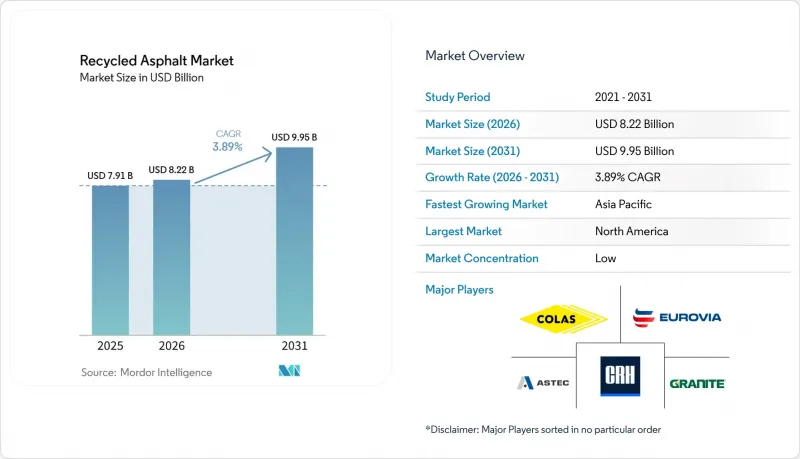
Mordor Intelligence에 의하면, 재생 아스팔트 시장 규모는 2025년 79억 1,000만 달러, 2026년 82억 2,000만 달러에서 2031년까지 99억 5,000만 달러로 확대되어 2026년부터 2031년까지 CAGR 3.89%를 나타낼 것으로 예측됩니다.
본 보고서는 RAP 함유율(저 RAP 함유율(20% 이하), 중등도 RAP 함유율(21-50%), 그 이상), 재생 아스팔트의 용도(패치 재료, 핫믹스 아스팔트, 기타), 최종 사용자 산업(상업, 산업, 지자체), 지역(아시아태평양, 북미, 유럽, 남미, 중동 및 아프리카)별로 분류되어 있습니다. 시장 전망은 금액(달러) 기준으로 제공됩니다.
세계 재생 아스팔트 시장 동향 및 분석
랩과 버진 혼합물의 가격 경쟁력
미국 아스팔트 포장 협회(NAPA)의 보고서에 따르면, 2023년에는 평균 21.9%의 배합 비율로 9,610만 톤의 재생 아스팔트 포장재(RAP)를 사용함으로써, 미국 생산자들은 34억 달러의 비용 절감을 달성했습니다. 이는 원자재 비용 관리에서 RAP의 역할을 입증하는 것입니다. 플로리다주 교통국의 현장 데이터에 따르면, 아열대 기후에서 RAP를 많이 사용한 포장은 더 낮은 시공 비용으로 동등한 성능을 발휘하는 것으로 나타났습니다. 원유 가격 상승에 따라 비용 면에서의 경쟁력은 더욱 높아질 것입니다. 예를 들어, 브렌트유 가격이 배럴당 85달러를 넘으면, 신규 아스팔트와 재생 아스팔트의 가격 차이는 2배로 벌어질 가능성이 있습니다. 이를 통해 인도의 건설사들은 고속도로 프로젝트에서 25-30%의 비용 절감을 달성할 수 있었습니다. 게다가, 지자체의 예산 제약 또한 RAP 도입을 뒷받침하고 있어, 신규 아스팔트 수요 변동에 따른 영향을 덜 받게 되었습니다.
주 교통국(DOT) 및 지방 자치 단체의 엄격한 지속가능성 조달 의무
캘리포니아주 의회 법안 2953호, 뉴저지주 공법 2023 c.134, 콜로라도주의 ‘바이 클린 법’, 그리고 미네소타주의 2025년 EPD 규정에서는 입찰자에게 탄소 강도 문서화를 의무화하고 있으며, 모든 적격 프로젝트에 재생 아스팔트 함량을 포함하도록 요구하고 있습니다. 위반 시 부과되는 제재에는 계약금 보류나 자격 박탈 등의 조치가 포함되어 있으며, 원유 가격 변동과 관계없이 안정적인 수요를 확보하기 위한 준법 기준이 확립되어 있습니다. 이러한 규제는 라이프사이클 평가(LCA) 도구에 투자해 온 공급업체를 지원하기 위한 것입니다.
RAP에서의 분산된 물류 및 재고 관리
흡습, 오염 및 입도 분포의 편차는 재생 아스팔트 포장재(RAP)의 성능 여력에 영향을 미치며, 혼합 비용을 증가시킵니다. 많은 공공 저장 시설에서는 선별 설비나 보호 덮개가 부족하기 때문에 미국 교통부(DOT)는 추가적인 실험실 시험이 실시되지 않는 한 RAP의 함유율을 20-30%로 제한하고 있습니다. 재생 아스팔트 시장이 RAP 활용의 높은 잠재력을 실현하기 위해서는 지붕이 있는 저장 시설, 현장 선별, 그리고 지속적인 시료 채취에 대한 투자가 필수적입니다.
부문별 분석
2025년, 재생 아스팔트 시장에서 낮은 RAP 함유율(20% 이하) 제품이 가장 큰 점유율을 차지했습니다. 이는 대부분의 DOT 기준이 기존의 성능 데이터에 의존하고 있기 때문입니다. 이러한 혼합물은 일관된 다짐 성능을 제공하며, 개조되지 않은 배치 플랜트와 호환되므로 도입 위험을 줄여줍니다. 중간 수준의 RAP 배합(21-50%)은 듀얼 빈 공급 장치로의 개조 및 노화 방지제의 화학적 개선을 통해 사용이 증가하고 있으며, 경쟁력 있는 비용으로 균형 잡힌 피로 저항성을 제공합니다.
RAP 함량이 높은(50% 이상) 혼합물은 2031년까지 연평균 성장률(CAGR) 3.98%로 재생 아스팔트 시장을 주도할 것으로 예측됩니다. 유로비아(Eurovia)의 100% RAP 고속도로 시범 운영이나 아스텍(Astec)의 ReMix CCPR 플랜트와 같은 노력을 통해 현장에서의 실현 가능성이 입증되었습니다. 또한, 2026년에 도입된 삼원 복합 재생 기술 덕분에 저온 취성에 대한 기존의 우려가 해소되었습니다. 현재 미국의 일부 주에서는 RAP를 40% 이상 배합한 프로젝트 입찰에 대해 추가 가점을 부여하고 있으며, 이에 따라 사양 수립자들은 비용과 위험의 균형을 재평가하도록 유도되고 있습니다. 분류 처리 및 자동 배합 제어에 투자하는 건설업체들은 이 부문을 수익성이 높은 시장 기회로 확대할 수 있는 유리한 위치에 있습니다.
지역별 분석
아시아태평양은 2031년까지 연평균 성장률(CAGR) 4.41%로 성장할 것으로 전망됩니다. 중국에서는 연간 약 2억 톤의 재생 아스팔트 포장재(RAP)가 생산되고 있지만, 재활용률은 고작 30%에 그치고 있으며, GB/T25033 규격이 핫, 웜, 콜드 방식의 재활용 방법을 모두 허용하고 있다는 점에서 재활용 확대의 여지가 있음을 시사하고 있습니다. 인도에서는 2023-24 회계연도에 6,634km에 달하는 고속도로에서 6,300만 톤 이상의 폐기물이 재활용되었으며, 일부 주에서는 재활용 골재(RAP)를 40% 함유한 표층 포장 시험이 진행되고 있습니다. 포장 재활용률이 99%에 달하는 일본은 고도의 수거 및 물류 체계를 갖추고 있으며, 한편 PWRI의 새로운 시험 방법에서는 재생 바인더를 최대 70% 함유한 혼합물의 유효성을 검증하는 것을 목표로 하고 있습니다. 호주와 한국은 현재 재활용률에 상한선을 두고 있으나, 기준치를 상향 조정하기 위한 재정적 검토에 직면해 있습니다.
북미: 정책과 비용 절감이 시장 점유율을 견인하고 있습니다. 2025년, 북미는 재생 아스팔트 시장의 41.89%를 차지했습니다. 2023년, 미국의 건설업체들은 9,610만 톤의 RAP를 활용함으로써 34억 달러의 자재 비용을 절감했습니다. 캘리포니아주의 AB 2953이나 콜로라도주의 ‘바이 클린 법’과 같은 주 차원의 규제에서는 환경 제품 선언(EPD)이 의무화되어 있으며, 균형 잡힌 배합 설계를 적용한 시범 사업을 통해 RAP의 허용 비율이 45-50%로 상향 조정되었습니다. Wirtgen사와 각 주 교통국(DOT) 간의 교육 파트너십을 통해 현장에서의 콜드 리사이클링 공정에 대한 작업자의 기술이 향상되고 있습니다.
유럽에서는 매립 금지 및 탄소세 도입을 배경으로, 2024년에 생산된 1억 톤의 RAP 중 95%가 재활용되었습니다. 프랑스의 A10 시험에서는 고속도로 층에 100% RAP를 사용하는 것이 입증되었으며, 한편 코라스(Coras)사는 유럽 최대의 도로 시장인 독일에서 프라우엔라트(Frauenlad)사를 인수함으로써 재활용 역량을 확대했습니다. 이러한 동향은 유럽이 지속 가능한 도로 건설 실천에 주력하고 있음을 반영하고 있습니다.
남미와 중동 및 아프리카는 규모는 작지만 성장세가 매우 빠른 시장입니다. 브라질에서는 상파울루의 도시 인프라 개보수 사업에 콜드 리사이클링 시스템이 도입되었습니다. 사우디아라비아는 국도 건설 시 RAP 사용 비율을 25%로 승인했습니다. 이 지역들의 인프라 부양책 예산과 순환형 경제 정책은 재활용 도입이 점차 증가하고 있음을 보여줍니다.
기타 혜택:
- 엑셀 형식 시장 예측(ME) 시트
- 3개월간의 애널리스트 지원
자주 묻는 질문
목차
제1장 서론
제2장 조사 방법
제3장 주요 요약
제4장 시장 구도
제5장 시장 규모와 성장 예측
제6장 경쟁 구도
제7장 시장 기회와 향후 전망
JHS 26.06.19According to Mordor Intelligence, the recycled asphalt market size is projected to expand from USD 7.91 billion in 2025 and USD 8.22 billion in 2026 to USD 9.95 billion by 2031, registering a CAGR of 3.89% between 2026 to 2031.
This report is Segmented by RAP Content Level (Low RAP Content (Less Than or Equal To 20%), Medium RAP Content 21-50%, and More), Recycled Asphalt Application (Patch Material, Hot Mix Asphalt, and More), End-User Industry (Commercial, Industrial, Municipal), and Geography (Asia-Pacific, North America, Europe, South America, Middle-East and Africa). The Market Forecasts are Provided in Terms of Value (USD).
Global Recycled Asphalt Market Trends and Insights
Cost Competitiveness of RAP Versus Virgin Mixes
The National Asphalt Pavement Association reported USD 3.4 billion in U.S. producer savings in 2023 through the use of 96.1 million tons of Reclaimed Asphalt Pavement (RAP) at an average inclusion rate of 21.9%. This demonstrates the role of RAP in managing raw material costs. Field data from the Florida Department of Transportation indicated that RAP-rich pavements provide comparable performance at a lower delivered cost in subtropical climates. Cost advantages increase during crude oil price rises; for example, when Brent crude exceeds USD 85 per barrel, the price difference between virgin and reclaimed binder can double. This has enabled contractors in India to achieve cost reductions of 25-30% on highway projects. Furthermore, municipal budget limitations support RAP adoption, making its usage less influenced by fluctuations in virgin asphalt demand.
Stringent Sustainability Procurement Mandates By DOTs And Municipalities
California's Assembly Bill 2953, New Jersey's Public Law 2023 c.134, Colorado's Buy Clean Act, and Minnesota's 2025 EPD rule require bidders to document carbon intensity, integrating reclaimed asphalt content into all qualifying projects. Non-compliance penalties include measures such as contract holdbacks and disqualification, establishing a compliance baseline that ensures consistent demand regardless of crude oil price fluctuations. These regulations support suppliers that have invested in life-cycle assessment tools.
Fragmented Logistics and Stockpile Management For RAP
Moisture absorption, contamination, and variability in gradation impact the performance margins of Reclaimed Asphalt Pavement (RAP) and increase blending costs. Many public storage facilities lack fractionation and protective covering, leading Departments of Transportation (DOTs) to limit RAP content to 20-30% unless additional laboratory testing is conducted. Investments in covered storage, on-site screening, and continuous sampling are essential for the recycled asphalt market to achieve its high-RAP potential.
Other drivers and restraints analyzed in the detailed report include:
- Expansion Of 100%-RAP And Warm-Mix Plant Technologies
- Corporate Net-Zero Targets Spurring Carbon-Negative Pavement Credits
- Emergent Microplastics Scrutiny on Recycled Pavement Runoff
For complete list of drivers and restraints, kindly check the Table Of Contents.
Segment Analysis
In 2025, low RAP content (less than or equal to 20%) held the largest share of the recycled asphalt market. This is due to most DOT standards relying on legacy performance data. These mixes provide consistent compaction and are compatible with unmodified batch plants, reducing adoption risks. Medium RAP blends (21-50%) have seen increased usage due to dual-bin feed retrofits and advancements in rejuvenator chemistries, offering balanced fatigue resistance at a competitive cost.
High RAP content (greater than 50%) is expected to lead the recycled asphalt market with a 3.98% CAGR through 2031. Initiatives such as Eurovia's 100% RAP motorway trial and Astec's ReMix CCPR plant have demonstrated field feasibility. Furthermore, the introduction of ternary composite rejuvenation in 2026 addressed earlier concerns regarding low-temperature brittleness. Project bids incorporating at least 40% RAP now qualify for additional scoring credits in several U.S. states, prompting specifiers to reassess the cost-risk balance. Contractors investing in fractionation and automated dosage controls are positioned to expand this segment into a profitable market opportunity.
Geography Analysis
Asia-Pacific is projected to grow at a CAGR of 4.41% through 2031. China produces approximately 200 million tons of Reclaimed Asphalt Pavement (RAP) annually, but reuses only 30%, indicating potential for increased recycling as GB/T25033 supports hot, warm, and cold recycling methods. In India, over 63 million tons of waste were reused in FY 2023-24 across 6,634 kilometers of highways, with several states testing 40% RAP surface courses. Japan, with a 99% pavement recycling rate, has advanced collection logistics, while new PWRI test methods aim to validate mixes containing up to 70% reclaimed binder. Australia and South Korea currently maintain capped reuse levels but face fiscal considerations to increase thresholds.
North America: Market Share Driven by Policy and Cost Savings. North America accounted for 41.89% of the recycled asphalt market in 2025. In 2023, U.S. contractors saved USD 3.4 billion in material costs by utilizing 96.1 million tons of RAP. State regulations, such as California AB 2953 and Colorado's Buy Clean Act, mandate Environmental Product Declarations, while balanced mix design pilots are increasing allowable RAP percentages to 45-50%. Training partnerships between Wirtgen and state Departments of Transportation (DOTs) are enhancing operator skills for on-site cold recycling processes.
Europe recycled 95% of its 100 million-ton RAP output in 2024, driven by landfill bans and carbon taxes. France's A10 trial validated the use of 100% RAP in highway layers, while Colas expanded its recycling capabilities in Germany, Europe's largest road market, through the acquisition of Frauenrath. These developments reflect Europe's focus on sustainable road construction practices.
South America and the Middle East & Africa are smaller but growing markets. In Brazil, cold recycling systems were incorporated into Sao Paulo's urban infrastructure upgrades. Saudi Arabia approved the use of 25% RAP for national highways. Infrastructure stimulus budgets and circular-economy policies in these regions indicate a gradual increase in recycling adoption.
- Allan Myers, Inc.
- Apollo Asphalt Reclaimers LLC
- Astec Industries
- Colas
- CRH
- Eurovia (VINCI)
- Granite Construction Inc.
- MARINI FAYAT GROUP
- Martin Marietta
- MR Roads
- necoTECH
- Superpave Engineering Inc.
- WIRTGEN INDIA Pvt. Ltd.
Additional Benefits:
- The market estimate (ME) sheet in Excel format
- 3 months of analyst support
TABLE OF CONTENTS
1 Introduction
- 1.1 Study Assumptions and Market Definition
- 1.2 Scope of the Study
2 Research Methodology
3 Executive Summary
4 Market Landscape
- 4.1 Market Overview
- 4.2 Market Drivers
- 4.2.1 Cost competitiveness of RAP versus virgin mixes
- 4.2.2 Stringent sustainability procurement mandates by DOTs and municipalities
- 4.2.3 Expansion of 100 %-RAP and warm-mix plant technologies
- 4.2.4 Corporate net-zero targets spurring carbon-negative pavement credits
- 4.2.5 Secondary materials trading platforms unlocking high-quality RAP supply
- 4.3 Market Restraints
- 4.3.1 Fragmented logistics and stockpile management for RAP
- 4.3.2 Emergent microplastics scrutiny on recycled pavement runoff
- 4.3.3 Volatility of bitumen-rejuvenator additive pricing
- 4.4 Value Chain Analysis
- 4.5 Porter's Five Forces
- 4.5.1 Bargaining Power of Suppliers
- 4.5.2 Bargaining Power of Buyers
- 4.5.3 Threat of New Entrants
- 4.5.4 Threat of Substitutes
- 4.5.5 Competitive Rivalry
5 Market Size and Growth Forecasts (Value)
- 5.1 By RAP Content Level
- 5.1.1 Low RAP Content (Less than or Equal to 20 %)
- 5.1.2 Medium RAP Content (21-50 %)
- 5.1.3 High RAP Content (Greater than 50 %)
- 5.2 By Recycled Asphalt Application
- 5.2.1 Patch Material
- 5.2.2 Hot Mix Asphalt
- 5.2.3 Temporary Driveways and Roads
- 5.2.4 Road Aggregate
- 5.2.5 Interlocking Bricks
- 5.2.6 New Asphalt Shingles
- 5.2.7 Energy Recovery
- 5.3 By End-User Industry
- 5.3.1 Commercial
- 5.3.2 Industrial
- 5.3.3 Municipal
- 5.4 By Geography
- 5.4.1 Asia-Pacific
- 5.4.1.1 China
- 5.4.1.2 India
- 5.4.1.3 Japan
- 5.4.1.4 Australia
- 5.4.1.5 South Korea
- 5.4.1.6 Rest of Asia-Pacific
- 5.4.2 North America
- 5.4.2.1 United States
- 5.4.2.2 Canada
- 5.4.2.3 Mexico
- 5.4.3 Europe
- 5.4.3.1 Germany
- 5.4.3.2 United Kingdom
- 5.4.3.3 France
- 5.4.3.4 Italy
- 5.4.3.5 Rest of Europe
- 5.4.4 South America
- 5.4.4.1 Brazil
- 5.4.4.2 Argentina
- 5.4.4.3 Rest of South America
- 5.4.5 Middle-East and Africa
- 5.4.5.1 Saudi Arabia
- 5.4.5.2 South Africa
- 5.4.5.3 Rest of Middle-East and Africa
- 5.4.1 Asia-Pacific
6 Competitive Landscape
- 6.1 Market Concentration
- 6.2 Strategic Moves
- 6.3 Market Share (%)/Ranking Analysis
- 6.4 Company Profiles (includes Global Overview, Market Overview, Core Segments, Financials, Strategic Information, Products and Services, and Recent Developments)
- 6.4.1 Allan Myers, Inc.
- 6.4.2 Apollo Asphalt Reclaimers LLC
- 6.4.3 Astec Industries
- 6.4.4 Colas
- 6.4.5 CRH
- 6.4.6 Eurovia (VINCI)
- 6.4.7 Granite Construction Inc.
- 6.4.8 MARINI FAYAT GROUP
- 6.4.9 Martin Marietta
- 6.4.10 MR Roads
- 6.4.11 necoTECH
- 6.4.12 Superpave Engineering Inc.
- 6.4.13 WIRTGEN INDIA Pvt. Ltd.
7 Market Opportunities and Future Outlook
- 7.1 White-space and Unmet-need Assessment


