|
시장보고서
상품코드
2062149
사마귀 치료제 시장 : 시장 점유율 분석, 업계 동향 및 통계, 성장 예측(2026-2031년)Warts Therapeutics - Market Share Analysis, Industry Trends & Statistics, Growth Forecasts (2026 - 2031) |
||||||
 Mordor Intelligence
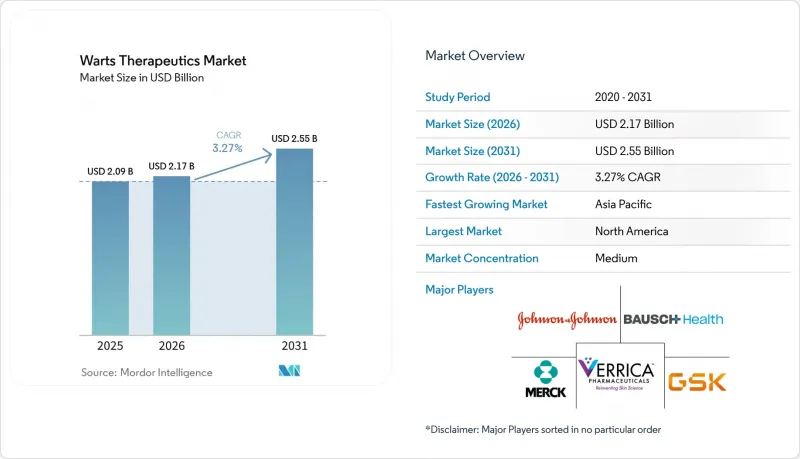
Mordor Intelligence에 의하면, 사마귀 치료제 시장 규모는 2025년 20억 9,000만 달러로 평가되었고, 2026년에는 21억 7,000만 달러로 추정되고, 2031년까지 25억 5,000만 달러에 이를 것으로 예상되고 있으며, 2026-2031년 CAGR 3.27%로 성장할 전망입니다.
본 보고서는 치료 방식별(외용 각질 용해제, 냉동 요법 기기, 면역 요법제, 레이저 및 에너지 요법, 온열 요법 및 광역학 요법, 기타), 사마귀 유형별(평상성 사마귀, 발바닥 사마귀, 편평 사마귀, 기타), 지역별(북미, 유럽, 아시아태평양, 중동 및 아프리카, 남미)로 분류되어 있습니다. 시장 전망은 금액(달러) 기준으로 제시되어 있습니다.
세계의 사마귀 치료제 시장 동향 및 인사이트
HPV 감염률 증가
중국의 대규모 여성 코호트에서 HPV 지속 감염률은 21.41% 수준을 유지하고 있으며, 일부 남성 집단에서는 30%를 초과하고 있어 치료제에 대한 수요는 안정적인 상태입니다. 21세 미만 및 61세 이상 연령대에서 감염률이 정점에 달함에 따라, 연령대별 치료 수요가 발생하여 사마귀 치료제 시장이 확대되고 있습니다. 피부형 베타형 HPV는 현재 백신 접종 대상에서 제외되어 있으므로, 예방이 아닌 치료를 통해 당면한 임상적 공백이 메워지고 있습니다. 바이러스의 지리적 집중, 특히 아시아태평양에서의 HPV 52형 및 HPV 58형의 분포는 해당 지역에 특화된 치료법 개발을 촉진하고 있습니다. 면역결핍 환자 수가 증가함에 따라, 재발로 인한 수요가 더욱 공고해지고 있습니다. 이러한 역학적 경향이 결합되어 장기적인 시장 성장의 기반이 되고 있습니다.
각질 용해제의 일반의약품(OTC)으로서의 접근성 확대
21 CFR Part 358에 근거한 FDA 규격서는 살리실산 농도에 대한 명확한 표시를 규정하고 있어, 소매점에서 폭넓게 구입할 수 있도록 하고 있습니다. 피부과 진료 예약을 기다려야 하는 소비자들에게 일반의약품은 매력적인 선택지이며, 흡수율을 높인 신제제는 복약 순응도를 향상시킵니다. 처방약 수준의 효능과 가정에서의 사용 안전성 사이에서 균형을 이룬 이 브랜드는 사마귀 치료제 시장에서 확고한 리더십을 구축하고 있습니다. 셀프케어 시장 동향은 판매 채널을 확대하며, 시술만 제공하는 경쟁사들에 비해 수익 회복력을 강화하고 있습니다.
높은 재발률과 치료 실패율
단일 요법의 실패율은 39-49%에 달하며, 이는 재치료의 악순환을 초래하고 환자의 신뢰를 떨어뜨리고 있습니다. 냉동 요법의 경우 재발률이 38%에 육박하기도 하여, 의료비 증가와 불편한 증상의 장기화를 초래하고 있습니다. 면역결핍 환자는 기존 치료법에 내성을 보이는 HPV 보균 상태가 지속되어, 지속적인 치료를 받을 수밖에 없습니다. 이러한 현실로 인해, 파이프라인의 진전에도 불구하고 사마귀 치료제 시장의 성장이 저해되고 있습니다.
부문별 분석
2025년, 사마귀 치료제 시장에서 국소 각질 용해제의 점유율은 38.81%를 차지했으며, 살리실산 및 유사 약물에 대한 소비자의 의존도가 높다는 사실이 드러났습니다. 각질 용해제 시장 규모는 소매점의 재고 관리를 간소화하는 FDA 승인 라벨링의 혜택을 받은 데다, 스마트 폴리머 제형으로 인한 피부 침투성 향상도 기여했습니다. 동결 요법은 2위를 차지했으며, 그 활용은 동결 정밀 공학에 기반한 Brymill사의 선도적인 역할에 힘입어 이루어지고 있습니다. 냉동 요법에 대한 만족도는 여전히 높은 편이지만, 환자마다 내성이 다르기 때문에 대체 요법에 대한 수요가 여전히 존재합니다.
온열 요법과 광역학 요법은 2031년까지 연평균 성장률(CAGR) 4.98%로 확대될 전망이며, 치료법 중 가장 높은 성장률을 보일 것으로 전망됩니다. 71%라는 뛰어난 치료 성공률은 차별화를 추구하는 클리닉들의 관심을 끌고 있습니다. 이미퀴모드 등의 면역요법은 생식기 병변에 대해 50%의 완치율을 보이고 있으나, 비용적인 제약에 직면해 있습니다. 펄스 색소 레이저와 같은 에너지 기반 치료법은 특정 증례에서 95%의 성공률을 보이고 있지만, 여전히 설비 투자 비용이 큰 부담이 되고 있습니다. 신흥 솔루션인 고강도 집속 초음파(HIFU) 및 일산화질소(NO) 플랫폼은 '기타' 범주에 속하며, 난치성 사례를 대상으로 하여 사마귀 치료제 시장에서의 제품 출시 속도를 유지하고 있습니다.
지역별 분석
2025년 기준, 북미는 사마귀 치료제 시장 규모의 34.65%를 차지했습니다. 이 지역은 풍부한 피부과 전문의 인력, 진료소에서의 시술 및 일반의약품(OTC) 모두에 대한 확립된 보험 환급 제도, 그리고 액체 질소 및 살리실산 제품의 탄탄한 공급망이라는 장점을 갖추고 있습니다. 원격 피부과 진료는 지방의 의료 격차를 해소하고 있으며, 영상 기반 진료를 통해 95%의 치료 완료율을 보고하는 플랫폼도 있습니다. 누적된 자외선 노출을 경험하는 고령 인구 증가로 인해 발병률은 높은 수준을 유지하고 있습니다.
아시아태평양은 2031년까지 연평균 성장률(CAGR) 5.44%를 기록하며 가장 빠른 성장세를 보일 것으로 전망됩니다. 현지 연구에 따르면, 특히 중국에서 HPV52 및 HPV58의 유병률이 높은 것으로 지적되고 있으며, 적응성이 높은 치료법에 대한 수요가 지속되고 있습니다. 각국의 의료 시스템은 디지털 의료 서비스 제공에 투자하고 있으며, 스마트폰을 활용한 분류 진료 및 약국과의 연계가 널리 보급되고 있습니다. 지역 제조업체들은 냉동 치료 기기 및 외용제의 생산 능력을 확충하여 수입 의존도를 낮추고 가격을 인하하고 있습니다.
유럽에서는 규제 조화가 진행되고 있어 수요가 안정적입니다. 확립된 제약 인프라를 바탕으로 신제품 시장 출시가 가속화되고 있으며, 엄격한 품질 기준이 임상의들의 신뢰를 쌓아가고 있습니다. 라틴아메리카와 중동 및 아프리카에서는 새로운 전망이 열리고 있습니다. 도시 지역의 중산층이 증가함에 따라 미용 피부과에 대한 수요가 높아지고 있으며, 이동 진료소와 원격 의료가 전문의 부족 문제 해결에 기여하고 있습니다. 따라서, 이러한 지역에서는 인프라가 뒤처져 있어 사마귀 치료제 시장에 추가적인 수요 증가를 가져오고 있습니다.
기타 혜택 :
- 엑셀 형식 시장 예측(ME) 시트
- 3개월간의 애널리스트 지원
자주 묻는 질문
목차
제1장 서론
제2장 조사 방법
제3장 주요 요약
제4장 시장 구도
제5장 시장 규모 및 성장 예측
제6장 경쟁 구도
제7장 시장 기회 및 향후 전망
AJY 26.06.22According to Mordor Intelligence, the warts therapeutics market size is expected to increase from USD 2.09 billion in 2025 to USD 2.17 billion in 2026 and reach USD 2.55 billion by 2031, growing at a CAGR of 3.27% over 2026-2031.
This report is Segmented by Treatment Modality (Topical Keratolytics, Cryotherapy Devices, Immunotherapy Agents, Laser & Energy-Based Therapies, Hyperthermia & Photodynamic Therapies, Others), Wart Type (Common Wart, Plantar Wart, Flat Wart, Others), and Geography (North America, Europe, Asia Pacific, Middle East & Africa, South America). The Market Forecasts are Provided in Terms of Value (USD).
Global Warts Therapeutics Market Trends and Insights
Rising HPV Infection Prevalence
HPV persists at 21.41% in large Chinese female cohorts and exceeds 30% in some male populations, keeping therapeutics demand steady. Peaks in people under 21 and over 61 create age-specific treatment needs that broaden the warts therapeutics market. Cutaneous beta types remain outside current vaccine coverage, so therapy rather than prevention meets immediate clinical gaps. The virus's geographic clustering, notably HPV52 and HPV58 in the Asia Pacific, encourages the development of region-focused regimens. Expanding immunocompromised populations further entrenches recurring demand. Together, these epidemiological patterns underpin long-range market growth.
Growing OTC Availability of Keratolytics
The FDA monograph under 21 CFR Part 358 defines clear labeling for salicylic acid strengths, enabling broad retail access. Over-the-counter options appeal to consumers facing dermatologist wait times, and new permeation-enhanced formulations lift adherence rates. Brands balancing prescription-level efficacy with home-use safety solidify leadership in the warts therapeutics market. The self-care trend widens channels and strengthens revenue resilience against procedure-only competitors.
High Recurrence & Treatment-Failure Rates
Monotherapy failure ranges from 39-49%, driving retreatment cycles that erode patient confidence. Recurrence can approach 38% for cryotherapy, raising healthcare costs and prolonging discomfort.Immunocompromised individuals retain HPV reservoirs that resist conventional modalities, keeping them in perpetual therapy. These realities temper the expansion of the warts therapeutics market despite pipeline advances.
Other drivers and restraints analyzed in the detailed report include:
- Dermatology Adoption of Ambulatory Cryotherapy
- Emergence of Heat-Based Hyperthermia Devices
- Pain & Scarring from Ablative Therapies
For complete list of drivers and restraints, kindly check the Table Of Contents.
Segment Analysis
Topical keratolytics accounted for 38.81% of the warts therapeutics market share in 2025, underscoring consumer reliance on salicylic acid and similar agents. The warts therapeutics market size for keratolytics benefited from FDA-endorsed labeling that simplifies retail stocking, while smart-polymer vehicles enhance skin penetration. Cryotherapy held second position, its usage buoyed by Brymill's leadership based on freeze-precision engineering. Although cryotherapy satisfaction remains high, tolerance varies across patients, leaving space for alternatives.
Hyperthermia and photodynamic therapy will rise at a 4.98% CAGR to 2031, the fastest among modalities. Superior 71% cure performances attract clinics seeking differentiation. Immunotherapy, such as imiquimod, shows 50% clearance for genital lesions but wrestles with cost restrictions. Energy-based modalities like pulsed dye laser achieve 95% success in select cases yet remain capital-intensive. Emerging solutions-high-intensity focused ultrasound and nitric-oxide platforms-enter the "others" bucket, targeting resistant presentations and sustaining product-launch cadence inside the warts therapeutics market.
Geography Analysis
North America retained 34.65% of the warts therapeutics market size in 2025. The region benefits from high dermatologist availability, established reimbursement for both office procedures and OTC options, and strong supply chains for liquid nitrogen and salicylic acid products. Tele-dermatology bridges rural gaps, with platforms reporting 95% treatment completion rates for image-based consultations. An aging demographic that experiences cumulative sun exposure keeps incidence elevated.
Asia Pacific will post the fastest advance at 5.44% CAGR through 2031. Local studies highlight HPV52 and HPV58 prevalence, especially in China, sustaining the need for adaptable therapeutics. National health systems invest in digital care delivery, enabling broad adoption of smartphone triage and pharmacy integration. Regional manufacturers build production capacity for cryotherapy equipment and topical agents, reducing import reliance and lowering price points.
Europe shows stable demand under harmonized regulatory oversight. Established pharmaceutical bases expedite novel formulation rollouts while strict quality standards foster clinician trust. Latin America, the Middle East, and Africa present emerging prospects: Rising urban middle classes seek cosmetic dermatology, and mobile clinics and telemedicine help overcome specialist shortages. These regions, s therefore, add incremental volume to the warts therapeutics market despite infrastructure lags.
- Merck
- GlaxoSmithKline
- Johnson & Johnson Consumer Health
- Verrica Pharmaceuticals Inc.
- Novan Inc.
- Bausch Health
- Teva Pharmaceutical Industries
- Glenmark Pharmaceuticals
- Cutera
- Candela Medical Corp.
- Brymill Cryogenic Systems
- Wallach Surgical Devices
- Stryker
- Medtronic
- Astellas Pharma
- Cipla
- Sanofi
- Medline Industries
- Taro Pharmaceutical Industries Ltd.
- Shanghai Fosun Pharmaceutical Group
Additional Benefits:
- The market estimate (ME) sheet in Excel format
- 3 months of analyst support
TABLE OF CONTENTS
1 Introduction
- 1.1 Study Assumptions & Market Definition
- 1.2 Scope of the Study
2 Research Methodology
3 Executive Summary
4 Market Landscape
- 4.1 Market Overview
- 4.2 Market Drivers
- 4.2.1 Rising HPV Infection Prevalence
- 4.2.2 Growing OTC Availability of Keratolytics
- 4.2.3 Dermatology Adoption of Ambulatory Cryotherapy
- 4.2.4 Emergence of Heat-Based Hyper-Thermia Devices
- 4.2.5 Regulatory Tailwinds for Compounded Immunotherapy
- 4.2.6 Direct-To-Consumer Tele-Dermatology Expansion
- 4.3 Market Restraints
- 4.3.1 High Recurrence & Treatment-Failure Rates
- 4.3.2 Pain & Scarring From Ablative Therapies
- 4.3.3 Supply Bottlenecks of Pharmaceutical-Grade Cantharidin
- 4.3.4 Regulatory Scrutiny on Topical Compounding Pharmacies
- 4.4 Supply Chain Analysis
- 4.5 Regulatory Landscape
- 4.6 Technological Outlook
- 4.7 Porter's Five Forces Analysis
- 4.7.1 Bargaining Power of Suppliers
- 4.7.2 Bargaining Power of Buyers
- 4.7.3 Threat of New Entrants
- 4.7.4 Threat of Substitutes
- 4.7.5 Competitive Rivalry
5 Market Size & Growth Forecasts (Value in USD)
- 5.1 By Treatment Modality
- 5.1.1 Topical Keratolytics
- 5.1.2 Cryotherapy Devices
- 5.1.3 Immunotherapy Agents
- 5.1.4 Laser & Energy-based Therapies
- 5.1.5 Hyperthermia & Photodynamic Therapies
- 5.1.6 Others
- 5.2 By Wart Type
- 5.2.1 Common Wart
- 5.2.2 Plantar Wart
- 5.2.3 Flat Wart
- 5.2.4 Others
- 5.3 By Geography
- 5.3.1 North America
- 5.3.1.1 United States
- 5.3.1.2 Canada
- 5.3.1.3 Mexico
- 5.3.2 Europe
- 5.3.2.1 Germany
- 5.3.2.2 United Kingdom
- 5.3.2.3 France
- 5.3.2.4 Italy
- 5.3.2.5 Spain
- 5.3.2.6 Rest of Europe
- 5.3.3 Asia Pacific
- 5.3.3.1 China
- 5.3.3.2 Japan
- 5.3.3.3 India
- 5.3.3.4 South Korea
- 5.3.3.5 Australia
- 5.3.3.6 Rest of Asia Pacific
- 5.3.4 Middle East & Africa
- 5.3.4.1 GCC
- 5.3.4.2 South Africa
- 5.3.4.3 Rest of Middle East & Africa
- 5.3.5 South America
- 5.3.5.1 Brazil
- 5.3.5.2 Argentina
- 5.3.5.3 Rest of South America
- 5.3.1 North America
6 Competitive Landscape
- 6.1 Market Concentration
- 6.2 Market Share Analysis
- 6.3 Company Profiles (includes Global Level Overview, Market Level Overview, Core Segments, Financials as Available, Strategic Information, Market Rank/Share for Key Companies, Products & Services, and Recent Developments)
- 6.3.1 Merck & Co., Inc.
- 6.3.2 GlaxoSmithKline plc
- 6.3.3 Johnson & Johnson Consumer Health
- 6.3.4 Verrica Pharmaceuticals Inc.
- 6.3.5 Novan Inc.
- 6.3.6 Bausch Health Companies Inc.
- 6.3.7 Teva Pharmaceutical Industries Ltd.
- 6.3.8 Glenmark Pharmaceuticals Ltd.
- 6.3.9 Cutera Inc.
- 6.3.10 Candela Medical Corp.
- 6.3.11 Brymill Cryogenic Systems
- 6.3.12 Wallach Surgical Devices
- 6.3.13 Stryker Corporation
- 6.3.14 Medtronic plc
- 6.3.15 Astellas Pharma Inc.
- 6.3.16 Cipla Ltd.
- 6.3.17 Sanofi S.A.
- 6.3.18 Medline Industries LP
- 6.3.19 Taro Pharmaceutical Industries Ltd.
- 6.3.20 Shanghai Fosun Pharmaceutical Group
7 Market Opportunities & Future Outlook
- 7.1 White-space & Unmet-Need Assessment