|
시장보고서
상품코드
2062150
내마모 강판 시장 : 점유율 분석, 업계 동향과 통계, 성장 예측(2026-2031년)Wear Resistant Steel Plate - Market Share Analysis, Industry Trends & Statistics, Growth Forecasts (2026 - 2031) |
||||||
 Mordor Intelligence
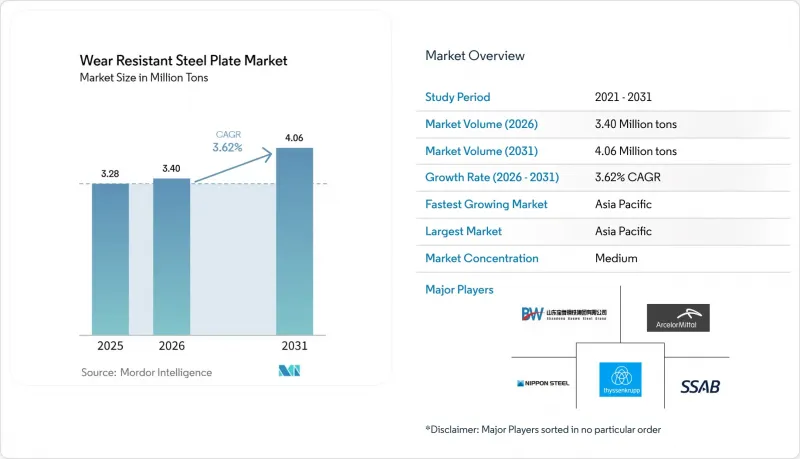
Mordor Intelligence에 의하면, 내마모 강판 시장 규모는 2025년에 328만 톤, 2026년에 340만 톤이 되어, 2031년까지 406만 톤에 이를 것으로 예측되며, 2026년부터 2031년까지 CAGR 3.62%로 성장할 전망입니다.
본 보고서는 제품 유형(내마모 강판, 고강도 내마모 강판 등), 두께(10mm 미만, 10-30mm, 30mm 이상), 용도(광업, 건설, 중장비 등), 지역(아시아태평양, 북미, 유럽, 남미, 중동 및 아프리카)별로 분류되어 있습니다. 시장 전망은 수량(톤) 기준으로 제시되어 있습니다.
세계 내마모 강판 시장 동향 및 분석
인프라 개발과 도시화의 진전
미국 연방 정부의 자금 지원이 굴삭기 버킷, 로더 에지 및 철거용 시어에 대한 수요를 견인하고 있습니다. 가동 시간을 향상시키기 위해 현재 500 HBW 강판을 사용하고 있으며, 프로젝트별 사용량은 증가하고 있지만 전반적인 성장세는 여전히 완만합니다. 인도에서는 누적 자본 지출이 1조 4,000억 달러에 달하는 국가 인프라 계획에 힘입어, 400-500 HBW 등급의 크러셔 라이너 및 컨베이어 슈트에 대한 수요가 유지되고 있습니다. 베트남, 인도네시아, 태국에서는 고속도로 및 항만 투자를 통해, 특히 말뚝 머리 부분이나 준설용 부품에 사용되는 두께 40mm 이상의 내마모 강판에 대한 수요가 증가하고 있습니다. 아시아의 2선 도시 건설사들은 ISO 6301-1의 경도 공차를 채택하여, 조달처를 현지 연강에서 전 세계적으로 인증받은 내마모 등급으로 전환하고 있습니다. 이러한 토목 공사 프로그램은 사양 기준에 영향을 미치고 있으며, 처리되는 콘크리트 1톤당 더 두껍고 경도가 높은 재료가 요구되고 있습니다.
산업기계 및 중장비 부문의 성장
코마츠 제980E 덤프 트럭의 차체 패널에는 현재 400 HBW를 초과하는 경도가 요구되고 있습니다. 이러한 변화로 인해 기존의 HSLA 강재를 활용한 대안은 배제되고, 담금질 및 템퍼링 처리를 거친 강판에 대한 수요가 증가하고 있습니다. 시간당 1,000톤의 처리 능력을 목표로 하는 파쇄기 제조업체는 오버레이 라이너를 채택하고 있습니다. 이 라이너는 연강 기판에 마르텐사이트 조직의 표층을 결합한 것으로, 내구성을 유지하면서 무게를 25% 줄였습니다. 2010년부터 2015년까지 상품 가격이 급등하던 시기에 도입된 북미 및 유럽의 차량들은 이제 수명이 다해가고 있습니다. 이로 인해 신규 광산 개발의 변동에 거의 영향을 받지 않는 예측 가능한 갱신 수요의 흐름이 형성되고 있습니다. 서비스 센터는 부가가치 비율을 높임으로써 이러한 추세에 대응하고 있습니다. 현장 작업을 줄이고 가동 중지 시간을 최소화할 수 있도록, 레이저 가공이 완료된 키트 형태의 세트를 공급하고 있습니다. 그 결과, 내마모 강판 시장은 단순한 톤수뿐만 아니라 키트 제조에 대한 수요와 현장 서비스의 효율화에도 힘입어 성장하고 있습니다.
대체 재료(경질 피복, 세라믹, 폴리머)의 활용 가능성
플럭스가 포함된 경면재(hard facing material)는 마모가 발생하는 부위에 크롬 카바이드를 정밀하게 증착시켜, 강재 사용량을 70% 절감하고 부품을 분리할 필요 없이 현장에서 보수 작업을 수행할 수 있게 합니다. 일부 석탄 및 곡물 관련 설비에서는 초고분자량 폴리에틸렌(UHMW-PE) 라이너가 충격이 적은 슈트 내의 퇴적물을 줄여주어, 강재를 완전히 대체하는 결과를 가져오고 있습니다. 슬러리 펌프용 세라믹 타일 패키지는 현재 1,000 HV의 경도를 달성하여 600 HBW 플레이트의 수명을 능가하며, 높은 수익률을 보이는 틈새 시장에 영향을 미치고 있습니다. SSAB사의 Duroxite는 구조용 모재에 탄화물을 중첩 용접하는 기술로, 세라믹의 내마모과 용접성을 겸비하여 시장에서 대체재에 대한 하이브리드형 방어 수단이 되고 있습니다. 그러나 폴리머와 세라믹 모두, 특히 충격이 가해지는 영역에서 파괴 인성이 부족하기 때문에 내마모 강판 시장의 핵심 부문은 안정적인 상태를 유지하고 있습니다.
부문별 분석
2025년, 내마모 강판은 시장 점유율의 46.61%를 차지했습니다. 이는 400-500 HBW의 경도가 요구되는 운반 트럭의 바닥이나 컨베이어 스커트 등, 지속적인 마모 환경에서 사용된 경험을 바탕으로 개발되었습니다. 내충격 강판 부문은 2031년까지 연평균 성장률(CAGR) 4.12%로 성장할 것으로 전망됩니다. 이러한 발전은 취성 파괴를 줄이기 위해 해체 및 재활용 현장에서 -40°C에서 샤르피 인성이 27 J 이상인 플레이트가 채택되고 있기 때문입니다. 연강 기판 위에 4-8mm 두께의 탄화물 층을 형성한 오버레이 및 바이메탈 솔루션은 솔리드 플레이트에 비해 무게를 30% 줄여줍니다. 이러한 경량화는 비용에 민감한 중견 광산 기업의 예산 측면에서 매력적입니다. 항복 강도 1,000 MPa의 고강도 내마모강은 내마모보다 구조적 강도가 더 중요한 이동식 크레인 및 텔레핸들러용으로 설계되었습니다.
표준 400 및 500 HBW 등급 시장에서는 치열한 경쟁이 벌어지고 있으며, 내마모 강판 시장에서는 전 세계적으로 20개 이상의 제철소가 가동되고 있습니다. 하이브리드 오버레이는 전체 두께의 판재 비용의 약 60% 수준으로 국부적인 경도를 제공함으로써 시장의 접근성을 높이고 있습니다. 이러한 높은 비용 효율성 덕분에 채석장 운영자와 골재 생산자들은 경도가 더 높은 등급의 도입을 검토하고 있습니다. 이 부문은 범용 시트에서 용도 특화형 키트로 전환되고 있으며, 현재는 디지털 마모 추적 기능이 통합되어 있습니다.
지역별 분석
2025년, 아시아태평양은 전 세계 총생산량의 47.72%를 차지해, 2031년까지 연평균 성장률(CAGR) 4.66%로 성장하여 다른 모든 지역을 앞지를 것으로 전망됩니다. 중국은 Baowu와 HBIS가 각각 700만 톤이 넘는 내마모 강재의 생산 능력을 보유하고 있는 데 힘입어, 해당 지역의 생산량에서 여전히 주요 기여자로 자리매김하고 있습니다. 그러나 이중 생산 규제가 도입됨에 따라 제철소는 대량 생산보다는 부가가치가 높은 강판 생산에 더욱 주력하고 있습니다. 인도에서는 국가 인프라 계획이 크러셔 라이너와 컨베이어 슈트의 교체 수요를 견인하고 있으며, 400-500 HBW 등급의 꾸준한 성장에 기여하고 있습니다. 동남아시아에서는 공공 투자 완료율이 95%를 넘어선 만큼, 고속도로 및 항만 투자를 배경으로 두께 40mm 이상의 두꺼운 강판이 말뚝 상부 및 준설용 자재로 사용되고 있습니다.
북미에서는 미국의 ‘인프라 투자 및 고용법’에 따라 500 HBW의 버킷 에지 업그레이드가 진행되고 있습니다. 이러한 조치로 인해 프로젝트 진행 중 발생하는 가동 중단으로 인한 벌금이 줄어들게 되어, 각 OEM 업체들이 두꺼운 판재의 재고를 유지하도록 장려되고 있습니다. 캐나다의 철광석 및 칼륨 광산 사업은 마모 방지 강판에 대한 안정적인 수요를 지속적으로 창출하고 있는 반면, 멕시코의 자동차 공급망이 근거리 조달(nearshoring) 방식으로 전환됨에 따라 자재 운반 장비용 라이너에 대한 수요가 증가하고 있습니다. 광업 및 건설용 차량의 교체 주기가 일치함에 따라, 북미 내마모 강판 시장은 연평균 성장률(CAGR) 3.5%로 성장할 것으로 전망됩니다.
유럽에서는 서방 국가들이 환경 대책에 주력하는 반면, 동방 국가들은 비용 압박에 직면해 있습니다. 독일과 스칸디나비아 국가들은 화석 연료에 의존하지 않는 에너지 공급 체계로의 전환을 추진하고 있습니다. CBAM 입찰 요건을 충족하는 SSAB의 수소용 강판은 약 7%의 프리미엄을 적용받아 OEM 계약을 수주했습니다. 반면, 고로 방식에 의존하는 동유럽의 제철소들은 톤당 50-80유로의 CBAM 과세에 직면해 있으며, 이는 시장 점유율에 영향을 미치고 있습니다. 해당 지역은 신규 생산량보다는 주로 교체 수요에 의존하고 있지만, 저탄소 조달 규정에 따라 적격 공급업체들은 이익률을 유지하고 있습니다.
남미 및 중동 및 아프리카에서는 브라질의 발레(Vale)사가 트럭 차체와 분쇄기용 강판을 활용하고 있습니다. 사우디아라비아에서는 ‘비전 2030’ 이니셔티브에 따라 해체용 전단기를 위한 두꺼운 강판의 수입이 촉진되고 있습니다. 남아프리카공화국과 아르헨티나에서는 에너지 가격 변동과 환율 변동이 성장을 제약하고 있지만, 인산염 및 금광과 같은 틈새 시장이 수요를 지탱하고 있습니다.
기타 혜택:
- 엑셀 형식 시장 예측(ME) 시트
- 3개월간의 애널리스트 지원
자주 묻는 질문
목차
제1장 서론
제2장 조사 방법
제3장 주요 요약
제4장 시장 구도
제5장 시장 규모와 성장 예측
제6장 경쟁 구도
제7장 시장 기회와 향후 전망
JHS 26.06.19According to Mordor Intelligence, the wear resistant steel plate market size is projected to be 3.28 Million tons in 2025, 3.40 Million tons in 2026, and reach 4.06 Million tons by 2031, growing at a CAGR of 3.62% from 2026 to 2031.
This report is Segmented by Product Type (Abrasion-Resistant Plates, High-Strength Wear-Resistant Plates, and More), Thickness (Below 10 Mm, 10-30 Mm, and Above 30 Mm), Application (Mining, Construction, Heavy Machinery, and More), and Geography (Asia-Pacific, North America, Europe, South America, and Middle-East and Africa). The Market Forecasts are Provided in Terms of Volume (Tons).
Global Wear Resistant Steel Plate Market Trends and Insights
Increasing Infrastructure Development and Urbanization
U.S. federal funding is driving demand for excavator buckets, loader edges, and demolition shears. These now use 500 HBW plates to improve uptime, increasing per-project tonnage while overall growth remains moderate. In India, the National Infrastructure Pipeline, with a cumulative capital outlay of USD 1.4 trillion, is supporting demand for crusher-liners and conveyor-chutes in the 400 to 500 HBW grade range. In Vietnam, Indonesia, and Thailand, investments in highways and ports are increasing the need for thick (> 40 mm) wear plates, particularly for piling shoes and dredge components. Contractors in tier-2 Asian cities are adopting ISO 6301-1 hardness tolerances, shifting sourcing from local soft steels to globally certified abrasion-resistant grades. These civil-works programs are influencing the specification baseline, requiring greater thickness and hardness for each tonne of concrete handled.
Growth in Industrial Machinery and Heavy Equipment Sectors
Body panels for the Komatsu 980E haul truck now require a hardness of over 400 HBW. This change eliminates conventional HSLA alternatives and highlights the demand for quenched-and-tempered plates. Crusher manufacturers targeting a throughput of 1,000 ton/hour are adopting overlay liners. These liners incorporate martensitic skins on a mild-steel backing, achieving a 25% reduction in weight while maintaining service life. Fleets in North America and Europe, acquired during the commodity boom from 2010 to 2015, have reached their end-of-life. This creates a predictable wave of replacements, largely unaffected by fluctuations in new mine activity. Service centers are responding to this trend by increasing their value-added share. They are supplying laser-profiled, kit-ready sets, which reduce on-site labor and minimize downtime. Consequently, the wear-resistant steel plate market is driven not only by raw tonnage but also by the demand for kit fabrication and field service efficiency.
Availability of substitutes (hard-facing, ceramics, polymers)
Flux-cored hard-facing deposits place chromium-carbide precisely where wear occurs, reducing steel usage by 70% and enabling in-situ refurbishments that eliminate the need for component removal. In some coal and grain installations, UHMW-PE liners reduce material build-up in low-impact chutes, leading to a complete replacement of steel. Ceramic tile packages in slurry pumps have now achieved a hardness of 1,000 HV, exceeding the 600 HBW plate life and affecting high-margin niches. SSAB's Duroxite overlay welds carbide onto a structural backing, combining the wear life of ceramics with their weldability, creating a hybrid defense against market substitution. However, the lack of fracture toughness in both polymers and ceramics, particularly in impact zones, ensures the core of the wear-resistant steel plate market remains stable.
Other drivers and restraints analyzed in the detailed report include:
- Need for Longer Equipment Life and Lower Maintenance Costs
- Digital Wear-Monitoring and Predictive-Maintenance Adoption
- Supply-Chain Emissions Caps Tightening Scrap-to-Billet Availability
For complete list of drivers and restraints, kindly check the Table Of Contents.
Segment Analysis
In 2025, abrasion-resistant plates accounted for 46.61% of the market share, supported by their use in continuous-wear environments such as haul-truck floors and conveyor skirts, which require a hardness of 400-500 HBW. The impact-resistant plate segment is anticipated to grow at a CAGR of 4.12% through 2031. This growth is driven by the adoption of plates with a Charpy toughness of 27 J or higher at -40 °C in demolition and recycling yards to mitigate brittle fractures. Overlay and bimetallic solutions, featuring 4-8 mm carbide layers on mild-steel backings, reduce weight by 30% compared to solid plates. This weight reduction appeals to cost-sensitive mid-tier mining budgets. High-strength wear-resistant grades with a 1,000 MPa yield are designed for mobile cranes and tele-handlers, where structural strength is prioritized over abrasion resistance.
The standard 400 and 500 HBW grades experience significant competition, with more than 20 active mills operating globally in the wear-resistant steel plate market. Hybrid overlays are increasing market accessibility by offering localized hardness at approximately 60% of the cost of full-thickness plates. This cost efficiency is encouraging quarry operators and aggregate producers to explore higher hardness classes. The segment is shifting from generic commodity sheets to application-specific kits, which are now integrated with digital wear tracking features.
Geography Analysis
In 2025, Asia-Pacific accounted for 47.72% of the global volume and is expected to grow at a 4.66% CAGR through 2031, surpassing all other regions. China, supported by Baowu and HBIS capacities each exceeding 7 million tons for wear grades, remains a key contributor to the region's volume. However, with dual-control output caps in place, mills are shifting focus toward value-added plates instead of bulk production. In India, the National Infrastructure Pipeline is driving demand for crusher-liners and conveyor-chute replacements, contributing to consistent growth for the 400-500 HBW grades. In Southeast Asia, public-investment completion rates exceeding 95% are directing thicker plates (> 40 mm) into piling shoes and dredge components, driven by investments in highways and ports.
In North America, the U.S. Infrastructure Investment and Jobs Act has prompted upgrades to 500 HBW bucket edges. This initiative reduces mid-project downtime fines and encourages OEMs to maintain inventories of thicker plates. Canada's iron-ore and potash operations continue to generate steady demand for wear plates, while Mexico's near-shoring of automotive supply chains is increasing the need for material-handling equipment liners. As replacement cycles align across mining and construction fleets, the wear-resistant steel plate market in North America is projected to grow at a 3.5% CAGR.
In Europe, western countries are focusing on green initiatives, while eastern countries face cost pressures. Germany and Scandinavia are transitioning to fossil-free supplies. SSAB's hydrogen plate, which complies with CBAM tenders, has secured OEM contracts with premiums of approximately 7%. In contrast, eastern mills that rely on blast-furnace routes are dealing with EUR 50-80/ton CBAM levies, which are affecting their market share. The region primarily relies on replacement demand rather than new tonnage, but low-carbon procurement rules are helping qualified suppliers maintain margins.
In South America and the Middle East-Africa, Brazil's Vale is utilizing plates for truck bodies and crushers. In Saudi Arabia, the Vision 2030 initiative is driving imports of thicker gauges for demolition shears. Although energy volatility and currency fluctuations are limiting growth in South Africa and Argentina, niche markets in phosphate and gold mining are sustaining demand.
- AG der Dillinger Huttenwerke
- ArcelorMittal
- Bisalloy
- EVRAZ
- HYUNDAI STEEL
- JFE Steel Corporation
- Nippon Steel Corporation
- NLMK
- Nucor Corporation
- Outokumpu
- POSCO
- China BaoWu Steel Group Corporation Limited
- SSAB
- thyssenkrupp AG
- voestalpine Stahl GmbH
- Yieh Corp.
Additional Benefits:
- The market estimate (ME) sheet in Excel format
- 3 months of analyst support
TABLE OF CONTENTS
1 Introduction
- 1.1 Study Assumptions and Market Definition
- 1.2 Scope of the Study
2 Research Methodology
3 Executive Summary
4 Market Landscape
- 4.1 Market Overview
- 4.2 Market Drivers
- 4.2.1 Increasing infrastructure development and urbanisation
- 4.2.2 Growth in industrial machinery and heavy equipment sectors
- 4.2.3 Need for longer equipment life and lower maintenance costs
- 4.2.4 Digital wear-monitoring and predictive-maintenance adoption
- 4.2.5 Hydrogen-ready "green steel" routes requiring ultra-clean wear grades
- 4.3 Market Restraints
- 4.3.1 Availability of substitutes (hard-facing, ceramics, polymers)
- 4.3.2 Volatility in iron-ore and alloying-element prices
- 4.3.3 Supply-chain emissions caps tightening scrap-to-billet availability
- 4.4 Value Chain Analysis
- 4.5 Porter's Five Forces
- 4.5.1 Threat of New Entrants
- 4.5.2 Bargaining Power of Buyers
- 4.5.3 Bargaining Power of Suppliers
- 4.5.4 Threat of Substitutes
- 4.5.5 Competitive Rivalry
5 Market Size and Growth Forecasts (Volume)
- 5.1 By Product Type
- 5.1.1 Abrasion-resistant plates
- 5.1.2 High-strength wear-resistant plates
- 5.1.3 Impact-resistant plates
- 5.1.4 Overlay and bimetallic plates
- 5.2 By Thickness
- 5.2.1 Below 10 mm
- 5.2.2 10 to 30 mm
- 5.2.3 Above 30 mm
- 5.3 By Application
- 5.3.1 Mining
- 5.3.2 Construction
- 5.3.3 Heavy machinery
- 5.3.4 Steel and foundry
- 5.3.5 Transportation
- 5.3.6 Other Applications (Agriculture, Recycling, Cement and aggregate industry)
- 5.4 By Geography
- 5.4.1 Asia-Pacific
- 5.4.1.1 China
- 5.4.1.2 Japan
- 5.4.1.3 India
- 5.4.1.4 South Korea
- 5.4.1.5 ASEAN Countries
- 5.4.1.6 Rest of Asia-Pacific
- 5.4.2 North America
- 5.4.2.1 United States
- 5.4.2.2 Canada
- 5.4.2.3 Mexico
- 5.4.3 Europe
- 5.4.3.1 Germany
- 5.4.3.2 United Kingdom
- 5.4.3.3 France
- 5.4.3.4 Italy
- 5.4.3.5 Spain
- 5.4.3.6 Russia
- 5.4.3.7 NORDIC Countries
- 5.4.3.8 Rest of Europe
- 5.4.4 South America
- 5.4.4.1 Brazil
- 5.4.4.2 Argentina
- 5.4.4.3 Rest of South America
- 5.4.5 Middle-East and Africa
- 5.4.5.1 Saudi Arabia
- 5.4.5.2 South Africa
- 5.4.5.3 Rest of Middle-East and Africa
- 5.4.1 Asia-Pacific
6 Competitive Landscape
- 6.1 Market Concentration
- 6.2 Strategic Moves
- 6.3 Market Share (%)/Ranking Analysis
- 6.4 Company Profiles (includes Global Overview, Market Overview, Core Segments, Financials, Strategic Information, Products and Services, and Recent Developments)
- 6.4.1 AG der Dillinger Huttenwerke
- 6.4.2 ArcelorMittal
- 6.4.3 Bisalloy
- 6.4.4 EVRAZ
- 6.4.5 HYUNDAI STEEL
- 6.4.6 JFE Steel Corporation
- 6.4.7 Nippon Steel Corporation
- 6.4.8 NLMK
- 6.4.9 Nucor Corporation
- 6.4.10 Outokumpu
- 6.4.11 POSCO
- 6.4.12 China BaoWu Steel Group Corporation Limited
- 6.4.13 SSAB
- 6.4.14 thyssenkrupp AG
- 6.4.15 voestalpine Stahl GmbH
- 6.4.16 Yieh Corp.
7 Market Opportunities and Future Outlook
- 7.1 White-space and unmet-need assessment