

|
시장보고서
상품코드
2062288
에틸렌글리콜 시장 : 시장 점유율 분석, 업계 동향 및 통계, 성장 예측(2026-2031년)Ethylene Glycol - Market Share Analysis, Industry Trends & Statistics, Growth Forecasts (2026 - 2031) |
||||||
 Mordor Intelligence
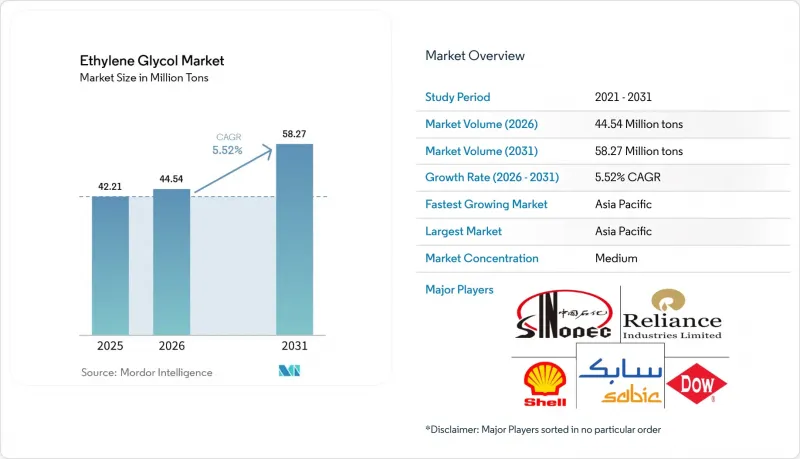
Mordor Intelligence에 의하면, 에틸렌글리콜 시장 규모는 2025년 4,221만 톤으로 평가되었고, 2026년 4,454만 톤으로 추정되고, 2031년까지 5,827만 톤으로 확대될 전망이며, 2026-2031년 연평균 복합 성장률(CAGR)은 5.52%를 나타낼 것으로 예측됩니다.
본 보고서는 제품 유형별(모노에틸렌글리콜, 디에틸렌글리콜, 트리에틸렌글리콜), 제조 공정별(에틸렌옥사이드법, 석탄 유래 MEG법, 바이오법), 용도별(폴리에스터 섬유, PET 등), 최종 사용자 산업별(섬유 및 의류, 자동차 등), 지역별(아시아태평양, 북미 등)로 분류되어 있습니다. 시장 전망은 수량(톤) 기준으로 제시되어 있습니다.
세계의 에틸렌글리콜 시장 동향 및 분석
전기차(EV) 열 관리용 냉각수 수요의 급증
BEV(배터리식 전기차)의 수냉식 배터리 팩, 전력 전자 장치 및 전기 모터는 일반적으로 온도 조절을 위해 50-60%의 에틸렌글리콜-물 혼합액이 필요합니다. 테슬라의 2026년형 모델 Y 설명서에는 북미 시장용 HTF-LS, 유럽 시장용 G48, 중국 시장용 LC100이 명시되어 있으며, 이들 모두는 내식성과 열효율을 확보하기 위해 50-60%의 농도 범위 내에 있습니다. 800V 구동 시스템의 보급에 따라 차량 전체의 글리콜 사용량이 증가하고 있으며, 이것이 에틸렌글리콜 시장의 장기적인 성장을 견인하고 있습니다. BYD와 같은 중국 자동차 제조업체들은 이미 차량 1대당 여러 개의 글리콜 회로를 채택하고 있는 반면, 미국의 기가팩토리에서는 교차 오염을 방지하기 위해 냉각수의 등급을 맞춤화하고 있습니다. 유전체 액침 냉각 유체은 고성능 차량에서 틈새 시장으로 활용될 가능성이 있지만, 주류 전기차 모델들은 여전히 물과 글리콜 혼합액에 의존하고 있어 수요가 꾸준히 증가할 것으로 예측됩니다.
아시아 내 메가크래커 생산 능력 확대
중국과 한국에서 2025년 하반기부터 2027년에 걸쳐 가동을 시작할 예정인 6개의 대형 에틸렌 복합 시설은 300만 톤이 넘는 새로운 MEG(메틸렌 에테르)의 정격 생산 능력을 추가할 것으로 예측됩니다. 사우디 아람코와 시노펙이 YASREF 정유시설에 건설하는 180만 톤 규모의 크래커는 유리한 원유 원료를 활용하여 글리콜 및 그 유도체를 생산하는 ‘액체에서 화학제품으로의 전환’의 좋은 사례입니다. 단기적인 공급 과잉으로 인해 중국의 가동률은 1-2포인트 하락할 가능성이 있습니다. 그러나 통합형 생산 체제에 따른 비용 우위 덕분에, 석탄 기반 MEG 생산업체들은 마진이 축소되고 있음에도 불구하고 처리량을 유지할 수 있습니다. 이러한 추가 생산 능력은 하류 폴리에스터 수출업체의 경우 지역적 공급 안정성을 높여주고, 섬유 방적업체의 경우 원자재 비용 안정화에 기여할 것입니다.
DEG의 작업장 노출에 관한 EU REACH 규정
네덜란드 보건위원회는 디에틸렌글리콜(DEG)에 대해 8시간 노출 한계치를 70 mg/m³로 설정할 것을 권고하고 있으며, 경피 흡수 위험을 나타내는 피부 관련 주석도 첨부되어 있습니다. 덴마크의 11 mg/m³부터 영국의 101 mg/m³에 이르기까지, 국가별 제한치의 차이는 규정 준수를 복잡하게 만들고, 환기, 모니터링 및 개인보호구(PPE)에 드는 비용을 증가시키고 있습니다. 그 결과, 브레이크 오일 및 용제 혼합 업체 등 하류 사용자들은 프로파일렌글리콜이나 고순도 MEG 유도체로 전환할 가능성이 있어, 에틸렌글리콜 시장에서 DEG의 성장 전망을 저해할 우려가 있습니다.
부문별 분석
폴리에스터 섬유 및 PET 수지 공급망에 힘입어, 모노에틸렌글리콜은 2025년 출하량의 86.44%를 차지했습니다. 이 부문의 절대적인 물량 증가로 인해, 성장세가 빠른 특수용도 제품으로 인해 MEG의 비중이 감소하고 있음에도 불구하고, 에틸렌글리콜 시장 규모는 견조한 추세를 유지하고 있습니다. 디에틸렌글리콜은 DEG 중간체를 거쳐 제조되는 메틸디글리콜 및 메틸트리글리콜에 의존하는 고사양 브레이크 오일 수요에 힘입어, 2031년까지 연평균 성장률(CAGR) 8.47%를 기록하며 성장할 것으로 전망됩니다. 트리에틸렌글리콜은 천연가스 탈수 분야와 관련된 안정적인 틈새 시장으로 자리 잡고 있으며, 그 동향은 업스트림 부문의 시추 주기를 반영하고 있습니다.
생산 능력에 대한 투자도 이러한 추세를 반영하고 있습니다. 2025년 하반기에 가동을 시작할 BASF의 잔장(Zhanjiang) 메틸글리콜 공장은 DEG 원료를, 증가하는 중국의 자동차 보유 대수에 맞추어 최신 브레이크 플루이드 등급으로 전환할 예정입니다. 그러나 규제 당국의 독성 검토로 인해 DEG 수요가 위축될 가능성이 있으며, 식품 및 의약품 분야에서 배합 제조업체들은 더 안전한 프로파일렌글리콜로 대체해야 할 수도 있습니다. 특수 블렌드가 가격 프리미엄을 확보하는 가운데, 균형 잡힌 포트폴리오는 생산자가 원자재 MEG의 마진 변동을 완화하고 에틸렌글리콜 시장에서 시장 점유율 선두 자리를 유지하는 데 도움이 됩니다.
2025년 생산량의 77.79%는 에틸렌옥사이드 공법을 통해 생산되며, 북미의 크래커와의 통합 및 에탄 가격 경쟁력을 활용하고 있습니다. 지난 10년 동안 중국의 증산분 대부분은 석탄 유래 MEG가 차지해 왔으나, 현재는 탄소 비용 상승과 가동률 저하에 직면해 있습니다. 약 150만 톤 규모의 석탄 기반 생산 능력은 재가동 가능성이 희박하여, 향후 공급 여력을 축소하게 될 것입니다.
바이오 부문은 2031년까지 연평균 성장률(CAGR) 9.23%를 기록하며 가장 빠르게 성장할 분야입니다. Sustainea의 Lafayette 프로젝트는 기존 PET 자산과 호환되며 확장성이 뛰어난 드롭인형 재생 가능 MEG의 대표적인 사례이며, UPM의 활엽수 기반 BioPura는 중기적으로 탄소 음성 글리콜을 공급할 가능성이 있습니다. MOSAIK사의 당 분해 화학 기술을 도입한 실증 플랜트는 전체 수명 주기에 걸친 CO2 지표를 평가하고 있는 각 폴리에스터 브랜드사에 샘플을 배포하고 있습니다. 구매자들이 스코프 3 목표를 조달 프로세스에 반영함에 따라, 검증된 저탄소 글리콜에 대한 프리미엄이 바이오 MEG를 에틸렌글리콜 시장의 주류 공급원으로 자리매김하게 할 가능성이 있습니다.
지역별 분석
아시아태평양은 2025년 생산량의 59.22%를 차지했으며, 2031년까지 연평균 성장률(CAGR) 5.78%로 확대될 것으로 전망됩니다. 중국이 거의 자급자족 상태에 이르면서 수입은 계속 줄어들고 있는 반면, 2026년 신규 가동으로 인해 단기적으로는 마진에 압박이 가해질 것입니다. 사우디아라비아는 YASREF의 확장 등 비용 경쟁력이 있는 액체에서 화학제품으로의 복합 설비를 활용하여, 2024-2025년 중국의 MEG 수입량의 절반 이상을 공급했습니다. 인도의 폴리에스터 수요 증가와 릴라이언스 인더스트리즈의 국내 가격 인상은 남아시아 지역의 수급이 타이트해지고 있음을 시사합니다.
북미는 셰일가스로 인한 비용 우위를 누리고 있습니다. 다우 케미칼이 MEGlobal의 오이스터 크릭 공장에 연간 10만 톤의 에틸렌 공급을 확대하고, 엑슨모빌과 SABIC이 연간 110만 톤 규모의 MEG 생산 라인을 가동함에 따라, 이 지역의 수출 체제가 강화되고 있습니다. 서스테니아의 바이오 MEG 플랜트는 미국 기업의 탈탄소화 전략에 부합하는 재생에너지원 도입을 추진하고 있습니다.
유럽은 높은 에너지 비용으로 어려움을 겪고 있으며, 2023년부터 2025년 중반에 걸쳐 50곳 이상의 화학 공장이 폐쇄되거나 가동을 축소할 수밖에 없는 상황에 처해 있습니다. 2025년 10월 INEOS가 쾰른에서 프로파일렌글리콜 생산을 중단한 것은 이익률 압박을 여실히 보여주고 있는 반면, EU의 순환 경제 관련 법규는 화학 재활용에 대한 투자를 촉진하고 있습니다. 그 때문에 글리콜류의 수입 의존도는 서서히 높아지고 있습니다.
남미, 중동 및 아프리카의 점유율은 소폭에 그치고 있습니다. 2027년 가동을 예정하고 있는 인드라마 벤처스의 연간 생산량 4,000톤 규모의 라고스 rPET 공장은 아프리카 최초의 대규모 재생 글리콜 밸류체인의 기반이 될 것입니다. 사우디 아람코의 1,000억 달러 규모의 ‘액체에서 화학제품으로’ 로드맵은 중동의 수출 역량을 한층 더 공고히 하고, 에틸렌글리콜 시장에서 전 세계적으로 균형 잡힌 공급 거점이 유지되도록 보장할 것입니다.
기타 혜택 :
- 엑셀 형식 시장 예측(ME) 시트
- 3개월간의 애널리스트 지원
자주 묻는 질문
목차
제1장 서론
제2장 조사 방법
제3장 주요 요약
제4장 시장 구도
제5장 시장 규모 및 성장 예측
제6장 경쟁 구도
제7장 시장 기회 및 향후 전망
AJY 26.06.26According to Mordor Intelligence, the ethylene glycol market size is projected to expand from 42.21 Million tons in 2025 and 44.54 Million tons in 2026 to 58.27 Million tons by 2031, registering a CAGR of 5.52% between 2026 to 2031.
This report is Segmented by Product Type (Monoethylene Glycol, Diethylene Glycol, and Triethylene Glycol), Manufacturing Process (Ethylene-Oxide Route, Coal-To-MEG, Bio-Based Route), Application (Polyester Fiber, PET, and More), End-User Industry (Textiles and Apparel, Automotive, and More), and Geography (Asia-Pacific, North America, and More). The Market Forecasts are Provided in Terms of Volume (Tons).
Global Ethylene Glycol Market Trends and Insights
Electric Vehicle Thermal-Management Coolant Demand Surge
Liquid-cooled battery packs, power electronics, and e-motors in BEVs generally require 50-60% ethylene-glycol-water mixtures for temperature regulation. Tesla's 2026 Model Y manuals specify HTF-LS for North America, G48 for Europe, and LC100 for China, all within the 50-60% concentration range to ensure corrosion resistance and thermal efficiency. As 800-volt drivetrains become more common, vehicle-level glycol volumes are increasing, driving long-term growth in the ethylene glycol market. Chinese OEMs like BYD are already incorporating multiple glycol circuits per vehicle, while U.S. gigafactories are customizing coolant grades to prevent cross-contamination. While dielectric immersion coolants may find niche applications in high-performance vehicles, mainstream electrified fleets continue to rely on water-glycol mixtures, ensuring steady demand growth.
Mega-Cracker Capacity Additions in Asia
Six large ethylene complexes planned for start-up between late 2025 and 2027 in China and South Korea are expected to add over 3 million tons of new MEG nameplate capacity. Saudi Aramco and Sinopec's 1.8-million-ton cracker at the YASREF refinery exemplifies the shift toward liquids-to-chemicals production, utilizing advantaged crude feedstocks for glycols and derivatives. Short-term oversupply may reduce Chinese operating rates by 1-2 percentage points, but integrated cost advantages allow coal-to-MEG producers to maintain throughput despite narrower margins. This additional capacity improves regional availability for downstream polyester exporters and helps stabilize raw material costs for fiber spinners.
EU REACH Limits on DEG Workplace Exposure
The Health Council of the Netherlands has recommended an 8-hour exposure limit of 70 mg/m3 for diethylene glycol (DEG), with a skin notation indicating dermal absorption risks Variations in national limits, ranging from Denmark's 11 mg/m3 to the UK's 101 mg/m3, complicate compliance and increase costs for ventilation, monitoring, and personal protective equipment. As a result, downstream users, such as brake-fluid and solvent blenders, may shift toward propylene glycol or higher-purity MEG derivatives, potentially reducing DEG's growth prospects within the ethylene glycol market.
Other drivers and restraints analyzed in the detailed report include:
- Accelerating Shift to Bio-Based MEG
- AI-Optimized Demand Forecasting Boosts Inventory Pull-Through
- Virgin-PET Demand Erosion After 2028 Recycling Mandates
For complete list of drivers and restraints, kindly check the Table Of Contents.
Segment Analysis
Monoethylene glycol captured 86.44% of 2025 shipments, anchored by polyester fiber and PET resin chains. The segment's absolute volume rise keeps the ethylene glycol market size on a solid trajectory, even as MEG's proportional share edges lower due to faster-growing specialties. Diethylene glycol is projected to grow at a 8.47% CAGR to 2031, energized by higher-spec brake fluids that rely on methyl diglycol and methyl triglycol, both manufactured via DEG intermediates. Triethylene glycol remains a stable niche tied to natural-gas dehydration; its fortunes mirror upstream drilling cycles.
Capacity investments echo these trends. BASF's Zhanjiang methyl-glycols plant, starting late-2025, will channel DEG feed into modern brake-fluid grades for China's expanding auto parc. Regulatory toxicity scrutiny, however, could constrain DEG, nudging formulators toward safer propylene glycol alternatives in food and pharma uses. As specialty blends claim a price premium, balanced portfolios help producers buffer swings in commodity MEG margins and sustain ethylene glycol market share leadership.
The ethylene-oxide process supplied 77.79% of the 2025 output, leveraging cracker integration and advantaged ethane in North America. Coal-to-MEG supplied much of China's incremental volume over the last decade but now faces tightening carbon costs and lower run rates. Approximately 1.5 million tons of coal-based capacity is unlikely to restart, trimming future supply slack.
Bio-based route is the fastest-growing slice at a 9.23% CAGR to 2031. Sustainea's Lafayette project exemplifies scalable, drop-in renewable MEG compatible with legacy PET assets, and UPM's hardwood-based BioPura could deliver negative-carbon glycols mid-term. Demonstration units employing MOSAIK sugar-cracking chemistry are distributing samples to polyester brands evaluating full-cycle CO2 metrics. As buyers embed Scope 3 targets into procurement, premiums for verified low-carbon glycols may cement bio-MEG as a mainstream supply tier within the ethylene glycol market.
Geography Analysis
Asia-Pacific accounted for 59.22% of the 2025 volume and is forecast to expand at a 5.78% CAGR to 2031. China's near-self-sufficiency compresses imports, while 2026 start-ups add short-term pressure on margins. Saudi Arabia supplied over half of China's MEG imports in 2024-2025, leveraging cost-advantaged liquids-to-chemicals complexes such as the YASREF expansion. India's polyester uptick and Reliance Industries' domestic price increases signal tightening balances in South Asia.
North America enjoys shale-gas cost leadership. Dow's 100,000 tons per year ethylene supply boost to MEGlobal's Oyster Creek unit and ExxonMobil-SABIC's 1.1 million tons per year MEG line reinforce the region's export posture. Sustainea's bio-MEG plant introduces a renewable stream that aligns with U.S. corporate decarbonization agendas.
Europe battles high energy costs; over 50 chemical sites either closed or curtailed between 2023 and mid-2025. INEOS' Cologne shutdown of propylene glycol in October 2025 illustrates margin pressure, while EU circular-economy statutes nudge investment toward chemical recycling. Import-reliance for glycols is therefore inching upward.
South America and the Middle-East and Africa capture smaller share. Indorama Ventures' 4,000 tons per year Lagos rPET plant, slated for 2027, underpins Africa's first large-scale recycled-glycol value chain. Saudi Aramco's USD 100 billion liquids-to-chemicals roadmap further entrenches Middle-East export heft, ensuring the ethylene glycol market retains globally balanced supply nodes.
- BASF
- China Petrochemical Corporation
- Dow
- Equate Petrochemical Company
- Formosa Plastics Corporation, U.S.A.
- Indorama Ventures Public Company Limited
- INEOS
- LOTTE Chemical Corporation
- Mitsubishi Chemical Group Corporation
- PTT Global Chemical Public Company Limited
- Reliance Industries Limited
- SABIC
- Sasol
- Shell plc
- Technip Energies N.V.
Additional Benefits:
- The market estimate (ME) sheet in Excel format
- 3 months of analyst support
TABLE OF CONTENTS
1 Introduction
- 1.1 Study Assumptions and Market Definition
- 1.2 Scope of the Study
2 Research Methodology
3 Executive Summary
4 Market Landscape
- 4.1 Market Overview
- 4.2 Market Drivers
- 4.2.1 Electric vehicle thermal-management coolant demand surge
- 4.2.2 Mega-cracker capacity additions in Asia
- 4.2.3 Accelerating shift to bio-based MEG
- 4.2.4 AI-optimised demand-forecasting boosts inventory pull-through
- 4.2.5 On-purpose rMEG from chemical recycling loops
- 4.3 Market Restraints
- 4.3.1 EU REACH limits on DEG workplace exposure
- 4.3.2 Virgin-PET demand erosion after 2028 recycling mandates
- 4.3.3 Carbon-pricing shocks on coal-to-MEG projects
- 4.4 Value Chain Analysis
- 4.5 Porter's Five Forces
- 4.5.1 Bargaining Power of Suppliers
- 4.5.2 Bargaining Power of Buyers
- 4.5.3 Threat of New Entrants
- 4.5.4 Threat of Substitutes
- 4.5.5 Degree of Competition
5 Market Size and Growth Forecasts (Volume)
- 5.1 By Product Type
- 5.1.1 Monoethylene Glycol (MEG)
- 5.1.2 Diethylene Glycol (DEG)
- 5.1.3 Triethylene Glycol (TEG)
- 5.2 By Manufacturing Process
- 5.2.1 Ethylene-Oxide Route
- 5.2.2 Coal-to-MEG (CTM)
- 5.2.3 Bio-Based Route
- 5.3 By Application
- 5.3.1 Polyester Fibre
- 5.3.2 PET
- 5.3.3 Antifreeze and Coolant
- 5.3.4 Industrial Films and Sheets
- 5.3.5 Other Applications
- 5.4 By End-user Industry
- 5.4.1 Textiles and Apparel
- 5.4.2 Automotive
- 5.4.3 Oil and Gas
- 5.4.4 Plastics and Packaging
- 5.4.5 Medical and Pharmaceutical
- 5.4.6 Other End-user Industries
- 5.5 By Geography
- 5.5.1 Asia-Pacific
- 5.5.1.1 China
- 5.5.1.2 India
- 5.5.1.3 Japan
- 5.5.1.4 South Korea
- 5.5.1.5 ASEAN Countries
- 5.5.1.6 Rest of Asia-Pacific
- 5.5.2 North America
- 5.5.2.1 United States
- 5.5.2.2 Canada
- 5.5.2.3 Mexico
- 5.5.3 Europe
- 5.5.3.1 Germany
- 5.5.3.2 United Kingdom
- 5.5.3.3 France
- 5.5.3.4 Italy
- 5.5.3.5 Russia
- 5.5.3.6 Rest of Europe
- 5.5.4 South America
- 5.5.4.1 Brazil
- 5.5.4.2 Argentina
- 5.5.4.3 Rest of South America
- 5.5.5 Middle-East and Africa
- 5.5.5.1 Saudi Arabia
- 5.5.5.2 South Africa
- 5.5.5.3 Rest of Middle-East and Africa
- 5.5.1 Asia-Pacific
6 Competitive Landscape
- 6.1 Market Concentration
- 6.2 Strategic Moves
- 6.3 Market Share (%)/Ranking Analysis
- 6.4 Company Profiles (includes Global level Overview, Market level overview, Core Segments, Financials as available, Strategic Information, Products and Services, and Recent Developments)
- 6.4.1 BASF
- 6.4.2 China Petrochemical Corporation
- 6.4.3 Dow
- 6.4.4 Equate Petrochemical Company
- 6.4.5 Formosa Plastics Corporation, U.S.A.
- 6.4.6 Indorama Ventures Public Company Limited
- 6.4.7 INEOS
- 6.4.8 LOTTE Chemical Corporation
- 6.4.9 Mitsubishi Chemical Group Corporation
- 6.4.10 PTT Global Chemical Public Company Limited
- 6.4.11 Reliance Industries Limited
- 6.4.12 SABIC
- 6.4.13 Sasol
- 6.4.14 Shell plc
- 6.4.15 Technip Energies N.V.
7 Market Opportunities and Future Outlook
- 7.1 White-space and Unmet-need Assessment


