

|
시장보고서
상품코드
2062357
에틸 터셔리 부틸 에테르 : 시장 점유율 분석, 업계 동향 및 통계, 성장 예측(2026-2031년)Ethyl Tertiary Butyl Ether - Market Share Analysis, Industry Trends & Statistics, Growth Forecasts (2026 - 2031) |
||||||
 Mordor Intelligence
에틸 터셔리 부틸 에테르 시장 규모는 2025년에 71억 2,000만 달러로 평가되었습니다. 2026년에 77억 9,000만 달러에 달하고, 2031년까지 122억 1,000만 달러에 이를 것으로 예측됩니다.
2026년부터 2031년까지 연평균 성장률(CAGR) 9.41%를 나타낼 것으로 전망됩니다.
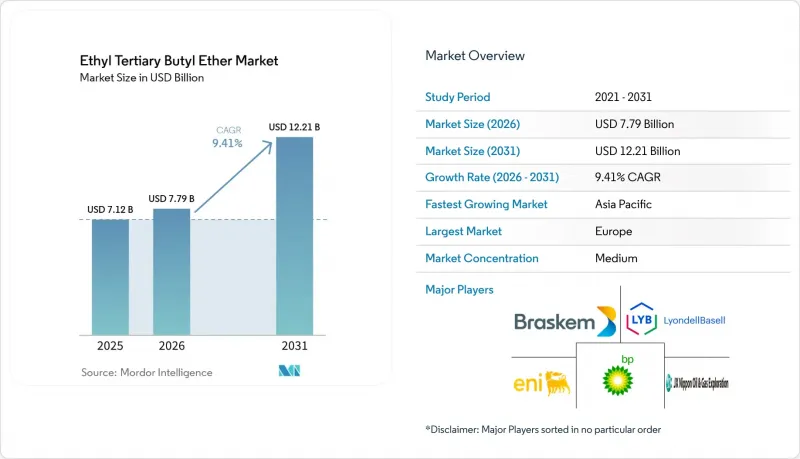
본 보고서는 원료(에탄올계 ETBE 및 이소부틸렌계 ETBE), 연료 유형(무연 휘발유 등), 기능(옥탄가 향상제 등), 최종 사용자 산업(정유시설 및 혼합 시설 등), 지역(아시아태평양, 북미, 유럽, 남미, 중동 및 아프리카)별로 분류되어 있습니다. 시장 전망은 금액(달러) 기준으로 제시되어 있습니다.
세계의 에틸 터셔리 부틸 에테르 시장 동향 및 분석
지하수 오염 위험 감소를 통한 MTBE에서 ETBE로의 대체
캘리포니아주는 2003년에 MTBE 사용을 금지했으며, 미국 전역에서 광범위한 지하수 오염이 발생함에 따라 2006년까지 전국적으로 단계적으로 폐지되면서, 더 안전한 에테르 대체재인 ETBE에 대한 지속적인 수요가 생겨났습니다. 일본도 2003년에 이에 발맞추어 코스모석유의 사카이 공장을 ETBE 생산이 가능하도록 개조했으며, 2023년도에는 29만 7,000킬로리터의 바이오 ETBE를 혼합했습니다. 한국과 대만에서는 여전히 산소화제 선택지를 검토 중이며, 구형 MTBE 생산 설비가 단계적으로 폐지됨에 따라 ETBE의 도입이 점차 확대될 것으로 보입니다. ETBE는 생분해 속도가 빠르고 물에 대한 용해도가 낮기 때문에 연료 판매업자의 오염 대책 부담이 줄어듭니다. 2030년 이후에는 기존의 MTBE 공장의 대부분이 이미 전환되거나 폐쇄되었기 때문에 대체 효과는 둔화될 것입니다.
자동차 배기가스 규제 강화
유로 7, EPA Tier 3, 중국 국가 VI, 인도 BS-VI 기준은 NOx, 미세먼지, 방향족 화합물의 배출 제한을 강화하고 있으며, 정유사들은 더 깨끗한 연소를 실현하기 위해 산소 함량을 높여야 하는 압박을 받고 있습니다. ETBE는 중량 기준으로 15.66%의 산소를 함유하고 있으며, RON(연구 옥탄가)이 119이므로 엔진 제어 설정을 변경하지 않고도 더 희박한 혼합비로 엔진을 가동할 수 있습니다. 중국의 GB 18351-2025는 비에탄올 휘발유의 산소 함량을 2.7%로 제한하고 있으며, 이로 인해 고옥탄가 혼합유 시장에서 ETBE를 위한 프리미엄 틈새 시장이 형성되고 있습니다. 유럽의 저온 조건에서 실시되는 실제 주행 배기가스 시험은 저휘발성 산소화제의 장점을 더욱 부각시키고 있습니다. 규제 동향에 따라 직접 에탄올 혼합이 확대되고 있는 상황에서도 이 첨가제의 중요성은 여전히 유지되고 있습니다.
바이오 유래 에테르 및 직접 에탄올 혼합에 의한 경쟁
인도는 2025년에 전국적으로 E20를 달성했으며, 현재 199억 리터의 에탄올 생산 능력을 보유하고 있어, 이로 인해 직접 혼합이 ETBE 합성보다 비용이 저렴해졌습니다. 중국의 E10 규격에서는 추가 산소화제 사용이 금지되어 있기 때문에 ETBE는 프리미엄 비에탄올 등급으로만 제한되어 있습니다. 유럽에서는 2023년 E10의 점유율이 40.3%이었지만, 독일이 남아 있는 E5 등급을 폐지하면 이 비율은 더욱 확대될 가능성이 있습니다. 한편, 타샤리 아밀 에틸 에테르와 기타 C5 계열 에테르들이 같은 프리미엄 휘발유 시장에서 점유율을 놓고 경쟁하고 있습니다. 앞으로 2년 동안, 비용에 민감한 아시아 시장에서 이러한 역풍이 가장 거세게 불 것으로 보입니다.
부문별 분석
에탄올 유래 ETBE는 RED(재생에너지 지침)를 준수하는 셀룰로오스계 원료의 흐름과, 일본의 수입을 뒷받침하는 미국·브라질 간 에탄올 회랑에 힘입어, 2025년에는 에틸 터셔리 부틸 에테르 시장 점유율의 62.22%를 차지했습니다. 에탄올계 ETBE 원료인 에틸 터셔리 부틸 에테르 시장 규모는 2031년까지 연평균 성장률(CAGR) 9.22%로 확대될 것으로 전망됩니다. 비용 민감도가 높기 때문에 성장은 옥수수나 사탕수수의 가격 변동에 좌우되지만, RED III에 따른 인센티브의 이중 계상으로 인해 이익률은 부분적으로 유지되고 있습니다. 재생 가능 원료 공급망이 성숙해짐에 따라, 특히 Global Bioenergies의 Leuna 공장과 Gevo의 Net-Zero 1이 초기 상업적 규모공급을 시작하면, 이소부틸렌 기반 ETBE의 전략적 중요성이 더욱 커질 것입니다.
중기적으로는 ‘인증된 첨단 연료(Certified Advanced)’ 지위에 따라 유럽 수요가 셀룰로오스계 에탄올 및 폐가스 유래 이소부틸렌으로 더욱 이동할 전망입니다. 2028년 이후, 규모의 경제가 성숙함에 따라 재생 가능 이소부틸렌이 석유화학 유래 공급량의 15-20%를 대체할 수 있게 되어, 에틸 터셔리 부틸 에테르 시장의 원료 기반 다각화가 정착될 가능성이 있습니다.
2025년에는 무연 휘발유가 에틸 터셔리 부틸 에테르 시장의 매출액의 45.11%를 차지했으며, 유럽과 일본의 많은 프리미엄 등급 제품에서는 증기압의 급격한 상승을 억제하기 위해 에탄올이 배제되고 있기 때문에 이 제품이 계속해서 시장의 주축을 이루고 있습니다. 그러나 E10 및 기타 바이오연료 혼합연료와 관련된 에틸 터셔리 부틸 에테르 시장 규모는 예측 기간(2026-2031년) 동안 연평균 성장률(CAGR) 9.78%로 가장 빠르게 확대될 전망입니다. 이는 유해 대기 오염 물질의 규제 기준을 충족하기 위해 ETBE의 바이오에탄올 기여분을 이중으로 산정하고, 방향족 화합물의 배출을 억제하도록 의무화한 조치가 뒷받침하고 있기 때문입니다. 독일과 프랑스는 이러한 양면성을 여실히 보여주고 있습니다. E10의 보급률은 상승하고 있지만, 프리미엄 E5는 여전히 수익성이 높은 ETBE의 틈새 시장을 유지하고 있습니다.
앞으로도 증기압 제한이 있는 여름용 휘발유나 한랭 지역에서의 콜드 스타트(냉간 시동)에 대한 우려가 에테르 혼합의 정당성을 계속해서 뒷받침할 것입니다. 그렇긴 하지만, 차량이 완전히 E10에 대응하게 되고 소매 네트워크가 재구축되면, 순수 에탄올이 더 큰 시장 점유율을 차지하게 되어 표준 등급 휘발유에서 ETBE의 사용량은 감소하겠지만, 프리미엄 시장에서의 입지는 유지될 가능성이 있습니다. 이러한 미묘한 변화는 에틸 터셔리 부틸 에테르 시장에 진출한 기업들에게 매우 중요한 사항입니다.
지역별 분석
2025년, 유럽은 RED III 할당량과 성숙한 프리미엄 휘발유 수요에 힘입어 에틸 터셔리 부틸 에테르 시장 매출의 36.22%를 차지했습니다. 독일, 프랑스, 이탈리아, 스페인 등 4개국이 유럽 대륙의 처리량의 대부분을 차지하고 있는데, 이는 프리미엄 등급에서 높은 ETBE 함유율이 유지되고 있기 때문입니다. 오를렌 리에투바(Orlen Lietuva) 등 동유럽의 정유업체들도 국경을 넘는 수출 기준을 준수하기 위해 MTBE에서 ETBE로의 전환을 검토하고 있습니다.
아시아태평양은 2031년까지 연평균 성장률(CAGR) 9.15%를 기록하며 가장 빠르게 성장하고 있는 지역입니다. 일본만 해도 2024년에 18억 3,000만 리터의 ETBE를 수입했으며, 5억 리터의 에탄올 환산량을 의무화하는 엄격한 규제를 유지하고 있습니다. 중국의 고급 휘발유 시장은 E10의 제약에 영향을 받지 않고 여전히 고급 브랜드를 대상으로 에테르계 산소화제를 지정하고 있으며, 일반 등급이 에탄올로 전환되는 상황 속에서도 에틸 터셔리 부틸 에테르 시장에는 상승 여지가 남아 있습니다. 인도에서는 2028년 이후 플렉스 연료 차량이 보급되기 시작함에 따라, 정유시설 기획 담당자들이 고급 부문에서 ETBE가 E20과 공존할 수 있는지 여부를 평가했습니다.
북미 시장은 성숙 단계에 있으며, RFS2에 근거한 연간 150억 갤런 규모의 옥수수 유래 에탄올 할당량 체계 하에서 운영되고 있습니다. 그 결과, 에틸 터셔리 부틸 에테르 시장의 입지는 특수 레이싱용 연료나 제한된 항공용 가솔린 시장으로 국한되어 있습니다. 캐나다와 멕시코도 비슷한 경향을 보이고 있으며, 비용과 공급 가능성 등의 이유로 각각 에탄올의 직접 혼합을 선호하고 있습니다. 브라질을 중심으로 한 남미 지역에서는 사탕수수에서 추출한 에탄올이 풍부하고, E27.5 가솔린 블렌드가 널리 보급되어 있기 때문에 ETBE는 채택되지 않고 있습니다.
중동 및 아프리카에서의 보급은 아직 초기 단계이지만, 전략적으로는 흥미로운 시장입니다. 사우디아라비아의 정유업체들은 나프타 개질 설비를 대폭 확장하지 않고도 국내 옥탄가 목표를 달성할 수 있는 방안으로 ETBE를 검토하고 있는 반면, 남아프리카공화국에서는 연료 품질 향상이 예정되어 있어, 규모는 작지만 프리미엄 등급에 대한 수요가 발생할 전망입니다. 두 지역 모두 휘발유 소매 가격이 낮은 수준이어서 단기적인 판매량은 억제되고 있지만, 높은 수익률을 보이는 프리미엄 틈새 시장에는 여전히 여지가 남아 있습니다.
기타 혜택 :
- 엑셀 형식 시장 예측(ME) 시트
- 3개월간의 애널리스트 지원
자주 묻는 질문
목차
제1장 서론
제2장 조사 방법
제3장 주요 요약
제4장 시장 구도
제5장 시장 규모 및 성장 예측
제6장 경쟁 구도
제7장 시장 기회 및 향후 전망
KTH 26.06.22According to Mordor Intelligence, the ethyl tertiary butyl ether market size is projected to be USD 7.12 billion in 2025, USD 7.79 billion in 2026, and reach USD 12.21 billion by 2031, growing at a CAGR of 9.41% from 2026 to 2031.
This report is Segmented by Feedstock (Ethanol-Based ETBE and Isobutylene-Based ETBE), Fuel Type (Unleaded Gasoline and More), Function (Octane Enhancer and More), End-User Industry (Oil Refineries and Blending Facilities, and More), and Geography (Asia-Pacific, North America, Europe, South America, and the Middle East and Africa). The Market Forecasts are Provided in Terms of Value (USD).
Global Ethyl Tertiary Butyl Ether Market Trends and Insights
Substitution of MTBE With ETBE Due to Lower Groundwater-Contamination Risk
California banned MTBE in 2003, and the United States phased it out nationwide by 2006 after widespread groundwater contamination, opening durable demand for ETBE as a safer ether alternative. Japan followed in 2003, retrofitting Cosmo Oil's Sakai unit to ETBE and blending 297,000 kiloliters of bio-ETBE in fiscal 2023. South Korea and Taiwan still review oxygenate options, suggesting incremental uptake as older MTBE capacity retires. ETBE's faster biodegradation and lower water solubility reduce remediation liabilities for fuel distributors. The substitution effect will taper after 2030 because most legacy MTBE plants will already be converted or shut down.
Stricter Automotive-Emission Regulations
Euro 7, EPA Tier 3, China National VI, and India BS-VI standards tighten limits on NOx, particulates, and aromatics, prompting refiners to raise oxygen content for cleaner combustion. ETBE provides 15.66% oxygen by weight and a RON of 119, letting engines run leaner without calibration changes. China's GB 18351-2025 caps oxygen at 2.7% for non-ethanol gasoline, carving a premium niche for ETBE in high-octane blends. Europe's real-driving-emissions testing under cold conditions further rewards low-volatility oxygenates. Regulatory momentum keeps the additive relevant even as direct ethanol blending expands.
Competition From Bioderived Ethers and Direct Ethanol Blending
India reached E20 nationwide in 2025 and now holds 19.9 billion liters of ethanol capacity, making direct blending cheaper than ETBE synthesis. China's E10 standard forbids extra oxygenates, so ETBE stays limited to premium non-ethanol grades. Europe's E10 share of 40.3% in 2023 could grow if Germany scraps its residual E5 grade. Meanwhile, tertiary amyl ethyl ether and other C5-based ethers vie for the same premium-gasoline space. The headwind is strongest in cost-sensitive Asian markets during the next two years.
Other drivers and restraints analyzed in the detailed report include:
- European Union RED II Advanced Biofuel Quotas Unlocking Premium Demand
- Emerging Need for Oxygenates in Low-Emission Marine and Sustainable-Aviation Fuels
- High CAPEX for Retrofitting ETBE Production Units
For complete list of drivers and restraints, kindly check the Table Of Contents.
Segment Analysis
Ethanol-based ETBE secured 62.22% of the ethyl tertiary butyl ether market share in 2025, buoyed by RED-compliant cellulosic streams and the U.S.-Brazil ethanol corridor fueling Japanese imports. The Ethyl tertiary butyl ether market size for Ethanol-based ETBE feedstock is projected to expand at a 9.22% CAGR to 2031. Cost sensitivity ties growth to corn and sugarcane price swings, yet double-counting incentives under RED III partially shelter margins. Isobutylene-based ETBE gains strategic relevance as renewable routes mature, especially once Global Bioenergies' Leuna unit and Gevo's Net-Zero 1 supply early commercial volumes.
In the medium term, certified-advanced status tilts European demand further toward cellulosic ethanol and waste-gas-derived isobutylene. Beyond 2028, maturing scale economics could let renewable isobutylene replace 15-20% of petrochemical supply, cementing a diversified feedstock base for the Ethyl tertiary butyl ether market.
Unleaded gasoline captured 45.11% of the ethyl tertiary butyl ether market revenue in 2025 and remains the backbone because many premium European and Japanese grades exclude ethanol to limit vapor-pressure spikes. Yet the Ethyl tertiary butyl ether market size associated with E10 and other biofuel blends is set to rise fastest at a CAGR of 9.78% during the forecast period (2026-2031), propelled by mandates that double-count ETBE's bioethanol contribution and curb aromatics to meet toxic-air-pollutant limits. Germany and France illustrate this duality: E10 penetration rises, but premium E5 retains a profitable ETBE niche.
Going forward, vapor-pressure-limited summer gasoline and cold-start concerns in northern climates continue to justify ether blending. Even so, once vehicle fleets are fully E10-capable and retail networks reconfigured, direct ethanol could claim a larger share, trimming ETBE volumes in standard-grade petrol while preserving it in premium niches, a nuance critical to Ethyl tertiary butyl ether market participants.
Geography Analysis
Europe anchored 36.22% of the ethyl tertiary butyl ether market revenue in 2025, driven by RED III quotas and mature premium-gasoline demand. Germany, France, Italy, and Spain together make up most of the continental throughput because premium grades retain high ETBE loadings. Eastern European refiners such as Orlen Lietuva are also evaluating MTBE-to-ETBE conversions to comply with cross-border export standards.
Asia-Pacific is the fastest-growing region at a 9.15% CAGR through 2031. Japan alone imported 1.83 billion liters of ETBE in 2024 and maintains a hard 500 million-liter ethanol-equivalent mandate. China's premium gasoline pool, shielded from E10 constraints, still specifies ether oxygenates for high-end brands, preserving upside for the Ethyl tertiary butyl ether market even as mass grades migrate to ethanol. In India, refinery planners assess whether ETBE can coexist with E20 in premium categories once flex-fuel vehicles enter volume after 2028.
North America is mature, operating in the shadow of a 15 billion-gallon-per-year corn-ethanol quota under RFS2. As a result, the Ethyl tertiary butyl ether market presence is confined to specialty racing fuels and limited aviation-gasoline pools. Canada and Mexico follow similar patterns, each favoring direct ethanol blending for cost and availability reasons. South America, led by Brazil, abstains from ETBE because of abundant sugarcane ethanol and entrenched E27.5 gasoline blends.
Middle East-and-Africa uptake remains nascent but strategically interesting. Saudi refiners examine ETBE as a route to meet domestic octane targets without major naphtha reformer expansions, while South Africa's pending fuel-quality upgrade opens a small premium-grade opportunity. In both sub-regions, low pump prices temper near-term volumes yet leave room for high-margin premium niches.
- BP p.l.c.
- Braskem
- Cosmo Engineering Co., Ltd.
- Eni S.p.A.
- Exxon Mobil Corporation
- Georganics Ltd.
- Gevo, Inc.
- INEOS Group
- JX Nippon Oil and Energy Corporation
- LyondellBasell Industries Holdings B.V.
- Merck KGaA
- Mitsui Chemicals, Inc.
- Neste
- Orlen
- PETRONAS Chemicals Group
- Tokyo Chemical Industry (India) Pvt. Ltd.
- TotalEnergies
Additional Benefits:
- The market estimate (ME) sheet in Excel format
- 3 months of analyst support
TABLE OF CONTENTS
1 Introduction
- 1.1 Study Assumptions and Market Definition
- 1.2 Scope of the Study
2 Research Methodology
3 Executive Summary
4 Market Landscape
- 4.1 Market Overview
- 4.2 Market Drivers
- 4.2.1 Substitution of MTBE with ETBE due to lower groundwater-contamination risk
- 4.2.2 Stricter automotive-emission regulations
- 4.2.3 European Union RED II advanced biofuel quotas unlocking premium demand
- 4.2.4 Integration of renewable isobutylene from industrial waste-gas fermentation
- 4.2.5 Emerging need for oxygenates in low-emission marine and sustainable-aviation fuels
- 4.3 Market Restraints
- 4.3.1 Competition from bioderived ethers and direct ethanol blending
- 4.3.2 High CAPEX for retrofitting/refurbishing ETBE production units
- 4.3.3 Fragmented ethanol sustainability certification schemes raising compliance cost
- 4.4 Value Chain Analysis
- 4.5 Porter's Five Forces
- 4.5.1 Threat of New Entrants
- 4.5.2 Bargaining Power of Buyers
- 4.5.3 Bargaining Power of Suppliers
- 4.5.4 Threat of Substitutes
- 4.5.5 Competitive Rivalry
5 Market Size and Growth Forecasts (Value)
- 5.1 By Feedstock
- 5.1.1 Ethanol-based ETBE
- 5.1.2 Isobutylene-based ETBE
- 5.2 By Fuel Type
- 5.2.1 Unleaded Gasoline
- 5.2.2 Premium Gasoline
- 5.2.3 E10 and Other Biofuel Blends
- 5.2.4 Other Fuel Types
- 5.3 By Function
- 5.3.1 Octane Enhancer
- 5.3.2 Anti-knocking Agent
- 5.3.3 Oxygenate Fuel Additive
- 5.3.4 Emissions-reduction Additive
- 5.4 By End-user Industry
- 5.4.1 Oil Refineries and Blending Facilities
- 5.4.2 Fuel Distributors and Retail Chains
- 5.4.3 Automotive OEMs and Aftermarket
- 5.4.4 Marine and Aviation Fuel Suppliers
- 5.4.5 Government and Regulatory Agencies
- 5.4.6 Testing Labs and Custom Blenders
- 5.5 By Geography
- 5.5.1 Asia-Pacific
- 5.5.1.1 China
- 5.5.1.2 India
- 5.5.1.3 Japan
- 5.5.1.4 South Korea
- 5.5.1.5 ASEAN Countries
- 5.5.1.6 Rest of Asia-Pacific
- 5.5.2 North America
- 5.5.2.1 United States
- 5.5.2.2 Canada
- 5.5.2.3 Mexico
- 5.5.3 Europe
- 5.5.3.1 Germany
- 5.5.3.2 United Kingdom
- 5.5.3.3 France
- 5.5.3.4 Italy
- 5.5.3.5 Spain
- 5.5.3.6 Russia
- 5.5.3.7 Nordic Countries
- 5.5.3.8 Rest of Europe
- 5.5.4 South America
- 5.5.4.1 Brazil
- 5.5.4.2 Argentina
- 5.5.4.3 Rest of South America
- 5.5.5 Middle-East and Africa
- 5.5.5.1 Saudi Arabia
- 5.5.5.2 South Africa
- 5.5.5.3 Rest of Middle-East and Africa
- 5.5.1 Asia-Pacific
6 Competitive Landscape
- 6.1 Market Concentration
- 6.2 Strategic Moves
- 6.3 Market Share(%)/Ranking Analysis
- 6.4 Company Profiles (includes Global Overview, Market Overview, Core Segments, Financials, Strategic Information, Products and Services, and Recent Developments)
- 6.4.1 BP p.l.c.
- 6.4.2 Braskem
- 6.4.3 Cosmo Engineering Co., Ltd.
- 6.4.4 Eni S.p.A.
- 6.4.5 Exxon Mobil Corporation
- 6.4.6 Georganics Ltd.
- 6.4.7 Gevo, Inc.
- 6.4.8 INEOS Group
- 6.4.9 JX Nippon Oil and Energy Corporation
- 6.4.10 LyondellBasell Industries Holdings B.V.
- 6.4.11 Merck KGaA
- 6.4.12 Mitsui Chemicals, Inc.
- 6.4.13 Neste
- 6.4.14 Orlen
- 6.4.15 PETRONAS Chemicals Group
- 6.4.16 Tokyo Chemical Industry (India) Pvt. Ltd.
- 6.4.17 TotalEnergies
7 Market Opportunities and Future Outlook
- 7.1 White-space and Unmet-need Assessment


