

|
시장보고서
상품코드
2120612
MTBE(Methyl Tertiary Butyl Ether) : 시장 점유율 분석, 업계 동향 및 통계, 성장 예측(2026-2031년)Methyl Tertiary Butyl Ether (MTBE) - Market Share Analysis, Industry Trends & Statistics, Growth Forecasts (2026 - 2031) |
||||||
 Mordor Intelligence
Mordor Intelligence에 의하면, MTBE(Methyl Tertiary Butyl Ether) 시장 규모는 2026년에 182억 6,000만 달러로 평가되었습니다. 예측 기간(2026-2031년) CAGR 5.42%로 성장을 지속하여, 2031년에는 237억 7,000만 달러에 이를 전망입니다.
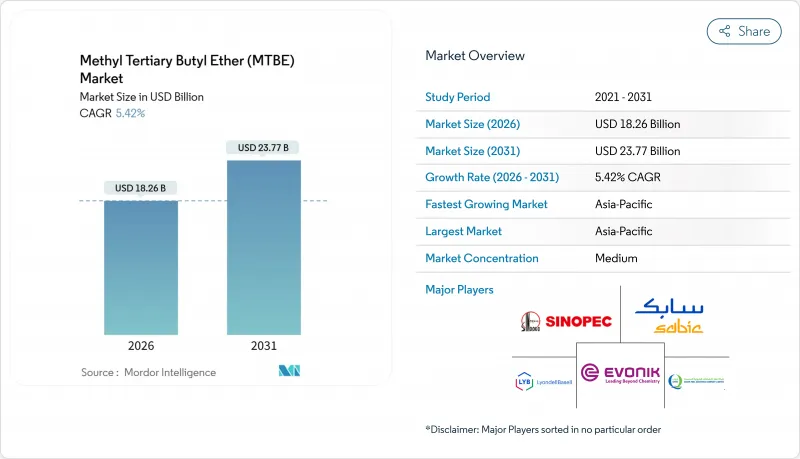
본 보고서는 등급별(산업용 등급, 의약품 등급), 유통 채널별(직접 판매, 유통업체, 기타), 용도별(가솔린 첨가제, 이소부텐, 기타), 최종 사용자 산업별(자동차, 석유 및 가스, 기타), 지역별(아시아태평양, 북미, 유럽, 기타)로 분류되어 있습니다. 시장 전망은 금액(달러) 기준으로 제시됩니다.
세계의 MTBE(Methyl Tertiary Butyl Ether) 시장 동향 및 인사이트
아시아태평양의 저방향족·고옥탄가 휘발유 의무화 급증
아시아태평양의 각국 정부는 도시 지역의 대기 오염을 억제하기 위해 휘발유 규격을 강화하고 있습니다. 중국의 GB 17930-2016 규격에서는 벤젠을 0.8%, 방향족 화합물을 40%로 제한하는 동시에 최소 92RON을 의무화하고 있습니다. MTBE를 10-15% 혼합함으로써 정유사는 대규모 수소화 분해 설비에 투자하지 않고도 이 규제를 충족할 수 있습니다. 2025년 개정을 앞두고 검토 중인 인도의 ‘바랏 스테이지 VI’ 연료 규격도 동일한 논리에 기반을 두었으며, Indian Oil Corp(IOC)와 바랏 페트롤리엄은 MTBE의 혼합 비율을 높였습니다. 일본의 연료 규격에서는 경작 가능한 토지가 제한적이기 때문에 에탄올이 아닌 MTBE가 우선시되고 있으며, 안정적인 수요 기반이 유지되고 있습니다. 아시아태평양의 승용차 보유 대수는 연간 5% 가까운 속도로 증가하고 있으며, 차량이 1대 늘어날 때마다 연간 120-225리터의 MTBE 함유 휘발유 수요가 발생합니다. 따라서 이 첨가제는 2030년 이후 전기차가 일반 시장에 보급될 때까지 옥탄가 확보를 위한 과도기적 해결책으로 기능할 것입니다.
중동의 정유시설 확장과 전용 MTBE 플랜트의 통합
국영 석유 회사들은 단순한 원유 수출에서 벗어나기 위해 원유 정제와 석유화학 사업의 통합을 추진하고 있습니다. 2025년 4월에 발표된 사우디 아람코(Saudi Aramco)와 시노펙(Sinopec)의 야스레프(Yasref) 확장 계획에서는 C4 라피네이트의 부가가치를 높이기 위해 연간 180만 톤 규모의 에틸렌 크래커에 더해 MTBE 생산 설비가 추가되었습니다. 이와 유사한 계획은 시노펙-아람코 푸젠(100억 달러, 2024년 11월 착공)이나 카타르 에너지의 노스 필드 프로그램에 따른 60억 달러 규모의 복합 시설에서도 확인할 수 있습니다. 라피네이트는 메탄올이나 유리 이소부틸렌보다 저렴하게 거래되기 때문에 통합된 공정으로 원료 비용이 절감되어 정유시설의 복합 마진이 배럴당 약 3달러 향상됩니다. ‘비전 2030’의 ‘국가 산업 개발 및 물류 프로그램’은 인허가 절차의 효율화와 프로젝트 파이낸싱 지원을 보장하고 있으며, 이에 따라 걸프 지역 내 MTBE 플랜트의 가동 개시가 가속화되고 있습니다.
대체품(에탄올, ETBE, TAME)의 확보 가능성
유럽의 RED II 및 RED III에서는 2030년까지 운송 부문에서 재생에너지의 비율을 14%로 높일 것을 요구하고 있으며, 바이오에탄올로 제조된 ETBE는 이에 해당하지만, 화석 연료 유래의 MTBE는 대상에서 제외됩니다. 프랑스, 독일, 이탈리아의 정유사들은 2024년까지 거의 완전히 ETBE로 전환을 완료했습니다. 브라질에서는 오랜 기간 지속된 ‘E27’ 에탄올 의무화 정책으로 인해 MTBE가 완전히 대체되었으며, 해당 국가의 플렉스 연료 차량 군이 에탄올의 입지를 확고히 하고 있습니다. 미국의 재생 가능 연료 기준(RFS)은 블렌더에게 연간 150억 갤런의 옥수수 유래 에탄올 사용을 의무화하고 있으며, 이로 인해 MTBE는 옥탄가 향상제의 선택지에서 제외되었습니다. 한국과 대만에서는 지하수에서 더 빠르게 생분해된다는 이유로 TAME 도입이 검토되고 있습니다. 동남아시아 국가들에서는 바이오디젤 및 에탄올 도입 프로그램이 진행 중이며, 향후 10년 동안 해당 지역의 MTBE 수요를 더욱 감소시킬 가능성이 있습니다.
부문별 분석
2025년 매출액 중 산업용 MTBE가 90.05%를 차지해, 아시아태평양 및 중동의 가솔린 시장에서 옥탄가 향상제로 널리 사용되고 있음을 알 수 있습니다. 한편, 의약품용 MTBE의 경우, API(의약품 원료의약품) 제조업체들이 낮은 극성과 FDA 클래스 3 인증을 높이 평가하고 있어 2031년까지 5.93%의 성장이 예상됩니다. 산업용 부문의 MTBE(Methyl Tertiary Butyl Ether) 시장 규모는 신규 정유시설에서 MTBE를 10-15% 배합할 때마다 대량 수요가 확보되므로, 절대적인 성장률이 높은 수준을 유지할 것으로 예측됩니다. 중국과 걸프 지역에 위치한 통합형 복합 시설이 라피네이트의 안정적인 공급을 확보하고 있어 비용 경쟁력을 유지하고 있습니다.
전략적인 성장 여지는 의약품 부문에 있으며, 이 부문에서는 99.8%의 순도, 10ppm 이하의 수분, 50ppm 이하의 메탄올이라는 사양에 따라 20-30%의 가격 프리미엄이 요구되고 있습니다. 하이데라바드, 아메다바드, 비사카파트남에 위치한 인도와 중국의 API 허브에서는 생산 능력 확충이 진행되고 있으며, 이에 따라 의약품 등급 수요는 5-6%의 성장세를 유지할 것으로 전망됩니다. 또한, 유럽의 API 제조업체들도 REACH 규제에 따라 디클로로메탄에서 전환을 추진하고 있어, 이 고수익성 판로를 더욱 강화하고 있습니다. 전환 프로젝트가 계획대로 진행된다면, 연료 사이클에 의존하고 있는 생산자들에게는 의미 있는 사업 다각화로 이어질 것으로 보입니다.
2025년 출하량의 70.12%를 직접 판매가 차지한 것은 정유시설와의 인수 계약에서 수량, 가격 산정식, 기술 지원이 세트로 제공되며, 가솔린 랙에서의 옥탄가 기준 준수가 보장되기 때문입니다. 이 경로는 벌크 연료 용도에서 계속해서 주류를 이룰 것이지만, MTBE(Methyl Tertiary Butyl Ether) 시장에서는 중규모 화학제품 구매자를 대상으로 하는 새로운 전자상거래 모델이 등장하고 있습니다.
1688.com이나 ChemBuyersClub과 같은 온라인 플랫폼에서는 중국 연안 성에서 익일 배송이 가능한 MTBE 현물 오퍼가 게시되고 있으며, 물류 네트워크의 개선에 따라 그 이용이 인도로도 확대되고 있습니다. 온라인 판매는 2031년까지 연평균 성장률(CAGR) 6.32%로 급속히 확대될 것으로 예측됩니다. 도매업체들은 저장 시설이나 신용 한도가 없는 지역의 구매자들에게 지속적으로 공급하고 있습니다. 2031년까지 직접 계약의 점유율은 여전히 60%를 초과할 가능성이 있지만, 특수 등급 및 의약품 등급 부문에서는 디지털 상거래가 추가 수익의 대부분을 차지할 것으로 보입니다.
지역별 분석
아시아태평양은 2025년 MTBE(Methyl Tertiary Butyl Ether) 시장의 42.26%를 점유했으며, 2031년까지 연평균 성장률(CAGR) 6.24%로 확대될 것으로 예측됩니다. 중국은 연간 1,500만 톤이 넘는 생산 능력을 가동하고 있으며, GB 17930-2016에 규정된 옥탄가 및 방향족 화합물의 상한치를 충족하기 위해 MTBE를 10-15% 비율로 혼합하고 있습니다. 한편, 인도, 일본, 동남아시아에서는 유사한 산소화제 함유 수준을 의무화하는 연료 기준이 강화되고 있습니다. 중국의 메탄올에서 휘발유로의 전환 플랜트는 정유시설의 가동 상황과는 별개로 추가적인 구조적 수요층을 창출하고 있습니다. 자동차 보유 대수가 연간 약 5%의 속도로 증가하고 있어 휘발유 소비량은 높은 수준을 유지하고 있으며, 이것이 해당 지역의 MTBE 수요를 뒷받침하고 있습니다.
중동은 정유사들이 석유화학 단지 내에 MTBE 전용 공장을 통합하고 있어 성장 속도가 두 번째로 빠른 지역이 되었습니다. Saudi Aramco, Sinopec, Yasref 및 푸젠 복합 시설이 이 모델의 대표적인 예이며, 한편 Qatar Energy의 North Field 확장 프로젝트는 주로 아시아 시장을 위한 새로운 공급원을 제공할 것입니다. 통합형 사이트에서는 할인된 가격의 C4 라피네이트를 수익화하고 있어, 메탄올과 이소부틸렌을 결합한 단일 공정에 비해 경제성이 향상되고 있습니다. 아프리카에서는 남아프리카공화국이 연료 품질 관련 법규를 개정하고 있으며, 나이지리아의 당고트 정유시설가 생산을 확대함에 따라, 비록 산발적이긴 하지만 기회가 증가하고 있습니다.
북미와 유럽은 MTBE 혼합 시장에서 거의 철수했습니다. 미국에서는 주 차원의 금지 조치에 따라 2024년에 일일 생산량이 3만 배럴 아래로 떨어졌으며, 캐나다의 정유사들은 에탄올로 전환했습니다. 유럽의 RED III(재생에너지 지침 III)에 따라 정유사들은 ETBE나 에탄올로 전환해야 하는 상황에 놓여 있어, 해당 지역의 MTBE 수요는 틈새 시장인 용제 및 화학 용도로만 제한되고 있습니다. 라틴아메리카 역시 마찬가지로 수요가 제한적입니다. 브라질에서는 E27 에탄올이 혼합되고 있으며, 아르헨티나도 유사한 바이오연료 의무화 조치를 시행하고 있기 때문입니다. 따라서 수요 분포도에서는 수에즈 동쪽으로의 현저한 편중이 나타나고 있으며, 아시아에서 재생 가능 옥탄가 대체 연료가 본격화되기 전까지는 이러한 추세가 역전될 가능성은 낮다고 볼 수 있습니다.
기타 혜택
- 엑셀 형식 시장 예측(ME) 시트
- 3개월간의 애널리스트 지원
자주 묻는 질문
목차
제1장 서론
제2장 조사 방법
제3장 주요 요약
제4장 시장 구도
제5장 시장 규모 및 성장 예측
제6장 경쟁 구도
제7장 시장 기회 및 향후 전망
KTH 26.09.04According to Mordor Intelligence, the methyl tertiary butyl ether market size is estimated at USD 18.26 billion in 2026, and is expected to reach USD 23.77 billion by 2031, at a CAGR of 5.42% during the forecast period (2026-2031).
This report is Segmented by Grade (Industrial Grade and Pharmaceutical Grade), Distribution Channel (Direct Sales, Distributors, and More), Application (Gasoline Additives, Isobutene, and More), End-User Industry (Automotive, Oil and Gas, and More), and Geography (Asia-Pacific, North America, Europe, and More). The Market Forecasts are Provided in Terms of Value (USD).
Global Methyl Tertiary Butyl Ether (MTBE) Market Trends and Insights
Surging Low-Aromatic, High-Octane Fuel Mandates in Asia-Pacific
Governments across the Asia-Pacific are tightening gasoline specifications to curb urban air pollution. China's GB 17930-2016 caps benzene at 0.8% and aromatics at 40% while requiring a minimum 92 RON; blending MTBE at 10-15% allows refiners to meet the rule without major hydrocracker investments. India's Bharat Stage VI fuel code under review for a 2025 update follows a similar logic, prompting Indian Oil Corporation and Bharat Petroleum to raise MTBE ratios. Japan's fuel standard favors MTBE instead of ethanol because arable land is scarce, sustaining a stable demand base. Passenger-car fleets in Asia-Pacific are expanding at nearly 5% annually, so every additional vehicle locks in 120-225 liters of MTBE-containing gasoline each year. The additive, therefore, acts as a transitional octane solution until electric vehicles reach mass-market penetration after 2030.
Petro-Refinery Expansion in the Middle East with On-Purpose MTBE
National oil companies are integrating crude refining and petrochemicals to diversify away from pure crude exports. Saudi Aramco and Sinopec's Yasref expansion, announced in April 2025, added a 1.8 million tpy ethylene cracker plus an MTBE unit to valorize C4 raffinate. Similar blueprints are evident in Sinopec-Aramco Fujian (USD 10 billion, ground-breaking November 2024) and QatarEnergy's USD 6 billion complex under the North Field program. Integrated flows cut feedstock costs because raffinate trades at a discount to methanol and free isobutylene, lifting refinery complexity margins by about USD 3 per barrel. Vision 2030's National Industrial Development and Logistics Program guarantees streamlined permitting and project-finance support, accelerating MTBE start-ups in the Gulf.
Availability of Substitutes Such as Ethanol, ETBE, and TAME
Europe's RED II and RED III require 14% renewable energy in transport by 2030, and ETBE made from bioethanol qualifies, whereas fossil-based MTBE does not. Refiners in France, Germany, and Italy had already shifted almost completely to ETBE by 2024. Brazil's long-standing E27 ethanol mandate displaces MTBE altogether, and the nation's flex-fuel fleet entrenches ethanol's position. The U.S. Renewable Fuel Standard compels blenders to use 15 billion gallons of corn ethanol annually, removing MTBE from the octane toolbox. South Korea and Taiwan are exploring TAME because it biodegrades faster in groundwater. Southeast Asian countries are rolling out biodiesel and ethanol programs that may further erode regional MTBE demand over the next decade.
Other drivers and restraints analyzed in the detailed report include:
- Methanol-to-Gasoline Adoption Elevates MTBE Demand
- Rising Iso-Octene Demand via MTBE Dehydrogenation for High-Performance Tires
- Pollutant Classification and Blending Bans in North America
For complete list of drivers and restraints, kindly check the Table Of Contents.
Segment Analysis
Industrial-grade MTBE accounted for 90.05% of 2025 revenue, underscoring its use as an octane booster in Asia-Pacific and Middle Eastern gasoline pools, whereas pharmaceutical-grade MTBE is forecast to increase at 5.93% through 2031 as API producers favor its low polarity and Class 3 FDA status. The Methyl tertiary butyl ether market size for the industrial segment is projected to maintain high absolute growth because every new refinery barrel blended at 10-15% MTBE locks in a large volumetric pull. Integrated complexes in China and the Gulf ensure secure raffinate supply, preserving cost competitiveness.
Strategic upside resides in the pharmaceutical niche, which commands a 20-30% price premium due to 99.8% assay, sub-10 ppm water, and sub-50 ppm methanol specifications. Indian and Chinese API hubs in Hyderabad, Ahmedabad, and Visakhapatnam are adding capacity that will sustain a 5-6% demand trajectory for pharmaceutical-grade. European API makers are also shifting away from dichloromethane under REACH, reinforcing this high-margin outlet. If conversion projects proceed as planned, this will provide meaningful diversification for producers exposed to fuel cycles.
Direct sales claimed 70.12% of 2025 deliveries because refinery offtake agreements bundle volume, pricing formulas, and technical support, ensuring octane compliance at the gasoline rack. This route will stay dominant for bulk fuel applications, but the Methyl tertiary butyl ether market is witnessing new e-commerce models that cater to mid-sized chemical buyers.
Online platforms such as 1688.com and ChemBuyersClub are posting spot MTBE offers with next-day delivery in China's coastal provinces, and adoption is spreading to India as logistics networks improve. Online sales are expected to expand faster at a 6.32% CAGR through 2031. Distributors keep serving regional buyers who lack storage or credit lines. By 2031, direct contracts may still exceed 60% share, yet digital commerce will capture most of the incremental margin in specialty and pharma grades.
Complete Report Scope:
- By Grade
- Industrial Grade
- Pharmaceutical Grade
- By Distribution Channel
- Direct Sales
- Distributors
- Online Sales
- By Application
- Gasoline Additives
- Isobutene
- Solvents
- Other Applications
- By End-user Industry
- Automotive
- Oil and Gas
- Chemicals
- Pharmaceuticals
- Other End-user Industries
- By Geography
- Asia-Pacific
- China
- India
- Japan
- South Korea
- Rest of Asia-Pacific
- North America
- United States
- Canada
- Mexico
- Europe
- Germany
- United Kingdom
- Italy
- France
- Rest of Europe
- South America
- Brazil
- Argentina
- Rest of South America
- Middle East and Africa
- Saudi Arabia
- United Arab Emirates
- Qatar
- Turkey
- South Africa
- Nigeria
- Rest of Middle East and Africa
- Asia-Pacific
Geography Analysis
Asia-Pacific dominated the Methyl tertiary butyl ether market with a 42.26% share in 2025 and is forecast to expand at a 6.24% CAGR to 2031. China operates over 15 million tons/year of capacity and blends MTBE at 10-15% to hit GB 17930-2016 octane and aromatic caps, while India, Japan, and Southeast Asia tighten fuel standards that require similar oxygenate levels. Methanol-to-gasoline plants in China create an additional structural demand layer that is decoupled from refinery runs. Vehicle-fleet growth of nearly 5% annually keeps gasoline consumption high, sustaining the regional pull for MTBE.
The Middle East is the second-fastest growing cluster due to refiners embedding on-purpose MTBE units within petrochemical parks. Saudi Aramco-Sinopec Yasref and the Fujian complex exemplify the model, while QatarEnergy's project under the North Field expansion adds new supply aimed primarily at Asian markets. Integrated sites monetize discounted C4 raffinate, improving economics relative to standalone methanol-plus-isobutylene routes. Africa offers scattered but rising opportunities as South Africa reviews fuel-quality laws and Nigeria's Dangote refinery ramps up.
North America and Europe have largely exited the MTBE blend pool. U.S. production fell below 30,000 bpd in 2024 after state-level bans, and Canadian refiners shifted to ethanol. Europe's RED III pushes refiners to ETBE or ethanol, so MTBE demand there is confined to niche solvent and chemical uses. Latin America is similarly limited because Brazil blends E27 ethanol, and Argentina follows comparable biofuel mandates. The demand map therefore shows a pronounced east-of-Suez tilt that is unlikely to reverse before renewable-octane substitutes scale in Asia.
- BP plc
- Chevron Phillips Chemical Company LLC
- China Petrochemical Corporation
- CNPC
- Eni S.p.A.
- ENOC Company
- Enterprise Products Partners L.P.
- PETRONAS Chemicals Group Berhad
- Evonik Industries AG
- Exxon Mobil Corporation
- Formosa Plastics Corporation, U.S.A.
- Gazprom
- Huntsman International LLC
- LUKOIL
- LyondellBasell Industries Holdings B.V.
- QAFAC
- Reliance Industries Limited
- SABIC
- Shell plc
- Vinati Organics Limited
- Wanhua
Additional Benefits:
- The market estimate (ME) sheet in Excel format
- 3 months of analyst support
TABLE OF CONTENTS
1 Introduction
- 1.1 Study Assumptions and Market Definition
- 1.2 Scope of the Study
2 Research Methodology
3 Executive Summary
4 Market Landscape
- 4.1 Market Overview
- 4.2 Market Drivers
- 4.2.1 Surging low-aromatic, high-octane gasoline mandates in Asia-Pacific
- 4.2.2 Petro-refinery expansion in Middle-East integrated with on-purpose MTBE units
- 4.2.3 Methanol-to-gasoline route adoption in Asia elevating MTBE demand
- 4.2.4 Rising demand for iso-octene (via MTBE dehydrogenation) in high-performance tyres
- 4.2.5 Growing use of MTBE as co-solvent in specialty API extraction
- 4.3 Market Restraints
- 4.3.1 Availability of substitutes (ethanol, ETBE, TAME)
- 4.3.2 Classification as pollutant and gasoline-blending bans in North America
- 4.3.3 Volatility in C4 raffinate availability from steam crackers
- 4.4 Value Chain Analysis
- 4.5 Porter's Five Forces Analysis
- 4.5.1 Bargaining Power of Suppliers
- 4.5.2 Bargaining Power of Buyers
- 4.5.3 Threat of New Entrants
- 4.5.4 Threat of Substitute Products and Services
- 4.5.5 Degree of Competition
5 Market Size and Growth Forecasts (Value)
- 5.1 By Grade
- 5.1.1 Industrial Grade
- 5.1.2 Pharmaceutical Grade
- 5.2 By Distribution Channel
- 5.2.1 Direct Sales
- 5.2.2 Distributors
- 5.2.3 Online Sales
- 5.3 By Application
- 5.3.1 Gasoline Additives
- 5.3.2 Isobutene
- 5.3.3 Solvents
- 5.3.4 Other Applications
- 5.4 By End-user Industry
- 5.4.1 Automotive
- 5.4.2 Oil and Gas
- 5.4.3 Chemicals
- 5.4.4 Pharmaceuticals
- 5.4.5 Other End-user Industries
- 5.5 By Geography
- 5.5.1 Asia-Pacific
- 5.5.1.1 China
- 5.5.1.2 India
- 5.5.1.3 Japan
- 5.5.1.4 South Korea
- 5.5.1.5 Rest of Asia-Pacific
- 5.5.2 North America
- 5.5.2.1 United States
- 5.5.2.2 Canada
- 5.5.2.3 Mexico
- 5.5.3 Europe
- 5.5.3.1 Germany
- 5.5.3.2 United Kingdom
- 5.5.3.3 Italy
- 5.5.3.4 France
- 5.5.3.5 Rest of Europe
- 5.5.4 South America
- 5.5.4.1 Brazil
- 5.5.4.2 Argentina
- 5.5.4.3 Rest of South America
- 5.5.5 Middle East and Africa
- 5.5.5.1 Saudi Arabia
- 5.5.5.2 United Arab Emirates
- 5.5.5.3 Qatar
- 5.5.5.4 Turkey
- 5.5.5.5 South Africa
- 5.5.5.6 Nigeria
- 5.5.5.7 Rest of Middle East and Africa
- 5.5.1 Asia-Pacific
6 Competitive Landscape
- 6.1 Market Concentration
- 6.2 Strategic Moves
- 6.3 Market Share/Ranking Analysis
- 6.4 Company Profiles (includes Global-level Overview, Market-level Overview, Core Segments, Financials as available, Strategic Information, Products and Services, and Recent Developments)
- 6.4.1 BP plc
- 6.4.2 Chevron Phillips Chemical Company LLC
- 6.4.3 China Petrochemical Corporation
- 6.4.4 CNPC
- 6.4.5 Eni S.p.A.
- 6.4.6 ENOC Company
- 6.4.7 Enterprise Products Partners L.P.
- 6.4.8 PETRONAS Chemicals Group Berhad
- 6.4.9 Evonik Industries AG
- 6.4.10 Exxon Mobil Corporation
- 6.4.11 Formosa Plastics Corporation, U.S.A.
- 6.4.12 Gazprom
- 6.4.13 Huntsman International LLC
- 6.4.14 LUKOIL
- 6.4.15 LyondellBasell Industries Holdings B.V.
- 6.4.16 QAFAC
- 6.4.17 Reliance Industries Limited
- 6.4.18 SABIC
- 6.4.19 Shell plc
- 6.4.20 Vinati Organics Limited
- 6.4.21 Wanhua
7 Market Opportunities and Future Outlook
- 7.1 White-space and Unmet-Need Assessment
- 7.2 Innovation in Bio-based MTBE for Gasoline


