

|
시장보고서
상품코드
2063273
공장내 물류 시장 : 시장 점유율 분석, 업계 동향 및 통계, 성장 예측(2026-2031년)In-plant Logistics - Market Share Analysis, Industry Trends & Statistics, Growth Forecasts (2026 - 2031) |
||||||
 Mordor Intelligence
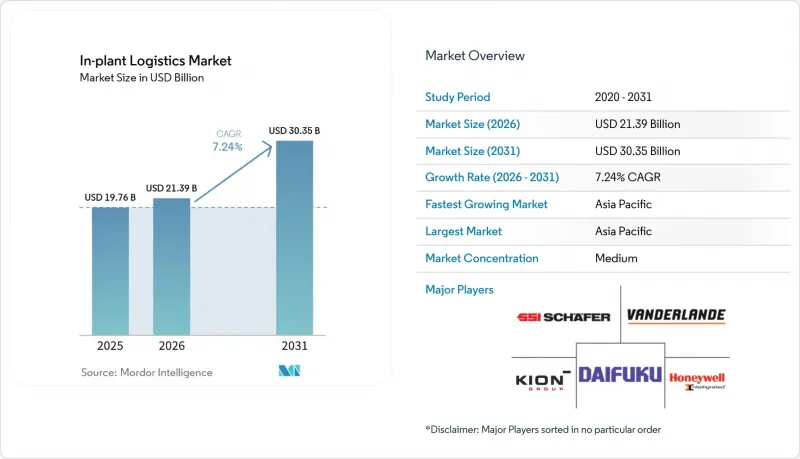
Mordor Intelligence에 의하면, 공장내 물류 시장 규모는 2025년 197억 6,000만 달러로 평가되었고, 2026년 213억 9,000만 달러로 추정되고, 2031년까지 303억 5,000만 달러로 확대될 전망이며, 2026-2031년 CAGR 7.24%를 나타낼 것으로 예측됩니다.
제조업체들은 창고, 제조, 운송 운영 시스템을 통합해 나가고 있는 한편, 브랜드 소유주의 Scope 3 요건으로 인해 과거에는 내부 비용 센터에 불과했던 것이 계약상 필수적인 규정 준수 플랫폼으로 변모하고 있습니다. 본 보고서는 기능별(운송 관리 및 자재관리 등), 최종 사용자별(자동차, 일렉트로믹스 및 반도체, 의약품 및 헬스케어, 식품 및 음료 등), 공장 및 시설 규모별(소규모, 중규모, 대규모), 그리고 지역별(북미, 남미, 아시아태평양 등)로 분류되어 있습니다. 시장 전망은 금액(달러) 기준으로 제시되어 있습니다.
세계의 공장 내 물류 시장 동향 및 인사이트
브랜드 소유주들의 Scope 3 추적성 의무화 요구
2024년에 발효되는 기업 지속가능성 지침은 독립적인 제3자 기관의 검증을 거친 스코프 3 배출량 공개를 의무화함으로써 공급망의 재구성을 촉진하고 있습니다. 이로 인해 공급업체는 자사의 업무에 대해 보다 상세한 가시성을 확보해야 할 압박을 받고 있으며, 공장 내 모든 이동에 따른 에너지 사용량, 운송 거리, 포장 등 세부적인 데이터를 파악해야 합니다. 동시에, 의약품 추적 및 추적 가능성와 같은 규제 체계가 지속가능성 목표와 융합되면서, 더욱 통합되고 투명성이 높은 실행 시스템이 촉진되고 있습니다. 이러한 변화들이 결합되어, 환경에 미치는 영향, 제품의 무결성, 업무의 투명성이 통합된 디지털 생태계 내에서 관리되는 데이터 기반의 종단간 책임성 체계로의 광범위한 전환을 보여줍니다.
다품종 소량 생산 환경에서 'Goods-to-Person' 로봇 시스템의 투자 회수 기간 단축
모듈식 큐브형 보관 시스템과 이동 로봇 시스템 덕분에 창고 자동화의 진입 장벽은 급속히 낮아지고 있습니다. 도입 기간이 수개월에서 수주로 단축되어, SKU가 매우 복잡한 환경에서도 2년보다 훨씬 짧은 기간 내에 투자 회수가 가능해졌습니다. AutoStore와 같은 솔루션은 인력의 이동을 최소화하면서도 보관 밀도를 획기적으로 높이고 있으며, Geek+와 같은 공급업체는 제약 업계와 같이 요구 사항이 까다로운 분야에서 거의 완벽한 정확도를 제공함으로써 전 세계로 사업을 확장하고 있습니다. 이 모든 점을 종합해 보면, 이러한 기술들은 대규모 초기 투자 없이 속도, 공간 효율성, 신뢰성을 우선시하는 유연하고 정밀한 주문 처리 모델로의 전환을 반영하고 있습니다.
생산 현장의 공간 축소가 컨베이어 개조를 제약하고 있습니다.
도시 지역의 제조 거점에서는 부지 면적이 대폭 축소됨에 따라, 컨베이어와 같은 기존의 직선형 자재 이송 시스템은 더 이상 실용적이지 않게 되었습니다. 이러한 공간적 제약으로 인해 자율 주행 로봇이나 수직 리프트 모듈과 같이 유연하고 공간 효율성이 뛰어난 솔루션의 도입이 확대되고 있습니다. 이 제품들은 좁은 공간에서도 이동이 가능하며, 수직 방향의 보관 공간을 최대한 활용할 수 있습니다. 그 결과, 시설 설계는 직선적인 흐름보다는 기동성과 수직 방향의 최적화를 우선시하는 적응성이 높고 고밀도인 구조로 점차 전환되고 있습니다.
부문별 분석
2025년 기준으로 공장 내 물류 시장의 60.03%를 '수송 관리 및 자재관리'가 차지했으며, 이는 자율주행 차량 증가와 AI를 통한 경로 최적화에 힘입은 결과입니다. 그러나 키팅, 포스트포네먼트, 코패킹을 아우르는 부가가치 서비스 부문은 2031년까지 연평균 성장률(CAGR) 8.77%를 나타낼 것으로 예측되며, 제조업체들이 수주 단계에 가까운 시점에서 최종 제품의 맞춤화를 진행함에 따라 핵심 운송 업무를 상회하는 성장이 전망됩니다. 이 부문의 성장은 반제품 재고를 확보하고 라스트 마일에서 지역별 특화 SKU를 구성하는 브랜드 전략을 반영한 것으로, 제품 노후화를 억제하고 Scope 3 감축 목표에 부합하는 것입니다. 현재 의약품 위탁 포장 업체들은 일련번호 부여, 언어 라벨 부착, 온도 센서 장착을 하나의 공정으로 통합하고 있으며, 이를 통해 물류 시설은 규제 대상 생산 거점의 연장선상에서 기능하게 되어 부가가치 업무에 특화된 공장 내 물류 시장을 확대되고 있습니다. 통합형 실행 스위트와의 연동을 통해, 수작업에 의한 이관 과정 없이 시리얼화된 데이터가 하류의 규제 당국으로 확실하게 전달되어 DSCSA 및 EU FMD의 요건을 충족하고 있습니다. 적정 크기 포장 알고리즘에 대한 투자를 통해 골판지 사용량을 15% 줄였으며, 이는 비용 절감과 탄소 배출 감축 목표 달성에 시너지 효과를 가져온다는 사실이 입증되었습니다.
두 번째 문단 : WMS에 통합된 운송 오케스트레이션은 에너지 사용량과 처리 용량의 균형을 조정하며, RFID를 활용한 재고 관리는 1초 미만의 정확도로 위치 정보를 파악합니다. 또한, 이러한 융합으로 인해 다양한 분야의 기술에 대한 수요도 높아지고 있습니다. 기술자는 AGV(무인 운반차)의 차량 관리 소프트웨어뿐만 아니라, 공동 포장용 로봇의 조작법도 익혀야 합니다. 이러한 서비스를 패키지로 묶어 제공하는 업체들은 고객이 사내에서 장기간의 인증 절차를 거쳐야 하는 전문 역량에 의존하고 있기 때문에 더 장기적인 계약을 체결하고 있습니다. 그 결과, 공장 내 물류 시장에서는 자산의 대량 보유에서 프로세스 인텔리전스로의 전환이 나타나고 있으며, 향후 10년 동안의 경쟁 우위 개념이 재정의되고 있습니다.
지역별 분석
아시아태평양은 공장 내 물류 시장에서 36.51%의 점유율과 8.41%의 연평균 성장률(CAGR)을 기록했습니다. 이는 완전 자동화 공장을 목표로 하는 중국의 목표와, 로봇 구매를 지원하는 인도의 생산 연계형 인센티브에 힘입은 것입니다. 중국의 자동차 공장에서는 인력 중심의 팔레트 트레인에서 임금 상승을 초래하지 않으면서도 연중무휴 24시간 조립을 유지할 수 있는 5G 지원 AGV로의 전환이 진행되고 있습니다. 베트남과 태국은 전자기기 제조업체들의 이전지로 주목받고 있으며, 임대 시설에 도입 가능한 모듈식 컨베이어 셀에 대한 수요를 끌어올리고 있습니다. 또한, 지방 정부는 기술자들이 다양한 브랜드의 로봇 군을 관리할 수 있도록 인력 재교육 프로그램을 지원하고 있습니다.
아시아태평양은 중국의 1만 개 이상의 민간 5G 기지국과 인도의 인더스트리 4.0에 기반한 인센티브에 힘입어 성장하고 있습니다. 동남아시아의 신규 공장에서는 건설 초기부터 고도의 자동화 시스템이 도입되어 있으며, 공정을 합리화하기 위해 백지 상태에서 설계된 레이아웃의 이점을 누리고 있습니다. 북미에서는 CHIPS 법안과 2,000억 달러가 넘는 제약 업계의 리쇼어링 투자가 이어지면서, 단순한 인건비 차익 거래보다 탄탄한 공급망을 우선시하고 있습니다. 멕시코에서의 니어쇼어링이 급증함에 따라, 미국의 부품 공급과 멕시코의 조립 라인을 연계하는 양국 간 TMS(운송 관리 시스템) 연계가 요구되고 있습니다.
유럽의 탄소국경조정제도(CBAM)와 기업 지속가능성 보고 지침(CSRD)은 기업에 에너지 집약적 업무의 투명성을 요구하고 있으며, 규정 준수 측면에서 통합 실행 솔루션이 필수적입니다. 독일의 OPC-UA 분야 리더십과 5G 확산으로 통합 비용이 절감되었으며, 영국은 서로 다른 규제 하에서 항공우주 및 생명과학 분야의 생산 역량을 재편하고 있고, 남유럽에서는 처리량보다 처리 정밀도가 우선시되는 특수 제품을 활용하고 있습니다.
기타 혜택 :
- 엑셀 형식 시장 예측(ME) 시트
- 3개월간의 애널리스트 지원
자주 묻는 질문
목차
제1장 서론
제2장 조사 방법
제3장 주요 요약
제4장 시장 구도
제5장 시장 규모 및 성장 예측
제6장 경쟁 구도
제7장 시장 기회 및 향후 전망
AJY 26.06.22According to Mordor Intelligence, the in-plant logistics market size is projected to expand from USD 19.76 billion in 2025 and USD 21.39 billion in 2026 to USD 30.35 billion by 2031, registering a 7.24% CAGR between 2026 and 2031.
Manufacturers are converging warehouse, manufacturing, and transport execution systems, while brand-owner Scope-3 mandates transform formerly internal cost centers into contract-critical compliance platforms. This report is Segmented by Function (Transportation Management and Material Handling, and More), by End-User (Automotive, Electronics and Semiconductor, Pharmaceuticals and Healthcare, Food and Beverage, and More), by Plant/Facility Size (Small-Scale, Medium, Large Scale), and by Geography (North America, South America, Asia Pacific, and More). The Market Forecasts are Provided in Terms of Value (USD).
Global In-plant Logistics Market Trends and Insights
Mandatory Scope-3 Traceability Demands From Brand-Owners
Corporate sustainability directives taking effect in 2024 are reshaping supply chains by requiring independently verified Scope 3 emissions disclosures. This is pushing suppliers to gain far deeper visibility into their operations, capturing granular data such as energy use, transport distances, and packaging across every in-plant movement. At the same time, regulatory frameworks like pharmaceutical track-and-trace are converging with sustainability goals, encouraging more integrated, transparent execution systems. Together, these shifts signal a broader transition toward data-driven, end-to-end accountability where environmental impact, product integrity, and operational transparency are managed within unified digital ecosystems.
Accelerating Payback on Goods-to-Person Robotics Under High-Mix, Low-Volume Production
Modular cube-storage and mobile-robot systems are rapidly lowering the barrier to warehouse automation, with deployments now measured in weeks rather than months and returns realized in well under two years even for highly complex SKU environments. Solutions like AutoStore dramatically increase storage density while minimizing human movement, while providers such as Geek+ are scaling globally to deliver near-perfect accuracy in demanding sectors like pharmaceuticals. Taken together, these technologies reflect a shift toward flexible, high-precision fulfillment models that prioritize speed, space efficiency, and reliability without requiring massive upfront transformation.
Shrinking Production-Floor Footprints Constraining Conveyor Retrofits
Urban manufacturing sites are increasingly constrained by significantly smaller footprints, making traditional straight-line material handling systems like conveyors impractical. This spatial pressure is driving greater adoption of flexible, space-efficient solutions such as autonomous mobile robots and vertical lift modules, which can navigate tighter layouts and maximize vertical storage. As a result, facility design is shifting toward more adaptive, high-density configurations that prioritize maneuverability and vertical optimization over linear flow.
Other drivers and restraints analyzed in the detailed report include:
- Global Roll-Out of 5G Private Networks Enabling Real-Time Fleet Orchestration
- Convergence of WMS, MES & TMS Into Unified Execution Suites
- Persistent Firmware Obsolescence Across Multi-Vendor Fleets
For complete list of drivers and restraints, kindly check the Table Of Contents.
Segment Analysis
Transportation Management and Material Handling accounted for 60.03% of the in-plant logistics market share in 2025, underpinned by increasingly autonomous fleets and AI route optimization. Yet the Value-Added Services segment covering kitting, postponement, and co-packing is forecast to post an 8.77% CAGR through 2031, outpacing core conveyance tasks as manufacturers push final-product customization closer to order receipt. The segment's rise mirrors brand strategies that hold semi-finished inventory and configure region-specific SKUs at the last mile, curbing obsolescence and aligning with Scope-3 reduction goals. Pharmaceutical contract packagers now integrate serialization, language labeling, and temperature sensors within the same flow, transforming logistics halls into regulated production extensions and lifting the in-plant logistics market devoted to value-add tasks. Integration with unified execution suites ensures serialized data flows to downstream regulators without manual hand-offs, meeting DSCSA and EU FMD dictates. Investments in right-size packaging algorithms trim corrugate by 15%, evidencing synergy between cost and carbon goals.
Second paragraph continues: WMS-embedded transport orchestration balances energy use with throughput, and RFID-enabled inventory controls deliver sub-second location granularity. Convergence also raises cross-skill demand; technicians must master co-packing robotics alongside AGV fleet software. Providers bundling these services capture stickier contracts, as customers depend on specialized capabilities that would require lengthy internal certifications. Consequently, the in-plant logistics market sees a tilt from asset bulk to process intelligence, redefining competitive moats for the decade ahead.
Geography Analysis
Asia-Pacific combined a 36.51% in-plant logistics market share with an 8.41% CAGR, underpinned by China's goal of fully automated factories and India's production-linked incentives that subsidize robotics purchases. Chinese automotive plants are shifting from manual pallet trains to 5G-enabled AGVs that sustain 24/7 assembly without wage escalation. Vietnam and Thailand attract electronics relocations, boosting demand for modular conveyor cells deployable in leased facilities. Regional governments also sponsor workforce reskilling programs so technicians can manage multi-brand robot fleets.
Asia Pacific is propelled by China's 10,000+ private 5G factories and India's Industry 4.0-dependent incentives. New Southeast Asian greenfields embed advanced automation from day zero, benefiting from clear-sheet layouts that streamline flows. North America follows with CHIPS-Act and pharma reshoring outlays exceeding USD 200 billion, prioritizing resilient supply chains over pure labor cost arbitrage. Mexico's near-shore surge demands bi-national TMS links that align United States component feeds with Mexican assembly gates.
Europe's carbon-border measures and Corporate Sustainability Reporting Directive push firms toward energy-intensive transparency, making unified execution suites a compliance necessity. Germany's OPC-UA leadership and 5G expansions compress integration costs, the UK rebuilds aerospace and life-science capacity under divergent regulations, and Southern Europe leverages specialty goods where handling precision overrides volume.
- DHL Supply Chain
- Kuehne + Nagel International AG
- XPO Logistics Inc.
- Ryder System Inc.
- CEVA Logistics
- Penske Logistics
- FedEx Supply Chain
- Geodis
- DSV Panalpina
- C.H. Robinson Worldwide Inc.
- Nippon Express Co. Ltd.
- DACHSER SE
- Yusen Logistics Co. Ltd.
- Agility Logistics
- GXO Logistics Inc.
- Daifuku Co., Ltd.
- KION Group (Dematic)
- SSI Schaefer Group
- Vanderlande Industries
- Honeywell Intelligrated
Additional Benefits:
- The market estimate (ME) sheet in Excel format
- 3 months of analyst support
TABLE OF CONTENTS
1 Introduction
- 1.1 Study Assumptions & Market Definition
- 1.2 Scope of the Study
2 Research Methodology
3 Executive Summary
4 Market Landscape
- 4.1 Market Overview
- 4.2 Market Drivers
- 4.2.1 Mandatory Scope-3 traceability demands from brand-owners
- 4.2.2 Accelerating payback on goods-to-person robotics under high-mix, low-volume production
- 4.2.3 Global roll-out of 5G private networks enabling real-time fleet orchestration
- 4.2.4 Convergence of WMS, MES & TMS into unified execution suites
- 4.2.5 Sensor-level energy-harvested power systems eliminating AGV charging downtimes
- 4.2.6 Tokenised ESG-linked financing lowering cost of capital for green intralogistics
- 4.3 Market Restraints
- 4.3.1 Shrinking production-floor footprints constraining conveyor retrofits
- 4.3.2 Persistent firmware obsolescence across multi-vendor fleets
- 4.3.3 Volatility in lithium-iron-phosphate (LFP) commodity pricing
- 4.3.4 Scarcity of TUV/CE-certified cobot trainers for multi-shift plants
- 4.4 Value / Supply-Chain Analysis
- 4.5 Regulatory Landscape
- 4.6 Technological Outlook
- 4.7 Porter's Five Forces
- 4.7.1 Threat of New Entrants
- 4.7.2 Bargaining Power of Suppliers
- 4.7.3 Bargaining Power of Buyers
- 4.7.4 Threat of Substitutes
- 4.7.5 Competitive Rivalry
5 Market Size & Growth Forecasts
- 5.1 By Function
- 5.1.1 Transportation Management and Material Handling
- 5.1.2 Inventory Management
- 5.1.3 Packaging and Labeling Operations
- 5.1.4 Valud-Added Services
- 5.2 By End-use Industry
- 5.2.1 Automotive Manufacturing
- 5.2.2 Electronics and Semiconductor
- 5.2.3 Pharmaceuticals and Healthcare
- 5.2.4 Food and Beverage
- 5.2.5 Chemical and Petrochemical
- 5.2.6 Metals and Heavy Machinery
- 5.2.7 Others (Aerospace, Consumer Goods, etc.)
- 5.3 By Plant/Facility Size
- 5.3.1 Small-scale Facilities
- 5.3.2 Medium Facilities
- 5.3.3 Large Scale Facilities
- 5.4 By Geography
- 5.4.1 North America
- 5.4.1.1 United States
- 5.4.1.2 Canada
- 5.4.1.3 Mexico
- 5.4.2 South America
- 5.4.2.1 Brazil
- 5.4.2.2 Peru
- 5.4.2.3 Chile
- 5.4.2.4 Argentina
- 5.4.2.5 Rest of South America
- 5.4.3 Asia-Pacific
- 5.4.3.1 India
- 5.4.3.2 China
- 5.4.3.3 Japan
- 5.4.3.4 Australia
- 5.4.3.5 South Korea
- 5.4.3.6 Southeast Asia (Singapore, Malaysia, Thailand, Indonesia, Vietnam, and Philippines)
- 5.4.3.7 Rest of Asia-Pacific
- 5.4.4 Europe
- 5.4.4.1 United Kingdom
- 5.4.4.2 Germany
- 5.4.4.3 France
- 5.4.4.4 Spain
- 5.4.4.5 Italy
- 5.4.4.6 BENELUX (Belgium, Netherlands, and Luxembourg)
- 5.4.4.7 NORDICS (Denmark, Finland, Iceland, Norway, and Sweden)
- 5.4.4.8 Rest of Europe
- 5.4.5 Middle East and Africa
- 5.4.5.1 United Arab Emirates
- 5.4.5.2 Saudi Arabia
- 5.4.5.3 South Africa
- 5.4.5.4 Nigeria
- 5.4.5.5 Rest of Middle East and Africa
- 5.4.1 North America
6 Competitive Landscape
- 6.1 Market Concentration
- 6.2 Strategic Moves
- 6.3 Market Share Analysis
- 6.4 Company Profiles (includes Global level Overview, Market level overview, Core Segments, Financials as available, Strategic Information, Market Rank/Share for key companies, Products & Services, and Recent Developments)
- 6.4.1 DHL Supply Chain
- 6.4.2 Kuehne + Nagel International AG
- 6.4.3 XPO Logistics Inc.
- 6.4.4 Ryder System Inc.
- 6.4.5 CEVA Logistics
- 6.4.6 Penske Logistics
- 6.4.7 FedEx Supply Chain
- 6.4.8 Geodis
- 6.4.9 DSV Panalpina
- 6.4.10 C.H. Robinson Worldwide Inc.
- 6.4.11 Nippon Express Co. Ltd.
- 6.4.12 DACHSER SE
- 6.4.13 Yusen Logistics Co. Ltd.
- 6.4.14 Agility Logistics
- 6.4.15 GXO Logistics Inc.
- 6.4.16 Daifuku Co., Ltd.
- 6.4.17 KION Group (Dematic)
- 6.4.18 SSI Schaefer Group
- 6.4.19 Vanderlande Industries
- 6.4.20 Honeywell Intelligrated


