

|
시장보고서
상품코드
2063288
제품 프로토타이핑 시장 : 시장 점유율 분석, 업계 동향 및 통계, 성장 예측(2026-2031년)Product Prototyping - Market Share Analysis, Industry Trends & Statistics, Growth Forecasts (2026 - 2031) |
||||||
 Mordor Intelligence
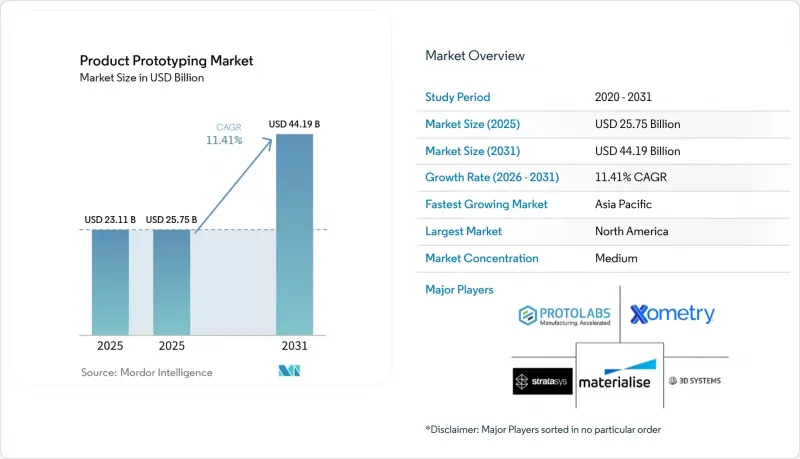
Mordor Intelligence에 의하면, 제품 프로토타이핑 시장 규모는 2025년 231억 1,000만 달러로 평가되었고, 2026년 257억 5,000만 달러로 추정되고, 2031년까지 441억 9,000만 달러로 확대될 전망이며, 2026-2031년 연평균 복합 성장률(CAGR)은 11.41%를 나타낼 것으로 예측됩니다.
본 보고서는 제품 유형별(3D 프린팅, CNC 가공 등), 소재 유형별(플라스틱, 금속, 복합 소재 등), 서비스 유형별(설계 및 엔지니어링, 시제품 제작 등), 최종 이용 산업별(자동차, 항공우주 및 방위, 소비자 가전, 의료기기, 산업기계 등) 및 지역별로 분류되어 있습니다. 시장 전망은 금액(달러) 기준으로 제시되어 있습니다.
세계의 제품 프로토타이핑 시장 동향 및 인사이트
주문형 생산 및 초개인화 제품에 대한 수요 증가
전자, 의료기기, 자동차 내장재 분야의 각 브랜드는 주문형 생산에 대한 의존도를 높이고 있으며, 며칠 이내에 납품되는 단품이나 소량 생산 물량을 발주하고 있습니다. 환자별로 맞춤 제작된 정형외과용 가이드는 형상의 편차로 인해 기존의 금형 제작이 비경제적이 되는 대표적인 사례입니다. 신발 제조업체는 각자의 보행 패턴에 맞춘 격자 구조의 미드솔을 테스트하고 있으며, 안경 디자이너는 얼굴 스캔 데이터를 바탕으로 안경테 시제품을 반복해서 제작하고 있습니다. ISO 13485 및 ISO 9001의 프레임워크를 통해 분산형 워크플로우에서도 생산 단계의 추적성이 보장되어 도입이 용이해졌습니다. AI를 활용한 제조 가능성 검사의 자동화로 인해 엔지니어 이외의 담당자도 참여할 수 있게 되면서, 제품 프로토타이핑 시장이 확대되고 있습니다.
적층 가공에서 부품 단가의 하락 가속화
멀티 레이저 시스템을 통한 생산성 향상과 분말 회수 루프를 통한 폐기물 감축으로 인해, 폴리머 및 금속 적층 가공 부품의 비용은 5년 동안 30-40% 감소했습니다. 바인더 제트 방식의 플랫폼에서는 사이클 간에 분말을 재사용하게 되어, 단위당 비용이 더욱 낮아지고 있습니다. 항공우주 프로그램에서는 이러한 비용 절감 효과를 활용하여, 단조 전 설계 검증을 위해 티타늄 부품의 시제품을 조기에 제작하고 있습니다. 원자재 공급업체들은 엔지니어링 폴리머 가격을 2020년 대비 20-30% 인하했으며, 이로 인해 해당 제품의 보급이 촉진되고 있습니다. 고급 빌드 최적화 소프트웨어와 더불어 이러한 변화로 인해, 제품 프로토타이핑 시장은 과거 CNC 가공으로만 제한되었던 용도로 확대되고 있습니다.
기능성 프로토타입의 후가공 및 마감에 드는 높은 비용
지지대 제거, 샌드블라스팅, 열처리 등의 공정은 금속 부품의 기본 제조 비용을 3배로 증가시킬 가능성이 있어, 비용에 민감한 분야의 기능성 프로토타입 사업 타당성을 저해할 우려가 있습니다. AM Flow와 PostProcess Technologies가 자동화된 마감 셀을 제공하고 있지만, 40만 달러가 넘는 도입 비용이 많은 제조 현장에 있어 걸림돌이 되고 있습니다. 또한, 수작업 공정은 편차를 초래하여 항공우주 및 정형외과용 임플란트에 적용되는 엄격한 공차 요건을 충족하기 어렵게 만듭니다. 이러한 비용을 부담하고 싶지 않은 고객들은 리드타임이 길어지더라도 기존의 기계 가공 방식으로 되돌아가고 있으며, 자동화가 보급되어 설비 투자 비용이 낮아질 때까지는 제품 프로토타이핑 시장의 수익화를 저해하는 요인이 될 것입니다.
부문별 분석
3D 프린팅은 2025년 매출의 36.57%를 차지했으며, 제품 프로토타이핑 시장에서 가장 큰 점유율을 확보하고 있으며, 연평균 성장률(CAGR) 11.64%로 성장할 것으로 전망됩니다. 복잡한 격자 구조와 등방성 냉각 채널의 구현으로 인해, 항공우주용 브라켓이나 의료용 임플란트의 경우 적층 가공가 표준적인 공법이 되었습니다. CNC 가공은 10마이크론 미만의 공차나 거울 같은 마감이 필수적인 분야에서는 여전히 그 중요성을 유지하고 있지만, 세팅에 시간이 오래 걸린다는 점이 성장의 걸림돌이 되고 있습니다. 사출 성형은 외관이 우수한 표면이나 대량 생산용 플라스틱이 필수적인 경우, 여전히 대량 생산을 위한 검증 공정으로 활용되고 있지만, 초기 금형 비용이 장벽이 되어 소량 생산 프로그램의 도입을 제한하고 있습니다.
하이브리드 워크플로에서는 얇은 두께의 케이스를 위해 판금 레이저 절단과 CNC 벤딩 공정을 통합하여, 평면 형상의 부품에 있어 적층 가공에 필적하는 사이클 타임을 실현하고 있습니다. 단일 조형 공정에서 경질 및 엘라스토머계 폴리머를 적층하는 다중 재료 적층 조형 플랫폼은 제조 방식 간의 경계를 더욱 모호하게 만들며, 조립의 통합과 리드타임 단축을 촉진하고 있습니다. 이러한 기술들이 융합됨에 따라, 제품 프로토타이핑 시장은 유연하고 디지털 중심의 생산 체제로 지속적으로 전환되고 있습니다.
2025년에는 플라스틱이 매출의 44.88%를 차지했으며, 그 비용 효율성과 가공의 범용성을 입증하고 있습니다. 그러나 복합재료 시장은 2031년까지 연평균 성장률(CAGR) 11.67%를 나타낼 것으로 예측되며, 이는 모든 재료 부문 중 가장 높은 성장률입니다. 연속 섬유 인쇄 기술을 통해 현재는 오토클레이브용 금형을 제작하기 전에 자동차나 항공우주 구조물의 하중 경로를 검증할 수 있게 되었습니다. 방열성이나 생체 적합성이 요구되는 분야에서는 여전히 금속이 필수적이며, 의료 및 항공우주용 프로토타입의 적층 가공에서는 티타늄과 알루미늄이 주류를 이루고 있습니다.
엘라스토머 프로토타입은 다양한 쇼어 경도 수준을 구현할 수 있는 포토폴리머의 도움을 받아 씰링 및 촉각 피드백과 같은 이용 사례를 지원합니다. 세라믹과 바이오 폴리머에 대한 수요는 틈새 시장 분야이긴 하지만, 유럽의 지속가능성 규제를 배경으로 확대되고 있습니다. 프로토타입용 소재와 양산용 소재 간의 격차가 좁혀짐에 따라 재설계 주기가 단축되고, 제품 프로토타이핑 시장의 추가적인 성장이 촉진되고 있습니다.
지역별 분석
북미는 자동차 및 항공우주 설계 센터가 집중되어 있고 수탁 제조가 활발한 점을 배경으로, 2025년 매출의 30.18%를 차지했습니다. 중요한 공급망의 국내 복귀(리쇼어링)를 위한 정부의 인센티브는 현지 프로토타입 수요를 지속적으로 뒷받침하고 있습니다. 그러나 아시아태평양은 연평균 성장률(CAGR) 12.11%를 나타낼 것으로 전망됩니다. 이는 2026년 1분기 중국에서 3D 프린팅 장비 생산량이 전년 동기 대비 54% 증가한 데 기인합니다. 인도의 프렌드쇼어링(우방국으로의 생산 이전) 이니셔티브는 해당 지역의 생산 능력 확대를 더욱 가속화하고 있습니다.
유럽의 성장은 독일의 자동차 금형 산업 집적지와 영국의 항공우주 인증 관련 전문 지식에 힘입고 있습니다. GE 에어로스페이스의 1억 1,000만 유로(1억 2,400만 달러) 규모의 지역 투자는 지속적인 신뢰를 입증하고 있습니다. 중동 및 아프리카 시장은 신흥 시장이며, 사우디아라비아가 추진하는 2,600만 달러 규모의 텅스텐 코어 프레임워크는 현지 혁신과 세계 OEM 파트너십을 연결하는 좋은 사례가 되고 있습니다.
남미 시장은 여전히 규모가 작지만, 브라질 기업들이 래피드 툴링을 시범 도입하고 아르헨티나의 항공우주 프로젝트가 위성 부품용 금속 적층 가공를 시험하고 있는 등 성장세를 보이고 있습니다. 지역을 불문하고 공급업체 선정 시에는 비용 및 리드타임과 지적 재산권 보호, 인증 인프라 간의 균형이 중요시되고 있으며, 이러한 판단 기준이 제품 프로토타이핑 시장의 흐름을 형성하고 있습니다.
기타 혜택 :
- 엑셀 형식 시장 예측(ME) 시트
- 3개월간의 애널리스트 지원
자주 묻는 질문
목차
제1장 서론
제2장 조사 방법
제3장 주요 요약
제4장 시장 구도
제5장 시장 규모 및 성장 예측
제6장 경쟁 구도
제7장 시장 기회 및 향후 전망
AJY 26.06.22According to Mordor Intelligence, the product prototyping market size is projected to expand from USD 23.11 billion in 2025 and USD 25.75 billion in 2026 to USD 44.19 billion by 2031, registering a CAGR of 11.41% between 2026 to 2031.
This report is Segmented by Product Type (3D Printing, CNC Machining, and More), Material Type (Plastics, Metals, Composites, and More), Service Type (Design and Engineering, Prototype Manufacturing, and More), End-Use Industry (Automotive, Aerospace and Defense, Consumer Electronics, Medical Devices, Industrial Machinery, and More), and Geography. The Market Forecasts are Provided in Terms of Value (USD).
Global Product Prototyping Market Trends and Insights
Rising Demand for On-Demand Manufacturing and Hyper-Personalized Products
Brands in electronics, medical devices, and automotive interiors increasingly rely on pull-based fabrication, ordering single pieces or micro-batches that arrive within days. Patient-specific orthopedic guides exemplify how geometry variability makes traditional tooling uneconomical. Footwear firms test lattice midsoles tuned to individual gait patterns, while eyewear designers iterate frames from facial scans. ISO 13485 and ISO 9001 frameworks ensure that distributed workflows meet production-grade traceability, easing adoption. As AI automates manufacturability checks, non-engineers gain entry, broadening the product prototyping market.
Accelerating Cost Decline per Part in Additive Manufacturing
Polymer and metal additive part costs have fallen 30-40% in five years as multi-laser systems lift throughput and powder-recovery loops curb waste. Binder-jetting platforms now re-use powder across cycles, further reducing unit economics. Aerospace programs prototype titanium parts earlier to validate designs before forging, leveraging these savings. Material vendors are pricing engineering polymers 20-30% below 2020 levels, stimulating broader uptake. Combined with advanced build-optimization software, these shifts pull the product prototyping market toward applications once reserved for CNC machining.
High Post-Processing and Finishing Costs for Functional Prototypes
Support removal, sand-blasting, and heat treatment can triple the base build cost of metal parts, eroding the business case for functional prototypes in cost-sensitive sectors. Although AM Flow and PostProcess Technologies offer automated finishing cells, entry tickets above USD 400,000 deter many shop floors. Labor-driven steps also introduce variability that undermines tight tolerance requirements in aerospace and orthopedic implants. Clients unwilling to absorb these expenses revert to traditional machining despite longer lead times, constraining revenue realization for the product prototyping market until automation spreads and capital costs decline.
Other drivers and restraints analyzed in the detailed report include:
- Automotive OEM Shift Toward Agile Hardware Sprints
- High Post-Processing and Finishing Costs for Functional Prototypes
- IP-Theft Concerns in Distributed Manufacturing Ecosystems
For complete list of drivers and restraints, kindly check the Table Of Contents.
Segment Analysis
3D printing generated 36.57% of 2025 revenue, securing the largest product prototyping market share, and is projected to expand at an 11.64% CAGR. Complex lattices and conformal cooling channels make additive manufacturing the default for aerospace brackets and medical implants. CNC machining keeps relevance where sub-10 micron tolerances and mirror finishes are mandatory, although longer setups limit its growth. Injection molding endures for production-intent validation when cosmetic surfaces and production plastics are essential, but up-front mold costs gatekeep low-volume programs.
Hybrid workflows integrate sheet-metal laser cutting and CNC bending for thin-wall enclosures with cycle times that rival additive for flat-pattern parts. Multi-material additive platforms that deposit rigid and elastomeric polymers in one build further erode the boundaries between methods, consolidating assemblies and shrinking lead times. As these technologies converge, the product prototyping market continues shifting toward flexible, digital-driven production engines.
Plastics provided 44.88% of revenues in 2025, underlining their cost and processing versatility. However, composites are expected to post an 11.67% CAGR through 2031, the fastest of any material segment. Continuous-fiber printing now validates load paths for automotive and aerospace structures before committing to autoclave tooling. Metals remain indispensable where heat dissipation or biocompatibility matter, with titanium and aluminum dominating additive builds for medical and aerospace prototypes.
Elastomeric prototypes support sealing and haptic feedback use cases, aided by photopolymers that replicate multiple shore hardness levels. Ceramic and bio-based polymer demand, while niche, grows on sustainability regulations in Europe. The narrowing gap between prototype and production materials reduces redesign cycles and pushes further growth in the product prototyping market.
Geography Analysis
North America controlled 30.18% of 2025 revenue, supported by clustered automotive and aerospace design centers and contract-manufacturing density. Government incentives for reshoring critical supply chains continue to reinforce local prototype demand. However, Asia-Pacific is projected to post a 12.11% CAGR as China recorded a 54% year-on-year jump in 3D-printing equipment output during Q1 2026. India's friendshoring initiatives further amplify regional capacity additions.
Europe's growth is built on Germany's automotive-tooling corridors and the United Kingdom's aerospace-certification expertise. GE Aerospace's EUR 110 million (USD 124 million) regional investment underscores lasting confidence. Middle East and Africa markets are emerging, exemplified by Saudi Arabia's USD 26 million tungsten-core framework that pairs local innovation with global OEM partnerships.
South America remains small but shows momentum as Brazilian firms trial rapid tooling and Argentine aerospace projects test metal additive for satellite parts. Across geographies, vendor selection now weighs cost and lead time against IP protection and certification infrastructure, a calculus that shapes flows in the product prototyping market.
- Proto Labs, Inc.
- Materialise NV
- 3D Systems Corporation
- Stratasys Ltd.
- Xometry, Inc.
- Fathom Digital Manufacturing Corporation
- Quickparts.com, Inc.
- Star Rapid Manufacturing Co., Ltd.
- Hubs B.V.
- GE Additive (General Electric Company)
- Renishaw plc
- Sculpteo S.A.
- Vaupell Holdings, Inc.
- HLH Prototypes Co., Ltd.
- Weerg S.r.l.
- Shapeways Holdings, Inc.
- RapidDirect (Hangzhou Bright Technology Co., Ltd.)
- ProtoCAM Additive Manufacturing, LLC
- Forecast 3D, Inc.
- Rapid Manufacturing Group Co., Ltd.
Additional Benefits:
- The market estimate (ME) sheet in Excel format
- 3 months of analyst support
TABLE OF CONTENTS
1 INTRODUCTION
- 1.1 Study Assumptions and Market Definition
- 1.2 Scope of the Study
2 RESEARCH METHODOLOGY
3 EXECUTIVE SUMMARY
4 MARKET LANDSCAPE
- 4.1 Market Overview
- 4.2 Market Drivers
- 4.2.1 Surge in on-demand manufacturing for hyper-personalized products
- 4.2.2 Rapid decline in additive-manufacturing cost per part
- 4.2.3 Shorter product life-cycles in consumer electronics
- 4.2.4 Automotive OEM pivot towards agile hardware sprints
- 4.2.5 Venture-capital inflows into cloud-connected prototyping platforms
- 4.2.6 Government R&D subsidies for localized manufacturing resilience
- 4.3 Market Restraints
- 4.3.1 High post-processing and finishing costs for functional prototypes
- 4.3.2 Persistent skills gap in hybrid (CNC + AM) workflow integration
- 4.3.3 Volatile raw-material (engineering-grade polymer) prices
- 4.3.4 IP-theft concerns in distributed manufacturing networks
- 4.4 Industry Value / Supply-Chain Analysis
- 4.5 Regulatory Landscape
- 4.6 Technological Outlook
- 4.7 Porter's Five Forces Analysis
- 4.7.1 Threat of New Entrants
- 4.7.2 Bargaining Power of Suppliers
- 4.7.3 Bargaining Power of Buyers
- 4.7.4 Threat of Substitutes
- 4.7.5 Competitive Rivalry
- 4.8 Pricing Analysis
5 MARKET SIZE AND GROWTH FORECASTS (VALUE)
- 5.1 By Product Type
- 5.1.1 3D Printing
- 5.1.2 CNC Machining
- 5.1.3 Injection Molding
- 5.1.4 Sheet-Metal Prototyping
- 5.1.5 Other Product Type
- 5.2 By Material Type
- 5.2.1 Plastics
- 5.2.2 Metals
- 5.2.3 Composites
- 5.2.4 Rubber
- 5.2.5 Other Material Type
- 5.3 By Service Type
- 5.3.1 Design and Engineering
- 5.3.2 Prototype Manufacturing
- 5.3.3 Functional Testing
- 5.3.4 3D Scanning and Reverse Engineering
- 5.3.5 Other Service Type
- 5.4 By End-Use Industry
- 5.4.1 Automotive
- 5.4.2 Aerospace and Defense
- 5.4.3 Consumer Electronics
- 5.4.4 Medical Devices
- 5.4.5 Industrial Machinery
- 5.4.6 Other End-Use Industry
- 5.5 By Geography
- 5.5.1 North America
- 5.5.1.1 United States
- 5.5.1.2 Canada
- 5.5.1.3 Mexico
- 5.5.2 Europe
- 5.5.2.1 Germany
- 5.5.2.2 United Kingdom
- 5.5.2.3 France
- 5.5.2.4 Russia
- 5.5.2.5 Rest of Europe
- 5.5.3 Asia-Pacific
- 5.5.3.1 China
- 5.5.3.2 Japan
- 5.5.3.3 India
- 5.5.3.4 South Korea
- 5.5.3.5 Australia
- 5.5.3.6 Rest of Asia-Pacific
- 5.5.4 Middle East and Africa
- 5.5.4.1 Middle East
- 5.5.4.1.1 Saudi Arabia
- 5.5.4.1.2 United Arab Emirates
- 5.5.4.1.3 Rest of Middle East
- 5.5.4.2 Africa
- 5.5.4.2.1 South Africa
- 5.5.4.2.2 Egypt
- 5.5.4.2.3 Rest of Africa
- 5.5.4.1 Middle East
- 5.5.5 South America
- 5.5.5.1 Brazil
- 5.5.5.2 Argentina
- 5.5.5.3 Rest of South America
- 5.5.1 North America
6 COMPETITIVE LANDSCAPE
- 6.1 Market Concentration
- 6.2 Strategic Moves
- 6.3 Market Share Analysis
- 6.4 Company Profiles (includes Global level Overview, Market level overview, Core Segments, Financials as available, Strategic Information, Market Rank/Share for key companies, Products and Services, and Recent Developments)
- 6.4.1 Proto Labs, Inc.
- 6.4.2 Materialise NV
- 6.4.3 3D Systems Corporation
- 6.4.4 Stratasys Ltd.
- 6.4.5 Xometry, Inc.
- 6.4.6 Fathom Digital Manufacturing Corporation
- 6.4.7 Quickparts.com, Inc.
- 6.4.8 Star Rapid Manufacturing Co., Ltd.
- 6.4.9 Hubs B.V.
- 6.4.10 GE Additive (General Electric Company)
- 6.4.11 Renishaw plc
- 6.4.12 Sculpteo S.A.
- 6.4.13 Vaupell Holdings, Inc.
- 6.4.14 HLH Prototypes Co., Ltd.
- 6.4.15 Weerg S.r.l.
- 6.4.16 Shapeways Holdings, Inc.
- 6.4.17 RapidDirect (Hangzhou Bright Technology Co., Ltd.)
- 6.4.18 ProtoCAM Additive Manufacturing, LLC
- 6.4.19 Forecast 3D, Inc.
- 6.4.20 Rapid Manufacturing Group Co., Ltd.
7 MARKET OPPORTUNITIES AND FUTURE OUTLOOK
- 7.1 White-space and unmet-need assessment


