

|
시장보고서
상품코드
2115172
래피드 프로토타이핑 재료 시장 : 시장 점유율 분석, 업계 동향 및 통계, 성장 예측(2026-2031년)Rapid Prototyping Materials - Market Share Analysis, Industry Trends & Statistics, Growth Forecasts (2026 - 2031) |
||||||
 Mordor Intelligence
Mordor Intelligence에 의하면, 래피드 프로토타이핑 재료 시장 규모는 2025년 59억 5,000만 달러로 평가되었고, 2026년에는 64억 4,000만 달러로 추정되고, 2026-2031년 CAGR 8.15%로 성장을 지속할 전망이며, 2031년까지 95억 3,000만 달러에 이를 것으로 예측됩니다.
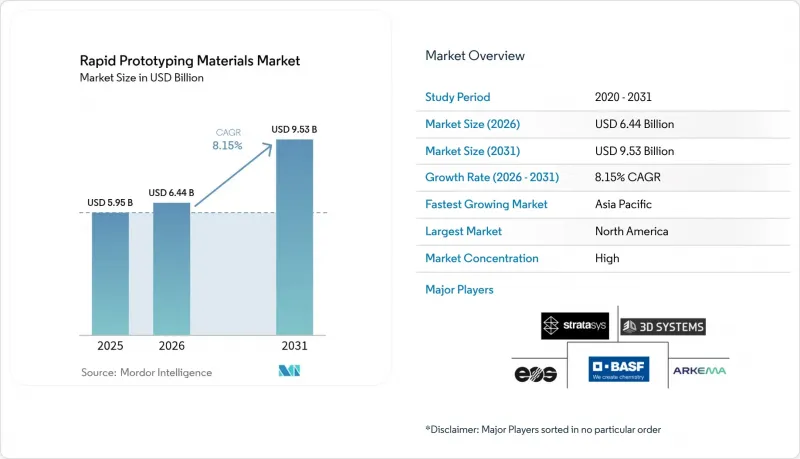
본 보고서는 소재 유형별(플라스틱(폴리머), 금속·합금, 세라믹, 기타), 최종 사용자 산업별(자동차, 항공우주 및 방위, 의료, 전자기기, 건설, 기타), 지역별(아시아태평양, 북미, 유럽, 남미, 중동 및 아프리카)로 분류되어 있습니다. 시장 예측은 금액(달러) 기준으로 제시됩니다.
세계의 래피드 프로토타이핑 재료 시장 동향 및 인사이트
항공우주 및 방위 부문에서 프로토타이핑을 위한 적층 가공 채택 확대
항공우주 및 방위 산업에서는 설계 반복 횟수를 줄이고 복잡한 내부 형태를 구현하기 위해 적층 조형의 도입을 가속화하고 있습니다. 미국 국방고등연구계획국(DARPA)은 복잡한 마이크로전자 시스템의 생산을 국내에 정착시키고 공급 자립성을 확보하기 위해 AMME 프로그램을 시작했습니다. GE가 3D 프린팅 기술을 활용해 일체 성형한 LEAP 연료 노즐은 기존 제조 방식에 비해 무게를 25% 줄이고 내구성을 5배 향상시켰습니다. 1,300℃를 견디는 세라믹 매트릭스 복합재 부품이 현재 터빈 유로에 장착되어 열효율 향상과 배기가스 감축에 기여하고 있습니다. 보잉(Boeing)과 에어버스(Airbus)는 1Kg의 경량화가 항공사의 운영 비용 절감으로 직결된다는 점을 인식하고, 비행 인증을 받은 폴리머 및 금속 부품을 처리하기 위해 각각 사내 3D 프린팅 시설을 확충했습니다.
생체 적합성 소재가 필요한 의료용 임플란트 및 해부학적 모델의 급증
의료시설에서는 환자별로 맞춤화된 의료기기의 진료 현장 3D 프린팅화가 진행되고 있습니다. 2025년, 3D Systems는 병원 내에서 MDR(의료기기 규정)을 준수한 최초의 PEEK 재질 안면 임플란트를 제조했습니다. 이 솔루션을 통해 외부 기계 가공을 기다리는 긴 대기 시간이 해소되었으며, 외과의사는 수술 몇 분 전이라도 설계를 조정할 수 있게 되었습니다. 특정 환자 하위 집단에서 발생하는 티타늄 거부 반응을 해결하기 위해 탄탈륨이나 니오브 등의 대체 합금에 대한 검사가 진행되고 있습니다. 개정된 FDA 지침을 통해 적층 가공 의료기기의 검증 절차가 명확해졌으며, 승인 주기를 단축할 수 있게 되었습니다. 에보닉(Evonik)은 척추 케이지의 하중 지지 성능을 향상시킬 것으로 기대되는 탄소섬유 강화 PEEK 필라멘트를 상용화했습니다. 이러한 발전은 스캐폴드를 활용한 조직 공학의 진보와 맞물려, 신속 프로토타이핑 소재 시장에서 맞춤형 의료 솔루션의 급속한 부상을 뒷받침하고 있습니다.
티타늄 및 고성능 폴리머 원료 가격 변동
2024년 12월, 티타늄 제련소 가격은 전년 동월 대비 4.48% 상승했고, 미국 생산자물가지수(PPI)는 219.99를 기록하여 항공우주 산업의 조달 예산에 부담을 주고 있습니다. 러시아-우크라이나 간 긴장으로 인해 증폭된 지정학적 리스크가 스폰지 티타늄 공급을 제약하고 있는 반면, 중동 및 북미의 신규 진출기업들은 생산 규모를 확대하기 위해 수년의 시간이 필요합니다. 항공기용 및 임플란트용 등급의 수지는 인증 주기가 길기 때문에 신속한 소재 대체가 어렵고, 제조업체는 재고를 늘리거나 이익률 하락을 감수하는 것 중 하나를 선택할 수밖에 없습니다. 따라서 이러한 가격 변동은 새로운 적층 가공 라인에 대한 자본 배분을 저해하는 요인이 되고 있습니다.
부문 분석
2025년, 플라스틱은 래피드 프로토타이핑 재료 시장 점유율의 44.12%를 유지했으며, 금속에 비해 범용성과 비용 면에서의 우위를 입증했습니다. Victrex의 PAEK과 같은 고온 등급은 파우더 베드 방식에서 리프레시율을 낮추기 위해 설계되었으며, 폴리머의 용도를 자동차 보닛 아래 및 항공우주 부문의 덕트 용도로 확대되고 있습니다. 금속 및 합금은 더욱 빠르게 성장하고 있으며, 항공우주 부문의 주요 제조업체들이 내피로성이 뛰어난 티타늄-알루미늄 합금을 요구하는 한편, 코발트-크롬 임플란트가 정형외과 부문에서 보급됨에 따라 연평균 성장률(CAGR)은 10.03%로 성장을 지속하고, 있습니다.
이와 병행하여 공정 혁신도 중요한 동향으로 떠오르고 있습니다. 파운데이션 알로이(Foundation Alloys)사의 고체 상태 야금법은 용융 풀의 불안정성을 피하고, 단조품에 비해 2배의 강도를 지닌 합금을 제조할 수 있을 뿐만 아니라, 개발 주기를 수개월로 단축할 수 있습니다. 이러한 획기적인 기술은 후처리를 줄임으로써 금속이 폴리머와의 비용 격차를 좁히는 데 기여할 것으로 보입니다. 그러나 UV 경화형 수지 및 엘라스토머의 지속적인 개선으로 인해 폴리머가 여전히 시장의 대부분을 차지할 가능성이 높습니다. 전반적으로, 소재의 다양화는 래피드 프로토타이핑 재료 시장 전체를 확대시키고, 원자재 가격 급등에 대한 리스크 헤지 역할을 합니다.
지역별 분석
북미는 항공우주 및 의료 인프라의 견실한 발전을 배경으로 2025년에 래피드 프로토타이핑 재료 시장의 31.21%를 차지했습니다. DARPA의 첨단 제조 기술에 대한 누적 350억 달러 투자와 더불어, FDA의 적층 가공 장비에 대한 신속 승인 절차가 상업적 규모로의 확장을 뒷받침하고 있습니다.
아시아태평양은 가장 빠르게 성장하고 있으며, 2031년 연평균 성장률(CAGR)은 10.31%를 나타낼 것으로 전망됩니다. 인도의 대규모 교육 병원에서 반복적인 프로토타이핑 문화가 생체 적합성 폴리머에 대한 지역 특유 수요를 견인하고 있습니다. 일본에서는 소형 가전제품에 적층 가공 솔루션이 채택되고 있는 반면, 한국의 자동차 제조업체들은 격자 구조로 보강된 시트 프레임을 모색하고 있습니다.
유럽은 지속가능성을 최우선으로 하는 정책을 바탕으로 경쟁력을 유지하고 있습니다. EU의 ‘원자재 미래 전망 조사’에서는 2050년까지 전략적 자립성을 확보하기 위해 적층 조형을 우선 과제로 삼고 있습니다. 독일의 EOS와 SGL Carbon은 고온용 수지 및 세라믹 제품 포트폴리오 개발을 주도하고 있으며, 영국에서는 항공우주 부문의 연구 개발을 스칼알로이(Scalalloy)로 제작된 항공기 부품용 분말 침적 용융 공법에 적용하고 있습니다.
기타 혜택
- 엑셀 형식 시장 예측(ME) 시트
- 3개월간의 애널리스트 지원
자주 묻는 질문
목차
제1장 서론
제2장 조사 방법
제3장 주요 요약
제4장 시장 구도
제5장 시장 규모 및 성장 예측
제6장 경쟁 구도
제7장 시장 기회 및 향후 전망
AJY 26.08.28According to Mordor Intelligence, the rapid prototyping materials market size is expected to grow from USD 5.95 billion in 2025 to USD 6.44 billion in 2026 and is forecast to reach USD 9.53 billion by 2031 at 8.15% CAGR over 2026-2031.
This report is Segmented by Material Type (Plastics (Polymers), Metals and Alloys, Ceramics, and Other Materials), End-User Industry (Automotive, Aerospace and Defence, Medical, Electronics, Construction, and Other End-User Industries), and Geography (Asia-Pacific, North America, Europe, South America, and Middle-East and Africa). The Market Forecasts are Provided in Terms of Value (USD).
Global Rapid Prototyping Materials Market Trends and Insights
Expanding Adoption of Additive Manufacturing in Aerospace and Defense Prototyping
The aerospace and defense community is accelerating additive uptake to compress design iterations and unlock complex internal geometries. The U.S. Defense Advanced Research Projects Agency (DARPA) initiated its AMME program to localize production of intricate micro-electronic systems and safeguard supply sovereignty. GE's single-piece 3D-printed LEAP fuel nozzle demonstrated 25% weight reduction and a fivefold durability improvement compared with legacy builds. Ceramic-matrix-composite components able to tolerate 1,300 °C are now integrated in turbine pathways, contributing to higher thermal efficiency and lower emissions. Boeing and Airbus have each expanded in-house printing farms to accommodate flight-certified polymer and metal parts, recognizing that every kilogram shed translates directly into airline operating-cost savings.
Surge in Medical Implants and Anatomical Models Needing Biocompatible Materials
Healthcare facilities are moving toward point-of-care printing of patient-specific devices. In 2025, 3D Systems produced the first MDR-compliant PEEK facial implant directly inside a hospital setting. The solution removes lengthy external machining queues and lets surgeons adjust designs minutes before surgery. Alternative alloys such as tantalum and niobium are being trialed to solve titanium rejection in certain patient sub-groups. Updated FDA guidelines clarify validation routes for additive devices, enabling shorter approval cycles. Evonik has commercialized carbon-fiber-reinforced PEEK filaments promising enhanced load-bearing performance in spinal cages. These developments, alongside progress in scaffold-based tissue engineering, underpin the rapid ascent of personalized medical solutions within the rapid prototyping materials market.
Volatility of Titanium and High-Performance Polymer Feedstock Prices
Titanium mill prices climbed 4.48% year-over-year to a U.S. PPI of 219.99 in December 2024, straining aerospace procurement budgets. Geopolitical risk, amplified by Russia-Ukraine tensions, constrains sponge supply, while new entrants in the Middle East and North America require multi-year scale-up periods. Manufacturers either stockpile or accept lower margins because qualification cycles for flight- or implant-grade resins preclude rapid material substitution. Volatility thus acts as a drag on capital allocation to greenfield additive lines.
Other drivers and restraints analyzed in the detailed report include:
- Continued Decline in Polymer and Metal Powder Prices
- OEM Push for Lightweight Automotive Parts
- Skills Gap for Large-Scale Additive Manufacturing Design and Material Processing
For complete list of drivers and restraints, kindly check the Table Of Contents.
Segment Analysis
Plastics retained 44.12% of the rapid prototyping materials market share in 2025, confirming their versatility and cost advantage over metals. High-temperature grades such as Victrex's PAEK, engineered for lower refresh rates in powder-bed systems, extend polymer use into under-hood automotive and aerospace ducting applications. Metals and alloys are expanding faster, clocking a 10.03% CAGR as aerospace primes demand fatigue-resistant titanium aluminide and cobalt-chrome implants populate orthopedics.
A parallel trend centers on process innovation. Foundation Alloy's solid-state metallurgy bypasses melt-pool instabilities and can deliver alloys twice as strong as wrought counterparts while cutting development cycles to months. Such breakthroughs will help metals narrow the cost gap with polymers by reducing post-processing. Polymers, however, are likely to retain the lion's share because of continual upgrades in UV-curable resins and elastomers. Overall, material diversification enlarges the total rapid prototyping materials market and hedges against feedstock price shocks.
Complete Report Scope:
- By Material Type
- Plastics (Polymers)
- Metals and Alloys
- Ceramics
- Other Materials
- By End-User Industry
- Automotive
- Aerospace and Defence
- Medical
- Electronics
- Construction
- Other End-User Industries
- By Geography
- Asia-Pacific
- China
- India
- Japan
- South Korea
- Rest of Asia-Pacific
- North America
- United States
- Canada
- Mexico
- Europe
- Germany
- United Kingdom
- France
- Italy
- Rest of Europe
- South America
- Brazil
- Argentina
- Rest of South America
- Middle-East and Africa
- Saudi Arabia
- South Africa
- Rest of Middle-East and Africa
- Asia-Pacific
Geography Analysis
North America held 31.21% of the rapid prototyping materials market in 2025 on the back of robust aerospace and medical infrastructure. DARPA's cumulative USD 35 billion investment in advanced manufacturing, plus FDA fast-track pathways for additive devices, incentivize commercial scale-up.
Asia Pacific is the fastest grower, clocking a 10.31% CAGR through 2031. India's iterative prototyping culture within large teaching hospitals drives localized demand for biocompatible polymers. Japan applies additive solutions to miniaturized consumer electronics, while South Korea's automakers seek lattice-reinforced seat frames.
Europe maintains a competitive position anchored in sustainability-first policy. The EU Raw Materials Foresight Study prioritizes additive manufacturing for strategic autonomy through 2050. Germany's EOS and SGL Carbon pioneer high-temperature resin and ceramic portfolios; the UK channels aerospace research and development into powder-bed fusion of scalmalloy flight parts.
- 3D Systems Inc.
- Arkema
- BASF
- dsm-firmenich
- EOS GmbH
- Evonik Industries AG
- General Electric Company
- Hoganas AB
- HP Development Company, L.P.
- Model Solution Co, Ltd.
- Renishaw plc
- SABIC
- Sandvik AB
- Solvay
- Stratasys Ltd.
- Victrex plc
Additional Benefits:
- The market estimate (ME) sheet in Excel format
- 3 months of analyst support
TABLE OF CONTENTS
1 Introduction
- 1.1 Study Assumptions and Market Definition
- 1.2 Scope of the Study
2 Research Methodology
3 Executive Summary
4 Market Landscape
- 4.1 Market Overview
- 4.2 Market Drivers
- 4.2.1 Expanding Adoption of Additive Manufacturing in Aerospace and Defence Prototyping
- 4.2.2 Surge in Medical Implants and Anatomical Models Needing Biocompatible Materials
- 4.2.3 Continued Decline in Polymer and Metal Powder Prices
- 4.2.4 OEM Push for Lightweight Automotive Parts
- 4.2.5 Government-Funded Circular-Economy Mandates Favouring Bio-Based Polymers
- 4.3 Market Restraints
- 4.3.1 Volatility of Titanium and High-Performance Polymer Feedstock Prices
- 4.3.2 Skills Gap for Large-Scale Additive Manufacturing Design and Material Processing
- 4.3.3 Supply Bottlenecks of Rare-Earth Alloying Elements for Advanced Metal Powders
- 4.4 Value Chain Analysis
- 4.5 Porter's Five Forces
- 4.5.1 Threat of New Entrants
- 4.5.2 Bargaining Power of Buyers
- 4.5.3 Bargaining Power of Suppliers
- 4.5.4 Threat of Substitute Products
- 4.5.5 Degree of Competition
5 Market Size and Growth Forecasts (Value, USD)
- 5.1 By Material Type
- 5.1.1 Plastics (Polymers)
- 5.1.2 Metals and Alloys
- 5.1.3 Ceramics
- 5.1.4 Other Materials
- 5.2 By End-User Industry
- 5.2.1 Automotive
- 5.2.2 Aerospace and Defence
- 5.2.3 Medical
- 5.2.4 Electronics
- 5.2.5 Construction
- 5.2.6 Other End-User Industries
- 5.3 By Geography
- 5.3.1 Asia-Pacific
- 5.3.1.1 China
- 5.3.1.2 India
- 5.3.1.3 Japan
- 5.3.1.4 South Korea
- 5.3.1.5 Rest of Asia-Pacific
- 5.3.2 North America
- 5.3.2.1 United States
- 5.3.2.2 Canada
- 5.3.2.3 Mexico
- 5.3.3 Europe
- 5.3.3.1 Germany
- 5.3.3.2 United Kingdom
- 5.3.3.3 France
- 5.3.3.4 Italy
- 5.3.3.5 Rest of Europe
- 5.3.4 South America
- 5.3.4.1 Brazil
- 5.3.4.2 Argentina
- 5.3.4.3 Rest of South America
- 5.3.5 Middle-East and Africa
- 5.3.5.1 Saudi Arabia
- 5.3.5.2 South Africa
- 5.3.5.3 Rest of Middle-East and Africa
- 5.3.1 Asia-Pacific
6 Competitive Landscape
- 6.1 Market Concentration
- 6.2 Strategic Moves
- 6.3 Market Share Analysis
- 6.4 Company Profiles (includes Global level Overview, Market level overview, Core Segments, Financials as available, Strategic Information, Market Rank/Share for key companies, Products and Services, and Recent Developments)
- 6.4.1 3D Systems Inc.
- 6.4.2 Arkema
- 6.4.3 BASF
- 6.4.4 dsm-firmenich
- 6.4.5 EOS GmbH
- 6.4.6 Evonik Industries AG
- 6.4.7 General Electric Company
- 6.4.8 Hoganas AB
- 6.4.9 HP Development Company, L.P.
- 6.4.10 Model Solution Co, Ltd.
- 6.4.11 Renishaw plc
- 6.4.12 SABIC
- 6.4.13 Sandvik AB
- 6.4.14 Solvay
- 6.4.15 Stratasys Ltd.
- 6.4.16 Victrex plc
7 Market Opportunities and Future Outlook
- 7.1 White-space and Unmet-Need Assessment


