

|
시장보고서
상품코드
2063300
도크 및 야드 관리 시스템 : 시장 점유율 분석, 업계 동향 및 통계, 성장 예측(2026-2031년)Dock And Yard Management Systems - Market Share Analysis, Industry Trends & Statistics, Growth Forecasts (2026 - 2031) |
||||||
 Mordor Intelligence
Mordor Intelligence에 의하면, 도크 및 야드 관리 시스템 시장 규모는 2025년 43억 2,000만 달러로 평가되었습니다. 2026년 48억 4,000만 달러에서 2031년까지 85억 달러로 확대되고 2026년부터 2031년에 걸쳐 CAGR은 11.95%를 나타낼 것으로 예측됩니다.
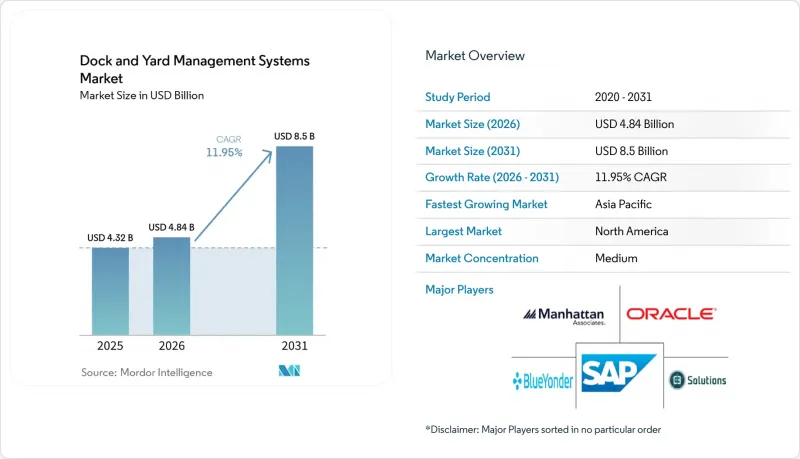
본 보고서는 구성 요소(소프트웨어, 하드웨어, 서비스), 도입 형태(On-Premise, 클라우드, 하이브리드), 업종(소매 및 전자상거래, 식품 및 음료, 자동차 등), 용도(도크 도어 스케줄링, 야드 자산 및 트레일러 관리, 게이트 및 보안 운영 등), 그리고 지역별로 분류되어 있습니다. 시장 전망은 금액(달러) 기준으로 제시되어 있습니다.
세계의 도크 및 야드 관리 시스템 시장 동향과 인사이트
전자상거래 소포 처리량 증가
2025년 전 세계 소포 처리량은 1,210억 개에 달했으며, 소매 물류 센터로 들어오는 트레일러의 일일 도착 대수는 30-40% 증가했습니다. 사업자들은 운송업체의 GPS 데이터와 창고 재고 우선순위를 활용하여, 실시간으로 부두를 재할당하는 동적 부두 스케줄링 시스템을 도입하고 있습니다. 아마존은 2024년에 개설한 55개의 물류센터에 로봇 분류 시스템을 도입하여, 하역장에서 출하까지의 주기를 45분 미만으로 단축했습니다. 월마트는 4,000개 이상의 매장에 야드 모듈을 도입하여 신선식품 폐기량을 12-15% 줄였습니다. 당일 배송이 표준화됨에 따라 체류료 발생 위험이 높아지고 있어, 화주들은 지연 도착 시 벌금을 부과하고 조기 체크인 시 인센티브를 제공하는 예약 준수 도구를 도입하고 있습니다.
실시간 시각화 플랫폼으로의 전환
2025년 조사에 따르면, 북미 물류 센터의 60%가 여전히 수동 체크인 절차를 채택하고 있었으며, 이로 인해 사각지대가 발생하고 재고 정확도를 저해하고 있었습니다. 새로운 플랫폼은 GPS, RFID, 컴퓨터 비전을 결합하여 트레일러의 모든 움직임이 기업 시스템에 즉시 반영되도록 하고 있습니다. FourKites의 YardWorks 제품군은 ID 정보를 자동으로 수집함으로써 게이트에서의 처리 시간을 최대 7분에서 90초로 대폭 단축했습니다. project44와 Celonis는 출하 데이터에 프로세스 마이닝을 적용하여, 하역 시간이 만성적으로 20-30% 더 오래 걸리는 도크 도어를 파악했습니다. 가시화 기능이 운송 관리 시스템과 통합됨에 따라 운송업체들은 모바일 알림을 수신할 수 있게 되었으며, 그 결과 노쇼율이 15-20% 감소했습니다.
기존 WMS/TMS 통합의 장애물
북미 창고의 약 70%에서는 여전히 API 기능이 제한적인 2015년 이전 버전의 WMS가 가동되고 있습니다. 따라서 야드 관리 소프트웨어를 도입하려면 맞춤형 미들웨어가 필요하며, 이로 인해 프로젝트 예산의 20-30%가 소요되고, 여러 거점에 걸친 네트워크 구축 기간이 1년까지 늘어날 수 있습니다. 기존 TMS 플랫폼에는 이벤트 기반 메시징 기능이 없어, 공급업체는 몇 분 간격으로 업데이트 정보를 폴링해야 하므로 예약의 정확도가 떨어지고 있습니다. 각 공급업체들은 주요 WMS 제품군을 위한 표준화된 커넥터를 출시하고 있지만, 틈새 시장의 맞춤형 시스템에는 여전히 맞춤형 코드가 필요합니다. EPCIS 2.0과 같은 업계 표준은 개선을 약속하고 있지만, 비용 제약이 있는 중견 사업자들 사이에서는 여전히 도입이 더딘 실정입니다.
부문별 분석
서비스 매출은 도크 및 야드 관리 시스템 시장 전체의 성장률을 상회할 것으로 예상되며, 기업들이 프로세스 매핑, API 설정 및 가동 후 최적화를 위해 통합 업체에 의존함에 따라 2026년부터 2031년 사이에 12.38% 성장할 것으로 전망됩니다. 정기 구독 서비스 덕분에 2025년 매출의 55.53%를 차지한 소프트웨어가 여전히 지배적인 위치를 차지하고 있지만, 클라우드의 경제성으로 인해 라이선스 마진은 축소되고 있으며, 가치는 전문 지식으로 이동하고 있습니다.
오픈 API 덕분에 소프트웨어가 특정 센서 브랜드에 얽매이지 않게 되면서, 하드웨어 시장 점유율은 계속해서 하락하고 있습니다. 맨해튼 어소시에이츠는 추가 라이선스 비용 없이 ‘액티브 야드 매니지먼트’를 제공하며, 도입 지원 및 프리미엄 지원을 통해 수익 창출을 도모하고 있습니다. 포카이트스는 게이트의 처리량을 모니터링하고 알고리즘을 재조정하는 관리형 서비스를 도입한 반면, 제브라 테크놀로지스는 설치 및 다년간의 유지보수를 운영비 계약에 포함시켰습니다.
2025년에는 화주들의 유연한 용량 활용 및 자동 업그레이드에 대한 선호를 배경으로, 클라우드가 매출의 60.44%를 차지했습니다. 이러한 추세는 물류 업계의 역동적인 수요에 부응하기 위해 클라우드 기반 솔루션에 대한 의존도가 높아지고 있음을 여실히 보여주고 있습니다. 그러나 하이브리드 아키텍처 역시 눈부신 성장을 거듭하며 12.58%의 속도로 확대되고 있습니다. 이러한 성장은 주로 운영 효율성과 실시간 의사 결정에 필수적인 1초 미만의 응답 시간을 확보하기 위해, 현장 게이트 카메라 및 트레일러 ID 추론 시스템을 운영하는 사업자들에 의해 주도되고 있습니다.
FDA의 21 CFR Part 11의 엄격한 요건을 준수해야 하는 의약품 콜드체인 야드에서는 감사 기록의 무결성을 유지하기 위해 실시간 데이터를 현지에서 저장하는 경우가 많습니다. 이러한 시설에서는 일반적으로 야간 시간대에 요약 데이터만 클라우드로 전송하여, 규정 준수와 운영 효율 간의 균형을 맞추고 있습니다. 엣지 컴퓨팅은 대역폭 사용을 최적화하는 데 중요한 역할을 하고 있습니다. 예를 들어, 50대의 카메라를 갖춘 야드에서는 10TB의 원본 영상 데이터를 불과 100GB의 메타데이터로 압축할 수 있어, 데이터 전송 요구 사항을 대폭 줄일 수 있을 뿐만 아니라 인터넷 장애 시에도 업무를 중단하지 않고 계속 진행할 수 있습니다. 또한, Kubernetes 패키징 기술의 발전으로 인해 기반 코드를 전혀 변경하지 않고도 On-Premise 또는 AWS 환경 내에서 컨테이너를 원활하게 운영할 수 있게 되어, 기업에 더 높은 유연성과 확장성을 제공합니다.
지역별 분석
북미는 DHL의 20억 유로(22억 6,000만 달러) 규모의 자동화 투자와 FedEx의 59억 달러 규모의 자본 투자 계획에 힘입어, 2025년 전 세계 매출의 36.67%를 차지했습니다. 캘리포니아주의 SB-415 법안은 창고 허가를 상세한 트럭 운행 계획의 제출을 조건으로 함으로써, 도입을 더욱 촉진하고 있습니다. 해당 지역에서의 기술 혁신과 규제 조치에 대한 집중은 시장 내 입지를 지속적으로 공고히 하고 있습니다.
아시아태평양은 대규모 스마트 창고에 대한 투자 덕분에 12.67%의 성장률을 기록하며 가장 빠르게 성장하고 있는 지역입니다. 아마존의 선전 물류센터는 AI를 활용한 슬롯 배정 및 야드 자동화를 통해 보관 비용을 45% 절감했으며, 야마토 홀딩스는 인도에 2만 4,900제곱미터 규모의 허브를 개설하여 전자상거래 및 콜드체인 고객을 지원하고 있습니다. 한국에서는 다이소의 새로운 물류 허브를 대상으로 6,600만 달러 규모의 로봇 관련 계약이 체결되면서, 지역 소매업체들이 다국적 기업의 야심에 발맞추고 있음을 보여주었습니다.
유럽에서는 브렉시트 이후의 복잡한 상황 속에서 인더스트리 4.0 프로그램의 도입이 가속화되고 있습니다. DP 월드는 런던 게이트웨이의 BOXBAY에 대해 트럭의 사이클 타임을 60분 미만으로 단축하기 위해 1억 7,000만 유로(1억 8,000만 달러)를 투자했습니다. 한편, 스위스로그와 밴팅은 도크 스케줄링과 콜드체인 모니터링을 통합한 신선식품 전용 자동화 창고를 건설 중입니다. 중동 및 아프리카는 ‘사우디 비전 2030’과 UAE의 물류 허브 전략의 혜택을 누리고 있지만, 남미는 인프라 부족으로 인해 여전히 개발도상국 시장에 머물러 있습니다.
기타 혜택 :
- 엑셀 형식 시장 예측(ME) 시트
- 3개월간의 애널리스트 지원
자주 묻는 질문
목차
제1장 서론
제2장 조사 방법
제3장 주요 요약
제4장 시장 구도
제5장 시장 규모 및 성장 예측
제6장 경쟁 구도
제7장 시장 기회 및 향후 전망
KTH 26.06.22According to Mordor Intelligence, the dock and yard management systems market size is projected to expand from USD 4.32 billion in 2025 and USD 4.84 billion in 2026 to USD 8.50 billion by 2031, registering an 11.95% CAGR between 2026 and 2031.
This report is Segmented by Component (Software, Hardware, and Services), Deployment Mode (On-Premises, Cloud, and Hybrid), Industry Vertical (Retail and E-Commerce, Food and Beverages, Automotive, and More), Application (Dock Door Scheduling, Yard Asset and Trailer Management, Gate and Security Operations, and More), and Geography. The Market Forecasts are Provided in Terms of Value (USD).
Global Dock And Yard Management Systems Market Trends and Insights
Rising E-Commerce Parcel Volumes
Global parcel volume hit 121 billion units in 2025, lifting daily trailer arrivals at retail distribution centers by 30-40%. Operators are adopting dynamic dock scheduling that reallocates bays in real time using carrier GPS feeds and warehouse inventory priorities. Amazon equipped its 55 fulfillment centers opened in 2024 with robotic sortation, trimming dock-to-dispatch cycles to under 45 minutes. Walmart integrated yard modules across 4,000-plus stores, cutting perishable spoilage by 12-15%. Same-day fulfillment norms increase detention-fee exposure, prompting shippers to adopt appointment-compliance tools that penalize late arrivals and reward early check-ins.
Shift to Real-Time Visibility Platforms
A 2025 study found 60% of North American yards still used manual check-in processes, creating blind spots that hampered inventory accuracy. New platforms combine GPS, RFID, and computer vision so every trailer movement updates enterprise systems instantly. FourKites' YardWorks suite slashed gate processing from up to seven minutes to 90 seconds by automating ID capture. project44 and Celonis layered process mining on shipment data to uncover dock doors with chronic 20-30% longer unload times. As visibility converges with transportation management systems, carriers receive mobile alerts that reduce no-show rates by 15-20%.
Legacy WMS/TMS Integration Hurdles
Roughly 70% of North American warehouses still run pre-2015 WMS installations with limited APIs. Implementing yard software therefore requires custom middleware that can consume 20-30% of project budgets, extending rollouts to a year for multi-site networks. The absence of event-driven messaging in legacy TMS platforms forces vendors to poll for updates every few minutes, degrading appointment accuracy. Providers are releasing standardized connectors for top WMS suites, but long-tail custom systems continue to demand bespoke code. Industry standards such as EPCIS 2.0 promise relief, yet adoption remains slow among cost-constrained mid-tier operators.
Other drivers and restraints analyzed in the detailed report include:
- Adoption of Cloud-Native Supply-Chain Suites
- Regulatory Push for Truck-Turn-Time Reduction
- High Up-Front Hardware Costs (RFID, Cameras)
For complete list of drivers and restraints, kindly check the Table Of Contents.
Segment Analysis
Services revenue is set to outpace overall dock and yard management systems market growth, expanding 12.38% between 2026 and 2031 as enterprises lean on integrators for process mapping, API configuration, and post-go-live optimization. Software still dominated with 55.53% of 2025 turnover, thanks to recurring subscriptions, but cloud economics are compressing license margins and shifting value to expertise.
The share of hardware continues to decline because open APIs now decouple software from any one sensor brand. Manhattan Associates provides Active Yard Management at no extra license fee, monetizing via implementation and premium support. FourKites introduced managed services that monitor gate throughput and retune algorithms, while Zebra Technologies bundles installation and multi-year maintenance in operational-expense contracts.
In 2025, the cloud accounted for 60.44% of the revenue, driven by shippers' preference for elastic capacity and automatic upgrades. This trend highlights the increasing reliance on cloud-based solutions to meet the dynamic demands of the shipping industry. However, hybrid architectures are experiencing significant growth, expanding at a rate of 12.58%. This growth is primarily fueled by operators who maintain on-site gate cameras and trailer-ID inference systems to ensure sub-second response times, which are critical for operational efficiency and real-time decision-making.
Pharmaceutical cold-chain yards, which must comply with the stringent requirements of FDA's 21 CFR Part 11, often store real-time data locally to preserve audit integrity. These facilities typically transmit only summarized data to the cloud during overnight hours, balancing regulatory compliance with operational efficiency. Edge computing has emerged as a key enabler in optimizing bandwidth usage. For example, a yard equipped with 50 cameras can reduce 10 TB of raw video data to just 100 GB of metadata, significantly minimizing data transfer requirements while ensuring uninterrupted operations during internet outages. Additionally, advancements in Kubernetes packaging now allow containers to operate seamlessly on-premises or within AWS environments without requiring any modifications to the underlying code, offering greater flexibility and scalability for businesses.
Geography Analysis
North America accounted for 36.67% of global 2025 revenue, bolstered by DHL's EUR 2 billion (USD 2.26 billion) automation outlay and FedEx's USD 5.9 billion capital program. California's SB-415 further motivates adoption by conditioning warehouse permits on detailed truck-routing plans. The region's focus on technological advancements and regulatory measures continues to strengthen its market position.
Asia-Pacific is the fastest-growing region, with 12.67% growth, thanks to large-scale smart-warehouse investments. Amazon's Shenzhen fulfillment center cut storage costs 45% through AI-driven slotting and yard automation, and Yamato Holdings launched a 24,900 sq m hub in India to serve e-commerce and cold-chain clients. South Korea awarded USD 66 million in robotics contracts for Daiso's new distribution hub, showing that regional retailers are matching multinational ambition.
Europe's adoption of Industry 4.0 programs is accelerating amid post-Brexit complexity. DP World committed EUR 170 million (USD 180 million) for BOXBAY at London Gateway to achieve sub-60-minute truck cycles, while Swisslog and Bunting are building an automated fresh-goods warehouse that merges dock scheduling with cold-chain monitoring. The Middle East and Africa benefit from Saudi Vision 2030 and the UAE's logistics-hub strategies, whereas South America remains a nascent opportunity, limited by infrastructure gaps.
- Manhattan Associates Inc.
- Oracle Corporation
- SAP SE
- Blue Yonder Group, Inc.
- C3 Solutions Inc.
- Descartes Systems Group Inc.
- Zebra Technologies Corporation
- Kaleris, Inc.
- FourKites, Inc.
- project44, Inc.
- Korber AG
- Infor, Inc.
- Yard Management Solutions LLC
- YardView, LLC
- Softeon, Inc.
- Epicor Software Corporation
- Peripass NV
- Softeon, Inc.
- Exotrac LLC
Additional Benefits:
- The market estimate (ME) sheet in Excel format
- 3 months of analyst support
TABLE OF CONTENTS
1 INTRODUCTION
- 1.1 Study Assumptions and Market Definition
- 1.2 Scope of the Study
2 RESEARCH METHODOLOGY
3 EXECUTIVE SUMMARY
4 MARKET LANDSCAPE
- 4.1 Market Overview
- 4.2 Market Drivers
- 4.2.1 Rising E-Commerce Parcel Volumes
- 4.2.2 Shift to Real-Time Visibility Platforms
- 4.2.3 Adoption of Cloud-Native Supply-Chain Suites
- 4.2.4 Regulatory Push for Truck-Turn-Time Reduction
- 4.2.5 AI-Enabled Yard Automation for Labor-Scarce Sites
- 4.2.6 Convergence of Dock Scheduling With ESG Reporting
- 4.3 Market Restraints
- 4.3.1 Legacy WMS/TMS Integration Hurdles
- 4.3.2 High Up-Front Hardware Costs (RFID, Cameras)
- 4.3.3 Cyber-Security Concerns in Connected Yards
- 4.3.4 Shortage of In-House OT/IT Convergence Skills
- 4.4 Impact of Macroeconomic Factors on the Market
- 4.5 Industry Value / Supply-Chain Analysis
- 4.6 Regulatory Landscape
- 4.7 Technological Outlook
- 4.8 Porter's Five Forces Analysis
- 4.8.1 Threat of New Entrants
- 4.8.2 Bargaining Power of Buyers
- 4.8.3 Bargaining Power of Suppliers
- 4.8.4 Threat of Substitutes
- 4.8.5 Competitive Rivalry
5 MARKET SIZE AND GROWTH FORECASTS (VALUE)
- 5.1 By Component
- 5.1.1 Software
- 5.1.2 Hardware
- 5.1.3 Services
- 5.2 By Deployment Mode
- 5.2.1 On-Premises
- 5.2.2 Cloud
- 5.2.3 Hybrid
- 5.3 By Industry Vertical
- 5.3.1 Retail and E-Commerce
- 5.3.2 Food and Beverages
- 5.3.3 Automotive
- 5.3.4 Pharmaceutical and Healthcare
- 5.3.5 Manufacturing and 3PL
- 5.3.6 Rest of Industry Vertical
- 5.4 By Application
- 5.4.1 Dock Door Scheduling
- 5.4.2 Yard Asset and Trailer Management
- 5.4.3 Gate and Security Operations
- 5.4.4 Labor and Resource Management
- 5.4.5 Analytics and Reporting
- 5.5 By Geography
- 5.5.1 North America
- 5.5.1.1 United States
- 5.5.1.2 Canada
- 5.5.1.3 Mexico
- 5.5.2 Europe
- 5.5.2.1 Germany
- 5.5.2.2 United Kingdom
- 5.5.2.3 France
- 5.5.2.4 Russia
- 5.5.2.5 Rest of Europe
- 5.5.3 Asia-Pacific
- 5.5.3.1 China
- 5.5.3.2 Japan
- 5.5.3.3 India
- 5.5.3.4 South Korea
- 5.5.3.5 Australia
- 5.5.3.6 Rest of Asia-Pacific
- 5.5.4 Middle East and Africa
- 5.5.4.1 Middle East
- 5.5.4.1.1 Saudi Arabia
- 5.5.4.1.2 United Arab Emirates
- 5.5.4.1.3 Rest of Middle East
- 5.5.4.2 Africa
- 5.5.4.2.1 South Africa
- 5.5.4.2.2 Egypt
- 5.5.4.2.3 Rest of Africa
- 5.5.4.1 Middle East
- 5.5.5 South America
- 5.5.5.1 Brazil
- 5.5.5.2 Argentina
- 5.5.5.3 Rest of South America
- 5.5.1 North America
6 COMPETITIVE LANDSCAPE
- 6.1 Market Concentration
- 6.2 Strategic Moves
- 6.3 Market Share Analysis
- 6.4 Company Profiles (includes Global Level Overview, Market Level Overview, Core Segments, Financials as available, Strategic Information, Market Rank/Share, Products and Services, Recent Developments)
- 6.4.1 Manhattan Associates Inc.
- 6.4.2 Oracle Corporation
- 6.4.3 SAP SE
- 6.4.4 Blue Yonder Group, Inc.
- 6.4.5 C3 Solutions Inc.
- 6.4.6 Descartes Systems Group Inc.
- 6.4.7 Zebra Technologies Corporation
- 6.4.8 Kaleris, Inc.
- 6.4.9 FourKites, Inc.
- 6.4.10 project44, Inc.
- 6.4.11 Korber AG
- 6.4.12 Infor, Inc.
- 6.4.13 Yard Management Solutions LLC
- 6.4.14 YardView, LLC
- 6.4.15 Softeon, Inc.
- 6.4.16 Epicor Software Corporation
- 6.4.17 Peripass NV
- 6.4.18 Softeon, Inc.
- 6.4.19 Exotrac LLC
7 MARKET OPPORTUNITIES AND FUTURE OUTLOOK
- 7.1 White-Space and Unmet-Need Assessment


