
|
시장보고서
상품코드
2063424
ERP(전사적 자원 계획) 분야 생성형 AI : 시장 점유율 분석, 업계 동향 및 통계, 성장 예측(2026-2031년)Generative AI In Enterprise Resource Planning - Market Share Analysis, Industry Trends & Statistics, Growth Forecasts (2026 - 2031) |
||||||
 Mordor Intelligence
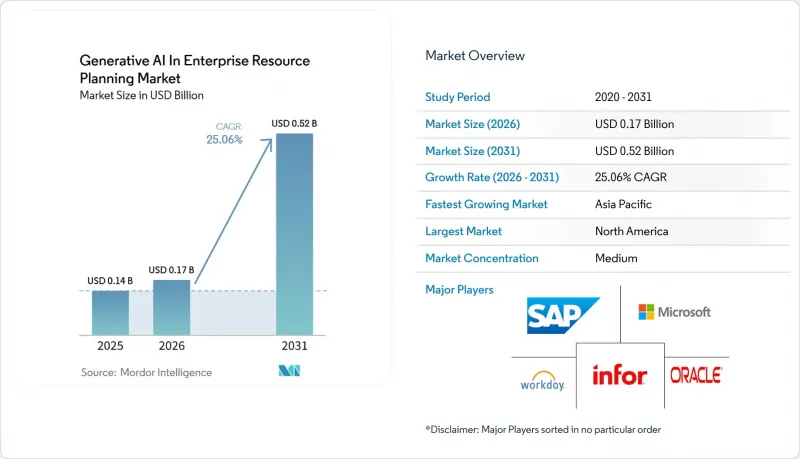
Mordor Intelligence에 의하면, ERP(전사적 자원 계획) 분야 생성형 AI 시장 규모는 2025년 1억 4,000만 달러로 평가되었습니다. 2026년 1억 7,000만 달러로 확대되어 2031년까지 5억 2,000만 달러에 이를 것으로 예측됩니다.
2026년부터 2031년까지의 연평균 성장률(CAGR)은 25.06%를 나타낼 것으로 전망됩니다.
본 보고서는 구성 요소(소프트웨어 및 서비스), 도입 모델(On-Premise, 하이브리드, 클라우드), 기업 규모(대기업 및 중소기업), ERP 모듈(재무 및 회계, 인사 등), 업종(제조업, BFSI 등) 및 지역별로 분류되어 있습니다. 시장 전망은 금액(달러) 기준으로 제공됩니다.
세계의 ERP(전사적 자원 관리) 분야 생성형 AI 시장 동향 및 인사이트
생성형 AI를 활용한 코드 생성이 ERP 맞춤화 비용을 절감
그동안 기업들은 전체 ERP 예산의 40%에서 60%를, 레거시 프로세스나 독자적인 비즈니스 요구 사항에 시스템을 맞추기 위한 맞춤형 코딩에 할애해 왔습니다. 그러나 생성형 코드 완성 기술의 발전으로 인해, 현재는 자연어 프롬프트를 통해 ABAP, PL/SQL, C#의 확장 기능을 직접 생성할 수 있게 되었습니다. 이러한 혁신 덕분에 납기 기간이 대폭 단축되어, 최대 절반까지 단축되었습니다. 예를 들어, Microsoft GitHub Copilot Enterprise는 이전에는 수 주간의 수작업이 필요했던 복잡한 수익 인식 로직을 불과 몇 시간 만에 생성, 단위 테스트, 배포할 수 있게 되었음을 입증했습니다. 이러한 변화는 시스템 통합사업자의 이익률을 압박하고, 컨설팅의 가치 제안을 기존의 수작업 코딩에서 프롬프트 엔지니어링의 전문 지식으로 전환시킴으로써 ERP 업계의 양상을 완전히 바꿔놓고 있습니다.
트랜스포머 기반의 자연어 인터페이스, 최종 사용자 채택 확대
예전에는 복잡한 내비게이션으로 인해 일반 사용자를 멀어지게 만들었던 복잡한 메뉴 구조도, 트랜스포머를 활용한 어시스턴트의 통합을 통해 점차 간소화되고 있습니다. 이러한 고급 어시스턴트는 승인이나 차이 분석과 같은 다단계 프로세스를 직관적인 대화형 명령을 통해 실행할 수 있습니다. 예를 들어, Oracle Fusion Cloud ERP 에이전트는 “지난 분기 매출총이익률이 하락한 이유는 무엇인가”와 같은 복잡한 쿼리를 해석하고, 원장, 가격 책정, 재고 등의 데이터 소스에서 정보를 원활하게 통합하여, 이전에는 전문적인 SQL 지식이 필요했던 실무적인 인사이트를 제공할 수 있습니다. 마찬가지로, 44개 언어를 지원하는 SAP Joule은 시범 도입 기간 동안 헬프데스크 문의 건수를 35% 줄임으로써 그 효과를 입증했으며, 이로 인해 해당 기능의 혜택을 누릴 수 있는 잠재적 라이선스 구매자의 범위를 확대되고 있습니다.
미션 크리티컬 거래에서 알고리즘에 의한 환각의 위험
확률적 오류, 즉 허상(hallucination)은 사베옥슬리법 준수에 있어 중대한 위협이 됩니다. 왜냐하면, 단 한 건의 잘못된 분개가 연결 계층 전체에 파급되어 재무 보고에 광범위한 부정확성을 초래할 가능성이 있기 때문입니다. 이러한 위험을 줄이기 위해 기업들은 다단계 규칙 점검 및 인적 승인 절차를 도입하고 있지만, 이러한 절차는 필수적임과 동시에 자동화를 통해 얻을 수 있는 생산성 향상을 부분적으로 상쇄해 버립니다. 또한, EU AI법에서는 재무 기록에 사용되는 AI 용도를 고위험 시스템으로 분류하고 있으며, 엄격한 사고 보고 요건을 의무화함으로써 도입을 지연시키는 추가적인 규제 장벽을 도입하고 있습니다.
부문별 분석
이 서비스는 2025년 매출의 38.69%를 차지했으며, 예측 기간 동안 연평균 성장률(CAGR) 25.46%를 기록하며 소프트웨어보다 더 빠르게 성장할 것으로 전망됩니다. 이는 조직이 프로젝트의 성공을 보장하는 데 있어 프롬프트 라이브러리, 검색 파이프라인, 그리고 사용자 변경 관리의 중요성을 점점 더 인식하고 있기 때문입니다. 팀이 모델의 출력을 효과적으로 뒷받침하기 위해 지식 그래프 큐레이션에 주력함에 따라, 컨설팅 서비스에 대한 수요가 증가하고 있습니다. 이러한 추세에 따라 ERP(전사적 자원 관리) 분야 생성형 AI 시장 규모는 제품 및 서비스의 수익원 간 균형에 점차 가까워지고 있습니다.
각 벤더사는 현재 플랫폼 라이선스와 용도 애드온을 분리하고 있으며, 이를 통해 서비스 제공의 유연성이 향상되고 있습니다. 또한, 매니지드 서비스는 원활한 운영에 필수적인 지연 시간 보장을 확보하면서 추론 클러스터의 운영을 담당하고 있습니다. SAP의 AI 비즈니스 서비스 부문은 재교육 서비스에 대한 수요 증가에 대응하기 위해 2026년에 직원 수를 40% 늘렸습니다. 이러한 움직임은 ERP(전사적 자원 관리) 분야 생성형 AI 시장에서 자문 및 관리형 서비스 제공이 계속해서 시장 점유율을 확대할 것으로 예상되는 이유를 여실히 보여주고 있습니다.
클라우드 구성은 2025년까지 지출의 72.41%를 차지했지만, 하이브리드 배포 모델은 예측 기간 동안 연평균 성장률(CAGR) 25.66%를 나타낼 것으로 전망됩니다. 이는 데이터 현지화에 관한 법적 규제가 점점 더 엄격해지는 가운데, 이에 대한 수요가 증가하고 있기 때문입니다. 다국적 기업들은 기밀성이 높은 원장을 On-Premise에서 관리하는 한편, 영업이나 인사 분야의 ‘코파일럿’과 같은 기능에는 클라우드 GPU를 활용하는 이중 접근 방식을 채택하고 있습니다. 이 전략을 통해 규제 준수와 성과 향상 사이의 균형을 맞출 수 있게 됩니다. 예를 들어, Microsoft Dynamics 365 Hybrid에서는 추론 프로세스를 데이터와 가까운 곳에서 실행하면서 모델 가중치를 동기화할 수 있으며, 이 기능은 인도나 중국 등의 국가에서 요구하는 데이터 상주 요건을 충족합니다.
또한, 에지 환경에 최적화된 디스티 모델이 도입되어 공장 현장에서 직접 저지연 경험을 제공하는 한편, 중앙 집중형 클라우드 시스템이 모델 가중치의 월별 업데이트를 처리하고 있습니다. 이러한 유연한 접근 방식은 특히 하이브리드 환경에서 기업 자원 계획(ERP) 시장의 생성형 AI 성장 궤도를 이끌고 있습니다. 동시에, 엄격한 보안 요건이 요구되는 국방 및 중요 인프라 등 특정 분야에서는 순수한 On-Premise형 솔루션의 보급을 제한하는 요인이 되고 있습니다.
지역별 분석
북미는 견고한 클라우드 인프라와 풍부한 프롬프트 엔지니어링 인력을 활용하여 2025년 지출의 41.29%를 차지했습니다. 미국 기업들은 임금 인플레이션 상승으로 인한 영향을 완화하기 위해 조달 및 공급망 업무에 생성형 AI 기능을 신속하게 통합하고 있습니다. 한편, 캐나다의 천연자원 기업들은 업무 효율성을 높이기 위해 국경을 넘는 물류 최적화를 최우선 과제로 삼고 있습니다. 멕시코에서는 마키라도라(수출가공구)가 USMCA(미국·멕시코·캐나다 협정)의 조달 규정을 준수하기 위해 생성형 ERP 솔루션을 도입하고 있으며, 이는 해당 지역 내 첨단 ERP 기술 도입을 더욱 촉진하고 있습니다.
아시아태평양은 연평균 성장률(CAGR)이 26.06%로 예측되어 가장 빠른 성장이 예상됩니다. 중국에서는 국영 기업에 국산 기반 모델의 채택을 의무화하는 정부의 지침이 국내 ERP 공급업체의 성장을 뒷받침하고 있습니다. 인도의 아웃소싱 업계는 변혁의 한가운데에 있으며, 수출 경쟁력을 높이기 위해 AI를 활용한 워크플로우를 통해 공유 서비스 센터의 재구축이 진행되고 있습니다. 일본은 대화형 현장 스케줄링 솔루션을 도입하여 인력 부족 문제에 대응하고 있는 반면, 한국의 재벌들은 정부의 AI 보조금을 활용해 반도체 및 가전제품공급망을 최적화함으로써 세계 경쟁력을 한층 더 강화하고 있습니다.
유럽에서는 규제 감독이 강화되고 있는 가운데, 꾸준한 성장이 예상됩니다. EU AI법에 따라 규정 준수 관련 투자가 증가하고 있으며, 풍부한 자금력을 갖춘 기존 대기업들이 유리한 입지를 점하고 있습니다. 독일의 자동차 제조업체들은 반도체 공급망 변동으로 인한 영향을 완화하기 위해 생성형 ERP 솔루션을 도입하고 있습니다. 영국에서는 기업들이 AI 보조 조종사를 활용해 브렉시트 이후의 통관 서류 절차를 효율화함으로써, 서류 작성 오류를 25% 줄이는 데 성공했습니다. 프랑스는 소버린 클라우드 정책을 통해 하이브리드 ERP 솔루션 수요를 주도하고 있지만, 이탈리아와 스페인에서는 이러한 기술을 도입하는 데 어려움을 겪는 중소기업의 비율이 높아 그 움직임이 더딘 임베디드니다. 중동 및 아프리카는 걸프 국가들의 AI 인프라 프로그램에 대한 투자와 남아프리카공화국 은행들이 규제 대응 업무의 효율적인 관리에 주력하고 있는 점을 배경으로, 새로운 성장 가능성을 내포하고 있습니다.
기타 혜택 :
- 엑셀 형식 시장 예측(ME) 시트
- 3개월간의 애널리스트 지원
자주 묻는 질문
목차
제1장 서론
제2장 조사 방법
제3장 주요 요약
제4장 시장 구도
제5장 시장 규모 및 성장 예측
제6장 경쟁 구도
제7장 시장 기회 및 향후 전망
KTH 26.06.22According to Mordor Intelligence, the generative aI in Enterprise Resource Planning market size is expected to increase from USD 0.14 billion in 2025 to USD 0.17 billion in 2026 and reach USD 0.52 billion by 2031, growing at a CAGR of 25.06% over 2026-2031.
This report is Segmented by Component (Software, and Services), Deployment Model (On-Premise, Hybrid, and Cloud), Enterprise Size (Large Enterprises, and Small and Medium Enterprises), ERP Module (Finance and Accounting, Human Resources, and More), Industry Vertical (Manufacturing, BFSI, and More), and Geography. The Market Forecasts are Provided in Terms of Value (USD).
Global Generative AI In Enterprise Resource Planning Market Trends and Insights
Generative AI-Driven Code Generation Cuts ERP Customization Costs
Historically, enterprises allocated between 40% and 60% of their total ERP budgets to custom coding efforts to adapt systems to legacy processes and unique business requirements. However, advancements in generative code-completion technology now enable the creation of ABAP, PL SQL, and C# extensions directly from plain-language prompts. This innovation significantly reduces delivery timelines, cutting them by up to half. For instance, Microsoft GitHub Copilot Enterprise demonstrated that complex revenue-recognition logic, which previously required weeks of manual effort, can now be generated, unit-tested, and deployed within just a few hours. This transformation is reshaping the ERP landscape by compressing systems integrators' profit margins and shifting the consulting value proposition toward expertise in prompt engineering rather than traditional manual coding practices.
Transformer-Based Natural-Language Interfaces Expand End-User Adoption
Complex menu structures, which previously discouraged casual users due to their intricate navigation, are now being simplified with the integration of transformer-powered assistants. These advanced assistants can execute multistep processes, such as approvals or variance analyses, through intuitive conversational commands. For instance, Oracle Fusion Cloud ERP agents can interpret complex queries such as 'why did gross margin dip last quarter,' seamlessly integrate data from sources such as the ledger, pricing, and inventory, and provide actionable insights that previously required specialized SQL expertise. Similarly, SAP Joule, which supports 44 languages, has demonstrated its effectiveness by reducing help-desk tickets by 35% during pilot implementations, thereby expanding the range of potential licensees who can benefit from its capabilities.
Algorithmic Hallucination Risk in Mission-Critical Transactions
Probabilistic errors, or hallucinations, pose a significant threat to Sarbanes-Oxley compliance because even a single false journal entry can cascade through consolidation hierarchies, leading to widespread inaccuracies in financial reporting. To mitigate these risks, enterprises implement layered rule checks and human approval processes, which, while necessary, partially offset the productivity gains achieved through automation. Additionally, the EU AI Act categorizes AI applications used for financial records as high-risk systems, mandating strict incident-reporting requirements and introducing additional regulatory hurdles that slow adoption.
Other drivers and restraints analyzed in the detailed report include:
- Rapid Expansion of Industry-Specific Foundation Models for ERP Workflows
- Falling Inference Costs Thanks to ASIC-Based AI Accelerators
- Copyright and Training-Data IP Exposure in Regulated Industries
For complete list of drivers and restraints, kindly check the Table Of Contents.
Segment Analysis
Services accounted for 38.69% of 2025 revenue and are forecast to grow faster than software with a CAGR of 25.46% over the forecast period, as organizations increasingly recognize the importance of prompt libraries, retrieval pipelines, and user change management in ensuring project success. The demand for consulting hours is rising as teams focus on curating knowledge graphs to ground model outputs effectively. This trend is driving the Generative AI in Enterprise Resource Planning market size closer to achieving parity between product and services revenue streams.
Vendors are now unbundling platform licenses from application add-ons, allowing for greater flexibility in service offerings. Additionally, managed services are taking on the operation of inference clusters while ensuring guaranteed latency, which is critical for seamless operations. SAP's AI Business Services unit expanded its workforce by 40% in 2026 to address the growing demand for retraining services. This development highlights why advisory and managed service offerings are expected to continue gaining a larger share in the Generative AI in Enterprise Resource Planning market.
Cloud configurations, which are projected to account for 72.41% of spending by 2025, however, the hybrid deployment model is expected to register a CAGR of 25.66% over the forecast period. The traction as data-localization laws become increasingly stringent. Multinational corporations are adopting a dual approach by maintaining sensitive ledgers on-premise while leveraging cloud GPUs for functions such as sales or HR copilots. This strategy allows them to balance regulatory compliance with enhanced performance. For instance, Microsoft Dynamics 365 hybrid enables customers to synchronize model weights while ensuring inference processes remain close to the data, a feature that aligns with residency mandates in countries such as India and China.
Additionally, edge-optimized distilled models are being deployed to deliver low-latency experiences directly on factory floors, while centralized cloud systems handle monthly updates to model weights. This flexible approach is driving the growth trajectory of Generative AI in the Enterprise Resource Planning market, particularly for hybrid setups. At the same time, it limits the expansion of pure on-premises solutions to specific sectors, such as defense or critical infrastructure, where stringent security requirements prevail.
Geography Analysis
North America accounted for 41.29% of 2025 expenditure, leveraging its robust cloud infrastructure and a significant pool of prompt engineering talent. U.S. enterprises have been quick to integrate generative features into procurement and supply chain operations to mitigate the impact of rising wage inflation. Meanwhile, Canadian natural resources firms are prioritizing cross-border logistics optimization to enhance operational efficiency. In Mexico, maquiladoras are adopting generative ERP solutions to ensure compliance with USMCA sourcing regulations, further driving the region's adoption of advanced ERP technologies.
Asia-Pacific is anticipated to experience the fastest growth, with a projected CAGR of 26.06%. In China, the government's directive for state enterprises to adopt local foundation models is driving the growth of domestic ERP suppliers. India's outsourcing industry is transforming, with shared-service centers being retooled using AI-augmented workflows to boost export competitiveness. Japan is addressing its labor shortages by implementing conversational shop-floor scheduling solutions, while South Korean conglomerates are capitalizing on government AI subsidies to optimize semiconductor and consumer electronics supply chains, further strengthening their global competitiveness.
Europe is expected to grow steadily, albeit under stricter regulatory oversight. The EU AI Act is increasing compliance-related investments, giving larger incumbents with substantial financial resources an advantage. German automakers are deploying generative ERP solutions to mitigate the impact of semiconductor supply chain volatility. In the United Kingdom, companies are utilizing AI copilots to streamline post-Brexit customs paperwork, achieving a 25% reduction in documentation errors. France is channeling its sovereign-cloud policies to drive demand for hybrid ERP solutions, while Italy and Spain are lagging due to the prevalence of smaller-sized firms that face challenges in adopting such technologies. The Middle East and Africa region presents emerging growth potential, driven by Gulf countries' investments in AI infrastructure programs and South African banks' focus on managing regulatory workloads effectively.
- SAP SE
- Oracle Corporation
- Microsoft Corporation
- Sage Group Plc
- Infor Inc.
- Epicor Software Corporation
- Acumatica, Inc.
- Workday, Inc.
- Priority Software Ltd.
- Odoo SA
- QAD Inc.
- Ramco Systems Limited
- Plex Systems, Inc.
- SYSPRO (Pty) Ltd.
- Rootstok Software
- Deltek, Inc.
- Zoho Corporation Pvt. Ltd.
- IFS AB
- Unit4 N.V.
- Aptean , Inc.
Additional Benefits:
- The market estimate (ME) sheet in Excel format
- 3 months of analyst support
TABLE OF CONTENTS
1 INTRODUCTION
- 1.1 Study Assumptions and Market Definition
- 1.2 Scope of the Study
2 RESEARCH METHODOLOGY
3 EXECUTIVE SUMMARY
4 MARKET LANDSCAPE
- 4.1 Market Overview
- 4.2 Market Drivers
- 4.2.1 Generative AI-Driven Code Generation Cuts ERP Customization Costs
- 4.2.2 Transformer-Based Natural-Language Interfaces Expand End-User Adoption
- 4.2.3 Rapid Expansion of Industry-Specific Foundation Models for ERP Workflows
- 4.2.4 Falling Inference Costs Thanks to ASIC-Based AI Accelerators
- 4.2.5 Cloud-Native ERP Road-maps Embedding Generative Copilots by Default
- 4.2.6 Vendor Ecosystem Race to Build Proprietary Domain Data Lakes
- 4.3 Market Restraints
- 4.3.1 Algorithmic Hallucination Risk in Mission-Critical Transactions
- 4.3.2 Copyright and Training-Data IP Exposure in Regulated Industries
- 4.3.3 Talent Shortage for ERP-Focused Prompt Engineering
- 4.3.4 Escalating Sovereign-Cloud Compliance Requirements
- 4.4 Impact of Macroeconomic Factors on the Market
- 4.5 Industry Value Chain Analysis
- 4.6 Regulatory Landscape
- 4.7 Technological Outlook
- 4.8 Porter's Five Forces Analysis
- 4.8.1 Bargaining Power of Suppliers
- 4.8.2 Bargaining Power of Buyers
- 4.8.3 Threat of New Entrants
- 4.8.4 Threat of Substitutes
- 4.8.5 Intensity of Competitive Rivalry
5 MARKET SIZE AND GROWTH FORECASTS (VALUE)
- 5.1 By Component
- 5.1.1 Software
- 5.1.2 Services
- 5.2 By Deployment Model
- 5.2.1 On-Premise
- 5.2.2 Hybrid
- 5.2.3 Cloud
- 5.3 By Enterprise Size
- 5.3.1 Large Enterprises
- 5.3.2 Small and Medium Enterprises
- 5.4 By ERP Module
- 5.4.1 Finance and Accounting
- 5.4.2 Human Resources
- 5.4.3 Supply Chain and Logistics
- 5.4.4 Manufacturing and Production
- 5.4.5 Sales and Customer Rlationship
- 5.4.6 Other ERP Modules
- 5.5 By Industry Vertical
- 5.5.1 Manufacturing
- 5.5.2 Retail and E-commerce
- 5.5.3 Healthcare and Life Sciences
- 5.5.4 BFSI
- 5.5.5 Energy and Utilities
- 5.5.6 Other Industry Verticals
- 5.6 By Geography
- 5.6.1 North America
- 5.6.1.1 United States
- 5.6.1.2 Canada
- 5.6.1.3 Mexico
- 5.6.2 South America
- 5.6.2.1 Brazil
- 5.6.2.2 Argentina
- 5.6.2.3 Rest of South America
- 5.6.3 Europe
- 5.6.3.1 United Kingdom
- 5.6.3.2 Germany
- 5.6.3.3 France
- 5.6.3.4 Italy
- 5.6.3.5 Spain
- 5.6.3.6 Rest of Europe
- 5.6.4 Asia-Pacific
- 5.6.4.1 China
- 5.6.4.2 Japan
- 5.6.4.3 India
- 5.6.4.4 South Korea
- 5.6.4.5 Rest of Asia-Pacific
- 5.6.5 Middle East and Africa
- 5.6.5.1 Middle East
- 5.6.5.1.1 United Arab Emirates
- 5.6.5.1.2 Saudi Arabia
- 5.6.5.1.3 Rest of Middle East
- 5.6.5.2 Africa
- 5.6.5.2.1 South Africa
- 5.6.5.2.2 Egypt
- 5.6.5.2.3 Rest of Africa
- 5.6.5.2.4 Saudi Arabia
- 5.6.5.2.5 Rest of Middle East
- 5.6.5.3 Africa
- 5.6.5.3.1 South Africa
- 5.6.5.3.2 Egypt
- 5.6.5.3.3 Rest of Africa
- 5.6.5.1 Middle East
- 5.6.1 North America
6 COMPETITIVE LANDSCAPE
- 6.1 Market Concentration
- 6.2 Strategic Moves
- 6.3 Market Share Analysis
- 6.4 Company Profiles (includes Global Level Overview, Market Level Overview, Core Segments, Financials as available, Strategic Information, Market Rank/Share, Products and Services, Recent Developments)
- 6.4.1 SAP SE
- 6.4.2 Oracle Corporation
- 6.4.3 Microsoft Corporation
- 6.4.4 Sage Group Plc
- 6.4.5 Infor Inc.
- 6.4.6 Epicor Software Corporation
- 6.4.7 Acumatica, Inc.
- 6.4.8 Workday, Inc.
- 6.4.9 Priority Software Ltd.
- 6.4.10 Odoo SA
- 6.4.11 QAD Inc.
- 6.4.12 Ramco Systems Limited
- 6.4.13 Plex Systems, Inc.
- 6.4.14 SYSPRO (Pty) Ltd.
- 6.4.15 Rootstok Software
- 6.4.16 Deltek, Inc.
- 6.4.17 Zoho Corporation Pvt. Ltd.
- 6.4.18 IFS AB
- 6.4.19 Unit4 N.V.
- 6.4.20 Aptean , Inc.
7 MARKET OPPORTUNITIES AND FUTURE OUTLOOK
- 7.1 White-Space and Unmet-Need Assessment