

|
시장보고서
상품코드
2063435
에이전틱 기업 소프트웨어 : 시장 점유율 분석, 업계 동향 및 통계, 성장 예측(2026-2031년)Agentic Enterprise Software - Market Share Analysis, Industry Trends & Statistics, Growth Forecasts (2026 - 2031) |
||||||
 Mordor Intelligence
Mordor Intelligence에 의하면, 에이전틱 기업 소프트웨어 시장 규모는 2025년 25억 7,000만 달러로 평가되었습니다. 2026년 31억 1,000만 달러로 확대되고 2026년부터 2031년에 걸쳐 CAGR은 19.63%를 나타내, 2031년까지 76억 2,000만 달러에 이를 것으로 예측됩니다.
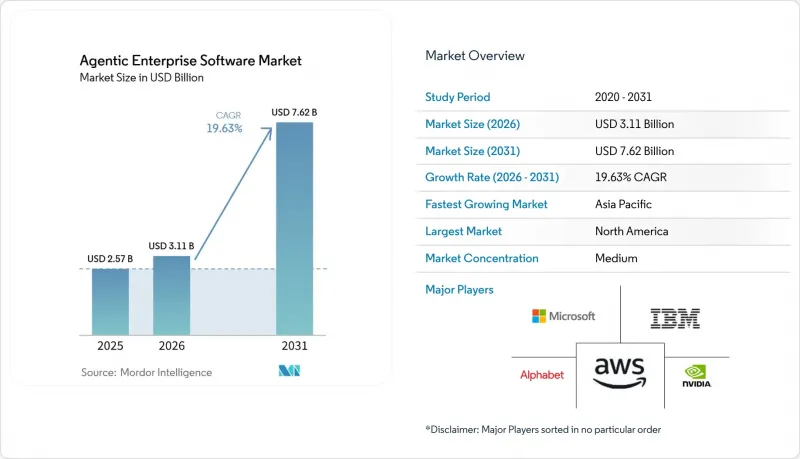
본 보고서는 도입 형태(클라우드, On-Premise, 하이브리드), 구성 요소(소프트웨어 및 서비스), 조직 규모(대기업 및 중소기업), 업종(은행, 금융서비스 및 보험(BFSI), 헬스케어 및 생명과학, 제조, 소매 및 전자상거래 등) 및 지역별로 분류되어 있습니다. 시장 전망은 금액(달러) 기준으로 제시되어 있습니다.
세계의 에이전틱 기업 소프트웨어 시장 동향 및 인사이트
하이퍼 오토메이션 및 비용 효율화에 대한 기업 수요
기업들은 특히 재무, 인사, 조달 부서에서 분산되어 있는 개별 도구를 통합된 에이전트 스택으로 집약하여, 사이클 타임 단축과 인건비 절감을 도모하고 있습니다. 에이전트는 사용자 인터페이스나 데이터 스키마가 변경되더라도 견고성을 유지하기 때문에 기존의 로봇 프로세스 자동화(RPA) 도입을 저해했던 비용이 많이 드는 스크립트 재작성을 피할 수 있습니다. 고임금 지역에서는 도입에 따른 투자 회수 기간이 1년 미만으로 단축됨에 따라 경영진 차원의 지원이 강화되고 있습니다. 예를 들어, 은행의 컴플라이언스 팀은 거래를 실시간으로 모니터링하는 에이전트를 도입하여, 규제상 감사 추적을 유지하면서도 오탐을 두 자릿수만큼 줄였습니다. 인건비 급등과 뿌리 깊은 기술 격차로 인해 디지털 노동의 매력은 더욱 높아지고 있으며, 성숙한 경제권과 신흥 경제권 모두에서 하이퍼 오토메이션에 대한 수요는 계속해서 높은 수준을 유지할 것으로 전망됩니다.
대규모 언어 모델과 도구 오케스트레이션 프레임워크의 급속한 발전
LangGraph, AutoGen, CrewAI 등의 프레임워크를 통해 개발자는 데이터 수집, 코드 실행, 추론에 특화된 에이전트를 연동하여, 인간 분석가의 성과에 근접하는 일관된 워크플로를 구축할 수 있습니다. OpenAI의 Frontier 플랫폼은 계약서 검토, 고객 지원 분류, 공급망 진단을 위해 즉시 사용 가능한 템플릿을 도입함으로써 도입 주기를 수 분기에서 수 주일로 단축했습니다. 컨텍스트 윈도우는 2025년 초 3만 2,000 토큰에서 20만 토큰 이상으로 비약적으로 확대되어, 에이전트가 코드베이스 전체나 수년에 걸친 원장을 한 번의 처리로 처리할 수 있게 되었습니다. 이 기능은 제조업 분야의 근본 원인 분석에서 높은 평가를 받고 있습니다. 안전 대책 기능을 갖춘 수직 최적화 모델은 환각 현상에 대한 우려를 해소하고 있으며, 이로 인해 확정적인 롤백과 종합적인 감사 추적이 요구되는 규제 분야에서 채택이 확대되고 있습니다.
높은 도입 비용과 레거시 시스템과의 통합에 따른 과제
수십년전부터 운영되어 온 전사적 자원 관리(ERP) 시스템이나 고객 관리 플랫폼에 에이전트를 통합하려면, 맞춤형 커넥터, 데이터 조화, 그리고 철저한 회귀 테스트가 필요합니다. 은행 및 보험 업계에서 여전히 운영되고 있는 메인프레임 환경은 COBOL 인터페이스에 최신 API가 결여되어 있어, 지연 시간과 장애 위험이 증가하며, 이로 인해 복잡성이 더욱 가중되고 있습니다. On-Premise 도입에는 전용 GPU 클러스터도 필요하며, 중규모 환경에서는 50만-200만 달러의 설비 투자가 필요합니다. 성과 기반 가격 책정은 위험의 일부를 공급업체에 전가하는 한편, 공급업체의 이익률을 압박하고 유능한 통합업체의 선택지를 좁혀 버립니다. 이러한 요인들로 인해 총소유비용(TCO) 측면에서 볼 때 매력적임에도 불구하고, 프로젝트 기간이 장기화되면서 단기적인 도입이 주춤하고 있습니다.
부문별 분석
하이브리드 시장 규모는 2031년까지 연평균 20.23%의 속도로 확대되고 있습니다. 이는 기업이 환자 기록이나 신용 리스크 모델 등 기밀성이 높은 추론 워크로드를 On-Premise 노드에 할당하는 한편, 배치 분석이나 일반 사용자용 챗봇에는 클라우드의 확장성을 활용하고 있기 때문입니다. 클라우드 서비스는 신속한 프로비저닝과 공급업체에 의한 업데이트 관리를 통해 2025년 매출의 61.74%를 차지했지만, 독일과 스위스의 데이터 소재지 관련 법규로 인해 순수 클라우드의 보급은 제한되었습니다. Microsoft Azure Stack, AWS Outposts 및 이와 유사한 솔루션은 로컬 하드웨어에서 클라우드의 제어 플레인을 복제하여, 개발자가 위치에 관계없이 동일한 API를 호출할 수 있도록 합니다. 새로운 상호운용성 프로토콜을 통해 설정에 따른 부하가 줄어들고, 로봇 공학에서 소매 키오스크에 이르는 엣지 이용 사례에서 100밀리초 미만의 응답 시간이 요구됨에 따라, 하이브리드 솔루션을 위한 에이전트 기반 기업 소프트웨어 시장 규모는 가속화될 것으로 전망됩니다.
규제 당국은 고위험 추론 로그를 자국 영토 내에 보관하도록 의무화함으로써 하이브리드 모델로의 전환을 촉진하고 있으며, 이를 통해 미션 크리티컬 데이터를 On-Premise에 보관함으로써 벤더 종속성을 방지할 수 있습니다. 기업들은 지연 시간에 민감한 토큰을 로컬에 보관하는 한편, 중요도가 낮은 작업은 온디맨드 요금보다 최대 80% 저렴한 스팟 인스턴스로 버스트 처리함으로써 데이터 전송 비용을 절감하고 있습니다. 멀티 클라우드 거버넌스가 성숙해짐에 따라, 에이전트는 단일 워크플로우 내에서 AWS, Azure, Google Cloud에 걸쳐 있는 작업을 점점 더 많이 조정하게 되며, 이를 통해 실행 시의 위험을 분산시키고 복원력을 강화하게 됩니다.
2025년 지출 중 소프트웨어가 58.42%를 차지했으나, 서비스 부문이 연평균 성장률(CAGR) 20.03%로 성장을 지속하고, 있는 점을 고려할 때, 에이전틱 기업 소프트웨어 시장 점유율 구성은 변화하고 있으며, 이는 이기종 혼합 환경에 에이전트를 통합하는 데 따르는 어려움을 반영하고 있습니다. 데이터 엔지니어링, 스키마 매핑, 안전성 테스트에는 첫해 예산의 30%에서 50%가 소요될 가능성이 있으며, 주요 대도시권에서는 전문 엔지니어의 시급이 300달러에 달할 전망입니다. 명확한 성과 벤치마크를 약속하는 성과 기반 관리형 서비스는 사내에 머신러닝 전문 인력을 보유하지 않은 중견 기업의 구매자들을 끌어들이고 있습니다.
OpenAI가 전 세계 컨설팅 기업들과 맺은 ‘Frontier Alliances’는 모델에 대한 전문 지식과 변경 관리 노하우를 통합함으로써 이 생태계를 체계화하고, 규제가 엄격한 업계에서의 시범 도입 기간을 단축하고 있습니다. 하이퍼스케일러가 제공하는 교육 프로그램을 통해 프롬프트 엔지니어링 및 레드팀 활동 분야에서 수천 명의 실무자가 인증을 취득했으며, 이는 서비스의 성장을 더욱 촉진하고 있습니다. 벤더가 운영 리스크를 부담함에 따라 에이전틱 기업 소프트웨어의 매니지드 서비스 시장 규모는 확대될 전망이지만, 이익률 압박으로 인해 자금력이 취약한 스타트업 간의 통합이 진행될 가능성이 있습니다.
지역별 분석
북미는 확고한 입지를 갖춘 기존 기술 기업들의 존재와 유리한 규제 환경의 뒷받침을 받아, 2025년 매출의 39.68%를 차지했습니다. 해당 지역이 시장을 독점하고 있는 요인은 첨단 기술의 조기 도입과 혁신에 대한 막대한 투자에 있습니다. 그러나 2031년까지 아시아·태평양 지역이 20.63%라는 지역별 최고 연평균 성장률(CAGR)을 달성할 것으로 예측됩니다. 중국, 일본, 인도, 한국 등의 국가들은 데이터 주권을 확보하기 위해 자체 개발한 모델 훈련 및 로컬 추론 클러스터에 막대한 투자를 하고 있습니다. 이러한 움직임에 힘입어 On-Premise형 가속기 및 오픈소스 도구에 대한 수요가 증가하고 있으며, 해당 지역은 시장의 주요 성장 동력으로서의 입지를 확고히 하고 있습니다. 한편, 유럽에서는 엄격한 개인정보 보호 규제로 인해 도입 속도가 둔화되고 있지만, 이러한 접근 방식은 장기적인 신뢰를 쌓는 데 기여하며, 해당 지역공급업체들에게 경쟁 우위를 제공할 가능성이 있습니다.
중동 및 아프리카에서는 석유 수입의 급증분을 AI 허브 개발에 투자하고 있습니다. 다만, 현재 AI 활용은 에너지 및 공공 서비스 등의 분야에 집중되어 있습니다. 이러한 투자는 지역 경제의 다각화와 기술력 강화를 목적으로 하고 있습니다. 라틴아메리카에서는 성장이 주로 브라질과 아르헨티나에 집중되어 있으며, 디지털 뱅킹 및 소매업 분야의 시범 프로젝트를 통해 사기 감지 및 맞춤형 상품 제안 분야에서 AI의 가치를 성공적으로 입증하고 있습니다. 이러한 진전은 경제의 불안정성이나 인프라의 제약과 같은 과제가 있음에도 불구하고, 해당 지역에서 AI 도입의 가능성을 여실히 보여주고 있습니다.
말레이시아, 태국, 사우디아라비아 등 여러 국가에서 하이퍼스케일러의 지역 거점을 확충함에 따라, 엣지 처리를 많이 활용하는 워크로드의 지연 시간을 줄이고, 첨단 기술의 도입을 더욱 촉진하고 있습니다. 이러한 움직임은 세계경제포럼(WEF)의 거버넌스 프레임워크에 의해 보완되고 있으며, 이 프레임워크는 기업이 여러 관할 구역에 걸친 사업을 조화롭게 운영할 수 있도록 표준화된 용어 체계를 제공합니다. 이 프레임워크는 다양한 규제 환경에서 사업을 전개하는 조직에 특히 유용하며, 보다 원활한 통합과 규정 준수를 가능하게 합니다. 전반적으로 볼 때, 이러한 지역별 동향은 AI 도입을 향한 전 세계적인 추세를 여실히 보여주고 있으며, 각 지역의 정책, 투자, 기술적 준비 상황에 따라 그 성장 양상은 다양합니다.
기타 혜택 :
- 엑셀 형식 시장 예측(ME) 시트
- 3개월간의 애널리스트 지원
자주 묻는 질문
목차
제1장 서론
제2장 조사 방법
제3장 주요 요약
제4장 시장 구도
제5장 시장 규모 및 성장 예측
제6장 경쟁 구도
제7장 시장 기회 및 향후 전망
KTH 26.06.22According to Mordor Intelligence, the agentic enterprise software market size is expected to grow from USD 2.57 billion in 2025 to USD 3.11 billion in 2026 and is forecast to reach USD 7.62 billion by 2031 at a 19.63% CAGR over 2026-2031.
This report is Segmented by Deployment Mode (Cloud, On-Premise, and Hybrid), Component (Software and Services), Organization Size (Large Enterprises and Small and Medium Enterprises), Industry Vertical (BFSI, Healthcare and Life Sciences, Manufacturing, Retail and E-Commerce, and More), and Geography. The Market Forecasts are Provided in Terms of Value (USD).
Global Agentic Enterprise Software Market Trends and Insights
Enterprise Demand for Hyper-Automation and Cost Efficiency
Organizations are consolidating scattered point tools into unified agent stacks that compress cycle times and shrink payroll outlays, especially in finance, human resources, and procurement. Agents remain resilient when user interfaces or data schemas shift, which avoids the costly re-scripting that undermined earlier robotic process automation efforts. In high-wage regions, deployments now attain payback in under one year, strengthening board-level sponsorship. Banking compliance teams, for example, deploy agents that monitor transactions in real time, achieving double-digit reductions in false positives while maintaining regulatory audit trails. Rising labor costs and persistent skills gaps further magnify the appeal of digital labor, ensuring that demand for hyper-automation will stay elevated across both mature and emerging economies.
Rapid Advances in Large Language Models and Tool-Orchestration Frameworks
Frameworks such as LangGraph, AutoGen, and CrewAI allow developers to chain specialized agents for data retrieval, code execution, and reasoning into cohesive workflows that approximate human analyst performance. OpenAI's Frontier platform introduced out-of-the-box templates for contract reviews, customer support triage, and supply chain diagnostics, cutting deployment cycles from quarters to weeks. Context windows have leapt from 32,000 tokens in early 2025 to more than 200,000, enabling agents to process entire code bases or multi-year ledgers in a single pass, a capability prized for root-cause investigations in manufacturing. Vertically tuned models backed by safety guardrails are addressing concerns about hallucinations, which is widening adoption in regulated fields that require deterministic rollback and comprehensive audit trails.
High Implementation Costs and Legacy Integration Challenges
Embedding agents into decades-old enterprise resource planning and customer management platforms demands custom connectors, data harmonization, and exhaustive regression testing. Mainframe environments that still power banking and insurance add another layer of complexity because COBOL interfaces lack modern APIs, which increases latency and failure risk. On-premise rollouts also require specialized GPU clusters, which entail capital expenditures ranging from USD 0.5 million to USD 2 million for mid-sized estates. While outcome-based pricing shifts some risk to vendors, it compresses their margins and restricts the pool of capable integrators. These factors prolong project timelines and temper near-term adoption despite compelling total cost-of-ownership calculations.
Other drivers and restraints analyzed in the detailed report include:
- Cloud Infrastructure Expansion and Lower Inference Costs
- Emergence of Multi-Agent Governance Standards Enabling Cross-Vendor Interoperability
- Data Privacy and Regulatory Uncertainty
For complete list of drivers and restraints, kindly check the Table Of Contents.
Segment Analysis
Hybrid deployments are expanding at a 20.23% annual clip through 2031 as firms route sensitive inference workloads, such as patient records or credit-risk models, to on-premise nodes while leveraging cloud elasticity for batch analytics and public-facing chatbots. Cloud offerings accounted for 61.74% of 2025 revenue due to rapid provisioning and vendor-maintained updates, yet data residency statutes in Germany and Switzerland limit pure-cloud penetration. Microsoft Azure Stack, AWS Outposts, and similar solutions replicate cloud control planes on local hardware, enabling developers to invoke identical APIs regardless of location. The agentic enterprise software market size for hybrid solutions is forecast to accelerate as emerging interoperability protocols reduce configuration overhead and as edge use cases, from robotics to retail kiosks, demand sub-100-millisecond response times.
Regulators are nudging adoption toward hybrid models by requiring that high-risk inference logs remain within sovereign borders, thereby guarding against vendor lock-in by keeping mission-critical data onsite. Enterprises cut egress bills by keeping latency-sensitive tokens local while bursting non-critical jobs to spot instances priced up to 80% below on-demand rates. As multi-cloud governance matures, agents will increasingly orchestrate tasks across AWS, Azure, and Google Cloud within a single workflow, thereby diversifying runtime risk and amplifying resilience.
Software accounted for 58.42% of 2025 spending, yet the agentic enterprise software market share mix is shifting as services register a 20.03% CAGR, mirroring the difficulty of stitching agents into heterogeneous estates. Data engineering, schema mapping, and safety testing can swallow 30% to 50% of first-year budgets, while hourly rates for specialized engineers reach USD 300 in major hubs. Outcome-based managed services that commit to definitive performance benchmarks are attracting mid-market buyers that lack in-house machine-learning talent.
OpenAI's Frontier Alliances with global consultancies formalize this ecosystem by pooling model expertise with change-management playbooks, shrinking pilot timelines in heavily regulated verticals. Training programs from hyperscalers certify thousands of practitioners in prompt engineering and red-teaming, further fueling services growth. The agentic enterprise software market size for managed offerings is set to expand as vendors assume operational risk, though margin pressures may induce consolidation among undercapitalized startups.
Geography Analysis
North America accounted for 39.68% of 2025 revenue, driven by the presence of established technology incumbents and a favorable regulatory environment. The region's market stronghold is attributed to its early adoption of advanced technologies and significant investments in innovation. However, the Asia-Pacific is expected to achieve the highest regional CAGR of 20.63% through 2031. Countries such as China, Japan, India, and South Korea are heavily investing in indigenous model training and local inference clusters to ensure data sovereignty. This focus has led to increased demand for on-premise accelerators and open-source tools, positioning the region as a key growth driver in the market. Meanwhile, Europe faces slower rollouts due to its stringent privacy regulations, but this approach fosters long-term trust, which could serve as a competitive advantage for vendors in the region.
The Middle East and Africa are channeling oil windfall revenues into the development of AI hubs, though current use remains concentrated in sectors such as energy and public services. These investments aim to diversify regional economies and enhance technological capabilities. In Latin America, growth is primarily centered around Brazil and Argentina, where digital banking and retail pilots are successfully demonstrating the value of AI in fraud detection and personalized merchandising. These advancements highlight the region's potential for AI adoption, despite challenges such as economic instability and infrastructure limitations.
Hyperscaler region build-outs in countries like Malaysia, Thailand, and Saudi Arabia are reducing latency for edge-heavy workloads, further enabling the adoption of advanced technologies. These developments are complemented by the World Economic Forum's governance framework, which provides a standardized vocabulary for enterprises to harmonize multi-jurisdiction deployments. This framework is particularly beneficial for organizations operating across diverse regulatory environments, ensuring smoother integration and compliance. Collectively, these regional dynamics underscore the global momentum toward AI adoption, with varying growth trajectories influenced by local policies, investments, and technological readiness.
- Microsoft Corporation
- Salesforce Inc
- ServiceNow Inc
- Amazon Web Services Inc
- Google Cloud (Alphabet Inc)
- IBM Corporation
- OpenAI LLC
- Anthropic PBC
- Cohere Inc
- Adept AI Labs
- NVIDIA Corporation
- UiPath Inc
- Aisera Inc
- DataRobot Inc
- Cognigy GmbH
- SAP SE
- Snowflake Inc
- Oracle Corporation
- Baidu Inc
- Automation Anywhere Inc
Additional Benefits:
- The market estimate (ME) sheet in Excel format
- 3 months of analyst support
TABLE OF CONTENTS
1 INTRODUCTION
- 1.1 Study Assumptions and Market Definition
- 1.2 Scope of the Study
2 RESEARCH METHODOLOGY
3 EXECUTIVE SUMMARY
4 MARKET LANDSCAPE
- 4.1 Market Overview
- 4.2 Market Drivers
- 4.2.1 Enterprise Demand for Hyper-Automation and Cost Efficiency
- 4.2.2 Rapid Advances in Large Language Models and Tool-Orchestration Frameworks
- 4.2.3 Cloud Infrastructure Expansion and Lower Inference Costs
- 4.2.4 Emergence of Multi-Agent Governance Standards Enabling Cross-Vendor Interoperability
- 4.2.5 Sector-Specific Responsible AI Frameworks Unlocking Regulated Industry Adoption
- 4.2.6 Availability of Outcome-Based Pricing Models Accelerating Mid-Market Uptake
- 4.3 Market Restraints
- 4.3.1 High Implementation Costs and Legacy Integration Challenges
- 4.3.2 Data Privacy and Regulatory Uncertainty
- 4.3.3 Scarcity of Safety-Alignment Engineering Talent
- 4.3.4 Absence of Enterprise-Grade Agent Reliability Benchmarks
- 4.4 Impact of Macroeconomic Factors on the Market
- 4.5 Industry Value Chain Analysis
- 4.6 Regulatory Landscape
- 4.7 Technological Outlook
- 4.8 Porter's Five Forces Analysis
- 4.8.1 Bargaining Power of Suppliers
- 4.8.2 Bargaining Power of Buyers
- 4.8.3 Threat of New Entrants
- 4.8.4 Threat of Substitutes
- 4.8.5 Intensity of Competitive Rivalry
5 MARKET SIZE AND GROWTH FORECASTS (VALUE)
- 5.1 By Deployment Mode
- 5.1.1 Cloud-Based
- 5.1.2 On-Premise
- 5.1.3 Hybrid
- 5.2 By Component
- 5.2.1 Software
- 5.2.2 Services
- 5.3 By Organization Size
- 5.3.1 Large Enterprises
- 5.3.2 Small and Medium Enterprises
- 5.4 By Industry Vertical
- 5.4.1 Banking Financial Services and Insurance BFSI
- 5.4.2 Healthcare and Life Sciences
- 5.4.3 Manufacturing
- 5.4.4 Retail and E-Commerce
- 5.4.5 Information Technology and Telecom
- 5.4.6 Government and Public Sector
- 5.5 By Geography
- 5.5.1 North America
- 5.5.1.1 United States
- 5.5.1.2 Canada
- 5.5.1.3 Mexico
- 5.5.2 South America
- 5.5.2.1 Brazil
- 5.5.2.2 Argentina
- 5.5.2.3 Rest of South America
- 5.5.3 Europe
- 5.5.3.1 United Kingdom
- 5.5.3.2 Germany
- 5.5.3.3 France
- 5.5.3.4 Italy
- 5.5.3.5 Spain
- 5.5.3.6 Rest of Europe
- 5.5.4 Asia-Pacific
- 5.5.4.1 China
- 5.5.4.2 Japan
- 5.5.4.3 India
- 5.5.4.4 South Korea
- 5.5.4.5 Rest of Asia-Pacific
- 5.5.5 Middle East and Africa
- 5.5.5.1 Middle East
- 5.5.5.1.1 United Arab Emirates
- 5.5.5.1.2 Saudi Arabia
- 5.5.5.1.3 Rest of Middle East
- 5.5.5.2 Africa
- 5.5.5.2.1 South Africa
- 5.5.5.2.2 Egypt
- 5.5.5.2.3 Rest of Africa
- 5.5.5.1 Middle East
- 5.5.1 North America
6 COMPETITIVE LANDSCAPE
- 6.1 Market Concentration
- 6.2 Strategic Moves
- 6.3 Market Share Analysis
- 6.4 Company Profiles (includes Global Level Overview, Market Level Overview, Core Segments, Financials as available, Strategic Information, Market Rank/Share, Products and Services, Recent Developments)
- 6.4.1 Microsoft Corporation
- 6.4.2 Salesforce Inc
- 6.4.3 ServiceNow Inc
- 6.4.4 Amazon Web Services Inc
- 6.4.5 Google Cloud (Alphabet Inc)
- 6.4.6 IBM Corporation
- 6.4.7 OpenAI LLC
- 6.4.8 Anthropic PBC
- 6.4.9 Cohere Inc
- 6.4.10 Adept AI Labs
- 6.4.11 NVIDIA Corporation
- 6.4.12 UiPath Inc
- 6.4.13 Aisera Inc
- 6.4.14 DataRobot Inc
- 6.4.15 Cognigy GmbH
- 6.4.16 SAP SE
- 6.4.17 Snowflake Inc
- 6.4.18 Oracle Corporation
- 6.4.19 Baidu Inc
- 6.4.20 Automation Anywhere Inc
7 MARKET OPPORTUNITIES AND FUTURE OUTLOOK
- 7.1 White-Space and Unmet-Need Assessment


