

|
시장보고서
상품코드
2063458
남미의 계약 물류 시장 : 시장 점유율 분석, 업계 동향 및 통계, 성장 예측(2026-2031년)South America Contract Logistics - Market Share Analysis, Industry Trends & Statistics, Growth Forecasts (2026 - 2031) |
||||||
 Mordor Intelligence
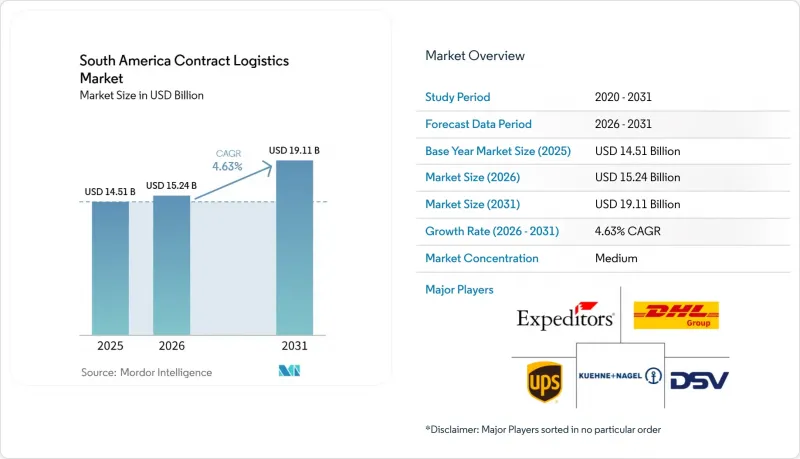
Mordor Intelligence에 의하면, 남미의 계약 물류 시장 규모는 2025년에 145억 1,000만 달러로 평가되었고, 2026년 152억 4,000만 달러로 추정되고, 2031년까지 191억 1,000만 달러에 이를 것으로 예측되며, 예측 기간(2026-2031년) CAGR은 4.63%를 나타낼 전망입니다.
전자상거래 물류, 자동차 조립의 니어쇼어링, 그리고 콜드체인 규제가 서비스 포트폴리오를 재편하고 있는 반면, 기간 및 금액 표시 계약은 환율 변동 위험을 헤지하고, 높은 처리 능력과 첨단 기술을 갖춘 물류 센터의 급속한 확충을 뒷받침하고 있습니다. 본 보고서는 서비스 유형별(운송, 창고 및 물류, 기타), 계약 기간별(1-3년, 3년 이상), 최종 사용자 산업별(제조 및 자동차, 식품 및 음료, 소매 및 전자상거래, 기타), 국가별(브라질, 아르헨티나, 칠레, 콜롬비아, 페루, 기타 남미)로 분류되어 있습니다. 시장 전망은 금액(달러) 기준으로 제시되어 있습니다.
남미의 계약 물류 시장 동향 및 인사이트
전자상거래의 급속한 성장과 당일 및 익일 배송에 대한 수요
플랫폼 사업자는 물류를 변동비에서 고정자산으로 전환했습니다. 이는 지역 전자상거래 거래량의 60%를 차지하는 주요 유통 경로에서 주문 처리 속도가 시장 점유율을 좌우하게 되었기 때문입니다. 메르카도 리브레는 2025년까지 브라질의 물류 센터를 21곳으로 두 배로 늘리고, 88만 제곱미터를 증설하여 상파울루, 리우데자네이루, 벨루오리존치에서 당일 배송을 실현했습니다. 이에 이어 Shopee는 2026년 3월 상파울루에 22만 제곱미터 규모의 물류센터를 개설하여, 주문에서 출하까지의 시간을 12시간 미만으로 단축했습니다. CEVA가 11주 만에 건설한 아마존의 브라질리아 물류 센터(6만 7,000제곱미터)는 하루 평균 13만 5,000개의 화물을 처리하고 있습니다. 아르헨티나에서는 이미 온라인 주문의 30%가 24시간 이내에 배송되고 있으며, 코르도바와 로사리오 인근에 재고를 배치하고 있습니다. 브라질의 리버스 로지스틱스 흐름에서 총 77%의 세금 부담을 안고 있는 수입품을 검사, 재포장, 재판매하는 업체들이 8-12%의 추가 마진을 얻고 있습니다.
자동차 생산 및 수출의 성장
니어쇼어링은 미중 간 긴장을 완화하고, 엄격한 USMCA(미국·멕시코·캐나다 협정)의 현지 조달률 규정을 확실히 준수하도록 합니다. BYD의 카마칼리 공장은 2025년에 연간 15만 대의 생산량을 달성한 것으로 평가되었으며, 10억 6,000만 달러를 투자해 2026년 말까지 생산량을 두 배로 늘릴 계획입니다. 이에 따라 생산 라인에서 30분 거리 내에 전용 시퀀싱 센터가 필요하게 됩니다. 그레이트월 모터스(Great Wall Motors)는 20억 달러 규모의 복합 단지를 건설 중이며, 닛산은 레젠데 공장에 5억 4,000만 달러를 투자해 2교대 근무를 도입함으로써 하루 12회의 밀크런(부품 공급) 노선을 운영할 수 있게 되었습니다. 브라질의 전기차 관세는 2026년 7월까지 35%를 나타낼 것으로 예측되며, 이는 현지 조립을 가속화할 뿐만 아니라 배터리 모듈 장착, 소프트웨어 펌웨어 업데이트, 규정 준수 라벨 부착에 대한 추가 비용을 높이고 있습니다. 멕시코의 395만 대라는 생산 대수는 해당 지역 각국 정부가 본보기로 삼고자 하는 기준이 되고 있습니다.
도로 및 항만 인프라의 병목 현상
산토스 항은 2025년에 130만 TEU를 처리했으나, 테콘 10 프로젝트가 본격 가동되는 것은 2040년이 될 예정이므로, 체류 시간은 여전히 평균 4-5일로 파나마 운하의 동급 항구에 비해 2배에 달할 전망입니다. 발파라이소 항구에서는 산티아고행 화물의 85%를 트럭에 의존하고 있어, 컨테이너 1개당 150-200달러의 추가 비용이 발생하고 운송 시간이 최대 1일 정도 늘어납니다. 아르헨티나의 인프라망은 재정 위기 기간 동안 노후화가 진행되어, 고속도로의 70%가 허용 기준을 밑도는 상태가 되었으며, 이로 인해 운송업체의 유지 관리 비용이 최대 20%까지 증가했습니다.
부문별 분석
2025년 기준으로 남미 계약 물류 시장 점유율의 62.87%를 운송 서비스가 차지했으며, 화물의 60%가 여전히 트럭으로 운송되고 있다는 사실은 이 대륙의 규모를 여실히 보여주고 있습니다. 부가가치 서비스는 6.18%의 성장 궤도에 오를 전망이며, 재고 비용을 최대 25% 절감하는 유예 전략과 재생 소재 함유량 공개와 관련된 새로운 표시 의무의 혜택을 받게 될 것입니다.
육상 운송은 팔레트당 비용을 12% 절감하는 아르헨티나의 비트렌(2대 연결 트럭) 도입 승인으로 혜택을 볼 것으로 예측됩니다. 철도는 브라질 화물 수송량의 15%에 불과하지만, 우르키사 노선의 현대화를 통해 2028년까지 최대 200만 톤의 화물이 도로에서 철도로 전환될 가능성이 있습니다. 항공 화물은 과룰류스 공항을 경유하는 의약품 및 신선식품이 주를 이루고 있으며, 화주들은 현재 에이프런에 인접한 냉장실을 사전 예약하고 있습니다. 해상 화물 증가세는 2026년까지 산토스항의 처리 능력을 170만 TEU로 확대하겠다는 DP 월드의 계획에 부합하는 것이며, 남미 계약 물류 시장과 관련된 컨테이너 운송량의 견조한 흐름을 반영하고 있습니다.
기타 혜택 :
- 엑셀 형식 시장 예측(ME) 시트
- 3개월간의 애널리스트 지원
자주 묻는 질문
목차
제1장 서론
제2장 조사 방법
제3장 주요 요약
제4장 시장 구도
제5장 시장 규모 및 성장 예측
제6장 경쟁 구도
제7장 시장 기회 및 향후 전망
AJY 26.06.22According to Mordor Intelligence, the south america contract logistics market size was valued at USD 14.51 billion in 2025 and estimated to grow from USD 15.24 billion in 2026 to reach USD 19.11 billion by 2031, at a CAGR of 4.63% during the forecast period (2026-2031).
E-commerce fulfillment, near-shoring of automotive assembly, and cold-chain mandates are reshaping service portfolios, while multiyear, dollar-denominated contracts hedge currency swings and underpin the rapid build-out of high-throughput, technology-enabled distribution centers. This report is Segmented by Service Type (Transportation, Warehousing & Distribution, and More), by Contract Duration (1-3 Years, Above 3 Years), by End-User Industry (Manufacturing & Automotive, Food & Beverage, Retail & E-Commerce, and More), and by Country (Brazil, Argentina, Chile, Colombia, Peru, Rest of South America). The Market Forecasts are Provided in Terms of Value (USD).
South America Contract Logistics Market Trends and Insights
E-Commerce Boom and Same- or Next-Day Fulfillment Demand
Platform operators converted logistics from a variable cost into a fixed asset because fulfillment speed now dictates share in corridors that host 60% of regional e-commerce volume. Mercado Libre doubled Brazilian distribution centers to 21 by 2025, adding 880,000 square meters and securing same-day delivery in Sao Paulo, Rio de Janeiro, and Belo Horizonte. Shopee followed by opening a 220,000-square-meter Sao Paulo warehouse in March 2026, cutting order-to-dispatch time below 12 hours. Amazon's 67,000-square-meter Brasilia fulfillment center, built by CEVA in eleven weeks, processes 135,000 packages daily. Argentina already delivers 30% of online orders within 24 hours, pushing inventory closer to Cordoba and Rosario. Reverse-logistics flows in Brazil earn 8-12% incremental margin for providers who inspect, repackage, and relist imports that face a combined 77% tax burden.
Automotive Production and Export Growth
Near-shoring mitigates U.S.-China tensions and ensures compliance with strict USMCA content rules. BYD's Camacari plant reached 150,000 units in 2025 and, following a USD 1.06 billion investment, will double output by the end of 2026, requiring dedicated sequencing centers within 30 minutes of the production line. Great Wall Motors is constructing a USD 20 billion complex, while Nissan invested USD 540 million to add a second shift in Resende, enabling twelve daily milk-run circuits. Rising EV tariffs in Brazil, set to reach 35% by July 2026, are accelerating local assembly and increasing the premium for battery-module installation, software flashing, and compliance labeling. Mexico's 3.95 million-unit output serves as a benchmark that regional governments aim to emulate.
Road and Port Infrastructure Bottlenecks
Santos moved 1.3 million TEU in 2025, yet still averages four to five-day dwell times, double that of Panama Canal peers, because the Tecon 10 project will only reach full capacity in 2040. Valparaiso relies on trucks for 85% of its Santiago-bound cargo, adding USD 150-200 per container and up to a full day of transit. Argentina's network downgraded during its fiscal crisis, leaving 70% of highways below acceptable standards and inflating carrier maintenance costs by up to 20%.
Other drivers and restraints analyzed in the detailed report include:
- Infrastructure Modernization Programs
- Near-Shoring of North American and EU Supply Chains
- Complex Cross-Border Customs and Tax Regimes
For complete list of drivers and restraints, kindly check the Table Of Contents.
Segment Analysis
Transportation services accounted for 62.87% of the South America contract logistics market share in 2025, underlining the scale of a continent where 60% of cargo still moves by truck. Value-added services are poised for a 6.18% growth trajectory, benefiting from postponement strategies that cut inventory costs by up to 25%, and from new labeling mandates tied to recycled-content disclosure.
Road haulage should benefit from Argentina's allowance of bitrenes, which lowers per-pallet costs by 12%. Rail remains limited at 15% of Brazil's freight share, though modernization of the Urquiza line could redirect up to two million tonnes from road to rail by 2028. Air freight centers on pharmaceuticals and perishables moving through Guarulhos, where shippers now pre-book apron-adjacent cold rooms. Sea freight growth aligns with DP World's plan to raise Santos capacity to 1.7 million TEU by 2026, reflecting strong containerized flows tied to the South America contract logistics market.
List of Companies Covered in this Report:
- DHL Supply Chain
- DSV Solutions
- Kuehne + Nagel
- CEVA Logistics (CMA CGM)
- Maersk Logistics & Services
- DP World
- JSL Logistica
- ID Logistics
- GEODIS
- UPS Supply Chain Solutions
- FedEx Logistics
- Andreani Logistica
- Penske Logistics
- Hellmann Worldwide Logistics
- Grupo TASA Logistica
- TPC Logistica
- Yusen Logistics
- R0hlig Logistics
- Expeditors
- Crane Worldwide Logistics
Additional Benefits:
- The market estimate (ME) sheet in Excel format
- 3 months of analyst support
TABLE OF CONTENTS
1 Introduction
- 1.1 Study Assumptions & Market Definition
- 1.2 Scope of the Study
2 Research Methodology
3 Executive Summary
4 Market Landscape
- 4.1 Market Overview
- 4.2 Market Drivers
- 4.2.1 E-Commerce Boom & Same-/Next-Day Fulfilment Demand
- 4.2.2 Automotive Production & Export Growth
- 4.2.3 Infrastructure Modernization Programmes
- 4.2.4 Near-Shoring of North-American/EU Supply Chains
- 4.2.5 Cold-Chain Needs for Agrifood & Vaccines
- 4.2.6 Pay-As-You-Go 3PL Micro-Fulfilment in Secondary Cities
- 4.3 Market Restraints
- 4.3.1 Road & Port Infrastructure Bottlenecks
- 4.3.2 Complex Cross-Border Customs & Tax Regimes
- 4.3.3 FX-Volatility Risk to Long-Term 3PL Contracts
- 4.3.4 Skilled Warehouse-Labor Shortages
- 4.4 Value / Supply-Chain Analysis
- 4.5 Regulatory Landscape
- 4.6 Technological Outlook
- 4.7 Porter's Five Forces
- 4.7.1 Threat of New Entrants
- 4.7.2 Bargaining Power of Suppliers
- 4.7.3 Bargaining Power of Buyers
- 4.7.4 Threat of Substitutes
- 4.7.5 Industry Rivalry
- 4.8 Insights on E-commerce (Domestic and Cross-Border)
- 4.9 Insights on Reverse Logistics
- 4.10 Impact of Geo-Political Events
5 Market Size & Growth Forecasts (Value)
- 5.1 By Service Type
- 5.1.1 Transportation
- 5.1.1.1 Road
- 5.1.1.2 Rail
- 5.1.1.3 Air
- 5.1.1.4 Sea
- 5.1.2 Warehousing & Distribution
- 5.1.3 Value-added Services (Assembly, Labelling, Kitting)
- 5.1.1 Transportation
- 5.2 By Contract Duration
- 5.2.1 1-3 Years
- 5.2.2 Above 3 years
- 5.3 By End-user Industry
- 5.3.1 Manufacturing and Automotive
- 5.3.2 Food and Beverage
- 5.3.3 Retail and E-commerce
- 5.3.4 Healthcare and Pharmaceuticals
- 5.3.5 Chemicals
- 5.3.6 Other Industries
- 5.4 By Country
- 5.4.1 Brazil
- 5.4.2 Argentina
- 5.4.3 Chile
- 5.4.4 Colombia
- 5.4.5 Peru
- 5.4.6 Rest of South America
6 Competitive Landscape
- 6.1 Market Concentration
- 6.2 Strategic Moves
- 6.3 Market Share Analysis
- 6.4 Company Profiles {(includes Global level Overview, Market level overview, Core Segments, Financials as available, Strategic Information, Market Rank/Share for key companies, Products & Services, and Recent Developments)}
- 6.4.1 DHL Supply Chain
- 6.4.2 DSV Solutions
- 6.4.3 Kuehne + Nagel
- 6.4.4 CEVA Logistics (CMA CGM)
- 6.4.5 Maersk Logistics & Services
- 6.4.6 DP World
- 6.4.7 JSL Logistica
- 6.4.8 ID Logistics
- 6.4.9 GEODIS
- 6.4.10 UPS Supply Chain Solutions
- 6.4.11 FedEx Logistics
- 6.4.12 Andreani Logistica
- 6.4.13 Penske Logistics
- 6.4.14 Hellmann Worldwide Logistics
- 6.4.15 Grupo TASA Logistica
- 6.4.16 TPC Logistica
- 6.4.17 Yusen Logistics
- 6.4.18 R0hlig Logistics
- 6.4.19 Expeditors
- 6.4.20 Crane Worldwide Logistics
7 Market Opportunities & Future Outlook
- 7.1 White-space & Unmet-need Assessment


