
|
시장보고서
상품코드
1910600
북미의 계약 물류 시장 : 점유율 분석, 업계 동향 및 통계, 성장 예측(2026-2031년)North America Contract Logistics - Market Share Analysis, Industry Trends & Statistics, Growth Forecasts (2026 - 2031) |
||||||
 Mordor Intelligence
북미의 계약 물류 시장은 2025년 724억 2,000만 달러로 평가되었으며, 2026년 746억 5,000만 달러에서 2031년까지 868억 6,000만 달러에 이를 것으로 예측됩니다.
예측기간(2026-2031년)의 CAGR은 3.08%로 전망되고 있습니다.
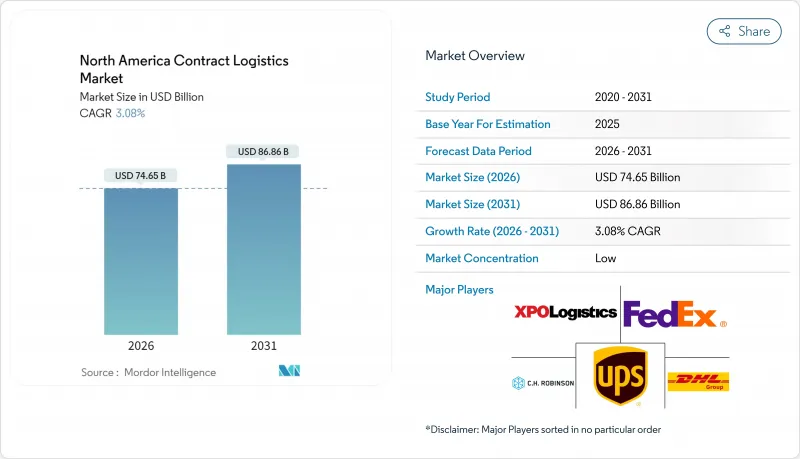
비핵심 물류 기능의 아웃소싱 확대, 지속적인 전자상거래 급증, 미국, 멕시코 및 캐나다 간 협정(USMCA)의 국경을 넘어서는 통합이 계속 시장 확대를 뒷받침하고 있습니다. 운송 서비스는 여전히 지출의 대부분을 차지하고 있지만, 화주가 최종 시장에 가까운 곳에서 비용 효율적인 커스터마이즈를 요구하는 가운데, 조립에서 라벨링에 이르는 부가가치 사업이 가장 급속한 성장을 기록하고 있습니다. 안정적인 장기 계약이 자동화와 콜드체인 인프라에 대한 투자를 지원하는 반면, 멕시코에 대한 니어쇼어링은 새로운 물류 센터 건설의 파도를 견인하고 있습니다. 세계 통합 기업이 규모를 확대하고 지역 전문 기업이 기술 집약형 틈새 시장을 개척함에 따라 경쟁의 격화가 진행되고 있습니다.
북미의 계약 물류 시장의 동향 및 인사이트
급증하는 전자상거래 풀필먼트량
소매업체는 현재 로봇 기술을 도입한 창고, 실시간 시각화, 옴니채널 연계를 요구하고 있습니다. 페덱스는 자율 이동 로봇과 고속 분류기를 도입하여 복잡화하는 소포에 대응하고 사이클 타임 단축과 처리 능력 향상을 달성했습니다. 물류사업자는 AI를 활용한 수요 예측과 재고 배치를 통해 소비자용 직송 및 B2B 플로에서 라스트마일 배송 정확도를 향상시키고 있습니다. 중견 3PL 기업은 배송 지역을 크게 줄이는 분산형 노드 네트워크를 제공함으로써 계약 획득을 증가시키고 있습니다. 한때 복잡한 솔루션을 가격 때문에 도입할 수 없었던 중소기업 화주는 창고 관리 시스템(WMS), 운송 관리 시스템(TMS), 요금 비교 기능을 구독 가격에 제공하는 클라우드 기반의 3PL 포털을 이용하고 있습니다. 이러한 변화는 아웃소싱 파트너에 대한 수익 증가를 촉진하고 북미의 계약 물류 시장에서 부가가치 서비스의 중요성을 더욱 높입니다.
비용 효율적인 자산 경량 모델로 아웃소싱 추진
화주 기업은 자사 물류 자산의 현금화에 의해 재무 체질을 재구축하는 한편, 3PL 사업자는 창고, 차량 및 인재를 획득하고 있습니다. 2024년판 '물류현황보고서'에 의하면 계약 물류 수익은 견조한 성장을 보였으며 변동성이 높아짐에 따라 보증된 운송 능력이 중요시되는 가운데 기존의 트럭 운송 부문을 상회했습니다. 장기 계약을 통해 공급자는 자동화 투자를 상각하고 전임 노동력을 투입할 수 있으므로 화주를 위한 서비스 KPI 향상과 공급자의 현금 흐름 안정화를 실현합니다. 이 동향은 전용 자산과 중재의 유연성을 융합한 하이브리드 모델로 꾸준히 전환하는 북미의 계약 물류 시장과 조화를 이루고 있습니다.
창고 노동력 부족과 임금 상승
2024년 실업률이 저하되고 전자상거래 노동 수요가 급증함에 따라, 공급자 각사는 피킹 작업자나 지게차 운전자에게 두 자릿수의 임금 상승을 실시했습니다. 로봇 도입은 23% 증가해 부족분을 일부 보완하는 반면 설비 투자 수요를 높였습니다. 2,500달러의 입사 보너스를 포함한 도입 인센티브는 운영 비용을 높이지만 시설 인력 확보에 실패하면 서비스 페널티 위험이 발생합니다. 규모가 부족한 화주들은 간접적으로 신뢰할 수 있는 인원을 확보하기 위해 북미의 계약 물류 시장에 의존하는 경향이 있습니다.
부문 분석
운송 부문은 2025년 매출의 64.35%를 차지하였으며 이는 북미의 계약 물류 시장에서 화물 운송의 대체 불가능한 역할을 보여줍니다. 트럭 운송은 여전히 핵심을 담당하며 미국-멕시코 간 화물의 72.2%, 미국-캐나다 간 화물의 60.1%를 운송하고 있습니다. 철도는 대량화물과 장거리 소비재를, 항공은 고가치 SKU를, 해상 운송은 해안 배송 센터를 각각 뒷받침하고 있습니다. 이 부문의 규모는 유지되지만, 부가가치 서비스와 비교할 때 성장 속도는 여전히 완만합니다.
부가가치 서비스군(클러스터 조립, 키팅, 라벨링)은 2031년까지 연평균 복합 성장률(CAGR) 3.53%를 기록해 다른 카테고리를 상회할 전망입니다. 제조업체는 최종 단계의 커스터마이즈를 3PL 사업자에게 위탁함으로써 완제품 재고의 절감과 시장 대응력의 강화를 도모하고 있습니다. 라이더용 열 수축 포장 라인과 블리스터 씰 라인은 통합 서비스가 고객의 정착률을 얼마나 높이는지를 보여줍니다. 바스켓 물류 키트 조립 프로그램은 공장의 생산 공간을 재사용하여 생산성을 향상시킵니다. 이러한 솔루션이 성숙함에 따라 공급자는 기존의 창고 보관 서비스와 결합하여 계약 점유율을 확대하고 벤더 리스트의 합리화를 목표로 하는 화주들에게 북미의 계약 물류 시장의 전략적 가치를 높이고 있습니다.
기타 혜택
- 시장 예측(ME) 엑셀 시트
- 3개월 애널리스트 서포트
자주 묻는 질문
목차
제1장 서론
- 조사 전제조건 및 시장 정의
- 조사 범위
제2장 조사 방법
제3장 주요 요약
제4장 시장 상황
- 시장 개요
- 촉진요인
- 급증하는 전자상거래의 풀필먼트량
- 비용 절감과 자산 경량화 모델을 향한 아웃소싱 추진
- USMCA 주도 크로스보더 물류 흐름의 성장
- 멕시코에 대한 니어 쇼어링이 새로운 배송 센터 건설을 촉진
- 중소기업의 AI 탑재 3PL 플랫폼 도입
- ESG 연동형 물류 계약의 보급
- 억제요인
- 창고 노동력 부족과 임금 상승
- 주별 트럭 수송 규제의 불일치성
- 제3자 물류 사업자용 사이버 보험의 보험료 상승
- EV 트럭 충전 인프라의 부족이 그린 플릿의 보급을 저해
- 가치 및 공급망 분석
- 규제 상황(USMCA의 영향 포함)
- 기술 전망(자동화, AI, IoT)
- Porter's Five Forces
- 공급자의 협상력
- 구매자의 협상력
- 신규 참가업체의 위협
- 대체품의 위협
- 경쟁 기업 간 경쟁 관계
- 전자상거래에 관한 인사이트(국내 및 크로스보더)
- 역물류에 관한 고찰
- COVID-19 및 지정학적 사건의 영향
제5장 시장 규모 및 성장 예측
- 서비스 유형별
- 운송
- 도로
- 철도
- 항공
- 해상
- 창고 및 유통
- 부가가치 서비스(조립, 라벨링, 키팅)
- 운송
- 계약 기간별
- 1-3년
- 3년 이상
- 최종 사용자 산업별
- 제조업 및 자동차 산업
- 식음료
- 소매 및 전자상거래
- 의료 및 제약
- 화학제품
- 기타 산업
- 국가별
- 미국
- 캐나다
- 멕시코
제6장 경쟁 구도
- 시장 집중도
- 전략적 동향
- 시장 점유율 분석
- 기업 프로파일
- Deutsche Post DHL Group
- United Parcel Service Inc.
- FedEx Corp.
- CH Robinson Worldwide
- XPO Logistics Inc.
- Kuehne Nagel International AG
- Ryder System Inc.
- JB Hunt Transport Services Inc.
- DSV
- CEVA Logistics
- Geodis
- Penske Logistics Inc.
- Hellmann Worldwide Logistics
- GXO Logistics
- NFI Industries
- Neovia Logistics Services LLC
- Yusen Logistics
- Werner Enterprises
- PiVAL International
- Metro Supply Chain
제7장 시장 기회 및 미래 전망
제8장 부록
- 활동별 GDP 분포
- 자본 흐름에 관한 분석
- 대외무역 통계
The North America Contract Logistics Market was valued at USD 72.42 billion in 2025 and estimated to grow from USD 74.65 billion in 2026 to reach USD 86.86 billion by 2031, at a CAGR of 3.08% during the forecast period (2026-2031).
Growing outsourcing of non-core logistics functions, persistent e-commerce volume spikes, and cross-border integration enabled by the USMCA continue to anchor expansion. Transportation services still dominate spend, but value-added activities-ranging from assembly to labeling-record the briskest growth as shippers search for cost-effective customization near end markets. Stable long-term contracts underpin investment in automation and cold-chain infrastructure, while near-shoring to Mexico drives a fresh wave of distribution-center construction. Competitive intensity is heightening as global integrators consolidate scale and regional specialists carve out technology-rich niches.
North America Contract Logistics Market Trends and Insights
Surging E-commerce Fulfillment Volumes
Retailers now demand robotics-equipped warehouses, real-time visibility, and omnichannel orchestration. FedEx has deployed autonomous mobile robots and high-speed sorters to cope with package complexity, cutting cycle times and lifting throughput. Logistics providers use AI for demand forecasting and inventory positioning, improving last-mile accuracy for direct-to-consumer and B2B flows. Mid-tier 3PLs increasingly win contracts by offering distributed node networks that slash shipping zones. SME shippers, once priced out of complex solutions, plug into cloud-based 3PL portals that bundle WMS, TMS, and rate shopping features at subscription pricing. These shifts direct more revenue toward outsourced partners and reinforce the importance of value-added services within the North America contract logistics market.
Outsourcing Push for Cost-Efficient Asset-Light Models
Shippers restructure balance sheets by monetizing captive logistics assets while 3PLs pick up warehouses, fleets, and talent. The 2024 State of Logistics report noted a robust uptick in contract logistics revenues, eclipsing traditional trucking segments as volatility made guaranteed capacity critical. Longer contracts enable providers to amortize automation investments and devote dedicated labor, producing higher service KPIs for shippers while stabilizing provider cash flows. The trend harmonizes with the North America contract logistics market's steady shift toward hybrid models that blend dedicated assets with brokerage flexibility.
Warehouse Labor Scarcity & Wage Inflation
Providers reported double-digit pay increases for pickers and forklift drivers in 2024 as unemployment dipped and e-commerce labor demand soared. Robotics deployments rose 23%, partially offsetting shortages while raising capex needs. Recruitment incentives, including USD 2,500 signing bonuses, inflate operating costs, but failing to staff facilities risks service penalties. Shippers lacking scale turn to the North America contract logistics market to secure reliable staffing indirectly.
Other drivers and restraints analyzed in the detailed report include:
- USMCA-Led Cross-Border Flow Growth
- Near-Shoring to Mexico Spurring New DC Builds
- Rising Cyber-Insurance Premiums for 3PLs
For complete list of drivers and restraints, kindly check the Table Of Contents.
Segment Analysis
Transportation contributed 64.35% of 2025 revenue, illustrating freight's irreplaceable role in the North America contract logistics market. Trucking remains the backbone, carrying 72.2% of U.S.-Mexico and 60.1% of U.S.-Canada flows. Rail supports bulk freight and long-haul consumer goods; air caters to high-value SKUs; ocean feeds coastal DCs. The segment's scale endures, yet its growth pace remains modest compared with ancillary offerings.
The value-added cluster-assembly, kitting, labeling-posts a 3.53% CAGR through 2031, outpacing every other category. Manufacturers delegate late-stage customization to 3PLs to shrink finished-goods inventory and sharpen market responsiveness. Ryder's heat-shrinking and blister-sealing lines illustrate how integrated services deepen customer stickiness. Buske Logistics' kitting programs reclaim plant floor space and elevate throughput. As these solutions mature, providers bundle them with conventional warehousing to lift contractual share of wallet, raising the strategic value of the North America contract logistics market size for shippers looking to rationalize vendor rosters.
The North America Contract Logistics Market Report is Segmented by Service Type (Transportation, Warehousing & Distribution, and Value-Added Services), Contract Duration (1-3 Years and Above 3 Years), End-User Industry (Manufacturing & Automotive, Food & Beverage, Retail & E-Commerce, Healthcare & Pharmaceuticals, and More), Country (United States, Canada, and Mexico). The Market Forecasts are Provided in Terms of Value (USD).
List of Companies Covered in this Report:
- Deutsche Post DHL Group
- United Parcel Service Inc.
- FedEx Corp.
- C.H. Robinson Worldwide
- XPO Logistics Inc.
- Kuehne + Nagel International AG
- Ryder System Inc.
- J.B. Hunt Transport Services Inc.
- DSV
- CEVA Logistics
- Geodis
- Penske Logistics Inc.
- Hellmann Worldwide Logistics
- GXO Logistics
- NFI Industries
- Neovia Logistics Services LLC
- Yusen Logistics
- Werner Enterprises
- PiVAL International
- Metro Supply Chain
Additional Benefits:
- The market estimate (ME) sheet in Excel format
- 3 months of analyst support
TABLE OF CONTENTS
1 Introduction
- 1.1 Study Assumptions & Market Definition
- 1.2 Scope of the Study
2 Research Methodology
3 Executive Summary
4 Market Landscape
- 4.1 Market Overview
- 4.2 Market Drivers
- 4.2.1 Surging e-commerce fulfilment volumes
- 4.2.2 Outsourcing push for cost & asset-light models
- 4.2.3 USMCA-led cross-border flow growth
- 4.2.4 Near-shoring to Mexico spurring new DC builds
- 4.2.5 SME adoption of AI-enabled 3PL platforms
- 4.2.6 ESG-linked logistics contracts gaining traction
- 4.3 Market Restraints
- 4.3.1 Warehouse labour scarcity & wage inflation
- 4.3.2 Patchy state-level trucking regulations
- 4.3.3 Rising cyber-insurance premiums for 3PLs
- 4.3.4 EV-truck charging gaps limiting green fleets
- 4.4 Value / Supply-Chain Analysis
- 4.5 Regulatory Landscape (incl. USMCA impact)
- 4.6 Technological Outlook (automation, AI, IoT)
- 4.7 Porter's Five Forces
- 4.7.1 Bargaining Power of Suppliers
- 4.7.2 Bargaining Power of Buyers
- 4.7.3 Threat of New Entrants
- 4.7.4 Threat of Substitutes
- 4.7.5 Competitive Rivalry
- 4.8 Insights on E-commerce (domestic & cross-border)
- 4.9 Insights on Reverse Logistics
- 4.10 Impact of COVID-19 and Geo-Political Events
5 Market Size & Growth Forecasts
- 5.1 By Service Type
- 5.1.1 Transportation
- 5.1.1.1 Road
- 5.1.1.2 Rail
- 5.1.1.3 Air
- 5.1.1.4 Sea
- 5.1.2 Warehousing & Distribution
- 5.1.3 Value-added Services (Assembly, Labelling, Kitting)
- 5.1.1 Transportation
- 5.2 By Contract Duration
- 5.2.1 1 - 3 Years
- 5.2.2 Above 3 years
- 5.3 By End-user Industry
- 5.3.1 Manufacturing & Automotive
- 5.3.2 Food & Beverage
- 5.3.3 Retail & E-commerce
- 5.3.4 Healthcare & Pharmaceuticals
- 5.3.5 Chemicals
- 5.3.6 Other Industries
- 5.4 By Country
- 5.4.1 United States
- 5.4.2 Canada
- 5.4.3 Mexico
6 Competitive Landscape
- 6.1 Market Concentration
- 6.2 Strategic Moves
- 6.3 Market Share Analysis
- 6.4 Company Profiles (includes Global level Overview, Market level overview, Core Segments, Financials as available, Strategic Information, Market Rank/Share for key companies, Products & Services, and Recent Developments)
- 6.4.1 Deutsche Post DHL Group
- 6.4.2 United Parcel Service Inc.
- 6.4.3 FedEx Corp.
- 6.4.4 C.H. Robinson Worldwide
- 6.4.5 XPO Logistics Inc.
- 6.4.6 Kuehne + Nagel International AG
- 6.4.7 Ryder System Inc.
- 6.4.8 J.B. Hunt Transport Services Inc.
- 6.4.9 DSV
- 6.4.10 CEVA Logistics
- 6.4.11 Geodis
- 6.4.12 Penske Logistics Inc.
- 6.4.13 Hellmann Worldwide Logistics
- 6.4.14 GXO Logistics
- 6.4.15 NFI Industries
- 6.4.16 Neovia Logistics Services LLC
- 6.4.17 Yusen Logistics
- 6.4.18 Werner Enterprises
- 6.4.19 PiVAL International
- 6.4.20 Metro Supply Chain
7 Market Opportunities & Future Outlook
- 7.1 White-space & Unmet-need Assessment
8 Appendix
- 8.1 GDP Distribution by Activity
- 8.2 Capital Flows Insights
- 8.3 External Trade Statistics