

|
시장보고서
상품코드
2063504
의료 데이터 저장 시장 : 점유율 분석, 업계 동향과 통계, 성장 예측(2026-2031년)Healthcare Data Storage - Market Share Analysis, Industry Trends & Statistics, Growth Forecasts (2026 - 2031) |
||||||
 Mordor Intelligence
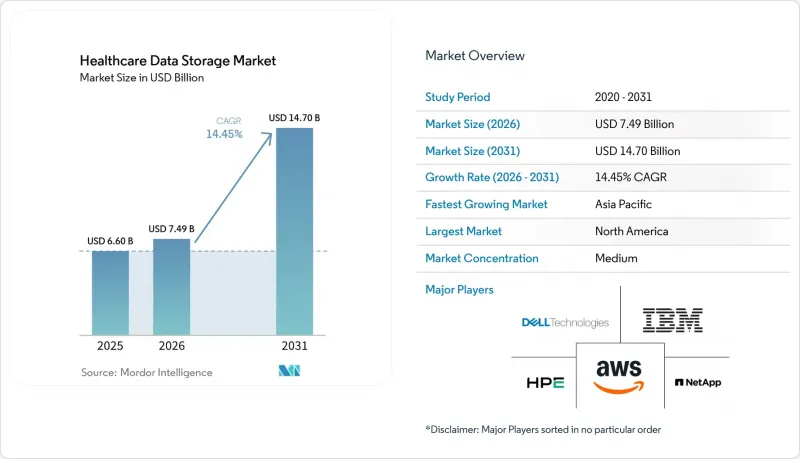
Mordor Intelligence에 의하면, 의료 데이터 저장 시장 규모는 2025년 66억 달러에서 2026년에는 74억 9,000만 달러로 확대되어 2031년까지 147억 달러에 이를 것으로 예측되며, 2026년부터 2031년까지 CAGR 14.45%로 성장할 전망입니다.
본 보고서는 배포 모드(On-Premise, 클라우드, 하이브리드), 아키텍처(블록 스토리지, 기타), 저장 매체(HDD, 기타), 최종 사용자(병원 및 진료소, 기타), 용도(PACS/엔터프라이즈 이미징, 기타), 지역(북미, 유럽, 아시아태평양, 중동 및 아프리카, 남미)별로 분류되어 있습니다. 시장 전망은 금액(달러) 기준으로 제시되어 있습니다.
세계 의료 데이터 저장 시장 동향 및 인사이트
영상 진단 및 엔터프라이즈 이미징 분야의 확대가 페타바이트 규모의 스토리지 수요를 견인하고 있습니다.
방사선과, 순환기내과, 병리과 및 기타 영상 진단을 많이 활용하는 전문 분야에서 저지연 영상 판독 및 확장 가능한 아카이브에 대한 지속적인 수요가 발생함에 따라, 엔터프라이즈 이미징은 스토리지 수요를 확대시키는 주요 요인이 되고 있습니다. 클라우드 네이티브 PACS 플랫폼을 통해 첫 번째 이미지 로딩 시간이 1초 미만으로 단축되고, 표시 속도가 2-3배 빨라짐에 따라 의료 기관에서는 진단 속도가 빨라지고 생산성이 향상되었다고 보고하고 있습니다. 이로 인해 신규 도입 시 클라우드 환경으로의 대규모 전환이 촉진되고 있습니다. 현재 신규 진단 영상 고객의 대부분이 ‘클라우드 우선’ 전략을 선택하고 있어, 의료 데이터 저장 시장에서 설비 투자에서 예측 가능한 운영 모델로의 전환이 가속화되고 있습니다. 각 벤더사들도 DICOM 워크로드를 네이티브로 처리하고, 세분화된 라이프사이클 계층화를 지원하며, 임상 시스템의 랜섬웨어 저항성을 강화하기 위한 관리형 불변성을 제공하는 전용 설계 클라우드 서비스에 투자하고 있습니다. 확장 가능한 오브젝트 스토리지 위에 벤더 중립 아카이브(NVA)를 결합한, 특정 분야를 겨냥한 영상 진단 플랫폼은 중규모 병원 및 여러 거점을 보유한 영상 진단센터로 확대되고 있으며, 규정 준수 아키텍처와 운영 비용 절감을 동시에 실현하고 있습니다. 하이퍼스케일 클라우드 제공업체는 유럽의 의료 호스팅 기준을 준수하고 있어, 이를 통해 병원 및 연구 기관은 데이터 저장 요건을 충족하면서 영상 관리 및 분석 워크로드를 이전할 수 있습니다.
EHR의 상호운용성과 환자 접근성이 데이터 양과 보존 기간을 확대
국가 차원의 상호운용성 프로그램이 급속히 확대되고 있으며, 미국의 TEFCA에 따르면 2026년 2월 기준으로 약 5억 건의 의료 기록이 교환된 것으로 보고되었습니다. 이는 네트워크를 가로지르는 임상 데이터의 이동량과 속도 측면에서 획기적인 변화가 일어나고 있음을 보여줍니다. CMS(미국 의료보험 및 의료보조 서비스 센터)의 상호운용성 및 사전 승인에 관한 최종 규정에서는 환자 접근, 의료 제공업체 접근, 보험사 간 정보 교환, 그리고 사전 승인을 위한 FHIR 기반 API 제품군이 의무화되어 있습니다. 주요 기능은 2027년 1월 1일까지 도입될 예정이며, 1영업일 이내에 응답이 이루어질 것으로 예상에 따라, 높은 처리량을 요구하는 트랜잭션에 대한 스토리지 및 로깅 수요가 암묵적으로 증가하고 있습니다. 이러한 규정으로 인해 청구, 진료 기록, 사전 승인 및 임상 데이터 요소 전반에 걸쳐 생성·보관되는 페이로드의 양이 증가함에 따라, 의료 데이터 저장 시장에서 라이프사이클 계층형 오브젝트 스토리지의 도입이 가속화되고 있습니다. 연방 관보에 게재된 사항에서는 응답 타임라인, 데이터 클래스 및 표준화된 형식이 FHIR 릴리스 4.0.1 및 USCDI v3에 어떻게 통합되는지가 명확히 명시되어 있으며, 이를 통해 API 중심의 접근, 출처 추적 및 감사 가능성에 최적화된 스토리지 설계가 추진되고 있습니다. 보험사 및 의료 제공업체 간에 임상 데이터와 관리 데이터를 주고받는 API가 늘어남에 따라, 조직들은 변화하는 연방 정부의 감독 하에서 증거 및 분쟁 해결에 대한 요구 사항을 충족하기 위해 불변 로그와 장기 아카이브를 확대되고 있습니다. 그 결과, 의료 데이터 저장 시장에서는 스토리지 수요의 기준선이 상승하고, 장기 보존 계층을 갖춘 오브젝트 스토리지에 대한 의존도가 높아지며, API 플랫폼과 스토리지 정책의 통합이 더욱 진전되고 있습니다.
예산 제약과 인력 부족으로 인해 EI 및 클라우드 전환이 지연되고 있습니다.
예산이 정체되거나 감소하고 있는 의료 시스템에서는 대규모 PACS 및 VNA 현대화 작업을 미루고 기존 플랫폼의 최적화로 전환하는 경향이 있어, 그 결과 엔터프라이즈 이미징 분야의 단기적인 전환 규모가 줄어들고 있습니다. 의료 IT 업체가 발표한 조사 결과에 따르면, 지출 양상이 양극화되는 모습을 보이고 있는데, 데이터 관리 예산을 늘리는 조직이 있는 반면, 설비 투자를 줄이고 단계적인 효율화에 주력하는 조직도 있어, 이로 인해 의료 데이터 저장 시장의 광범위한 도입이 지연되고 있습니다. 인력 부족도 걸림돌이 되고 있습니다. 이미징 전환이나 멀티오믹스 플랫폼 도입에는 현재 부족한 전문적인 엔지니어링 및 거버넌스 역량이 필요하기 때문입니다. 이에 대해 의료기관은 1사이클 내에서의 전면적인 재구축이 아닌, 불변성 백업, 감사 대응, 애플리케이션 통합과 같은 우선 과제를 과도기적 조치로 삼아 대응하고 있습니다. 현대화가 진행되더라도, 팀은 병렬 운영 비용을 절감하고 제한된 클라우드 및 데이터 엔지니어링 리소스를 가장 시급한 목표에 할당하기 위해 프로젝트를 단계적으로 진행하는 경우가 많습니다. 이러한 상충 관계로 인해 단기적으로는 도입 속도가 둔화되는 반면, 의료 데이터 저장 시장에서 하이브리드 방식의 도입 경로가 강화되고 있습니다.
부문별 분석
2025년 현재, 클라우드 도입은 의료 데이터 저장 시장 점유율의 50.46%를 차지하고 있으며, 임상 영상 진단 및 데이터 분석이 구현 기간을 단축하는 유연한 플랫폼으로 통합됨에 따라 2031년까지 연평균 성장률(CAGR) 16.21%로 성장할 것으로 전망됩니다. 대역폭에 제약이 있는 사이트나, 감가상각 일정 및 보존 요건으로 인해 로컬 관리가 필요한 곳에서는 On-Premise 도입이 계속되고 있습니다. 핫 데이터에는 로컬 캐시를, 계층화된 아카이브에는 클라우드 오브젝트 스토리지를 활용하는 하이브리드 설계는 저장 요건을 충족하면서 시설 간 접근성을 유지합니다. 영상 진단에 특화된 서비스는 현재 오브젝트 스토리지와 워크플로우 오케스트레이션을 결합하여 중규모 병원 및 대규모 영상 진단센터의 운영을 간소화하고 있으며, 이는 의료 데이터 저장 시장에서 클라우드 점유율 확대를 뒷받침하고 있습니다. 도입 사례를 통해 이미지에 대한 거의 즉각적인 접근과 방사선과 의사의 처리 능력 향상이 입증되었으며, 이를 통해 전환 위험이 감소하고 자본 예산을 운영비로 전환하는 것이 촉진되고 있습니다.
정기적인 갱신 주기를 없애고 현장 유지보수 수요를 줄이는 5년간의 비용 모델은 조직이 전체 수명 주기 동안 데이터 전송 비용 및 네트워크 비용 관리에 주력하고 있는 경우에도 클라우드 도입의 예산적 타당성을 강화합니다. 많은 의료 기관은 재해 복구 및 장기 보관 계층부터 시작하여, 이후 진단용 뷰어 및 고성능 캐시로 전환하는 단계적 접근 방식을 채택하고 있으며, 이는 위험 관리 태도와 예산 모두에 부합합니다. EHR, 영상 진단, 보험사 시스템 간의 API 우선 상호 운용성은 객체 쓰기 및 불변 로그 증가를 촉진하여, 의료 데이터 저장 시장에서 새로운 용량을 클라우드 서비스로 더욱 전환시키고 있습니다. 국경을 넘어 사업을 전개하는 기업에게 있어, 지역 내 클라우드 시설 및 HDS 인증 플랫폼은 유연성을 유지하면서 규정 준수를 위한 길을 제시하고, 거주지 제약 하에서 사이트 간 연동을 지원합니다. 조직이 클라우드 플랫폼상의 가시성과 거버넌스를 향상시켜 감에 따라, 정책을 활용하여 라이프사이클 계층화와 보존 체계를 최적화하고, 성능 허용 범위를 유지하면서 비용을 안정화하고 있습니다.
블록 스토리지는 저지연 응답 프로파일이 필요한 성능에 민감한 트랜잭션 시스템, 이미지 캐시 및 미션 크리티컬 데이터베이스 분야에서 강점을 발휘하여, 2025년에는 47.43%의 시장 점유율을 차지했습니다. 파일 스토리지는 2031년까지 연평균 성장률(CAGR) 15.26%를 기록하며 가장 빠르게 성장하고 있는 아키텍처 계층입니다. 이는 NAS 협업과 계층형 네임스페이스를 활용하는 벤더 중립 아카이브(NVA)에서 DICOM 및 비-DICOM 컨텐츠를 통합하는 엔터프라이즈 이미징이 확대되고 있기 때문입니다. 오브젝트 스토리지는 많은 클라우드 네이티브 플랫폼의 기반이 되며, 사실상 무제한의 확장성, 세밀한 불변성, 그리고 의료 데이터 저장 시장에서 규정 준수 및 장기 보존 기간에 적합한 딥 아카이브 계층을 제공합니다. 임상 사용자를 위한 파일 세맨틱스와 장기 보관을 위한 객체 계층 구조를 결합한 벤더는 총 비용과 내구성을 향상시키는 하이브리드 경제성을 실현하고 있으며, 이를 통해 레거시 사일로로부터의 전환이 촉진됩니다. FHIR 및 DICOM 데이터 서비스를 통합한 엔터프라이즈급 스토리지 포트폴리오는 병원 네트워크 전반에 걸친 하이브리드 아키텍처의 표준적인 접근 방식을 확립해 나가고 있습니다.
실제로 병원에서는 핫패스를 임상용 읽기·쓰기 용도로, 다직종 간 협업 및 영상 관리 메타데이터 용도로는 파일을, 영구적인 아카이브 및 불변 백업 용도로는 오브젝트를 활용하고 있습니다. 객체에 직접 쓰기를 지원하는 이미지 플랫폼은 운영 절차를 간소화하고, 대규모 환경에서의 검색 성능을 향상시킵니다. 이를 통해 의료진이 첫 번째 영상을 확인하기까지 걸리는 시간이 단축되고, 의료 데이터 저장 시장에서 시스템의 내결함성이 향상됩니다. 파일 증가 현상은 디지털 병리학이나 안과와 같은 새로운 분야와도 관련이 있으며, 이러한 분야는 대용량 파일을 생성하는 한편, SMB나 NFS 기반의 협업 방식이 제공하는 이점을 누리고 있습니다. 영상 진단과 분석이 융합됨에 따라, 비용과 속도 측면에서 핫, 웜, 콜드 각 계층을 횡단해야 하는 AI 훈련, 검증, 추론 워크로드에 맞추어 계층화 정책이 조정되고 있습니다. 예측 기간 동안 아키텍처의 통합은 지속될 것이며, 정책 엔진이 임상 성과 목표와 보존 의무 사이의 조정자 역할을 수행하게 될 것입니다.
지역별 분석
북미는 2025년에 48.56%의 점유율을 차지했습니다. 이는 성숙한 컴플라이언스 체계, 급속히 성장하는 상호운용성 네트워크, 그리고 헬스테크 혁신가들이 구축한 긴밀한 생태계에 힘입은 결과입니다. 2026년 2월까지 TEFCA 네트워크를 통해 교환되는 기록 수가 5억 건에 육박할 것이라는 진전은 실제 운영 규모에서 전국적인 데이터 교환이 가능함을 입증하는 것이며, 이에 따라 의료 데이터 저장 시장에서 공급자와 지불자 전반에 걸친 스토리지 및 감사 수요가 확대되고 있습니다. 상호 운용성 및 사전 승인에 관한 연방 규정이 제정됨에 따라 구체적인 API 및 응답 벤치마크가 설정되었으며, 내구성과 성능을 향상시키기 위해 스토리지 시스템은 API 플랫폼에 가까워지고 있습니다. 캐나다는 하이퍼스케일러의 지역적 입지와 미국식 개인정보 보호 프레임워크와의 일관성이라는 이점을 누리고 있으며, 이를 통해 통합된 아키텍처를 제공하는 국경을 초월한 벤더 전략이 뒷받침되고 있습니다. 멕시코 및 북미의 특정 라틴아메리카에서는 현대화 노력에 힘입어 공립 병원 및 민간 네트워크 내에서 전자 건강 기록(EHR)과 영상 아카이브의 도입이 단계적으로 진행되고 있습니다. 이 지역 전체에서 불변성 백업 도입, SIEM(보안 정보 및 이벤트 관리) 통합, 그리고 하이브리드형 재해 복구는 현재 스토리지 설계를 구성하는 표준 프로그램의 핵심 요소로 자리 잡고 있습니다.
아시아태평양은 각국의 디지털 헬스 전략에 따라 데이터 수집, 영상 진단, 분석이 확대되고 있어, 2031년까지의 예상 연평균 성장률(CAGR)이 16.36%로 가장 빠르게 성장하고 있는 지역입니다. 클라우드 제공업체는 의료 데이터 저장 시장에서 의료 기관이 엔터프라이즈 영상 진단 및 FHIR 기반 서비스를 확장하는 데 필요한 데이터 상주성과 성능을 제공하기 위해 해당 지역 내 여러 시설을 운영하고 있습니다. 일본, 한국, 싱가포르, 호주의 의료 시스템에서는 AI를 활용한 진단 도입과 원격의료 확대가 진행되고 있으며, 이에 따라 영상, 원격 측정 데이터 및 장기적인 임상 기록에 대한 하류 스토리지 요구 사항이 증가하고 있습니다. 중국과 인도는 계속해서 국내 클라우드 리전 및 하이브리드 모델에 대한 의존도를 높이는 주권 데이터 정책을 중시하고 있습니다. 전문적인 데이터 엔지니어링 및 생물정보학 분야의 인력 부족은 APAC의 일부 시장에서 고도의 유전체 규모 스토리지 도입에 있어 지속적인 걸림돌로 작용하고 있으며, 이로 인해 관리형 서비스 및 플랫폼 기반 접근 방식이 확대되고 있습니다.
유럽은 시장 점유율이 높으며, 도입 여부를 좌우하는 독자적인 규제 환경에 직면해 있습니다. ‘유럽 건강 데이터 공간 규정(European Health Data Space Regulation)’은 EHR 시스템의 상호 운용성, 로그 기록 및 1차 이용에 대한 CE 마크 적합성 의무를 규정하는 한편, 안전한 처리 환경 하에서 2차 이용을 위한 프레임워크를 구축하고 있으며, 이에 따라 의료 데이터 저장 시장의 스토리지, 감사 및 거버넌스 요구 사항이 높아지고 있습니다. 각 클라우드 서비스 제공업체들은 의료용 호스팅 프로그램 인증을 획득하고, 각국의 거주지 규정에 따라 병원, 연구센터, 생명과학 기관을 지원하기 위해 EU 지역 내 서비스 제공 범위를 확대되고 있습니다. 소규모 시장에서는 EU 전역을 아우르는 클라우드 인프라의 혜택을 누리고 있지만, 공공 기관의 예산 제약과 GDPR(EU 개인정보보호규정)에 따른 감사로 인해 기업의 이미지 데이터 통합 진전이 더뎌질 가능성이 있습니다. 영국과 독일에서는 API 중심의 데이터 교환을 촉진하고, 감사 대응형 저장 관행을 강화하기 위한 국가 차원의 디지털 헬스 인프라 구축이 진행되고 있습니다.
기타 혜택:
- 엑셀 형식 시장 예측(ME) 시트
- 3개월간의 애널리스트 지원
자주 묻는 질문
목차
제1장 서론
제2장 조사 방법
제3장 주요 요약
제4장 시장 구도
제5장 시장 규모와 성장 예측
제6장 경쟁 구도
제7장 시장 기회와 향후 전망
JHS 26.06.23According to Mordor Intelligence, the healthcare data storage market size is expected to increase from USD 6.60 billion in 2025 to USD 7.49 billion in 2026 and reach USD 14.70 billion by 2031, growing at a CAGR of 14.45% over 2026-2031.
This report is Segmented by Deployment Mode (On-Premise, Cloud, Hybrid), Architecture (Block Storage, and Others), Storage Medium (HDD, and Others), End User (Hospitals & Clinics, and Others), Application (PACS/Enterprise Imaging, and Others), and Geography (North America, Europe, Asia-Pacific, Middle East and Africa, South America). The Market Forecasts are Provided in Terms of Value (USD).
Global Healthcare Data Storage Market Trends and Insights
Imaging and Enterprise Imaging Expansion Drives Petabyte-Scale Storage
Enterprise imaging has become the leading storage multiplier as radiology, cardiology, pathology, and other image-heavy specialties create sustained demand for low-latency reads and scalable archives. Providers report faster diagnostics and productivity gains as cloud-native PACS platforms deliver sub-second first-image load times and 2-3 times faster display speeds, which encourages larger-scale migrations to cloud deployment for new implementations. A large share of new diagnostic imaging customers now chooses cloud-first rollouts, reinforcing the shift from capital expenditures to predictable operating models in the healthcare data storage market. Vendors are also investing in purpose-built cloud services that handle DICOM workloads natively, support granular lifecycle tiering, and provide managed immutability to strengthen ransomware resilience for clinical systems. Targeted imaging platforms that layer vendor-neutral archive capabilities on scalable object storage are extending to mid-sized hospitals and multi-site imaging centers, combining compliance-ready architectures with lower operational overhead. Hyperscale cloud providers are aligning to European healthcare hosting standards, which enables hospitals and research organizations to move image management and analytics workloads while meeting residence requirements.
EHR Interoperability and Patient Access Expand Data Volumes and Retention
National interoperability programs have scaled quickly, with America's TEFCA reporting nearly 500 million health records exchanged as of February 2026, which signals a step-change in the volume and velocity of clinical data movement across networks. The CMS Interoperability and Prior Authorization Final Rule mandates a suite of FHIR-based APIs for patient access, provider access, payer-to-payer exchange, and prior authorization, with key capabilities due by January 1, 2027, and one-business-day response expectations that implicitly raise storage and logging needs for high-throughput transactions. These rules increase the number of payloads generated and retained across claims, encounters, prior authorizations, and clinical data elements, which accelerates lifecycle-tiered object storage adoption in the healthcare data storage market. The Federal Register entry clarifies how response timelines, data classes, and standardized formats converge on FHIR Release 4.0.1 and USCDI v3, which drives storage designs that are optimized for API-driven access, provenance, and auditability. As more APIs exchange clinical and administrative artifacts across payers and providers, organizations are expanding immutable logs and long-term archives to satisfy evidence and dispute needs under evolving federal oversight. The net effect is higher baseline storage demand, increased reliance on object storage with deep archive tiers, and closer integration between API platforms and storage policies in the healthcare data storage market.
Budget Constraints and Staffing Shortages Slow EI and Cloud Migrations
Health systems that face flat or declining budgets often delay large-scale PACS or VNA modernization and shift toward optimizing existing platforms, which reduces near-term migration volume for enterprise imaging. Survey findings published by healthcare IT vendors highlight a bifurcation in spending, where some organizations increase data management budgets while others reduce capital commitments and focus on incremental efficiencies, which slows broad-based adoption in the healthcare data storage market. Staffing shortages add friction, since imaging migration and multi-omics platform rollouts require specialized engineering and governance skill sets that are in short supply. Providers respond by elevating priorities like immutable backup, audit readiness, and consolidation of applications as bridging steps rather than full re-architecture in one cycle. Where modernization proceeds, teams often phase projects to limit parallel-run costs and to match scarce cloud and data engineering resources with the most time-sensitive objectives. These trade-offs moderate implementation velocity in the short term while reinforcing a hybrid adoption path in the healthcare data storage market.
Other drivers and restraints analyzed in the detailed report include:
- Accelerating Cloud Adoption for Imaging, Analytics, and Backup/Disaster Recovery
- Genomics and Multi-Omics Pipelines Create High-Throughput, High-Volume Datasets
- Localization and Sovereignty Restrict Cross-Border Clinical-Data Storage
For complete list of drivers and restraints, kindly check the Table Of Contents.
Segment Analysis
Cloud deployment captured 50.46% of the healthcare data storage market share in 2025, and it is forecast to grow at a 16.21% CAGR through 2031 as clinical imaging and data analytics consolidate on elastic platforms that compress implementation timelines. On-premise installations continue in bandwidth-constrained sites and where depreciation schedules or residency requirements support local control. Hybrid designs that use local caches for hot studies and cloud object storage for tiered archiving align to residency mandates while sustaining cross-facility access. Imaging-focused services now combine object storage and workflow orchestration to simplify operations for mid-sized hospitals and large imaging centers, which supports continued share gains for cloud in the healthcare data storage market. Implementation case studies demonstrate near-immediate access to images and higher radiologist throughput, which lowers the risk of migration and supports the conversion of capital budgets into operating expense commitments.
Five-year cost models that remove periodic refresh cycles and reduce on-site maintenance demand strengthen the budget case for cloud, even as organizations work to manage egress and network costs over the lifecycle. Many providers adopt a phased approach to cloud adoption, starting with disaster recovery or long-term archive tiers before moving diagnostic viewing and high-performance caches, which aligns with both risk posture and budget. API-first interoperability across EHR, imaging, and payer systems drives incremental object writes and immutable logs, which further tilts new capacity toward cloud services in the healthcare data storage market. For cross-border operators, in-region cloud facilities and HDS-certified platforms offer a path to compliance while retaining elasticity, which supports cross-site collaboration under residency constraints. As organizations improve observability and governance on cloud platforms, they use policies to optimize lifecycle tiering and retention schemes, which stabilizes cost while preserving performance envelopes.
Block storage held 47.43% share in 2025 on the strength of performance-sensitive transactional systems, imaging caches, and mission-critical databases, which require low-latency response profiles. File storage is the fastest-growing architectural tier at a 15.26% CAGR through 2031 as enterprise imaging expands to unify DICOM and non-DICOM content in vendor-neutral archives that use NAS collaboration and hierarchical namespaces. Object storage underpins many cloud-native platforms, offering effectively unlimited scale, granular immutability, and deep archive tiers that suit compliance and long retention windows in the healthcare data storage market. Vendors that pair file semantics for clinical users with object tiers for long-term storage create blended economics that improve total cost and durability, which aids migrations from legacy silos. Enterprise-grade storage portfolios that integrate FHIR and DICOM data services are establishing a playbook for hybrid architectures across hospital networks.
In practice, hospitals use block for hot-path clinical reads and writes, file for multidisciplinary collaboration and image management metadata, and object for persistent archiving and immutable backups. Imaging platforms that support direct-to-object writes reduce operational steps and improve retrieval performance at scale, which shortens time to first image for clinicians and improves system resilience in the healthcare data storage market. File growth is also linked to new modalities such as digital pathology and ophthalmology that contribute large files and benefit from SMB and NFS-based collaboration. As imaging merges with analytics, tiering policies are tuned for AI training, validation, and inference workloads that need to traverse hot, warm, and cold tiers for cost and speed. Over the forecast period, architectural convergence will continue, with policy engines mediating between clinical performance targets and retention obligations.
Geography Analysis
North America captured 48.56% share in 2025, supported by a mature compliance regime, fast-growing interoperability networks, and a dense ecosystem of health-tech innovators. The TEFCA network's progression to nearly 500 million records exchanged by February 2026 demonstrates live-scale national exchange, which expands storage and audit demands across providers and payers in the healthcare data storage market. Federal rulemaking on interoperability and prior authorization has set specific API and response benchmarks, which move storage closer to API platforms for durability and performance. Canada benefits from hyperscalers' regional presence and from alignment with U.S.-style privacy frameworks, which supports cross-border vendor strategies that deliver unified architectures. In Mexico and select Latin subregions of North America, modernization efforts raise incremental deployments of EHR and imaging archives within public hospitals and private networks. Across the region, immutable backup adoption, SIEM integration, and hybrid disaster recovery are now standard program pillars that shape storage design.
Asia-Pacific is the fastest-growing region with a 16.36% forecast CAGR through 2031 as national digital-health missions expand data capture, imaging, and analytics. Cloud providers maintain multiple in-region facilities that give health systems the residency and performance needed to scale enterprise imaging and FHIR-based services in the healthcare data storage market. Health systems in Japan, South Korea, Singapore, and Australia are rolling out AI-augmented diagnostics and expanding remote care, which adds downstream storage requirements for images, telemetry, and longitudinal clinical records. China and India continue to emphasize sovereign data policies that increase reliance on in-country cloud regions and hybrid models. Staffing constraints in specialized data engineering and bioinformatics remain a pinch point for advanced genomics-scale storage across several APAC markets, which encourages managed services and platform approaches.
Europe holds a substantial share and faces distinct regulatory contours that guide deployment choices. The European Health Data Space Regulation sets obligations for EHR system interoperability, logging, and CE-marked conformity for primary uses, and it creates a framework for secondary uses under secure processing environments, which elevates storage, audit, and governance requirements in the healthcare data storage market. Cloud providers are certifying for healthcare hosting programs and expanding EU-region coverage to support hospitals, research centers, and life-sciences organizations under national residency rules. Smaller markets benefit from pan-EU cloud footprints, though budget constraints in public systems and GDPR-driven audits can slow enterprise imaging consolidations. The United Kingdom and Germany are advancing national digital-health infrastructure that will increase API-driven data exchange and reinforce audit-ready storage practices.
- Amazon Web Services (AWS)
- Cloudian
- CloudWave
- Cohesity
- Commvault
- Dell Technologies
- Fujitsu
- Google Cloud (Healthcare API)
- Hewlett Packard Enterprise (HPE)
- Hitachi Vantara
- Huawei
- Hyland Healthcare
- IBM
- Infinidat
- Microsoft (Azure Health Data Services)
- NetApp
- Oracle
- Pure Storage
- Quantum
- Qumulo
- Rubrik
- Scality
- Veeam
- Western Digital
Additional Benefits:
- The market estimate (ME) sheet in Excel format
- 3 months of analyst support
TABLE OF CONTENTS
1 Introduction
- 1.1 Study Assumptions and Market Definition
- 1.2 Scope of the Study
2 Research Methodology
3 Executive Summary
4 Market Landscape
- 4.1 Market Overview
- 4.2 Market Drivers
- 4.2.1 Imaging and Enterprise Imaging Expansion Drives Petabyte-Scale Storage
- 4.2.2 EHR Interoperability and Patient Access Expand Data Volumes and Retention
- 4.2.3 Accelerating Cloud Adoption for Imaging, Analytics, and Backup/Disaster Recovery
- 4.2.4 Genomics and Multi-Omics Pipelines Create High-Throughput, High-Volume Datasets
- 4.2.5 Cybersecurity Goals Mandate Immutable Backups and Centralized Logging
- 4.2.6 Data-Sovereignty Rules (EU HDS v2.0) and EU Data Act Spur Sovereign/Hybrid and Portability
- 4.3 Market Restraints
- 4.3.1 Budget Constraints and Staffing Shortages Slow EI/Cloud Migrations
- 4.3.2 Interoperability, VNA Migrations, and Multi-Year Archive Transitions Add Risk
- 4.3.3 Cloud Egress Fees and Vendor Lock-in Complicate Lifecycle TCO
- 4.3.4 Localization and Sovereignty Restrict Cross-Border Clinical-Data Storage
- 4.4 Value-Chain Analysis
- 4.5 Regulatory Landscape
- 4.6 Technological Outlook
- 4.7 Porter's Five Forces Analysis
- 4.7.1 Threat of New Entrants
- 4.7.2 Bargaining Power of Suppliers
- 4.7.3 Bargaining Power of Buyers
- 4.7.4 Threat of Substitutes
- 4.7.5 Competitive Rivalry
5 Market Size & Growth Forecasts (Value, USD)
- 5.1 By Deployment Mode
- 5.1.1 On-Premise
- 5.1.2 Cloud
- 5.1.3 Hybrid
- 5.2 By Architecture
- 5.2.1 Block Storage
- 5.2.2 File Storage
- 5.2.3 Object Storage
- 5.3 By Storage Medium
- 5.3.1 HDD
- 5.3.2 SSD/Flash
- 5.3.3 Tape
- 5.4 By End User
- 5.4.1 Hospitals & Clinics
- 5.4.2 Pharmaceutical & Biotechnology Companies
- 5.4.3 Healthcare Payers
- 5.4.4 Others
- 5.5 By Application
- 5.5.1 PACS/Enterprise Imaging
- 5.5.2 EHR/EMR and Clinical Data
- 5.5.3 Genomics & Multi-omics
- 5.5.4 Others
- 5.6 By Geography
- 5.6.1 North America
- 5.6.1.1 United States
- 5.6.1.2 Canada
- 5.6.1.3 Mexico
- 5.6.2 Europe
- 5.6.2.1 Germany
- 5.6.2.2 United Kingdom
- 5.6.2.3 France
- 5.6.2.4 Italy
- 5.6.2.5 Spain
- 5.6.2.6 Rest of Europe
- 5.6.3 Asia-Pacific
- 5.6.3.1 China
- 5.6.3.2 Japan
- 5.6.3.3 India
- 5.6.3.4 Australia
- 5.6.3.5 South Korea
- 5.6.3.6 Rest of Asia-Pacific
- 5.6.4 Middle East and Africa
- 5.6.4.1 GCC
- 5.6.4.2 South Africa
- 5.6.4.3 Rest of Middle East and Africa
- 5.6.5 South America
- 5.6.5.1 Brazil
- 5.6.5.2 Argentina
- 5.6.5.3 Rest of South America
- 5.6.1 North America
6 Competitive Landscape
- 6.1 Market Concentration
- 6.2 Market Share Analysis
- 6.3 Company Profiles (includes Global level Overview, Market level overview, Core Segments, Financials as available, Strategic Information, Market Rank/Share for key companies, Products & Services, Recent Developments)
- 6.3.1 Amazon Web Services (AWS)
- 6.3.2 Cloudian
- 6.3.3 CloudWave
- 6.3.4 Cohesity
- 6.3.5 Commvault
- 6.3.6 Dell Technologies
- 6.3.7 Fujitsu
- 6.3.8 Google Cloud (Healthcare API)
- 6.3.9 Hewlett Packard Enterprise (HPE)
- 6.3.10 Hitachi Vantara
- 6.3.11 Huawei
- 6.3.12 Hyland Healthcare
- 6.3.13 IBM
- 6.3.14 Infinidat
- 6.3.15 Microsoft (Azure Health Data Services)
- 6.3.16 NetApp
- 6.3.17 Oracle
- 6.3.18 Pure Storage
- 6.3.19 Quantum
- 6.3.20 Qumulo
- 6.3.21 Rubrik
- 6.3.22 Scality
- 6.3.23 Veeam
- 6.3.24 Western Digital
7 Market Opportunities & Future Outlook
- 7.1 White-space & Unmet-need Assessment


