

|
시장보고서
상품코드
2064424
의료 데이터 오케스트레이션용 AI 시장 : 시장 점유율 분석, 산업 동향 및 통계 데이터, 성장 예측(2026-2031년)AI In Healthcare Data Orchestration - Market Share Analysis, Industry Trends & Statistics, Growth Forecasts (2026 - 2031) |
||||||
 Mordor Intelligence
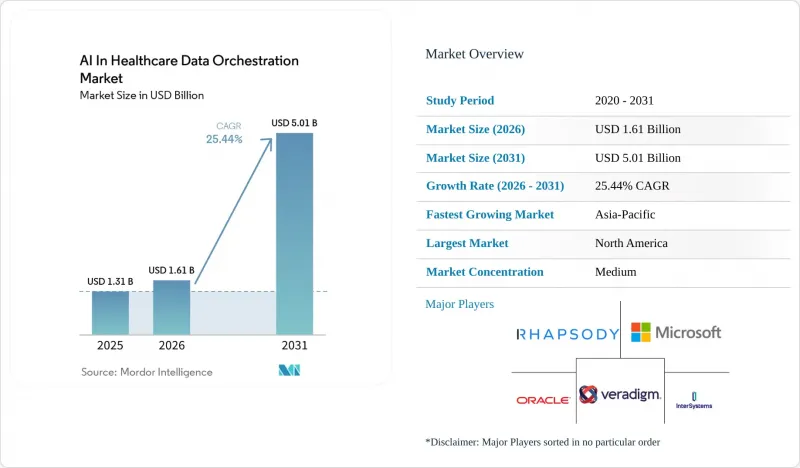
Mordor Intelligence에 의하면, 의료 데이터 오케스트레이션용 AI(인공지능) 시장 규모는 2025년 13억 1,000만 달러로 평가되었고, 2026년에는 16억 1,000만 달러로 추정되며, 2031년까지 50억 1,000만 달러에 이를 것으로 예측됩니다.
2026-2031년 연평균 성장률(CAGR) 25.44%로 성장할 것으로 전망됩니다.
본 보고서는 구성 요소별(소프트웨어, 플랫폼·미들웨어, 서비스), 용도별(데이터 수집·정규화 등), 배포 방식별(클라우드 등), 최종 사용자별(의료 제공업체 등), 상호 운용성 수준별(기초 수준 등), 지역별(북미, 유럽, 아시아태평양 등)로 분류되어 있습니다. 시장 전망은 금액(달러) 기준으로 제시되어 있습니다.
세계의 의료 데이터 오케스트레이션용 AI 시장 동향 및 인사이트
FHIR API와 사전 승인 의무화가 오케스트레이션을 가속화합니다.
의료 데이터 오케스트레이션용 AI 시장은 임의적인 기술 투자라기보다는 규제에 의해 우선적으로 추진되고 있습니다. CMS-0057-F는 영향을 받는 지급 기관에 대해 2026년 1월 1일부터 사전 승인 결정을 신속히 처리할 것을 요구했으며, 또한 사전 승인, 제공업체 접근 및 지급 기관 간 FHIR API의 규정 준수 달성 기한을 2027년 1월 1일로 정했습니다. 이러한 요건으로 인해 조직은 개별 수동 팀을 통해 처리하는 것이 아니라, 단일 통합 워크플로우 내에서 접수, 라우팅, 정규화 및 응답 생성을 처리해야 하므로 오케스트레이션의 가치가 높아지고 있습니다. 2026년에 제안된 의약품 사전 승인 기준에 관한 규정은 이 규정 준수 대상 범위를 확대하며, 보험사 측의 첫 번째 변경 단계를 넘어선 후에도 이행 과제가 지속될 것임을 의미합니다. 의료 데이터 오케스트레이션용 AI 시장에서는 이로 인해 미들웨어와 워크플로우 로직이 단순한 통합 지원 기능이 아닌 핵심적인 운영 요건으로 변화하게 됩니다. 또한, 보험사가 기존 시스템을 처음부터 재구축하도록 강요하지 않으면서도 관리 데이터, 임상 기록 및 표준 기반 데이터 교환을 연결해 줄 수 있는 공급업체가 유리해집니다.
QHIN·HIE의 확장에 따른 정책 기반 라우팅 수요 증가
의료 데이터 오케스트레이션용 AI 시장은 미국 내 신뢰할 수 있는 교환 인프라의 확대로 인해 혜택을 보고 있습니다. TEFCA 공통 합의 v2.1은 허용되는 교환 목적을 공식적으로 규정하고, 라우팅 로직을 정책에 더욱 민감하게 조정했습니다. 이는 조직이 데이터를 어디로 보내야 할 뿐만 아니라, 왜 데이터가 교환되는지까지 구분해야 하기 때문입니다. 전국적인 데이터 교환이 본격적으로 운영 단계에 접어들면서, 의료 시스템은 여전히 환자의 신원 정보를 표준화하고, 워크플로우의 트리거를 관리하며, 하류 분석 도구 및 AI 도구를 수신 레코드에 연결하기 위한 내부 오케스트레이션이 필요합니다. Oracle Health가 제휴 네트워크에의 참여를 추진하고 있다는 사실은 엔터프라이즈 벤더들이 현재 상호운용성 네트워크 참여를 단순한 별개의 서비스 부가 기능이 아닌 전략적인 제품 계층으로 자리매김하고 있음을 반영합니다. 의료 데이터 오케스트레이션용 AI 시장에서 이는 교환 엔드포인트와 내부 진료, 지급, 리스크 관리 워크플로우 사이에 위치하는 정책 기반 라우팅에 대한 지속적인 수요를 창출하고 있습니다. 또한, 모든 교환 경로가 컴플라이언스 팀과 운영 팀 모두에게 이해 가능해야 하므로, 감사 가능성의 중요성도 커지고 있습니다.
PHI의 개인정보 보호, 사이버 보안 및 국경 간 규제
의료 데이터 오케스트레이션용 AI 시장은 데이터가 조직이나 국경을 넘어 이동하기 시작함에 따라 점점 더 엄격해지는 개인정보 보호 및 거버넌스 의무라는 명확한 제약에 직면해 있습니다. TEFCA 공통 합의 규칙에는 허용되는 교환 목적이 여러 가지로 정의되어 있으며, 이는 라우팅 로직이 기술적 연결성뿐만 아니라 정책의 의도도 반영해야 함을 의미합니다. 유럽에서는 EHDS(유럽 건강 데이터 전략)가 또 다른 과제를 안겨주고 있습니다. 우선적인 의료 데이터 범주에 대한 국경을 초월한 교환은 데이터 처리 및 2차 이용에 대해 엄격한 요건을 부과하는 체계적인 규제 일정에 따라 이루어지게 될 것이기 때문입니다. 또한, 프랑스의 2026년 디지털 헬스 전략 역시 국내 상호운용성 아키텍처가 무제한적인 데이터 마이그레이션이 아닌, 관리된 FHIR 기반의 교환으로 전환되고 있음을 뒷받침하고 있습니다. 의료 데이터 오케스트레이션용 AI 시장에서는 AI 워크플로우를 확장하기 전에 구매자가 국가별 통제, 목적별 권한, 그리고 추적 가능한 거버넌스를 필요로 할 경우 도입이 지연될 수 있습니다. 또한, 범용 의료용 커넥터를 구축한 벤더의 경우, 핵심 플랫폼에 의료 등급 정책 적용 기능을 통합하지 않았다면 확장 비용이 증가하게 됩니다.
부문별 분석
2025년 기준으로 소프트웨어는 시장의 47.32%를 차지했으며, 의료 데이터 오케스트레이션용 AI 시장에서 가장 큰 구성 요소로서의 위치를 유지했습니다. 이 위상은 EHR(전자건강기록) 및 보험사의 핵심 시스템과 긴밀하게 연동되는 분석 도구, 활성화 계층, 그리고 애플리케이션 소프트웨어에 대한 다년간의 투자를 반영하고 있습니다. 가장 급속한 변화가 나타나는 분야는 플랫폼 및 미들웨어 분야로, 구매자들이 고립된 이용 사례에서 거버넌스가 적용된 시스템 전반에 걸친 실행으로 전환함에 따라 2031년까지 연평균 성장률(CAGR) 26.24%를 나타낼 것으로 예측됩니다. 이러한 변화가 일어나고 있는 이유는 조직이 현재 라우팅, 스키마 적용, 동의 처리 및 후속 AI 조치를 통합적으로 관리할 수 있는 단일 계층을 필요로 하기 때문입니다. 실용적인 관점에서 볼 때, 의료 데이터 오케스트레이션용 AI 시장은 단순한 메시지 전달이 아닌, 정책을 고려한 상호 운용성을 지원할 수 있는 벤더들에게 이점을 제공합니다.
이러한 변화는 각 벤더사의 제품 전략에서도 드러나고 있습니다. Redox는 2026년 1월, 자사의 상호운용성 레이어를 장기적인 파트너십 모델로 자리매김하며, 광범위한 연결 네트워크 전반에 걸친 구성 자동화 및 복잡한 트랜잭션의 문제 해결을 강조했습니다. Rhapsody와 InterSystems 역시 인터페이스 수준에 그치지 않고, 운영 오케스트레이션 영역으로 깊이 진출하고 있습니다. 이는 의료 데이터 오케스트레이션용 AI 시장이 미들웨어를 일상적인 워크플로우 실행과 더욱 밀접하게 연결하고 있음을 보여줍니다. 많은 도입 사례에서 자문, 구현 및 관리형 지원이 필요하기 때문에 서비스는 여전히 중요합니다. 그렇긴 하지만, 서비스는 단독의 통합 프로젝트가 아니라 플랫폼 구축과 연계되는 경향이 점점 더 강해지고 있습니다. 이것이 바로 의료 데이터 오케스트레이션용 AI 시장이 일회성 프로젝트 기반 과금 방식에서 지속적인 인프라 관련 모델로 전환되고 있는 이유입니다.
2025년에는 데이터 수집 및 정규화가 시장의 45.73%를 차지했으며, 의료 데이터 오케스트레이션용 AI 시장의 최대 용도 분야가 되었습니다. 이 논리는 타당합니다. 왜냐하면 대부분의 조직은 더 고도의 처리를 수행하기 전에 여전히 구조화된 파이프라인이 필요하기 때문입니다. 임상 문서에 대한 이해 분야는 2031년까지 연평균 성장률(CAGR)이 25.94%로 가장 빠르게 성장할 전망이며, 이는 기초적인 파이프라인이 구축된 후 가치가 어디로 이동하고 있는지를 보여줍니다. 의료 기관들은 업무상 가장 유용한 세부 정보가 대개 진료 기록, 의뢰서, 요약본 및 기타 서술형 기록에 포함되어 있다는 사실을 점차 인식하고 있습니다. 그 결과, 의료 데이터 오케스트레이션용 AI 시장은 단순한 데이터 전송에서 벗어나, 다양한 임상 컨텐츠를 해석하고 이를 바탕으로 행동할 수 있는 시스템으로 전환되고 있습니다.
이러한 변화는 인접한 워크플로우 통합 분야에서도 확인할 수 있습니다. GRAIL사의 Epic 통합은 다양한 암종의 조기 발견 데이터를 주류 EHR 워크플로우에 접목하고 있으며, Labcorp사는 Epic Aura를 통해 수백 개의 의료 시스템으로 진단 통합을 확대했습니다. 이는 오케스트레이션에 대한 수요가 일반적인 관리 프로세스에 부합해야 하는 보다 전문적인 데이터 범주까지 확대되고 있음을 보여줍니다. 사전 승인이나 치료 조정은 통합된 맥락 없이는 충분히 확장할 수 없기 때문에 환자 기록의 통합과 워크플로우 자동화는 여전히 중요합니다. 또한, 조직이 임상 업무와 근거 창출을 연계하려는 과정에서 조사 및 실제 임상 근거의 활용도 점점 더 중요해지고 있습니다. 의료 데이터 오케스트레이션용 AI 업계에서 이로 인해 용도의 적용 범위는 백엔드 데이터 준비 단계에서 최전선의 임상 및 관리 업무 수행 단계로 확대되고 있습니다. 또한, 해석, 타이밍, 그리고 액션이 하나로 어우러져야 하는 분야에서 용도의 성장이 가장 두드러지는 이유도 바로 여기에 있습니다.
지역별 분석
2025년, 북미는 의료 데이터 오케스트레이션용 AI 시장 점유율의 47.33%를 차지했으며, 주요 지역 클러스터로 자리매김하고 있습니다. 미국이 이 분야에서 선도적인 위치를 차지하고 있는 이유는 규제상의 의무, 지불 주체의 현대화, 그리고 성숙한 EHR의 활용이 모두 오케스트레이션에 대한 조기 투자를 뒷받침하고 있기 때문입니다. CMS-0057-F는 사전 승인 절차의 신속화와 정의된 FHIR API의 일정을 연계함으로써 해당 지역을 선두 자리에 유지하고 있습니다. TEFCA 공통 합의 규칙은 전국적인 데이터 교환 과정에서 운영 시스템에서 보다 명확한 라우팅, 거버넌스 및 목적에 부합하는 처리가 요구됨에 따라 그 수요가 더욱 높아지고 있습니다. 의료 데이터 오케스트레이션용 AI 시장에서 이러한 요인들이 복합적으로 작용함에 따라, 북미는 규제 주도형 수익원으로서 가장 중요한 지역이 되었습니다.
유럽은 가장 규모가 큰 지역은 아니지만, 긴 구축 주기를 가지고 있어 의료 데이터 오케스트레이션용 AI 시장의 꾸준한 수요를 뒷받침하고 있습니다. EHDS는 2025년 3월 26일에 발효되었으며, 2029년부터 우선순위가 높은 의료 데이터 범주의 국경 간 교환을 위한 단계적 로드맵을 제시하고 있습니다. 프랑스는 2026년, 개정된 디지털 헬스 정책에 따라 CI-SIS 구성 요소에 대해 FHIR 기반 아키텍처로의 전환을 의무화함으로써 이러한 방향성을 강화했습니다. 따라서 유럽에서는 강력한 상호운용성에 대한 요구와 더욱 엄격한 거버넌스에 대한 기대가 결합되어 있으며, 그 결과 하이브리드 배포와 추적 가능성이 다른 지역보다 더 중요하게 여겨지고 있습니다.
아시아태평양은 2031년까지 연평균 성장률(CAGR)이 28.15%로 가장 빠르게 성장할 전망이며, 의료 데이터 오케스트레이션용 AI 시장에서 가장 강력한 성장세를 보이고 있습니다. 일본에서는 2026년 초에 시작된 후지쯔와 JMDC의 제휴가 보여주듯이, 의료기관이 이미 보험사, 의료 제공업체 및 개인의 건강 기록 데이터를 연계하고 있다는 점이 두드러집니다. 일본 내 공공기관의 활동에서도 AI를 활용한 임상 워크플로우 지원에 대한 관심이 높아지고 있음을 알 수 있습니다. 그 예로, 오사카 국제암센터의 문진 시스템과 간호 음성 입력 시스템을 들 수 있습니다. 중동 및 아프리카은 여전히 규모는 작지만, GCC(걸프협력회의) 회원국들에서는 뚜렷한 수요가 발생하고 있습니다. 사우디아라비아의 민간 병원 부문에서는 Oracle Health Foundation EHR과 같은 통합형 임상·업무 플랫폼이 도입되어 있습니다. 남미는 도입 단계로서는 아직 초기 단계이지만, 국가 차원의 디지털 헬스케어 추진 노력과 민간 병원의 투자가 FHIR 기반의 광범위한 상호운용성을 뒷받침하고 있습니다. 이에 따라 의료 데이터 오케스트레이션용 AI 시장에서는 북미가 현재의 규모로 주도하고, 유럽이 규제를 통해 기반을 구축하며, 아시아태평양이 인프라 확장을 통해 가장 빠르게 성장하는 명확한 패턴이 나타납니다.
기타 혜택 :
- Excel 형식 시장 예측(ME) 시트
- 3개월간의 애널리스트 지원
자주 묻는 질문
목차
제1장 서론
제2장 분석 방법
제3장 주요 요약
제4장 시장 구도
제5장 시장 규모 및 성장률 예측
제6장 경쟁 구도
제7장 시장 기회 및 향후 전망
AJY 26.06.26According to Mordor Intelligence, the aI in healthcare data orchestration market size is expected to increase from USD 1.31 billion in 2025 to USD 1.61 billion in 2026 and reach USD 5.01 billion by 2031, growing at a CAGR of 25.44% over 2026-2031.
This report is Segmented by Component (Software, Platforms and Middleware, Services), Application (Data Ingestion and Normalization, and More), Deployment Model (Cloud, and More), End User (Healthcare Providers, and More), Interoperability Level (Foundational, and More), and Geography (North America, Europe, Asia-Pacific, and More). The Market Forecasts are Provided in Terms of Value (USD).
Global AI In Healthcare Data Orchestration Market Trends and Insights
FHIR API and Prior-Authorization Mandates Accelerate Orchestration
The AI in healthcare data orchestration market is being pushed forward first by regulation rather than discretionary technology spending. CMS-0057-F required impacted payers to move faster on prior authorization decisions beginning January 1, 2026, and it set January 1, 2027, as the compliance point for Prior Authorization, Provider Access, and Payer-to-Payer FHIR APIs. That requirement raises the value of orchestration because organizations must handle intake, routing, normalization, and response generation in one connected flow rather than through separate manual teams. The 2026 proposed rule for prior authorization standards for drugs expands that compliance surface and keeps the implementation agenda active beyond the first wave of payer changes. In the AI in healthcare data orchestration market, this turns middleware and workflow logic into a core operating requirement rather than a supporting integration feature. It also favors vendors that can bridge administrative data, clinical records, and standards-based exchange without forcing payers to rebuild older systems from scratch.
QHIN and HIE Expansion Increases Policy-Aware Routing Demand
The AI in healthcare data orchestration market is also benefiting from wider trusted exchange infrastructure in the United States. TEFCA Common Agreement v2.1 formalized permitted exchange purposes and made routing logic more policy sensitive because organizations must distinguish why data is being exchanged, not only where it should go. As national exchange becomes more operational, health systems still need internal orchestration to normalize patient identity, manage workflow triggers, and connect downstream analytics or AI tools to incoming records. Oracle Health's push into aligned network status reflects how enterprise vendors now treat interoperability network participation as a strategic product layer rather than a separate service add-on. In the AI in healthcare data orchestration market, that creates sustained demand for policy-aware routing that sits between exchange endpoints and internal care, payment, and risk workflows. It also increases the importance of auditability because every exchange pathway must be understandable to compliance teams and operating teams at the same time.
PHI Privacy, Cybersecurity, and Cross-Border Controls
The AI in healthcare data orchestration market faces a clear restraint from privacy and governance obligations that become harder once data starts moving across organizational and national boundaries. TEFCA Common Agreement rules define multiple permitted exchange purposes, which means routing logic must reflect policy intent as well as technical connectivity. In Europe, EHDS adds another layer because cross-border exchange of priority health data categories will roll in under a structured regulatory timetable that places strict expectations on data handling and secondary use. France's 2026 digital health doctrine also reinforces that national interoperability architecture is moving toward controlled FHIR-based exchange rather than open-ended data movement. In the AI in healthcare data orchestration market, this slows deployment when buyers need country-specific controls, purpose-based permissions, and traceable governance before scaling any AI workflow. It also raises the cost of expansion for vendors that built generic healthcare connectors but did not build healthcare-grade policy enforcement into the core platform.
Other drivers and restraints analyzed in the detailed report include:
- Multimodal Data Growth Requires Longitudinal Data Unification
- Cloud-Native Health Data Platforms Embed AI-Ready Normalization
- Legacy Heterogeneity and Integration Complexity
For complete list of drivers and restraints, kindly check the Table Of Contents.
Segment Analysis
Software held 47.32% of the market in 2025, which kept it as the largest component in the AI in healthcare data orchestration market. That position reflects years of spending on analytics tools, activation layers, and application software that sat close to the EHR or payer core. The faster change is in platforms and middleware, which is projected to grow at 26.24% CAGR through 2031 as buyers move from isolated use cases to governed cross-system execution. This shift is happening because organizations now need one layer that can manage routing, schema enforcement, consent handling, and downstream AI actions together. In practical terms, the AI in healthcare data orchestration market is rewarding component vendors that can support policy-aware interoperability instead of simple message transfer.
That change is visible in product strategy across the vendor base. Redox positioned its interoperability layer as a long-term partner model in January 2026 and highlighted automation for configuration and complex transaction troubleshooting across a broad connected network. Rhapsody and InterSystems also moved deeper into operational orchestration rather than staying at the interface level, which shows that the AI in healthcare data orchestration market is pulling middleware closer to day-to-day workflow execution. Services still matter because many deployments require advisory, implementation, and managed support. Even so, services are increasingly tied to platform rollouts instead of stand-alone integration projects. This is why the AI in healthcare data orchestration industry is moving toward recurring infrastructure relationships rather than one-time project billing.
Data ingestion and normalization accounted for 45.73% of the market in 2025, making it the largest application area in the AI in healthcare data orchestration market. That lead makes sense because most organizations still need structured pipelines before they can do anything more advanced. Clinical document understanding is growing fastest at 25.94% CAGR through 2031, which shows where value is moving once foundational pipelines are in place. Healthcare organizations are learning that the most useful operational detail often sits inside notes, referrals, summaries, and other narrative records. As a result, the AI in healthcare data orchestration market is shifting from pure transport toward systems that can interpret and act on mixed clinical content.
The change is also visible in adjacent workflow integration. GRAIL's Epic integration brings multi-cancer early detection data into a mainstream EHR workflow, and Labcorp expanded diagnostic integration through Epic Aura across hundreds of health systems, which shows that orchestration demand now includes more specialized data categories that must fit normal care processes. Patient record unification and workflow automation remain important because prior authorization and care coordination cannot scale well without a consolidated context. Research and real-world evidence activation are also becoming more material as organizations try to connect clinical operations with evidence generation. Within the AI in healthcare data orchestration industry, this broadens the application map from back-end data preparation to front-line clinical and administrative execution. It also explains why application growth is strongest where interpretation, timing, and action need to happen together.
Geography Analysis
North America accounted for 47.33% of AI in healthcare data orchestration market share in 2025, making it the leading regional cluster. The United States drives this position because regulatory mandates, payer modernization, and mature EHR usage all support earlier spending on orchestration. CMS-0057-F keeps the region in front by linking faster prior authorization handling with a defined FHIR API timeline. TEFCA Common Agreement rules add another layer of demand because national exchange requires more explicit routing, governance, and purpose handling in production systems. In the AI in healthcare data orchestration market, that combination makes North America the most regulation-driven revenue center.
Europe is not the largest region, but it has a long build cycle that supports steady demand in the AI in healthcare data orchestration market. EHDS entered into force on March 26, 2025, and it creates a staged path toward cross-border exchange of priority health data categories starting in 2029. France reinforced that direction in 2026 by requiring CI-SIS components to move to FHIR-based architecture under its updated digital health doctrine. Europe, therefore, combines strong interoperability pressure with tighter governance expectations, which keep hybrid deployment and traceability more relevant than in some other regions.
Asia-Pacific is the fastest-growing region at 28.15% CAGR through 2031, which gives it the strongest expansion profile in the AI in healthcare data orchestration market. Japan stands out because healthcare organizations are already linking insurer, provider, and personal health record data, as shown by the Fujitsu Japan and JMDC collaboration launched in early 2026. Official activity in Japan also shows growing interest in AI-enabled clinical workflow support, including medical interview and nursing voice input systems at the Osaka International Cancer Center. The Middle East and Africa remain smaller, but the GCC is generating visible demand, with Saudi Arabia's private hospital sector adopting unified clinical and business platforms such as Oracle Health Foundation EHR. South America is still earlier in the adoption curve, yet national digital health efforts and private hospital investment are beginning to support broader FHIR-based connectivity. This leaves the AI in healthcare data orchestration market with a clear pattern where North America leads on current scale, Europe builds through regulation, and Asia-Pacific accelerates fastest through infrastructure expansion.
- 1upHealth, Inc.
- Amazon Web Services, Inc.
- Arcadia Solutions, LLC
- Databricks, Inc.
- Datavant, Inc.
- Epic Systems
- Google Cloud
- Health Catalyst, Inc.
- Innovaccer
- Intersystems
- Medical Information Technology, Inc. (MEDITECH)
- Microsoft
- Optum
- Oracle
- Orion Health
- Redox, Inc.
- Rhapsody Health Solutions
- Salesforce, Inc.
- Snowflake Inc.
- Veradigm
Additional Benefits:
- The market estimate (ME) sheet in Excel format
- 3 months of analyst support
TABLE OF CONTENTS
1 Introduction
- 1.1 Study Assumptions & Market Definition
- 1.2 Scope of the Study
2 Research Methodology
3 Executive Summary
4 Market Landscape
- 4.1 Market Overview
- 4.2 Market Drivers
- 4.2.1 FHIR API and Prior-Authorization Mandates Accelerate Orchestration
- 4.2.2 QHIN and HIE Expansion Increases Policy-Aware Routing Demand
- 4.2.3 Multimodal Data Growth Requires Longitudinal Data Unification
- 4.2.4 Cloud-Native Health Data Platforms Embed AI-Ready Normalization
- 4.2.5 USCDI And FHIR Version Migrations Create Recurring Remapping Demand
- 4.2.6 AI Governance and Lineage Requirements Add Orchestration Layers
- 4.3 Market Restraints
- 4.3.1 PHI Privacy, Cybersecurity, and Cross-Border Controls
- 4.3.2 Legacy Heterogeneity and Integration Complexity
- 4.3.3 Consent Fragmentation Complicates Purpose-Based Data Routing
- 4.3.4 QHIN Onboarding, Patient Matching, and Directory Sync Overhead
- 4.4 Value / Supply-Chain Analysis
- 4.5 Regulatory Landscape
- 4.6 Technological Outlook
- 4.7 Porter's Five Forces Analysis
- 4.7.1 Threat of New Entrants
- 4.7.2 Bargaining Power of Suppliers
- 4.7.3 Bargaining Power of Buyers
- 4.7.4 Threat of Substitutes
- 4.7.5 Industry Rivalry
5 Market Size & Growth Forecasts
- 5.1 By Component
- 5.1.1 Software
- 5.1.2 Platforms and Middleware
- 5.1.3 Services
- 5.2 By Application
- 5.2.1 Data Ingestion and Normalization
- 5.2.2 Clinical Document Understanding
- 5.2.3 Patient Record Unification
- 5.2.4 Workflow Automation and Prior Authorization
- 5.2.5 Population Health and Care Management
- 5.2.6 Research and Real-World Evidence Activation
- 5.3 By Deployment Model
- 5.3.1 Cloud
- 5.3.2 Hybrid
- 5.3.3 On-Premise
- 5.4 By End User
- 5.4.1 Healthcare Providers
- 5.4.2 Healthcare Payers
- 5.4.3 Government and Public Health Agencies
- 5.4.4 Life Sciences Organizations
- 5.4.5 Health Information Exchanges and Digital Health Networks
- 5.5 By Interoperability Level
- 5.5.1 Foundational
- 5.5.2 Structural
- 5.5.3 Semantic
- 5.5.4 Organizational
- 5.6 By Geography
- 5.6.1 North America
- 5.6.1.1 United States
- 5.6.1.2 Canada
- 5.6.1.3 Mexico
- 5.6.2 Europe
- 5.6.2.1 Germany
- 5.6.2.2 United Kingdom
- 5.6.2.3 France
- 5.6.2.4 Italy
- 5.6.2.5 Spain
- 5.6.2.6 Rest of Europe
- 5.6.3 Asia-Pacific
- 5.6.3.1 China
- 5.6.3.2 Japan
- 5.6.3.3 India
- 5.6.3.4 Australia
- 5.6.3.5 South Korea
- 5.6.3.6 Rest of Asia-Pacific
- 5.6.4 Middle East & Africa
- 5.6.4.1 GCC
- 5.6.4.2 South Africa
- 5.6.4.3 Rest of Middle East & Africa
- 5.6.5 South America
- 5.6.5.1 Brazil
- 5.6.5.2 Argentina
- 5.6.5.3 Rest of South America
- 5.6.1 North America
6 Competitive Landscape
- 6.1 Market Concentration
- 6.2 Market Share Analysis
- 6.3 Company Profiles (includes Global level Overview, Market-level Overview, Core Segments, Financials, Strategic Information, Market Rank/Share, Products & Services, Recent Developments)
- 6.3.1 1upHealth, Inc.
- 6.3.2 Amazon Web Services, Inc.
- 6.3.3 Arcadia Solutions, LLC
- 6.3.4 Databricks, Inc.
- 6.3.5 Datavant, Inc.
- 6.3.6 Epic Systems Corporation
- 6.3.7 Google Cloud
- 6.3.8 Health Catalyst, Inc.
- 6.3.9 Innovaccer Inc.
- 6.3.10 InterSystems Corporation
- 6.3.11 Medical Information Technology, Inc. (MEDITECH)
- 6.3.12 Microsoft Corporation
- 6.3.13 Optum, Inc.
- 6.3.14 Oracle Corporation
- 6.3.15 Orion Health Group Limited
- 6.3.16 Redox, Inc.
- 6.3.17 Rhapsody Health Solutions
- 6.3.18 Salesforce, Inc.
- 6.3.19 Snowflake Inc.
- 6.3.20 Veradigm LLC
7 Market Opportunities & Future Outlook
- 7.1 White-space & Unmet-need Assessment


