

|
시장보고서
상품코드
2063525
대사 어세이 시장 : 점유율 분석, 업계 동향과 통계, 성장 예측(2026-2031년)Metabolism Assays - Market Share Analysis, Industry Trends & Statistics, Growth Forecasts (2026 - 2031) |
||||||
 Mordor Intelligence
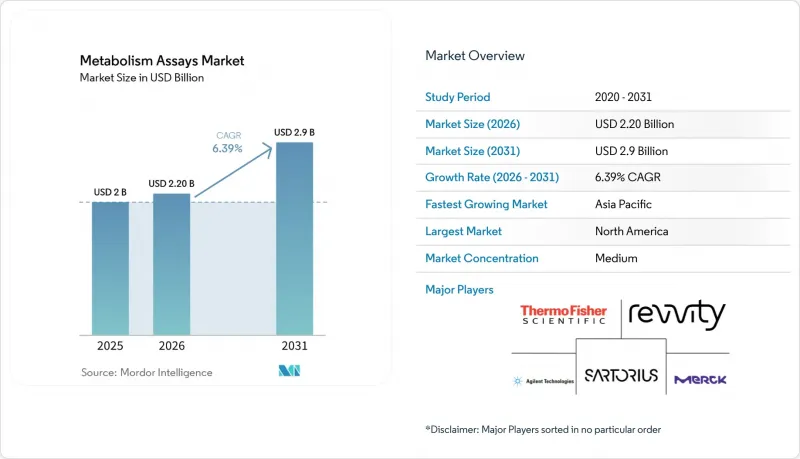
Mordor Intelligence에 의하면, 대사 어세이 시장 규모는 2025년에 20억 달러로 평가되었고 2026년 22억 달러에서 2031년까지 29억 달러에 이를 것으로 예측되며, 예측 기간(2026-2031년) CAGR은 6.39%를 나타낼 전망입니다.
본 보고서는 제품(키트 및 시약, 기기·분석 장비, 소프트웨어 및 서비스), 기술(비색법, 형광법, 분광법), 용도(진단, 조사), 최종 사용자(병원, 진단실험실 등), 지역(북미, 유럽, 아시아태평양, 중동 및 아프리카, 남미)별로 분류되어 있습니다. 시장 전망은 금액(달러) 기준으로 제시되어 있습니다.
세계 대사 어세이 시장 동향 및 인사이트
만성 질환 및 대사성 질환의 부담 증가로 인해 조사 및 진단 활용 사례가 확대되고 있습니다.
현재 대사증후군은 15억 4,000만 명의 성인에게 영향을 미치고 있으며, 당뇨병 환자 수는 2050년까지 8억 5,300만 명에 달할 것으로 예측됩니다. 병원에서는 혈당 수치가 상승하기 몇년전에 병세를 감지할 수 있는 분지쇄 아미노산 및 세라마이드 검사 패널을 도입하고 있습니다. 2026년의 멀티오믹스 연구에서는 2형 당뇨병 예측에 있어 AUC가 0.85를 초과하는 머신러닝 모델이 제시되었으며, 이에 따라 보험사들은 다항목 검사 키트의 보험 적용을 검토하고 있습니다. 당화 알부민 및 아디포카인의 측정법은 혈당 수치의 변동을 단기간 내에 파악할 수 있어 월별 모니터링을 가능하게 하며, 시약 공급업체에게 새로운 수익원이 됩니다. 그 결과, 대사 검사 시장은 일상적인 선별 검사 과정에 지속적으로 통합되고 있습니다.
신약 개발 워크플로우에서의 연구개발 자금 증가와 제약 업계에서의 채용
NIH의 연구비 지원 사업인 PAR-25-153 및 PAR-25-059는 분석법의 소형화와 하이컨텐츠 스크리닝에 자원을 투입하고 있습니다. 제약 기업들은 미토콘드리아 관련 위험 요인을 조기에 파악하기 위해 비표적 LC-MS 패널을 도입하고 있습니다. 서모피셔 사이언티피크의 Orbitrap Astral Zoom은 2,000개 이상의 이온을 ppm 미만의 정확도로 검출할 수 있어, 독성 시험에서의 탈락률을 낮춥니다. 아웃소싱은 유연성과 틈새 전문 지식에 대한 접근성을 제공하기 때문에 CRO의 매출은 사내 예산보다 더 빠르게 증가하고 있습니다. 신약 개발 파이프라인이 대사 및 면역대사 표적으로 전환됨에 따라, 대사 어세이 시장은 1차 및 2차 스크리닝 분야로의 진출을 확대되고 있습니다.
높은 설비 투자 및 운영 비용, 그리고 고도의 전문 지식 필요성
Seahorse XF Pro 분석기의 가격은 20만 달러를 초과하며, 연간 소모품 비용과 서비스 계약비가 추가로 5만-10만 달러가 더해지기 때문에 많은 중규모 병원이나 신흥 시장의 연구소에게는 감당하기 어려운 플랫폼이 되고 있습니다. Tecan사는 2025년에 매출이 5.5% 감소하고 1억 2,300만 달러의 순손실을 기록했다고 보고했으며, 그 주요 원인으로 장비 교체 주기의 장기화와 유럽의 보조금 지급 지연을 꼽았습니다. 또한, 실시간 분석에는 가스 제어, 액체 처리 로봇 및 동적 데이터 분석에 대한 훈련을 받은 인력이 필요하기 때문에 인건비가 총 소유 비용을 더욱 높이고 있습니다. 소규모 조직에서는 CRO에 검사를 위탁하는 사례가 증가하고 있지만, 탐색적 연구에서 시료당 비용은 여전히 고액이어서 초기 신약 개발 단계에서 분석법 도입을 제한하고 있습니다. 이러한 요인들이 복합적으로 작용하여, 비용에 민감한 지역에서 시장 확대를 저해하고 있습니다.
부문별 분석
기기 부문은 2025년에 매출의 63.29%를 차지해, 2031년까지 연평균 성장률(CAGR) 6.98%로 성장할 전망입니다. 키트 공급업체들은 판매량 측면에서 주도권을 유지하고 있지만, 하드웨어, 소모품, 소프트웨어를 구독 번들로 통합하는 추세에 따라 수익은 서비스 계약 쪽으로 이동하고 있습니다. MetaboAnalystR 4.0과 같은 소프트웨어 중심 제품은 사용자가 자동화된 경로 예측을 요구하는 가운데, 규모는 작지만 빠르게 성장하고 있는 분야입니다.
대사 어세이 시장에서는 장비와 후단 분석 기능을 결합한 업체들이 계속해서 우위를 점하고 있습니다. 예를 들어, 애지런트의 Seahorse 포트폴리오는 플럭스 측정값을 클라우드 대시보드에 연동하여 지점 간 비교를 가능하게 함으로써 시약 수요를 안정화하고 있습니다. 한편, Revvity의 QSight 시스템은 신생아 선별 검사 키트를 독자적인 컬럼과 결합함으로써 소모품의 이익률을 유지하고 있습니다. 따라서 시약 전문 기업들은 고객 기반의 통합이 진행되는 가운데 장비에 대한 부가율을 확보하기 위해 공동 마케팅 계약 체결을 모색하고 있습니다.
2025년 기준으로, 비색법이 대사 어세이 시장 점유율의 53.29%를 차지했습니다. 이는 병원의 화학 분석기나 혈당 측정기가 가시광선 파장에서의 흡광도에 의존하기 때문입니다. 그러나 연구자들이 저농도 검출 및 다중 사이토카인 패널을 요구함에 따라, 2031년까지 연평균 성장률(CAGR) 6.76%를 나타낼 것으로 예측되는 형광법이 비색법의 성장률을 앞지를 것으로 보입니다. 대사 어세이 업계에서는 PHERAstar 리더에서 Z-prime 값이 0.9를 초과한다는 보고가 있으며, 이는 견고한 스크리닝 능력을 입증하고 있습니다.
분광 측정법은 한 번의 측정으로 최대 2,000종의 분석 대상 물질을 프로파일링함으로써 측정 범위를 확대합니다. Orbitrap Astral Zoom 시스템은 제약 기업이 대사 산물의 시그니처를 약물 노출과 연관 짓는 데 도움을 주며, 표적 효소 분석법을 대체하기보다는 이를 보완하는 역할을 합니다. 시간 분해 형광법 및 발광법은 자가형광을 저감시키지만, 도입 비용이 높기 때문에 현장 진단 검사나 신흥 시장에서의 도입에 있어서는 여전히 비색법이 중요한 위치를 차지하고 있습니다.
지역별 분석
북미는 2025년 매출의 35.19%를 차지했습니다. 이는 FDA의 유효성 관련 지침과 NIH의 자금 지원 덕분에 분석법 파이프라인이 탄탄했기 때문입니다. 써모피셔와 애지런트는 비색 분석 키트와 고분해능 MS가 모두 필요한 생명공학 클러스터와의 근접성을 활용하여 시장 점유율을 주도하고 있습니다. 고급 패널에 대한 보험사 측의 면밀한 검토는 계속되고 있지만, 임상적 유용성을 입증하는 논문이 발표됨에 따라 보험 적용 범위가 점차 확대되고 있습니다.
유럽에서는 2025년 1월 유럽의약품청(EMA)이 참조 표준 물질의 요건을 공식적으로 규정한 지침이 긍정적인 영향을 미치며, 후원사가 검증된 대사 측정값을 채택하도록 뒷받침하고 있습니다. 공립 대학의 예산 제약으로 인해 설비 투자 갱신이 둔화되고 있으며, 테칸(Tecan)의 2025년 매출 감소에서 볼 수 있듯이 그 영향이 나타나고 있습니다. 그럼에도 불구하고, 독일과 영국은 대사 플럭스 연구 분야에서 여전히 강력한 입지를 유지하고 있으며, 시약 수요를 뒷받침하고 있습니다.
아시아태평양은 중국의 NMPA와 인도의 CDSCO가 승인 절차를 효율화하고 있는 덕분에 연평균 성장률(CAGR) 6.65%로 성장할 것으로 전망됩니다. 2026년 2월 프로메가사의 MSI 검출 키트가 승인된 것은 현지에서의 신청이 실현 가능함을 입증하고 있습니다. 국내 제조업체들은 다국적 기업보다 최대 50%나 저렴한 가격으로 제품을 공급하고 있으며, 2차 의료기관을 대상으로 한 비색법 키트의 판매를 확대되고 있습니다. 한편, 다국적 기업들은 고급 연구 장비에 주력하고 있어, 대사 어세이 시장은 수량과 가치 양면에서 성장하는 이중 성장 모델로 전환되고 있습니다.
기타 혜택:
- 엑셀 형식 시장 예측(ME) 시트
- 3개월간의 애널리스트 지원
자주 묻는 질문
목차
제1장 서론
제2장 조사 방법
제3장 주요 요약
제4장 시장 구도
제5장 시장 규모와 성장 예측
제6장 경쟁 구도
제7장 시장 기회와 향후 전망
JHS 26.06.23According to Mordor Intelligence, the metabolism assays market size was valued at USD 2 billion in 2025 and is estimated to grow from USD 2.20 billion in 2026 to reach USD 2.9 billion by 2031, at a CAGR of 6.39% during the forecast period (2026-2031).
This report is Segmented by Product (Kits & Reagents, Instruments & Analyzers, Software & Services), Technology (Colorimetry, Fluorimetry, Spectrometry), Application (Diagnostics, Research), End User (Hospitals, Diagnostic Laboratories, and More), and Geography (North America, Europe, Asia-Pacific, Middle East & Africa, South America). The Market Forecasts are Provided in Terms of Value (USD).
Global Metabolism Assays Market Trends and Insights
Chronic and Metabolic Disease Burden Expanding Research and Diagnostics Use-Cases
Metabolic syndrome now affects 1.54 billion adults, and diabetes cases are projected to reach 853 million by 2050. Hospitals are adding branched-chain amino acid and ceramide panels that detect pathology years before glucose rises. A 2026 multi-omic study showed machine-learning models with AUC greater than 0.85 for type 2 diabetes prediction, prompting payers to consider coverage for multiplexed kits. Glycated albumin and adipokine assays provide a short glycemic window, supporting monthly monitoring and new revenue for reagent suppliers. Consequently, the metabolism assays market continues to integrate into routine screening pathways.
Rising R&D Funding and Pharma Adoption in Drug Discovery Workflows
NIH grants PAR-25-153 and PAR-25-059 are channeling resources to assay miniaturization and high-content screening . Pharmaceutical firms deploy untargeted LC-MS panels to flag mitochondrial liabilities early; Thermo Fisher's Orbitrap Astral Zoom detects more than 2,000 ions with sub-ppm accuracy, cutting toxicology attrition. CRO revenue is therefore rising faster than in-house budgets because outsourcing offers flexibility and access to niche expertise. As drug pipelines shift toward metabolic and immunometabolic targets, the metabolism assays market sees deeper penetration into primary and secondary screens.
High Capital and Operational Costs and Skilled Expertise Requirements
Seahorse XF Pro analyzers list above USD 200,000, while annual consumables and service contracts can add another USD 50,000-100,000, making the platform inaccessible to many mid-tier hospitals and emerging-market laboratories. Tecan reported a 5.5% revenue decline and a USD 123 million net loss in 2025, citing lengthened instrument replacement cycles and delayed grant disbursements in Europe as key headwinds. Staffing further inflates the total cost of ownership because real-time assays need personnel trained in gas control, liquid-handling robotics, and kinetic data interpretation. Smaller organizations increasingly outsource testing to CROs, yet per-sample fees remain high for exploratory studies, limiting assay adoption in early discovery. Collectively, these factors trim market expansion in cost-sensitive regions.
Other drivers and restraints analyzed in the detailed report include:
- Technology Advances in Real-Time Flux, High-Throughput Kits, and Multimode Readers
- Shift Toward Personalized and Cell-Based Assays in Translational Research
- Substitution Overlap with Metabolomics MS / NMR and Standardization Gaps
For complete list of drivers and restraints, kindly check the Table Of Contents.
Segment Analysis
Instruments commanded 63.29% revenue in 2025 and will expand at a 6.98% CAGR through 2031. Kit suppliers maintain volume leadership, yet integration of hardware, consumables, and software into subscription bundles is shifting revenue to service contracts. Software-centric offerings such as MetaboAnalystR 4.0 remain a small but fast-growing slice as users seek automated pathway prediction.
The metabolism assays market continues to favor vendors that couple instruments with downstream analytics. Agilent's Seahorse portfolio, for example, links flux measurements to cloud dashboards for cross-site comparison, locking in reagent demand. Meanwhile, Revvity's QSight systems tie newborn screening kits to proprietary columns, protecting consumable margins. Pure-play reagent firms, therefore, explore co-marketing deals to secure instrument attachment rates in a consolidating customer base.
Colorimetry retained 53.29% of the metabolism assays market share in 2025 because hospital chemistry analyzers and glucose meters rely on absorbance at visible wavelengths. However, fluorimetry's 6.76% CAGR through 2031 overtakes colorimetric growth as researchers demand low-abundance detection and multiplexed cytokine panels. The metabolism assays industry reports Z-prime values above 0.9 on PHERAstar readers, demonstrating robust screening.
Spectrometry adds breadth by profiling up to 2,000 analytes in one run. Orbitrap Astral Zoom systems help pharma link metabolite signatures to drug exposure, complementing targeted enzyme assays rather than replacing them. Time-resolved fluorescence and luminescence reduce autofluorescence but impose higher entry costs, keeping colorimetry relevant for point-of-care testing and emerging-market adoption.
Geography Analysis
North America generated 35.19% of 2025 revenue as FDA potency guidance and NIH funding kept assay pipelines full. Thermo Fisher and Agilent dominate the installed base, leveraging close proximity to biotech clusters that demand both colorimetric kits and high-resolution MS. Payer scrutiny on advanced panels persists, yet clinical-utility publications are unlocking coverage incrementally.
Europe benefits from the January 2025 EMA guideline that formalized reference-standard requirements, spurring sponsors to adopt validated metabolic readouts. Budget constraints in public universities slowed capital upgrades, seen in Tecan's 2025 revenue decline. Nevertheless, Germany and the United Kingdom retain strong footprints in metabolic flux research, sustaining reagent demand.
Asia-Pacific is forecast to grow at 6.65% CAGR as China's NMPA and India's CDSCO streamline approvals. Promega's MSI Detection Kit clearance in February 2026 proves the viability of local filings. Domestic manufacturers undercut multinationals by up to 50%, expanding sales of colorimetric kits in tier-2 hospitals. Multinationals, meanwhile, focus on premium research instruments, positioning the metabolism assays market for a twin-track growth model of volume and value.
- AAT Bioquest, Inc.
- Abcam Ltd
- Abnova
- Agilent Technologies
- Reagent Genie Limited
- Bio-Rad Laboratories
- BMG LABTECH GmbH
- BMG LABTECH GmbH
- Cayman Chemical Company
- Dojindo Molecular Technologies, Inc.
- Elabscience Biotechnology Co., Ltd.
- Enzo Biochem
- Kaneka
- Merck
- Promega
- RayBiotech Life
- Revvity
- Sartorius
- Tecan Group
- Thermo Fisher Scientific
Additional Benefits:
- The market estimate (ME) sheet in Excel format
- 3 months of analyst support
TABLE OF CONTENTS
1 Introduction
- 1.1 Study Assumptions & Market Definition
- 1.2 Scope of the Study
2 Research Methodology
3 Executive Summary
4 Market Landscape
- 4.1 Market Overview
- 4.2 Market Drivers
- 4.2.1 Chronic And Metabolic Disease Burden Expanding Research and Diagnostics Use-Cases
- 4.2.2 Rising R&D Funding and Pharma Adoption in Drug Discovery Workflows
- 4.2.3 Technology Advances in Real-Time Flux, High-Throughput Kits, And Multimode Readers
- 4.2.4 Shift Toward Personalized and Cell-Based Assays in Translational Research
- 4.2.5 Cell & Gene Therapy QC/Potency Readouts Adopting Metabolic Profiling
- 4.2.6 Live-Cell Kinetic ATP/MMP Analytics Enabling Mechanism-Aware Screening.
- 4.3 Market Restraints
- 4.3.1 High Capital/Operational Costs and Skilled Expertise Requirements
- 4.3.2 Substitution/Overlap with Metabolomics MS/NMR; Standardization Gaps
- 4.3.3 Reproducibility/Normalization Challenges in Real-Time Metabolic Assays
- 4.3.4 Compound Fluorescence/Luminescence Interference Necessitating Orthogonal Validation
- 4.4 Supply Chain Analysis
- 4.5 Regulatory Landscape
- 4.6 Technological Outlook
- 4.7 Porter's Five Forces Analysis
- 4.7.1 Threat of New Entrants
- 4.7.2 Bargaining Power of Suppliers
- 4.7.3 Bargaining Power of Buyers
- 4.7.4 Threat of Substitutes
- 4.7.5 Competitive Rivalry
5 Market Size & Growth Forecasts (Value, USD)
- 5.1 By Product
- 5.1.1 Kits & Reagents
- 5.1.2 Instruments & Analyzers
- 5.1.3 Software & Services
- 5.2 By Technology
- 5.2.1 Colorimetry
- 5.2.2 Fluorimetry
- 5.2.3 Spectrometry
- 5.3 By Application
- 5.3.1 Diagnostics
- 5.3.1.1 Diabetes
- 5.3.1.2 Obesity
- 5.3.1.3 Cancer
- 5.3.1.4 Cardiovascular Diseases
- 5.3.1.5 Other Diagnostics
- 5.3.2 Research
- 5.3.1 Diagnostics
- 5.4 By End User
- 5.4.1 Hospitals
- 5.4.2 Diagnostic Laboratories
- 5.4.3 Pharmaceutical & Biotechnology Companies
- 5.4.4 CROs & Academic Research Institutes
- 5.5 By Geography
- 5.5.1 North America
- 5.5.1.1 United States
- 5.5.1.2 Canada
- 5.5.1.3 Mexico
- 5.5.2 Europe
- 5.5.2.1 Germany
- 5.5.2.2 United Kingdom
- 5.5.2.3 France
- 5.5.2.4 Italy
- 5.5.2.5 Spain
- 5.5.2.6 Rest of Europe
- 5.5.3 Asia-Pacific
- 5.5.3.1 China
- 5.5.3.2 India
- 5.5.3.3 Japan
- 5.5.3.4 South Korea
- 5.5.3.5 Australia
- 5.5.3.6 Rest of APAC
- 5.5.4 Middle East & Africa
- 5.5.4.1 GCC
- 5.5.4.2 South Africa
- 5.5.4.3 Rest of MEA
- 5.5.5 South America
- 5.5.5.1 Brazil
- 5.5.5.2 Argentina
- 5.5.5.3 Rest of South America
- 5.5.1 North America
6 Competitive Landscape
- 6.1 Market Concentration
- 6.2 Market Share Analysis
- 6.3 Company Profiles (includes Global level Overview, Market Level Overview, Core Segments, Financials as Available, Strategic Information, Market Rank/Share for Key Companies, Products & Services, and Recent Developments)
- 6.3.1 AAT Bioquest, Inc.
- 6.3.2 Abcam Ltd
- 6.3.3 Abnova Corporation
- 6.3.4 Agilent Technologies, Inc
- 6.3.5 Reagent Genie Limited
- 6.3.6 Bio-Rad Laboratories, Inc.
- 6.3.7 BMG LABTECH GmbH
- 6.3.8 BMG LABTECH GmbH
- 6.3.9 Cayman Chemical Company
- 6.3.10 Dojindo Molecular Technologies, Inc.
- 6.3.11 Elabscience Biotechnology Co., Ltd.
- 6.3.12 Enzo Life Sciences, Inc.
- 6.3.13 Kaneka Eurogentec
- 6.3.14 Merck KGaA
- 6.3.15 Promega Corporation
- 6.3.16 RayBiotech Life
- 6.3.17 Revvity
- 6.3.18 Sartorius AG
- 6.3.19 Tecan Group
- 6.3.20 Thermo Fisher Scientific
7 Market Opportunities & Future Outlook
- 7.1 White-space & Unmet-need Assessment


