
|
시장보고서
상품코드
2063527
병리학 분야 인공지능(AI) : 시장 점유율 분석, 업계 동향 및 통계, 성장 예측(2026-2031년)AI In Pathology - Market Share Analysis, Industry Trends & Statistics, Growth Forecasts (2026 - 2031) |
||||||
 Mordor Intelligence
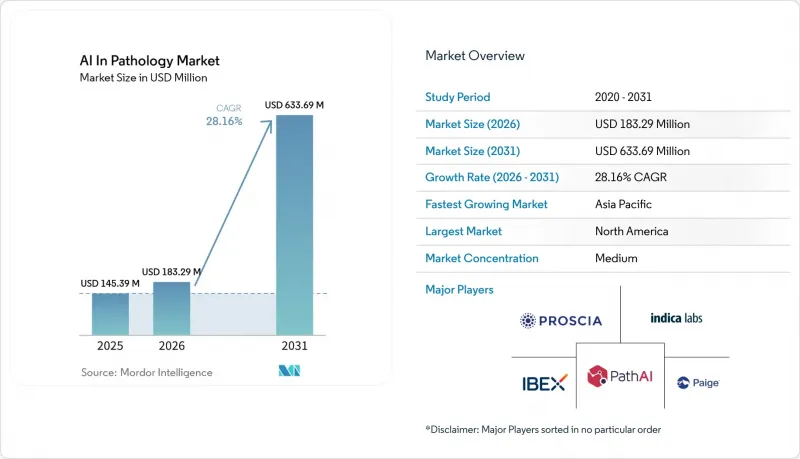
Mordor Intelligence에 의하면, 병리학 분야 인공지능(AI) 시장 규모는 2025년에 1억 4,539만 달러로 평가되었습니다. 2026-2031년 CAGR은 28.16%를 나타내 2031년에는 6억 3,369만 달러에 이를 것으로 예측됩니다.
본 보고서는 구성 요소(소프트웨어, 서비스, 하드웨어), 기능(이미지 분석·패턴 인식, 기타), 이용 사례(신약 개발·트랜스레이셔널 리서치, 기타), 최종 사용자(병원, 진단실험실, 기타), 지역(북미, 유럽, 아시아태평양, 중동 및 아프리카, 남미)별로 분류되어 있습니다. 시장 전망은 금액(달러) 기준으로 제시되어 있습니다.
세계의 병리학 분야 인공지능(AI) 시장 동향 및 인사이트
도입을 가능하게 하는 임상 승인(FDA/CE-IVDR 진행 상황)
2025년부터 2026년에 걸친 규제 관련 주요 단계는 임상 등급 플랫폼과 표적 맞춤형 컴퓨터 진단을 가능하게 함으로써 도입 위험을 줄였습니다. 2025년 6월, PathAI사의 AISight Dx는 사전에 결정된 변경 관리 계획(Predetermined Change Control Plan)을 포함하는 최초의 FDA 승인 디지털 병리 영상 관리 시스템이 되었으며, 규제 대상 진료 현장에서 반복적인 소프트웨어 개선을 위한 실질적인 선례를 확립했습니다. 2025년 4월, FDA는 로슈사의 ‘VENTANA TROP2 RxDx 기기’에 대해 획기적 의료기기(Breakthrough Device) 지정을 부여했습니다. 이는 해당 인증을 받은 최초의 계산병리학 동반진단제로, AI를 통한 점수 산정이 비소세포폐암의 치료법 선택에 지침이 될 수 있음을 입증하는 것입니다. 이러한 결정의 취지는 임상 검증, 분석 성능 및 시판 후 감시를 학습 시스템의 현실과 조화시키는 데 있습니다. 병리학 분야 인공지능(AI) 시장에 미치는 영향으로는 디지털 플랫폼이 기업의 워크플로우에서 운영 체제 역할을 하고, AI 모듈이 명확하게 정의된 임상 업무와 연계됨에 따라 인식되는 규제 위험이 실질적으로 감소하고 있다는 점을 들 수 있습니다. 이와 동시에 디지털 병리학 분야의 EU IVDR 인증도 확대되고 있으며, 각 공급업체들은 장기적인 규정 준수를 뒷받침하는 품질 관리 시스템, 다기관 검증 및 기술 문서를 제시하고 있습니다. 이러한 움직임은 전반적으로 소프트웨어 기반의 혁신 주기에 부합하는 감독 체제의 성숙도를 보여주고 있으며, 병리학 분야 인공지능(AI) 시장에서 기업들의 조달을 가속화하고 있습니다.
종양학 분야에서 바이오마커의 급증과 표준화된 IHC 정량화의 필요성
치료 접근성은 점점 더 정교해지는 바이오마커 기준치에 좌우되고 있으며, 이로 인해 면역조직화학 점수 매기기의 표준화 필요성이 커지고 있습니다. 2026년 1월에 실시된 HER2 점수 산정을 위한 AI 기법에 대한 다중 모델 평가에서는 독자적으로 개발된 알고리즘 간에 편차가 관찰되었으며, HER2-low와 같이 임계값을 기준으로 치료 적격성이 결정되는 경우, 일관된 정량적 기법의 가치가 재확인되었습니다. 동시에, Lunit의 PD-L1 스코어링 스위트와 같은 임상 등급 도구는 판독 시간 단축과 재현성 향상을 목표로 하며, 면역종양학 워크플로우의 과제 해결에 힘쓰고 있습니다. 미국 의학협회(AMA)의 부록 S에 명시된 분류 체계가 개정됨에 따라, AI를 활용한 임상 서비스를 ‘지원 기능’, ‘확장 기능’, ‘자율 기능’의 세 가지로 분류하는 방법이 명확해졌습니다. 이를 통해 이러한 도구들이 진료 경로에서 어떤 위치를 차지하게 될지, 또한 보험 적용 여부의 판단 기준이 어떻게 변화해 나갈지에 대한 시사점을 얻을 수 있습니다. 이러한 발전들이 합쳐져, 수동적인 시각적 추정에서 표준화된 정량적 채점 방식으로의 전환을 촉진하고 있습니다. 이러한 전환은 병리 진료에서 의사결정 지원의 역할을 더욱 명확히 하고, 임상적 확신을 높이는 동시에, 병리학 분야 인공지능(AI) 시장에서의 임상시험 및 치료법 선택을 가속화할 것입니다.
AI 병리학 분야에서 불명확한 보험 급여 및 ROI의 전망
보험 적용 및 코딩 방침은 병원이 AI에 대한 투자를 어느 정도 신속하게 정당화할 수 있는지를 좌우합니다. CMS(미국 의료보험서비스센터)의 지급 일관성 및 중복 방지 규정은 동일한 분석 대상을 평가하는 여러 기법에 대한 개별 지급을 제한하고 있으며, 이로 인해 알고리즘을 활용한 병리 서비스가 독립적인 것인지, 아니면 기존 코드에 통합되는 것인지에 대해 모호성이 발생하고 있습니다. 디지털 병리 슬라이드의 디지털화와 관련된 카테고리 III CPT 코드는 추적 기능을 제공하지만, 할당된 RVU(상대 가치 단위)가 없기 때문에 보험사별로 개별적인 대응이 필요하며, 이는 예측 가능한 보험금 지급이 지연되는 원인이 되고 있습니다. AMA의 부록 S 분류법은 AI를 활용한 서비스를 ‘보조적’, ‘확장적’, ‘자율적’으로 분류하는 체계를 제공하며, 이를 통해 케어 패스웨이 내에서 이러한 도구의 기록 및 청구 방법이 명확해집니다. 단기적으로는 이로 인해 의료 제공업체가 AI 지원 업무로부터 직접 수익을 회수할 수 있는 속도가 제한될 것이며, 그 정당화의 근거는 생산성, 처리 시간 및 품질 향상으로 전환될 것입니다. 운영상의 복잡성도 중대한 우려 사항입니다. 메디케어의 종량제 보수 제도에서 발생한 부적절한 지급액 추정치를 보면, 코딩 오류가 의료 시스템에 있어 뿌리 깊은 위험 요인으로 작용하고 있기 때문입니다. 보다 명확한 지불 경로가 확립될 때까지는 병리학 분야 인공지능(AI) 시장의 도입이 AI를 인프라로 삼아 자금을 조달하고, 규모의 경제를 통해 가치를 회수할 수 있는 대규모 의료 시스템이나 검사실로 편중될 것입니다.
부문별 분석
2025년에는 병리학 분야 인공지능(AI) 시장에서 엔터프라이즈 플랫폼이 검증된 임상 및 연구 과제를 위해 이미지 관리와 AI 모듈을 통합함에 따라 소프트웨어가 50.33%로 가장 큰 점유율을 차지했습니다. 병원 및 검사실은 규정을 준수하는 운영을 유지하기 위해 도입 지원, 워크플로우 설계, LIS(검사 정보 시스템)와의 통합, 그리고 지속적인 모델 검증이 필요하기 때문에 서비스 부문은 2031년까지 연평균 성장률(CAGR) 29.20%를 나타낼 것으로 전망됩니다. 대규모 의료 시스템과의 다년간 제휴에는 플랫폼 도입과 관리형 서비스, 교육, 알고리즘 공동 개발이 결합되어 있으며, 이는 조직이 개별 도구가 아닌 전체 솔루션을 구매하는 경향을 반영하고 있습니다. 이러한 서비스에는 대개 품질 보증, 정책 템플릿, 그리고 분산된 사업장 전반에 걸친 디지털 1차 진단의 규정 준수를 효율화하는 문서화가 포함됩니다. 하드웨어 선택은 클라우드 기반 워크플로우 및 대규모 전송 및 저장 부하를 경감하는 차세대 파일 출력 형식과 점점 더 밀접하게 연계되고 있습니다. 시간이 지남에 따라, 이러한 서비스의 조합은 거버넌스 체계, 모델 모니터링 관행 및 지속적인 업데이트를 병리학 분야 인공지능(AI) 시장의 일상 업무에 통합함으로써 재현 가능한 성과를 뒷받침하게 될 것입니다.
서비스 주도형 성장은 벤더 관리를 통한 도입 및 라이프사이클 지원을 통해 구매자가 변화에 수반되는 위험을 완화하고 있는 현실을 반영하고 있습니다. 플랫폼 출시로 인해 다중 알고리즘 워크플로우, 유연한 슬라이드 가져오기, 공동 검토가 더욱 용이해졌으며, 이를 통해 다중 거점 네트워크 전반에 걸친 표준화가 가속화되고 있습니다. 클라우드 퍼스트 도입은 On-Premise 환경의 오버헤드를 줄이고, 서로 다른 IT 환경이 혼재된 각 검사실에서의 도입을 가속화합니다. 경영진의 지원과 거버넌스 위원회를 통한 체계적인 추진은 알고리즘 업데이트 및 검증 주기를 위한 지속 가능한 기반을 마련합니다. 도입 파트너는 또한 시설이 디지털 워크플로우 관련 인증 기준 요건에 따라 SOP(표준 작업 절차서)를 준수할 수 있도록 지원합니다. 조직들이 단순한 라이선스 모델보다 신뢰할 수 있는 성과를 우선시함에 따라, 이러한 운영 관행은 병리학 분야 인공지능(AI) 시장의 서비스 중심적 태도를 더욱 공고히 하고 있습니다.
이미지 분석과 패턴 인식은 2025년 병리학 분야 인공지능(AI) 시장 점유율의 48.38%를 차지했으며, 이는 조사 및 초기 단계의 임상 업무를 뒷받침해 온 분할, 감지, 분류 엔진에 대한 역사적인 의존도를 반영했습니다. 진단 의사결정 지원은 임상 등급 솔루션이 검증된 점수 산출 결과를 통해 치료법 선택 및 보고에 정보를 제공함에 따라, 2031년까지 연평균 성장률(CAGR) 29.46%를 나타낼 것으로 예측됩니다. VENTANA TROP2 RxDx 기기에 대한 FDA의 획기적 기기 지정은 비소세포폐암 치료법 선택을 안내하는 AI 기반 지표의 선례가 되었으며, 규제 대상인 CDx 프레임워크 내에서 의사결정 지원 도구의 역할이 커지고 있음을 보여줍니다. 의사결정 지원의 확산세는 보조 도구가 의사의 업무 흐름에 어떻게 통합되는지를 명확히 하는 분류 체계의 업데이트에 힘입어 가속화되고 있으며, 이를 통해 도입 장벽을 낮추는 동시에 가치와 위험을 체계적으로 평가할 수 있게 하고 있습니다. 또한, 검증된 품질 관리(QC) 워크플로우가 점차 보급되면서, 후속 단계의 의사결정 지원 신뢰성을 높이고, 보고를 지연시키는 재검사를 억제하고 있습니다.
의료 기관들이 AI를 실용화함에 따라, 정량적 평가와 임상 보고 프로세스를 연계하는 도구가 명확한 우선 과제로 대두되고 있습니다. 다중 알고리즘의 연동 및 검체 단위 보고 기능을 통해, 대규모 네트워크 전체에서 병리 전문의가 사례 증거를 수집하는 과정이 효율화됩니다. IHC 표적에 대해 신속하고 재현성 있는 정량화를 제공하며, LIS 워크플로우와 통합할 수 있는 능력은 패턴 인식에서 대규모 의사결정 지원에 이르는 실용적인 가교 역할을 합니다. QC 자동화 단계는 사람이 검토하기 전에 입력 오류를 포착하여, 생산성을 저하시키는 재절단이나 재스캔을 방지합니다. 전반적으로, 이러한 변화들은 환자 관리에 영향을 미치는 도구로의 신중하면서도 꾸준한 전환과 일치하며, 병리학 분야 인공지능(AI) 시장 내 이 기능의 성장 전망을 더욱 공고히 하고 있습니다.
지역별 분석
2025년 북미는 병리학 AI 시장 점유율의 50.13%를 차지했습니다. 이는 기업 도입의 위험을 완화한 규제 당국의 승인과, 대규모 디지털 1차 진단을 입증한 대규모 시스템 도입에 힘입은 결과입니다. FDA 승인을 받은 엔터프라이즈 플랫폼은 병원 및 검사실 네트워크에 도입 및 통합되어 워크플로우를 현대화하는 동시에, 알고리즘을 활용한 의사결정 지원을 위한 공유 인프라를 구축했습니다. 대규모 네트워크를 통한 시스템 전반의 도입은 거버넌스 기준을 확립하고, 다른 의료기관의 구매 의욕을 북돋아주었습니다. 플랫폼 간 상호 운용성과 스캐너 호환성의 발전, 그리고 클라우드 지원 아키텍처 덕분에 북미의 의료 기관에는 실질적인 확장 가능성이 열렸습니다. 이러한 요소들은 임상 AI의 보다 광범위한 활용을 위한 기반을 공고히 하며, 병리학 분야 인공지능(AI) 시장에서 해당 지역의 선도적 지위를 뒷받침하고 있습니다.
유럽에서는 IVDR에 따라 진전이 이루어졌으며, 각 공급업체들은 지속 가능한 임상 활용을 뒷받침하는 인증된 품질 시스템, 임상 성능 및 시판 후 조사 계획을 입증했습니다. 모델과 이를 뒷받침하는 품질 관리 인프라를 모두 아우르는 인증은 제품 수명 주기 전반에 걸친 엄격성을 중시하는 점차 성숙해 가는 규제 환경을 반영하고 있습니다. 유럽 의료 시스템의 검사실 역시 엄격한 데이터 거버넌스를 준수하는 클라우드 기반 플랫폼 전략의 혜택을 누리고 있으며, 이를 통해 조직은 내부 IT 팀을 확대하지 않고도 도입 과정의 복잡성을 관리할 수 있게 되었습니다. IVDR 규제 체계와 엔터프라이즈급 플랫폼의 결합을 통해, 유럽은 1차 진단, 품질 보증(QA), 그리고 임상 보고서에 통합된 알고리즘 기반 점수 산정 등 각 분야에서 꾸준한 성장을 이룰 준비가 되어 있습니다. 스캐너 공급업체들이 스토리지 오버헤드를 줄이는 파일 형식을 지속적으로 개발함에 따라, 유럽의 네트워크는 디지털화를 보다 효율적으로 확대하고, 보존 의무를 충족하는 다년간의 아카이브를 유지할 수 있게 될 것입니다.
아시아태평양에서는 2031년까지 연평균 성장률(CAGR) 31.24%를 나타낼 것으로 예측되며, 이러한 수요는 인력 수용 능력의 한계와 대규모 센터 간 워크플로우 표준화의 필요성에 의해 주도되고 있습니다. 병리 전문의와 인구 비율이 낮은 지역에서는 트리아지, 품질 관리(QC), 정량적 채점을 위한 AI 기반 프로세스가, 통제되고 감사 가능한 방식으로 진단 처리 능력을 확대하는 데 도움이 됩니다. 클라우드 지원 플랫폼의 성장은 초기 투자 부담을 줄이고, 다중 사이트 시스템 전반에 걸친 통합적인 도입을 촉진함으로써 접근성을 더욱 확대합니다. 기초 모델과 임베디드 모델이 조직별 특화 과제의 수행 능력을 향상시킴에 따라, 지역 의료 제공업체들은 현지 질병 부담에 대한 요구를 충족시키는 의사결정 지원 시스템을 도입할 수 있게 되며, 이에 따라 투자의 정당성이 더욱 높아집니다. 또한, 전 세계 진단 및 제약 생태계와의 벤더 제휴는 지식 이전과 표준화를 가속화하여, 병리학 분야 인공지능(AI) 시장이 종양학 프로그램 전반에 걸쳐 확산되도록 촉진할 것입니다.
기타 혜택 :
- 엑셀 형식 시장 예측(ME) 시트
- 3개월간의 애널리스트 지원
자주 묻는 질문
목차
제1장 서론
제2장 조사 방법
제3장 주요 요약
제4장 시장 구도
제5장 시장 규모 및 성장 예측
제6장 경쟁 구도
제7장 시장 기회 및 향후 전망
KTH 26.06.24According to Mordor Intelligence, the aI in Pathology market size was USD 145.39 million in 2025 and is projected to reach USD 633.69 million by 2031 at a 28.16% CAGR during 2026-2031.
This report is Segmented by Component (Software, Services, Hardware), Function (Image Analysis & Pattern Recognition, and Others), Use Case (Drug Discovery & Translational Research, and Others), End User (Hospitals, Diagnostic Laboratories, and Others), and Geography (North America, Europe, Asia-Pacific, Middle East and Africa, South America). The Market Forecasts are Provided in Terms of Value (USD).
Global AI In Pathology Market Trends and Insights
Clinical Approvals Enabling Adoption (FDA/CE-IVDR Progress)
Regulatory milestones between 2025 and 2026 lowered adoption risk by enabling clinical-grade platforms and targeted computational diagnostics. In June 2025, PathAI's AISight Dx became the first FDA-cleared digital pathology image management system that included a Predetermined Change Control Plan, setting a practical precedent for iterative software improvements within regulated practice.In April 2025, the FDA granted Breakthrough Device Designation to Roche's VENTANA TROP2 RxDx Device, marking the first computational pathology companion diagnostic to receive this recognition and evidencing that AI-derived scoring can guide therapy selection in non-small cell lung cancer. The intent of such decisions is to align clinical validation, analytical performance, and postmarket oversight with the realities of learning systems. The effect for the AI in Pathology market is a tangible reduction in perceived regulatory risk as digital platforms become the operating system for enterprise workflows while AI modules connect to well-defined clinical tasks. In parallel, EU IVDR certifications across digital pathology are expanding, with vendors demonstrating quality management systems, multi-site validation, and technical documentation that support long-term compliance. This momentum collectively signals maturing oversight that aligns with software-based innovation cycles and accelerates enterprise procurement in the AI in Pathology market.
Oncology Biomarker Surge and Need for Standardized IHC Quantification
Therapy access increasingly hinges on precise biomarker thresholds, which magnifies the need to standardize immunohistochemistry scoring. A January 2026 multi-model evaluation of AI methods for HER2 scoring highlighted variability across independently developed algorithms, reinforcing the value of consistent quantitative methods when treatment eligibility depends on cutoffs like HER2-low. At the same time, clinical-grade tools like Lunit's PD-L1 scoring suite seek to reduce reading time and improve reproducibility, addressing pressure points in immuno-oncology workflows. The American Medical Association's Appendix S taxonomy update clarifies how to categorize AI-enabled clinical services across assistive, augmentative, and autonomous functions, which informs how these tools are positioned in care pathways and how coverage determinations may evolve. Together, these advances support the ongoing transition from manual visual estimation toward standardized quantitative scoring. This transition fosters a clearer role for decision support in pathology practice, improving clinical confidence and accelerating trials and treatment selection in the AI in Pathology market.
Unclear Reimbursement and ROI Pathways for AI Pathology
Coverage and coding policies shape how quickly hospitals can justify investment in AI. CMS payment integrity and anti-duplication rules restrict separate payment for multiple methods that assess the same analyte, which creates ambiguity about whether an algorithmic pathology service is distinct or bundled into an existing code. Category III CPT codes for digital pathology slide digitization provide tracking but do not carry assigned RVUs, requiring payer-by-payer engagement that delays predictable reimbursement. AMA's Appendix S taxonomy creates a framework to classify AI-enabled services as assistive, augmentative, or autonomous, which informs how these tools are documented and billed within care pathways. In the near term this limits the speed at which providers can reclaim direct revenue for AI-supported tasks, shifting the justification toward productivity, turnaround time, and quality gains. Operational complexity is a material concern as well, since Medicare's fee-for-service improper payment estimates show coding errors are a persistent source of risk for health systems. Until clearer payment pathways mature, adoption in the AI in Pathology market will skew toward large systems and labs that can fund AI as infrastructure and recoup value through scale.
Other drivers and restraints analyzed in the detailed report include:
- Pharma-CDx Partnerships Embedding AI in Assay Workflows
- Foundation and Embedding Models Improving Scalability and Domain Robustness
- Compute, Storage, and IT Overhead for WSI-Scale AI Inference
For complete list of drivers and restraints, kindly check the Table Of Contents.
Segment Analysis
Software commanded the largest share at 50.33% in 2025 as enterprise platforms integrated image management and AI modules for validated clinical and research tasks in the AI in Pathology market. Services is projected to grow at 29.20% CAGR through 2031 as hospitals and labs require implementation support, workflow design, LIS integration, and continuous model validation to maintain regulated use. Multi-year collaborations with large health systems pair platform deployment with managed services, training, and algorithm co-development, reflecting how organizations buy solutions rather than point tools. These services often include quality assurance, policy templates, and documentation that streamline compliance for digital primary diagnosis across distributed sites. Hardware choices increasingly align with cloud-enabled workflows and next-generation file outputs that ease transmission and storage load at scale. Over time, the services mix supports repeatable outcomes by embedding governance structures, model monitoring practices, and continuous updates into routine operations for the AI in Pathology market.
Service-led growth also reflects how buyers de-risk transformation with vendor-managed deployments and lifecycle support. Platform releases increasingly enable multi-algorithm workflows, flexible slide ingestion, and collaborative review, which accelerates standardization across multi-site networks. Cloud-first deployments reduce on-premises overhead and speed adoption across labs with heterogeneous IT capabilities. Structured rollouts with executive sponsorship and governance boards create durable pathways for algorithm updates and validation cycles. Implementation partners also help facilities align SOPs with accreditation expectations for digital workflows. These operating practices strengthen the services thesis for the AI in Pathology market as organizations prioritize dependable outcomes over license-only models.
Image analysis and pattern recognition held 48.38% AI in Pathology market share in 2025, reflecting historical reliance on segmentation, detection, and classification engines that supported research and early-stage clinical tasks. Diagnostic decision support is forecast to grow at 29.46% CAGR through 2031 as clinical-grade solutions inform therapy selection and reporting with validated scoring outputs. FDA Breakthrough Device Designation for the VENTANA TROP2 RxDx Device established a precedent for AI-derived metrics to guide therapy selection in non-small cell lung cancer, signaling the rising role of decision support tools within regulated CDx frameworks. Momentum for decision support is reinforced by taxonomy updates that specify how augmentative tools fit within physician workflows, reducing adoption friction while enabling methodical evaluation of value and risk. Validated QC workflows are also gaining traction, raising the reliability of downstream decision support and limiting rescans that delay reporting.
As health systems operationalize AI, tools that connect quantitative scoring with clinical reporting pathways gain clear priority. Multi-algorithm orchestration and specimen-level reporting features streamline how case evidence is assembled for pathologists across large networks. The ability to deliver prompt, reproducible quantification for IHC targets and to integrate with LIS workflows represents a practical bridge from pattern recognition to decision support at scale. QC automation layers catch input issues before human review, preventing recuts and rescans that diminish productivity. Collectively, these shifts align with a measured but steady pivot toward tools that affect patient management, reinforcing the growth prospects for this function within the AI in Pathology market.
Geography Analysis
North America held 50.13% of AI in Pathology market share in 2025, supported by regulatory clearances that de-risked enterprise deployment and by large system rollouts that validated digital primary diagnosis at scale. FDA-cleared enterprise platforms converged with hospital and lab network deployments, which modernized workflows and created shared infrastructure for algorithmic decision support. System-wide adoption by large networks established governance baselines and reinforced purchasing confidence across additional providers. Advances in platform interoperability and scanner compatibility, together with cloud-enabled architecture, gave North American providers a practical path to scale. These elements stabilized the foundation for broader clinical AI use and underpin the region's leadership position in the AI in Pathology market.
Europe progressed under IVDR with vendors demonstrating certified quality systems, clinical performance, and postmarket surveillance plans that support sustainable clinical use. Certifications that cover both models and the supporting quality management infrastructure reflect a maturing regulatory environment that emphasizes lifecycle rigor. Labs in European health systems also benefit from cloud-enabled platform strategies that align with strict data governance, helping organizations manage deployment complexity without enlarging internal IT teams. The combination of IVDR guardrails and enterprise-grade platforms positions Europe for steady expansion across primary diagnosis, QA, and algorithmic scoring embedded in clinical reporting. As scanner vendors iterate on file formats that reduce storage overhead, European networks can scale digitization more efficiently and sustain multi-year archives that satisfy retention mandates.
Asia-Pacific is projected to record 31.24% CAGR through 2031, with demand driven by workforce capacity constraints and the need to standardize workflows across high-volume centers. In regions where the ratio of pathologists to population is low, AI-augmented processes for triage, QC, and quantitative scoring can help scale diagnostic throughput in a controlled and auditable manner. Growth in cloud-enabled platforms further expands access by reducing up-front capital requirements and by facilitating uniform deployments across multi-site systems. As foundation and embedding models improve performance for tissue-specific tasks, regional providers can adopt decision support that meets local disease burden needs, advancing the case for investment. Vendor partnerships with global diagnostics and pharma ecosystems also accelerate knowledge transfer and standard-setting, accelerating uptake across oncology programs in the AI in Pathology market.
- Aiforia Technologies
- Aiosyn
- Deciphex (Patholytix)
- DeepBio
- 3DHISTECH / Epredia QuantCenter
- Roche
- Ibex Medical Analytics
- Indica Labs
- Lunit
- Mindpeak
- Nucleai
- OptraSCAN
- Owkin
- Paige
- Philips Digital & Computational Pathology
- Proscia
- Qritive
- Sectra
- Techcyte
- Visiopharm
Additional Benefits:
- The market estimate (ME) sheet in Excel format
- 3 months of analyst support
TABLE OF CONTENTS
1 Introduction
- 1.1 Study Assumptions and Market Definition
- 1.2 Scope of the Study
2 Research Methodology
3 Executive Summary
4 Market Landscape
- 4.1 Market Overview
- 4.2 Market Drivers
- 4.2.1 Clinical Approvals Enabling Adoption (FDA/CE/IVDR Progress)
- 4.2.2 Oncology Biomarker Surge and Need for Standardized IHC Quantification
- 4.2.3 AI-Ready Digital Pathology Platforms Easing Deployment
- 4.2.4 Pharma-CDx Partnerships Embedding AI in Assay Workflows
- 4.2.5 Foundation and Embedding Models Improving Scalability and Domain Robustness
- 4.2.6 Automated Slide QC Reducing Rescans and Enabling Reliable AI at Scale
- 4.3 Market Restraints
- 4.3.1 Unclear Reimbursement and ROI Pathways for AI Pathology
- 4.3.2 Domain Shift Across Scanners/Stains/Sites Limiting Generalizability
- 4.3.3 IVDR Notified-Body Capacity and Evidentiary Burden Raising Time-to-Market
- 4.3.4 Compute, Storage, and IT Overhead for WSI-Scale AI Inference
- 4.4 Value-Chain Analysis
- 4.5 Regulatory Landscape
- 4.6 Technological Outlook
- 4.7 Porter's Five Forces Analysis
- 4.7.1 Threat of New Entrants
- 4.7.2 Bargaining Power of Suppliers
- 4.7.3 Bargaining Power of Buyers
- 4.7.4 Threat of Substitutes
- 4.7.5 Competitive Rivalry
5 Market Size & Growth Forecasts (Value, USD)
- 5.1 By Component
- 5.1.1 Software
- 5.1.2 Services
- 5.1.3 Hardware (WSI scanners, AI-enabled microscopes)
- 5.2 By Function
- 5.2.1 Image Analysis and Pattern Recognition
- 5.2.2 Diagnostic Decision Support
- 5.2.3 Workflow/Quality Control Automation
- 5.2.4 Others
- 5.3 By Use Case
- 5.3.1 Drug Discovery and Translational Research
- 5.3.2 Primary Diagnosis and Quality Assurance
- 5.3.3 Clinical Trials and Companion Diagnostics
- 5.3.4 Others
- 5.4 By End User
- 5.4.1 Hospitals
- 5.4.2 Diagnostic Laboratories
- 5.4.3 Pharmaceutical and Biopharmaceutical Companies
- 5.4.4 Others
- 5.5 By Geography
- 5.5.1 North America
- 5.5.1.1 United States
- 5.5.1.2 Canada
- 5.5.1.3 Mexico
- 5.5.2 Europe
- 5.5.2.1 Germany
- 5.5.2.2 United Kingdom
- 5.5.2.3 France
- 5.5.2.4 Italy
- 5.5.2.5 Spain
- 5.5.2.6 Rest of Europe
- 5.5.3 Asia-Pacific
- 5.5.3.1 China
- 5.5.3.2 Japan
- 5.5.3.3 India
- 5.5.3.4 Australia
- 5.5.3.5 South Korea
- 5.5.3.6 Rest of Asia-Pacific
- 5.5.4 Middle East and Africa
- 5.5.4.1 GCC
- 5.5.4.2 South Africa
- 5.5.4.3 Rest of Middle East and Africa
- 5.5.5 South America
- 5.5.5.1 Brazil
- 5.5.5.2 Argentina
- 5.5.5.3 Rest of South America
- 5.5.1 North America
6 Competitive Landscape
- 6.1 Market Concentration
- 6.2 Market Share Analysis
- 6.3 Company Profiles (includes Global level Overview, Market level overview, Core Segments, Financials as available, Strategic Information, Market Rank/Share for key companies, Products & Services, Recent Developments)
- 6.3.1 Aiforia Technologies
- 6.3.2 Aiosyn
- 6.3.3 Deciphex (Patholytix)
- 6.3.4 DeepBio
- 6.3.5 3DHISTECH / Epredia QuantCenter
- 6.3.6 F. Hoffmann La Roche
- 6.3.7 Ibex Medical Analytics
- 6.3.8 Indica Labs
- 6.3.9 Lunit
- 6.3.10 Mindpeak
- 6.3.11 Nucleai
- 6.3.12 OptraSCAN
- 6.3.13 Owkin
- 6.3.14 Paige
- 6.3.15 Philips Digital & Computational Pathology
- 6.3.16 Proscia
- 6.3.17 Qritive
- 6.3.18 Sectra
- 6.3.19 Techcyte
- 6.3.20 Visiopharm
7 Market Opportunities & Future Outlook
- 7.1 White-space & Unmet-need Assessment