|
시장보고서
상품코드
2063528
재사용 가능 인공호흡기 시장 : 점유율 분석, 업계 동향과 통계, 성장 예측(2026-2031년)Reusable Resuscitators - Market Share Analysis, Industry Trends & Statistics, Growth Forecasts (2026 - 2031) |
||||||
 Mordor Intelligence
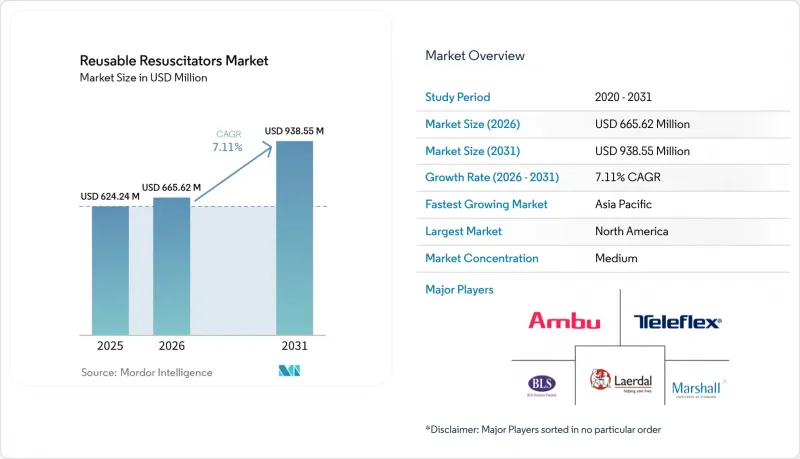
Mordor Intelligence에 의하면, 재사용 가능 인공호흡기 시장 규모는 2025년에 6억 2,424만 달러로 평가되었고 2026년 6억 6,562만 달러에서 2031년까지 9억 3,855만 달러에 이를 것으로 예측되며, 예측 기간(2026-2031년) CAGR은 7.11%를 나타낼 전망입니다.
본 보고서는 환자 유형(신생아, 소아, 성인), 백 유형(자가 팽창식, 유량 팽창식), 최종 사용자(병원, ASC, EMS/병원 전 단계, 클리닉) 및 지역(북미, 유럽, 아시아태평양, 중동 및 아프리카, 남미)별로 분류되어 있습니다. 시장 전망은 금액(달러) 기준으로 제공됩니다.
전 세계 재사용 가능 인공호흡기 시장 동향 및 인사이트
자가팽창식 부문의 장점이 정기적인 교체, 교육 및 업그레이드를 촉진합니다.
자가팽창식 백은 외부에서 가스를 공급받을 필요가 없기 때문에 산소 공급 라인을 사용할 수 없는 구급차나 응급실에서는 없어서는 안 될 존재가 되었습니다. 실리콘 부품은 134℃에서 오토클레이브 처리를 15-20회 반복하면 경화되기 시작하기 때문에 이용 빈도가 높은 시설에서는 약 2년마다 유닛을 교체하고 있으며, 이것이 안정적인 수익을 창출하고 있습니다. 또한, 훈련 센터에서는 임상 현장에서 사용되지 않는 시뮬레이션용 인형도 조달하고 있어, 이로 인해 총 구매 수량이 증가하고 있습니다. 기술 훈련을 통해 쌓은 장비 숙련도는 시설에서 응급 카트(크래시 카트) 재고를 갱신할 때의 선정 기준에 반영됩니다. 기존 공급업체들은 ISO 10651-5 준수 여부와 장기 서비스 계약을 활용하고 있으며, 이러한 요인들은 문서화 및 직원 교육 비용을 감당할 수 없는 신규 시장 진출기업들을 가로막고 있습니다.
주요 최종 사용자인 병원이 안정적인 기본 수요와 사양 중심의 조달을 뒷받침하고 있습니다.
2025년 시장 규모에서 병원이 큰 점유율을 차지한 이유는 모든 응급 카트, 마취기, 환자 이송용 들것에 수동식 인공호흡기가 장착되어 있어야 하기 때문입니다. 인증 기관은 교대 근무마다 기능 점검을 의무화하고 있으며, 처치 건수와는 무관하게 예측 가능한 교체 주기가 보장되고 있습니다. 미국의 대규모 공동구매 조직은 수년에 걸친 상세한 사양을 반영한 입찰을 실시하고 있으며, 이를 통해 종합적인 규정 준수 라이브러리를 보유한 제조업체가 우대받습니다. 중국에서는 2023년에 37,946개의 병원이 유례없는 조달 기반을 구축했으나, 가격 압박으로 인해 수요는 고급 브랜드의 재사용 가능 키트와 저가 일회용 제품으로 양분되고 있습니다.
고도의 치료 환경에서 감염 관리상의 이유로 일회용 백이 선호되는 것이 재사용 가능 제품의 보급을 저해하고 있습니다.
중환자실에서는 교차 감염의 위험을 방지하기 위해 대부분의 경우 일회용 백이 기본으로 사용되고 있습니다. 2025년 중국 멸균 처리 부문을 대상으로 실시한 조사에 따르면, 73.7%가 재처리 후 기능 검사를 생략하고 있었으며, 28.2%는 서면으로 된 세척 절차가 마련되어 있지 않았습니다. CDC의 지침을 따르는 미국의 의료 기관에서는 인공호흡기를 고도의 소독이 필요한 준중요 기기로 분류하고 있으며, 위원회는 일회용 제품으로의 전환을 장려하고 있습니다. Ambu의 PVC 무함유 제품인 ‘SPUR II’ 시리즈는 이러한 수요의 상당 부분을 차지하고 있습니다.
부문별 분석
재사용 가능 인공호흡기 시장에서 성인용 모델은 2025년 매출의 60.23%를 차지해, 2031년까지 연평균 성장률(CAGR) 8.32%로 성장할 전망입니다. 심정지 발생률이 높고, 구급 카트에 상비해야 할 의무가 있으며, 2년마다 교체해야 한다는 기준이 이러한 성장을 뒷받침하고 있습니다. 소아 및 신생아용 제품은 규모는 작지만 필수적인 수요를 유지하고 있으며, 재사용 가능 인공호흡기 업계공급업체들은 소아용의 경우 40 cmH₂O, 영아용의 경우 30 cmH₂O에 대응하는 팝오프 밸브를 조정하고 있습니다. 아프리카와 남아시아의 기부자 프로그램에서는 반복적인 증기 멸균 주기를 견딜 수 있는 직립형 신생아용 백이 계속해서 공급되고 있으며, 이로 인해 해당 계층에서 T-피스 대체 수요가 부분적으로 완화되고 있습니다.
임상적 선호도에 따라 하위 부문마다 특징이 다릅니다. 성인용 가방의 경우 인체공학에 기반한 그립감과 1,500mL의 용량이 중요시되는 반면, 신생아용 제품의 경우 사각지대를 최소화하고 분해가 용이해야 한다는 점이 우선시됩니다. ISO 10651-5와 같은 규격은 모든 크기에 대해 기류 및 압력의 안전 임계값을 정의하고 있으며, 이로 인해 공급업체들은 내구성과 오토클레이브에 의한 취화 현상 간의 균형을 맞추기 위해 재료 과학 분야에 투자할 수밖에 없습니다.
지역별 분석
북미는 엄격한 규정 준수 체계와 높은 교체 빈도를 바탕으로, 2025년 재사용 가능 인공호흡기 시장 매출의 42.67%를 차지했습니다. 유럽은 현재 일회용 폐기물의 흐름을 감독하는 지속가능성 관련 법규에 힘입어 안정적인 판매량을 유지하고 있습니다. 아시아태평양은 중국의 997만 병상 규모와 인도의 1차 의료 확대가 조달을 가속화하며, 연평균 성장률(CAGR) 9.12%로 예상되는 성장을 주도하고 있습니다.
동남아시아 국가들에서는 매년 200개 이상의 병원이 건설되고 있으며, 의료기기 등록 규정의 변화에 정통한 현지 유통업체와 제휴한 기업들에게 유리한 신규 입찰 프로젝트가 발생하고 있습니다. 일본에서는 고령화로 인해 재택 간호 분야가 확대될 전망이지만, 엄격한 보상 상한선으로 인해 단가는 억제될 것으로 보입니다. 중동 및 아프리카의 판매량은 걸프 연안 국가들의 전문 의료 센터에 집중되어 있는 반면, 사하라 이남 아프리카에서는 내구성이 뛰어난 재사용 가능 실리콘 소재 제품이 선호되는 기부자 공급 경로에 의존하고 있습니다.
남미 시장은 여전히 세분화되어 있습니다. 브라질의 공공 의료 예산은 공급업체들이 낮은 이익률과 대량 수주형 입찰을 선택하도록 유도하는 반면, 아르헨티나의 환율 변동은 예측의 신뢰성을 복잡하게 만들고 있습니다. 제세동기를 산소 농축기나 훈련 모듈과 세트로 판매하는 제조업체는 이처럼 가격에 민감한 시장에서 우위를 점하고 있습니다.
기타 혜택:
- 엑셀 형식 시장 예측(ME) 시트
- 3개월간의 애널리스트 지원
자주 묻는 질문
목차
제1장 서론
제2장 조사 방법
제3장 주요 요약
제4장 시장 구도
제5장 시장 규모와 성장 예측
제6장 경쟁 구도
제7장 시장 기회와 향후 전망
JHS 26.06.23According to Mordor Intelligence, the reusable resuscitators market size was valued at USD 624.24 million in 2025 and is estimated to grow from USD 665.62 million in 2026 to reach USD 938.55 million by 2031, at a CAGR of 7.11% during the forecast period (2026-2031).
This report is Segmented by Patient Type (Neonatal, Pediatric, Adult), Bag Type (Self-Inflating, Flow-Inflating), End User (Hospitals, Ascs, EMS/Prehospital, Clinics), and Geography (North America, Europe, Asia-Pacific, Middle East & Africa, South America). Market Forecasts are Provided in Terms of Value (USD).
Global Reusable Resuscitators Market Trends and Insights
Self-Inflating Segment Dominance Supports Recurring Replacement, Training, and Upgrades
Self-inflating bags require no external gas supply, making them indispensable for ambulances and emergency departments where oxygen lines are unavailable. Silicone components begin to harden after 15-20 autoclave cycles at 134 °C, so high-utilization fleets replace units roughly every two years, generating dependable revenue . Training centers also procure simulation-grade bags that never enter clinical rotation, enlarging total purchasing volumes. Device familiarity created during skills training translates into preference lists when facilities refresh crash-cart inventories. Established vendors leverage ISO 10651-5 conformity and long-term service contracts, which deter new entrants that cannot shoulder documentation and staff-education costs.
Hospitals as Primary End Users Underpin Stable Baseline Demand and Specification-Led Procurement
Hospitals held a major share of the 2025 volume because every crash cart, anesthesia machine, and patient-transfer stretcher must carry a manual resuscitator. Accreditation bodies oblige shift-by-shift functional checks, ensuring predictable replacement cycles independent of procedure counts. Large U.S. group-purchasing organizations award multiyear, specification-rich tenders, which favor manufacturers with comprehensive compliance libraries. In China, 37,946 hospitals created an unmatched procurement base in 2023, yet pricing pressure splits demand between premium-brand reusable kits and lower-priced disposables.
Infection-Control Preference for Single-Use Bags in High-Acuity Settings Curbs Reusable Penetration
Intensive-care units often default to disposable bags to remove cross-contamination risk. A 2025 survey of Chinese sterile-processing departments showed that 73.7% skipped functional tests after reprocessing, and 28.2% lacked written cleaning procedures . U.S. facilities consulting CDC guidance classify resuscitators as semi-critical devices requiring high-level disinfection, pushing committees toward single-use workarounds. Ambu's PVC-free SPUR II line captures much of this demand.
Other drivers and restraints analyzed in the detailed report include:
- North America Scale and APAC Expansion Sustain Global Volume and Channel Leverage
- Out-of-Hospital Cardiac Arrest and Respiratory Emergencies Sustain EMS Demand
- Sterile Processing Capacity, Training, and Turnaround Time Constraints Limit Reprocessing at Smaller Sites
For complete list of drivers and restraints, kindly check the Table Of Contents.
Segment Analysis
Adult models accounted for 60.23% of 2025 revenue within the reusable resuscitators market and will expand at an 8.32% CAGR through 2031. High cardiac-arrest incidence, mandatory crash-cart stocking, and two-year replacement norms underpin this performance. Pediatric and neonatal units sustain smaller but essential volumes, with reusable resuscitators industry suppliers tailoring pop-off valves to 40 cmH2O for children and 30 cmH2O for infants. Donor programs in Africa and South Asia continue to channel upright neonatal bags that withstand repeated steam cycles, partially shielding this cohort from T-piece substitution.
Clinical preference differentiates subsegments. Adult bags emphasize ergonomic grip and 1,500 mL volume, whereas neonatal items prioritize minimal dead space and easy disassembly. Standards such as ISO 10651-5 define airflow and pressure safety thresholds across all sizes, compelling vendors to invest in material science that balances durability against autoclave-induced brittleness.
Geography Analysis
North America supplied 42.67% of 2025 sales in the reusable resuscitators market, supported by stringent compliance regimes and high replacement cadence. Europe follows with steady volume tied to sustainability legislation that now audits single-use waste streams. Asia-Pacific leads growth at a projected 9.12% CAGR as China's 9.97 million hospital beds and India's primary-care expansion turbocharge procurement.
Southeast Asian countries build 200+ hospitals each year, presenting greenfield tenders that reward firms partnering with local distributors familiar with variable device-registration rules. Japan's aging demographic will lift the home-care segment, though tight reimbursement caps constrain per-unit pricing. Middle East and Africa volumes cluster in the Gulf states' specialty centers, while Sub-Saharan Africa relies on donor pipelines that favor rugged, reusable silicone designs.
South America remains fragmented; Brazil's public health budgets push suppliers toward low-margin, high-volume bids, whereas Argentina's currency swings complicate forecast reliability. Manufacturers that bundle resuscitators with oxygen concentrators and training modules enjoy an edge in these price-sensitive arenas.
- Allied Healthcare Products
- Ambu
- Archeon Medical
- Besmed Health Business
- BLS Systems Limited
- EMSRUN
- Flexicare
- GaleMed
- HSINER
- Intersurgical
- Laerdal Medical
- Marshall Airway Products
- Teleflex
- VBM Medizintechnik
- ZOLL Medical
Additional Benefits:
- The market estimate (ME) sheet in Excel format
- 3 months of analyst support
TABLE OF CONTENTS
1 Introduction
- 1.1 Study Assumptions & Market Definition
- 1.2 Scope of the Study
2 Research Methodology
3 Executive Summary
4 Market Landscape
- 4.1 Market Overview
- 4.2 Market Drivers
- 4.2.1 Self-Inflating Segment Dominance Supports Recurring Replacement, Training, And Upgrades
- 4.2.2 Hospitals As Primary End Users Underpin Stable Baseline Demand and Specification-Led Procurement
- 4.2.3 North America Scale and APAC Expansion Sustain Global Volume and Channel Leverage
- 4.2.4 Out-Of-Hospital Cardiac Arrest and Respiratory Emergencies Sustain EMS Demand
- 4.2.5 Donor-Funded Neonatal Programs Mandate Reusable, Autoclavable Silicone Sets in LMICs
- 4.2.6 Sustainability And Total-Cost Pressures Nudge Mixed Portfolios Toward Reusables in Targeted Settings
- 4.3 Market Restraints
- 4.3.1 Infection-Control Preference for Single-Use Bags in High-Acuity Settings Curbs Reusable Penetration
- 4.3.2 Sterile Processing Capacity, Training, and Turnaround Time Constraints Limit Reprocessing at Smaller Sites
- 4.3.3 T-Piece Preference in High-Resource Neonatal Units Displaces Self-Inflating Bags for Primary PPV
- 4.3.4 Autoclave-Cycle Wear and IFU Compliance Risks Reduce Realized Lifecycle Benefits
- 4.4 Supply-Chain Analysis
- 4.5 Regulatory Landscape
- 4.6 Technological Outlook
- 4.7 Porter's Five Forces
- 4.7.1 Threat of New Entrants
- 4.7.2 Bargaining Power of Suppliers
- 4.7.3 Bargaining Power of Buyers
- 4.7.4 Threat of Substitutes
- 4.7.5 Competitive Rivalry
5 Market Size & Growth Forecasts (Value, USD)
- 5.1 By Patient Type
- 5.1.1 Neonatal
- 5.1.2 Pediatric
- 5.1.3 Adult
- 5.2 By Bag Type
- 5.2.1 Self-inflating (SIB)
- 5.2.2 Flow-inflating (Anesthesia bag)
- 5.3 By End User
- 5.3.1 Hospitals
- 5.3.2 Ambulatory Surgical Centers (ASCs)
- 5.3.3 EMS / Prehospital
- 5.3.4 Clinics and Urgent Care
- 5.4 By Geography
- 5.4.1 North America
- 5.4.1.1 United States
- 5.4.1.2 Canada
- 5.4.1.3 Mexico
- 5.4.2 Europe
- 5.4.2.1 Germany
- 5.4.2.2 United Kingdom
- 5.4.2.3 France
- 5.4.2.4 Italy
- 5.4.2.5 Spain
- 5.4.2.6 Rest of Europe
- 5.4.3 Asia-Pacific
- 5.4.3.1 China
- 5.4.3.2 India
- 5.4.3.3 Japan
- 5.4.3.4 South Korea
- 5.4.3.5 Australia
- 5.4.3.6 Rest of Asia-Pacific
- 5.4.4 Middle East and Africa
- 5.4.4.1 GCC
- 5.4.4.2 South Africa
- 5.4.4.3 Rest of Middle East and Africa
- 5.4.5 South America
- 5.4.5.1 Brazil
- 5.4.5.2 Argentina
- 5.4.5.3 Rest of South America
- 5.4.1 North America
6 Competitive Landscape
- 6.1 Market Concentration
- 6.2 Market Share Analysis
- 6.3 Company Profiles {(includes Global level Overview, Market level overview, Core Segments, Financials as available, Strategic Information, Market Rank/Share for key companies, Products & Services, and Recent Developments)}
- 6.3.1 Allied Healthcare Products
- 6.3.2 Ambu A/S
- 6.3.3 Archeon Medical
- 6.3.4 Besmed Health Business Corp.
- 6.3.5 BLS Systems Limited
- 6.3.6 EMSRUN
- 6.3.7 Flexicare
- 6.3.8 GaleMed
- 6.3.9 HSINER
- 6.3.10 Intersurgical
- 6.3.11 Laerdal Medical
- 6.3.12 Marshall Airway Products
- 6.3.13 Teleflex Incorporated
- 6.3.14 VBM Medizintechnik GmbH
- 6.3.15 ZOLL Medical
7 Market Opportunities & Future Outlook
- 7.1 White-space & unmet-need assessment