|
시장보고서
상품코드
2114640
수동 인공호흡기 : 시장 점유율 분석, 업계 동향 및 통계, 성장 예측(2026-2031년)Manual Resuscitator - Market Share Analysis, Industry Trends & Statistics, Growth Forecasts (2026 - 2031) |
||||||
 Mordor Intelligence
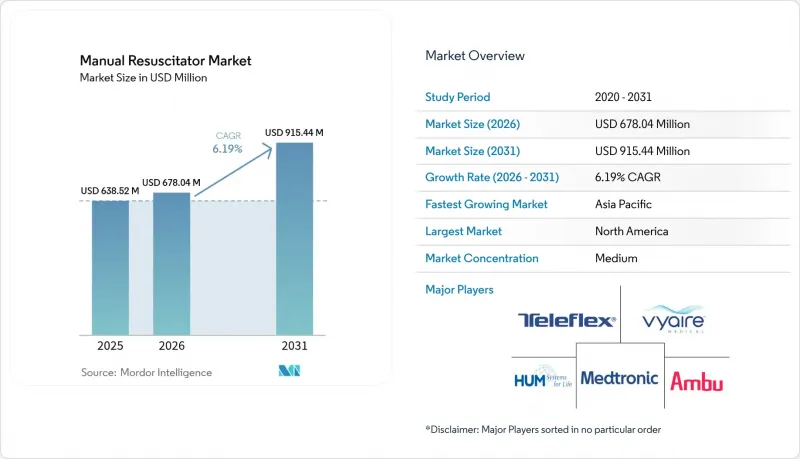
수동 인공호흡기 시장 규모는 2026년에 6억 7,804만 달러로 추정되고 있으며, 2025년 6억 3,852만 달러에서 2031년에는 9억 1,544만 달러에 달할 것으로 예측됩니다.
2026년부터 2031년까지의 연평균 성장률(CAGR)은 6.19%를 기록할 것으로 전망됩니다.
본 보고서는 제품 유형(자가팽창식 백, 유량팽창식 백, T-피스식 소생기), 용도(일회용, 재사용 가능), 환자 유형(성인, 소아, 신생아),소재(실리콘 등), 최종 사용자(병원 등), 지역(북미, 유럽, 아시아태평양, 중동 및 아프리카, 남미)별로 분류되어 있습니다. 시장 예측은 금액(달러)으로 표시되어 있습니다.
전 세계 수동식 소생기 시장 동향 및 인사이트
COPD 및 기타 만성 호흡기 질환으로 인한 부담 증가
저·중소득 국가에서는 선별 검사의 부족과 개입 지연으로 인해 가장 높은 사망률 부담을 안고 있습니다. COPD와 관련된 장애 조정 생명년(DALY) 중 34.8%는 흡연이 원인이며, 대기 중 미세먼지(입자상 물질)가 22.2%를 차지합니다. 아시아태평양 전체에서 호흡기 응급 상황이 증가함에 따라, 수동식 인공호흡기는 특히 시설 내 이송 시 필수적인 가교 치료 키트로서의 입지를 강화하고 있습니다. 급성 악화의 발생이 인공호흡기 공급 능력을 초과하는 경우가 많아, 수동식 인공호흡기 시장은 일선에서의 해결책으로서 입지를 확고히 하고 있습니다.
BVM(수동 인공호흡기)를 통한 지원이 필요한 갑작스러운 심정지 발생률 증가
매년 약 35만 6,000명의 미국인이 병원 밖 심정지를 경험하고 있으며, 생존율은 10% 전후입니다. 미국심장협회가 제시한 “2030년까지 일반 시민의 심폐소생술(CPR) 실시율을 50% 이상으로 끌어올린다”는 목표는 중요한 초기 몇 분 동안 산소 공급을 유지하는 백-밸브-마스크(BVM) 장치에 대한 수요를 암묵적으로 높이고 있습니다. 영국 응급 서비스에서는 연간 약 3만 건의 소생 처치가 이루어지고 있으며, 그중 30%의 사례에서 자발적 순환이 회복되고 있습니다. 젊은 운동선수에게 신속한 인공호흡이 신경학적 예후 개선에 기여한다는 스포츠 경기장용 지침 또한 수동식 소생 장비 시장의 추가적인 확장을 뒷받침하고 있습니다. 팬데믹 기간 동안의 감염 방지 대책으로 인해, 구조자를 보호하기 위한 고효율 미립자 공기(HEPA) 필터를 장착한 일회용 소생 장치의 도입이 촉진되었습니다.
대체 환기 솔루션의 이용 가능성
고유량 비강 캐뉼라 시스템과 휴대용 비침습적 인공호흡기는 에어로졸 위험을 줄이면서 산소를 공급하기 때문에 일부 중환자 치료 프로토콜에서 수동식 인공호흡기에 대한 의존도를 낮추고 있습니다. 기계식 흉골 압박 장치는 구조자의 피로를 줄여주지만, 한편으로는 백 환기가 우선시되는 시간적 여유를 단축시키기도 합니다. 자동체외제세동기(AED)의 보급 확대는 응급처치 순서를 재편하여, 1차 선택 수단으로서의 백-마스크법(BVM) 사용을 억제할 가능성이 있습니다. 비디오 후두경이나 성문 상부 기도 장치는 보다 신속한 기도 확보를 가능하게 하지만, 사전 산소 공급이나 삽관 후 지원에 있어서는 수동식 소생기가 여전히 필수적입니다. 따라서 각 장비 제조업체들은 수동식 소생기 시장을 유지하기 위해 단순한 판매 대수 확대보다는 부가 기능의 확충을 중시하고 있습니다.
부문 분석
2025년 시점에서 수동식 소생기 시장에서 가장 큰 점유율(46.28%)을 차지한 것은 범용성이 높고 가스 공급원에 의존하지 않는 자가 팽창식 백이었습니다. 한편, T-피스형 장치는 폐 순응도가 변동하는 상황에서도 보다 안정적인 PEEP를 제공한다는 증거에 힘입어, 2031년까지 연평균 성장률(CAGR) 8.28%라는 가장 빠른 성장이 예상됩니다. 군의와 구급대원은 견고성과 설치가 간편하다는 점 때문에 여전히 자가팽창식 백을 선호하고 있습니다. 그러나 3차 의료기관에서는 분만실이나 소아 중환자실(PICU)용으로 T-피스형 시스템을 지정하는 사례가 증가하고 있으며, 이는 ‘첫 호흡부터 폐 보호 환기를 실시한다’는 방침을 반영한 것입니다.
압력 제어 및 센서 피드백의 고도화로 인해 프리미엄 가격 책정이 진행되고 있어, 판매 수량은 정체 상태임에도 불구하고 매출액 확대에 기여하고 있습니다. 현재 교육 과정에는 두 기술에 대한 시뮬레이션이 포함되어 있어, 임상의와 응급구조사 사이에서 기술이 확실하게 유지되고 있습니다. 이러한 대조적인 도입 양상은 수동식 소생기 시장에서 제품의 다양성이 여전히 경쟁력의 핵심인 이유를 보여줍니다.
일회용 제품은 2025년 매출의 55.78%를 차지하며, 코로나19 이후 감염 관리 규정이 엄격해짐에 따라 9.22%라는 가장 높은 연평균 성장률(CAGR)을 보이고 있습니다. 병원 측은 처리 시간 단축과 재처리 실수 방지를 주요 이점으로 꼽고 있습니다. 또한, 멸균 포장으로 인해 별도의 클린룸 자재 없이 현장에서 바로 사용할 수 있어 군사 및 인도주의 지원 활동에서 매력적입니다.
재사용 가능한 백은 1회당 비용이 결정적인 요소가 되는 교육용 실습실이나 자원이 제한된 진료소에서 여전히 중요한 역할을 하고 있습니다. 30회의 오토클레이브 사이클에 대한 내성이 입증된 앰브(Amb)사의 ‘Mark IV’는 수년 단위의 장기적인 관점에서 보더라도 그 가치를 입증하고 있습니다. 유럽연합(EU)은 현재 엄격한 검증 하에 일회용 의료기기의 재처리를 허용하고 있으며, 이로 인해 일회용과 재사용 범주를 아우르는 틈새 시장이 형성되고 있습니다. 그러나 법적 책임 및 추적 가능성과 관련된 과제가 보급을 저해하고 있어, 수동 인공호흡기 시장에서는 일회용 제품이 계속해서 성장을 주도하고 있습니다.
지역별 분석
북미는 고도의 응급 의료 서비스, 광범위한 CPR(심폐소생술) 교육 네트워크, 그리고 대규모 국방 조달을 배경으로 2025년에는 매출 점유율 37.95%로 1위를 유지했습니다. ‘전술적 전투 외상 치료(TCCC)’ 프로토콜에서는 수동 환기가 전장에서 예방 가능한 사망을 억제하는 데 기여하는 것으로 평가받고 있으며, 이것이 군으로부터의 안정적인 수주를 뒷받침하고 있습니다. 지속적인 자금 지원 덕분에 병원들은 품질 감사를 효율화하는 센서 탑재 가방에 투자할 수 있게 되었습니다.
아시아태평양은 중국, 인도 및 동남아시아 국가들이 외상 센터와 병원 도착 전 의료 체계 확충에 자금을 투입하고 있어, 2031년까지 8.71%라는 가장 강력한 연평균 성장률(CAGR)을 나타낼 전망입니다. 중국에서는 현재 공적 보험 제도를 통해 신생아 소생용 소모품 비용이 상환되고 있으며, 인도의 ‘아유슈만 바라트’ 프로그램에서는 구급차 개조를 위해 자본 예산이 배정되고 있습니다. 일본이나 한국 등 부유한 시장에서는 건강한 고령화를 촉진하는 정책이 재택 간호 및 장기 요양 시설을 위한 조달을 뒷받침하고 있어, 수동식 소생기 시장 수요 증가로 이어지고 있습니다.
유럽은 성숙한 시장임에도 불구하고 견조한 성장 궤도를 유지하고 있습니다. 2026년에 시행될 예정인 재활용 가능한 포장 의무화 규제가 공정 혁신을 촉진하는 한편, EU 의료기기 규정 2017/745는 관리된 재처리의 길을 열어주고 있습니다. 독일, 영국, 프랑스가 판매량을 주도하는 반면, 스페인과 이탈리아에서는 신생아 병동을 위한 고급 실리콘 모델이 선호되고 있습니다. 라틴아메리카, 중동 및 아프리카에서는 한 자릿수 중반대의 성장률을 기록하고 있습니다. 브라질의 SAMU 구급차 네트워크와 남아프리카공화국 도시 지역의 응급의료서비스(EMS) 개편은 점진적인 성장을 보여주고 있지만, 경제 변동과 공급망 제약으로 인해 더 빠른 시장 침투는 제한되고 있습니다.
기타 혜택:
- 엑셀 형식 시장 예측(ME) 시트
- 3개월간의 애널리스트 지원
자주 묻는 질문
목차
제1장 서론
제2장 조사 방법
제3장 주요 요약
제4장 시장 구도
제5장 시장 규모와 성장 예측
제6장 경쟁 구도
제7장 시장 기회와 향후 전망
LSH 26.08.26According to Mordor Intelligence, the manual resuscitator market size in 2026 is estimated at USD 678.04 million, growing from 2025 value of USD 638.52 million with 2031 projections showing USD 915.44 million, growing at 6.19% CAGR over 2026-2031.
This report is Segmented by Product Type (Self-Inflating Bags, Flow-Inflating Bags, T-Piece Resuscitators), Usage (Disposable, Reusable), Patient Type (Adult, Pediatric, Neonatal), Material (Silicone, and More), End User (Hospitals, and More), and Geography (North America, Europe, Asia-Pacific, Middle East & Africa, South America). The Market Forecasts are Provided in Terms of Value (USD).
Global Manual Resuscitator Market Trends and Insights
Growing Burden of COPD and Other Chronic Respiratory Diseases
Low- and middle-income nations carry the heaviest mortality load, hindered by limited screening and late intervention. Tobacco use explains 34.8% of COPD-related disability-adjusted life years, while ambient particulate matter accounts for 22.2%. Escalating respiratory emergencies across Asia-Pacific have moved manual resuscitators into essential bridge-therapy kits, especially for intra-facility transport. Acute exacerbations often outstrip mechanical ventilator availability, cementing the manual resuscitator market as a frontline solution.
Rising Incidence of Sudden Cardiac Arrest Requiring BVM Support
Roughly 356,000 Americans experience out-of-hospital cardiac arrest each year, with survival rates near 10%. The American Heart Association's 2030 target to lift bystander CPR rates above 50% implicitly raises demand for bag-valve-mask (BVM) devices that sustain oxygenation during the critical first minutes. United Kingdom ambulance services manage approximately 30,000 resuscitation attempts annually, achieving return-of-spontaneous-circulation in 30% of cases. Guidelines for athletic venues, where prompt ventilation assists neurological outcomes in young athletes, further broaden the manual resuscitator market. Pandemic-era infection-control measures boosted adoption of single-use resuscitators fitted with high-efficiency particulate air filters to protect rescuers.
Availability of Alternative Ventilation Solutions
High-flow nasal cannula systems and portable non-invasive ventilators provide oxygenation with lower aerosol risk, decreasing reliance on manual bags in some intensive-care algorithms. Mechanical chest-compression devices relieve rescuer fatigue but also shorten the window in which bag ventilation is prioritized. Wider placement of automated external defibrillators reorders the rescue sequence, potentially curbing first-line BVM use. Video laryngoscopes and supraglottic airways offer faster airway control, though manual resuscitators remain indispensable for pre-oxygenation and post-intubation support. Device makers therefore emphasize add-on features rather than raw volume growth to defend the manual resuscitator market.
Other drivers and restraints analyzed in the detailed report include:
- Increasing Geriatric Population and Home-Care Respiratory Demand
- Steady Advancements in Integrated Pressure-Monitoring and PEEP Valves
- Price Sensitivity in Low- and Middle-Income Markets
For complete list of drivers and restraints, kindly check the Table Of Contents.
Segment Analysis
Self-inflating bags controlled the largest slice of the manual resuscitator market in 2025 at 46.28%, owing to versatility and independence from gas outlets. T-piece devices, however, are positioned for the most rapid 8.28% CAGR through 2031, supported by evidence that they deliver steadier PEEP across variable lung compliance. Military medics and ambulance crews keep favoring self-inflating bags because of ruggedness and minimal setup. Yet tertiary hospitals increasingly specify T-piece systems for deliveries and pediatric intensive-care units, reflecting policy that demands lung-protective ventilation from the first breath.
Enhanced pressure control and sensor feedback spur premium pricing, which contributes to revenue expansion even as unit volumes stay balanced. Training curricula now incorporate simulations for both technologies, ensuring skill retention among clinicians and paramedics. These contrasting adoption patterns demonstrate why product diversity remains central to competitiveness within the manual resuscitator market.
Disposable units represented 55.78% of 2025 revenue and show the fastest 9.22% CAGR thanks to tightened infection-control rules after COVID-19. Hospitals cite reduced turnaround time and elimination of reprocessing error as prime benefits. Sterile packaging also permits field deployment without auxiliary clean-room supplies, appealing to military and humanitarian missions.
Reusable bags keep relevance in teaching labs and resource-constrained clinics where cost per use is decisive. Ambu's Mark IV, validated for 30 autoclave cycles, exemplifies value over multiyear horizons. The European Union now permits reprocessing of single-use devices under strict validation, creating a niche that straddles disposable and reusable categories. Even so, legal liability and traceability hurdles limit uptake, ensuring disposables retain growth leadership in the manual resuscitator market.
Complete Report Scope:
- By Product Type
- Self-Inflating Bags
- Flow-Inflating Bags
- T-Piece Resuscitators
- By Usage
- Disposable
- Reusable
- By Patient Type
- Adult
- Pediatric
- Neonatal
- By Material
- Silicone
- PVC
- Rubber & Others
- By End User
- Hospitals
- Ambulatory Surgical Centers
- Speciality Clinics
- By Geography
- North America
- United States
- Canada
- Mexico
- Europe
- Germany
- United Kingdom
- France
- Italy
- Spain
- Rest of Europe
- Asia-Pacific
- China
- Japan
- India
- Australia
- South Korea
- Rest of Asia-Pacific
- Middle East & Africa
- GCC
- South Africa
- Rest of Middle East & Africa
- South America
- Brazil
- Argentina
- Rest of South America
- North America
Geography Analysis
North America led with 37.95% revenue share in 2025 on the strength of advanced emergency medical services, extensive CPR training networks and sizeable defense procurement. Tactical Combat Casualty Care protocols credit manual ventilation with helping curb preventable battlefield deaths, which sustains steady military orders. Consistent funding permits hospitals to invest in sensor-enabled bags that streamline quality audits.
Asia-Pacific is poised for the most vigorous 8.71% CAGR to 2031 as China, India and Southeast Asian states fund trauma centers and pre-hospital care expansion. Public insurance schemes in China now reimburse neonatal resuscitation consumables, and India's Ayushman Bharat program allocates capital budgets for ambulance upgrades. In affluent markets such as Japan and South Korea, healthy aging policies spur procurement for home-care and long-term-care facilities, broadening exposure for the manual resuscitator market.
Europe maintains a mature but resilient trajectory. Pending 2026 rules that require recyclable packaging stir process innovation, while EU Medical Device Regulation 2017/745 opens a pathway for controlled reprocessing. Germany, United Kingdom and France drive volume, while Spain and Italy favor premium silicone models for neonatal wards. Latin America, the Middle East and Africa post mid-single-digit growth: Brazil's SAMU ambulance network and South Africa's urban EMS upgrades illustrate incremental gains, yet economic volatility and supply-chain constraints restrain faster penetration.
- Ambu
- Vyaire Medical
- ICU Medical - Smiths Medical
- Medtronic
- Teleflex
- Medline Industries
- Intersurgical
- Laerdal Medical
- Mercury Medical
- O-Two Medical Technologies
- WEINMANN Emergency
- HUM
- Allied Healthcare Products
- Resmed
- Hopkins Medical Products
- Besmed Health Business
- Armstrong Medical
- Airon
- Parker Healthcare
- GENTEC Corporation
Additional Benefits:
- The market estimate (ME) sheet in Excel format
- 3 months of analyst support
TABLE OF CONTENTS
1 Introduction
- 1.1 Study Assumptions & Market Definition
- 1.2 Scope of the Study
2 Research Methodology
3 Executive Summary
4 Market Landscape
- 4.1 Market Overview
- 4.2 Market Drivers
- 4.2.1 Growing Burden of COPD & Other Chronic Respiratory Diseases
- 4.2.2 Rising Incidence of Sudden Cardiac Arrest Requiring BVM Support
- 4.2.3 Increasing Geriatric Population & Home-Care Respiratory Demand
- 4.2.4 Steady Advancements in Integrated Pressure-Monitoring & PEEP Valves
- 4.2.5 Post-COVID Infection-Control Shift Toward Single-Use Resuscitators
- 4.2.6 Growing Adoption in Wilderness, Military & Veterinary Emergency Training
- 4.3 Market Restraints
- 4.3.1 Availability of Alternative Ventilation Solutions
- 4.3.2 Price Sensitivity in Low- & Middle-Income Markets
- 4.3.3 Environmental Pushback Against Disposable Plastics & Upcoming EU MDR Documentation
- 4.3.4 Skill-Gap & Inadequate Hands-On Training for Optimal BVM Use
- 4.4 Regulatory Landscape
- 4.5 Technological Outlook
- 4.6 Porter's Five Forces Analysis
- 4.6.1 Threat of New Entrants
- 4.6.2 Bargaining Power of Buyers
- 4.6.3 Bargaining Power of Suppliers
- 4.6.4 Threat of Substitutes
- 4.6.5 Intensity of Competitive Rivalry
5 Market Size & Growth Forecasts (Value in USD)
- 5.1 By Product Type
- 5.1.1 Self-Inflating Bags
- 5.1.2 Flow-Inflating Bags
- 5.1.3 T-Piece Resuscitators
- 5.2 By Usage
- 5.2.1 Disposable
- 5.2.2 Reusable
- 5.3 By Patient Type
- 5.3.1 Adult
- 5.3.2 Pediatric
- 5.3.3 Neonatal
- 5.4 By Material
- 5.4.1 Silicone
- 5.4.2 PVC
- 5.4.3 Rubber & Others
- 5.5 By End User
- 5.5.1 Hospitals
- 5.5.2 Ambulatory Surgical Centers
- 5.5.3 Speciality Clinics
- 5.6 By Geography
- 5.6.1 North America
- 5.6.1.1 United States
- 5.6.1.2 Canada
- 5.6.1.3 Mexico
- 5.6.2 Europe
- 5.6.2.1 Germany
- 5.6.2.2 United Kingdom
- 5.6.2.3 France
- 5.6.2.4 Italy
- 5.6.2.5 Spain
- 5.6.2.6 Rest of Europe
- 5.6.3 Asia-Pacific
- 5.6.3.1 China
- 5.6.3.2 Japan
- 5.6.3.3 India
- 5.6.3.4 Australia
- 5.6.3.5 South Korea
- 5.6.3.6 Rest of Asia-Pacific
- 5.6.4 Middle East & Africa
- 5.6.4.1 GCC
- 5.6.4.2 South Africa
- 5.6.4.3 Rest of Middle East & Africa
- 5.6.5 South America
- 5.6.5.1 Brazil
- 5.6.5.2 Argentina
- 5.6.5.3 Rest of South America
- 5.6.1 North America
6 Competitive Landscape
- 6.1 Market Concentration
- 6.2 Market Share Analysis
- 6.3 Company Profiles (includes Global level Overview, Market level overview, Core Segments, Financials as available, Strategic Information, Market Rank/Share for key companies, Products & Services, and Recent Developments)
- 6.3.1 Ambu A/S
- 6.3.2 Vyaire Medical Inc.
- 6.3.3 ICU Medical - Smiths Medical
- 6.3.4 Medtronic
- 6.3.5 Teleflex Inc.
- 6.3.6 Medline Industries LP
- 6.3.7 Intersurgical Ltd
- 6.3.8 Laerdal Medical
- 6.3.9 Mercury Medical
- 6.3.10 O-Two Medical Technologies
- 6.3.11 WEINMANN Emergency
- 6.3.12 HUM GmbH
- 6.3.13 Allied Healthcare Products
- 6.3.14 ResMed Inc.
- 6.3.15 Hopkins Medical Products
- 6.3.16 Besmed Health Business
- 6.3.17 Armstrong Medical
- 6.3.18 Airon Corporation
- 6.3.19 Parker Healthcare
- 6.3.20 GENTEC Corporation
7 Market Opportunities & Future Outlook
- 7.1 White-space & Unmet-Need Assessment