

|
시장보고서
상품코드
2063531
생식 독성 시험 시장 : 점유율 분석, 업계 동향과 통계, 성장 예측(2026-2031년)Reproductive Toxicity Testing - Market Share Analysis, Industry Trends & Statistics, Growth Forecasts (2026 - 2031) |
||||||
 Mordor Intelligence
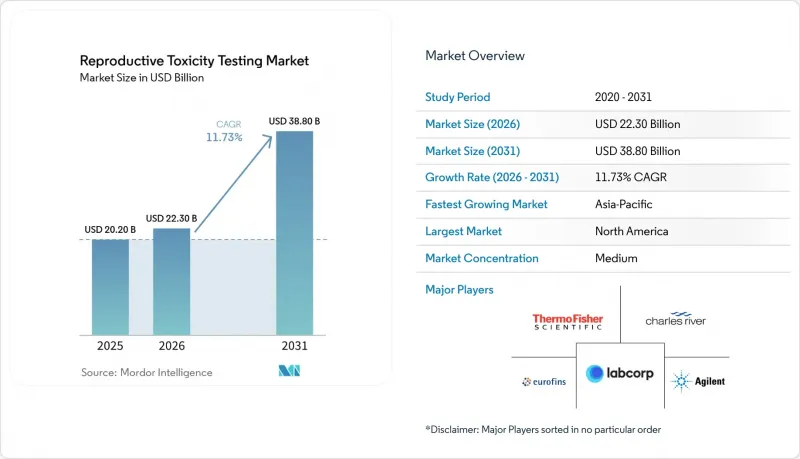
Mordor Intelligence에 의하면, 생식 독성 시험 시장 규모는 2025년에 202억 달러, 2026년에 223억 달러, 2031년까지 388억 달러에 이를 것으로 예측됩니다.
2026년부터 2031년까지 연평균 성장률(CAGR) 11.73%로 성장할 것으로 전망됩니다.
본 보고서는 제품(소모품, 분석 키트, 기기, 장비), 시험 유형(in vivo, in vitro, in silico 및 컴퓨터 시뮬레이션), 기술(세포 배양, 하이스루풋, 독성유전체학), 최종 사용자(의약품·바이오의약품 등), 지역(북미, 유럽, 아시아태평양 등)별로 분류되어 있습니다. 시장 전망은 금액(달러) 기준으로 제시되어 있습니다.
세계 생식 독성 시험 시장 동향 및 인사이트
규제 당국은 ICH S5(R3) 및 OECD 시험 지침의 확장판에 부합합니다.
ICH S5(R3)에 따라, 의뢰사는 약물 분류별 및 적응증에 따라 임상시험 설계를 맞춤화할 수 있게 되어, 인체에 대한 안전 여유를 유지하면서 중복되는 동물 실험을 최소화할 수 있게 됩니다. OECD 시험 지침 443(EOGRTS)은 2세대 모델을 대체하여 동물 사용을 약 40% 줄이는 한편, 발달 신경독성 및 면역독성 평가를 위한 선택적 코호트 방식을 포함하고 있습니다. 2023년 검토 결과, EOGRTS 신청 건의 20%에서 투여량이 불충분하다는 문제가 지적되면서, 업계 이해관계자 및 규제 당국 사이에서 투여량 선정에 관한 논의가 다시 불붙었습니다. 2025년, 영국은 OECD TG 408을 확대하여 갑상선 및 지질 지표 등을 포함시킴으로써, 일반적인 90일 시험을 내분비 교란 물질 선별 검사와 더욱 긴밀하게 연계시켰습니다.
확대되는 바이오의약품 파이프라인이 DART 패키지 수요를 견인하고 있습니다.
2024년, 미국 FDA는 주로 종양학, 희귀질환, 대사성 질환을 대상으로 한 55개의 신규 분자 실체를 승인했으나, 이들 모두에 맞춤형 DART 패키지가 필요합니다. 당초 당뇨병 치료제로 개발된 GLP-1 수용체 작용제는 현재 심혈관 및 신장 보호 효과가 연구되고 있으며, 전임상 생식 평가를 받는 후보 약물의 수가 증가하고 있습니다. 바이오시밀러 신청이 증가함에 따라 생식 관련 평가 지표에 대한 동등성 입증이 필요해지면서, EOGRTS 및 배아·태아 발생(EFD) 시험의 업무 부담이 커지고 있습니다. 2025년 12월에 제정된 BIOSECURE법은 특정 중국계 생명공학 공급업체 및 관련 기업과의 연방 정부 계약을 제한함에 따라, 중소규모 후원사의 경우 이관에 12-18개월의 지연이 발생하고 있어, 인도 및 동유럽의 규제 준수 CRO 서비스에 대한 수요가 증가하고 있습니다.
복잡한 오르간 온 칩 시스템에 대한 규제 당국의 검증 범위 제한
오르간 온 칩 플랫폼은 제어된 마이크로플루이딕스 환경에서 태반 이식, 난포 성숙, 정자 형성 등의 기능을 입증하고 있습니다. 그러나 규제 당국은 이러한 시스템에 대해 아직 공식적인 적합성 평가 의견을 내놓지 않았습니다. IAMPS는 시설 간 링 테스트 및 기준 화합물 라이브러리 개발을 통해 재현성 문제를 해결하기 위해 노력하고 있습니다. 그럼에도 불구하고, 세포 공급처, 세포외 기질 및 유체 매개변수에서의 불일치가 업계 전반에 걸친 합의 형성을 계속해서 방해하고 있습니다.
부문별 분석
2025년, 생식 독성 시험 시장에서 소모품이 주도적인 위치를 차지하며 전 세계 매출의 57.80%를 차지했습니다. 모든 in vitro 시험의 실시가 독자적인 시약, 줄기세포주, 분석 키트에 대한 안정적인 수요를 창출하여 공급업체에 확실한 현금 흐름을 가져다주고 있습니다. 업계의 표준화 플랫폼으로의 전환을 상징하듯, 찰스 리버(Charles River)사의 ‘ReproTracker’ 키트는 인간 줄기세포를 이용한 신속한 발생독성 스크리닝을 가능하게 합니다. 또한, 2026년 2월에 중국의 내분비 관련 규정이 시행될 예정인 만큼, 시약, 특히 갑상선 호르몬 분석 키트와 항문-음부 거리 측정 키트에 대한 수요가 급증하고 있습니다.
2025년, 생체 내 시험(in vivo)이 생식 독성 시험 시장의 53.80%를 차지했으나, 체외 시험(in vitro) 방식이 시장 점유율을 급성장하고 있습니다. 현재 규제 당국은 검증된 줄기세포 및 오가노이드 분석법을 승인하고 있어, 개발 프로그램 초기 단계에서 유해성을 파악할 수 있게 되었습니다. 이러한 승인으로 인해, 특히 저위험 화학물질의 경우 종합적인 EOGRTS 패키지의 필요성이 줄어들고 있습니다. 384웰 형식의 하이컨텐츠 이미징 및 다중 바이오마커 측정과 같은 기술을 통해, 의뢰사는 기존에 하나의 생체 내 코호트를 분석하는 데 소요되던 시간 내에 수백 개의 후보 물질을 평가할 수 있게 되었습니다.
필요에 따라 배아·태아 및 출생 전·출생 후 발생에 관한 연구는 여전히 필수적이지만, 후원사들은 계산 독성학 및 NAM 스크리닝을 활용한 후보 물질 평가를 점점 더 우선시하고 있습니다. 이러한 전략적 접근 방식은 3R의 목표에 부합할 뿐만 아니라, 후기 단계에서의 중도 탈락을 최소화하고, 생식 독성 시험 시장에서 동물 실험 방식과 비동물 실험 방식 간의 균형 잡힌 비율을 촉진하고 있습니다.
지역별 분석
북미는 CRO 인프라 및 규제 관련 전문 지식 면에서 여전히 최대의 거점으로 자리 잡고 있습니다. 미국에는 찰스 리버, 라보코프, 이노티브와 같은 주요 기업 외에도 몇몇 중견 공급업체들이 거점을 두고 있으며, 이들 모두 DART 제품군의 이용률이 높은 것으로 보고되고 있습니다. 스폰서들이 해외에서 비용 절감 기회를 모색하는 한편, 일관된 NIH의 자금 지원과 개정된 FDA 지침이 국내 수요를 계속해서 견인하고 있습니다. 미국은 NAM(비동물 실험법)의 신속한 도입과 AI를 활용한 실험 설계의 조기 통합을 통해 연구 방법의 혁신 분야에서 주도적인 위치를 유지하고 있습니다.
유럽도 이에 뒤를 잇고 있습니다. 그러나 규제가 복잡하다는 점 때문에 어려움을 겪고 있습니다. 산업용 화학물질에 관한 EOGRTS 신청 서류에 대한 ECHA의 엄격한 요건은 화장품 시험 금지 규정과 상충되므로, 신청사는 사례별로 면제 조치를 모색해야 합니다. 영국의 브렉시트 이후 ‘과학 분야에서 동물 대체(Replacing Animals in Science)’ 로드맵은 NAMs로의 단계적 전환을 시사하는 한편, 독일과 프랑스는 투여량 선정에 관한 모범 사례의 조화에 주력하고 있습니다. 바젤, 케임브리지 및 스칸디나비아 회랑의 연구 클러스터는 해당 지역의 CRO에 안정적인 수주를 가져다주고 있습니다.
아시아태평양은 가장 빠르게 성장하고 있는 지역입니다. 중국의 OECD 프로토콜 준수 및 인도의 GLP 생태계 확대는 전 세계 제약사와 농약 제조업체들의 관심을 끌고 있습니다. 지방 자치 단체는 실험실 건설에 대해 세제 혜택을 제공하고 있으며, 학술 기관은 졸업생들을 독성학 분야로 유도함으로써 병리 전문의 부족 문제를 부분적으로 해소하고 있습니다. 고속 처리 자동화 및 데이터 사이언스 팀에 대한 투자를 통해, 지역 CRO들은 향후 5년 동안 전 세계 생식 독성 시험 시장에서 더 큰 점유율을 확보할 준비를 갖추고 있습니다.
기타 혜택:
- 엑셀 형식 시장 예측(ME) 시트
- 3개월간의 애널리스트 지원
자주 묻는 질문
목차
제1장 서론
제2장 조사 방법
제3장 주요 요약
제4장 시장 구도
제5장 시장 규모와 성장 예측
제6장 경쟁 구도
제7장 시장 기회와 향후 전망
JHS 26.06.23According to Mordor Intelligence, the reproductive toxicity testing market size is projected to be USD 20.20 billion in 2025, USD 22.30 billion in 2026, and reach USD 38.80 billion by 2031, growing at a CAGR of 11.73% from 2026 to 2031.
This report is Segmented by Product (Consumables, Assays, Equipment, and Instruments), Testing Type (In Vivo, in Vitro, in Silico & Computational), Technology (Cell Culture, High-Throughput, Toxicogenomics), End-User (Pharmaceuticals & Biopharmaceuticals, and More), and Geography (North America, Europe, Asia-Pacific, and More). Market Forecasts are Provided in Terms of Value (USD).
Global Reproductive Toxicity Testing Market Trends and Insights
Regulatory Bodies Align with ICH S5(R3) & OECD TG Expansions
ICH S5(R3) enables sponsors to customize study designs according to drug class and indication, minimizing redundant animal testing while maintaining human safety margins. OECD's Test Guideline 443 (EOGRTS) has replaced the two-generation model, reducing animal use by approximately 40% and incorporating optional cohorts for developmental neuro- and immunotoxicity assessments. A 2023 review identified under-dosing issues in 20% of EOGRTS submissions, sparking renewed discussions on dose selection among industry stakeholders and regulators. In 2025, the United Kingdom expanded OECD TG 408 to include thyroid and lipid markers, aligning routine 90-day studies more closely with endocrine disruptor screening.
Growing Biopharma Pipelines Fueling Demand for DART Packages
In 2024, the U.S. FDA approved 55 new molecular entities, primarily targeting oncology, rare diseases, and metabolic conditions, all requiring customized DART packages. GLP-1 receptor agonists, initially developed for diabetes, are now being explored for cardiovascular and renal protection, increasing the number of candidates undergoing preclinical reproductive evaluations. The rise in biosimilar submissions has necessitated the demonstration of equivalence on reproductive endpoints, adding to the workload for EOGRTS and embryo-fetal development (EFD) studies. The BIOSECURE Act, enacted in December 2025, restricted federal contracts with companies associated with specific Chinese biotechnology vendors, causing relocation delays of 12 to 18 months for smaller sponsors and increasing the demand for compliant CRO services in India and Eastern Europe.
Limited Regulatory Validation of Complex Organ-On-Chip Systems
Organ-on-chip platforms showcase capabilities such as placental transfer, follicle maturation, and spermatogenesis within controlled microfluidic environments. However, regulatory agencies have not yet issued formal qualification opinions for these systems. IAMPS is addressing reproducibility challenges through inter-laboratory ring trials and the development of reference-compound libraries. Nonetheless, inconsistencies in cell sourcing, extracellular matrices, and flow parameters continue to impede consensus adoption across the industry.
Other drivers and restraints analyzed in the detailed report include:
- Global Push for 3Rs/Animal-Testing Bans Boosting NAM Adoption
- Expansion of CRO Capacity in APAC & Eastern Europe
- High Cost & Long Timelines of OECD TG 443/EOGRTS
For complete list of drivers and restraints, kindly check the Table Of Contents.
Segment Analysis
In 2025, consumables dominated the reproductive toxicity testing market, capturing 57.80% of global revenues. Every in vitro run drives consistent demand for proprietary reagents, stem-cell lines, and assay kits, ensuring reliable cash flows for suppliers. Highlighting the industry's shift towards standardized platforms, Charles River's ReproTracker kit facilitates swift developmental-toxicity screenings in human stem cells. Additionally, with China's endocrine-endpoint rules set to take effect in February 2026, there's a surge in demand for reagents, particularly thyroid-hormone assays and anogenital-distance measurement kits.
In 2025, while in vivo studies held a 53.80% share of the reproductive toxicity testing market, in vitro methods are rapidly gaining ground. Regulators now endorse validated stem-cell and organoid assays, allowing early hazard identification in development programs. This acceptance diminishes the necessity for comprehensive EOGRTS packages, especially for lower-risk chemicals. Techniques like high-content imaging and multiplexed biomarker readouts in 384-well formats enable sponsors to evaluate hundreds of candidates in the time it traditionally took for one in vivo cohort.
While studies on embryo-fetal and pre-/postnatal development remain essential where required, sponsors are increasingly prioritizing candidate evaluations using computational toxicology and NAM screens. This strategic approach not only aligns with the 3Rs objectives but also minimizes late-stage attrition, promoting a balanced split in the reproductive toxicity testing market between animal and non-animal methods.
Geography Analysis
North America remains the largest hub for CRO infrastructure and regulatory expertise. The United States hosts key players such as Charles River, Labcorp, and Inotiv, along with several mid-tier providers, all reporting high utilization rates for DART suites. While sponsors explore cost-saving opportunities abroad, consistent NIH funding and updated FDA guidance continue to drive domestic demand. The United States maintains its leadership in methodological innovation through the rapid adoption of NAMs and early integration of AI-driven study designs.
Europe follows closely but faces challenges due to regulatory complexities. ECHA's stringent requirements for EOGRTS dossiers on industrial chemicals conflict with bans on cosmetics testing, requiring sponsors to navigate waivers on a case-by-case basis. The United Kingdom's post-Brexit "Replacing Animals in Science" roadmap signals a gradual shift toward NAMs, while Germany and France focus on harmonizing best practices for dose selection. Research clusters in Basel, Cambridge, and the Scandinavian corridor provide a steady flow of contracts for regional CROs.
Asia-Pacific is the fastest-growing region. China's alignment with OECD protocols and India's expanding GLP ecosystem attract global pharmaceutical and agrochemical companies. Local governments offer tax incentives for laboratory construction, and academic institutions channel graduates into toxicology careers, partially addressing the shortage of pathologists. Investments in high-throughput automation and data science teams position regional CROs to capture a larger share of the global reproductive toxicity testing market over the next five years.
- Agilent Technologies
- BioIVT
- BioReliance Corp. (Merck KGaA)
- Catalent
- Charles River
- Cyprotex Ltd. (Evotec AG)
- Danaher Corp. (Beckman Coulter Life Sciences)
- Eurofins
- Gentronix Ltd.
- ICON
- Inotiv Inc.
- InSphero
- Intertek Group
- Laboratory Corp. of America Holdings (Labcorp)
- Mimetas BV
- SGS
- Thermo Fisher Scientific
- WuXi AppTec Co., Ltd.
Additional Benefits:
- The market estimate (ME) sheet in Excel format
- 3 months of analyst support
TABLE OF CONTENTS
1 Introduction
- 1.1 Study Assumptions & Market Definition
- 1.2 Scope of the Study
2 Research Methodology
3 Executive Summary
4 Market Landscape
- 4.1 Market Overview
- 4.2 Market Drivers
- 4.2.1 Regulatory Alignment with ICH S5(R3) & OECD TG Expansions
- 4.2.2 Rising Biopharma Pipelines Demanding DART Packages
- 4.2.3 Global 3Rs/Animal-Testing Bans Accelerating NAM Uptake
- 4.2.4 CRO Capacity Expansion in APAC & Eastern Europe
- 4.2.5 AI-Driven Virtual-Cell Models Lowering Screening Costs
- 4.2.6 Growing Use of Human Biomonitoring to Trigger Testing
- 4.3 Market Restraints
- 4.3.1 Limited Regulatory Validation of Complex Organ-On-Chip Systems
- 4.3.2 High Cost & Long Timelines of OECD TG 443/EOGRTS
- 4.3.3 Shortage Of Trained DART Pathologists Globally
- 4.3.4 Data-Ownership Hurdles for Federated Learning Platforms
- 4.4 Value / Supply-Chain Analysis
- 4.5 Regulatory Landscape
- 4.6 Technological Outlook
- 4.7 Porter's Five Forces Analysis
- 4.7.1 Threat of New Entrants
- 4.7.2 Bargaining Power of Suppliers
- 4.7.3 Bargaining Power of Buyers
- 4.7.4 Threat of Substitutes
- 4.7.5 Competitive Rivalry
5 Market Size & Growth Forecasts
- 5.1 By Product
- 5.1.1 Consumables
- 5.1.2 Assays
- 5.1.3 Equipment and Instruments
- 5.2 By Testing Type
- 5.2.1 In Vivo Reproductive Toxicity Testing
- 5.2.1.1 Fertility & Early Embryonic Development (FEED)
- 5.2.1.2 Embryo-Fetal Development (EFD)
- 5.2.1.3 Pre- & Postnatal Development (PPND)
- 5.2.1.4 Extended One-Generation Study (EOGRTS)
- 5.2.1.5 Specialized In Vivo Endocrine Assays
- 5.2.2 In Vitro Reproductive Toxicity Testing
- 5.2.2.1 Cell-based Assays
- 5.2.2.2 Embryonic Stem-Cell Test (EST)
- 5.2.2.3 Rodent Whole-Embryo Culture (WEC)
- 5.2.2.4 3D Organoids & Microphysiological Systems
- 5.2.2.5 High-Throughput Screening Panels
- 5.2.3 In Silico & Computational Testing
- 5.2.3.1 QSAR Models
- 5.2.3.2 AI-Driven Virtual-Cell Models
- 5.2.3.3 PBPK Modelling
- 5.2.1 In Vivo Reproductive Toxicity Testing
- 5.3 By Technology
- 5.3.1 Cell culture technology
- 5.3.2 High-throughput technology
- 5.3.3 Toxicogenomics
- 5.4 By End-User
- 5.4.1 Pharmaceuticals & Biopharmaceuticals
- 5.4.2 Medical Devices & Combination Products
- 5.4.3 Chemicals & Agrochemicals
- 5.4.4 Cosmetics & Personal Care
- 5.4.5 Others
- 5.5 By Geography
- 5.5.1 North America
- 5.5.1.1 United States
- 5.5.1.2 Canada
- 5.5.1.3 Mexico
- 5.5.2 Europe
- 5.5.2.1 Germany
- 5.5.2.2 United Kingdom
- 5.5.2.3 France
- 5.5.2.4 Italy
- 5.5.2.5 Spain
- 5.5.2.6 Rest of Europe
- 5.5.3 Asia-Pacific
- 5.5.3.1 China
- 5.5.3.2 India
- 5.5.3.3 Japan
- 5.5.3.4 South Korea
- 5.5.3.5 Australia
- 5.5.3.6 Rest of Asia-Pacific
- 5.5.4 Middle East and Africa
- 5.5.4.1 GCC
- 5.5.4.2 South Africa
- 5.5.4.3 Rest of Middle East and Africa
- 5.5.5 South America
- 5.5.5.1 Brazil
- 5.5.5.2 Argentina
- 5.5.5.3 Rest of South America
- 5.5.1 North America
6 Competitive Landscape
- 6.1 Market Concentration
- 6.2 Market Share Analysis
- 6.3 Company Profiles (includes Global level Overview, Market-level Overview, Core Segments, Financials, Strategic Information, Market Rank/Share, Products & Services, Recent Developments)
- 6.3.1 Agilent Technologies Inc.
- 6.3.2 BioIVT LLC
- 6.3.3 BioReliance Corp. (Merck KGaA)
- 6.3.4 Catalent Inc.
- 6.3.5 Charles River Laboratories International Inc.
- 6.3.6 Cyprotex Ltd. (Evotec AG)
- 6.3.7 Danaher Corp. (Beckman Coulter Life Sciences)
- 6.3.8 Eurofins Scientific SE
- 6.3.9 Gentronix Ltd.
- 6.3.10 ICON plc
- 6.3.11 Inotiv Inc.
- 6.3.12 InSphero AG
- 6.3.13 Intertek Group plc
- 6.3.14 Laboratory Corp. of America Holdings (Labcorp)
- 6.3.15 Mimetas BV
- 6.3.16 SGS SA
- 6.3.17 Thermo Fisher Scientific Inc.
- 6.3.18 WuXi AppTec Co., Ltd.
7 Market Opportunities & Future Outlook
- 7.1 White-Space & Unmet-Need Assessment


