

|
시장보고서
상품코드
2063535
무균 주사제 CDMO 시장 : 점유율 분석, 업계 동향과 통계, 성장 예측(2026-2031년)Sterile Injectables CDMO - Market Share Analysis, Industry Trends & Statistics, Growth Forecasts (2026 - 2031) |
||||||
 Mordor Intelligence
Mordor Intelligence에 의하면, 무균 주사제 CDMO 시장 규모는 2025년 156억 4,000만 달러, 2026년 171억 3,000만 달러에서 2031년까지 269억 2,000만 달러로 확대되어 2026년부터 2031년까지 CAGR 9.47%를 나타낼 것으로 예측됩니다.
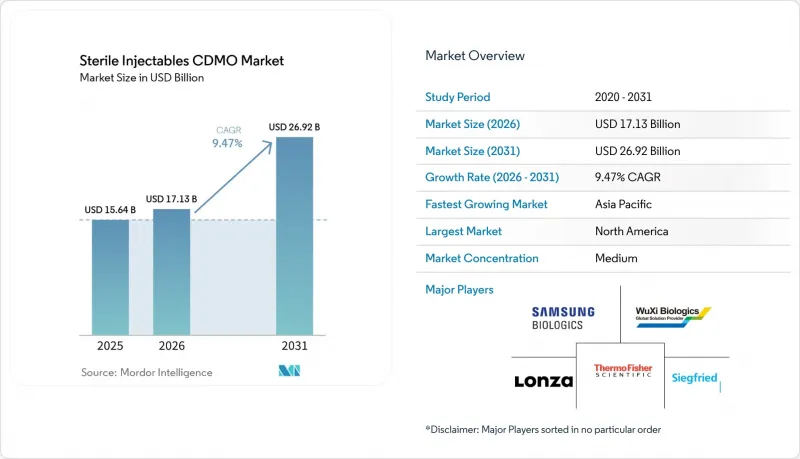
본 보고서는 분자 유형(저분자, 고분자/바이오의약품), 서비스(제제 개발 등), 제형(바이알·앰플, 프리필드 주사기, 특수 주사제, 기타), 최종 사용자(제약사, 바이오기술 기업, 기타), 지역(북미 등)별로 분류되어 있습니다. 시장 전망은 금액(달러) 기준으로 제시되어 있습니다.
전 세계 무균 주사제 CDMO 시장 동향 및 인사이트
바이오로직스의 파이프라인의 급속한 확대
2024년에 FDA가 승인한 55개의 신약 중 바이오의약품이 약 40%를 차지하고 있으며, 이는 5년 전의 25%에서 증가한 수치입니다. 지속적인 항체 공학 및 유전자 치료의 발전, 그리고 바이오시밀러의 확산에 힘입어, 혁신 기업들은 임상 및 상업적 규모에서 무균 충전 및 최종 가공을 관리할 수 있는 파트너를 찾고 있습니다. 아달리무맙이나 베바시주맙 등의 약품 특허 만료로 인해 바이오시밀러 파이프라인은 확대되었지만, 검증된 바이오의약품 생산 설비를 보유한 중견 기업은 극히 소수에 불과합니다. 항체-약물 복합체(ADC)나 이중 특이성 항체는 특수한 격리 환경이 필요하기 때문에 세포 독성 약물의 취급 및 아이솔레이터 기술 분야에서 실적이 있는 CDMO가 타사를 압도할 정도 수요를 확보하고 있습니다.
중견 제약 기업의 사내 무균 제조 능력 부족
전용 무균 생산 라인 구축에는 3억 달러가 넘는 비용이 소요되며, 최대 5년이 걸릴 수도 있습니다. 초기 단계 자산의 임상 성공률이 10% 전후에 그치는 가운데, 많은 중견 기업들은 이러한 설비 투자에 대한 수익이 제한적이라고 판단하여 외부 위탁을 선택하고 있습니다. 업계 조사에 따르면, 2024년 전 세계 충전·포장 설비의 가동률은 85%를 넘어섰으며, 동결건조 라인의 경우 그 수치가 더욱 높아 18-24개월 분량의 일정 지연이 발생하고 있습니다. 현재 초기 단계의 생물학적 제제 개발 기업의 60% 이상을 차지하는 가상 바이오테크 기업들은 독성 시험부터 시판에 이르기까지 모든 공정을 CDMO에 의존하고 있습니다.
전 세계 동결건조 능력 부족이 일정상의 병목 현상을 초래합니다.
동결건조는 열에 민감한 바이오의약품에 있어 여전히 바람직한 안정화 기법이지만, 전 세계 동결건조 생산 능력은 수요보다 약 15-20% 부족한 것으로 추정되며, 상업적 규모의 생산 캠페인 리드타임은 18-24개월에 달하고 있습니다. 동결건조 라인의 설비 투자액은 1기당 1,500만-2,500만 달러에 달하며, 게다가 설치와 검증에 12-18개월이 소요되기 때문에 신속한 생산 능력 확대가 저해되고 있습니다. 또한, 며칠에 걸친 동결건조 주기의 에너지 비용은 2022년 이후 30-40% 급등하고 있습니다. 스폰서들은 전략적인 선택을 해야 하는 상황에 놓여 있습니다. 시장 진출을 늦추는 장기화를 수용할 것인지, 아니면 액제 형태로 제품을 재설계하여 안정성을 확보할 것인지의 문제입니다. 후자의 방법을 선택할 경우, 추가적인 규제 당국에 대한 신청이나 임상 브릿징 시험이 필요합니다. 기존의 동결건조 능력을 갖춘 CDMO 기업들은 이러한 공급 부족을 배경으로 높은 가격을 제시하고 있지만, 이러한 병목 현상이 시장 전체의 성장을 저해하고 있습니다. 이러한 제약은 바이오시밀러 분야에서 가장 심각하며, 가격 경쟁으로 인해 스폰서가 고액의 CDMO 비용을 부담하려는 의지가 위축됨에 따라, 오리지널 바이오의약품이 생산 능력을 확보하는 반면, 바이오시밀러 개발자들은 대기할 수밖에 없는 양극화된 시장이 형성되고 있습니다.
부문별 분석
2025년, 무균 주사제 CDMO 시장 매출의 62.34%를 저분자 의약품이 차지해, 그 기반이 되는 것은 마취 및 종양학 분야에서 확고히 자리 잡은 병원용 주사제입니다. 바이오의약품은 기저가 낮은 편이지만, 2031년까지 연평균 성장률(CAGR) 10.34%를 기록하며 성장하고 있습니다. 이러한 추세는 환자 1인당 5만-15만 달러에 달하는 높은 가격 책정과, 경쟁을 제한하는 기술적 장벽을 반영하고 있습니다. 항체-약물 복합체(ADC)와 GLP-1 아날로그는 세포독성 처리 설비를 갖춘 CDMO에 의존하고 있으며, 이러한 설비를 보유한 전 세계 공급업체는 20곳 미만입니다. 저분자 의약품과 바이오의약품의 제조 라인을 모두 갖춘 듀얼 기능형 CDMO는 파이프라인의 변동에 따라 생산 능력을 유연하게 조정할 수 있지만, 배치당 단가가 높고 독점 기간이 길어짐에 따라 이익률은 바이오의약품 쪽이 확실히 더 높습니다.
견조한 바이오시밀러 개발도 또 다른 촉진요인입니다. 단일클론 항체의 특허 만료 후 시장 점유율 확보를 서두르는 개발 기업들은 촉박한 출시 일정을 맞추기 위해 제3자 제조 시설에 의존하고 있습니다. 연속 제조는 아직 발전 단계에 있지만, 향후 저분자 의약품의 원가 절감을 위한 가능성을 내포하고 있습니다. 한편, 바이오의약품의 아웃소싱 결정은 콜드체인 물류와 동결건조 설비의 가용 여부에 따라 달라집니다. 이러한 과제들은 통합된 파트너의 중요성을 더욱 부각시키고 있습니다. 그 결과, 무균 주사제 CDMO 시장에서는 바이오의약품 생산 능력에 대한 자본 유입이 나타나고 있지만, 저분자 의약품 라인에서는 제네릭 항암제 주사제가 여전히 기본적인 생산량을 지탱하고 있습니다.
2025년에는 규제 당국이 유효 성분, 내독소, 추출물에 대한 분석 요건을 강화함에 따라, 분석 및 시험 서비스가 해당 부문 매출의 39.95%를 차지했습니다. 그러나 많은 스폰서에게 새로운 클린룸 건설은 수익성이 떨어지기 때문에 제조 서비스 시장은 연평균 성장률(CAGR) 9.67%로 확대되고 있습니다. 현대식 충전·마감 라인에서는 바이알 취급 및 카메라를 이용한 검사에 로봇 기술이 통합되어 있어, 이를 통해 작업자와의 접촉을 줄이고 생산성을 높이고 있습니다. 제제 개발은 규모는 작지만, 고농도 바이오의약품의 점도 저감에 있어 매우 중요한 역할을 하고 있습니다.
일괄 계약에 대한 수요가 증가하고 있습니다. 스폰서는 인수인계 업무를 줄이기 위해 제제, 분석, 상업용 배치까지 포괄하는 단일 마스터 서비스 계약을 선호합니다. 그 결과, 유전자 치료용 세포 기반 효능 시험과 같은 틈새 시장용 분석 서비스를 제공하지 않는 한, 독립 분석 실험실의 성장은 둔화될 것입니다. 인라인 릴리스를 위한 공정 분석 기술을 도입한 CDMO는 배치 처리 시간을 수주에서 수시간으로 단축할 수 있으며, 이는 향후 경쟁 우위로 이어질 것입니다. 예측 기간 동안 무균 주사제 CDMO 시장에서는 RTU(Ready-to-Use) 용기에 대응하는 고속 생산 라인에 대한 설비 투자가 진행됨에 따라, 제조 부문의 매출 비중이 점차 증가할 것으로 전망됩니다.
지역별 분석
북미는 보스턴, 노스캐롤라, 캘리포니아의 생명공학 집적지를 배경으로 2025년 무균 주사제 CDMO 시장 매출의 45.25%를 차지했습니다. 노보 홀딩스의 카탈렌트 165억 달러 인수와, 이에 이어 노보 노르디스크가 카탈렌트의 공장 3곳을 117억 달러에 인수한 움직임은 GLP-1 제제의 충전 및 포장 능력을 확보하기 위한 수직 통합의 조짐을 보여주고 있습니다. 써모피셔는 2025년에 사노피의 뉴저지주 리지필드 사업장을 인수해 생산 능력을 확대했으며, 베터는 2029년 가동을 목표로 일리노이주에 임상용 공장 건설에 착수했습니다. 인건비 급등이 역풍으로 작용하고 있지만, FDA의 신뢰성 덕분에 북미의 생산 능력은 전 세계 제품 출시에서 여전히 높은 수요를 유지하고 있습니다.
유럽에서는 독일, 프랑스, 이탈리아, 스페인에 광범위한 무균 제조 시설이 위치해 있으며, 이들 시설이 해당 지역 전체의 생산 능력을 구성하고 있습니다. 부록 1의 개정은 시설의 업그레이드를 촉진하고, 유럽의 품질에 대한 평가를 강화했습니다. 한편, 프랑스의 세제 혜택은 바이오의약품 분야에 대한 새로운 투자를 유치하고 있습니다. 사모펀드(PE)의 활동은 여전히 활발하며, 2025년에 EQT와 ADIA가 레시팜 인수를 완료한 것이 그 증거입니다. 스페인의 낮은 인건비는 비용 효율을 중시하는 프로젝트를 유치하고 있지만, 규제된 품질 기준은 EMA 회원국 전체에서 통일되어 있습니다. 영국의 브렉시트 이후 규제 차이로 인해 추가 서류 제출이 필요하게 되었으나, GMP 준수를 통해 무역 마찰은 낮은 수준으로 억제되고 있습니다.
아시아태평양은 2031년까지 연평균 성장률(CAGR)이 10.48%로, 가장 빠르게 성장하고 있는 지역입니다. 삼성바이오로직스는 1조 9,000억 원을 투자해 2025년에 18만 리터 규모의 제5공장을 가동함으로써, 한국을 바이오의약품의 주요 거점으로 도약시켰습니다. 우시 바이오로직스는 국내 수요와 수출에 대응하기 위해 중국 내 여러 거점을 확장하고 있습니다. 인도의 풍부한 인력 풀과 경쟁력 있는 비용은 저분자 의약품 프로젝트를 유치하고 있는 반면, 호주의 화이자 공장에서는 1억 5,000만 호주 달러를 투자한 항균제 제조 설비 현대화 작업이 진행 중이며, 2026년에 완료될 예정입니다. 규제 조화는 여전히 진행 중이지만, 꾸준한 개선을 통해 주요 제약사들의 감사 승인을 획득함에 따라 무균 주사제 CDMO 시장에서 아시아태평양의 역할이 강화되고 있습니다.
기타 혜택:
- 엑셀 형식 시장 예측(ME) 시트
- 3개월간의 애널리스트 지원
자주 묻는 질문
목차
제1장 서론
제2장 조사 방법
제3장 주요 요약
제4장 시장 구도
제5장 시장 규모와 성장 예측
제6장 경쟁 구도
제7장 시장 기회와 향후 전망
JHS 26.06.23According to Mordor Intelligence, the sterile injectables cDMO market size is projected to expand from USD 15.64 billion in 2025 and USD 17.13 billion in 2026 to USD 26.92 billion by 2031, registering a CAGR of 9.47% between 2026 to 2031.
This report is Segmented by Molecule Type (Small Molecule, Large Molecule / Biologics), Services (Formulation Development and More), Dosage Form (Vials and Ampoules, Prefilled Syringes, Specialty Injectables, and Others), End-User (Pharmaceutical Companies, Biotechnology Companies, and Others), and Geography (North America, and More). The Market Forecasts are Provided in Terms of Value (USD).
Global Sterile Injectables CDMO Market Trends and Insights
Rapid Biologics Pipeline Expansion
Biologics represented about 40% of the 55 novel drugs cleared by the FDA in 2024, up from 25% five years earlier. Continuous antibody engineering, gene therapy breakthroughs, and a wave of biosimilars are pushing innovators toward partners that can manage sterile fill-finish at clinical and commercial scale. Patent expirations for agents such as adalimumab and bevacizumab have expanded biosimilar pipelines, yet very few mid-tier firms possess validated biologics suites. CDMOs with proven track records in cytotoxic handling and isolator technology are capturing disproportionate demand as antibody-drug conjugates and bispecifics require specialized containment.
Shortage of In-house Aseptic Capacity among Mid-size Pharma
Building a dedicated aseptic line can exceed USD 300 million and take up to five years. With clinical success rates near 10% for early-stage assets, many mid-size companies see limited return on such capital and therefore outsource. Industry surveys show global fill-finish utilization surpassed 85% in 2024, with lyophilization lines even higher, creating 18- to 24-month scheduling backlogs. Virtual biotech models, now more than 60% of early biologics developers, depend on CDMOs for everything from toxicology runs to commercial release.
Limited Global Lyophilization Capacity Causing Schedule Bottlenecks
Lyophilization remains the preferred stabilization method for heat-sensitive biologics, yet global freeze-drying capacity lags demand by an estimated 15-20%, with lead times for commercial-scale campaigns extending to 18-24 months. The capital intensity of lyophilization lines, USD 15-25 million per unit, plus 12-18 months for installation and validation, deters rapid capacity expansion, while energy costs for multi-day freeze-drying cycles have surged 30-40 % since 2022. Sponsors face a strategic choice: accept extended timelines that delay market entry or reformulate products for liquid-stable presentations, a path that requires additional regulatory filings and clinical bridging studies. CDMOs with existing lyophilization capacity leverage this scarcity to command premium pricing, yet the bottleneck constrains overall market growth. The constraint is most acute for biosimilars, where price competition limits sponsors' willingness to absorb premium CDMO fees, creating a bifurcated market where innovator biologics secure capacity while biosimilar developers queue.
Other drivers and restraints analyzed in the detailed report include:
- Growing Demand for Ready-to-use (RTU) Fill-finish Formats
- Heightened Regulatory Scrutiny Driving Outsourcing to Experts
- Highly Fragmented Regulatory Requirements Across Emerging Markets
For complete list of drivers and restraints, kindly check the Table Of Contents.
Segment Analysis
Small molecules generated 62.34% of the sterile injectables CDMO market revenue in 2025, anchored by entrenched hospital injections in anesthesia and oncology. Biologics, although starting from a lower base, are growing at a 10.34% CAGR to 2031. This momentum reflects premium pricing of USD 50,000-150,000 per patient and technical barriers that limit competition. Antibody-drug conjugates and GLP-1 analogs depend on CDMOs with cytotoxic suites, an asset held by fewer than 20 global providers. Dual-capability CDMOs that run adjacent small-molecule and biologic lines can flex capacity based on pipeline swings, but margins clearly favor biologics due to batch values and extended exclusivity.
Robust biosimilar development is another catalyst. Developers racing to seize share after patent expiry for monoclonal antibodies rely on third-party plants to meet tight launch windows. Continuous manufacturing remains nascent yet offers promise for future small-molecule cost reduction. Meanwhile, biologics outsourcing decisions hinge on cold-chain logistics and lyophilization slots, issues that magnify the importance of an integrated partner. As a result, the Sterile injectables CDMO market is seeing capital flow toward biologic capacity, though generic oncology injections still sustain base volumes in small-molecule lines.
Analytical and testing services contributed 39.95% of segment revenue in 2025 as regulators tightened assay expectations for potency, endotoxin, and extractables. Yet manufacturing services are accelerating at a 9.67% CAGR because constructing new clean rooms is uneconomic for many sponsors. Modern fill-finish suites now integrate robotics for vial handling and camera-based inspection that cut operator contact and elevate output. Formulation development, though smaller, is mission-critical for viscosity reduction in concentrated biologics.
Demand for bundled contracts is rising. Sponsors prefer a single master service agreement covering formulation, analytics, and commercial batches to reduce hand-offs. Consequently, stand-alone analytical labs face slower growth unless they offer niche assays such as cell-based potency tests for gene therapies. CDMOs adopting process analytical technology for in-line release can shorten batch disposition from weeks to hours, a future competitive edge. Over the forecast, the sterile injectables CDMO market is expected to see manufacturing's revenue share inch upward as capital investment migrates toward high-speed lines equipped for ready-to-use containers.
Geography Analysis
North America generated 45.25% of the sterile injectables CDMO market revenue in 2025, buoyed by dense biotech clusters in Boston, North Carolina, and California. Catalent's acquisition by Novo Holdings for USD 16.5 billion, followed by Novo Nordisk purchasing three Catalent plants for USD 11.7 billion, signals vertical integration aimed at securing GLP-1 fill-finish slots. Thermo Fisher added capacity by taking over Sanofi's Ridgefield, New Jersey site in 2025, and Vetter broke ground on a clinical plant in Illinois slated for 2029. High labor costs are a headwind, yet FDA credibility keeps North American capacity in high demand for global launches.
Europe hosts extensive aseptic facilities across Germany, France, Italy, and Spain, collectively representing regional capacity. Annex 1 revisions catalyzed facility upgrades that strengthen Europe's reputation for quality, while France's tax incentives are bringing fresh biologics investment. Private equity remains active, demonstrated by EQT and ADIA closing Recipharm's purchase in 2025. Spain's lower labor rates lure cost-sensitive projects, although regulated quality standards remain uniform across EMA states. The United Kingdom's post-Brexit divergence introduces added documentation, but alignment on GMP keeps trade friction low.
Asia-Pacific is the fastest-growing region with a 10.48% CAGR through 2031. Samsung Biologics switched on its 180,000-liter Plant 5 in 2025 after investing KRW 1.9 trillion, making South Korea a leading biologics hub. WuXi Biologics is scaling multiple Chinese sites to serve domestic demand and exports. India's large talent pool and competitive costs attract small-molecule projects, while Australia's Pfizer plant is undergoing an AU 150 million antimicrobial upgrade, finishing in 2026. Regulatory harmonization remains a work in progress, yet steady improvements have drawn big-pharma audit approvals, reinforcing Asia-Pacific's role in the Sterile injectables CDMO market.
- AbbVie Contract Manufacturing
- Aenova Group
- Ajinomoto Bio-Pharma
- Alcami
- Novo Holdings A/S (Catalent Inc.)
- Delpharm
- Fareva
- Fresenius Kabi (mAbxience)
- Jabil Inc (Pharmaceutics International Inc,)
- Jubilant HollisterStier
- Lonza Group
- PCI Pharma Services
- Recipharm (ETQ)
- Samsung Group
- Siegfried Holding AG
- Thermo Fisher Scientific Inc. (Patheon)
- Vetter Pharma
- Wuxi Biologics
Additional Benefits:
- The market estimate (ME) sheet in Excel format
- 3 months of analyst support
TABLE OF CONTENTS
1 Introduction
- 1.1 Study Assumptions & Market Definition
- 1.2 Scope of the Study
2 Research Methodology
3 Executive Summary
4 Market Landscape
- 4.1 Market Overview
- 4.2 Market Drivers
- 4.2.1 Rapid Biologics Pipeline Expansion
- 4.2.2 Shortage of In-house Aseptic Capacity among Mid-size Pharma
- 4.2.3 Growing Demand for Ready-to-use (RTU) Fill-finish Formats
- 4.2.4 Heightened Regulatory Scrutiny Driving Outsourcing to Experts
- 4.2.5 Increase Prevalence of Chronic and Complex Diseases
- 4.2.6 Automation?enabled Micro-batch fill-finish for orphan drugs
- 4.3 Market Restraints
- 4.3.1 Limited Global Lyophilization Capacity Causing Schedule Bottlenecks
- 4.3.2 Highly Fragmented Regulatory Requirements Across Emerging Markets
- 4.3.3 Rising Glass-vial Shortages & CCI failures
- 4.3.4 Talent Scarcity in High-potent Aseptic Suites
- 4.4 Value / Supply-Chain Analysis
- 4.5 Regulatory Landscape
- 4.6 Technological Outlook
- 4.7 Porter's Five Forces
- 4.7.1 Threat of New Entrants
- 4.7.2 Bargaining Power of Suppliers
- 4.7.3 Bargaining Power of Buyers
- 4.7.4 Threat of Substitutes
- 4.7.5 Industry Rivalry
5 Market Size & Growth Forecasts (Value, USD)
- 5.1 By Molecule Type
- 5.1.1 Small Molecule
- 5.1.2 Large Molecule / Biologics
- 5.2 By Services
- 5.2.1 Formulation Development
- 5.2.2 Analytical and Testing Services
- 5.2.3 Manufacturing
- 5.2.4 Fill-Finish & Packaging
- 5.2.5 Others
- 5.3 By Dosage Form
- 5.3.1 Vials and Ampoules
- 5.3.2 Prefilled Syringes
- 5.3.3 Speciality Injectables
- 5.3.4 Others
- 5.4 By End-User
- 5.4.1 Pharmaceutical Companies
- 5.4.2 Biotechnology Companies
- 5.4.3 Others
- 5.5 By Geography
- 5.5.1 North America
- 5.5.1.1 United States
- 5.5.1.2 Canada
- 5.5.1.3 Mexico
- 5.5.2 Europe
- 5.5.2.1 Germany
- 5.5.2.2 United Kingdom
- 5.5.2.3 France
- 5.5.2.4 Italy
- 5.5.2.5 Spain
- 5.5.2.6 Rest of Europe
- 5.5.3 Asia-pacific
- 5.5.3.1 China
- 5.5.3.2 Japan
- 5.5.3.3 India
- 5.5.3.4 South Korea
- 5.5.3.5 Australia
- 5.5.3.6 Rest of Asia-pacific
- 5.5.4 Middle East and Africa
- 5.5.4.1 GCC
- 5.5.4.2 South Africa
- 5.5.4.3 Rest of Middle East and Africa
- 5.5.5 South America
- 5.5.5.1 Brazil
- 5.5.5.2 Argentina
- 5.5.5.3 Rest of South America
- 5.5.1 North America
6 Competitive Landscape
- 6.1 Market Concentration
- 6.2 Strategic Moves
- 6.3 Market Share Analysis
- 6.4 Company Profiles {(includes Global level Overview, Market level overview, Core Segments, Financials as available, Strategic Information, Market Rank/Share for key companies, Products & Services, and Recent Developments)}
- 6.4.1 AbbVie Contract Manufacturing
- 6.4.2 Aenova Group
- 6.4.3 Ajinomoto Bio-Pharma
- 6.4.4 Alcami Corporation
- 6.4.5 Novo Holdings A/S (Catalent Inc.)
- 6.4.6 Delpharm
- 6.4.7 Fareva
- 6.4.8 Fresenius Kabi (mAbxience)
- 6.4.9 Jabil Inc (Pharmaceutics International Inc,)
- 6.4.10 Jubilant HollisterStier
- 6.4.11 Lonza Group AG
- 6.4.12 PCI Pharma Services
- 6.4.13 Recipharm (ETQ)
- 6.4.14 Samsung Biologics
- 6.4.15 Siegfried Holding AG
- 6.4.16 Thermo Fisher Scientific Inc. (Patheon)
- 6.4.17 Vetter Pharma
- 6.4.18 WuXi Biologics
7 Market Opportunities & Future Outlook
- 7.1 White-Space & Unmet-Need Assessment


