

|
시장보고서
상품코드
2063635
아시아태평양의 건설 및 해체 폐기물 관리 시장 : 점유율 분석, 업계 동향과 통계, 성장 예측(2026-2031년)Asia-Pacific Construction And Demolition Waste Management - Market Share Analysis, Industry Trends & Statistics, Growth Forecasts (2026 - 2031) |
||||||
 Mordor Intelligence
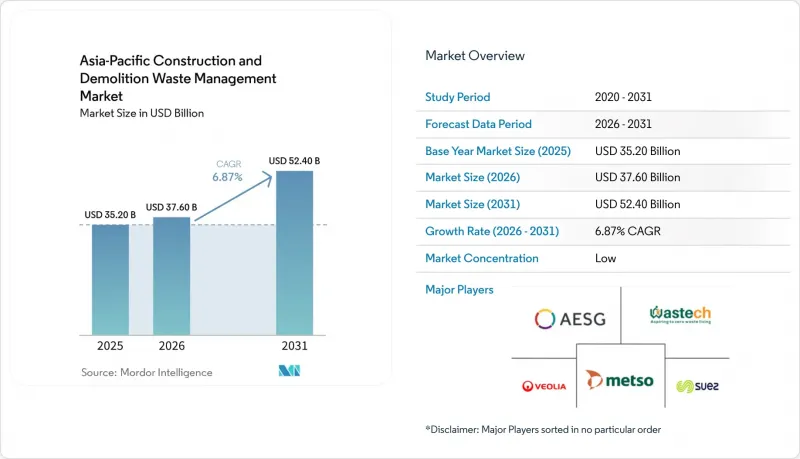
Mordor Intelligence에 의하면, 아시아태평양 건설 및 해체 폐기물 관리 시장 규모는 2025년에 352억 달러로 평가되었고 2026년 376억 달러에서 2031년까지 524억 달러에 이를 것으로 예측되며, 예측 기간 CAGR은 6.87%입니다(2026-2031년).
본 보고서는 폐기물의 유형(비유해 폐기물 및 유해 폐기물), 소재(콘크리트·벽돌, 아스팔트 등), 서비스(수집·운송, 선별·분리 등), 그리고 지역(중국, 일본, 인도, 한국, 아세안, 호주 및 기타 아시아태평양)별로 분류되어 있습니다. 예상치는 달러로 표시되어 있습니다.
아시아태평양의 건설 및 해체 폐기물 관리 시장 동향과 인사이트
급속한 도시화와 대규모 인프라 개발
아시아 전역의 도시 성장에 따라 대량의 해체 잔토, 굴착 토사, 개보수 폐기물이 발생하고 있습니다. 이러한 증가는 아시아태평양의 건설 및 해체 폐기물 관리 시장에서 적절한 폐기물 관리 서비스에 대한 수요를 높이고 있습니다. 주요 경제국의 정부는 정책에 기반을 둔 프로젝트를 원동력으로 삼아, 폐기물 발생자에게 자재 분리 수거 및 추적 가능한 운송을 장려하고 있습니다. 이러한 변화는 디지털 도구와 현장 처리의 역할이 커지고 있음을 여실히 보여주고 있습니다. 중국에서는 건설 폐기물 관리에 관한 새로운 규정이 발생원에서의 분리 수거와 프로젝트 진행 중 자재 재사용에 중점을 두고 있습니다. 이 접근 방식은 건설 진행 상황과 재활용 목표를 연계하고, 여러 기관의 단속을 통해 불법 투기를 방지합니다. 재활용 목표 설정 및 모니터링 요건으로 인해, 기업들은 이동식 파쇄·선별 장비와 정밀한 분리 방법을 도입해야 할 이유를 점점 더 많이 발견하고 있습니다. 이러한 노력은 장거리 운송을 줄이고, 재활용 자재 시장의 활성화에 기여하고 있습니다. 도시의 과밀화가 진행되는 가운데, 가동 중인 현장에 대한 접근이 제한됨에 따라 모듈식 설비나 단계적 물류가 점점 더 보편화되고 있습니다. 이러한 솔루션은 자재를 현장에서 승인된 수거 센터로 신속하게 운반하는 데 도움이 됩니다. 이러한 변화에 따라, 수거·선별·재활용 시스템의 확대가 중국 내 중앙 및 지방 정부의 플랫폼을 통해 지원되는 실시간 모니터링과 연계되고 있습니다.
정부의 순환형 경제 및 제로 웨이스트 정책
2030년까지 중국의 중앙 및 지방 정부는 고형 폐기물의 종합적인 활용과 건설 폐기물 관리의 표준화를 목표로 하고 있습니다. 이러한 노력은 재활용, 선별, 추적 가능한 운송과 같은 서비스에 대한 장기적인 수요를 뒷받침합니다. 국무원의 2025년 행동 계획과 그 운영 지침은 건설 폐기물의 분리 처리를 중시하고, 친환경 건설 실천을 촉진하는 한편, 폐기물 감축 비용을 프로젝트 예산에 반영하도록 의무화하고 있습니다. 한편, 베트남의 국가 순환형 경제 실행 계획은 높은 회수율을 목표로, 건축자재 관련 분야에서 확대 생산자 책임을 제도화함으로써 분리 수거와 하류 처리를 강화하고 있습니다. 중국에서는 민간 기업이 지방 자치 단체와 협력하여 폐기물의 유입 및 유출을 모니터링하고 수거를 최적화하는 디지털 플랫폼을 구축하고 있습니다. 이러한 협력은 재사용률과 제품 전환율에 있어 새로운 기준을 확립하고 있습니다. 대만에서는 무기 자원의 회수를 강화하고, 이를 아스팔트 골재나 관리된 저강도 자재 등의 용도로 전환하는 부문 간 협력 사업이 진행되고 있습니다. 이는 건설 분야에서 재활용 자재의 최종 용도를 확보할 뿐만 아니라, 규제 목표, 공공 조달, 기술 도입 간의 일관성을 높이는 데에도 기여합니다. 이러한 협력적인 노력이 아시아·태평양 지역의 건설 및 해체 폐기물 관리 시장을 강화하고 있습니다.
개발도상국에서의 규제 집행 미비
일부 신흥 시장에서는 건설 폐기물 관련 규정 및 면허 요건의 집행이 일관되지 않아, 폐기물의 재사용이 제한되거나 첨단 회수 라인에 대한 투자가 지연되는 경우가 있습니다. 당국은 합동 점검, 전자 문서화, 제재 조치를 통해 감독을 강화하기 시작했으나, 일부 성 및 지자체에서는 일관된 이행이 여전히 과제로 남아 있습니다. 중국이 최근 발표한 지침은 건설 폐기물과 관련된 부처 간 집행 체계와 감시 시스템, 그리고 전자 운송장(e-waybills)의 활용을 공식적으로 규정하고 있으며, 디지털 거버넌스가 어떻게 유출을 억제하고 규정 준수를 향상시킬 수 있는지를 보여주고 있습니다. 디지털 추적 시스템이 충분히 도입되지 않은 경우, 수거 및 운반의 초기 단계에서 누락이 발생할 가능성이 있으며, 그 결과 고부가가치 분리수거물의 회수율이 낮아져 자원 회수 사업자의 수익이 압박을 받게 됩니다. 규제 당국이 감사를 확대하고 보고를 표준화해 나감에 따라, 민간 서비스 제공업체들은 자사의 처리 능력을 정책 방향에 맞추어 조정함으로써 장기 계약을 확보하기가 더 쉬워질 것입니다. 감시 및 집행 분야의 지속적인 발전은 아시아태평양의 건설 및 해체 폐기물 관리 시장에서 자원 회수 목표 달성을 지원하고, 불법 투기 위험을 줄이는 데 기여할 것입니다.
부문별 분석
2025년에는 비유해성 폐기물이 시장을 독점하며 98.3%의 점유율을 차지했습니다. 해체 및 개보수 활동에서 발생하는 콘크리트, 벽돌, 흙, 아스팔트, 목재 등의 자재에 힘입어 이러한 우위는 아시아태평양의 건설 및 해체 폐기물 관리 시장에서 투자 우선순위를 계속해서 형성하고 있습니다. 일본의 도시를 대상으로 한 조사에 따르면, 비유해 폐기물의 흐름 중에서 콘크리트 블록이 가장 큰 비중을 차지하고 있습니다. 또한, 체계적인 분리 기술을 통해 골재, 금속, 목재의 회수율이 향상되고 있습니다. 전용 파쇄 설비를 갖춘 공공기관의 사례를 보면, 업스트림 공정에서 고품질의 선별 작업을 수행함으로써 콘크리트와 암석을 인프라 및 매립 프로젝트용 개량성 토사로 재활용할 수 있음이 입증되었습니다. 그러나 이러한 재활용 경로는 입도, 오염 물질, 성능 기준을 확인하는 효율적인 물류 관리 및 품질 보증 절차에 달려 있습니다. 현장에서의 이동식 전처리는 비유해 폐기물 흐름에 큰 이점을 제공하며, 운반 거리를 단축하는 동시에 하류 공장에 공급될 원료의 크기를 일관되게 유지해 줍니다. 이러한 효율화는 아시아태평양의 건설 및 해체 폐기물 관리 시장을 뒷받침하며, 수거, 선별 및 대량 재활용을 정책 주도형 이용 목표와 조화시키는 것입니다.
유해 폐기물은 2025년에는 고작 1.7%의 점유율에 불과했으나, 2031년까지 연평균 성장률(CAGR) 7.1%라는 견조한 성장세가 예상됩니다. 이러한 성장은 주로 아시아태평양의 건설 및 해체 폐기물 관리 시장에서 석면, 납계 도료, 오염 토양 등의 물질에 대한 규제가 강화된 데 기인합니다. 지역 규제 당국은 석면 취급 규정을 강화하고 있으며, 일부 지역에서는 석면을 전면적으로 금지하고, 석면의 제거, 운송 및 처분을 인가를 받은 업체에 위탁하도록 의무화하고 있습니다. 이 문제를 부각시키는 맥락에서 인도네시아 보건 당국은 석면 함유 자재의 지속적인 사용과 이로 인한 공중보건상의 문제를 지적하며, 향후 규제 강화와 전문적인 처리 시설의 필요성을 뒷받침하고 있습니다. 규제 준수가 엄격한 시장에서는 명확한 표시, 관리 이력(체인 오브 카스투디) 관리, 전용 매립 구역 및 처리 경로와 같은 관행이 표준으로 자리 잡고 있습니다. 감시가 강화되고 법 집행이 엄격해짐에 따라 유해 폐기물의 양을 정확히 파악하고 적절한 처리 경로로 유도하는 체계가 개선되어 안전성이 향상되었으며, 비유해 처리 라인과의 교차 오염이 최소화되고 있습니다. 이러한 조치는 규정 준수를 강화할 뿐만 아니라, 아시아태평양의 건설 및 해체 폐기물 관리 시장에서 전문 서비스의 기회를 확대하는 계기가 될 것입니다.
기타 혜택:
- 엑셀 형식 시장 예측(ME) 시트
- 3개월간의 애널리스트 지원
자주 묻는 질문
목차
제1장 서론
제2장 조사 방법
제3장 주요 요약
제4장 시장 구도
제5장 시장 규모와 성장 예측
제6장 경쟁 구도
제7장 시장 기회와 향후 전망
JHS 26.06.23According to Mordor Intelligence, the asia-Pacific construction and demolition waste management market size was valued at USD 35.20 billion in 2025 and is estimated to grow from USD 37.60 billion in 2026 to reach USD 52.40 billion by 2031, at a CAGR of 6.87% during the forecast period (2026-2031).
This report is Segmented by Waste Type (Non-Hazardous Waste, and Hazardous Waste), by Material (Concrete & Bricks, Asphalt, and More), by Service (Collection & Transportation, Sorting & Segregation, and More), and by Geography (China, Japan, India, South Korea, ASEAN, Australia, and Rest of Asia-Pacific). Forecasts are Provided in Terms of Value in USD.
Asia-Pacific Construction And Demolition Waste Management Market Trends and Insights
Rapid Urbanization and Mega Infrastructure Development
Urban growth across Asia is producing large amounts of demolition debris, excavation soil, and renovation waste. This increase is boosting the need for proper waste management services in the Asia-Pacific Construction and Demolition Waste Management market. Governments in major economies are encouraging waste producers to sort materials and ensure traceable transport, driven by policy-backed projects. This shift highlights the rising role of digital tools and on-site processing. In China, new rules for managing construction waste focus on sorting at the source and reusing materials during projects. This approach connects construction progress with recycling goals and uses multi-agency enforcement to prevent illegal dumping. By setting reuse targets and monitoring requirements, businesses are finding more reasons to adopt mobile crushing, screening, and precise sorting methods. These practices cut down on long-distance transport and support markets for recycled materials. As cities grow denser, limited access to active sites is making modular equipment and phased logistics more popular. These solutions help move materials quickly from job sites to approved recovery centers. This shift is aligning the growth of collection, sorting, and recycling systems with real-time monitoring, supported by national and local platforms in China.
Government Circular Economy and Zero Waste Policies
By 2030, Chinese central and municipal authorities aim to comprehensively utilize bulk solid waste and standardize construction waste governance. These initiatives bolster the long-term demand for services like recycling, sorting, and traceable hauling. The State Council's 2025 action plan, along with its operational guidance, emphasizes the classified treatment of construction waste, promotes green construction practices, and mandates the integration of waste reduction costs into project budgets. Meanwhile, Vietnam's national circular economy action plan aims for high collection rates and formalizes extended producer responsibility in sectors linked to building materials, enhancing segregation and downstream processing. In China, corporate operators are collaborating with local governments to launch digital platforms that monitor waste inflows and outflows, optimizing recovery. These collaborations establish new benchmarks for reuse rates and product conversion. Taiwan is witnessing cross-sector initiatives that enhance the recovery of inorganic resources, repurposing them for uses like asphalt aggregates and controlled low-strength material. This not only stabilizes end-use outlets for recycled content in construction but also tightens the alignment between regulatory targets, public procurement, and technology adoption. Such concerted efforts fortify the Asia-Pacific Construction and Demolition Waste Management market.
Weak Regulatory Enforcement in Developing Nations
In several emerging markets, uneven enforcement of construction waste rules and licensing requirements can limit diversion and slow investment in advanced recovery lines. Authorities have started to strengthen oversight through joint inspections, electronic documentation, and penalties, but consistent implementation remains a work in progress in some provinces and municipalities. China's recent guidance formalizes inter-departmental enforcement and the use of surveillance and e-waybills for construction waste, which illustrates how digital governance can curb leakage and improve compliance. Where digital tracking is not fully deployed, gaps may persist in first-mile collection and transfer, which reduces the capture of higher-value fractions and constrains revenues for material recovery operators. As regulators expand audits and standardize reporting, private service providers can better align capacity with policy direction and secure long-term contracts. Continued progress in monitoring and enforcement will support recovery targets and reduce illicit dumping risk in the Asia-Pacific Construction and Demolition Waste Management market.
Other drivers and restraints analyzed in the detailed report include:
- Aging Building Stock Demolition in Mature Markets
- Environmental Pollution Concerns from Illegal Dumping
- Low Tipping Fees Favoring Landfill Disposal
For complete list of drivers and restraints, kindly check the Table Of Contents.
Segment Analysis
In 2025, non-hazardous waste dominated the scene, capturing a 98.3% share. This dominance, driven by materials like concrete, brick, soil, asphalt, and timber from demolition and renovation activities, continues to shape investment priorities in the Asia-Pacific Construction and Demolition Waste Management market. Assessments in Japanese cities reveal that concrete blocks lead the non-hazardous stream. Moreover, structured separation techniques boost yields for aggregates, metals, and wood. Public agencies with dedicated crushing capacities have shown that, with high-quality upstream sorting, concrete and rock can be recycled into engineered fill for infrastructure and reclamation projects. However, these recycling pathways hinge on efficient logistics management and quality assurance processes that check for gradation, contaminants, and performance standards. Mobile pre-processing at sites offers significant advantages for non-hazardous streams, cutting down haul distances and ensuring a consistent feedstock size for downstream plants. Such efficiencies bolster the Asia-Pacific Construction and Demolition Waste Management market, aligning collection, sorting, and high-volume recycling with policy-driven utilization goals.
While hazardous waste made up a mere 1.7% share in 2025, it's set to grow at a robust 7.1% CAGR through 2031. This growth is largely due to heightened enforcement on materials like asbestos, lead-based coatings, and contaminated soils in the Asia-Pacific Construction and Demolition Waste Management market. Regional regulators have tightened asbestos handling rules, with some areas outright banning it and mandating licensed contractors for its removal, transport, and disposal. Highlighting the issue, health authorities in Indonesia have pointed out the ongoing use of asbestos-containing materials and the resultant public health challenges, bolstering the case for future restrictions and the need for specialized disposal facilities. In markets with stringent compliance, practices like clear labeling, chain-of-custody controls, and dedicated landfill cells or treatment routes have become the norm. As monitoring intensifies and enforcement tightens, the identification and routing of hazardous waste volumes improve, enhancing safety and minimizing cross-contamination with non-hazardous processing lines. Such measures not only boost compliance but also open doors for specialized services in the Asia-Pacific Construction and Demolition Waste Management market.
List of Companies Covered in this Report:
- AESG
- Wastech
- Veolia
- Metso
- SUEZ Asia
- Bingo Industries
- Remondis Australia
- Shanghai Environment Group
- Tapbo Environmental Limited
- Bhangarwala Waste Management Pvt Ltd
- Terreco Resources
- Fieldmans Waste Management
- Ward Demolition
- Cleanaway Waste Management
- China Tianying Inc. (CNTY)
- Advanced Construction Technologies (P) Ltd
- Re Sustainability
- IL&FS Offices
- Saahas Zero Waste
- JM Ecotech Solutions Co.
Additional Benefits:
- The market estimate (ME) sheet in Excel format
- 3 months of analyst support
TABLE OF CONTENTS
1 Introduction
- 1.1 Study Assumptions & Market Definition
- 1.2 Scope of the Study
2 Research Methodology
3 Executive Summary
4 Market Landscape
- 4.1 Market Overview
- 4.2 Market Drivers
- 4.2.1 Rapid Urbanization and Mega Infrastructure Development
- 4.2.2 Government Circular Economy and Zero Waste Policies
- 4.2.3 Aging Building Stock Demolition in Mature Markets
- 4.2.4 Environmental Pollution Concerns from Illegal Dumping
- 4.2.5 Smart City Sustainable Waste Integration
- 4.2.6 Natural Aggregate Shortages in Dense Urban Areas
- 4.3 Market Restraints
- 4.3.1 Weak Regulatory Enforcement in Developing Nations
- 4.3.2 Low Tipping Fees Favoring Landfill Disposal
- 4.3.3 Limited Recycling Infrastructure in Emerging Economies
- 4.3.4 Cultural Preference for Virgin Materials
- 4.4 Value / Supply-Chain Analysis
- 4.5 Regulatory Landscape
- 4.6 Technological Outlook
- 4.7 Porter's Five Forces
- 4.7.1 Threat of New Entrants
- 4.7.2 Bargaining Power of Suppliers
- 4.7.3 Bargaining Power of Buyers
- 4.7.4 Threat of Substitutes
- 4.7.5 Industry Rivalry
- 4.8 Australia-Japan Technology Leadership in Robotic Sorting
- 4.9 Circular Economy & Material Flow Analysis
- 4.10 On-site mobile recycling units reducing transportation costs
- 4.11 Environmental & Life-Cycle Assessment Considerations
5 Market Size & Growth Forecasts (value USD)
- 5.1 By Waste Type
- 5.1.1 Non-Hazardous Waste
- 5.1.2 Hazardous Waste
- 5.2 By Material
- 5.2.1 Concrete & Bricks
- 5.2.2 Asphalt
- 5.2.3 Metal
- 5.2.4 Timber
- 5.2.5 Soil and Sand
- 5.2.6 Gypsum & Drywall
- 5.2.7 Others (Plastic, Wood, Glass)
- 5.3 By Service
- 5.3.1 Collection & Transportation
- 5.3.2 Sorting & Segregation
- 5.3.3 Recycling & Material Recovery
- 5.3.4 Landfilling & Disposal
- 5.4 By Geography
- 5.4.1 China
- 5.4.2 Japan
- 5.4.3 India
- 5.4.4 South Korea
- 5.4.5 ASEAN (Indonesia, Thailand, Philippines, Malaysia, Vietnam)
- 5.4.6 Australia
- 5.4.7 Rest of Asia-Pacific
6 Competitive Landscape
- 6.1 Market Concentration
- 6.2 Strategic Moves
- 6.3 Market Share Analysis
- 6.4 Company Profiles (includes Global level Overview, Market level overview, Core Segments, Financials as available, Strategic Information, Products & Services, and Recent Developments)
- 6.4.1 AESG
- 6.4.2 Wastech
- 6.4.3 Veolia
- 6.4.4 Metso
- 6.4.5 SUEZ Asia
- 6.4.6 Bingo Industries
- 6.4.7 Remondis Australia
- 6.4.8 Shanghai Environment Group
- 6.4.9 Tapbo Environmental Limited
- 6.4.10 Bhangarwala Waste Management Pvt Ltd
- 6.4.11 Terreco Resources
- 6.4.12 Fieldmans Waste Management
- 6.4.13 Ward Demolition
- 6.4.14 Cleanaway Waste Management
- 6.4.15 China Tianying Inc. (CNTY)
- 6.4.16 Advanced Construction Technologies (P) Ltd
- 6.4.17 Re Sustainability
- 6.4.18 IL&FS Offices
- 6.4.19 Saahas Zero Waste
- 6.4.20 JM Ecotech Solutions Co.
7 Market Opportunities & Future Outlook
- 7.1 White-space & unmet-need assessment


