

|
시장보고서
상품코드
2063734
영아용 산소 후드 시장 : 점유율 분석, 업계 동향과 통계, 성장 예측(2026-2031년)Infant Oxygen Hoods - Market Share Analysis, Industry Trends & Statistics, Growth Forecasts (2026 - 2031) |
||||||
 Mordor Intelligence
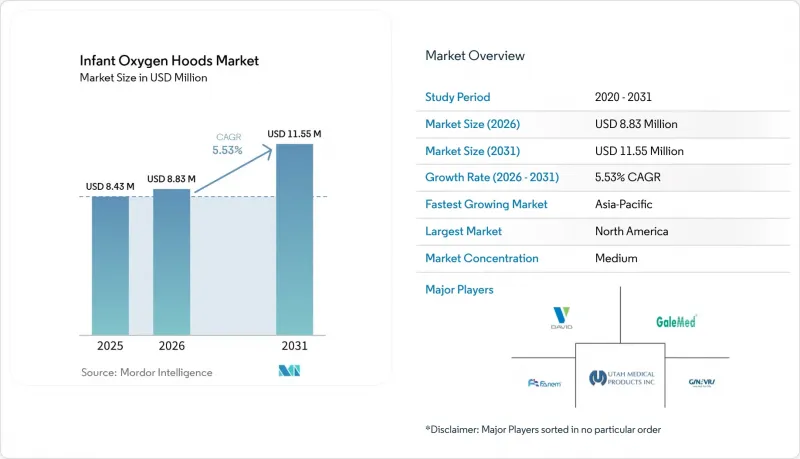
Mordor Intelligence에 의하면, 영아용 산소 후드 시장 규모는 2025년 843만 달러, 2026년 883만 달러에서 2031년까지 1,155만 달러로 확대되어 2026년부터 2031년까지 연평균 복합 성장률(CAGR)은 5.53%를 나타낼 것으로 예측됩니다.
본 보고서는 제품 유형(일회용, 재사용 가능), 최종 사용자(레벨 III/IV 신생아 중환자실(NICU), 레벨 II 신생아 집중 치료실(SCBU), 산부인과·분만 센터 및 소아 병동·응급실, 재택 간호·이송), 지역(북미, 남미, 유럽, 아시아태평양, 중동 및 아프리카)별로 분류되어 있습니다. 시장 전망은 금액(백만 달러) 단위로 제시되어 있습니다.
전 세계 영아용 산소 마스크 시장 동향 및 분석
조산 및 신생아 저산소증 증가
고소득 국가 시장에서 조산은 신생아의 산소 수요를 주도하는 안정적인 요인으로 계속 작용하고 있습니다. 미국에서는 2024년 조산율이 10.4%로 기록되었으며, 이는 생후 초기 단계에서 신중하게 조절된 산소 요법이 필요한 저산소혈증 위험이 있는 신생아가 꾸준히 유입되고 있음을 보여줍니다. 산소 후드는 단기간의 안정화 기간 동안 비강 캐뉼라나 CPAP 인터페이스를 사용할 수 없는 신생아에게 비접촉식 대안을 제공하며, 조직의 무결성이 취약한 상태에서 코 손상을 줄이는 데 도움이 됩니다. 그 유용성은 호기 말 양압(PEEP)이 없습니다는 점에 제한을 받기 때문에 그 적용 범위는 산소화 지원에 그치며, 표면활성제 결핍이나 무기폐가 있는 폐에 대해 CPAP가 제공하는 폐 재확장 전략까지는 미치지 못합니다. 미숙아의 산소 포화도 목표 범위가 좁기 때문에 엄격한 FiO2 관리와 지속적인 모니터링의 필요성이 강조되고 있습니다. 지침에 따르면, 미숙아 망막병증 및 기관지폐이형성증의 위험을 줄이기 위해 극저체중아의 경우 90-95% 전후의 범위를 유지할 것을 권장하고 있습니다. 이러한 임상적 매개변수 덕분에, 영아용 산소 후드 시장에서 특히 양압이 필요하지 않은 단시간 이용 사례에서 산소 후드의 명확한 입지가 유지되고 있습니다. 동시에, 모니터링 및 에스컬레이션 프로토콜을 손쉽게 이용할 수 있도록 보장되어 있습니다.
신흥 시장의 신생아 중환자실(NICU)/신생아 집중치료실(SNCU) 수용 능력 확대
아시아와 아프리카에서 정부 주도로 신생아 돌봄 서비스가 확대됨에 따라, 비침습적 양압 시스템이 반드시 도입되어 있지는 않은 2급 의료기관 및 지역 의료시설에서도 산소 후드를 포함한 필수 호흡기 장비의 도입 기반이 확대되고 있습니다. 인도네시아 사와후룬트 지역 종합병원은 2026년 4월에 4병상의 신생아 중환자실(NICU)과 4병상의 소아 중환자실을 개설했습니다. 이는 총 24억 루피아 규모의 특별 배분 기금으로 자금을 지원받으며, SIHREN과의 통합을 통해 의뢰 체계 간의 연계를 강화하고 시설 간 장비를 표준화하는 것을 목적으로 하고 있습니다. WHO가 제시한 모델에 따르면, 저·중소득 국가에서는 가동률 85% 기준, 출생아 1,000명당 2.8개의 신생아용 병상이 필요한 것으로 추정됩니다. 이는 일부 지역의 현재 수용 능력을 초과하는 수치이며, 시설에서 병상 수와 인력을 늘려감에 따라 위생 관리에 중점을 둔 소모품에 대한 수요가 증가하고 있습니다. 중국의 단계별 대응 능력 목록에는 현급 의료기관이 중등도 중증 환자의 상태를 안정화시키고, 이송 전에 정해진 기간 동안 CPAP 치료를 실시해야 한다고 명시되어 있습니다. 이 체계에서는 초기 안정화 단계에서 비강 인터페이스를 사용할 수 없는 환자에 대해 산소 후드 사용도 고려하고 있습니다. 의료 체계의 확대에 따라 감염 예방 대책과 신속한 회전을 중시하여 일회용 소모품이 선호되는 반면, 멸균 작업 흐름이 적절히 관리되고 운영 예산이 제한된 곳에서는 재사용 가능한 후드가 여전히 사용되고 있어, 이에 따라 영아용 산소 후드 시장은 지역별로 상이한 가격대와 성능 수준에 대응할 수 있는 체제가 갖춰져 있습니다. 세계은행이 산소 공급 및 신생아 소생 장비를 갖춘 나이지리아의 1차 의료 네트워크 강화를 위해 자금을 지원하는 등, 다자간 파트너들의 자금 지원에 힘입어 기본적인 호흡기 소모품의 대상 시장은 더욱 확대되고 있습니다.
HFNC/CPAP로의 전환으로 인해 일상적인 후드 사용이 감소
HFNC 및 CPAP는 3차 의료 환경에서 비침습적 신생아 호흡 지원의 1차 선택법으로 자리 잡고 있으며, 산소 후드의 사용은 코용 인터페이스에 대한 내성이 낮은 경우나, 보다 고도의 처치로 전환하기 전의 단기간 안정화 등 특정 적응증으로 제한되어 있습니다. 영국의 25개 의료기관을 대상으로 실시된 소아 중환자 치료에 관한 무작위 대조 시험(RCT)에서 호흡 보조 장치에서 분리되기까지의 기간에 있어 HFNC는 CPAP에 뒤지지 않는 결과를 보였으나, 튜브 제거 후의 주요 평가 지표에서는 CPAP가 더 양호한 예후를 보였으며, 양압 호흡 보조가 우선시되는 경우에는 CPAP가 권장되는 치료법임을 뒷받침하고 있습니다. 신생아를 대상으로 버블 CPAP와 가온가습식 HFNC를 비교한 3차 의료기관 연구에 따르면, CPAP 군에서 호흡 지원 기간 및 인공호흡기 사용 일수가 단축된 것으로 보고되었으며, 이는 양압 지원이 필수적인 급성기 관리에서 CPAP의 유용성을 뒷받침하는 결과입니다. 이러한 임상적 경향으로 인해, 영아용 산소 후드 시장은 수동적인 산소 공급으로 충분하고, 코와의 접촉이 금기이거나 내약성이 낮은 상황, 그리고 복잡한 장비나 호흡치료사가 없는 경증 환자 치료 현장에 한정되어 있습니다. 이러한 환경에서 각 벤더사는 동일한 치료 에피소드 내에서 CPAP 및 HFNC를 통합한 단계적 치료 경로에 대한 통합 옵션을 유지하면서, 사용 편의성과 신속한 설정을 강조하고 있습니다.
부문별 분석
일회용 산소 후드는 2025년에 45.92%를 차지해, 2031년까지 연평균 성장률(CAGR) 6.57%로 성장할 것으로 전망됩니다. 이는 감염 관리 의무화뿐만 아니라, 산부인과 및 소아과 병동에서 환자 교체 빈도가 높은 상황에서 환자 1인당 1회만 사용해야 하는 운영상의 필요성을 반영한 것입니다. 재사용 가능한 후드는 2025년 시장 규모의 54.08%를 차지하고 있으며, 확립된 멸균 워크플로우를 갖춘 예산 제약이 있는 시설에 의해 뒷받침되고 있지만, 재처리 과정의 복잡성과 불충분한 소독으로 인한 위험 때문에 많은 의료 서비스 제공업체들이 신규 입찰에서 일회용 제품을 우선적으로 선택하고 있습니다. 영아용 산소 후드 시장에서는 회전율이 높은 치료 구역의 감염 관리 목표를 보완하는 지속가능성 기준에 따라, 바이오 폴리머나 가소제 무첨가 수지 등의 소재에 대한 관심이 높아지고 있습니다. 병원들이 분만실이나 소아 응급실과 같이 바쁜 환경에서 장비 설치의 번거로움을 줄이려고 노력하는 가운데, 후드 표면을 따라 가스 주입구를 배치한 설계와 가시성 및 시술 시 접근성을 향상시키는 투명한 쉘은 차별화 요소로 작용하고 있습니다. 코로나19 시대의 안전 대책에 따른 감염 예방 방침의 영향으로, 멸균 능력이 제한된 환경, 직원 보호 프로토콜상 호흡기 경로의 필터 처리 및 재사용을 최소화하는 것이 우선시되는 환경에서는 일회용 제품의 사용이 더욱 보편화되고 있습니다.
일회용 모델은 MDR, ISO 13485 및 관련 품질 기준 준수를 효율화하기 위한 조달 체계와 부합합니다. 이는 일회용 기기가 다양한 병원 프로토콜 및 장비군에 걸친 재처리 절차의 검증 부담을 줄이기 위함입니다. 영아용 산소 후드 시장에서는 신생아 호흡기 관련 제품 포트폴리오가 폭넓은 공급업체들이 조달 과정에서 규모의 경제를 활용하기 위해, 후드를 CPAP 인터페이스나 인공호흡기 회로와 세트로 판매하고 있습니다. 이 접근 방식은 단일 공급업체의 생태계 내에서 에스컬레이션 절차에 관한 교육 및 교차 교육을 지원하는 것입니다. 자원이 제한된 병원에서 효과적인 멸균 부서를 운영하기 위해서는 재사용 가능한 후드가 여전히 비용 절감 방안으로서 중요하지만, 정기적인 관리에 드는 노력과 품질 보증 점검으로 인한 숨겨진 비용은 위생 및 처리 시간을 중시하는 입찰 과정에서 점점 더 엄격하게 검토되고 있습니다. 종합적으로 볼 때, 일회용 제품 시장 점유율은 계속해서 확대되고 있습니다. 이는 세계 조달 기준에 포함된 감염 예방 및 지속가능성 요건에 따라 일회용 영아용 산소 후드 시장 규모가 확대될 것으로 예상되기 때문입니다.
지역별 분석
북미는 2025년 매출의 46.11%를 차지했습니다. 이는 3차 NICU 및 산부인과 병원에서 일회용 제품의 적극적인 도입, 엄격한 감염 관리 기준, 그리고 일회용 호흡기 소모품에 대응한 지불 모델에 힘입은 결과입니다. 또한, 2024년 미국의 조산율은 10.4%로 성장을 지속하고, 있으며, 지속적인 관리에 있어 고유량 비강 캐뉼라(HFNC)나 지속 양압 호흡(CPAP)이 주류를 이루고 있음에도 불구하고, 초기 안정화 단계에서 산소 공급의 필요성이 입증됨에 따라 해당 지역에서는 기본적인 수요도 유지되고 있습니다. 이러한 환경에서는 비강 인터페이스 사용이 금기인 경우, 분만 시 단기간의 안정화 기간 동안, 그리고 이송 직전 및 직후의 신생아 관리에 중점을 두는 지방 병원에서 후드가 가장 일반적으로 사용되고 있습니다. 공급망의 취약성은 여전히 지속되고 있으며, 일부 공급업체에서는 2024년 장비 출하에 악영향을 미친 수지 및 실리콘 공급 제약이 보고되고 있습니다. 이는 영아용 소모품 분야에서 조달처의 다각화와 재고 완충의 중요성을 여실히 보여주고 있습니다. 그 결과, 영아용 산소 후드 시장은 위생성, 구하기 쉬움, 사용 편의성을 모두 충족시키는 병원의 구매 방침에 따라 계속해서 추세를 이어가고 있습니다.
유럽의 조달 환경은 의료기기 규정(MDR)에 따라 형성되어 있습니다. 이 규정에 따라 기존 기기의 재승인에 소요되는 비용과 시간이 증가했으며, 임상 평가 및 시판 후 조사에 대한 증거 요건이 강화되고 있습니다. 조기에 MDR 인증을 획득한 공급업체들은 해당 지위를 활용하여, 인공호흡기 및 CPAP를 보완하는 부속 소모품을 포함하여 대규모 병원 네트워크 전반에 걸쳐 지속적인 공급을 보장하고 있습니다. 종합적인 호흡 관리 플랫폼을 우선시하는 프레임워크 계약은 소모품의 도입 경로에 영향을 미치고 있으며, 서비스 및 교육을 효율화하기 위해 회로, 인터페이스, 호환 가능한 후드를 세트로 판매하는 경우가 많습니다. 이러한 추세에 따라 산소 후드는 특정 이용 사례에서 보조적인 역할에 그치는 반면, 조달 측면에서는 양압 지원과 수동 산소 공급을 모두 제공하는 다중 모드 시스템에 중점을 두고 있습니다. 이러한 맥락에서 영아용 산소 후드 시장 점유율은 감염 예방을 위한 일회용 제품, 병상에서의 처치를 간소화하는 투명 쉘을 중시하는 의료 기관들에 의해 지탱되고 있습니다.
아시아태평양은 연평균 성장률(CAGR) 6.24%로 가장 빠르게 성장하고 있으며, 이는 영아용 침대에 대한 막대한 공공 투자와 출산 현장에 가까운 곳에서 돌봄 서비스를 확대하기 위한 단계적 역량 강화 체계를 반영한 것입니다. 인도네시아가 새로운 신생아 집중치료실(NICU)의 수용 능력을 이송 네트워크에 통합한 사례는 일회용 산소 후드를 포함한 표준화된 조달이 도시와 농촌 지역 모두에서 신생아의 안정화 능력을 어떻게 확대할 수 있는지를 보여줍니다. 중국 신생아 병동을 대상으로 한 수정 델파이법 접근 방식은 현 차원의 치료 범위와 상급 기관 이송 절차를 명확히 하고, CPAP와 함께 산소 후드가 안정화 워크플로우에서 어떤 위치에 놓이는지를 정의하는 데 도움이 되고 있습니다. 아프리카와 중동에서는 1차 의료 기관 및 의뢰 기관에 산소 공급 설비와 신생아 소생 장비를 도입하는 다자간 금융 프로그램을 통해 기본적인 호흡기 소모품의 목표 시장이 확대되고 있습니다.
기타 혜택:
- 엑셀 형식 시장 예측(ME) 시트
- 3개월간의 애널리스트 지원
자주 묻는 질문
목차
제1장 서론
제2장 조사 방법
제3장 주요 요약
제4장 시장 구도
제5장 시장 규모와 성장 예측
제6장 경쟁 구도
제7장 시장 기회와 향후 전망
JHS 26.06.23According to Mordor Intelligence, the infant oxygen hoods market size is projected to expand from USD 8.43 million in 2025 and USD 8.83 million in 2026 to USD 11.55 million by 2031, registering a CAGR of 5.53% between 2026 to 2031.
This report is Segmented by Product Type (Disposable, Reusable), End User (Level III/IV NICUs, Level II SCBUs, Maternity/Birthing Centers and Pediatric Wards/ER, Home Care/Transport), and Geography (North America, South America, Europe, Asia Pacific, Middle East and Africa). Market Forecasts are Provided in Value (USD Million).
Global Infant Oxygen Hoods Market Trends and Insights
Rising Preterm Births and Neonatal Hypoxemia Burden
Preterm births remain a stable driver of neonatal oxygen needs in high-income markets, with the United States recording a 2024 preterm rate of 10.4%, indicating steady inflows of infants at risk of hypoxemia who require carefully titrated oxygen therapy in early life. Oxygen hoods offer a non-contact alternative for newborns that do not tolerate nasal prongs or CPAP interfaces during short stabilization periods, helping reduce nasal trauma when tissue integrity is fragile. Their utility is bounded by the absence of positive end-expiratory pressure, which limits application to oxygenation support rather than lung recruitment strategies that CPAP provides in surfactant-deficient or atelectatic lungs. Narrow oxygen saturation targets for preterm infants reinforce the need for tight FiO2 control and continuous monitoring, with guidelines emphasizing ranges around 90-95% in extremely low-birth-weight infants to mitigate retinopathy of prematurity and bronchopulmonary dysplasia risk. These clinical parameters preserve a targeted place for oxygen hoods in the infant oxygen hoods market, particularly for brief use cases that do not require positive pressure, while ensuring monitoring and escalation protocols are readily available.
NICU/SNCU Capacity Expansion in Emerging Markets
Government-backed neonatal-care upgrades in Asia and Africa are expanding the installed base for essential respiratory equipment, including oxygen hoods in level II and district facilities where noninvasive positive-pressure systems are not always present. Indonesia's Sawahlunto Regional General Hospital opened a four-bed NICU and four-bed pediatric ICU in April 2026, funded by Special Allocation Funds totaling Rp 2.4 billion, with integration into SIHREN to strengthen referral alignment and standardize equipment across facilities. A WHO-supported model estimates that low and middle-income countries require 2.8 neonatal beds per 1,000 live births at 85% occupancy, exceeding current capacity in several regions, which raises demand for hygiene-focused consumables as facilities add beds and staff. China's tiered capability lists specify that county-level units should stabilize moderate acuity cases and deliver CPAP for defined durations before escalation, a framework that also accommodates oxygen hoods for cases where nasal interfaces are not tolerated during initial stabilization. As systems expand, disposable consumables are favored for infection control and fast turnover, while reusable hoods remain present where sterilization workflows are well-managed and operating budgets are tight, positioning the infant oxygen hoods market to serve distinct price and performance tiers across geographies. Funding from multilateral partners, such as the World Bank's financing to strengthen Nigeria's primary healthcare network with oxygen access and neonatal resuscitation equipment, further broadens the addressable base for basic respiratory consumables.
Shift to HFNC/CPAP Reducing Routine Hood Use
HFNC and CPAP have become first-line modalities for noninvasive neonatal respiratory support in tertiary environments, limiting oxygen hoods to defined indications such as poor tolerance of nasal interfaces or short stabilization prior to escalation. In a pediatric critical care RCT across 25 U.K. units, HFNC was non-inferior to CPAP for time to liberation from respiratory support, though post-extubation outcomes favored CPAP for key endpoints, reinforcing CPAP's preferred role when positive-pressure support is a priority. A tertiary-center study comparing bubble CPAP to heated humidified HFNC in neonates reported shorter durations of respiratory support and ventilator days in CPAP cohorts, which strengthens the case for CPAP in acute management where pressure support is crucial. These clinical patterns confine the infant oxygen hoods market to scenarios where passive oxygen delivery suffices and where nasal contact is contraindicated or poorly tolerated, as well as to lower-acuity points of care that lack complex equipment or a respiratory therapist. In this environment, vendors emphasize ease of use and fast setup, while maintaining integration options for escalation pathways that involve CPAP and HFNC within the same care episode.
Other drivers and restraints analyzed in the detailed report include:
- Availability of Disposable Hoods for Infection Control
- Clinical Guidance Formalizing Oxygen Hood Use in Defined Scenarios
- CO2 Retention Risk and Variable FiO2 Without Analyzer
For complete list of drivers and restraints, kindly check the Table Of Contents.
Segment Analysis
Disposable oxygen hoods accounted for 45.92% in 2025 and are projected to grow at a 6.57% CAGR through 2031, reflecting infection-control mandates and the operational need for single-patient-use devices during rapid patient turnover in maternity and pediatric units. Reusable hoods held 54.08% of 2025 volume, supported by budget-constrained facilities with established sterilization workflows, although reprocessing complexity and the risk of suboptimal disinfection have led many providers to prioritize disposables in new tenders. The infant oxygen hoods market is seeing greater attention to materials, such as bio-based polymers and plasticizer-free resins, in line with sustainability standards that complement infection-control objectives in high-throughput care areas. Engineering choices that spread gas inlets along the hood surface, along with transparent shells that improve visualization and access for care procedures, have become differentiators as hospitals aim to reduce setup friction in busy delivery suites and pediatric emergency rooms. Infection-prevention policies influenced by COVID-19-era safeguards further entrench disposables in environments with limited sterilization capacity or where staff protection protocols prioritize filtered expiratory pathways and minimized reuse.
Disposable models align with purchasing frameworks that aim to streamline compliance with MDR, ISO 13485, and related quality standards, since single-use devices reduce the burden of validating reprocessing instructions across diverse hospital protocols and equipment fleets. In the infant oxygen hoods market, vendors with broader neonatal respiratory portfolios bundle hoods with CPAP interfaces and ventilator circuits to leverage scale in procurement, an approach that supports education and cross-training for escalation pathways within a single vendor ecosystem. For resource-limited hospitals that maintain effective sterilization departments, reusable hoods remain relevant as a cost-control measure, although recurring labor and quality assurance checks add hidden costs that are increasingly scrutinized in tenders focused on hygiene and turnaround times. On balance, disposables continue to gain share as the infant oxygen hoods market size for disposables is projected to expand in line with infection prevention and sustainability specifications embedded in global procurement standards.
Geography Analysis
North America held 46.11% of 2025 revenue, driven by strong adoption of disposables in tertiary NICUs and maternity hospitals, tight infection-control standards, and payment models that accommodate single-use respiratory consumables. The region also sustains baseline demand as the United States preterm rate remained at 10.4% in 2024, which supports the need for supplemental oxygen during early stabilization despite the dominance of HFNC and CPAP in ongoing management. In this environment, hoods are most common when nasal interfaces are contraindicated, during short stabilization periods in labor and delivery, and in rural hospitals that focus on immediate postnatal care prior to transfer. Supply chain sensitivity persists, with some vendors reporting resin and silicone constraints that weighed on device shipments in 2024, underscoring the importance of diversified inputs and inventory buffering in neonatal consumables. As a result, the infant oxygen hoods market continues to track hospital purchasing policies that align hygiene, availability, and ease of use.
Europe's procurement landscape is shaped by the Medical Device Regulation, which adds cost and time for reapproval of legacy devices and raises evidence expectations for clinical evaluations and post-market surveillance. Vendors with early MDR certification leverage that status to ensure continuity of supply across large hospital networks, including for accessory consumables that complement ventilators and CPAP. Framework agreements that prioritize comprehensive respiratory platforms influence consumable adoption paths, often bundling circuits, interfaces, and compatible hoods to streamline service and training. These dynamics keep oxygen hoods in ancillary roles for defined use cases, while procurement concentrates on multi-modality systems that deliver both positive-pressure support and passive oxygenation. Within this construct, the infant oxygen hoods market share is sustained by facilities that value disposable options for infection control and transparent shells that simplify procedures at the bedside.
Asia Pacific is the fastest-growing region at a 6.24% CAGR, reflecting significant public investment in neonatal beds and tiered capability frameworks that expand care closer to where births occur. Indonesia's integration of new NICU capacity into its referral network is an example of how standardized procurement, including disposable oxygen hoods, can extend neonatal stabilization capabilities in both urban and rural districts. China's modified Delphi approach for neonatal units clarifies the scope of county-level care and escalation pathways, which helps define where oxygen hoods fit within stabilization workflows alongside CPAP . In Africa and the Middle East, multilateral financing programs that upgrade primary and referral facilities with oxygen access and neonatal resuscitation equipment expand the addressable base for basic respiratory consumables.
- ATEFCO
- Fanem
- Farstar (Wuxi) Medical Equipment
- GaleMed Corporation
- GIGANTE Recem Nascido
- GINEVRI srl
- HEMC Medical
- IndoSurgicals
- JDMeditech
- Medical Dynamics (SuperDome)
- Mercury Medical
- Ningbo David Medical Device
- nice Neotech Medical Systems
- Olidef Medical
- Phoenix Medical Systems
- Plasti-med
- Qingdao Hiprove Medical
- SoCare India
- Utah Medical Products
- VNG Medical
Additional Benefits:
- The market estimate (ME) sheet in Excel format
- 3 months of analyst support
TABLE OF CONTENTS
1 Introduction
- 1.1 Study Assumptions & Market Definition
- 1.2 Scope of the Study
2 Research Methodology
3 Executive Summary
4 Market Landscape
- 4.1 Market Overview
- 4.2 Market Drivers
- 4.2.1 Rising preterm births and neonatal hypoxemia burden
- 4.2.2 NICU/SNCU capacity expansion in emerging markets
- 4.2.3 Clinical guidance formalizing oxygen hood use in defined scenarios
- 4.2.4 Availability of disposable hoods for infection control
- 4.2.5 Feasibility of iNO delivery via oxygen hood in select term neonates
- 4.2.6 Design advances improving CO2 washout and caregiver access
- 4.3 Market Restraints
- 4.3.1 Shift to HFNC/CPAP reducing routine hood use
- 4.3.2 CO2 retention risk and variable FiO2 without analyzer
- 4.3.3 Not routinely recommended; used when cannula not tolerated
- 4.3.4 Reprocessing burden and potential HAI risk with reusables
- 4.4 Value / Supply-Chain Analysis
- 4.5 Regulatory Landscape
- 4.6 Technological Outlook
- 4.7 Porter-s Five Forces
5 Market Size & Growth Forecasts (Value)
- 5.1 By Product Type
- 5.1.1 Disposable oxygen hoods
- 5.1.2 Reusable oxygen hoods
- 5.2 By End User
- 5.2.1 Level III/IV NICUs (tertiary)
- 5.2.2 Level II SCBUs/step-down units
- 5.2.3 Maternity/birthing centers and pediatric wards/ER
- 5.2.4 Home care/transport use
- 5.3 By Geography
- 5.3.1 North America
- 5.3.1.1 United States
- 5.3.1.2 Canada
- 5.3.1.3 Mexico
- 5.3.2 Europe
- 5.3.2.1 Germany
- 5.3.2.2 France
- 5.3.2.3 United Kingdom
- 5.3.2.4 Italy
- 5.3.2.5 Spain
- 5.3.2.6 Rest of Europe
- 5.3.3 Asia-Pacific
- 5.3.3.1 China
- 5.3.3.2 India
- 5.3.3.3 Japan
- 5.3.3.4 South Korea
- 5.3.3.5 Australia
- 5.3.3.6 Rest of Asia Pacific
- 5.3.4 Middle East and Africa
- 5.3.4.1 GCC
- 5.3.4.2 South Africa
- 5.3.4.3 Rest of Middle East and Africa
- 5.3.5 South America
- 5.3.5.1 Brazil
- 5.3.5.2 Argentina
- 5.3.5.3 Rest of South and Central America
- 5.3.1 North America
6 Competitive Landscape
- 6.1 Market Concentration
- 6.2 Market Share Analysis
- 6.3 Company Profiles
- 6.3.1 ATEFCO
- 6.3.2 Fanem
- 6.3.3 Farstar (Wuxi) Medical Equipment
- 6.3.4 GaleMed Corporation
- 6.3.5 GIGANTE Recem Nascido
- 6.3.6 GINEVRI srl
- 6.3.7 HEMC Medical
- 6.3.8 IndoSurgicals
- 6.3.9 JDMeditech
- 6.3.10 Medical Dynamics (SuperDome)
- 6.3.11 Mercury Medical
- 6.3.12 Ningbo David Medical Device
- 6.3.13 nice Neotech Medical Systems
- 6.3.14 Olidef Medical
- 6.3.15 Phoenix Medical Systems
- 6.3.16 Plasti-med
- 6.3.17 Qingdao Hiprove Medical
- 6.3.18 SoCare India
- 6.3.19 Utah Medical Products
- 6.3.20 VNG Medical
7 Market Opportunities & Future Outlook
- 7.1 White-space & unmet-need assessment


