

|
시장보고서
상품코드
2063743
피부 재생 기기 : 시장 점유율 분석, 업계 동향 및 통계, 성장 예측(2026-2031년)Skin Resurfacing Devices - Market Share Analysis, Industry Trends & Statistics, Growth Forecasts (2026 - 2031) |
||||||
 Mordor Intelligence
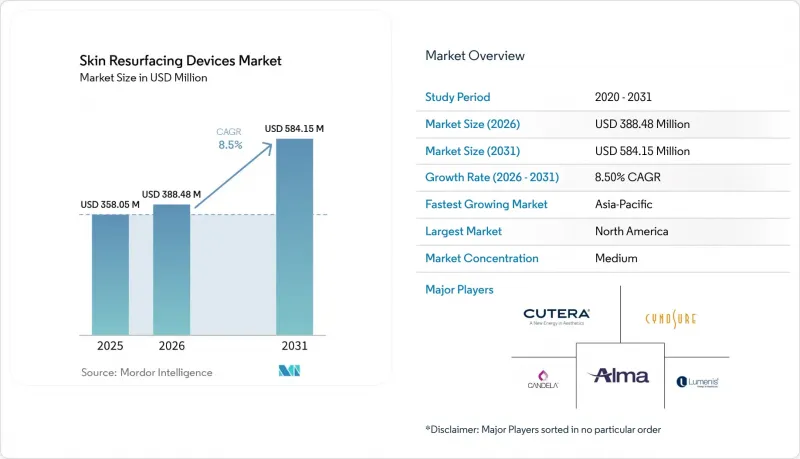
Mordor Intelligence에 의하면, 피부 재생 기기 시장 규모는 2025년에 3억 5,805만 달러로 평가되었습니다. 2026년에 3억 8,848만 달러에서 2031년까지 5억 8,415만 달러에 이를 것으로 예측되며, 2026-2031년 CAGR은 8.5%를 나타낼 전망입니다.
본 보고서는 제품(레이저 리서페이싱 기기, RF 마이크로니들링 시스템 등), 기술(절제성, 비절제성), 용도(주름·잔주름 개선, 기미, 피부 탄력 강화·피부 질 개선 등), 최종 사용자(피부과 클리닉, 병원 등), 지역(북미, 유럽 등)별로 분류되어 있습니다. 시장 전망은 금액(달러) 기준으로 제시되어 있습니다.
세계의 피부 재생 기기 시장 동향 및 인사이트
고령화에 따른 저침습 미용 시술에 대한 수요
세계 인구의 고령화에 따라, 수술로 인한 회복 기간 없이 외모를 젊게 가꿔주는 시술에 대한 관심이 높아지고 있습니다. 미국 미용외과학회(The Aesthetic Society)의 기록에 따르면, 2020년부터 2024년에 걸쳐 비수술적 미용 시술이 14% 증가했으며, 이는 지속적인 수요가 있음을 뒷받침하고 있습니다. 동료 심사를 거친 연구에 따르면, 프랙셔널 CO2 레이저는 시술 후 1개월 이내에 사용할 경우 뛰어난 흉터 관리 효과를 발휘하며, 이는 이러한 경향을 더욱 뒷받침하고 있습니다. 안전성 프로파일이 개선됨에 따라 고령 환자들이 더 이른 시기에 예방적 치료를 받기 시작하면서, 장기적인 시술의 보급이 촉진되고 있습니다.
병용 요법(레이저 + RF 마이크로니들링)의 급증
프랙셔널 레이저와 고주파 마이크로니들링을 병행함으로써, 표피에 가해지는 손상을 최소화하면서 콜라겐 생성을 촉진할 수 있습니다. 4년 반에 걸친 안전성 검토 결과, RF 마이크로니들링과 미용 주사제를 병용했을 때 유해 반응이 확인되지 않았으며, 이 치료법의 폭넓은 적용 가능성이 부각되었습니다. 현재 각 제조업체들은 두 가지 에너지원을 하나의 콘솔에 통합하고 있어, 클리닉에서는 여러 가지 효과를 한 번에 얻을 수 있는 시술을 제공할 수 있게 되었습니다. 이를 통해 시술 시간을 단축하고 환자 1인당 수익을 높일 수 있게 되었습니다.
레이저 워크스테이션의 높은 초기 비용
전문용 피부 재생 콘솔은 유지보수 및 교육 비용을 제외하더라도 10만-50만 달러가 듭니다. 2026년에 시행될 예정인 미국 품질 시스템 규정 개정에 따라, 규정 준수 관련 지출이 더욱 증가하여 제조업체의 정가가 상승할 것으로 예상됩니다(1). 그 때문에 소규모 클리닉에서는 구매를 미루거나 더 저렴한 단일 에너지 장비를 선택하고 있어, 비용에 민감한 지역에서는 보급이 더딘 실정입니다.
부문별 분석
레이저를 이용한 피부 재생 기기는 2024년 매출의 42.78%를 차지하며, 피부 재생 시장의 핵심 축으로서의 입지를 유지했습니다. 이 제품들은 임상 현장에서 폭넓은 인지도를 얻고 있을 뿐만 아니라, 평균 판매 가격을 끌어올리는 프리미엄 가격대의 이점을 누리고 있습니다. 그러나 RF 마이크로니들링 시스템은 회복 기간 단축과 다용도 시술법에 대한 의료진의 높은 관심을 반영하여 연평균 성장률(CAGR) 9.16%를 나타낼 것으로 전망됩니다. AI를 활용한 정밀 제어를 통해 시술자는 진피의 두께에 맞추어 에너지 공급을 조절할 수 있으므로, 피부색이 어두운 분들의 안전성도 향상됩니다. 이러한 시너지 효과 덕분에, 레이저가 매출의 주축으로 자리매김하고 있는 한편, RF 장비는 수요 증가의 핵심 요소로 자리 잡고 있습니다.
플랫폼 통합도 진행되고 있습니다. 멀티모달 워크스테이션은 프랙셔널 레이저, 바이폴라 RF, IPL을 하나의 설치 공간에 통합하고 있어, 클리닉은 여러 대의 장비를 구매하지 않고도 서비스를 확대할 수 있습니다. 이러한 통합형 콘솔의 확산에 따라, 구매자는 단일 장비로 더 광범위한 적응증을 다룰 수 있게 됨에 따라 피부 재표면화 시장의 회복탄력성이 강화되고 있습니다.
2024년, 아브레이티브(박리) 시스템의 매출 점유율은 56.10%를 차지했으며, 이는 깊은 흉터 교정 및 뚜렷한 주름 치료 분야에서 입증된 그 효능을 뒷받침하는 것입니다. 이러한 시스템은 치료당 비용이 높아, 장비의 투자 수익률(ROI)을 유지하고 있습니다. 반면, 비절제형 플랫폼은 환자들이 주말 정도의 회복 기간이나 염증 후 색소 침착 위험 감소를 중요하게 여기기 때문에 연평균 성장률(CAGR) 9.57%를 나타낼 것으로 예측됩니다. 최첨단 1550nm 프랙셔널 레이저는 표피 조직을 증발시키지 않고 진피의 콜라겐을 자극하여, 직장인을 대상으로 한 입술 및 입 주변의 회춘 치료를 가능하게 합니다.
하이브리드 솔루션은 기존의 경계를 모호하게 만들고 있습니다. 온도 제어형 CO2 레이저는 열 확산을 억제하는 프랙셔널 패턴을 생성하여, 절제 정밀도와 비절제 부위의 안전성을 조화시킵니다. 이러한 융합을 통해 제조업체들이 에너지 유형뿐만 아니라 매개변수의 유연성을 바탕으로 차별화를 꾀함에 따라, 스킨 리서페이싱 시장이 확대되고 있습니다.
지역별 분석
2024년, 북미는 피부 재표면화 시장에서 36.89%라는 가장 높은 점유율을 차지했습니다. 이는 높은 가처분 소득, 촘촘한 시술 시설 네트워크, 그리고 탄탄한 교육 체계에 힘입은 결과입니다. 이 지역의 메디컬 스파 수는 1만 개를 넘어섰으며, 점포당 평균 매출액은 139만 8,000달러에 달했습니다. 2026년에 예정된 FDA의 규제 변경에 따라 품질 관리 시스템이 표준화되고, 임상시험 대상자층이 다양해질 것입니다. 이로 인해 개발 비용이 증가할 가능성은 있지만, 승인을 받게 되면 대중의 신뢰를 높이는 데 기여할 것입니다.
아시아태평양은 연평균 성장률(CAGR) 10.93%를 기록하며, 다른 모든 지역을 앞지르고 있습니다. 중국, 일본, 한국의 도시 지역에 거주하는 밀레니얼 세대는 가처분 소득 중 예방적 미용 의료에 지출하는 비중을 늘리고 있습니다. 2024년에는 중국 고소득층 소비자의 91%가 미용 시술에 대한 지출을 유지하거나 늘렸습니다. 한국과 싱가포르의 국내 규제 당국은 국내 제조업체가 관여하는 경우 의료기기 승인을 신속하게 처리하고 있으며, 이로 인해 현지 혁신 기업들 시장 진출이 가속화되고 있습니다. 2025년까지 지역 의료 기술 부문 전체 규모가 1,900억 달러에 달한 가운데, 공급업체들은 잠재적 수요를 현실화하기 위해 유통업체와의 제휴 및 현지 교육에 우선순위를 두고 있습니다.
유럽에서는 엄격한 안전 문화와 탄탄한 보험 가입 기반을 바탕으로, 한 자릿수 중반대의 꾸준한 성장이 예상됩니다. 이러한 수요에는 환경에 대한 배려도 반영되어 있으며, 독일이나 북유럽 국가의 클리닉에서는 내부 ESG 목표를 달성하기 위해 소모품이 적은 핸드피스를 지정하는 사례가 늘고 있습니다. 남미와 중동 및 아프리카는 여전히 신흥 시장이지만, 매력적인 시장입니다. 브라질에는 오랜 역사를 지닌 미용 문화가 자리 잡고 있어, 시술을 목적으로 한 관광을 뒷받침하고 있습니다. 한편, 사우디아라비아가 Cytrellis사의 Micro-Coring 플랫폼을 승인한 것은 의료기기를 활용한 미용 치료에 대한 정책적 지원을 시사하고 있습니다. 이러한 지역들은 전반적으로, 주요 유럽 및 미국 시장 이외의 지역으로 제조업체의 수익 다각화를 도모하기 위한 확장 경로를 제공합니다.
기타 혜택 :
- 엑셀 형식 시장 예측(ME) 시트
- 3개월간의 애널리스트 지원
자주 묻는 질문
목차
제1장 서론
제2장 조사 방법
제3장 주요 요약
제4장 시장 구도
제5장 시장 규모 및 성장 예측
제6장 경쟁 구도
제7장 시장 기회 및 향후 전망
KTH 26.06.24According to Mordor Intelligence, the skin resurfacing devices market size is projected to be USD 358.05 million in 2025, USD 388.48 million in 2026, and reach USD 584.15 million by 2031, growing at a CAGR of 8.5% from 2026 to 2031.
This report is Segmented by Product (Laser Resurfacing Devices, RF Microneedling Systems, and More), Technology (Ablative, Non-Ablative), Application (Wrinkle & Fine-Line Reduction, Melasma, Skin Tightening & Texture Improvement and More), End User (Dermatology Clinics, Hospitals, and More), and Geography (North America, Europe, and More). The Market Forecasts are Provided in Terms of Value (USD).
Global Skin Resurfacing Devices Market Trends and Insights
Aging-driven demand for minimally-invasive aesthetics
Global population aging accelerates interest in procedures that rejuvenate appearance without surgical downtime. The Aesthetic Society recorded a 14% increase in nonsurgical aesthetic procedures from 2020 to 2024, underscoring durable demand. Fractional CO2 lasers further validate this preference by delivering superior scar management when used within one month post-surgery, according to peer-reviewed studies. Improved safety profiles encourage older patients to seek preventive care earlier, reinforcing long-term procedure adoption.
Surge in combination treatments (laser + RF microneedling)
Pairing fractional lasers with radiofrequency microneedling lifts collagen stimulation while moderating epidermal damage. A four-and-a-half-year safety review found no adverse events when RF microneedling was combined with cosmetic injectables, highlighting the modality's versatility. Manufacturers now embed both energies in single consoles, enabling clinics to offer multi-effect sessions that reduce overall chair time and boost revenue per patient.
High capital cost of laser workstations
Professional-grade resurfacing consoles cost USD 100,000-500,000 before maintenance and training outlays. Upcoming U.S. Quality System Regulation Amendments effective 2026 will further lift compliance expenditure, raising manufacturer list prices[1]. Smaller practices therefore delay purchases or opt for lower-priced single-energy tools, slowing penetration in cost-sensitive locales
Other drivers and restraints analyzed in the detailed report include:
- Rising male consumer adoption of cosmetic procedures
- Rapid expansion of medical-spa chains in Asia-Pacific
- Limited reimbursement for aesthetic indications
For complete list of drivers and restraints, kindly check the Table Of Contents.
Segment Analysis
Laser resurfacing devices generated 42.78% of 2024 revenue, keeping them the commercial anchor of the skin resurfacing market. They benefit from broad clinical familiarity and premium price points that lift average selling prices. RF microneedling systems, however, are projected to grow at a 9.16% CAGR, reflecting clinician enthusiasm for shorter downtime and versatile protocols. AI-enabled depth control enables practitioners to match energy delivery to dermal thickness, thereby improving safety for individuals with darker skin phenotypes. The combined momentum positions RF units as central to incremental demand even as lasers preserve headline revenue status.
Platform integration also advances. Multimodal workstations now combine fractional laser, bipolar RF, and IPL in a single footprint, enabling clinics to add services without requiring multiple capital purchases. As bundled consoles roll out, the skin resurfacing market gains resilience because purchasers can serve a broader range of indications from a single asset.
Ablative systems held a 56.10% revenue share in 2024, a testament to their proven efficacy in deep scar revision and the treatment of pronounced rhytides. They command higher treatment prices, sustaining device ROI. Non-ablative platforms, in contrast, are expected to expand at a 9.57% CAGR as patients value weekend-length recovery windows and reduced risk of post-inflammatory hyperpigmentation. Advanced 1550 nm fractional lasers stimulate dermal collagen without vaporizing surface tissue, enabling lip and perioral rejuvenation for working professionals.
Hybrid solutions blur traditional boundaries: temperature-modulated CO2 lasers deliver fractional patterns that limit thermal diffusion, merging ablative precision with non-ablative safety. Such convergence reinforces the skin resurfacing market as manufacturers differentiate through parameter flexibility rather than energy type alone.
Geography Analysis
North America generated the largest 36.89% share of the skin resurfacing market in 2024, driven by high disposable incomes, a dense network of providers, and a robust training infrastructure. The region's medical-spa count surpassed 10,000 outlets, with average site revenue of USD 1.398 million. FDA rule changes slated for 2026 will standardize quality systems and diversify clinical trial cohorts, potentially increasing development costs but enhancing public confidence once approvals are obtained.
Asia-Pacific is on course for a 10.93% CAGR, outpacing all other regions. Urban millennials in China, Japan, and South Korea are allocating a growing portion of their discretionary income to preventive aesthetics; 91% of high-income Chinese consumers either maintained or increased their spending on cosmetic procedures in 2024. National regulators in South Korea and Singapore fast-track device clearance when domestic manufacturing is involved, accelerating market entry for local innovators. With the broader regional med-tech sector projected to reach USD 190 billion by 2025, suppliers are prioritizing distributor partnerships and localized education to convert latent demand.
Europe delivers steady mid-single-digit growth anchored by stringent safety culture and a well-insured patient base. Demand also reflects environmental stewardship; clinics in Germany and the Nordics increasingly specify low-consumable handpieces to meet internal ESG goals. South America and the Middle East & Africa remain emerging but compelling. Brazil's long-standing cosmetic culture sustains procedure tourism, while Saudi Arabia's approval of Cytrellis's Micro-Coring platform signals policy support for device-based aesthetics. Collectively, these geographies provide expansion corridors that diversify manufacturer revenue beyond core Western markets.
- Aerolase
- Aerolase
- Alma Sisram Medical
- Alma Lasers
- Asclepion Laser
- Bausch Health - Solta Medical
- Bison Medical
- BTL
- Candela Medical
- Cutera
- Cutera Japan K.K.
- Cynosure
- DEKA M.E.L.A.
- Fotona
- Jeisys Medical
- Lumenis
- Lutronic
- Sciton
- Shanghai Fosun Pharmaceutical - Sisram
- Sharplight Technologies
- Candela Medical
- Venus Concept
Additional Benefits:
- The market estimate (ME) sheet in Excel format
- 3 months of analyst support
TABLE OF CONTENTS
1 Introduction
- 1.1 Study Assumptions & Market Definition
- 1.2 Scope of the Study
2 Research Methodology
3 Executive Summary
4 Market Landscape
- 4.1 Market Overview
- 4.2 Market Drivers
- 4.2.1 Aging-Driven Demand for Minimally-Invasive Aesthetics
- 4.2.2 Surge in Combination Treatments (Laser + RF Microneedling)
- 4.2.3 Rising Male Consumer Adoption of Cosmetic Procedures
- 4.2.4 Rapid Expansion of Medical-Spa Chains in Asia-Pacific
- 4.2.5 AI-Guided Laser Platforms Improving Treatment Outcomes
- 4.2.6 ESG-Linked Preference for Low-Consumable Devices
- 4.3 Market Restraints
- 4.3.1 High Capital Cost of Laser Workstations
- 4.3.2 Stringent Device Safety Regulations & Lengthier Approvals
- 4.3.3 Limited Reimbursement for Aesthetic Indications
- 4.3.4 Growing Popularity of Home-Use Resurfacing Gadgets
- 4.4 Value / Supply-Chain Analysis
- 4.5 Regulatory Landscape
- 4.6 Technological Outlook
- 4.7 Porter's Five Forces Analysis
- 4.7.1 Threat of New Entrants
- 4.7.2 Bargaining Power of Suppliers
- 4.7.3 Bargaining Power of Buyers
- 4.7.4 Threat of Substitutes
- 4.7.5 Industry Rivalry
5 Market Size & Growth Forecasts (Value, USD)
- 5.1 By Product
- 5.1.1 Laser Resurfacing Devices
- 5.1.2 RF Microneedling Systems
- 5.1.3 Microdermabrasion Devices
- 5.1.4 Chemical Peel Solutions & Kits
- 5.2 By Technology
- 5.2.1 Ablative
- 5.2.2 Non-Ablative
- 5.3 By Applications
- 5.3.1 Wrinkle & Fine-Line Reduction
- 5.3.2 Scar & Acne-Scar Revision
- 5.3.3 Hyper-Pigmentation / Melasma
- 5.3.4 Skin Tightening & Texture Improvement
- 5.4 By End User
- 5.4.1 Dermatology Clinics
- 5.4.2 Hospitals
- 5.4.3 Medical Spas & Aesthetic Centers
- 5.4.4 Home-Use / Consumer
- 5.5 By Geography
- 5.5.1 North America
- 5.5.1.1 United States
- 5.5.1.2 Canada
- 5.5.1.3 Mexico
- 5.5.2 Europe
- 5.5.2.1 Germany
- 5.5.2.2 United Kingdom
- 5.5.2.3 France
- 5.5.2.4 Italy
- 5.5.2.5 Spain
- 5.5.2.6 Rest of Europe
- 5.5.3 Asia-Pacific
- 5.5.3.1 China
- 5.5.3.2 Japan
- 5.5.3.3 India
- 5.5.3.4 Australia
- 5.5.3.5 South Korea
- 5.5.3.6 Rest of Asia-Pacific
- 5.5.4 Middle East & Africa
- 5.5.4.1 GCC
- 5.5.4.2 South Africa
- 5.5.4.3 Rest of Middle East & Africa
- 5.5.5 South America
- 5.5.5.1 Brazil
- 5.5.5.2 Argentina
- 5.5.5.3 Rest of South America
- 5.5.1 North America
6 Competitive Landscape
- 6.1 Market Concentration
- 6.2 Market Share Analysis
- 6.3 Company Profiles (includes Global level Overview, Market level overview, Core Segments, Financials as available, Strategic Information, Market Rank/Share, Products & Services, Recent Developments)
- 6.3.1 Aerolase
- 6.3.2 Aerolase Corporation
- 6.3.3 Alma Sisram Medical
- 6.3.4 Alma Lasers
- 6.3.5 Asclepion Laser
- 6.3.6 Bausch Health - Solta Medical
- 6.3.7 Bison Medical
- 6.3.8 BTL Aesthetics
- 6.3.9 Candela Medical
- 6.3.10 Cutera
- 6.3.11 Cutera Japan K.K.
- 6.3.12 Cynosure
- 6.3.13 DEKA M.E.L.A.
- 6.3.14 Fotona
- 6.3.15 Jeisys Medical
- 6.3.16 Lumenis
- 6.3.17 Lutronic
- 6.3.18 Sciton
- 6.3.19 Shanghai Fosun Pharmaceutical - Sisram
- 6.3.20 Sharplight Technologies
- 6.3.21 Syneron Medical
- 6.3.22 Venus Concept
7 Market Opportunities & Future Outlook
- 7.1 White-space & Unmet-Need Assessment


