
|
시장보고서
상품코드
2063852
직원 셀프서비스 포털 시장 : 점유율 분석, 업계 동향과 통계, 성장 예측(2026-2031년)Employee Self-Service Portal - Market Share Analysis, Industry Trends & Statistics, Growth Forecasts (2026 - 2031) |
||||||
 Mordor Intelligence
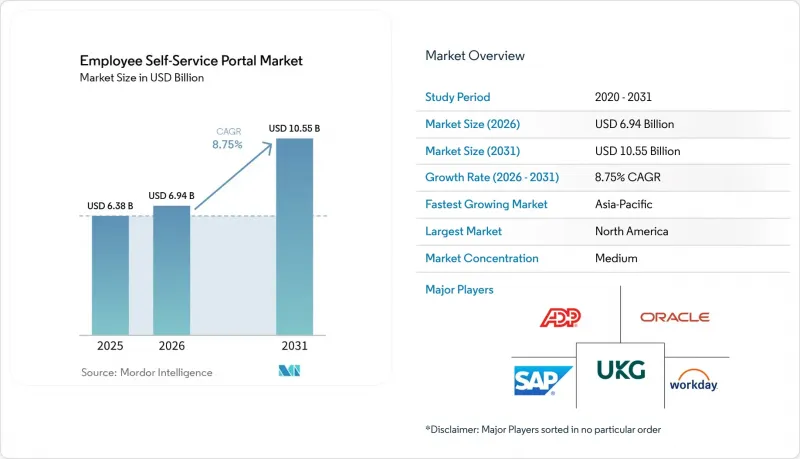
Mordor Intelligence에 의하면, 직원 셀프서비스 포털 시장 규모는 2025년에 63억 8,000만 달러, 2026년에 69억 4,000만 달러, 2031년까지 105억 5,000만 달러에 이를 것으로 예측됩니다.
2026년부터 2031년까지 연평균 성장률(CAGR) 8.75%로 성장할 것으로 전망됩니다.
본 보고서는 도입 형태(클라우드 기반 및 On-Premise형), 기능(급여 관리, 휴가·근태 관리, 복리후생 관리, 직원 데이터 관리 등), 기업 규모(중소기업 및 대기업), 최종 이용 산업(IT 및 통신 등), 그리고 지역별로 분류되어 있습니다. 시장 전망은 금액(달러) 기준으로 제시되어 있습니다.
전 세계 직원 셀프서비스 포털 시장 동향 및 인사이트
기업 전반에 걸친 디지털 HR 혁신 가속화
이 조직은 메인프레임 기반 인사 관리 소프트웨어를 폐지하고, 급여, 복리후생, 교육 시스템을 위한 API를 제공하는 유연성이 뛰어난 클라우드 스택으로 전환하고 있습니다. 9만 명의 사용자를 지원하는 캘리포니아주 고용개발국은 Salesforce 상에 다국어 지원이 가능한 myEDD 포털을 개설한 후, 향후 10년간 1억 5,000만 달러의 비용 절감을 기대하고 있습니다. ServiceNow HR Service Delivery를 도입한 한 연방 기관은 5개월 동안 286개의 워크플로를 통합하고, 200개 이상의 프로세스에서 병목 현상을 파악했습니다. 금융 업계에서도 이와 유사한 개혁이 자리 잡아가고 있는 가운데, Bajaj Finance는 급속한 도입 확대에 대응하기 위해 TCS Chroma를 활용해 모든 인사 업무를 디지털화했습니다. 이러한 근본적인 개혁에는 수년에 걸친 조달 프로세스가 수반되기 때문에 직원 셀프서비스 포털 시장에 대한 호재는 하룻밤 사이에 찾아오는 것이 아니라, 꾸준히 다가오고 있습니다.
중소기업의 클라우드 기반 HR 솔루션 도입이 급속히 확산되고 있습니다.
동남아시아, 아프리카, 남미의 중소기업들은 초기 하드웨어 비용을 절감할 수 있는 구독형 포털을 선호하고 있습니다. Darwinbox는 2025년에 1억 4,000만 달러를 조달하고, 싱가포르, 말레이시아, 필리핀에서 현지 상황에 맞춘 급여 계산 시스템을 출시하며, 여전히 급여 명세서 처리를 외부에 위탁하고 있는 기업들을 주요 타겟으로 삼고 있습니다. 케냐와 나이지리아에서는 경량 프로그레시브 웹 앱(PWA) 덕분에 고속 데이터 요금제가 없는 기본형 스마트폰을 사용하는 직원들도 급여 데이터를 확인할 수 있게 되었습니다. 바레인에서는 클라우드 포털이 노동부의 API와 연동되어 허가증 갱신을 자동화하고 있으며, 규정 준수 대응도 서비스로 제공할 수 있음을 입증하고 있습니다. 30일 미만의 도입 주기는 중소기업의 활력이 단기적으로 세계 수요를 끌어올리는 이유를 여실히 보여주고 있습니다.
직원 기록과 관련된 뿌리 깊은 데이터 보안 및 개인정보 보호에 대한 우려
포털에는 사회보장번호, 계좌 이체 정보, 의료 데이터 등이 저장되어 있으며, 이러한 정보는 랜섬웨어 조직의 표적이 됩니다. Oracle HCM Cloud는 2025년에 데이터 처리와 관련된 사고를 겪었으며, GDPR(EU 개인정보보호규정)에 따른 엄격한 감시의 대상이 되었습니다. 캘리포니아주 소비자 개인정보 보호법(CCPA)은 세밀한 동의 관리를 의무화하고 있으며, Sympa와 같은 공급업체들은 역할 기반 접근 제어, 감사 추적, ISO 27001 인증을 내세우기 시작했습니다. 다국적 기업들은 특히 의료 및 은행 업계에서 서비스 제공업체가 현지 데이터 상주성을 보장할 때까지 시스템 가동을 연기하고 있으며, 이러한 제약 요인은 당분간 계속해서 중대한 영향을 미칠 것으로 보입니다.
부문별 분석
2025년 기준으로, 직원 셀프서비스 포털 시장의 65.44%를 On-Premise 배포가 차지하고 있으며, 이는 데이터센터, 영구 라이선스 및 전문 IT 인력에 드는 매몰 비용을 반영한 것입니다. 한때 에어갭 방식의 시스템을 강력히 요구했던 주요 정부 기관들은 현재, 기밀 기록을 On-Premise에 보관하면서 패치 적용을 신속하게 하기 위해 포털 계층을 퍼블릭 클라우드에서 호스팅하는 하이브리드 모델로 전환하고 있습니다. Darwinbox나 Beisen 등 클라우드 전문 벤더들은 기업들이 계절적 채용 시기에 유연한 용량을 필요로 함에 따라, 2025년에 각각 30%가 넘는 매출 성장을 기록했습니다.
연평균 성장률(CAGR) 11.67%로 확대되고 있는 클라우드 도입은 3년마다 서버를 교체하는 데 자금을 할당할 수 없는 중소기업들의 관심을 끌고 있습니다. 구독형 가격 정책을 통해 고정자산에 대한 지출이 예측 가능한 월정액 요금제로 전환되며, 내장형 재해 복구 기능을 통해 다운타임 위험이 억제됩니다. 클라우드 솔루션 분야의 직원 셀프서비스 포털 시장 규모는 2031년까지 증가하는 지출에서 점차 더 큰 비중을 차지할 것으로 전망됩니다. 그러나 일부 방위 관련 기업이나 정보 기관에서는 여전히 On-Premise 관리가 요구되고 있으며, 이것이 급격한 전환이 아닌 하이브리드 방식이 주류를 이루는 이유를 보여줍니다.
급여 계산은 2025년 수익의 45.12%를 차지하며, 모든 신규 포털의 핵심 기능으로 자리 잡고 있습니다. ADP Workforce Now와 같은 플랫폼을 이용하면, 직원이 복리후생 옵션을 확정하기 전에 총 지급액부터 실수령액까지의 금액을 미리 확인할 수 있어 만족도 점수가 향상됩니다. Dayforce의 실시간 급여 계산 기능은 하루에 여러 급여 주기를 처리하는 공급업체의 차별화를 한층 더 강화하고 있습니다.
오리건주, 뉴욕시, 시애틀에서는 막판 근무 일정 변경 시 고액의 벌금이 부과되는 예측형 근무 일정 관련 법이 시행됨에 따라, 휴가 및 근태 관리가 연평균 성장률(CAGR) 10.56%로 확대되고 있습니다. UKG Pro의 피로도 알고리즘은 직원이 초과근무 한도에 가까워지면 관리자에게 경고를 보냅니다. 그 결과, 휴가 및 근태 관리 모듈 내 직원 셀프서비스 포털 시장 점유율은 다른 어떤 기능보다 빠르게 확대되고 있습니다. 기업들이 오픈 엔롤먼트 시의 질문을 60% 줄여주는 의사결정 지원 엔진을 도입하는 가운데, 복리후생 관리, 성과 관리 및 핵심 직원 데이터 관리가 나머지 시장을 차지하고 있습니다.
지역별 분석
2025년 북미는 전 세계 매출의 36.40%를 차지했습니다. 이는 초기 SaaS형 HCM 제품군을 표준화하고, 현재는 그 위에 AI 어시스턴트를 통합한 포춘 500대 기업 고객들의 지지를 바탕으로 한 것입니다. 토마 브라보가 Dayforce를 비상장 기업으로 전환한 것은 투자자들이 해당 지역을 교차 판매 및 통합을 위한 자금력이 풍부한 거점으로 보고 있음을 보여줍니다.
아시아태평양은 연평균 성장률(CAGR) 10.05%를 나타낼 것으로 예측되며, 인도, 중국, 동남아시아가 이를 주도할 것으로 보입니다. 이 지역들에서는 현지화된 급여 계산 엔진과 25개 이상의 언어로 제공되는 인터페이스를 통해 규정 준수 및 문화적 요건을 충족하고 있습니다. Darwinbox는 아세안 전역에 급여 계산 모듈을 출시했으며, Beisen은 2025년에 9억 4,510만 위안(1억 3,000만 달러)의 매출과 6,000개 이상의 고객사를 기록했다고 보고했습니다. 각국 정부가 디지털 노동법 및 중소기업을 위한 디지털화 지원금을 추진함에 따라, 해당 지역의 직원 셀프서비스 포털 시장의 우위는 더욱 확대될 전망입니다.
유럽에서는 동의 관리 대시보드나 ‘잊힐 권리’ 대응 워크플로우 등, GDPR(EU 개인정보보호규정) 준수 기능을 중심으로 꾸준한 성장이 나타나고 있습니다. 남미, 중동 및 아프리카는 절대 수치로는 뒤처지고 있지만, 모바일 머니나 USSD를 활용해 사무실 밖 직원들에게 접근하는 중소기업의 경우, 포털 도입률이 두 자릿수 후반대의 높은 수준을 기록하고 있습니다.
추가 혜택:
- Excel 형식 시장 예측(ME) 시트
- 3개월간의 애널리스트 지원
자주 묻는 질문
목차
제1장 서론
제2장 조사 방법
제3장 주요 요약
제4장 시장 구도
제5장 시장 규모와 성장 예측
제6장 경쟁 구도
제7장 시장 기회와 향후 전망
JHS 26.06.23According to Mordor Intelligence, the employee self-service portal market size is expected to be USD 6.38 billion in 2025, USD 6.94 billion in 2026, and reach USD 10.55 billion by 2031, growing at a CAGR of 8.75% from 2026 to 2031.
This report is Segmented by Deployment Mode (Cloud-Based, and On-Premises), Function (Payroll Management, Leave and Attendance Management, Benefits Administration, Employee Data Management, and More), Organization Size (Small and Medium-Sized Enterprises, and Large Enterprises), End-Use Industry (IT and Telecom, and More), and Geography. The Market Forecasts are Provided in Terms of Value (USD).
Global Employee Self-Service Portal Market Trends and Insights
Accelerating Digital HR Transformation Across Enterprises
Organizations are retiring mainframe HR software and moving to adaptable cloud stacks that expose APIs for payroll, benefits, and learning systems. California's Employment Development Department, which supports 90,000 users, projects USD 150 million in 10-year savings after launching its multi-language myEDD portal on Salesforce. A federal agency that rolled out ServiceNow HR Service Delivery consolidated 286 workflows in five months and uncovered more than 200 process bottlenecks. Similar makeovers are taking hold in finance, where Bajaj Finance digitized every HR activity with TCS Chroma to keep pace with rapid hiring. Because such overhauls involve multi-year procurement, the boost to the employee self-service portal market arrives steadily rather than overnight.
Rapid Adoption of Cloud-Based HR Solutions by SMEs
Small and midsize companies in Southeast Asia, Africa, and South America favor subscription portals that avoid upfront hardware expenses. Darwinbox raised USD 140 million in 2025 and released localized payroll in Singapore, Malaysia, and the Philippines to court firms that still outsource payslips. Across Kenya and Nigeria, lightweight progressive-web apps now let staff pull pay data through basic smartphones that lack high-bandwidth plans. In Bahrain, cloud portals sync with labor-ministry APIs to automate permit renewals, proving that compliance can be delivered as a service. The sub-30-day deployment cycle illustrates why SME momentum delivers a short-term lift to global demand.
Persistent Data Security and Privacy Concerns Over Employee Records
Portals store social-security numbers, direct-deposit details, and medical data that attract ransomware groups. Oracle HCM Cloud faced a 2025 handling incident that drew close GDPR scrutiny. California's Consumer Privacy Act forces granular consent controls, prompting vendors such as Sympa to market role-based access, audit trails, and ISO 27001 certification. Multinationals delay go-lives until providers guarantee local data residency, especially in healthcare and banking, keeping the restraint immediate and material.
Other drivers and restraints analyzed in the detailed report include:
- Expansion of Remote and Hybrid Work Models Requiring Anytime Self-Service Access
- Integration of Generative AI Chatbots Enhancing ESS ROI
- Integration Complexity With Legacy HR and ERP Systems
For complete list of drivers and restraints, kindly check the Table Of Contents.
Segment Analysis
On-premises deployments represented 65.44% of the employee self-service portal market in 2025, reflecting the sunk costs of data centers, perpetual licenses, and specialized IT labor. Major government bodies that once insisted on air-gapped systems now pivot to hybrid models that keep sensitive records on site while hosting the portal tier in public clouds for faster patches. Vendors that operate exclusively in the cloud, such as Darwinbox and Beisen, each posted revenue growth above 30% during 2025 as enterprises pursued elastic capacity during seasonal hiring.
Cloud implementations, expanding at an 11.67% CAGR, attract SMEs that cannot fund server refreshes every three years. Subscription pricing converts fixed capital payments into predictable monthly charges, and built-in disaster recovery limits downtime risk. The employee self-service portal market size for cloud solutions is projected to capture an increasing share of incremental spending to 2031. Yet certain defense contractors and intelligence agencies still require on-premises control, illustrating why a hybrid path will prevail rather than a sudden shift.
Payroll accounted for 45.12% of 2025 revenue, making it the anchor for every new portal. Platforms such as ADP Workforce Now let employees preview gross-to-net pay before finalizing benefit choices, which raises satisfaction scores. Real-time payroll in Dayforce further differentiates vendors that handle multiple daily pay cycles.
Leave and attendance tracking is growing at 10.56% CAGR as predictive-scheduling laws in Oregon, New York City, and Seattle levy stiff fines for last-minute shift changes. UKG Pro's fatigue algorithms alert managers when staff approach overtime caps. The employee self-service portal market share for leave and attendance modules is therefore advancing faster than any other function. Benefits administration, performance management, and core employee-data editing fill the remainder as firms push decision-support engines that cut open-enrollment questions by 60%.
Geography Analysis
North America delivered 36.40% of global revenue in 2025, buoyed by Fortune 500 clients that standardized on early SaaS HCM suites and now layer AI assistants on top. Thoma Bravo's take-private of Dayforce indicates investors view the region as a cash-rich base for cross-sell and consolidation.
Asia-Pacific is forecast to grow at a 10.05% CAGR, led by India, China, and Southeast Asia, where localized payroll engines and 25+ language interfaces meet compliance and cultural requirements. Darwinbox opened payroll modules across ASEAN, while Beisen reported RMB 945.1 million (USD 130 million) revenue in 2025 and more than 6,000 customers. The employee self-service portal market size advantage in the region will widen as governments push digital labor codes and SME digitization grants.
Europe shows steady growth, centered on GDPR-ready features such as consent dashboards and right-to-be-forgotten workflows. South America, the Middle East, and Africa trail in absolute numbers but post high double-digit portal adoption within SMEs that rely on mobile money and USSD to reach deskless staff.
- Workday Inc.
- SAP SE
- Oracle Corporation
- Automatic Data Processing Inc.
- UKG Inc.
- Ceridian HCM Holding Inc.
- BambooHR LLC
- Zoho Corporation Pvt. Ltd.
- Paycom Software Inc.
- Paylocity Holding Corporation
- Gusto Inc.
- Namely Inc.
- Rippling People Center Inc.
- Darwinbox Digital Solutions Pvt. Ltd.
- Personio GmbH
- HiBob Inc.
- Cornerstone OnDemand Inc.
- Ramco Systems Limited
- Beisen Cloud Computing Co. Ltd.
- Sage Group plc
Additional Benefits:
- The market estimate (ME) sheet in Excel format
- 3 months of analyst support
TABLE OF CONTENTS
1 INTRODUCTION
- 1.1 Study Assumptions and Market Definition
- 1.2 Scope of the Study
2 RESEARCH METHODOLOGY
3 EXECUTIVE SUMMARY
4 MARKET LANDSCAPE
- 4.1 Market Overview
- 4.2 Market Drivers
- 4.2.1 Accelerating Digital HR Transformation Across Enterprises
- 4.2.2 Rapid Adoption of Cloud-Based HR Solutions by SMEs
- 4.2.3 Expansion of Remote and Hybrid Work Models Requiring Anytime Self-Service Access
- 4.2.4 Integration of Generative AI Chatbots Enhancing ESS ROI
- 4.2.5 Growing Demand for Multilingual, Compliance-Localized ESS in Emerging Markets
- 4.2.6 Rise of Hyper-Personalized Employee Experience Platforms Driving ESS Upsell
- 4.3 Market Restraints
- 4.3.1 Persistent Data Security and Privacy Concerns over Employee Records
- 4.3.2 Integration Complexity with Legacy HR and ERP Systems
- 4.3.3 Low Digital Literacy among Frontline Workforce Limiting ESS Utilization
- 4.3.4 Vendor Lock-In Risks Due to Proprietary Workflows and Customizations
- 4.4 Industry Value Chain Analysis
- 4.5 Regulatory Landscape
- 4.6 Technological Outlook
- 4.7 Impact of Macroeconomic Factors on the Market
- 4.8 Porter's Five Forces Analysis
- 4.8.1 Threat of New Entrants
- 4.8.2 Bargaining Power of Suppliers
- 4.8.3 Bargaining Power of Buyers
- 4.8.4 Threat of Substitutes
- 4.8.5 Competitive Rivalry
5 MARKET SIZE AND GROWTH FORECASTS (VALUE)
- 5.1 By Deployment Mode
- 5.1.1 Cloud-Based
- 5.1.2 On-Premises
- 5.2 By Function
- 5.2.1 Payroll Management
- 5.2.2 Leave and Attendance Management
- 5.2.3 Benefits Administration
- 5.2.4 Employee Data Management
- 5.2.5 Performance and Appraisal Management
- 5.3 By Organization Size
- 5.3.1 Small and Medium-Sized Enterprises
- 5.3.2 Large Enterprises
- 5.4 By End-Use Industry
- 5.4.1 IT and Telecom
- 5.4.2 BFSI
- 5.4.3 Healthcare and Life Sciences
- 5.4.4 Manufacturing
- 5.4.5 Retail and E-commerce
- 5.4.6 Government and Public Sector
- 5.4.7 Other End-Use Industries
- 5.5 By Geography
- 5.5.1 North America
- 5.5.1.1 United States
- 5.5.1.2 Canada
- 5.5.1.3 Mexico
- 5.5.2 South America
- 5.5.2.1 Brazil
- 5.5.2.2 Argentina
- 5.5.2.3 Rest of South America
- 5.5.3 Europe
- 5.5.3.1 Germany
- 5.5.3.2 United Kingdom
- 5.5.3.3 France
- 5.5.3.4 Italy
- 5.5.3.5 Spain
- 5.5.3.6 Russia
- 5.5.3.7 Rest of Europe
- 5.5.4 Asia-Pacific
- 5.5.4.1 China
- 5.5.4.2 Japan
- 5.5.4.3 India
- 5.5.4.4 South Korea
- 5.5.4.5 Australia and New Zealand
- 5.5.4.6 Rest of Asia-Pacific
- 5.5.5 Middle East
- 5.5.5.1 Saudi Arabia
- 5.5.5.2 United Arab Emirates
- 5.5.5.3 Turkey
- 5.5.5.4 Rest of Middle East
- 5.5.6 Africa
- 5.5.6.1 South Africa
- 5.5.6.2 Nigeria
- 5.5.6.3 Rest of Africa
- 5.5.1 North America
6 COMPETITIVE LANDSCAPE
- 6.1 Market Concentration
- 6.2 Strategic Moves
- 6.3 Market Share Analysis
- 6.4 Company Profiles (includes Global Level Overview, Market Level Overview, Core Segments, Financials as available, Strategic Information, Market Rank/Share, Products and Services, Recent Developments)
- 6.4.1 Workday Inc.
- 6.4.2 SAP SE
- 6.4.3 Oracle Corporation
- 6.4.4 Automatic Data Processing Inc.
- 6.4.5 UKG Inc.
- 6.4.6 Ceridian HCM Holding Inc.
- 6.4.7 BambooHR LLC
- 6.4.8 Zoho Corporation Pvt. Ltd.
- 6.4.9 Paycom Software Inc.
- 6.4.10 Paylocity Holding Corporation
- 6.4.11 Gusto Inc.
- 6.4.12 Namely Inc.
- 6.4.13 Rippling People Center Inc.
- 6.4.14 Darwinbox Digital Solutions Pvt. Ltd.
- 6.4.15 Personio GmbH
- 6.4.16 HiBob Inc.
- 6.4.17 Cornerstone OnDemand Inc.
- 6.4.18 Ramco Systems Limited
- 6.4.19 Beisen Cloud Computing Co. Ltd.
- 6.4.20 Sage Group plc
7 MARKET OPPORTUNITIES AND FUTURE OUTLOOK
- 7.1 White-Space and Unmet-Need Assessment