
|
시장보고서
상품코드
2065582
데스크리스 및 프런트라인 워커용 HCM 시장 : 시장 점유율 분석, 업계 동향 및 통계, 성장 예측(2026-2031년)HCM For Deskless And Frontline Workers - Market Share Analysis, Industry Trends & Statistics, Growth Forecasts (2026 - 2031) |
||||||
 Mordor Intelligence
Mordor Intelligence에 의하면, 데스크리스 및 프런트라인 워커용 HCM 시장 규모는 2025년에 135억 2,000만 달러로 평가되었고, 2031년까지 307억 4,000만 달러에 이를 것으로 예측되며, 2026-2031년 CAGR 14.92%로 성장할 전망입니다.
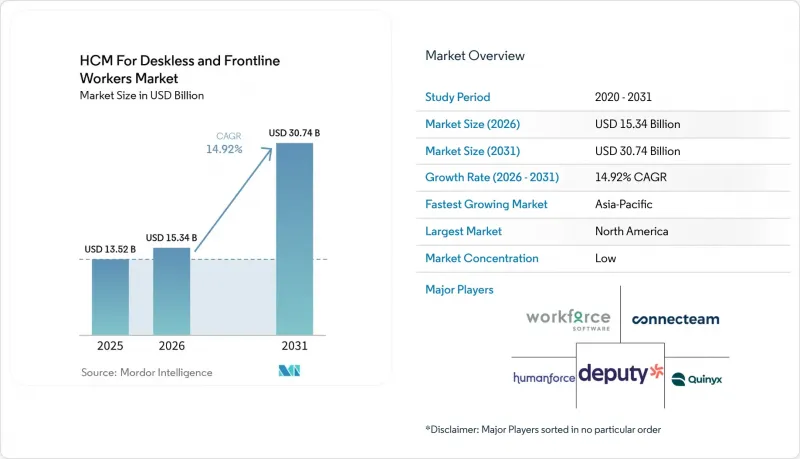
본 보고서는 제공 형태별(소프트웨어 및 서비스), 도입 형태별(클라우드 기반, 온프레미스형, 하이브리드형), 기업 규모별(대기업 및 중소기업), 최종 사용자 산업 분야별(소매 및 전자상거래, 헬스케어 및 생명과학, 호텔 및 외식 서비스 등) 및 지역별로 분류되어 있습니다. 시장 전망은 금액(달러) 기준으로 제시되어 있습니다.
데스크리스 및 프런트라인 워커용 HCM 시장 동향과 인사이트
여러 사업장에서의 교대 근무 운영에 따른 노동 규제의 복잡화
데스크리스 및 프런트라인 워커용 HCM 시장은 여러 거점에 걸친 교대 근무 환경에서 노동 규제가 점점 더 복잡해지는 추세를 호재로 삼고 있습니다. 샌프란시스코, 뉴욕, 시카고, 시애틀 등의 도시에서 제정된 예측형 근무표 관련 조례에서는 사전 통지, 휴식 시간 보장, 할증 임금 요건 준수가 의무화되어 있어, 수작업으로 근무표를 관리하는 것이 점점 더 어려워지고 있습니다. 단일 고용주가 여러 관할 구역에 걸쳐 사업을 영위하는 경우, 임금 및 근로 시간에 관한 규정, 휴식 요건, 초과근무 기준, 미성년자 근로 제한 등이 완전히 일치하지 않기 때문에 부담은 더욱 커집니다. 2026년 1월에 시행된 일리노이주 법안 HB 3773은 AI를 활용한 고용 결정에 대한 알고리즘 제한 요건을 추가하고 있으며, 이는 미국 전역에서 규정 준수 의무가 얼마나 빠르게 늘어나고 있는지를 보여줍니다. 이러한 상황에서 규제 변경에 맞추어 규칙을 인식하는 엔진을 탑재하고 이를 업데이트하는 벤더들은 규정 준수를 단순한 지원 기능에서 명확한 구매 결정 요인으로 변화시키고 있습니다.
데스크톱 없이 진행되는 업무 워크플로우의 ‘모바일 우선’ 디지털화
데스크리스 및 프런트라인 워커용 HCM 시장 역시, 비사무직 근로자들에게 있어 스마트폰이 인사 정보에 접근하는 주요 수단으로 자리 잡아가고 있는 점에 힘입어 성장하고 있습니다. 현장이나 병원 병동에서 근무하는 직원들은 데스크톱 시스템에 안정적으로 접속할 수 없기 때문에 고용주들은 일정, 급여 명세서, 업무, 교육, 팀 간 소통을 하나의 모바일 앱에서 관리할 수 있기를 점점 더 요구하고 있습니다. Connecteam, Beekeeper, Flip 등의 업체들은 이러한 기능들을 하나의 간편한 인터페이스에 통합함으로써 현장 직원의 참여도가 향상된다는 점을 보여주며, 이러한 기대를 고조시켜 왔습니다. 2025년 6월 『JMIR Formative Research』지에 게재된 조사에 따르면, 조사 대상인 의료 현장의 교대 근무자 중 76%가 근무 일정의 유연성과 자율적인 근무 교대 기능을 근무 조건과 관련하여 가장 중요한 사항으로 꼽았으며, 이는 모바일 네이티브 일정 관리 도구에 대한 수요를 뒷받침하는 것입니다. 이에 따라, 특히 중소기업(SME) 부문에서는 단순히 기능의 수보다 인터페이스의 품질이나 오프라인에서의 성능이 더 중요시되고 있으며, 사용자 경험이 미흡할 경우 구매자는 곧바로 타사 제품으로 갈아타는 경향이 있습니다.
인사, 급여, POS, EHR에 걸친 레거시 시스템 통합의 복잡성
데스크리스 및 프런트라인 워커용 HCM 시장은 여전히 가장 심각한 장벽에 직면해 있습니다. 바로 레거시 시스템 간의 통합이 복잡하다는 점입니다. 소매, 의료, 제조업 분야의 주요 기업들은 급여 계산, POS, EHR, ERP 시스템을 서로 다른 아키텍처에서 운영하는 경우가 많으며, 이러한 시스템들은 클라우드 네이티브 인력 관리 도구와 쉽게 통합할 수 없습니다. 따라서 일정 관리나 급여 계산 모듈이 각 거점 간에 원활하게 작동하도록 하려면 데이터 모델, ID 구조, 보고서 로직을 재구축해야 하는 경우가 많아 도입이 지연되곤 합니다. 여러 거점을 보유한 의료 시스템의 경우, 도입 기간이 9-18개월에 달하기도 하는데, 이로 인해 투자 회수가 지연될 뿐만 아니라 더 광범위한 제품군 도입에 대한 사내 지지 또한 약화될 수 있습니다. 이 문제는 인수합병(M&A) 이후 더욱 심각해집니다. 인수된 사업장에서는 서로 다른 인사·급여 시스템이 운영되고 있어, 표준화가 가능해지기까지는 추가적인 통합 작업이 필요하기 때문입니다.
부문별 분석
2025년, 데스크리스 및 프런트라인 워커용 HCM 시장 점유율 중 소프트웨어 솔루션이 65.72%를 차지했으며, 현장 도입에서 소프트웨어가 확실한 수익의 주축이 되었습니다. 수요는 인력 관리 및 급여·지급 관리 모듈에 집중되어 있습니다. 이는 다중 거점 운영 모델에서 이러한 모듈들이 인건비 관리 및 노동법 준수와 가장 밀접하게 관련되어 있기 때문입니다. 많은 고용주에게 근무 일정 관리와 근태 기록은 눈에 띄는 업무적 가치를 신속하게 가져다주기 때문에 인력 관리 솔루션은 여전히 가장 먼저 도입되는 제품으로 자리 잡고 있습니다. 동시에, 감사에 대응할 수 있는 일정 수립 및 규칙 검증 기능이 내부 보고와 마찬가지로 법적 정당성을 뒷받침하게 됨에 따라, 분석 도구와 컴플라이언스 도구는 부가가치가 더 높은 부가 기능으로 자리 잡고 있습니다.
서비스 분야는 2026-2031년 연평균 성장률(CAGR) 16.42%라는 가장 높은 성장률을 기록하며 확대될 것으로 전망됩니다. 이는 통합 작업, 업종별 설정 및 지속적인 규정 준수 지원에 대한 수요가 증가하고 있음을 반영한 것입니다. 따라서, 데스크리스 및 현장 직원을 대상으로 하는 HCM 시장은 개별 모듈 판매에서 벗어나, 핵심적인 인사, 직원 기록, 교육, 커뮤니케이션 기능을 단일 플랫폼에 통합한 종합적인 계약 형태로 전환되고 있습니다. 이러한 변화로 인해, 특히 기업의 구매 담당자가 도입 및 변경 관리를 단일 공급업체에 일임하는 것을 선호하는 경우, 학습 및 커뮤니케이션에 특화된 공급업체에게 있어 독립형 솔루션의 기회는 줄어들고 있습니다. Axonify사가 2026년 5월에 실시한 플랫폼 업데이트에서는 제품 라인 간의 통합이 진행되고 있음이 드러났습니다. 이 회사는 현장 학습을 업무 수행 지표와 더욱 긴밀하게 연계하고, AI를 활용한 교육 개입을 통해 고객의 매출 손실이 47% 감소하고 통화 처리 시간이 23% 단축되었다고 보고했습니다.
2025년, 데스크리스 및 프런트라인 워커용 HCM 시장에서 클라우드 기반 도입이 72.19%를 차지했습니다. 이는 구독형 서비스에 대한 선호도와 분산된 거점에 대한 신속한 도입 수요를 반영한 것입니다. 클라우드 제품은 인프라 부담을 줄이고, 다수의 거점에 걸친 업데이트를 용이하게 해주기 때문에 중견 기업의 구매 행태에 힘입어 이러한 선도적 지위를 유지하고 있습니다. 그렇다고는 해도, 데스크리스 및 일선 근로자를 대상으로 하는 HCM 시장은 완전한 클라우드 전환을 향해 일직선으로 나아가고 있는 것은 아닙니다. 하이브리드형 도입은 2026-2031년 연평균 성장률(CAGR) 17.36%로 확대될 것으로 예측됩니다. 이는 대규모 고용주가 EHR, POS 또는 MES 시스템을 온프레미스로 유지하면서, 그 주변에 클라우드 기반 HCM 모듈을 추가해야 하는 경우가 많기 때문입니다.
이러한 경향은 의료 및 제조업 분야에서 특히 두드러집니다. 이러한 업계에서는 업무 연속성, 규제 및 자본 예산의 제약으로 인해 일반적인 계획 주기 내에서 시스템 전체를 교체하기 어렵기 때문입니다. 이러한 구매자들에게 하이브리드 아키텍처는 일시적인 타협안이 아니라, 클라우드 기반의 일정 관리, 급여 계산, 직원 참여도 관리 도구를 기존 업무 시스템과 연동하기 위한 가장 현실적인 방법입니다. 온프레미스 배포는 점차 축소되는 추세이지만, 데이터 소재지나 보안 규정에 따라 호스팅 선택지가 제한되는 규제 산업이나 일부 정부 기관에서는 여전히 그 도입 기반이 중요한 위치를 차지하고 있습니다. 강력한 하이브리드 API 레이어와 실시간 동기화 기능을 갖춘 공급업체는 우선 완전한 전환을 강요하기보다는 구매자의 기존 인프라 환경에 맞추어 대응할 수 있기 때문에 기업의 계약 갱신을 확보하는 데 유리한 입장에 있습니다.
지역별 분석
2025년, 북미는 비사무직 및 현장 근로자 대상 HCM 시장에서 39.42%의 점유율을 차지하며 시장을 주도했습니다. 이는 미국의 소매업 및 의료 산업의 규모, 성숙한 클라우드 인프라, 그리고 자동화된 스케줄링 및 인력 관리 플랫폼의 도입을 가속화하는 규정 준수를 중시하는 규제 환경을 반영한 것입니다. 미국은 규정 준수 중심의 조달 주기로부터 지속적인 혜택을 누리고 있으며, 캐나다는 의료 분야의 디지털화와 물류 유연성을 통해 시장을 확대되고 있습니다. 또한 멕시코에서는 다국적 기업의 기준에 따라 형성된 북부 제조·수출 지역에서 도입이 더욱 확대되고 있습니다.
아시아태평양은 가장 빠른 성장이 예상되며, 2026-2031년 연평균 성장률(CAGR) 19.00%를 나타낼 것으로 전망됩니다. 중국, 인도, 동남아시아의 제조업 디지털화는 물론, 체계화된 소매업 및 QSR 체인의 급속한 확장이 주요 촉진요인으로 작용하고 있습니다. 긱 경제와 밀접한 관련이 있는 노동 모델은 모바일 네이티브 세대의 일정 관리 및 급여 조정에 대한 수요를 더욱 부추기고 있습니다. IHH Healthcare나 Health Management International과 같은 대형 의료 그룹은 업무를 통합하기 위해 엔터프라이즈급 플랫폼을 도입하고 있는 반면, 일본의 편의점 및 QSR 부문, 그리고 호주 및 뉴질랜드의 지역 공급업체들이 이 시장의 기회를 더욱 확대되고 있습니다.
유럽은 여전히 3위 수요 시장이며, 그 중심에는 독일, 영국, 프랑스가 있습니다. 독일의 복잡한 노동 제도는 감사에 대응할 수 있는 근무 일정 관리에 대한 수요를 뒷받침하고 있으며, ATOSS사는 2025년에 1억 8,930만 유로의 매출을 기록했고, 2026년에는 클라우드 사업에서 강력한 성장이 예상됩니다. 영국의 하이브리드형 인력 모델은 인사·급여 관리의 통합 도입을 촉진하고 있습니다. 남미, 중동 및 아프리카는 도입 초기 단계이긴 하지만 점차 성숙해 가고 있습니다. 브라질 소매 업계의 디지털화, 사우디아라비아 노동 시장의 정규화를 위한 노력, 그리고 Shoprite Group이 남아프리카공화국 내 3,600개 이상의 매장에 YOOBIC을 도입한 사례는 기업 내에서 이 기술이 더욱 광범위하게 도입되고 있음을 시사합니다.
기타 혜택 :
- 엑셀 형식 시장 예측(ME) 시트
- 3개월간의 애널리스트 지원
자주 묻는 질문
목차
제1장 서론
제2장 조사 방법
제3장 주요 요약
제4장 시장 구도
제5장 시장 규모 및 성장 예측
제6장 경쟁 구도
제7장 시장 기회 및 향후 전망
AJY 26.06.30According to Mordor Intelligence, the hCM for deskless and frontline workers market size reached USD 13.52 billion in 2025 and is forecast to reach USD 30.74 billion by 2031, advancing at a CAGR of 14.92% during 2026-2031.
This report is Segmented by Offering (Software, and Services), Deployment Mode (Cloud-Based, On-Premises, and Hybrid), Enterprise Size (Large Enterprises, and Small and Medium-Sized Enterprises), End-User Industry (Retail and E-Commerce, Healthcare and Life Sciences, Hospitality and Foodservice, and More), and Geography. The Market Forecasts are Provided in Terms of Value (USD).
Global HCM For Deskless And Frontline Workers Market Trends and Insights
Labor-Rule Complexity Across Multi-Site Shift Operations
The HCM for deskless and frontline workers market is gaining from the rising complexity of labor rules across multi-site shift environments. Predictive scheduling ordinances in cities such as San Francisco, New York City, Chicago, and Seattle require advance notice, rest-period protection, and compliance with premium pay requirements, making manual roster control harder to sustain. The burden rises further when a single employer operates across multiple jurisdictions, because wage-and-hour rules, break requirements, overtime thresholds, and minor-work restrictions do not align neatly. Illinois HB 3773, which took effect in January 2026, added algorithm restriction requirements for AI-driven employment decisions, showing how quickly compliance obligations are layering across the United States. In this setting, vendors that embed rule-aware engines and update them as regulations change are turning compliance from a support feature into a clear buying factor.
Mobile-First Digitization of Deskless Workflows
The HCM for deskless and frontline workers market is also being driven by the shift of smartphones to the primary HR access point for non-desk workers. Employers increasingly want one mobile app to handle schedules, payslips, tasks, training, and team communication, because workers on shop floors and hospital wards do not have reliable access to desktop systems. Vendors such as Connecteam, Beekeeper, and Flip have helped set that expectation by showing that frontline engagement improves when these functions are brought together in one simple interface. A June 2025 study in JMIR Formative Research found that 76% of surveyed healthcare shift workers ranked scheduling flexibility and autonomous shift-swap capability among their top work-condition preferences, which supports the demand for mobile-native scheduling tools. This is making interface quality and offline performance more important than raw feature count, especially in the SME tier, where buyers move quickly if the user experience is weak.
Legacy Integration Complexity Across HR, Payroll, POS, And EHR
The HCM market for deskless and frontline workers still faces its most serious barrier: legacy integration complexity. Large employers in retail, healthcare, and manufacturing often run payroll, POS, EHR, and ERP systems on separate architectures, and those systems do not integrate easily with cloud-native workforce tools. That slows implementation, because data models, identity structures, and reporting logic often need to be rebuilt before scheduling or payroll modules can run reliably across sites. In multi-site healthcare systems, deployment timelines can stretch to 9-18 months, delaying payback and weakening internal support for broader suite rollouts. The problem becomes even harder after M&A activity, when acquired locations operate different HR and payroll systems and require an additional layer of integration work before standardization becomes possible.
Other drivers and restraints analyzed in the detailed report include:
- AI-Led Labor Forecasting and Schedule Optimization
- Unified HR, Payroll, Scheduling, and Communication Stacks
- Workforce Data Privacy And Mobile Cybersecurity Exposure
For complete list of drivers and restraints, kindly check the Table Of Contents.
Segment Analysis
Software solutions accounted for 65.72% of the HCM market share for deskless and frontline workers in 2025, making software the clear revenue anchor across frontline deployments. Demand centered on workforce management and payroll-and-pay-management modules, because they sit closest to labor cost control and labor-law compliance in multi-site operating models. For many employers, workforce management remains the first product they buy, since scheduling and time capture deliver visible operational value quickly. At the same time, analytics and compliance tools are becoming higher-value add-ons because audit-ready scheduling and rule validation now support legal defensibility as much as internal reporting.
Services are projected to expand at the fastest CAGR of 16.42% from 2026 to 2031, reflecting the growing need for integration work, vertical configuration, and ongoing compliance support. The HCM for deskless and frontline workers market is therefore shifting from stand-alone module sales toward broader contracts that bundle core HR, employee records, learning, and communication functions into a single platform relationship. That change narrows the stand-alone opportunity for pure-play learning or communication vendors, especially when enterprise buyers prefer one vendor to manage deployment and change management. Axonify's May 2026 platform update showed how product lines are converging, as the company linked frontline learning more closely to operational execution metrics and reported that customers experienced a 47% reduction in lost sales and a 23% decrease in call-handling time after AI-enabled training interventions.
Cloud-based deployment accounted for 72.19% of the HCM market for deskless and frontline workers in 2025, reflecting the preference for subscription delivery and the need to onboard distributed sites quickly. That leadership is supported by mid-market buying behavior, because cloud products reduce infrastructure burden and make updates easier across many locations. Even so, the HCM for deskless and frontline workers market is not moving in a straight line toward full cloud replacement. Hybrid deployment is projected to expand at a 17.36% CAGR from 2026 to 2031, because large employers often need to keep EHR, POS, or MES systems on-premises while adding cloud HCM modules around them.
This dynamic is especially evident in healthcare and manufacturing, where continuity, regulations, and capital budget constraints make full-system replacement difficult within normal planning cycles. For these buyers, hybrid architecture is not a temporary compromise; it is the most realistic way to connect cloud scheduling, payroll, and engagement tools with entrenched operational systems. On-premises deployment is gradually shrinking, but its installed base remains important in regulated industries and some government environments where data residency or security rules limit hosting options. Vendors with stronger hybrid API layers and real-time synchronization are better placed to win enterprise renewals, because they meet buyers where their infrastructure already stands rather than forcing a complete migration first.
Geography Analysis
North America led the HCM for deskless and frontline workers market in 2025 with a 39.42% share, reflecting the scale of U.S. retail and healthcare, mature cloud infrastructure, and a compliance-heavy regulatory environment that accelerates the adoption of automated scheduling and workforce platforms. The U.S. continues to benefit from compliance-led procurement cycles, while Canada advances through healthcare digitization and logistics flexibility, and Mexico sees stronger uptake in northern manufacturing-export zones shaped by multinational standards.
Asia-Pacific is projected to grow fastest, with a 19.00% CAGR from 2026 to 2031. Manufacturing digitization in China, India, and Southeast Asia, along with the rapid expansion of organized retail and QSR chains, are key driver. Gig-adjacent labor models further boost demand for mobile-native scheduling and pay coordination. Large healthcare groups like IHH Healthcare and Health Management International are adopting enterprise-grade platforms to unify operations, while Japan's convenience and QSR sectors and Australia/New Zealand's regional vendors add depth to the opportunity.
Europe remains the third-largest demand block, with Germany, the UK, and France at the center. Germany's complex labor framework sustains demand for audit-ready scheduling, while ATOSS reported EUR 189.3 million in 2025 revenue and strong cloud growth in 2026. The UK's blended workforce model supports unified HR and payroll adoption. South America, the Middle East, and Africa are earlier-stage but maturing, with Brazil's retail digitization, Saudi Arabia's labor formalization agenda, and Shoprite Group's rollout of YOOBIC across 3,600+ South African stores pointing to broader enterprise adoption.
- Deputy Corporation
- Humanforce Holdings Pty Ltd
- Mobilesson Ltd. d/b/a Connecteam
- Quinyx AB
- WorkForce Software, LLC
- Legion Technologies, Inc.
- WorkJam Inc.
- Axonify Inc.
- Skedulo Holdings, Inc.
- ATOSS Software SE
- Zellis UK Limited
- YOOBIC Inc.
- Beekeeper AG
- SISQUAL WFM
- Homebase
- Flip
- Fountain
- Workforce.com
- Worklinq
- Teambridge
Additional Benefits:
- The market estimate (ME) sheet in Excel format
- 3 months of analyst support
TABLE OF CONTENTS
1 INTRODUCTION
- 1.1 Study Assumptions and Market Definition
- 1.2 Scope of the Study
2 RESEARCH METHODOLOGY
3 EXECUTIVE SUMMARY
4 MARKET LANDSCAPE
- 4.1 Market Overview
- 4.2 Market Drivers
- 4.2.1 Labor-Rule Complexity Across Multi-Site Shift Operations
- 4.2.2 Mobile-First Digitization of Deskless Workflows
- 4.2.3 AI-Led Labor Forecasting and Schedule Optimization
- 4.2.4 Unified HR, Payroll, Scheduling, and Communication Stacks
- 4.2.5 Explainable AI and Audit-Ready Scheduling Demand
- 4.2.6 Worker-Control Expectations Around Shifts, Pay, and Flexibility
- 4.3 Market Restraints
- 4.3.1 Legacy Integration Complexity Across HR, Payroll, POS, and EHR
- 4.3.2 Workforce Data Privacy and Mobile Cybersecurity Exposure
- 4.3.3 Shared-Device Identity and Digital Access Gaps
- 4.3.4 Manager and Worker Distrust of Opaque Scheduling AI
- 4.4 Industry Value-Chain Analysis
- 4.5 Regulatory Landscape
- 4.6 Technological Outlook
- 4.7 Impact of Macroeconomic Factors on the Market
- 4.8 Porter's Five Forces Analysis
- 4.8.1 Threat of New Entrants
- 4.8.2 Bargaining Power of Buyers
- 4.8.3 Bargaining Power of Suppliers
- 4.8.4 Threat of Substitutes
- 4.8.5 Intensity of Competitive Rivalry
5 MARKET SIZE AND GROWTH FORECASTS (VALUE)
- 5.1 By Offering
- 5.1.1 Software
- 5.1.1.1 Core HR and Employee Records
- 5.1.1.2 Workforce Management
- 5.1.1.3 Payroll and Pay Management
- 5.1.1.4 Talent Acquisition and Onboarding
- 5.1.1.5 Learning and Enablement
- 5.1.1.6 Employee Communication and Engagement
- 5.1.1.7 Analytics and Compliance
- 5.1.2 Services
- 5.1.1 Software
- 5.2 By Deployment Mode
- 5.2.1 Cloud-Based
- 5.2.2 On-Premises
- 5.2.3 Hybrid
- 5.3 By End Use Enterprise Size
- 5.3.1 Large Enterprises
- 5.3.2 Small and Medium-Sized Enterprises
- 5.4 By End-user Industry
- 5.4.1 Retail and E-commerce
- 5.4.2 Healthcare and Life Sciences
- 5.4.3 Manufacturing
- 5.4.4 Hospitality and Foodservice
- 5.4.5 Transportation and Logistics
- 5.4.6 Construction and Field Services
- 5.4.7 Energy and Utilities
- 5.4.8 Public Sector and Education
- 5.5 By Geography
- 5.5.1 North America
- 5.5.1.1 United States
- 5.5.1.2 Canada
- 5.5.1.3 Mexico
- 5.5.2 South America
- 5.5.2.1 Brazil
- 5.5.2.2 Argentina
- 5.5.2.3 Rest of South America
- 5.5.3 Europe
- 5.5.3.1 Germany
- 5.5.3.2 United Kingdom
- 5.5.3.3 France
- 5.5.3.4 Italy
- 5.5.3.5 Spain
- 5.5.3.6 Russia
- 5.5.3.7 Netherlands
- 5.5.3.8 Rest of Europe
- 5.5.4 Asia-Pacific
- 5.5.4.1 China
- 5.5.4.2 Japan
- 5.5.4.3 India
- 5.5.4.4 South Korea
- 5.5.4.5 Australia and New Zealand
- 5.5.4.6 Rest of Asia-Pacific
- 5.5.5 Middle East
- 5.5.5.1 Saudi Arabia
- 5.5.5.2 United Arab Emirates
- 5.5.5.3 Rest of Middle East
- 5.5.6 Africa
- 5.5.6.1 South Africa
- 5.5.6.2 Nigeria
- 5.5.6.3 Rest of Africa
- 5.5.1 North America
6 COMPETITIVE LANDSCAPE
- 6.1 Market Concentration
- 6.2 Strategic Moves
- 6.3 Market Share Analysis
- 6.4 Company Profiles (includes Global Level Overview, Market Level Overview, Core Segments, Financials as available, Strategic Information, Market Rank/Share, Products and Services, Recent Developments)
- 6.4.1 Deputy Corporation
- 6.4.2 Humanforce Holdings Pty Ltd
- 6.4.3 Mobilesson Ltd. d/b/a Connecteam
- 6.4.4 Quinyx AB
- 6.4.5 WorkForce Software, LLC
- 6.4.6 Legion Technologies, Inc.
- 6.4.7 WorkJam Inc.
- 6.4.8 Axonify Inc.
- 6.4.9 Skedulo Holdings, Inc.
- 6.4.10 ATOSS Software SE
- 6.4.11 Zellis UK Limited
- 6.4.12 YOOBIC Inc.
- 6.4.13 Beekeeper AG
- 6.4.14 SISQUAL WFM
- 6.4.15 Homebase
- 6.4.16 Flip
- 6.4.17 Fountain
- 6.4.18 Workforce.com
- 6.4.19 Worklinq
- 6.4.20 Teambridge
7 MARKET OPPORTUNITIES AND FUTURE OUTLOOK
- 7.1 White-Space and Unmet-Need Assessment