|
시장보고서
상품코드
2063900
녹색 비료 시장 : 점유율 분석, 업계 동향과 통계, 성장 예측(2026-2031년)Green Fertilizer - Market Share Analysis, Industry Trends & Statistics, Growth Forecasts (2026 - 2031) |
||||||
 Mordor Intelligence
Mordor Intelligence에 의하면, 녹색 비료 시장 규모는 2025년 28억 달러에서 2026년에는 29억 7,000만 달러로 확대되어 2031년까지 39억 7,000만 달러에 이를 것으로 예측되며, 2026년부터 2031년 기간에서 CAGR 6.0%를 나타낼 전망입니다.
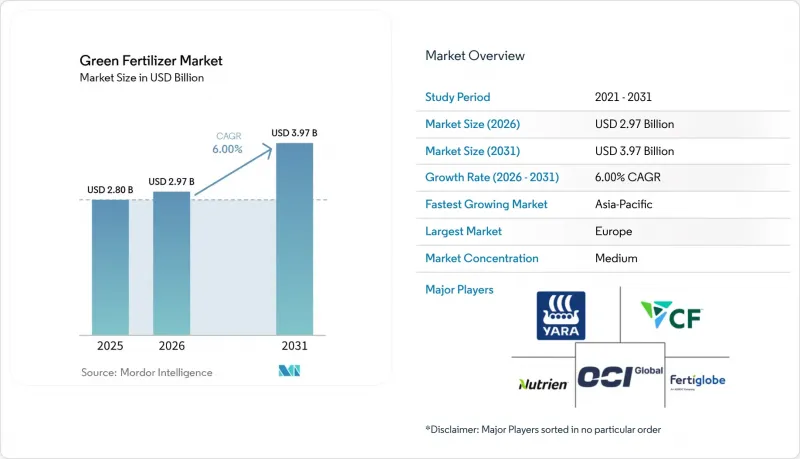
본 보고서는 비료의 유형(그린 암모니아, 그린 요소 등), 제조 기술(전해 수소, 바이오매스 가스화 등), 형태(고체 및 액체), 작물의 유형(곡물, 과일 및 채소 등), 그리고 지역(북미, 남미, 유럽, 아시아태평양, 중동 및 아프리카)별로 분류되어 있습니다. 시장 전망은 금액(달러) 기준으로 제시되어 있습니다.
세계 녹색 비료 시장 동향과 인사이트
탄소 중립 비료의 의무화
탄소중립 비료의 의무화는 법적 구속력이 있는 규제 체계를 통해 저배출형 질소 비료의 채택을 촉진하고 있습니다. 유럽연합 집행위원회에 따르면, ‘노력 분담 규정(ESR)’은 EU 회원국들에게 농업 등 배출권 거래 제도(ETS) 적용 대상이 아닌 부문에서 2030년까지 온실가스 배출량을 40% 감축할 것을 요구하고 있습니다. 이러한 규제로 인해 비료 제조업체들은 규제 기한을 준수하고 탄소 관련 제재를 피하기 위해 생산 공정의 탈탄소화를 추진하며, 그린 암모니아나 재생에너지 유래 원료로의 전환을 서둘러야 하는 상황에 놓여 있습니다.
재생 가능 전력의 비용 평형
재생에너지 비용의 하락은 수소 생산 비용을 절감함으로써 친환경 비료의 경제성을 높이는 데 있어 매우 중요한 역할을 하고 있습니다. 국제에너지기구(IEA)의 『Global Hydrogen Review 2024』에 따르면, 저배출 수소와 화석연료 기반 수소의 비용 격차는 2024년 1.5-8달러/kg에서 2030년까지 1-3달러/kg으로 축소될 것으로 전망됩니다. 이러한 비용 격차의 축소는 주로 저비용 재생 가능 전력의 이용 가능성과 전해조 도입 확대에 기인합니다. 비용 격차의 축소는 특히 중동, 호주, 칠레 등 풍부하고 저렴한 태양광·풍력에너지 자원을 보유한 지역에서 그린 암모니아 및 비료의 경쟁력을 높여줍니다.
1GW를 초과하는 전해 설비의 높은 자본 집약도
높은 자본 집약성은 주로 프로젝트 실현 지연과 자금 조달의 어려움으로 인해, 대규모 녹색 비료 프로젝트 개발의 중대한 장벽으로 남아 있습니다. 국제에너지기구(IEA)의 『Global Hydrogen Review 2024』에 따르면, 2030년까지 약 520GW로 추정되는 전 세계 전해조 프로젝트 파이프라인 중 최종 투자 결정 단계에 도달했거나 건설 중인 프로젝트는 불과 약 4%에 불과합니다. 이는 업계가 직면한 막대한 투자 및 실행상의 과제를 여실히 드러내고 있습니다. 발표된 생산량 기준으로 가동 중인 프로젝트로의 전환이 제한적이라는 점은 기가와트 규모의 전해조 시설에 수반되는 막대한 자본 수요와 재무적 위험을 여실히 드러내고 있으며, 그 결과 그린 수소 생산 확대 및 녹색 비료 제조와 같은 하류 분야로의 확대가 저해되고 있습니다.
부문별 분석
2025년, 그린 암모니아는 녹색 비료 시장 점유율의 46.0%를 차지하며 가장 큰 점유율을 기록했습니다. 이는 기존 암모니아계 비료 인프라와의 호환성은 물론, 농업 및 신흥 연료 시장에서의 이중 용도에 힘입은 결과입니다. 이러한 확장성은 하버-보슈 공정에 재생 가능 수소를 도입하는 등 이미 확립된 생산 방식에 의해 뒷받침되고 있습니다. 한편, 폐기물 유래 영양소에 대한 규제 측면의 지원과 지속 가능한 토양 관리에 기여함에 따라, 바이오 유래 칼륨 시장도 성장세를 보이고 있습니다. 이러한 요인들이 복합적으로 작용하여 암모니아 시장 지배력을 강화하는 한편, 칼리는 틈새 시장이면서도 급속히 성장하는 부문으로서의 입지를 확고히 하고 있습니다.
바이오 유래 칼륨 시장 규모는 순환형 영양분 회수 시스템의 도입 확대와 고부가가치 작물 분야에서 지속 가능한 대체재에 대한 수요에 힘입어, 2026년부터 2031년까지 연평균 성장률(CAGR) 9.0%라는 가장 높은 성장률을 기록하며 확대될 것으로 전망됩니다. 이러한 성장은 재활용 및 바이오 유래 원료의 사용을 장려하는 정책적 인센티브에 힘입어 더욱 가속화되고 있습니다. 반면, 암모니아는 확립된 물류망과 농업 분야에서의 폭넓은 수용성 덕분에 규모의 경제 효과를 누리고 있습니다. 이로 인해 암모니아가 수량 면에서 우위를 차지하는 한편, 바이오 유래 칼륨은 프리미엄 용도나 환경 규제의 대상이 되는 용도에서 확대되는 등 양극화된 시장 구조가 형성되고 있습니다.
2025년, 녹색 비료 시장 점유율의 최대 54.0%를 전해수소(재생에너지 유래)가 차지했습니다. 이는 강력한 정책 지원과 재생에너지를 활용한 수소 생산 시스템의 도입 확대에 힘입은 결과입니다. 이러한 우위는 높은 확장성과 에너지 및 농업 산업 전반의 탈탄소화 목표와의 부합성에서 비롯됩니다. 또한, 폐기물 기반 수소 생산 공정은 도시 폐기물이나 산업 폐기물을 활용할 수 있어 지역 내 생산을 가능하게 하고, 순환형 경제 추진을 뒷받침한다는 점에서 주목을 받고 있습니다.
폐기물 유래 수소는 자원 효율 및 폐기물 관리 솔루션에 대한 관심이 높아지는 가운데, 2026년부터 2031년까지 연평균 성장률(CAGR) 10.0%라는 가장 높은 성장률을 기록하며 확대될 것으로 전망됩니다. 명확한 규제 체계와 꾸준한 투자 덕분에 전해법이 여전히 주류를 이루고 있는 반면, 원료가 풍부한 지역에서는 폐기물을 이용한 수소 생산이 확대되고 있습니다. 이러한 추세는 지역별 차이를 여실히 드러내고 있으며, 재생에너지가 풍부한 지역에서는 전해법이 선호되는 반면, 폐기물이 많은 지역에서는 대체 수소 제조 기술이 채택되고 있습니다.
지역별 분석
2025년, 유럽은 친환경 비료 시장 점유율에서 32.0%를 차지하며 1위를 기록했습니다. 이는 견고한 규제 체계와 저배출형 농업 자재의 조기 도입에 힘입은 결과입니다. 탄소 가격 제도와 지속가능성에 관한 규제가 재생에너지를 기반으로 한 비료 생산으로의 전환을 촉진하고 있습니다. 독일과 네덜란드 등 여러 국가에서는 재생에너지와 수소·암모니아 생산 시스템을 통합함으로써 지역 공급망을 강화하고 있습니다. 각국 간 전력망의 제약이나 정책상의 차이는 존재하지만, 일관된 규제 압력으로 인해 지속 가능한 비료 도입에 있어 이 지역의 주도적 입지는 계속해서 뒷받침되고 있습니다.
아시아태평양은 급속한 산업화와 청정 에너지 통합을 촉진하는 강력한 정부 주도의 노력에 힘입어, 2026년부터 2031년까지 연평균 성장률(CAGR) 7.8%라는 가장 높은 성장률을 보일 것으로 전망됩니다. 중국, 인도, 호주 등의 국가들은 비료 생산을 뒷받침하기 위해 재생 가능 수소의 생산 능력을 확대되고 있습니다. 이 지역은 비용 면에서 우위를 점할 수 있는 풍부한 태양광 및 풍력 자원의 혜택을 누리고 있으며, 정책 주도형 투자가 인프라 개발을 가속화하고 있습니다. 수자원 확보나 송전망의 제약과 같은 과제가 있기는 하지만, 그 규모와 풍부한 자원을 고려할 때 이 지역은 여전히 주요한 성장 동력으로 자리 잡고 있습니다.
북미에서는 강력한 정책적 인센티브와 국경을 초월한 무역의 역동성을 통해 저탄소 비료의 밸류체인이 추진되고 있습니다. 제45V조에 따른 청정 수소 생산 세액 공제는 10년 동안 수소 1Kg당 최대 3달러를 지원함으로써 프로젝트의 경제성을 높이고, 멕시코만 연안 지역 및 중서부 지역의 설비 개조를 촉진하고 있습니다. 캐나다는 블루 암모니아 수출 전략을 추진하고 있으며, 멕시코는 미국 남서부로부터의 수입을 검토하고 있습니다. 동시에 중동에서는 재생에너지를 활용한 대규모 암모니아 프로젝트가 개발되고 있으며, 유럽과 아시아를 향한 중요한 수출 거점으로서의 위상을 확립해 가고 있습니다.
기타 혜택:
- 엑셀 형식 시장 예측(ME) 시트
- 3개월간의 애널리스트 지원
자주 묻는 질문
목차
제1장 서론
제2장 조사 방법
제3장 주요 요약
제4장 시장 구도
제5장 시장 규모와 성장 예측(금액, 2026-2031년)
제6장 경쟁 구도
제7장 시장 기회와 향후 전망
JHSAccording to Mordor Intelligence, the green fertilizer market size is projected to grow from USD 2.80 billion in 2025 to USD 2.97 billion in 2026 and is anticipated to reach USD 3.97 billion by 2031, registering a CAGR of 6.0% during the period 2026-2031.
This report is Segmented by Fertilizer Type (Green Ammonia, Green Urea, and More), by Source Technology (Electrolytic Hydrogen, Biomass Gasification, and More), by Form (Solid and Liquid), by Crop Type (Cereals and Grains, Fruits and Vegetables, and More), and by Geography (North America, South America, Europe, Asia-Pacific, Middle East, and Africa). The Market Forecasts are Provided in Terms of Value (USD).
Global Green Fertilizer Market Trends and Insights
Carbon-Neutral Fertilizer Mandates
Carbon-neutral fertilizer mandates are driving the adoption of low-emission nitrogen inputs through binding regulatory frameworks. According to the European Commission, the Effort Sharing Regulation (ESR) requires EU member states to achieve a 40% reduction in greenhouse gas emissions by 2030 in non-Emissions Trading System (ETS) sectors, including agriculture. This regulation is compelling fertilizer producers to decarbonize production processes and transition to green ammonia and renewable-based inputs to meet regulatory deadlines and avoid carbon-related penalties.
Renewable-Power Cost Parity
Reductions in renewable power costs play a crucial role in improving the economics of green fertilizers by decreasing hydrogen production expenses. According to the International Energy Agency's Global Hydrogen Review 2024, the cost gap between low-emissions hydrogen and fossil-based hydrogen is projected to shrink from USD 1.5-8/kg in 2024 to USD 1-3/kg by 2030 . This reduction is primarily attributed to the availability of low-cost renewable electricity and the scaling up of electrolyzer deployment. The narrowing cost gap enhances the competitiveness of green ammonia and fertilizers, particularly in regions with abundant and affordable solar and wind energy resources, such as the Middle East, Australia, and Chile.
High Capital Intensity of Electrolyzers Above 1 GW
High capital intensity remains a significant barrier to the development of large-scale green fertilizer projects, primarily due to delays in project realization and financing difficulties. According to the International Energy Agency's Global Hydrogen Review 2024, only approximately 4% of the global electrolyzer project pipeline estimated at around 520 GW by 2030 has reached the final investment decision stage or is under construction. This underscores the considerable investment and execution challenges faced by the industry. The limited transition from announced capacity to operational projects highlights the substantial capital demands and financial risks associated with gigawatt-scale electrolyzer facilities, thereby hindering the expansion of green hydrogen production and its downstream application in green fertilizer manufacturing.
Other drivers and restraints analyzed in the detailed report include:
- Corporate Net-Zero Farming Programs
- Ammonia Bunkering Demand Pull-Through for Maritime Fuel
- Grid Congestion Limiting Renewable Power Purchase Agreements in Key Hubs
For complete list of drivers and restraints, kindly check the Table Of Contents.
Segment Analysis
Green ammonia held the largest 46.0% of the green fertilizer market share in 2025, supported by compatibility with existing ammonia-based fertilizer infrastructure and its dual application across agriculture and emerging fuel markets. Its scalability is supported by established production methods, such as retrofitting the Haber-Bosch process with renewable hydrogen. At the same time, bio-based potash is gaining momentum due to regulatory support for waste-derived nutrients and its contribution to sustainable soil management. These factors collectively reinforce ammonia's market dominance while positioning potash as a niche but rapidly growing segment.
Bio-based potash market size is projected to grow at the fastest 9.0% CAGR from 2026 to 2031, driven by increasing adoption of circular nutrient recovery systems and demand for sustainable alternatives in high-value crops. Growth is further supported by policy incentives promoting the use of recycled and bio-based inputs. In contrast, ammonia benefits from scale advantages due to established logistics and widespread agronomic acceptance. This creates a dual-track market structure, with ammonia dominating in volume while bio-based potash expands in premium and environmentally regulated applications.
Electrolytic hydrogen (renewable energy) accounted for the largest 54.0% of the green fertilizer market share in 2025, supported by strong policy backing and increasing deployment of renewable-powered hydrogen production systems. Its prominence is attributed to its scalability and alignment with decarbonization goals across the energy and agriculture industries. Additionally, waste-derived hydrogen pathways are gaining traction due to their ability to utilize municipal and industrial waste streams, enabling localized production and supporting circular economy initiatives.
Waste-to-hydrogen is projected to grow at the fastest 10.0% CAGR from 2026 to 2031, driven by increasing interest in resource efficiency and waste management solutions. While electrolysis remains dominant due to well-defined regulatory frameworks and steady investment, waste-based hydrogen production is expanding in regions with abundant feedstock availability. This trend highlights a geographic distinction, with renewable-rich areas favoring electrolysis and waste-dense regions adopting alternative hydrogen production technologies.
Geography Analysis
Europe accounted for the largest 32.0% of the green fertilizer market share in 2025, driven by robust regulatory frameworks and the early adoption of low-emission agricultural inputs. Carbon pricing mechanisms and sustainability mandates are facilitating the shift toward renewable-based fertilizer production. Countries like Germany and the Netherlands are integrating renewable energy with hydrogen and ammonia production systems, thereby strengthening regional supply chains. Although grid constraints and policy differences exist across countries, consistent regulatory pressure continues to support the region's leadership in sustainable fertilizer adoption.
The Asia-Pacific region is projected to grow at the fastest CAGR of 7.8% from 2026 to 2031, driven by rapid industrialization and strong government initiatives promoting clean energy integration. Countries such as China, India, and Australia are expanding renewable hydrogen capacity to support fertilizer production. The region benefits from abundant solar and wind resources, which provide cost advantages, while policy-driven investments are accelerating infrastructure development. Despite challenges such as water availability and grid limitations, the region remains a key growth driver due to its scale and resource availability.
North America is advancing low-carbon fertilizer value chains through robust policy incentives and cross-border trade dynamics. The clean hydrogen production tax credit under Section 45V provides up to USD 3.00 per kilogram of hydrogen for a 10-year period, enhancing project economics and facilitating retrofits across the Gulf Coast and Midwest . Canada is progressing with blue-ammonia export strategies, while Mexico is assessing imports from the United States Southwest. Simultaneously, the Middle East is developing large-scale renewable-powered ammonia projects, positioning itself as a significant export hub for Europe and Asia.
- Yara International ASA
- CF Industries Holdings Inc.
- OCI N.V.
- Fertiglobe PLC
- Nutrien Ltd.
- ACME Group
- Air Products and Chemicals Inc.
- Engie SA
- Iberdrola S.A.
- thyssenkrupp AG
- Siemens Energy AG
- Nel ASA
- AmmPower Corp.
- Avina Clean Hydrogen Inc.
- Casale SA
Additional Benefits:
- The market estimate (ME) sheet in Excel format
- 3 months of analyst support
TABLE OF CONTENTS
1 Introduction
- 1.1 Study Assumptions and Market Definition
- 1.2 Scope of the Study
2 Research Methodology
3 Executive Summary
4 Market Landscape
- 4.1 Market Overview
- 4.2 Market Drivers
- 4.2.1 Carbon-neutral fertilizer mandates
- 4.2.2 Renewable-power cost parity
- 4.2.3 Corporate net-zero farming programs
- 4.2.4 Ammonia bunkering demand pull-through for maritime fuel
- 4.2.5 Carbon border adjustment mechanisms
- 4.2.6 Green-hydrogen tax credits in the United States
- 4.3 Market Restraints
- 4.3.1 High capital intensity of electrolyzers above 1 GW
- 4.3.2 Grid congestion limiting renewable Power Purchase Agreements in key hubs
- 4.3.3 Scarcity of certified green water resources in arid zones
- 4.3.4 Slow agronomic validation data for novel formulations
- 4.4 Regulatory Landscape
- 4.5 Technological Outlook
- 4.6 Porter's Five Forces
- 4.6.1 Bargaining Power of Suppliers
- 4.6.2 Bargaining Power of Buyers
- 4.6.3 Threat of New Entrants
- 4.6.4 Threat of Substitutes
- 4.6.5 Competitive Rivalry
5 Market Size and Growth Forecasts (Value, 2026-2031)
- 5.1 By Fertilizer Type
- 5.1.1 Green Ammonia
- 5.1.2 Green Urea
- 5.1.3 Green Phosphate
- 5.1.4 Bio-based Potash
- 5.1.5 Others
- 5.2 By Source Technology
- 5.2.1 Electrolytic Hydrogen (Renewable Energy)
- 5.2.2 Biomass Gasification
- 5.2.3 Waste-to-Hydrogen
- 5.2.4 Other Emerging Technologies
- 5.3 By Form
- 5.3.1 Solid
- 5.3.2 Liquid
- 5.4 By Crop Type
- 5.4.1 Cereals and Grains
- 5.4.2 Fruits and Vegetables
- 5.4.3 Oilseeds and Pulses
- 5.4.4 Others
- 5.5 By Region
- 5.5.1 North America
- 5.5.1.1 United States
- 5.5.1.2 Canada
- 5.5.1.3 Mexico
- 5.5.1.4 Rest of North America
- 5.5.2 South America
- 5.5.2.1 Brazil
- 5.5.2.2 Argentina
- 5.5.2.3 Rest of South America
- 5.5.3 Europe
- 5.5.3.1 Germany
- 5.5.3.2 France
- 5.5.3.3 United Kingdom
- 5.5.3.4 Italy
- 5.5.3.5 Spain
- 5.5.3.6 Russia
- 5.5.3.7 Rest of Europe
- 5.5.4 Asia-Pacific
- 5.5.4.1 China
- 5.5.4.2 Japan
- 5.5.4.3 India
- 5.5.4.4 South Korea
- 5.5.4.5 Australia and New Zealand
- 5.5.4.6 Rest of Asia-Pacific
- 5.5.5 Middle East
- 5.5.5.1 Saudi Arabia
- 5.5.5.2 United Arab Emirates
- 5.5.5.3 Turkey
- 5.5.5.4 Rest of Middle East
- 5.5.6 Africa
- 5.5.6.1 South Africa
- 5.5.6.2 Egypt
- 5.5.6.3 Rest of Africa
- 5.5.1 North America
6 Competitive Landscape
- 6.1 Market Concentration
- 6.2 Strategic Moves
- 6.3 Market Share Analysis
- 6.4 Company Profiles (Includes Global-Level Overview, Market-Level Overview, Core Segments, Financials as Available, Strategic Information, Market Rank/Share for Key Companies, Products and Services, and Recent Developments)
- 6.4.1 Yara International ASA
- 6.4.2 CF Industries Holdings Inc.
- 6.4.3 OCI N.V.
- 6.4.4 Fertiglobe PLC
- 6.4.5 Nutrien Ltd.
- 6.4.6 ACME Group
- 6.4.7 Air Products and Chemicals Inc.
- 6.4.8 Engie SA
- 6.4.9 Iberdrola S.A.
- 6.4.10 thyssenkrupp AG
- 6.4.11 Siemens Energy AG
- 6.4.12 Nel ASA
- 6.4.13 AmmPower Corp.
- 6.4.14 Avina Clean Hydrogen Inc.
- 6.4.15 Casale SA