|
시장보고서
상품코드
2063905
직원 업스킬링 및 리스킬링 플랫폼 시장 : 시장 점유율 분석, 업계 동향 및 통계, 성장 예측(2026-2031년)Employee Upskilling And Reskilling Platform - Market Share Analysis, Industry Trends & Statistics, Growth Forecasts (2026 - 2031) |
||||||
 Mordor Intelligence
Mordor Intelligence에 의하면, 직원 업스킬링 및 리스킬링 플랫폼 시장 규모는 2025년에 571억 2,000만 달러로 평가되었고, 2026-2031년 CAGR 10.24%로 성장을 지속할 전망이며, 2031년에는 1,009억 1,000만 달러에 이를 것으로 예측됩니다.
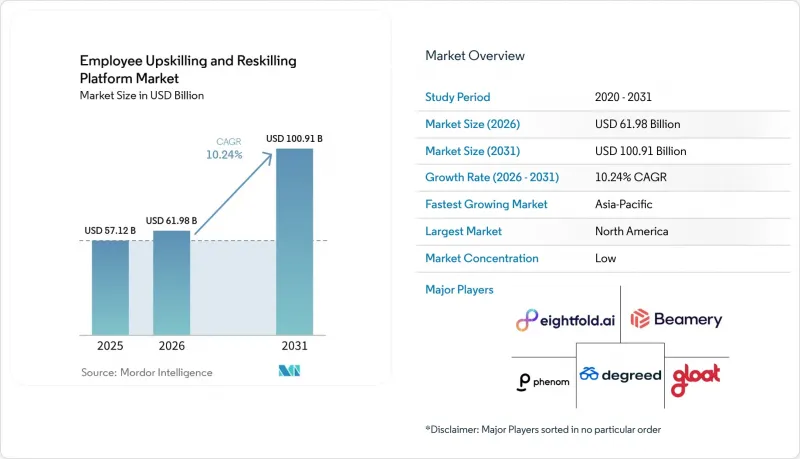
본 보고서는 교육 중점 분야별(기술 역량 및 디지털 역량, 기타), 도입 형태별(클라우드 기반, 기타), 기업 규모별(대기업 및 중소기업), 업종별(IT 및 통신, 은행, 금융서비스 및 보험(BFSI), 헬스케어 및 생명과학, 기타), 지역별로 분류되어 있습니다. 시장 전망은 금액(달러) 기준으로 제시되어 있습니다.
세계의 직원 업스킬링 및 리스킬링 플랫폼 시장 동향과 인사이트
AI와 자동화로 인한 기술의 노후화
AI 주도형 자동화는 직원 업스킬링 및 리스킬링 플랫폼 시장 전반에 걸쳐 인재 육성 예산의 주요 촉진요인으로 작용하고 있습니다. 세계경제포럼(WEF)의 보고서에 따르면, 2030년까지 핵심 인력의 기술 중 39%가 변화할 것으로 예상되며, 기업들은 정기적인 재교육이 아닌 지속적인 학습에 계속 주력하게 될 것입니다. IMF는 2026년 초, 선진국에서 구인 공고 10건 중 1건은 이미 적어도 하나의 완전히 새로운 기술을 요구하고 있으며, 새로운 기술 하나당 3%의 임금 프리미엄이 발생하고, 여러 가지 새로운 능력을 겸비한 근로자의 경우 최대 15%에 달한다고 밝혔습니다. 이에 따라 직원의 역량 강화 및 재교육 플랫폼 시장은 업무상의 변화와 밀접하게 연관되어 있습니다. 왜냐하면 AI 도구에 관한 직원 교육은 그 도입을 가속화하고, 새로운 기술 갱신의 물결을 일으키는 경우가 많기 때문입니다. 세계경제포럼(WEF)의 조사에서도 AI 및 빅데이터 관련 역량은 공감 능력이나 능동적 경청에 비해 완전하거나 하이브리드 형태의 변화를 필요로 할 가능성이 30배 이상 높은 것으로 밝혀졌으며, 이는 기업 수요 측면에서 기술적 학습이 얼마나 중요한지를 여실히 보여주고 있습니다. Skillsoft가 2025년과 2026년에 제시한, AI 네이티브 스킬 인텔리전스와 AI 지원형 컨텐츠 제작을 핵심으로 하는 제품 전략은 직원의 역량 강화 및 재교육 플랫폼 시장에서 컨텐츠 라이브러리를 보다 신속하게 업데이트해야 할 필요성을 반영한 것입니다.
'스킬 퍼스트' 인재 전략으로의 전환
'스킬 퍼스트' 방식의 인재 관리로의 전환은 직원의 역량 강화 및 리스킬링 플랫폼 시장에서 구매자들이 플랫폼을 평가하는 방식을 변화시키고 있습니다. 기업들은 일회성 과정 구매에서 벗어나, 역량을 파악하고 능력을 검증하며, 학습과 사내 전보를 연계할 수 있는 시스템을 더욱 중요하게 여기고 있습니다. 2025년 9월 Coursera가 시작한 ‘Skill Tracks’는 광범위한 컨텐츠 카탈로그에만 의존하는 것이 아니라, 노동 시장 데이터와 독자적인 기술 분류 체계를 통해 직종, 기술, 학습 컨텐츠를 연결함으로써 이러한 전환을 명확히 보여주었습니다. Docebo는 365Talents 인수를 두고, 기술에 대한 인사이트에서 기술의 실행으로의 전환이라고 설명하며, 업무 활동, 경험, 학습에서 얻어지는 지속적인 신호를 활용하여 격차를 파악하고 행동을 유도한다고 밝혔습니다. 따라서, 직원의 역량 강화 및 재교육 플랫폼 시장은 공유 기술 분류 체계가 HR 시스템, 학습 시스템, 인재 계획 도구 사이에 자리 잡게 됨에 따라 노동력 인프라에 점점 더 가까워지고 있습니다. 구매자들이 학습 활동과 인력 배치 및 역할 결정을 연결하는 공통 언어를 점점 더 필요로 하고 있기 때문에 보다 강력한 온톨로지 엔진과 기술 추론 도구를 갖춘 공급업체의 중요성이 커지고 있습니다. 이러한 변화에 따라, 직원의 역량 강화와 리스킬링 플랫폼 시장의 역할은 단순한 교육 과정 제공을 넘어 계속해서 확대되고 있습니다.
학습의 ROI를 입증하는 것의 어려움
비즈니스에 미치는 영향을 입증할 수 없습니다는 점은 직원의 역량 강화 및 재교육 플랫폼 시장의 확대에 있어 여전히 가장 명백한 제약 요인 중 하나입니다. Schoox는 2025년 말, 학습 담당자가 측정 가능한 비즈니스적 영향을 창출할 수 있도록 지원하기 위해 ‘Learning Impact Suite’를 도입했는데, 이는 성과 추적이 구매자의 기대치에서 얼마나 중요한 요소가 되었는지를 보여줍니다. Docebo는 365Talents 인수를 인력 분석 및 역량 격차의 자동 파악을 핵심으로 삼았습니다. 이는 또한 벤더들이 학습 활동과 실무 대응 능력 및 성과 지표를 연계하도록 요구받고 있음을 보여줍니다. 신뢰할 수 있는 역량 기준이 없다면, 단순히 과정 수료자 수만으로는 조직이 실제로 생산성, 적응력 또는 업무 회복탄력성을 향상시켰는지 여부를 판단할 수 없습니다. 이 문제는 AI가 도입된 직장 환경에서는 더욱 복잡해집니다. 왜냐하면 생산성 향상은 단순한 교육뿐만 아니라, 인간의 학습, 소프트웨어를 통한 자동화, 워크플로우 재설계가 결합된 결과일 가능성이 있기 때문입니다. 따라서, 평가, 스킬 그래프, 인재 분석을 결합할 수 있는 벤더는 직원의 역량 강화 및 리스킬링 플랫폼 시장에서 장기 계약을 확보하는 데 유리한 입장에 있습니다.
부문별 분석
기술·디지털 역량 부문은 2025년에 직원 업스킬링 및 리스킬링 플랫폼 시장의 34.81%를 차지한 것으로 평가되었으며, 2031년까지 연평균 성장률(CAGR) 12.81%로 확대될 것으로 전망됩니다. 이러한 상황은 업무의 핵심이 끊임없이 변화하는 가운데, 기업의 예산이 AI 운영, 데이터 리터러시, 사이버 보안 쪽으로 크게 전환되고 있음을 반영하고 있습니다. 세계경제포럼(WEF) 보고서에 따르면, AI 및 빅데이터 역량은 고용주들이 가장 우선시하는 역량 중 하나로 꼽히고 있으며, 이는 기술 컨텐츠 라이브러리와 평가 도구에 대한 지속적인 투자를 뒷받침하는 근거가 됩니다. 또한, Coursera가 ‘Skill Tracks’를 출시한 것은 주요 플랫폼들이 광범위한 강좌 카테고리뿐만 아니라 소프트웨어, IT, 데이터, 생성형 AI(GenAI) 분야의 역할과 숙련도 요구 사항에 맞추어 학습 과정을 체계화하고 있음을 보여줍니다.
기술의 변화, 업무 흐름의 혁신, 더욱 분산화된 운영 모델 속에서 관리자가 팀을 이끌어야 할 필요성이 커짐에 따라 리더십과 관리 역량의 중요성은 계속해서 커지고 있습니다. 세계경제포럼(WEF)의 기술 전망 보고서에 따르면, 분석적 사고, 회복탄력성, 유연성, 리더십, 사회적 영향력은 여전히 고용주들이 우선시할 것으로 예상되는 주요 역량 분야로 꼽히고 있으며, 순수하게 기술적인 분야 이외의 역량에 대한 수요가 강조되고 있습니다. 준법 및 규제 대응 역량과 현장 및 업무 역량은 해당 학습 예산이 재량적인 개발 목표보다는 절차, 감사, 역할 수행과 밀접하게 연결되어 있기 때문에 구조적으로 중요한 위치를 계속 차지하고 있습니다. 따라서, 직원 업스킬링 및 리스킬링 플랫폼 시장에서는 급변하는 디지털 컨텐츠와 보다 지속 가능한 업무 교육 수요를 모두 동일한 환경 내에서 지원할 수 있는 공급업체가 계속해서 높은 평가를 받고 있습니다.
2025년 기준으로, 직원 업스킬링 및 리스킬링 플랫폼 시장 규모의 68.42%를 클라우드 기반 서비스가 차지한 반면, 하이브리드형 도입은 2031년까지 연평균 성장률(CAGR) 13.22%를 나타낼 것으로 예측됩니다. 클라우드는 진입 장벽을 낮추고, 도입 기간을 단축하며, 통합된 컨텐츠 관리와 AI를 활용한 개인화를 지원하기 때문에 여전히 많은 구매자들에게 기본 선택지로 자리 잡고 있습니다. 한편, 고용주들이 유연성과 기밀성이 높은 직원 데이터 및 기술 데이터에 대한 엄격한 관리 사이의 균형을 모색하는 가운데, 직원 업스킬링 및 리스킬링 플랫폼 시장에서는 하이브리드 모델에 대한 수요가 증가하고 있습니다. 이러한 경향은 학습 시스템이 직원 기록, 성과 평가 시스템, 거버넌스 프로세스와 점점 더 긴밀하게 연계되고 있는 규제가 엄격한 환경에서 특히 두드러집니다.
Pluralsight의 2026년 전개 상황을 보면, 도입의 가치는 플랫폼이 어디에 호스팅되어 있는지가 아니라, 기존 HR 및 인재 아키텍처와 얼마나 쉽게 통합될 수 있는지에 크게 좌우된다는 점이 드러났습니다. Slack, Microsoft Teams, Glean 및 기타 엔터프라이즈 도구를 통한 워크플로우에 통합된 학습 역시, 관리되는 환경 간에 컨텐츠와 신호를 이동할 수 있는 유연한 아키텍처를 뒷받침하고 있습니다. 따라서 직원의 역량 강화와 재교육 산업은 단순한 ‘클라우드 대 On-Premise’라는 논쟁에서 상호 운용성, 거버넌스, 사용자 연속성 등 보다 광범위한 과제로 전환되고 있습니다. 클라우드 환경과 관리형 환경 모두에서 일관된 경험을 제공하는 벤더는 직원 업스킬링 및 리스킬링 플랫폼 시장에서 규제 대상 기업 수요에서 더 큰 점유율을 확보하고 있습니다.
지역별 분석
2025년, 북미는 직원 업스킬링 및 리스킬링 플랫폼 시장 규모의 38.91%를 차지했습니다. 이 지역은 성숙한 기업 소프트웨어의 도입, 기업용 학습 도구의 대규모 도입 기반, 그리고 다수의 세계 플랫폼 공급업체와 컨텐츠 생태계가 존재한다는 장점을 가지고 있습니다. 미국은 여전히 가장 영향력 있는 국가 시장으로 남아 있습니다. 이는 고용주들이 빈번한 기술 변화에 대응하고 있으며, 지식 노동과 현장 업무 모두에서 AI 대응에 대한 기대가 높아지고 있기 때문입니다. 유럽에서는 직원의 역량 강화 및 재교육 플랫폼 시장에서 서로 다른 수요 특성을 볼 수 있습니다. 이는 구매자들이 체계적으로 관리된 학습 기록, 역할에 따른 AI 활용 역량, 기업 환경에서의 보다 엄격한 데이터 처리 기준을 더욱 중요하게 여기기 때문입니다.
아시아태평양은 2031년까지 연평균 성장률(CAGR) 14.11%를 나타낼 것으로 예측되며, 이는 각 지역 중 가장 빠른 성장 속도입니다. 일본이 두드러지는 이유는 경제산업성이 ‘사회 5.0’ 지침에 따라 2026년도 말까지 230만 명의 ‘디지털 추진 인재’를 양성하겠다는 목표를 세우고, 디지털 인재의 역량 강화를 정책 과제로 중시하고 있기 때문입니다. 광역적인 지역 전체를 놓고 보면, 풍부한 노동력과 뿌리 깊은 디지털 기술 격차가 존재하기 때문에 강사 주도형 모델만으로는 충분히 제공할 수 없는 확장 가능한 플랫폼의 제공이 뒷받침되고 있습니다. 또한, 직원의 역량 강화 및 재교육 플랫폼 시장은 체계적인 학습을 국가적 경쟁력 강화 및 노동력 전환 목표와 연계하려는 민관 협력 노력의 혜택을 받고 있습니다. LearnUpon이 시드니에 진출한 것은 아시아태평양의 직원 수가 2년 만에 80% 증가한 데 따른 것으로, 각 벤더 기업들이 이 지역을 2차 판매 시장이 아닌 장기적인 성장의 우선 순위 부문으로 자리매김하고 있음을 보여줍니다.
2025년 시점에서 남미, 중동 및 아프리카는 직원 업스킬링 및 리스킬링 플랫폼 시장에서의 점유율은 낮았지만, 보다 경량화된 디지털 학습 모델에 있어서는 여전히 중요한 성장 시장으로 남아 있습니다. 남미에서는 비용에 대한 민감도와 HR 기술의 성숙도 차이가 크기 때문에 ROI 입증과 간편한 도입이 더 광범위한 보급을 위해 특히 중요해지고 있습니다. 중동에서는 사우디아라비아와 아랍에미리트에서 2030년까지 업무의 43% 이상이 자율적으로 수행될 것으로 예상되며, 이는 노동력의 재배치에 대한 강력한 수요를 보여주고 있습니다. 아프리카는 여전히 발전의 초기 단계에 있지만, ‘리스킬링 혁명(Reskilling Revolution)’ 이니셔티브를 통해 이 지역은 확장 가능한 디지털 학습에 대한 장기적인 관심을 뒷받침하는 보다 광범위한 가속화 프로그램 및 노동력 전환 프로그램의 일환으로 자리매김하고 있습니다.
기타 혜택
- 엑셀 형식 시장 예측(ME) 시트
- 3개월간의 애널리스트 지원
자주 묻는 질문
목차
제1장 서론
제2장 조사 방법
제3장 주요 요약
제4장 시장 구도
제5장 시장 규모 및 성장 예측
제6장 경쟁 구도
제7장 시장 기회 및 향후 전망
AJY 26.06.26According to Mordor Intelligence, the employee upskilling and reskilling platform market size reached USD 57.12 billion in 2025 and is forecast to reach USD 100.91 billion by 2031 at a CAGR of 10.24% over 2026-2031.
This report is Segmented by Training Focus (Technical and Digital Skills, and More), Deployment Mode (Cloud-Based, and More), Enterprise Size (Large Enterprises, and SME), Industry Vertical (IT and Telecommunications, Banking, Financial Services, and Insurance, Healthcare and Life Sciences, and More), and Geography. The Market Forecasts are Provided in Terms of Value (USD).
Global Employee Upskilling And Reskilling Platform Market Trends and Insights
Ai And Automation-Driven Skills Obsolescence
AI-driven automation has become a major driver of workforce training budgets across the employee upskilling and reskilling platform market. The World Economic Forum reported that 39% of core workforce skills are expected to change by 2030, keeping enterprises focused on continuous learning rather than periodic retraining. The IMF stated in early 2026 that 1 in 10 job vacancies in advanced economies already required at least 1 entirely new skill, with wage premiums of 3% per new skill and up to 15% for workers combining several new capabilities. This keeps the employee upskilling and reskilling platform market closely tied to operational change, because training workers on AI tools often speeds up their adoption and creates new rounds of skills renewal. The World Economic Forum also found that AI and big data skills were more than 30 times more likely to require full or hybrid transformation than empathy and active listening, underscoring the centrality of technical learning to enterprise demand. Skillsoft's 2025 and 2026 product positioning around AI-native skills intelligence and AI-assisted content creation reflects the need for content libraries to be refreshed more quickly in the employee upskilling and reskilling platform market.
Shift Toward Skills-First Talent Strategies
The move toward skills-first talent management is changing how buyers evaluate platforms in the employee upskilling and reskilling platform market. Enterprises are shifting away from one-time course purchases and are placing more value on systems that can map skills, validate capability, and connect learning with internal mobility. Coursera's Skill Tracks launch in September 2025 clearly demonstrated this transition by linking jobs, skills, and learning content through labor market data and a proprietary skills taxonomy, rather than relying solely on broad content catalogs. Docebo described its 365Talents acquisition as a move from skills insight to skills execution, with continuous signals from work activity, experience, and learning being used to detect gaps and guide action. The employee upskilling and reskilling platform market is, therefore, moving closer to workforce infrastructure, as shared skills taxonomies now sit between HR systems, learning systems, and talent planning tools. Vendors with stronger ontology engines and skills inference tools are gaining relevance because buyers increasingly need a common language that connects learning activity to staffing and role decisions. That shift continues to widen the role of the employee upskilling and reskilling platform market beyond course delivery alone.
Difficulty Proving Learning Roi
The inability to prove business impact remains one of the clearest limits on expansion in the employee upskilling and reskilling platform market. Schoox introduced its Learning Impact Suite in late 2025 specifically to help learning leaders deliver measurable business impact, which shows how central outcome tracking has become to buyer expectations. Docebo framed the 365Talents transaction around workforce analytics and the automated identification of capability gaps, again pointing to the pressure vendors face to connect learning activity with readiness and performance signals. Without a credible skills baseline, course-completion numbers do not indicate whether an organization actually improved productivity, mobility, or operational resilience. This issue becomes harder in AI-enabled workplaces because gains in output can come from a mix of human learning, software automation, and workflow redesign rather than from training alone. Vendors that can combine assessments, skills graphs, and workforce analytics are therefore better placed to win longer contracts in the employee upskilling and reskilling platform market.
Other drivers and restraints analyzed in the detailed report include:
- Remote And Hybrid Work Normalizing Digital Learning
- Compliance And Audit-Ready Training Demand
- Integration Complexity Across Hr And Collaboration Stacks
For complete list of drivers and restraints, kindly check the Table Of Contents.
Segment Analysis
Technical and Digital Skills held 34.81% of the employee upskilling and reskilling platform market share in 2025 and is projected to expand at a 12.81% CAGR through 2031. That position reflects how strongly enterprise budgets are being pulled toward AI operations, data literacy, and cybersecurity as core work continues to change. The World Economic Forum reported that AI and big data skills are among the fastest-rising priorities for employers, which supports continued spending on technical content libraries and assessments. Coursera's Skill Tracks launch also showed that large platforms are organizing learning around role and proficiency needs in software, IT, data, and GenAI rather than only around broad course categories.
Leadership and Management Skills continue to build relevance as managers are asked to guide teams through technology change, shifting workflows, and more distributed operating models. The World Economic Forum's skills outlook still ranks analytical thinking, resilience, flexibility, leadership, and social influence among the key capability areas employers expect to prioritize, underscoring demand outside purely technical domains. Compliance and Regulatory Skills and Frontline and Operational Skills remain structurally important because their learning budgets are more closely tied to procedures, audits, and role execution than to discretionary development goals. The employee upskilling and reskilling platform market, therefore, continues to reward vendors that can support both fast-changing digital content and more durable operational training needs within the same environment.
Cloud-based delivery accounted for 68.42% of the employee upskilling and reskilling platform market size in 2025, while hybrid deployment is projected to grow at a 13.22% CAGR through 2031. Cloud remains the default choice for many buyers because it lowers entry barriers, shortens deployment time, and supports centralized content management and AI-driven personalization. At the same time, the employee upskilling and reskilling platform market is seeing stronger demand for hybrid models as employers try to balance flexibility with tighter control over sensitive employee and skills data. This pattern is especially relevant in regulated settings where learning systems are increasingly connected to workforce records, performance systems, and governance processes.
Pluralsight's 2026 rollout showed that deployment value now depends heavily on how easily a platform fits into established HR and talent architectures, rather than where it is hosted. Workflow-embedded learning through Slack, Microsoft Teams, Glean, and other enterprise tools also supports flexible architectures that can move content and signals across controlled environments. The employee upskilling and reskilling industry is therefore shifting from a simple cloud-versus-on-premises discussion to a broader question of interoperability, governance, and user continuity. Vendors that deliver a consistent experience across cloud and controlled environments are taking a larger share of regulated enterprise demand in the employee upskilling and reskilling platform market.
Geography Analysis
North America accounted for 38.91% of the employee upskilling and reskilling platform market size in 2025. The region benefits from mature enterprise software adoption, a large installed base of corporate learning tools, and the presence of several global platform vendors and content ecosystems. The United States remains the most influential country market because employers are dealing with frequent skill changes and higher expectations for AI readiness across both knowledge work and frontline roles. Europe has a different demand profile in the employee upskilling and reskilling platform market, as buyers place greater emphasis on governed learning records, role-based AI literacy, and tighter data-handling standards in enterprise environments.
Asia-Pacific is projected to grow at a 14.11% CAGR through 2031, the fastest pace among regions. Japan stands out because the Ministry of Economy, Trade, and Industry has set a target of 2.3 million Digital Promotion Personnel by the end of FY2026 under its Society 5.0 direction, keeping digital workforce capability high on the policy agenda. Across the wider region, large labor pools and persistent digital skills gaps support scalable platform delivery more than instructor-led models alone can provide. The employee upskilling and reskilling platform market is also benefiting from public and private initiatives that keep structured learning aligned with national competitiveness and workforce transition goals. LearnUpon's Sydney expansion, after an 80% increase in Asia-Pacific headcount over 2 years, shows that vendors are treating the region as a long-term growth priority rather than a secondary sales market.
South America, the Middle East, and Africa accounted for a smaller share of the employee upskilling and reskilling platform market in 2025, but they remain important growth markets for lighter digital learning models. In South America, cost sensitivity and uneven HR technology maturity make proof of ROI and simple deployment especially important for wider adoption. In the Middle East, more than 43% of tasks were expected to be delivered autonomously by 2030 in Saudi Arabia and the UAE, indicating strong workforce repositioning needs. Africa is still in earlier stages of development, but the Reskilling Revolution initiative has kept the region within broader accelerator and workforce transition programs that support long-term interest in scalable digital learning.
- Coursera, Inc.
- Udemy, Inc.
- Degreed, Inc.
- Docebo Inc.
- Skillsoft Corp.
- D2L Inc.
- LearnUpon Limited
- Absorb Software Inc.
- Axonify Inc.
- OpenSesame Inc.
- 360Learning SA
- Litmos US, L.P.
- Go1 Pty Limited
- Valamis Group Oy
- Intellum, Inc.
- Fuse Universal Ltd.
- Thrive Learning Limited
- Rise To Limited, trading as Learn Amp
- Rallyware, Inc.
- Schoox, LLC
Additional Benefits:
- The market estimate (ME) sheet in Excel format
- 3 months of analyst support
TABLE OF CONTENTS
1 INTRODUCTION
- 1.1 Study Assumptions and Market Definition
- 1.2 Scope of the Study
2 RESEARCH METHODOLOGY
3 EXECUTIVE SUMMARY
4 MARKET LANDSCAPE
- 4.1 Market Overview
- 4.2 Market Drivers
- 4.2.1 AI and Automation-Driven Skills Obsolescence
- 4.2.2 Shift Toward Skills-First Talent Strategies
- 4.2.3 Remote and Hybrid Work Normalizing Digital Learning
- 4.2.4 Compliance and Audit-Ready Training Demand
- 4.2.5 AI Governance and Model-Risk Training Needs
- 4.2.6 Software Workflow Change Driving Continuous Micro-Upskilling
- 4.3 Market Restraints
- 4.3.1 Difficulty Proving Learning ROI
- 4.3.2 Integration Complexity Across HR and Collaboration Stacks
- 4.3.3 Employee Distrust of Skill Graphs and Workforce Surveillance
- 4.3.4 Data Residency and AI Transparency Constraints
- 4.4 Industry Value Chain Analysis
- 4.5 Regulatory Landscape
- 4.6 Technological Outlook
- 4.7 Porter's Five Forces Analysis
- 4.7.1 Threat of New Entrants
- 4.7.2 Bargaining Power of Buyers
- 4.7.3 Bargaining Power of Suppliers
- 4.7.4 Threat of Substitutes
- 4.7.5 Competitive Rivalry
5 MARKET SIZE AND GROWTH FORECASTS (VALUE)
- 5.1 By Training Focus
- 5.1.1 Technical and Digital Skills
- 5.1.2 Leadership and Management Skills
- 5.1.3 Compliance and Regulatory Skills
- 5.1.4 Functional Business Skills
- 5.1.5 Frontline and Operational Skills
- 5.2 By Deployment Mode
- 5.2.1 Cloud-Based
- 5.2.2 On-Premises
- 5.2.3 Hybrid
- 5.3 By End User Enterprise Size
- 5.3.1 Large Enterprises
- 5.3.2 Small and Medium-Sized Enterprises (SMEs)
- 5.4 By End User Industry Vertical
- 5.4.1 IT and Telecommunications
- 5.4.2 BFSI
- 5.4.3 Healthcare and Life Sciences
- 5.4.4 Manufacturing
- 5.4.5 Retail and E-commerce
- 5.4.6 Government and Public Sector
- 5.5 By Geography
- 5.5.1 North America
- 5.5.1.1 United States
- 5.5.1.2 Canada
- 5.5.1.3 Mexico
- 5.5.2 South America
- 5.5.2.1 Brazil
- 5.5.2.2 Argentina
- 5.5.2.3 Chile
- 5.5.2.4 Rest of South America
- 5.5.3 Europe
- 5.5.3.1 Germany
- 5.5.3.2 United Kingdom
- 5.5.3.3 France
- 5.5.3.4 Italy
- 5.5.3.5 Spain
- 5.5.3.6 Rest of Europe
- 5.5.4 Asia-Pacific
- 5.5.4.1 China
- 5.5.4.2 India
- 5.5.4.3 Japan
- 5.5.4.4 South Korea
- 5.5.4.5 Australia and New Zealand
- 5.5.4.6 Rest of Asia-Pacific
- 5.5.5 Middle East
- 5.5.5.1 Saudi Arabia
- 5.5.5.2 United Arab Emirates
- 5.5.5.3 Turkey
- 5.5.5.4 Qatar
- 5.5.5.5 Rest of Middle East
- 5.5.6 Africa
- 5.5.6.1 South Africa
- 5.5.6.2 Egypt
- 5.5.6.3 Nigeria
- 5.5.6.4 Kenya
- 5.5.6.5 Rest of Africa
- 5.5.1 North America
6 COMPETITIVE LANDSCAPE
- 6.1 Market Concentration
- 6.2 Strategic Moves
- 6.3 Market Share Analysis
- 6.4 Company Profiles (includes Global Level Overview, Market Level Overview, Core Segments, Financials as available, Strategic Information, Market Rank/Share, Products and Services, Recent Developments).
- 6.4.1 Coursera, Inc.
- 6.4.2 Udemy, Inc.
- 6.4.3 Degreed, Inc.
- 6.4.4 Docebo Inc.
- 6.4.5 Skillsoft Corp.
- 6.4.6 D2L Inc.
- 6.4.7 LearnUpon Limited
- 6.4.8 Absorb Software Inc.
- 6.4.9 Axonify Inc.
- 6.4.10 OpenSesame Inc.
- 6.4.11 360Learning SA
- 6.4.12 Litmos US, L.P.
- 6.4.13 Go1 Pty Limited
- 6.4.14 Valamis Group Oy
- 6.4.15 Intellum, Inc.
- 6.4.16 Fuse Universal Ltd.
- 6.4.17 Thrive Learning Limited
- 6.4.18 Rise To Limited, trading as Learn Amp
- 6.4.19 Rallyware, Inc.
- 6.4.20 Schoox, LLC
7 MARKET OPPORTUNITIES AND FUTURE OUTLOOK
- 7.1 White-Space and Unmet-Need Assessment