

|
시장보고서
상품코드
2063923
컴플라이언스 교육 소프트웨어 시장 : 점유율 분석, 업계 동향과 통계, 성장 예측(2026-2031년)Compliance Training Software - Market Share Analysis, Industry Trends & Statistics, Growth Forecasts (2026 - 2031) |
||||||
 Mordor Intelligence
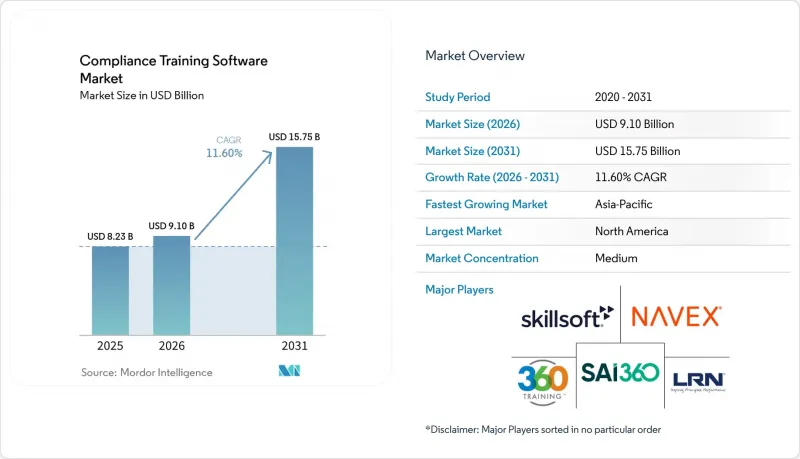
Mordor Intelligence에 의하면, 컴플라이언스 교육 소프트웨어 시장 규모는 2025년에 82억 3,000만 달러, 2026년에 91억 달러, 2031년까지 157억 5,000만 달러에 이를 것으로 예측됩니다.
2026년부터 2031년까지 연평균 성장률(CAGR) 11.60%로 성장할 것으로 전망됩니다.
본 보고서는 도입 모델(클라우드 기반 등), 제공 형태(온라인, 혼합형, 대면형), 기업 규모(대기업, 중소기업), 교육 유형(데이터 개인정보 보호 및 규정 준수 등), 업종(IT 및 통신, BFSI 등), 그리고 지역별로 분류되어 있습니다. 시장 전망은 금액(달러) 기준으로 제시되어 있습니다.
전 세계 컴플라이언스 교육 소프트웨어 시장 동향 및 인사이트
데이터 개인정보 보호 및 사이버 보안 규제 강화
컴플라이언스 교육 소프트웨어 시장은 여러 관할 구역에서 개인정보 보호 및 사이버 보안 규제가 급속히 확대되고 있는 것을 배경으로 성장세를 보이고 있습니다. 2026년 1월 현재, 미국 20개 주에서 종합적인 개인정보 보호법이 시행되고 있으며, 그중 8개 법은 2025년에 발효되었습니다. 이로 인해 기존의 교육 프로그램만으로는 컴플라이언스 환경을 관리하기가 어려워지고 있습니다. 미국 국방부는 2025년 11월, ‘사이버 보안 성숙도 모델 인증(CMMC)’에 대한 최종 규정을 공식적으로 제정했습니다. 이로 인해 사이버 보안 교육의 필요성이 방위 산업 공급망의 더 깊은 단계까지 확대되면서, 체계적인 프로그램을 필요로 하는 조직의 범위가 넓어졌습니다. 또한, NIST 사이버 보안 프레임워크 2.0은 거버넌스의 대상을 보다 광범위한 기업 전체로 확대하고, 교육 대상을 IT 팀 내부에만 국한하지 않고 법무, 홍보, 운영 및 경영진의 역할까지 포함하도록 요구하고 있습니다. 각 주의 개인정보 보호 규제 당국이 조사 활동을 더욱 긴밀히 협력해 나가는 가운데, 규정 준수 교육 소프트웨어 시장에서는 지역에 따른 컨텐츠 할당, 역할별 의무 추적, 그리고 여러 규정 세트에 걸친 이수 현황 기록을 동시에 수행할 수 있는 플랫폼에 대한 수요가 증가하고 있습니다.
직장 내 행동 강령 및 괴롭힘 예방 교육 의무화 확대
미국 각 관할 구역에서 직장 내 행동 및 괴롭힘에 관한 의무 교육의 확산 또한 컴플라이언스 교육 소프트웨어 시장을 뒷받침하고 있습니다. 현재 최소 14개 관할 구역에서 주 정부의 의무 규정이 근로자에게 적용되고 있으며, 그 밖의 많은 주에서도 공식 프로그램의 시행이 강력히 권장되고 있기 때문에 시행 시기, 기간, 기록 관리에 관한 다양한 규정에 대응할 수 있는 시스템에 대한 수요가 높아지고 있습니다. 워싱턴주는 2026년 1월 1일부터 외딴 지역에 위치한 호텔, 모텔, 소매점 및 경비원 직원을 대상으로 의무화된 교육을 확대했습니다. 이는 교육 규정이 시간이 지남에 따라 업종별로 특화되어 가고 있음을 보여줍니다. 미국 고용기회균등위원회(EEOC)에는 여전히 연간 2만 5,000건 이상의 직장 내 괴롭힘 관련 민원이 접수되고 있으며, 이로 인해 고용주들은 교육이 일회성이고 비공식적인 것이 아니라 체계화되어 있고 적절하게 문서화되어 있음을 입증해야 한다는 강한 압력을 받고 있습니다. 이러한 상황에서 컴플라이언스 교육 소프트웨어 시장에서는 서로 다른 관할 구역의 규정을 관리하고, 기록을 보관하며, 장기적으로 측정 가능한 교육 성과를 뒷받침할 수 있는 통합 플랫폼에 대한 수요가 높아지고 있습니다.
교육 피로와 학습자의 낮은 참여도
컴플라이언스 교육 소프트웨어 시장은 여전히 도입에 있어 큰 과제에 직면해 있습니다. 많은 직원들이 필수 교육을 일상 업무에 도움이 되는 것이 아니라, 단순한 법적 요건으로만 여기고 있기 때문입니다. 조사에 따르면, 72%의 조직이 온라인 교육의 주요 과제로 학습자의 참여도를 꼽은 반면, 온라인 강사 주도형 교육을 ‘매우 효과적’이라고 평가한 비율은 고작 27%에 그쳤습니다. 컨텐츠가 실제 업무 상황과 동떨어져 있다고 느껴질 경우, 자기 주도형 플랫폼의 수료율은 급격히 떨어질 가능성이 있습니다. 이로 인해 형식적인 수료율은 겉보기에는 양호해 보일지라도, 지식의 정착률과 소프트웨어 업데이트의 가치에 대한 인식이 모두 약화됩니다. 컴플라이언스 교육 소프트웨어 시장에서는 마이크로러닝, 게임화 형식, 시나리오 기반 도구 등을 통해 대응하고 있지만, 학습자의 피로감은 프로그램의 효과를 지속시키는 데 여전히 큰 걸림돌이 되고 있습니다.
부문별 분석
2025년, 컴플라이언스 교육 소프트웨어 시장의 66.12%를 클라우드 기반 배포가 차지했으며, 자동 업데이트, 일원화된 관리 및 관련 엔터프라이즈 시스템과의 통합이 필요한 조직의 경우 SaaS 제공 방식이 선호되는 모델로 자리 잡은 것으로 확인되었습니다. 실무적으로 볼 때, 이러한 상황은 규제 대상 컨텐츠의 신속한 업데이트, 더 높은 확장성, 그리고 HRIS 및 GRC 환경과의 강력한 워크플로우 통합에 대한 시장의 선호도를 반영하고 있습니다. 또한, 클라우드 모델은 여러 사무실이나 지역에 걸쳐 있는 로컬 인프라를 유지 관리할 필요 없이, 분산된 직원들에게 접근해야 하는 조직에도 적합합니다. 향후 몇 년 동안 사이버 보안 감사 요건이 더욱 체계화되고 문서화 부담이 커짐에 따라, 이러한 이점은 더욱 두드러지고 있습니다. 따라서 컴플라이언스 교육 소프트웨어 시장은 컨텐츠 배포, 보고서 작성, 감사 추적을 단일 관리 환경에 통합한 호스팅형 플랫폼으로 지속적으로 전환되고 있습니다.
On-Premise 배포는 데이터 보관 요건, 에어갭 환경 또는 내부 보안 규정으로 인해 공유 클라우드 환경의 이용이 제한되는 상황에서 여전히 그 중요성을 유지하고 있습니다. 정부 기관, 방위 관련 기업 및 일부 대형 금융 기관은 많은 일반 기업 사용자보다 더 엄격한 관리 요건 하에서 운영되는 경우가 많기 때문에 이러한 경향의 가장 두드러진 사례로 계속해서 꼽히고 있습니다. 하이브리드 모델은 2026년부터 2031년까지 연평균 성장률(CAGR) 14.67%를 나타낼 것으로 예측되며, 조직들이 클라우드의 유연성과 On-Premise 관리의 균형을 모색하는 가운데, 규정 준수 교육 소프트웨어 업계에서 가장 빠르게 성장하는 모델이 될 전망입니다. 2026년 4월에 출시된 ‘Companion’ 브라우저 확장 기능과 ‘Harmony AI’ 검색 도구는 주요 벤더들이 기존의 도입 모델이 아닌, 클라우드를 통해 제공되는 맥락 인식형 학습 경험을 기반으로 서비스를 구축하고 있음을 보여줍니다. 이 제품의 방향성은 컴플라이언스 교육 소프트웨어 시장에서 새로운 수요가 단순한 컨텐츠 호스팅을 넘어, 일상적인 업무 흐름에서의 사용 편의성과 점점 더 밀접하게 연결되고 있는 현 상황을 뒷받침하는 것입니다.
2025년, 컴플라이언스 교육 소프트웨어 시장의 72.74%를 온라인 제공 방식이 차지했으며, 기업 규모나 최종 사용자층에 관계없이 자기 주도형 디지털 학습이 주류 형식으로 자리 잡았습니다. 이러한 공유 방식은 지리적으로 분산된 직원들에게서 나타나는 규모 확대, 반복성 및 손쉬운 접근에 대한 요구를 반영한 것입니다. 또한, 온라인 형식은 고용주가 수료 현황을 보다 쉽게 추적하고 관리할 수 있게 해 주었으며, 여러 가지 규정 준수 주제를 동시에 다룰 수 있게 해주었습니다. 많은 조직에게 디지털 배포는 규정 준수 교육 소프트웨어 시장의 기반을 이루고 있습니다. 이는 교실에서의 프로그램보다 신속하게 진행할 수 있으며, 재택근무나 교대 근무 방식의 인력 배치 모델과 잘 어울리기 때문입니다. 이러한 기반이 더 높은 참여도를 요구하는 형식의 필요성을 배제하지는 않았지만, 디지털 학습을 기본 전달 수단으로 확립했습니다.
블렌디드 러닝 시장은 2026년부터 2031년까지 연평균 성장률(CAGR) 13.84%로 성장할 것으로 전망됩니다. 이는 많은 수강생들이 단순히 수료증을 취득하는 데 그치지 않고, 지식을 더욱 탄탄하게 다지고 실천에 옮기기를 원하고 있음을 보여줍니다. 이 형식은 자기 주도형 모듈과 실시간 세션, 코칭 또는 시나리오 토론을 결합한 것으로, 정책만 이해하는 것만으로는 충분하지 않은 주제를 다루는 데 도움이 됩니다. 블렌디드 러닝은 교실 내 교육만 실시하는 경우와 비교해 참여도를 24% 더 높여주며, 전 세계 조직에서 널리 채택되고 있습니다. 이와 병행하여, 2026년 1월에는 기업 내 학습 프로그램에서 지도형 실습을 손쉽게 확대할 수 있도록 하기 위한 목적으로, AI 비디오 시뮬레이션 및 프롬프트 기반 시나리오 코칭 도구가 출시되었습니다. 이러한 동향은 컴플라이언스 교육 소프트웨어 시장이 공식적인 수료와 직장 내 실질적인 적용을 연계하는 제공 모델로 전환되고 있음을 시사합니다.
지역별 분석
2025년 기준으로 북미는 규정 준수 교육 소프트웨어 시장 점유율의 36.88%를 차지하며, 이 시장에서 가장 큰 비중을 차지하는 지역입니다. 이 지역에서는 HIPAA, OSHA, FINRA, 사이버 보안 성숙도 모델 인증(CMMC), 법무부(DOJ) 데이터 보안 프로그램과 같은 연방 규정뿐만 아니라 다수의 주 개인정보 보호법이 복합적으로 적용되어, 전 세계에서 가장 다층적인 교육 환경 중 하나를 형성하고 있습니다. 이러한 구조 덕분에, 교육 배정을 자동화하고 기록을 보관하며, 역할, 주, 업무 기능별로 교육을 구분할 수 있는 플랫폼에 대한 높은 수요가 뒷받침되고 있습니다. 2025년 9월 캘리포니아주에서 부과된 135만 달러의 벌금은 규정 준수 미비로 인해 발생하는 막대한 비용을 여실히 보여주고 있습니다. 캐나다에서는 주 정부가 규제하는 식품 및 직장 안전 교육을 통해 수요가 주도되고 있는 반면, 멕시코에서는 북미 전역에서 사업을 전개하는 다국적 기업들 사이에서 스페인어 모듈에 대한 초기 수요가 발생하고 있습니다.
유럽은 GDPR(EU 개인정보보호규정) 시행으로 인해 직원의 개인 데이터 처리 상황이 엄격하게 감시되고, 관리 체제가 미흡한 기업에는 막대한 벌금이 부과되기 때문에 구조적으로 중요한 시장으로 남아 있습니다. EU AI법은 2025년 2월 제4조에 따른 AI 리터러시 의무가 시행되고, 2026년 8월까지 고위험 시스템에 대한 보다 철저한 규정 준수가 요구됨에 따라 새로운 수요층을 창출했습니다. 2026년 조사에 따르면, 직원 절반 이상이 이미 AI 도구를 사용하고 있음에도 불구하고 생성형 AI에 정통한 사람은 4명 중 1명에 불과한 것으로 나타나, 체계적인 직원 교육의 지속적인 필요성이 부각되었습니다. 독일, 영국, 프랑스는 규제 대상인 금융, 제조, 생명과학 분야의 활동이 집중되어 있어, 유럽 내에서 여전히 최대의 국가별 시장으로 자리매김하고 있습니다. 아시아태평양은 중국, 홍콩, 인도, 호주가 사이버 보안, 개인정보 보호, AI 관련 요건을 강화함에 따라 2026년부터 2031년까지 연평균 성장률(CAGR) 14.39%를 기록하며 가장 빠르게 성장하는 지역이 될 것으로 전망됩니다.
남미는 여전히 초기 단계에 있지만, 브라질의 데이터 보호법 집행과 칠레의 제도적 기반 구축이 진행되고 있는 만큼, 포르투갈어 및 스페인어를 활용한 디지털 규정 준수 대응에 대한 기초적인 수요가 발생하고 있습니다. 중동에서는 사우디아라비아와 아랍에미리트(UAE)가 데이터 보호, 보안 대책, 국경을 넘는 데이터 이전 의무와 관련된 체계를 구축해 나가고 있으며, 이에 따라 현지 언어로 번역된 교육 컨텐츠와 더욱 충실한 문서에 대한 수요가 높아지고 있습니다. 아프리카는 주로 남아프리카공화국의 ‘개인정보보호법’에 힘입어 장기적인 기회가 예상되지만, 나이지리아나 이집트 등 시장은 규제 체계가 아직 초기 단계에 있습니다. 이 지역 전반에 걸쳐, 컴플라이언스 교육 소프트웨어 시장에 대한 공급업체의 진출은 아직 성숙 단계에 이르지 못했으며, 수요는 대개 현지화 능력이나 새로운 국내 규정에 맞추어 컨텐츠를 조정하는 능력에 좌우되고 있습니다.
기타 혜택:
- 엑셀 형식 시장 예측(ME) 시트
- 3개월간의 애널리스트 지원
자주 묻는 질문
목차
제1장 서론
제2장 조사 방법
제3장 주요 요약
제4장 시장 구도
제5장 시장 규모와 성장 예측
제6장 경쟁 구도
제7장 시장 기회와 향후 전망
JHS 26.06.23According to Mordor Intelligence, the compliance training software market size is projected to be USD 8.23 billion in 2025, USD 9.10 billion in 2026, and reach USD 15.75 billion by 2031, growing at a CAGR of 11.60% from 2026 to 2031.
This report is Segmented by Deployment Model (Cloud-Based, and More), Delivery Mode (Online, Blended, and Classroom), Enterprise Size (Large Enterprises, and Small and Medium-Sized Enterprises), Training Type (Data Privacy and Protection Compliance, and More), Industry Vertical (IT and Telecom, BFSI, and More), and Geography. The Market Forecasts are Provided in Terms of Value (USD)
Global Compliance Training Software Market Trends and Insights
Stricter Data Privacy And Cybersecurity Enforcement
The compliance training software market is gaining momentum from the rapid expansion of privacy and cybersecurity enforcement across multiple jurisdictions. Twenty U.S. states had comprehensive privacy laws in effect as of January 2026, and 8 of those laws took effect in 2025, making the compliance environment harder to manage with static training programs alone. The U.S. Department of Defense formalized the Cybersecurity Maturity Model Certification final rule in November 2025, which extended cybersecurity training needs deeper into the defense supply chain and widened the pool of organizations that need structured programs. NIST Cybersecurity Framework 2.0 also expanded governance to a broader enterprise context, requiring training to reach legal, communications, operational, and executive roles rather than remaining within IT teams. As privacy regulators across states coordinate investigations more closely, the compliance training software market is benefiting from demand for platforms that can assign location-based content, track role-specific obligations, and document completion across multiple rule sets simultaneously.
Expansion Of Mandatory Workplace Conduct And Harassment Training
The broader adoption of mandatory workplace conduct and harassment training across U.S. jurisdictions also supports the compliance training software market. State obligations now cover employees in at least 14 jurisdictions, while many other states strongly encourage formal programs, which increases demand for systems that can handle different rules on timing, duration, and recordkeeping. Washington State expanded mandatory training to include isolated hotel, motel, retail, and security guard employees on January 1, 2026, demonstrating how training rules are becoming more sector-specific over time. The U.S. Equal Employment Opportunity Commission continues to receive more than 25,000 workplace harassment complaints annually, which keeps pressure on employers to demonstrate that training is structured and well-documented rather than occasional and informal. In this setting, the compliance training software market is seeing stronger demand for centralized platforms that can manage different jurisdictional rules, retain records, and support measurable training outcomes over time.
Training Fatigue And Low Learner Engagement
The compliance training software market still faces a meaningful adoption challenge because many employees approach mandatory training as a legal requirement rather than a useful part of daily work. Research found that 72% of organizations cited learner engagement as their main challenge in virtual training, while only 27% viewed their virtual instructor-led training as highly effective. Completion rates on self-directed platforms can fall sharply when content feels disconnected from real work situations. This weakens both knowledge retention and the perceived value of software renewals, even when formal completion rates look acceptable on paper. The compliance training software market is responding with microlearning, gamified formats, and scenario-based tools, but learner fatigue remains a real drag on sustained program effectiveness.
Other drivers and restraints analyzed in the detailed report include:
- Shift Toward Cloud-Based And Mobile Learning Delivery
- Greater Need For Audit-Ready Tracking, Certification, And Reporting
- Budget Constraints Among Small And Medium-Sized Enterprises
For complete list of drivers and restraints, kindly check the Table Of Contents.
Segment Analysis
Cloud-based deployment captured 66.12% of the compliance training software market in 2025, confirming that SaaS delivery had become the preferred model for organizations that need automatic updates, centralized administration, and integration with adjacent enterprise systems. In practical terms, this position reflects a market preference for faster regulatory content refreshes, greater scalability, and stronger workflow integration with HRIS and GRC environments. The cloud model also fits organizations that need to reach distributed employees without maintaining local infrastructure across several offices or regions. This advantage is becoming more visible as cybersecurity audit expectations become more formal and more documentation-heavy in the years ahead. The compliance training software market has therefore continued to shift toward hosted platforms that combine content delivery, reporting, and audit trails in a single managed environment.
On-premises deployment still retained relevance where data residency requirements, air-gapped operations, or internal security rules limited the use of shared cloud environments. Government agencies, defense contractors, and some large financial institutions remained the clearest examples of this pattern because they often operate under stricter control requirements than most commercial users. Hybrid deployment is projected to grow at a 14.67% CAGR from 2026 to 2031, making it the fastest-growing model in the compliance training software industry as organizations seek a balance between cloud flexibility and local control. The April 2026 release of the Companion browser extension and the Harmony AI search tools also showed how leading vendors are building on cloud-delivered, context-aware learning experiences rather than legacy deployment assumptions. That product direction supports a compliance training software market in which new demand is increasingly tied to usability in daily workflows rather than to basic content hosting alone.
Online delivery accounted for 72.74% of the compliance training software market in 2025, making self-paced digital learning the dominant format across enterprise sizes and end-user groups. This share reflected the need for scale, repeatability, and easy access across geographically spread workforces. Online formats also gave employers greater control over completion tracking and easier deployment across multiple compliance topics at once. For many organizations, digital delivery has become the foundation of the compliance training software market because it enables faster rollouts than classroom-led programs and works better with remote or shift-based staffing models. That base has not removed the need for higher-engagement formats, but it has established digital learning as the default delivery layer
Blended learning is projected to grow at a 13.84% CAGR from 2026 to 2031, which shows that many buyers now want stronger retention and behavioral reinforcement rather than certificate completion alone. The format combines self-paced modules with live sessions, coaching, or scenario discussions, helping organizations address topics where policy understanding alone is not enough. Blended learning delivered 24% higher engagement than classroom-only training and has seen wider adoption across organizations globally. In parallel, the January 2026 release of AI video simulations and prompt-to-scenario coaching tools aimed at making guided practice easier to scale within enterprise learning programs. These developments suggest that the compliance training software market is moving toward delivery models that connect formal completion with practical application in the workplace.
Geography Analysis
North America held 36.88% of the compliance training software market share in 2025, making it the largest regional contributor. The region combines federal requirements such as HIPAA, OSHA, FINRA, the Cybersecurity Maturity Model Certification, and the DOJ Data Security Program with a large body of state privacy laws, creating one of the most layered training environments globally. That structure supports high demand for platforms that can automate assignment, retain records, and differentiate training by role, state, and business function. A USD 1,350,000 fine issued in California in September 2025 illustrated the high cost of compliance gaps. Canada is driving demand through provincially regulated food and workplace safety training, while Mexico is generating early demand for Spanish-language modules among multinationals managing operations across North America.
Europe remains structurally important because GDPR enforcement keeps employee handling of personal data under scrutiny and exposes firms to large penalties for weak controls. The EU AI Act added a new demand layer when Article 4 AI literacy obligations became enforceable in February 2025, with fuller compliance for high-risk systems required by August 2026. Research in 2026 found that only 1 in 4 employees had high generative AI fluency, even though more than half were already using AI tools, underscoring a sustained need for structured workforce education. Germany, the United Kingdom, and France remain the largest country markets in Europe due to their concentration of regulated financial, manufacturing, and life sciences activity. Asia-Pacific is projected to grow at a 14.39% CAGR from 2026 to 2031, making it the fastest-growing region as China, Hong Kong, India, and Australia advance cybersecurity, privacy, and AI requirements.
South America remains at an earlier stage, but Brazil's data protection enforcement and Chile's evolving framework are creating baseline demand for digital compliance delivery in Portuguese and Spanish. The Middle East is advancing as Saudi Arabia and the UAE put more structure in place for data protection, security safeguards, and cross-border transfer obligations, which increases the need for localized training content and better documentation. Africa is a longer-horizon opportunity, led mainly by South Africa's Protection of Personal Information Act, while markets such as Nigeria and Egypt are still in earlier stages of regulatory development. Across these regions, vendor participation in the compliance training software market is still less mature, and demand often depends on localization capacity and the ability to adapt content to emerging national rules.
- Skillsoft Corporation
- NAVEX Global, Inc.
- SAI360 Inc.
- LRN Corporation
- Syntrio, Inc.
- Skillcast Group plc
- EasyLlama Inc.
- Axonify Inc.
- WorkRamp, Inc.
- OpenSesame Inc.
- iSpring Solutions, Inc.
- KnowBe4, Inc.
- Docebo Inc.
- Absorb Software Inc.
- Epignosis LLC
- Litmos US, L.P.
- RedVector.com, LLC
- GRC Solutions Pty Ltd
- LearnWorlds (CY) Ltd
- LearnUpon Limited
- 360training.com, Inc.
Additional Benefits:
- The market estimate (ME) sheet in Excel format
- 3 months of analyst support
TABLE OF CONTENTS
1 INTRODUCTION
- 1.1 Study Assumptions and Market Definition
- 1.2 Scope of the Study
2 RESEARCH METHODOLOGY
3 EXECUTIVE SUMMARY
4 MARKET LANDSCAPE
- 4.1 Market Overview
- 4.2 Market Drivers
- 4.2.1 Stricter Data Privacy and Cybersecurity Enforcement
- 4.2.2 Expansion of Mandatory Workplace Conduct and Harassment Training
- 4.2.3 Shift Toward Cloud-Based and Mobile Learning Delivery
- 4.2.4 Greater Need for Audit-Ready Tracking, Certification, and Reporting
- 4.2.5 Artificial Intelligence Literacy and Responsible Use Training Requirements
- 4.2.6 Workplace Violence Prevention Mandates Expanding Training Scope
- 4.3 Market Restraints
- 4.3.1 Training Fatigue and Low Learner Engagement
- 4.3.2 Budget Constraints Among Small and Medium-Sized Enterprises
- 4.3.3 Localization and Legal Review Bottlenecks Across Jurisdictions
- 4.3.4 Pushback on Sensitive Culture, Conduct, and Inclusion Content
- 4.4 Impact of Macroeconomic Factors on the Market
- 4.5 Industry Value Chain Analysis
- 4.6 Regulatory Landscape
- 4.7 Technological Outlook
- 4.8 Porter's Five Forces Analysis
- 4.8.1 Threat of New Entrants
- 4.8.2 Bargaining Power of Buyers
- 4.8.3 Bargaining Power of Suppliers
- 4.8.4 Threat of Substitutes
- 4.8.5 Intensity of Competitive Rivalry
5 MARKET SIZE AND GROWTH FORECASTS (VALUE)
- 5.1 By Deployment Model
- 5.1.1 Cloud-Based
- 5.1.2 On-Premises
- 5.1.3 Hybrid
- 5.2 By Delivery Mode
- 5.2.1 Online
- 5.2.2 Blended
- 5.2.3 Classroom
- 5.3 By End User Enterprise Size
- 5.3.1 Large Enterprises
- 5.3.2 Small and Medium-Sized Enterprises
- 5.4 By Training Type
- 5.4.1 Cybersecurity and Information Security Compliance
- 5.4.2 Data Privacy and Protection Compliance
- 5.4.3 AI Governance and Responsible AI Compliance
- 5.4.4 Ethics and Corporate Governance
- 5.4.5 DEI, Anti-harassment and Workplace Conduct
- 5.4.6 Anti-bribery and Anti-corruption
- 5.4.7 AML, KYC and Financial Crime Compliance
- 5.4.8 Workplace Safety and EHS Compliance
- 5.4.9 ESG and Sustainability Compliance
- 5.4.10 Third-party and Vendor Risk Compliance
- 5.4.11 Industry-specific Regulatory Compliance
- 5.5 By End User Vertical
- 5.5.1 IT and Telecom
- 5.5.2 Industrial Manufacturing
- 5.5.3 Healthcare and Life Sciences
- 5.5.4 Retail and Ecommerce
- 5.5.5 Energy and Utilities
- 5.5.6 Transportation and Logistics
- 5.5.7 BFSI
- 5.5.8 Construction and Engineering
- 5.5.9 Government, Defense, and Public Sector
- 5.6 By Geography
- 5.6.1 North America
- 5.6.1.1 United States
- 5.6.1.2 Canada
- 5.6.1.3 Mexico
- 5.6.2 South America
- 5.6.2.1 Brazil
- 5.6.2.2 Argentina
- 5.6.2.3 Chile
- 5.6.2.4 Rest of South America
- 5.6.3 Europe
- 5.6.3.1 Germany
- 5.6.3.2 United Kingdom
- 5.6.3.3 France
- 5.6.3.4 Italy
- 5.6.3.5 Spain
- 5.6.3.6 Rest of Europe
- 5.6.4 Asia-Pacific
- 5.6.4.1 China
- 5.6.4.2 Japan
- 5.6.4.3 India
- 5.6.4.4 Australia
- 5.6.4.5 South Korea
- 5.6.4.6 Singapore
- 5.6.4.7 Rest of Asia-Pacific
- 5.6.5 Middle East
- 5.6.5.1 Saudi Arabia
- 5.6.5.2 United Arab Emirates
- 5.6.5.3 Turkey
- 5.6.5.4 Rest of Middle East
- 5.6.6 Africa
- 5.6.6.1 South Africa
- 5.6.6.2 Egypt
- 5.6.6.3 Nigeria
- 5.6.6.4 Rest of Africa
- 5.6.1 North America
6 COMPETITIVE LANDSCAPE
- 6.1 Market Concentration
- 6.2 Strategic Moves
- 6.3 Market Share Analysis
- 6.4 Company Profiles (includes Global Level Overview, Market Level Overview, Core Segments, Financials as available, Strategic Information, Market Rank/Share, Products and Services, Recent Developments).
- 6.4.1 Skillsoft Corporation
- 6.4.2 NAVEX Global, Inc.
- 6.4.3 SAI360 Inc.
- 6.4.4 LRN Corporation
- 6.4.5 Syntrio, Inc.
- 6.4.6 Skillcast Group plc
- 6.4.7 EasyLlama Inc.
- 6.4.8 Axonify Inc.
- 6.4.9 WorkRamp, Inc.
- 6.4.10 OpenSesame Inc.
- 6.4.11 iSpring Solutions, Inc.
- 6.4.12 KnowBe4, Inc.
- 6.4.13 Docebo Inc.
- 6.4.14 Absorb Software Inc.
- 6.4.15 Epignosis LLC
- 6.4.16 Litmos US, L.P.
- 6.4.17 RedVector.com, LLC
- 6.4.18 GRC Solutions Pty Ltd
- 6.4.19 LearnWorlds (CY) Ltd
- 6.4.20 LearnUpon Limited
- 6.4.21 360training.com, Inc.
7 MARKET OPPORTUNITIES AND FUTURE OUTLOOK
- 7.1 White-Space and Unmet-Need Assessment


