|
시장보고서
상품코드
2063939
AI CRISPR 툴 시장 : 점유율 분석, 업계 동향과 통계, 성장 예측(2026-2031년)AI CRISPR Tools - Market Share Analysis, Industry Trends & Statistics, Growth Forecasts (2026 - 2031) |
||||||
 Mordor Intelligence
Mordor Intelligence에 의하면, AI CRISPR 툴 시장 규모는 2025년에 7억 8,000만 달러, 2026년에 9억 6,000만 달러, 2031년까지 27억 6,000만 달러에 이를 것으로 예측됩니다.
2026년부터 2031년까지 연평균 성장률(CAGR) 23.45%로 성장할 것으로 전망됩니다.
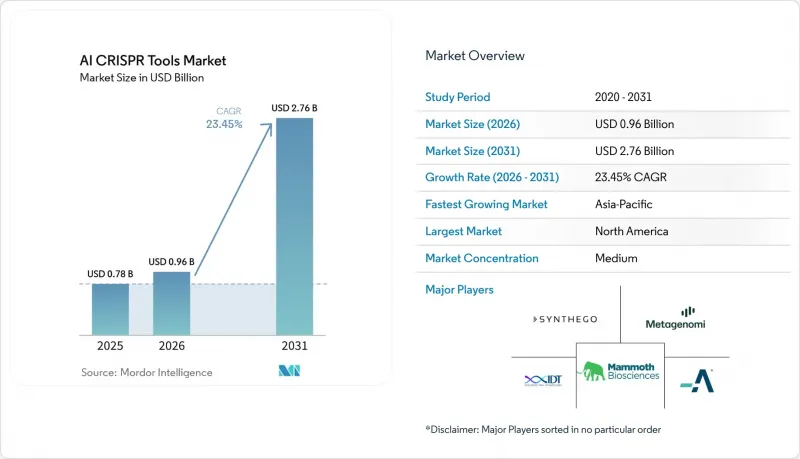
본 보고서는 제공 형태(소프트웨어, 하드웨어, 서비스), CRISPR 기술(Cas9, Cas12, Cas13, 베이스 에디팅, 프라임 에디팅, 기타), 용도(신약 개발, 치료제 개발, 유전체학, 진단, 기타), 도입 형태(클라우드 기반, 하이브리드형, On-Premise형), 최종 사용자(제약, 학술 기관, CRO, 기타), 지역(북미, 유럽, 아시아태평양, 중동 및 아프리카, 남미)에 따라 분류되어 있습니다. 예상치는 금액(달러)으로 표시되어 있습니다.
전 세계 AI CRISPR 툴 시장 동향 및 인사이트
가이드 RNA 설계 및 오프타겟 예측 분야에서 AI 활용 확대
AI CRISPR 툴 시장은 가이드 RNA 설계 및 오프타겟 예측 모델의 개선을 통해 발전하고 있습니다. 2025년, 딥러닝 모델인 CCLMoff는 시퀀싱 입력만을 활용하여 418종의 단일 가이드는 RNA에 걸친 CIRCLE-seq 오프타겟 데이터셋에서 AUROC 0.985를 달성했습니다. 이러한 높은 예측 정확도 덕분에 실험실에서의 스크리닝을 반복할 필요가 줄어들면서, 전임상 단계의 안전성 평가가 인실리코를 통한 선별 방식으로 전환되고 있습니다. 이러한 전환을 통해 설계 라이브러리의 확장성이 향상되었으며, 치료제 개발 및 신약 개발 프로그램에서 설계 소프트웨어와 예측 서비스에 대한 수요가 증가하고 있습니다. 연구자들은 더 많은 후보 물질을 조기에 평가할 수 있게 되었으며, 이를 통해 후속 단계에서 성능이 낮은 가이드 RNA를 최소화할 수 있게 되었습니다.
CRISPR 치료제의 임상 파이프라인 확대가 플랫폼 수요를 견인
다양한 질환에 걸친 CRISPR 임상 프로그램의 확대가 CRISPR 툴 시장에서 AI 플랫폼에 대한 수요를 견인하고 있습니다. 각 치료 프로그램에서는 표적 선정, 가이드 최적화, 안전성 모델링, 제조 준비를 위한 지속적인 설계 지원이 필요합니다. 현재 계산 엔진은 여러 대상을 지원하며, 플랫폼에 대한 수요는 실험실 지출보다 더 빠르게 증가하고 있습니다. 이러한 변화로 인해 단일 제품 판매보다 지속적인 소프트웨어 및 워크플로우 서비스의 가치가 높아지고 있습니다. 신속한 재설계와 근거 확보가 필수적인 희귀질환 및 맞춤형 의료 분야에서 AI 툴는 점점 더 없어서는 안 될 존재가 되고 있습니다. 검증된 워크플로우를 갖춘 공급업체는 프로그램이 임상적 이정표에 가까워질수록 더 대규모의 장기 계약을 체결할 수 있는 입장에 있습니다.
유전체학 분야에서 AI 모델 학습을 위한 고도의 복잡성과 대규모 데이터셋의 요구 사항
AI CRISPR 툴 시장은 다양한 편집 작업에 걸친 데이터 커버리지 부족으로 인해 중대한 과제에 직면해 있습니다. 2025년 리뷰에서는 3,456편의 논문을 바탕으로 50건의 AI 예측 연구를 분석했으나, 10가지 CRISPR 과제 전체에서 공개된 벤치마크 데이터셋은 고작 80건밖에 확인되지 않았습니다. 이러한 제약으로 인해, 많은 모델은 특정 훈련 조건에서는 우수한 성능을 발휘하지만, 다양한 세포 유형, 종 및 CRISPR 기법에 일반화할 수 없습니다. 벤더들은 신뢰성 높은 툴를 개발하기 위해 방대한 양의 독자적인 데이터 세트가 필요하지만, 이러한 데이터 세트를 생성하는 데는 막대한 비용이 소요되기 때문에 기존 주요 기업들이 유리한 입장에 서게 되어 신규 진입이 저해되고 있습니다. 그 결과, 중요한 생물학적 데이터에 접근하기 어렵기 때문에 시장의 성장 잠재력은 제한되고 있습니다.
부문별 분석
2025년, AI CRISPR 툴 시장에서 소프트웨어가 주도적인 위치를 차지하며 시장 점유율의 56.20%를 기록했습니다. 이는 조사 및 제약 워크플로우에서 설계, 분석, 데이터 관리 플랫폼이 수행하는 중요한 역할을 반영하고 있습니다. 이 소프트웨어는 가이드 설계, 편집 및 분석, 워크플로우 자동화, 데이터 추적성을 위한 제어 계층의 역할을 수행하며, 조기 도입과 높은 전환 비용을 촉진하고 있습니다. 시장은 모델, 실험 데이터, 규정 준수 요건을 통합하는 플랫폼을 통해 점점 더 형성되어 가고 있습니다.
2025년 10월 Benchling이 ‘Benchling AI’를 출시한 것은 심층 조사 에이전트 및 워크플로우에 대한 자동 데이터 입력 기능 등의 통합을 통해 제공 서비스의 진화를 여실히 보여주었습니다. 이 플랫폼은 머크(Merck)와 모더나(Moderna) 등 주요 기업을 포함해 전 세계 1,300개 이상의 생명공학 기업과 7,500개 이상의 학술 기관에 서비스를 제공합니다. 설계, 분석, 실행 모델을 통합한 솔루션에 대한 수요에 힘입어, 서비스 시장은 2031년까지 연평균 성장률(CAGR) 25.05%로 급속히 확대될 것으로 전망됩니다. 업계는 소프트웨어가 워크플로우의 기반이 되고, 사내에 충분한 역량을 갖추지 못한 고객에 대한 접근을 서비스가 확대하는 하이브리드 모델로 전환되고 있습니다.
2025년, CRISPR-Cas9은 AI CRISPR 툴 시장에서 37.78%의 점유율을 차지하며 주요 기술로서의 위상을 유지했습니다. 이러한 우위는 확립된 도입 프로토콜, 안전성 프로파일, 그리고 사용자의 신뢰를 쌓아온 광범위한 가이드 설계 실적을 바탕으로 뒷받침되고 있습니다. 많은 AI 모델은 업계의 기존 지식 기반을 활용하여 Cas9 데이터셋을 중심으로 최적화되어 있습니다.
CRISPR-Cas12는 2031년까지 연평균 성장률(CAGR) 25.76%를 기록하며 성장할 것으로 예상되며, 가장 빠르게 성장하는 부문이 될 전망입니다. 이 단일 가닥 DNA의 부수적인 절단 활성은 진단을 지원하고, 기존의 편집 워크플로우를 넘어선 활용 사례를 확대합니다. Cas12는 그 정확성, 다양한 표적화 특성, 그리고 높은 적응성을 갖춘 플랫폼 경제성 덕분에 지지를 얻고 있으며, 기능적 다양성 확대를 향한 시장의 변화를 반영하고 있습니다.
지역별 분석
2025년, 북미는 AI CRISPR 툴 시장의 42.30% 점유율을 차지하며 최대 지역 기여자로서의 위상을 유지했습니다. 이 지역은 플랫폼 개발자, 자금 조달 네트워크, 그리고 첨단 클라우드 인프라로 구성된 강력한 생태계의 혜택을 누리고 있습니다. 미국은 임상 단계의 유전자 편집 프로그램에서 증거 기준을 확립하는 데 중요한 역할을 수행하고 있으며, AI CRISPR 툴의 상용화 분야에서 북미의 주도적 위치를 더욱 공고히 하고 있습니다. 아시아태평양은 2031년까지 연평균 성장률(CAGR) 27.25%를 기록하며 성장할 것으로 예상되며, AI CRISPR 툴 시장에서 가장 빠르게 성장하는 지역이 될 전망입니다. 이러한 성장은 생명과학 분야에 대한 투자 증가, 개발 역량 확대, 그리고 연구개발 외주 수요 증가에 힘입어 이루어지고 있습니다. 레거시 시스템의 제약 없이 신속하게 규모를 확대할 수 있는 이 지역의 역량은 서비스 주도형 솔루션을 제공하는 데 있어 중요한 역할을 담당하고 있습니다.
유럽은 독일, 영국, 프랑스, 이탈리아, 스페인에서의 조사 활동을 바탕으로 2위 지역 시장이 되었습니다. 이 지역의 학술 연구 및 중개연구센터는 편집 설계, 복원 예측, 표적 검증에 크게 기여하고 있습니다. 강력한 국경을 초월한 협력을 통해, 유럽은 계산생물학 및 임상 연구의 허브로서의 역할을 더욱 공고히 하고 있습니다. 남미는 여전히 규모가 작고 발전 단계에 있으며, 활동은 브라질과 아르헨티나에 집중되어 있습니다. 이 지역은 확대되고 있는 CRO 네트워크와 유전자 편집 응용 분야에서의 정부 및 학계 간의 협력을 바탕으로 발전하고 있습니다. 이러한 동향은 AI CRISPR 툴 시장의 다양한 역동성을 여실히 보여주고 있으며, 북미는 상업적 측면에서 선두를 달리고 있고, 아시아태평양은 성장 면에서 두각을 나타내고 있으며, 유럽은 중요한 연구 거점으로서의 역할을 수행하고 있습니다.
기타 혜택:
- 엑셀 형식 시장 예측(ME) 시트
- 3개월간의 애널리스트 지원
자주 묻는 질문
목차
제1장 서론
제2장 조사 방법
제3장 주요 요약
제4장 시장 구도
제5장 시장 규모와 성장 예측
제6장 경쟁 구도
제7장 시장 기회와 향후 전망
JHS 26.06.23According to Mordor Intelligence, the aI cRISPR tools market size is projected to be USD 0.78 billion in 2025, USD 0.96 billion in 2026, and reach USD 2.76 billion by 2031, growing at a CAGR of 23.45% from 2026 to 2031.
This report is Segmented by Offering (Software, Hardware, Services), CRISPR Technology (Cas9, Cas12, Cas13, Base Editing, Prime Editing, Other), Application (Drug Discovery, Therapeutic Development, Genomics, Diagnostics, Other), Deployment (Cloud-Based, Hybrid, On-Premises), End User (Pharma, Academic, Cros, Other), and Geography (North America, Europe, Asia-Pacific, MEA, South America). Forecasts in Value (USD).
Global AI CRISPR Tools Market Trends and Insights
Growing Adoption of AI for Guide RNA Design and Off-Target Prediction
The AI CRISPR tools market is advancing due to improvements in guide RNA design and off-target prediction models. In 2025, a deep learning model, CCLMoff, achieved an AUROC of 0.985 on CIRCLE-seq off-target datasets across 418 single-guide RNAs using sequence input alone. This high prediction accuracy reduces the need for repeated wet-lab screenings, shifting preclinical safety evaluations to in silico filtering. This transition enhances the scalability of design libraries and drives demand for design software and predictive services in therapeutic and discovery programs. Researchers can now test more candidates earlier, minimizing weaker guides in downstream processes.
Expansion of CRISPR Therapeutic Clinical Pipelines Driving Platform Demand
The expansion of clinical CRISPR programs across diverse diseases is driving platform demand in the AI in CRISPR tools market. Each therapeutic program requires ongoing design support for target selection, guide optimization, safety modeling, and manufacturing readiness. Computational engines now support multiple targets, increasing platform demand faster than wet-lab spending. This shift elevates the value of recurring software and workflow services over single product sales. AI tools are becoming critical in rare diseases and personalized medicine, where rapid redesigns and evidence generation are essential. Vendors with validated workflows are positioned to secure larger, long-term contracts as programs approach clinical milestones.
High Complexity and Large Dataset Requirements for AI Model Training in Genomics
The AI CRISPR tools market faces significant challenges due to insufficient data coverage across various editing tasks. A 2025 review analyzed 50 AI predictor studies from 3,456 papers and identified only 80 public benchmark datasets across 10 CRISPR tasks. This limitation causes many models to perform well under specific training conditions but fail to generalize across diverse cell types, species, and CRISPR modalities. Vendors require extensive proprietary datasets to develop reliable tools, but the high cost of generating such datasets favors established players and hinders new entrants. As a result, the market's growth potential is constrained by the difficulty of accessing critical biological data.
Other drivers and restraints analyzed in the detailed report include:
- Emergence of Foundation Model-Based and Generative AI Nuclease Design Platforms
- Strategic Pharma-Biotech Alliances Accelerating AI CRISPR Workflow Adoption
- Regulatory Ambiguity Around AI-Assisted Gene Editing Workflows and Data Governance
For complete list of drivers and restraints, kindly check the Table Of Contents.
Segment Analysis
In 2025, software dominated the AI CRISPR tools market, capturing 56.20% of the market share. This reflects the critical role of design, analytics, and data management platforms in research and pharmaceutical workflows. Software serves as the control layer for guide design, editing analysis, workflow automation, and data traceability, driving early adoption and higher switching costs. The market is increasingly shaped by platforms that integrate models, experimental data, and compliance requirements.
Benchling's launch of Benchling AI in October 2025 highlighted the evolution of offerings, with features like deep research agents and automated data entry integrated into workflows. The platform served over 1,300 biotech companies and 7,500 academic institutions globally, including major players like Merck and Moderna. Services are projected to grow faster at a 25.05% CAGR through 2031, driven by demand for bundled design, analysis, and execution models. The industry is shifting toward a hybrid model where software anchors workflows, and services expand access for customers lacking internal capabilities.
In 2025, CRISPR-Cas9 held a 37.78% share of the AI CRISPR tools market, maintaining its position as the leading technology. Its dominance is supported by established delivery protocols, safety profiles, and extensive guide design work, which instill user confidence. Many AI models remain optimized around Cas9 datasets, benefiting from the industry's existing knowledge base.
CRISPR-Cas12 is forecast to grow at a 25.76% CAGR through 2031, making it the fastest-growing segment. Its single-stranded DNA collateral cleavage activity supports diagnostics and expands use cases beyond traditional editing workflows. Cas12 is gaining traction due to its precision, diverse targeting behavior, and adaptable platform economics, reflecting a market shift toward broader functional diversity.
Geography Analysis
In 2025, North America held a 42.30% share of the AI CRISPR tools market, maintaining its position as the largest regional contributor. The region benefits from a strong ecosystem of platform developers, financing networks, and advanced cloud infrastructure. The U.S. plays a key role in establishing evidence standards for clinical-stage gene editing programs, further strengthening North America's leadership in commercial adoption of AI CRISPR tools. Asia-Pacific is forecast to grow at a 27.25% CAGR through 2031, making it the fastest-growing region in the AI CRISPR tools market. This growth is driven by increased bioscience investments, expanding development capacity, and rising demand for outsourced research and manufacturing. The region's ability to scale quickly, without legacy system constraints, positions it as a key player in offering service-led solutions.
Europe ranked as the second-largest regional market, supported by research activities in Germany, the United Kingdom, France, Italy, and Spain. Academic and translational research centers in the region contribute significantly to editing design, repair prediction, and target validation. Strong cross-border collaborations further enhance Europe's role as a hub for computational biology and clinical research. South America remained smaller and more nascent, with activity concentrated in Brazil and Argentina. The region is supported by expanding CRO networks and collaborations between government and academia in gene editing applications. These developments highlight the diverse dynamics of the AI CRISPR tools market, with North America leading in commercial depth, Asia-Pacific excelling in growth, and Europe serving as a critical research base.
- Agilent Technologies
- ArsenalBio
- Benchling
- Broken String Biosciences
- EvolutionaryScale
- Inscripta
- Integrated DNA Technologies / IDT (Danaher)
- Mammoth Biosciences
- Merck KGaA (MilliporeSigma)
- Metagenomi
- picrisp.ai
- Profluent Bio
- Synthego Corporation
- TeselaGen Biotechnology
- Thermo Fisher Scientific
Additional Benefits:
- The market estimate (ME) sheet in Excel format
- 3 months of analyst support
TABLE OF CONTENTS
1 Introduction
- 1.1 Study Assumptions & Market Definition
- 1.2 Scope of the Study
2 Research Methodology
3 Executive Summary
4 Market Landscape
- 4.1 Market Overview
- 4.2 Market Drivers
- 4.2.1 Growing Adoption of AI for Guide RNA Design and Off-Target Prediction
- 4.2.2 Expansion of CRISPR Therapeutic Clinical Pipelines Driving Platform Demand
- 4.2.3 Rising Investment in AI-Driven Functional Genomics and Target Validation
- 4.2.4 Falling Compute Costs Democratizing AI-Enabled CRISPR Tool Access
- 4.2.5 Emergence of Foundation Model-Based and Generative AI Nuclease Design Platforms
- 4.2.6 Strategic Pharma-Biotech Alliances Accelerating AI CRISPR Workflow Adoption
- 4.3 Market Restraints
- 4.3.1 High Complexity and Large Dataset Requirements for AI Model Training in Genomics
- 4.3.2 Regulatory Ambiguity Around AI-Assisted Gene Editing Workflows and Data Governance
- 4.3.3 Ethical and IP Landscape Complexity Limiting Commercialization Speed
- 4.3.4 Off Target Effect and Safety Concern
- 4.4 Value / Supply-Chain Analysis
- 4.5 Regulatory Landscape
- 4.6 Technological Outlook
- 4.7 Porter's Five Forces Analysis
- 4.7.1 Bargaining Power of Suppliers
- 4.7.2 Bargaining Power of Buyers
- 4.7.3 Threat of New Entrants
- 4.7.4 Threat of Substitutes
- 4.7.5 Competitive Rivalry
5 Market Size & Growth Forecasts (Value, USD)
- 5.1 By Offering
- 5.1.1 Software
- 5.1.2 Hardware
- 5.1.3 Services
- 5.2 By CRISPR Technology
- 5.2.1 CRISPR-Cas9
- 5.2.2 CRISPR-Cas12 (Cpf1 / Cas12a)
- 5.2.3 CRISPR-Cas13
- 5.2.4 Base Editing Systems (CBE and ABE)
- 5.2.5 Prime Editing Systems
- 5.2.6 Other CRISPR Systems (CRISPRi/CRISPRa, Epigenome Editing, Novel AI-Designed Variants)
- 5.3 By Application
- 5.3.1 Drug Discovery and Development
- 5.3.2 Therapeutic Development
- 5.3.3 Functional Genomics and Target Identification
- 5.3.4 CRISPR-Based Diagnostics (Rapid Detection Tools)
- 5.3.5 Other
- 5.4 By Deployment Model
- 5.4.1 Cloud-based
- 5.4.2 Hybrid
- 5.4.3 On-Premises
- 5.5 By End User
- 5.5.1 Pharmaceutical and Biotechnology Companies
- 5.5.2 Academic and Government Research Institutes
- 5.5.3 Contract Research Organizations (CROs) and CDMOs
- 5.5.4 Other End Users
- 5.6 By Geography
- 5.6.1 North America
- 5.6.1.1 United States
- 5.6.1.2 Canada
- 5.6.1.3 Mexico
- 5.6.2 Europe
- 5.6.2.1 Germany
- 5.6.2.2 United Kingdom
- 5.6.2.3 France
- 5.6.2.4 Italy
- 5.6.2.5 Spain
- 5.6.2.6 Rest of Europe
- 5.6.3 Asia-Pacific
- 5.6.3.1 China
- 5.6.3.2 India
- 5.6.3.3 Japan
- 5.6.3.4 South Korea
- 5.6.3.5 Australia
- 5.6.3.6 Rest of Asia-Pacific
- 5.6.4 Middle East and Africa
- 5.6.4.1 GCC
- 5.6.4.2 South Africa
- 5.6.4.3 Rest of Middle East and Africa
- 5.6.5 South America
- 5.6.5.1 Brazil
- 5.6.5.2 Argentina
- 5.6.5.3 Rest of South America
- 5.6.1 North America
6 Competitive Landscape
- 6.1 Market Concentration
- 6.2 Market Share Analysis
- 6.3 Company Profiles {(includes Global level Overview, Market level overview, Core Segments, Financials as available, Strategic Information, Market Rank/Share for key companies, Products & Services, and Recent Developments)}
- 6.3.1 Agilent Technologies
- 6.3.2 ArsenalBio
- 6.3.3 Benchling
- 6.3.4 Broken String Biosciences
- 6.3.5 EvolutionaryScale
- 6.3.6 Inscripta
- 6.3.7 Integrated DNA Technologies / IDT (Danaher)
- 6.3.8 Mammoth Biosciences
- 6.3.9 Merck KGaA (MilliporeSigma)
- 6.3.10 Metagenomi
- 6.3.11 picrisp.ai
- 6.3.12 Profluent Bio
- 6.3.13 Synthego Corporation
- 6.3.14 TeselaGen Biotechnology
- 6.3.15 Thermo Fisher Scientific Inc.
7 Market Opportunities & Future Outlook
- 7.1 White-space and unmet-need assessment