

|
시장보고서
상품코드
2098550
AI 모델 및 LLM용 사이버 보안 시장 : 점유율 분석, 업계 동향 및 통계, 성장 예측(2026-2031년)Cybersecurity For AI Models and LLMs - Market Share Analysis, Industry Trends & Statistics, Growth Forecasts (2026 - 2031) |
||||||
 Mordor Intelligence
Mordor Intelligence에 의하면, AI 모델 및 LLM용 사이버 보안 시장 규모는 2025년에 28억 1,000만 달러, 2026년에 36억 2,000만 달러가 되고, 2031년까지 144억 7,000만 달러에 이를 것으로 예측되며, 2026년부터 2031년까지 CAGR 31.93%로 성장할 전망입니다.
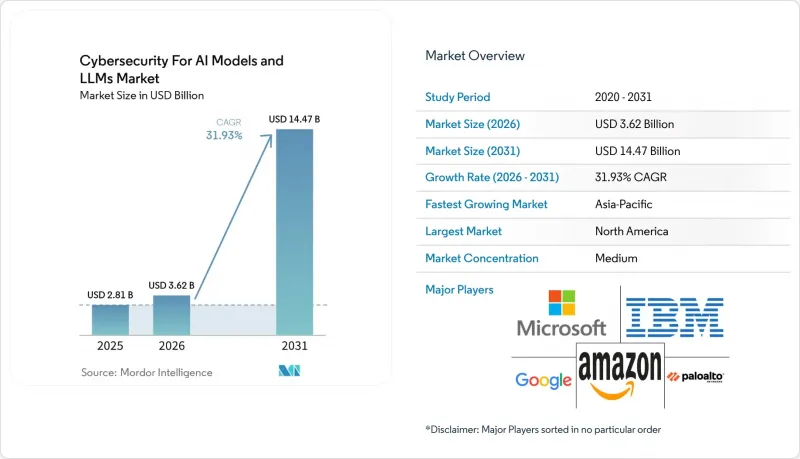
본 보고서는 구성 요소(솔루션 및 서비스), 보안 유형(모델 보안 등), 모델 양식(대규모 언어 모델(LLM) 등), 배포 방식(클라우드, On-Premise, 하이브리드), 기업 규모(대기업 및 중소기업), 최종 사용 산업(BFSI 등), 지역별로 분류되어 있습니다. 시장 전망은 금액(달러) 기준으로 제시되어 있습니다.
전 세계 AI 모델 및 LLM용 사이버 보안 시장 동향과 인사이트
증가하는 프롬프트 주입 및 탈옥(Jailbreak) 공격 시도
프롬프트 주입은 이미 도입된 생성형 AI 시스템에서 가장 두드러진 취약점으로 대두되고 있으며, 기업이 모델을 데이터 저장소, 도구, 에이전트에 연결함에 따라 그 위험은 확대되고 있습니다. OWASP는 프롬프트 주입을 2025년 ' LLM01’로 선정했으며, 기업 AI 도입 사례의 53%가 검색 강화 생성(Retrieval-Augmented Generation) 또는 에이전트형 파이프라인에 의존하고 있으며, 이들은 검색된 컨텐츠를 통한 간접적인 주입 공격에 특히 취약하다고 지적하고 있습니다. 2026년 리뷰에서는 2025년 6월 GitHub Copilot Chat의 CVSS 9.6 취약점이 공개된 사실이 다뤄졌습니다. 이 취약점으로 인해 간접적인 프롬프트 주입을 통해 비공개 저장소에서 기밀 정보나 소스 코드가 유출될 가능성이 있었습니다. 2026년 1월에 발표된 조사에서는 프롬프트 주입이 다단계 악성코드 배포 메커니즘이며, 현재 관측된 사고의 대부분에서 지속화 및 횡방향 이동까지 확대되고 있다고 설명하고 있습니다. 이에 따라 AI 모델 및 LLM용 사이버 보안 시장에서는 연쇄된 워크플로우 전체에서 공격이 어떻게 진화하는지 테스트할 수 있는 프롬프트 방화벽, 런타임 가드레일, 그리고 적대적 레드팀링 도구에 대한 수요가 꾸준히 증가하고 있습니다.
기업 워크플로우 전반에 걸쳐 확장되는 AI 모델의 공격 표면
AI 모델은 현재 코드 생성, 법률 검토, 고객 지원, 재무 분석 등에 통합되어 있으며, 그 결과 공격 표면은 모델에 정보를 전송하거나 그 출력을 기반으로 작동하는 모든 프로세스에까지 미치고 있습니다. CrowdStrike에 따르면, 자사 플랫폼의 텔레메트리 데이터를 통해 2026년 고객 환경 전반에서 1,800개 이상의 AI 용도이 식별되었으며, 그 수는 약 1억 6,000만 개의 고유 용도 인스턴스에 달했습니다. 2026년 Check Point의 보고서에 따르면, 전체 AI 연결 용도 중에서 입력 검증, 출력 필터링, 도구 사용 승인 등 런타임 LLM 제어를 광범위하게 도입한 조직은 불과 17%에 그쳤습니다. 에이전트형 시스템이 Model Context Protocol 서버를 통해 액션을 라우팅하기 시작함에 따라, 타사와의 연결이 하나 늘어날 때마다 많은 자산 인벤토리에서는 여전히 추적되지 않는 공급망상의 새로운 지점이 추가되게 됩니다. 따라서 AI 모델 및 LLM용 사이버 보안 시장은 AI 자산 감지, 섀도우 AI 거버넌스, 엔드포인트 수준의 런타임 보호에 대한 수요 증가의 혜택을 받고 있습니다.
보안 대책이 따라잡지 못하는 급변하는 모델 아키텍처
특정 세대의 모델에서 작동하던 보안 도구도 아키텍처가 변경되면 대대적인 조정이 필요한 경우가 많습니다. 텍스트 전용 시스템에서 멀티모달 모델로의 전환에 따라, 이미지 기반 프롬프트 주입, 적대적 오디오, 크로스모달리티 탈옥(jailbreak)과 같은 위협이 등장했으나, 이러한 위협들은 텍스트 중심 스캐너로는 감지할 수 없도록 설계되었습니다. 2026년 3월에 발표된 조사에서는 생성 기능과 이해 기능이 동일한 시스템 내에서 양방향 공격 경로를 만들어내는 통합형 멀티모달 모델의 취약점도 확인되었습니다. 또한, 모델의 빈번한 업데이트로 인해 레드팀 조사 결과의 유효 기간도 짧아지고 있습니다. 특정 버전에 대한 테스트 결과는 다음 릴리스 이후에는 더 이상 유효하지 않을 가능성이 있기 때문입니다. 이로 인해 AI 모델 및 LLM용 사이버 보안 시장은 둔화되고 있습니다. 모델의 설계와 작동 방식, 새로운 모달리티에 맞추어 도구의 요구 사항이 끊임없이 변화하기 때문에 구매자들이 구매를 주저하게 되기 때문입니다.
부문 분석
2025년, AI 모델 및 LLM용 사이버 보안 시장에서 솔루션이 62.14%의 점유율을 차지했습니다. 이는 구매자들이 당초 전용 프롬프트 보안, 런타임 모니터링, 출력 필터링 및 거버넌스 제품 도입에 중점을 두었음을 보여줍니다. 이러한 초기 지출 패턴은 기업들이 AI 보안 운영에 관한 장기적인 서비스 관계를 구축하기 전에, 표면화된 제어상의 격차를 시급히 해소해야 할 필요성이 있었음을 반영합니다. AI 레드팀 및 검증 플랫폼은 AI 거버넌스 및 규정 준수 도구와 함께, 조직이 일회성 점검이 아닌 반복적인 테스트를 필요로 하기 때문에 강한 수요를 모았습니다. AI 모델 및 LLM용 사이버 보안 시장의 솔루션 부문은 신속한 도입과 직접적인 정책 제어를 원하는 구매자의 요구로부터도 혜택을 받았습니다. 이로 인해 서비스 수요가 지속적으로 증가하는 상황에서도 솔루션 부문이 주도적인 위치를 유지했습니다.
서비스 분야는 2031년까지 연평균 성장률(CAGR) 32.98%로 확대될 것으로 예측되며, 고객이 사내에서 확보할 수 없는 외부 전문 지식을 추구함에 따라 성장률 측면에서 솔루션 분야를 앞지를 것으로 전망됩니다. 여기서 요구되는 업무는 기존의 관리형 보안과는 다릅니다. 팀은 실제 기업 환경에서 적대적 프롬프트를 생성하고, 출력의 드리프트를 평가하며, 모델의 거동을 AI 위험 분류 체계에 매핑해야 하기 때문입니다. SplxAI는 2024년 8월 서비스 개시 후 전 분기 대비 127%의 성장을 기록했으며, 이러한 실적을 바탕으로 2025년 3월에는 기능 확충을 위한 700만 달러 규모의 시드 라운드 투자를 유치했습니다. 2026년 SANS 조사 요약에서도 2025년부터 2026년까지 AI 보안 전문 인력에 대한 수요가 급증하고 있다는 점이 지적되었습니다. 이에 따라 AI 모델 및 LLM용 사이버 보안 시장에서는 대규모 LLM 도입 초기 단계에서 많은 구매자가 예상했던 것보다 매니지드 레드팀, 거버넌스 자문, AI 사고 대응 분야가 급속히 성장할 전망입니다.
2025년에는 모델 보안이 28.21%로 가장 큰 점유율을 차지했습니다. 이는 프롬프트 주입, 모델 무결성, 적대적 조작에 대한 구매자들의 시급한 우려를 반영한 것입니다. 이러한 대책은 모델에 가장 가깝고, 배포된 용도에서 표면화된 장애 모드를 직접 해결하는 것이기 때문에 가장 시급한 과제로 평가되었습니다. 또한, AI 모델 및 LLM용 사이버 보안 시장에서는 데이터 보안 및 용도 보안에 대한 수요도 견조했습니다. 이는 RAG(Retrieval-Augmented Generation)가 데이터 액세스와 용도의 동작을 동일한 워크플로우 내에서 연결하기 때문입니다. 그 결과, 구매 기업들은 모델 경계, 용도 계층, 데이터 경로를 개별 조달 대상이 아닌 단일 위험 영역으로 취급하는 경향이 강해졌습니다. 이를 통해 보안 유형 스택 전반에 걸친 보다 광범위한 대책의 조합이 촉진되었습니다.
거버넌스, 리스크, 컴플라이언스(GRC)는 2031년까지 연평균 성장률(CAGR) 33.09%를 나타낼 것으로 예측되며, AI 모델 및 대규모 언어 모델(LLM)용 사이버 보안 시장에서 가장 빠르게 성장하는 보안 분야가 될 전망입니다. 이러한 변화는 조달 행태와 밀접한 관련이 있는데, 이사회, 법무팀, 리스크 관리 부서가 AI 시스템이 광범위하게 도입되기 전에 테스트, 문서화, 모니터링을 거쳤다는 증거를 요구하게 되었기 때문입니다. 인도의 2026년 권고안에서는 AI 에이전트를 ‘특권을 가진 비인간적 정체성’으로 정의하고 있으며, 이로 인해 기업의 통제 설계에서 정체성, 접근, 거버넌스에 대한 우려가 더욱 밀접하게 연결되게 되었습니다. 또한 기업들은 구매 결정을 진행하기 전에 공급업체에 대해 적대적 테스트 증거, AI 사고 대응 매뉴얼, 그리고 NIST AI RMF 기능과의 부합성을 요구하고 있습니다. 이것이 바로 GRC가 백오피스 요구사항에서 기업의 AI 보안 프로그램 핵심인 운영 계층으로 전환된 이유입니다.
지역별 분석
2025년, 북미는 AI 모델 및 LLM용 사이버 보안 시장의 33.14%를 차지하며 최대 지역별 수익 기반이 되었습니다. 미국은 기업 내 AI 보급률이 높고, 주요 플랫폼 공급업체가 존재하며, 금융 기관 및 공공 기관 전반에 걸친 적극적인 부문별 지침이 결합되어 계속해서 핵심 시장으로서의 지위를 유지했습니다. 캐나다는 의료 및 금융 서비스 분야의 적극적인 도입을 통해 시장을 뒷받침한 반면, 멕시코는 규모는 작지만 성장세가 두드러지는 시장으로 자리매김했습니다. 이어 유럽에서는 규정 준수의 시급성에 따라 수요가 형성되고 있으며, 독일은 연방정보보안청(BSI)의 적극적인 지침과 AI 설계 원칙 및 AI 소프트웨어 BOM(BOM)에 관한 노력을 통해 지역 내 지출을 주도했습니다. 유럽의 AI 모델 및 LLM용 사이버 보안 시장은 EU AI법, DORA, 그리고 AI 보안을 보다 광범위한 IT 위험 예산에 통합하는 각국의 사이버 보안 규제에 힘입어 성장하고 있습니다.
아시아태평양은 2031년까지 AI 모델 및 LLM용 사이버 보안 시장에서 연평균 성장률(CAGR) 33.64%로 확대될 것으로 예측되며, 가장 빠르게 성장하는 지역이 될 전망입니다. 그 주된 요인은 중국에 있습니다. 2026년 1월 1일에 시행된 개정 사이버 보안 규정에서는 AI 시스템의 위험이 명시적으로 다루어졌으며, 생성형 AI의 보안 기준은 이미 2025년 말에 시행되었기 때문입니다. 인도 역시 2026년 인도준비은행이 프롬프트 주입, 모델 조작, 거버넌스 문서화를 포괄하는 부문별 권고안을 발표한 데 따라 빠르게 움직이기 시작했습니다. 일본과 한국에서는 기업의 전체 워크플로우 전반에 걸친 활용이 확대됨에 따라, 더욱 강력한 보안 대책이 요구되는 산업용 AI 도입이 진행되며 그 기세가 거세지고 있습니다. 이러한 규제와 도입 규모의 시너지 효과로 인해 아시아태평양은 보다 성숙한 지역보다 빠른 성장 궤도에 올라섰습니다.
2025년 시점에서 남미는 AI 모델 및 LLM용 사이버 보안 시장으로서 여전히 소규모 지역 시장에 머물러 있었으나, 핀테크 기반과 확립된 데이터 보호 체계를 배경으로 브라질이 확실한 리더로서의 입지를 굳혔습니다. 아르헨티나의 경우, 전반적인 경제 상황이 여전히 어려운 상황임에도 불구하고 활발한 기술 커뮤니티를 통해 지역 전체의 인식 제고에 기여했습니다. 중동 및 아프리카는 여전히 초기 단계에 있지만, 아랍에미리트(UAE)와 사우디아라비아는 자국의 AI 이니셔티브에 대한 ‘사이버 보안 바이 디자인(Cybersecurity by Design)’ 요건을 포함한 국가 AI 전략을 통해 진전을 이루었습니다. 남아프리카공화국과 나이지리아는 여전히 초기 단계 시장이며, 이 지역 수요는 금융 서비스 및 기타 서비스 주도형 부문에서 클라우드 호스팅형 AI 용도의 보급과 연동되어 있습니다.
기타 혜택:
- 엑셀 형식 시장 예측(ME) 시트
- 3개월간의 애널리스트 지원
자주 묻는 질문
목차
제1장 서론
제2장 조사 방법
제3장 주요 요약
제4장 시장 구도
제5장 시장 규모와 성장 예측
제6장 경쟁 구도
제7장 시장 기회와 향후 전망
JHS 26.08.07According to Mordor Intelligence, the cybersecurity for AI Models and LLMs Market size is projected to be USD 2.81 billion in 2025, USD 3.62 billion in 2026, and reach USD 14.47 billion by 2031, growing at a CAGR of 31.93% from 2026 to 2031.
This report is Segmented by Component (Solutions, and Services), Security Type (Model Security, and More), Model Modality (Large Language Models (LLMs), and More), Deployment (Cloud, On-Premises, and Hybrid), Enterprise Size (Large Enterprises, and Small and Medium Enterprises), End-User Industry (BFSI, and More), and Geography. The Market Forecasts are Provided in Terms of Value (USD).
Global Cybersecurity For AI Models and LLMs Market Trends and Insights
Rising Prompt Injection and Jailbreak Attempts
Prompt injection has become the most visible weakness in deployed generative AI systems, and the exposure is widening as enterprises connect models to data stores, tools, and agents. OWASP ranked prompt injection as LLM01 for 2025 and noted that 53% of enterprise AI deployments rely on retrieval-augmented generation or agentic pipelines, which are particularly vulnerable to indirect injection via retrieved content. A 2026 review described a June 2025 disclosure of a GitHub Copilot Chat CVSS 9.6 flaw that enabled the exfiltration of secrets and source code from private repositories via indirect prompt injection. Research circulated in January 2026 also described prompt injection as a multistep malware delivery mechanism that now extends into persistence and lateral movement in a large share of observed incidents. This is why the Cybersecurity for AI Models and LLMs Market is seeing steady demand for prompt firewalls, runtime guardrails, and adversarial red-teaming tools that can test how attacks evolve across chained workflows.
Expanding AI Model Attack Surface Across Enterprise Workflows
AI models are now embedded in code generation, legal review, customer support, and financial analysis, so the attack surface now stretches across every process that sends information into a model or acts on its output. CrowdStrike said its platform telemetry identified more than 1,800 AI applications across customer environments in 2026, covering nearly 160 million unique application instances. A 2026 Check Point report stated that only 17% of organizations had broadly deployed runtime LLM controls such as input validation, output filtering, and tool-use authorization across AI-connected applications. As agentic systems start routing actions through Model Context Protocol servers, each third-party connection adds another supply chain point that many asset inventories still do not track. The Cybersecurity for AI Models and LLMs Market is therefore gaining from rising demand for AI asset discovery, shadow AI governance, and endpoint-level runtime protection.
Rapidly Changing Model Architectures Outpacing Security Controls
Security tools that worked for one model generation often need major adjustment when the architecture changes. The move from text-only systems to multimodal models introduced image-based prompt injection, adversarial audio, and cross-modality jailbreaks that text-focused scanners were not built to detect. Research published in March 2026 also identified weaknesses in a unified multimodal model, in which generation and understanding functions create bidirectional attack paths within the same system. Frequent model updates also shorten the shelf life of red-team findings, because a test against one version may no longer hold after the next release. This slows the Cybersecurity for AI Models and LLMs Market because buyers hesitate when tool requirements keep shifting with model design, model behavior, and new modalities.
Other drivers and restraints analyzed in the detailed report include:
- Regulatory Pressure for AI Governance and Model Accountability
- Adversarial Use of GenAI for Automated Social Engineering
- Talent Shortage in AI Security, MLops, and Threat Research
For complete list of drivers and restraints, kindly check the Table Of Contents.
Segment Analysis
Solutions held 62.14% of the Cybersecurity for AI Models and LLMs market share in 2025, indicating that buyers initially focused on deploying dedicated prompt security, runtime monitoring, output filtering, and governance products. That early spending pattern also reflected the urgency of closing visible control gaps before enterprises built long service relationships around AI security operations. AI red-teaming and validation platforms, along with AI governance and compliance tools, attracted strong demand because organizations need repeated testing rather than one-time checks. The solutions side of the Cybersecurity for AI Models and LLMs Market also benefited from buyers wanting fast deployment and direct policy control. This kept solutions in the lead even as service demand continued to rise.
Services are projected to expand at a 32.98% CAGR through 2031, surpassing solutions in growth as customers seek external expertise they cannot hire internally. The work required here differs from traditional managed security, as teams need to craft adversarial prompts, assess output drift, and map model behavior to AI risk taxonomies in live enterprise settings. SplxAI reported 127% quarter-over-quarter growth after launching in August 2024, and followed that performance with a USD 7 million seed round in March 2025 to scale its capabilities. A 2026 SANS research summary also pointed to a sharp rise in demand for specialist AI security roles from 2025 to 2026. For that reason, the Cybersecurity for AI Models and LLMs Market is likely to see managed red-teaming, governance advisory, and AI incident response grow faster than many buyers expected at the start of large-scale LLM adoption.
Model security held the largest share at 28.21% in 2025, reflecting immediate buyer concern about prompt injection, model integrity, and adversarial manipulation. Those controls were the most urgent because they sat closest to the model and directly addressed visible failure modes in deployed applications. The Cybersecurity for AI Models and LLMs Market also saw steady demand for data security and application security, because retrieval-augmented generation ties data access and application behavior together in the same workflow. As a result, buyers increasingly treated the model boundary, the application layer, and the data path as a single risk surface rather than separate procurement tracks. This supported a broader mix of controls across the security type stack.
Governance, risk, and compliance is projected to grow at a 33.09% CAGR through 2031, making it the fastest-growing security type in the Cybersecurity for AI Models and LLMs Market. The shift is tied to procurement behavior because boards, legal teams, and risk functions now want evidence that AI systems were tested, documented, and monitored before wide deployment. India's 2026 advisory described AI agents as privileged non-human identities, which pushed identity, access, and governance concerns closer together in enterprise control design. Enterprises are also asking vendors for adversarial testing evidence, AI incident playbooks, and alignment with NIST AI RMF functions before moving forward with purchase decisions. This is why GRC has moved from a back-office requirement into a central operating layer for enterprise AI security programs.
Complete Report Scope:
- By Component
- Solutions
- Prompt Security Solutions
- Runtime Security and Monitoring
- Output Security and Content Moderation
- Data Security and Leakage Prevention
- AI Red Teaming and Validation Platforms
- AI Governance and Compliance Platforms
- Services
- Solutions
- By Security Type
- Model Security
- Data Security
- Application Security
- Identity and Access Security
- Governance, Risk and Compliance (GRC)
- By Model Modality
- Large Language Models (LLMs)
- Multimodal Foundation Models
- Image Generation Models
- Audio and Speech Models
- Video Generation Models
- By Deployment
- Cloud
- On-Premises
- Hybrid
- By Enterprise Size
- Large Enterprises
- Small and Medium Enterprises
- By End-user Industry
- BFSI
- Healthcare and Life Sciences
- Information Technology and Telecom
- Retail and E-commerce
- Industrial Manufacturing
- Government and Public Sector
- Other End-user Industries
- By Geography
- North America
- United States
- Canada
- Mexico
- South America
- Brazil
- Argentina
- Rest of South America
- Europe
- Germany
- United Kingdom
- France
- Italy
- Spain
- Russia
- Rest of Europe
- Asia-Pacific
- China
- India
- Japan
- South Korea
- Australia
- Rest of Asia-Pacific
- Middle East and Africa
- Middle East
- Saudi Arabia
- United Arab Emirates
- Rest of Middle East
- Africa
- South Africa
- Nigeria
- Rest of Africa
- Middle East
- North America
Geography Analysis
North America held 33.14% of the Cybersecurity for AI Models and LLMs market share in 2025, making it the largest regional revenue base. The United States remained the core market because it combines dense enterprise AI adoption, major platform vendors, and active sector guidance across financial and public institutions. Canada added support through strong adoption in healthcare and financial services, while Mexico remained a smaller but developing market. Europe followed, with demand shaped by compliance urgency, and Germany led regional spending through active guidance from the Federal Office for Information Security and its work on AI design principles and AI software bill of materials. The Cybersecurity for AI Models and LLMs Market in Europe is also being boosted by the EU AI Act, DORA, and national cyber rules that are integrating AI security into broader IT risk budgets.
Asia-Pacific is projected to expand at a 33.64% CAGR in the Cybersecurity for AI Models and LLMs market through 2031, making it the fastest-growing region. China is a major reason, because amended cybersecurity rules that took effect on January 1, 2026, explicitly addressed AI system risks, while generative AI security standards had already entered force in late 2025. India is also moving quickly after the Reserve Bank of India issued sector-level advisories in 2026 that covered prompt injection, model manipulation, and governance documentation. Japan and South Korea are adding momentum through industrial AI deployments that require stronger security controls as usage broadens across enterprise workflows. This combination of regulation and deployment scale gives Asia-Pacific a faster growth path than more mature regions.
South America remained a smaller regional market for Cybersecurity for AI Models and LLMs in 2025, with Brazil as the clear leader due to its fintech base and established data protection framework. Argentina contributed to regional awareness through an active technology community, even though broader economic conditions stayed difficult. The Middle East and Africa were still at an earlier stage, but the United Arab Emirates and Saudi Arabia moved ahead through national AI strategies that include cybersecurity-by-design requirements for sovereign AI efforts. South Africa and Nigeria remained nascent markets, where demand is tied to wider use of cloud-hosted AI applications in financial services and other service-led sectors.
- Amazon Web Services, Inc.
- Google LLC
- International Business Machines Corporation
- Palo Alto Networks, Inc.
- CrowdStrike Holdings, Inc.
- Fortinet, Inc.
- Zscaler, Inc.
- SentinelOne, Inc.
- Darktrace Holdings Limited
- Check Point Software Technologies Ltd.
- Trend Micro Incorporated
- Cisco Systems, Inc.
- HiddenLayer
- BigID, Inc.
- Protect AI
- Snyk Limited
- Qualys, Inc.
- Tenable, Inc.
- Rapid7, Inc.
- SplxAI Inc.
Additional Benefits:
- The market estimate (ME) sheet in Excel format
- 3 months of analyst support
TABLE OF CONTENTS
1 INTRODUCTION
- 1.1 Study Assumptions and Market Definition
- 1.2 Scope of the Study
2 RESEARCH METHODOLOGY
3 EXECUTIVE SUMMARY
4 MARKET LANDSCAPE
- 4.1 Market Overview
- 4.2 Market Drivers
- 4.2.1 Rising Prompt Injection and Jailbreak Attempts
- 4.2.2 Expanding AI Model Attack Surface Across Enterprise Workflows
- 4.2.3 Regulatory Pressure for AI Governance and Model Accountability
- 4.2.4 Adversarial Use of GenAI for Automated Social Engineering
- 4.2.5 Model Supply Chain Risk Across APIs, Plugins, and Open-Source Weights
- 4.2.6 Demand for Continuous AI Red-Teaming and Runtime Policy Enforcement
- 4.3 Market Restraints
- 4.3.1 Rapidly Changing Model Architectures Outpacing Security Controls
- 4.3.2 Limited Standardization for AI Security Benchmarks and Testing
- 4.3.3 High False Positive Rates in Output Filtering and Detection
- 4.3.4 Talent Shortage in AI Security, MLops, and Threat Research
- 4.4 Impact of Macroeconomic Factors on the Market
- 4.5 Industry Value-Chain Analysis
- 4.6 Regulatory Landscape
- 4.7 Technological Outlook
- 4.8 Porter's Five Forces Analysis
- 4.8.1 Bargaining Power of Buyers
- 4.8.2 Bargaining Power of Suppliers
- 4.8.3 Threat of New Entrants
- 4.8.4 Threat of Substitutes
- 4.8.5 Intensity of Competitive Rivalry
5 MARKET SIZE AND GROWTH FORECASTS (VALUE)
- 5.1 By Component
- 5.1.1 Solutions
- 5.1.1.1 Prompt Security Solutions
- 5.1.1.2 Runtime Security and Monitoring
- 5.1.1.3 Output Security and Content Moderation
- 5.1.1.4 Data Security and Leakage Prevention
- 5.1.1.5 AI Red Teaming and Validation Platforms
- 5.1.1.6 AI Governance and Compliance Platforms
- 5.1.2 Services
- 5.1.1 Solutions
- 5.2 By Security Type
- 5.2.1 Model Security
- 5.2.2 Data Security
- 5.2.3 Application Security
- 5.2.4 Identity and Access Security
- 5.2.5 Governance, Risk and Compliance (GRC)
- 5.3 By Model Modality
- 5.3.1 Large Language Models (LLMs)
- 5.3.2 Multimodal Foundation Models
- 5.3.3 Image Generation Models
- 5.3.4 Audio and Speech Models
- 5.3.5 Video Generation Models
- 5.4 By Deployment
- 5.4.1 Cloud
- 5.4.2 On-Premises
- 5.4.3 Hybrid
- 5.5 By Enterprise Size
- 5.5.1 Large Enterprises
- 5.5.2 Small and Medium Enterprises
- 5.6 By End-user Industry
- 5.6.1 BFSI
- 5.6.2 Healthcare and Life Sciences
- 5.6.3 Information Technology and Telecom
- 5.6.4 Retail and E-commerce
- 5.6.5 Industrial Manufacturing
- 5.6.6 Government and Public Sector
- 5.6.7 Other End-user Industries
- 5.7 By Geography
- 5.7.1 North America
- 5.7.1.1 United States
- 5.7.1.2 Canada
- 5.7.1.3 Mexico
- 5.7.2 South America
- 5.7.2.1 Brazil
- 5.7.2.2 Argentina
- 5.7.2.3 Rest of South America
- 5.7.3 Europe
- 5.7.3.1 Germany
- 5.7.3.2 United Kingdom
- 5.7.3.3 France
- 5.7.3.4 Italy
- 5.7.3.5 Spain
- 5.7.3.6 Russia
- 5.7.3.7 Rest of Europe
- 5.7.4 Asia-Pacific
- 5.7.4.1 China
- 5.7.4.2 India
- 5.7.4.3 Japan
- 5.7.4.4 South Korea
- 5.7.4.5 Australia
- 5.7.4.6 Rest of Asia-Pacific
- 5.7.5 Middle East and Africa
- 5.7.5.1 Middle East
- 5.7.5.1.1 Saudi Arabia
- 5.7.5.1.2 United Arab Emirates
- 5.7.5.1.3 Rest of Middle East
- 5.7.5.2 Africa
- 5.7.5.2.1 South Africa
- 5.7.5.2.2 Nigeria
- 5.7.5.2.3 Rest of Africa
- 5.7.5.1 Middle East
- 5.7.1 North America
6 COMPETITIVE LANDSCAPE
- 6.1 Market Concentration
- 6.2 Strategic Moves
- 6.3 Market Share Analysis
- 6.4 Company Profiles (includes Global Level Overview, Market Level Overview, Core Segments, Financials as available, Strategic Information, Market Rank/Share, Products and Services, Recent Developments)
- 6.4.1 Amazon Web Services, Inc.
- 6.4.2 Google LLC
- 6.4.3 International Business Machines Corporation
- 6.4.4 Palo Alto Networks, Inc.
- 6.4.5 CrowdStrike Holdings, Inc.
- 6.4.6 Fortinet, Inc.
- 6.4.7 Zscaler, Inc.
- 6.4.8 SentinelOne, Inc.
- 6.4.9 Darktrace Holdings Limited
- 6.4.10 Check Point Software Technologies Ltd.
- 6.4.11 Trend Micro Incorporated
- 6.4.12 Cisco Systems, Inc.
- 6.4.13 HiddenLayer
- 6.4.14 BigID, Inc.
- 6.4.15 Protect AI
- 6.4.16 Snyk Limited
- 6.4.17 Qualys, Inc.
- 6.4.18 Tenable, Inc.
- 6.4.19 Rapid7, Inc.
- 6.4.20 SplxAI Inc.
7 MARKET OPPORTUNITIES AND FUTURE OUTLOOK
- 7.1 White-Space and Unmet-Need Assessment


