

|
시장보고서
상품코드
2063959
제약 품질관리 분야 AI 시장 : 시장 점유율 분석, 업계 동향 및 통계, 성장 예측(2026-2031년)AI In Pharmaceutical Quality Management - Market Share Analysis, Industry Trends & Statistics, Growth Forecasts (2026 - 2031) |
||||||
 Mordor Intelligence
Mordor Intelligence에 의하면, 제약 품질관리 분야 AI 시장 규모는 2025년 6억 6,000만 달러로 평가되었고, 2026년에는 7억 9,000만 달러로 추정되고, 2026-2031년 CAGR 18.85%로 성장을 지속할 전망이며, 2031년에는 18억 7,000만 달러에 이를 것으로 예측됩니다.
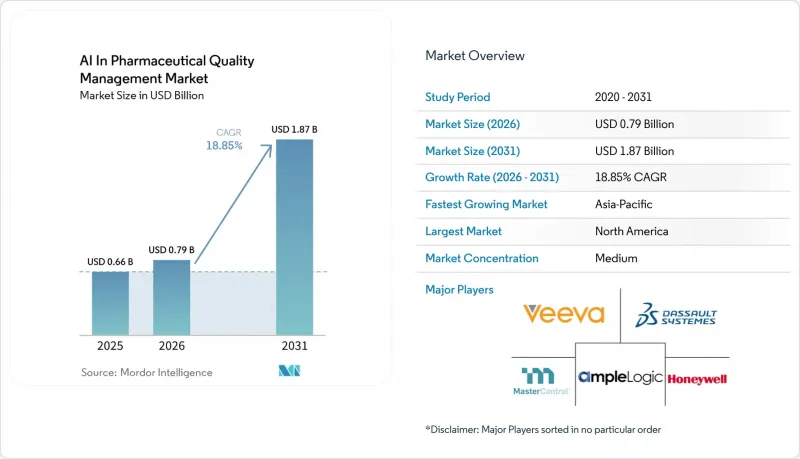
본 보고서는 컴포넌트별(소프트웨어, 서비스), 전개 모델별(클라우드 기반, 온프레미스형, 하이브리드형), AI 기능별(생성형 AI 코파일럿 및 에이전트, 예측 분석 및 리스크 스코어링 등), 최종 사용자별(제약 회사, 생명공학 기업 등) 및 지역별(북미 등)로 분류되어 있습니다. 시장 전망은 금액(달러) 기준으로 제시되어 있습니다.
세계의 제약 품질 관리 분야 AI 시장 동향 및 인사이트
AI를 활용한 이탈, CAPA 및 조사 워크플로우 자동화
이탈 및 CAPA 관리는 생명과학 제조 현장에서 여전히 전체 자원의 4%에서 6%를 차지했으며, 기존의 워크플로우에서는 조사 기간이 45일에서 90일까지 소요되는 경우가 많습니다. 제약 품질 관리 분야의 AI 시장이 성장세를 보이고 있는 이유는 AI를 활용한 이상치 분류, 근본 원인 조사 및 보고서 초안 작성을 통해 도입 사례에서 문서 작성 시간이 40%에서 60% 단축되고, 트리아지 속도가 15%에서 30% 향상되었기 때문입니다. 이러한 장점은 단순히 속도 향상에만 그치지 않습니다. CAPA 기록의 일관성이 높아지면 거점 간 품질 신호를 비교하기 쉬워지며, 고립된 거점 팀에서는 간과하기 쉬운 반복적으로 발생하는 프로세스상의 결함을 더 쉽게 파악할 수 있기 때문입니다. 아스테라스 제약은 2026년 4월, 자사 네트워크 전체에서 이상 감지 처리를 수행하는 7개의 에이전트로 구성된 AI 시스템을 도입하여 조사 업무 부담이 67% 감소했으며, 완전 도입 시에는 월간 980시간의 업무 시간이 절감될 것이라고 보고했습니다. 21 CFR Part 11, ICH Q10 및 GAMP 5에 기반한 규제 요건으로 인해, 인적 검토와 감사 추적이 여전히 중요하게 여겨지고 있으며, 이는 해당 도구의 구성 및 승인 방식에 영향을 미치고 있습니다.
GMP 업무 전반에 걸친 예측적 품질 위험 감지에 대한 수요 증가
예측적 품질 리스크 감지는 기업들이 제약 품질 관리 분야의 AI 시장에 투자하는 가장 분명한 이유 중 하나로 자리 잡고 있습니다. 이는 기존의 공정 내 테스트를 통해 문제가 드러나기 전에 팀이 배치의 위험 요소를 파악하는 데 도움이 되기 때문입니다. 'Scientific Reports' 저널에 실린 2025년 연구에 따르면, 공정 매개변수를 바탕으로 핵심 품질 특성(CQA)을 예측하는 딥러닝 모델은 R² 값이 0.9를 초과했으며, 3회의 생산 주기 동안 규격 미달 배치 비율을 18% 감소시켰습니다. 무균 충전 및 마무리 공정에서는 초안에 인용된 한 도입 사례를 통해 배치 불합격률이 12% 감소했으며, 감사에 대한 추적 가능성이 강화되었습니다. 이는 고도화된 관리 환경에서 AI 활용의 유효성을 입증하는 것입니다. 2026년 1월까지 전 기관 차원에서 전개될 예정인 FDA 내부 프로젝트 ‘Elsa’는 규제 당국이 전자 기록을 신속하게 검토하여 고위험 검사 대상을 파악할 수 있게 됨에 따라 이러한 변화를 뒷받침하고 있습니다. 2026년 'Journal of Pharmaceutical Innovation'지에 게재된, FDA 양식 483 데이터를 모델화한 연구에서도 데이터의 완전성과 시정 조치(CAPA)의 유효성이 규제상 문제가 재발하는 가장 강력한 예측 인자임이 밝혀졌으며, 이는 품질 관리에 대한 투자와 감사 위험을 직접적으로 연결 짓는 것입니다.
GxP 모델 검증, 설명 가능성 및 감사 추적 요건
제약 품질 관리 분야의 AI 시장 도입 비용은 여전히 모델의 설명 가능성으로 인해 상승하고 있습니다. 이는 품질 관리 팀이 AI를 대규모로 활용하기 전에, 추적 가능성, 문서화된 관리 체계, 그리고 신뢰할 수 있는 인적 검토가 필요하기 때문입니다. 이 초안에서는 EMA의 부속서 22 초안이 중요한 GMP 이용 사례에서 확률적 모델 및 적응형 모델의 사용을 제한하고, 생성형 AI를 감독 하에 있는 비중요한 역할로만 한정하고 있다는 점이 지적되고 있습니다. 이로 인해 벤더의 로드맵은 규정 준수 대응 경로와 비대응 경로, 두 가지로 나뉘게 되었습니다. 또한, 2026년 4월 FDA가 Purolea Cosmetics Lab에 발송한 경고서에는 AI로 생성된 제조 기록이 규제상 누락된 요소를 파악할 수 있는 전문가의 검토를 대체할 수 없습니다는 점도 명시되었습니다. 초안에 인용된 2026년 분석에 따르면, AI 시스템에는 품질 시스템 내에서 완벽한 추적 가능성을 갖춘 철저한 추적 체계가 필요하며, 이로 인해 일반적인 검증 부담에 더해 모델 버전 관리, 입출력 로그 기록 및 드리프트 모니터링이 추가된다고 합니다. 이러한 요건들은 일시적인 것이 아니기 때문에 명확한 감사 가능성을 입증하지 못하는 공급업체는 제약 품질 관리 분야의 AI 시장에서 경쟁하기가 더욱 어려워질 것입니다.
부문별 분석
2025년 기준으로, 제약 품질 관리 분야의 AI 시장 규모 중 65.2%를 소프트웨어가 차지했으며, 이는 대형 제약 기업에서 엔터프라이즈 eQMS, AI 강화형 LIMS 및 편차 관리 플랫폼이 확고한 입지를 차지하고 있음을 반영합니다. 제약 품질 관리 분야의 AI 시장이 여전히 소프트웨어 주도로 유지되고 있는 이유는 주요 제조업체들이 장기 플랫폼 계약에 CAPA 작성, 문서 요약, 규제 격차 점검을 위한 보조 기능을 포함시키고 있기 때문입니다. 이러한 구독 서비스는 단순한 자동화에 그치지 않습니다. 구매자는 이탈 대응, 교육, 문서 관리, 조사 기록을 연계할 수 있는 단일하고 검증된 환경을 원하기 때문입니다. 따라서 제약 품질 관리 분야의 AI 시장 전반에서 소프트웨어는 일상적인 디지털 품질 관리 업무의 기반이 되고 있습니다.
소프트웨어만으로는 CSA 도입, 데이터 준비, 재훈련 또는 지속적인 모델 거버넌스 문제를 해결할 수 없기 때문에 서비스 부문은 2031년까지 연평균 19.9%의 성장률을 기록할 전망이며, 시장 전체보다 빠르게 성장하고 있습니다. 제약 품질 관리 분야의 AI 업계에서는 CSA에 대한 지식 격차가 여전히 크며, 이로 인해 외부 기관을 통한 도입 및 검증 지원에 대한 수요가 지속되고 있습니다. 또한, 도입 초기 단계를 넘어선 지원을 원하는 고객이 늘어남에 따라, 매니지드 서비스는 드리프트 모니터링, 정기적인 재검증, 감사 추적 기록의 유지 관리로 그 범위가 확대되고 있습니다. 이는 기존의 CSV(준수 검증 성명서) 관행에서 벗어나, 새로운 문서화 관행과 거버넌스 절차가 필요한 위험 기반 보증 모델로 전환하는 기업들에게 특히 중요한 의미를 지닙니다. 그 결과, 서비스 수익은 소프트웨어 도입에 뒤처지지 않고, 도입 규모에 맞추어 확대되고 있습니다.
2025년에는 클라우드 기반 도입이 가장 큰 비중을 차지했으나, 온프레미스 방식은 2031년까지 20.1% 성장할 것으로 전망됩니다. 제약 품질 관리 시장에서는 공급업체가 규정 준수 문서와 관리된 환경을 제공할 수 있어, 많은 구매자에게 적합성 평가 절차가 간소화되기 때문에 계속해서 클라우드 인프라에 의존하고 있습니다. 하이브리드 방식은 새로운 디지털 도구를 기존 공장이나 기존의 기록 아키텍처와 연동해야 하는 조직에게 여전히 중요한 선택지입니다. 따라서 구성 비율은 변화하고 있지만, 클라우드는 여전히 주류 배포 플랫폼의 기반이 되고 있습니다.
온프레미스의 성장률은 2031년까지 연평균 20.1%로 더욱 가파르게 증가할 전망입니다. 이는 고위험 GxP 환경에서 데이터의 보관 장소, 검증 관리 및 감사 추적의 소유권이 더욱 중요하게 여겨지기 때문입니다. 본 초안에서는 이러한 변화를 유럽 및 아시아·태평양 지역의 현지화된 추론에 대한 수요와 연관 짓고 있습니다. 특히, GDPR(EU 개인정보보호규정), 지역별 규제 요건 또는 공장별 거버넌스 규칙으로 인해 멀티테넌트 환경에 대한 우려가 커지고 있는 지역에서 이러한 현상이 두드러집니다. 이에 따라 제약 품질 관리 분야의 AI 시장에서는 일반적인 기업 소프트웨어 부문에서 볼 수 있는 것보다 더 균형 잡힌 도입 패턴이 형성되고 있습니다. 구매자들은 클라우드를 거부하는 것은 아니지만, 위험이 낮은 품질 관리 업무와 보다 엄격한 On-Premise 관리가 필요한 최고 위험 등급의 워크플로우 사이에 더 명확한 경계를 설정하고 있습니다. 이러한 구분에 따라, 하이브리드 및 대면 수업 모델은 향후 몇 년 동안 그 중요성을 유지할 것입니다.
지역별 분석
2025년, 북미는 제약 품질 관리 분야 AI 시장 점유율의 38.2%를 차지했으며 지역별 1위를 유지했습니다. 이 지역에서 제약 품질 관리 분야의 AI 시장이 가장 활발한 이유는 FDA의 활동이 활발하고, 제조업체들이 보다 명확한 법 집행 및 거버넌스 환경에 직면해 있기 때문입니다. 이 초안은 ‘프로젝트 엘사’와 FDA의 보다 광범위한 디지털 현장조사 방침을, 미국 기업들이 전자 기록 전반에 걸쳐 더욱 철저한 현장조사 사전 준비를 해야 한다는 신호로 지적하고 있습니다. 전략적 원료의약품 비축에 관한 백악관의 지침 또한, 보다 엄격한 감시와 공급 보장 의무 증가를 예상하는 시설들이 품질 시스템에 추가 투자를 하도록 장려하고 있습니다. 캐나다와 멕시코는 MDSAP 관련 규정 준수 수요와 생산 확대를 통해 시장을 뒷받침하고 있지만, 이 지역의 핵심적인 경쟁력은 여전히 미국과 미국의 위험 기반 보증 체계에서 비롯됩니다.
유럽은 두 번째로 큰 지역 시장이며, 그 수요 동향은 보다 체계적이고 거버넌스를 우선시하는 접근 방식에 의해 형성되고 있습니다. 유럽의 제약 품질 관리 분야 AI 시장은 초안의 부속서 22, 개정된 부속서 11에 대한 논의, 그리고 EU AI법의 영향을 받고 있으며, 이 모든 요인들이 도입 가능한 시스템에 대한 규정 준수 기준을 높이고 있습니다. 독일은 프라우엔호퍼 IPT가 살트리아스, 그로닝거, 옥탐과 공동으로 주도하는 Qua2ntum 프로젝트를 통해 두각을 나타내고 있으며, 이 프로젝트는 규제 환경 내 AI를 위한 QMS 프레임워크를 구축하고 있습니다. 스페인, 이탈리아, 프랑스 역시 업무상의 품질 성과 측면에서 치열한 경쟁을 펼치고 있는 제네릭 의약품 클러스터를 통해 발전해 나가고 있습니다.
아시아·태평양 지역은 2031년까지 19.4%의 성장이 예상되며, 본 초안에서 가장 빠르게 성장하는 지역으로 꼽히고 있습니다. 이 지역의 제약 품질 관리 분야 AI 시장은 2026년 4월 중국이 발표한 ‘AI+의약품’ 규제 로드맵의 혜택을 받고 있습니다. 이 로드맵에는 2030년까지의 스마트 검사, AI를 활용한 신청 서류 심사, 그리고 다중 출처 위험 통합에 관한 목표가 제시되어 있습니다. 또한, 인도는 ‘Pharma 4.0’ 추진의 일환으로 사후 대응형 데이터 무결성 관리에서 예측형 품질 모델로 전환하고 있는 반면, 일본은 AI 신뢰성 평가 프레임워크를 구축하는 동시에 2026년부터 eCTD 4.0을 도입하여 구조화 데이터의 가용성을 높이고 있습니다. 2026년에 AI를 활용한 의약품 승인 심사로 전환하려는 한국의 움직임도 이 지역의 호재가 되고 있습니다. 한편, 중동 및 아프리카(MEA) 및 남미는 주로 다국적 기업의 표준화 노력과 특정 지역에 국한된 사업 확장에 힘입어 아직 초기 단계 시장에 머물러 있습니다.
기타 혜택:
- 엑셀 형식 시장 예측(ME) 시트
- 3개월간의 애널리스트 지원
자주 묻는 질문
목차
제1장 서론
제2장 조사 방법
제3장 주요 요약
제4장 시장 구도
제5장 시장 규모 및 성장 예측
제6장 경쟁 구도
제7장 시장 기회 및 향후 전망
AJY 26.06.24According to Mordor Intelligence, the aI in pharmaceutical quality management market size is expected to grow from USD 0.66 billion in 2025 to USD 0.79 billion in 2026 and is forecast to reach USD 1.87 billion by 2031 at 18.85% CAGR over 2026-2031.
This report is Segmented by Component (Software, Services), Deployment Model (Cloud-Based, On-Premises, Hybrid), AI Capability (Generative AI Copilots & Agents, Predictive Analytics & Risk Scoring, and More), End User (Pharmaceutical Companies, Biotechnology Companies, and More), and by Geography (North America, and More). The Market Forecasts are Provided in Terms of Value (USD).
Global AI In Pharmaceutical Quality Management Market Trends and Insights
AI Automation Of Deviation, CAPA, And Investigation Workflows
Managing deviations and CAPAs still absorbs 4% to 6% of total resources at a life science manufacturing site, and legacy workflows often extend investigations to 45 to 90 days. The AI in pharmaceutical quality management market is gaining momentum here because AI-assisted deviation classification, root-cause research, and draft preparation are cutting documentation time by 40% to 60% and improving triage speed by 15% to 30% in reported deployments. These gains matter beyond speed because more consistent CAPA records make it easier to compare quality signals across sites and detect recurring process failures that isolated site teams can miss. Astellas Pharma's April 2026 deployment of a seven-agent AI setup for deviation processing across its network reported a 67% reduction in investigation workload and an estimated 980 monthly hours recovered at full rollout. Regulatory expectations under 21 CFR Part 11, ICH Q10, and GAMP 5 are keeping human review and audit trails central, which is shaping how these tools are configured and approved.
Rising Demand For Predictive Quality Risk Detection Across GMP Operations
Predictive quality risk detection is becoming one of the clearest reasons companies are investing in the AI in pharmaceutical quality management market, because it helps teams identify batch risk before conventional in-process testing reveals the problem. A 2025 study in Scientific Reports showed that deep learning models predicting critical quality attributes from process parameters achieved R2 values above 0.9 and reduced out-of-specification batches by 18% over 3 production cycles. In sterile fill-finish settings, one deployment cited in the draft produced a 12% reduction in batch rejections and stronger audit traceability, which supports the case for using AI in high-control environments. The FDA's internal Project Elsa, scaled agency-wide by January 2026, is reinforcing this shift because regulators can now scan electronic records rapidly to target high-risk inspections. A 2026 Journal of Pharmaceutical Innovation study that modeled FDA Form 483 data also found data integrity and CAPA effectiveness to be the strongest predictors of repeat regulatory exposure, which ties predictive quality investment directly to inspection risk.
GxP Model Validation, Explainability, And Audit-Trail Requirements
Model explainability still raises deployment cost in the AI in pharmaceutical quality management market because quality teams need traceability, documented controls, and credible human review before AI can be used at scale. The draft notes that EMA's draft Annex 22 limits probabilistic and adaptive models in critical GMP use cases and keeps generative AI in supervised non-critical roles, which is splitting vendor roadmaps into compliant and non-compliant paths. The FDA's April 2026 warning letter to Purolea Cosmetics Lab also showed that AI-generated manufacturing records cannot replace expert review that can identify missing regulatory elements. A 2026 analysis cited in the draft said that AI systems need thorough tracking with complete traceability inside the quality system, which adds model version control, input and output logging, and drift monitoring to the normal validation burden. These requirements are not temporary, so vendors that cannot demonstrate clear auditability will find it harder to compete across the AI in pharmaceutical quality management market.
Other drivers and restraints analyzed in the detailed report include:
- Need To Reduce Batch Review, Release, And APQR Cycle Times
- CSA-Led Acceptance Of AI-Enabled Validation Approaches In GxP Systems
- Poor Data Readiness Across Legacy Quality Records And Disconnected Systems
For complete list of drivers and restraints, kindly check the Table Of Contents.
Segment Analysis
Software retained 65.2% of AI in pharmaceutical quality management market size in 2025, which reflects the strong position of enterprise eQMS, AI-enhanced LIMS, and deviation management platforms in large pharma accounts. The AI in pharmaceutical quality management market remains software-led because major manufacturers are embedding copilots for CAPA drafting, document summaries, and regulatory gap checks inside long-term platform contracts. These subscriptions are not only about automation, because buyers also want one validated environment that can connect deviation handling, training, document control, and investigation records. That makes software the foundation of daily digital quality work across the AI in pharmaceutical quality management market.
Services are growing faster than the overall market at 19.9% through 2031, because software alone does not solve CSA adoption, data preparation, retraining, or ongoing model governance. The AI in pharmaceutical quality management industry still has a wide knowledge gap around CSA, which supports demand for external implementation and validation help. Managed services are also expanding into drift monitoring, periodic re-validation, and audit-trail maintenance as buyers ask for support beyond the initial launch. This is especially relevant for companies moving from older CSV practices to risk-based assurance models that need new documentation habits and governance routines. As a result, service revenues are scaling alongside software deployments rather than trailing them.
Cloud-based deployment held the largest share in 2025, while on-premises was projected to expand at 20.1% through 2031. in pharmaceutical quality management market continues to rely on cloud infrastructure because vendors can provide compliance documentation and controlled environments that simplify qualification for many buyers. Hybrid deployment remains relevant for organizations that need to connect newer digital tools with legacy plants and older record architectures. Cloud therefore still anchors the mainstream deployment base even as the mix is shifting.
On-premises growth is faster at 20.1% through 2031 because data residency, validation control, and audit-trail ownership carry more weight in high-risk GxP settings. The draft links this shift to European and APAC demand for local inference, especially where GDPR, localized regulatory requirements, or plant-specific governance rules limit comfort with multi-tenant environments. This is creating a more balanced deployment pattern in the AI in pharmaceutical quality management market than a standard enterprise software category would normally show. Buyers are not rejecting cloud, but they are drawing a clearer line between lower-risk quality tasks and the highest-risk workflows that need tighter local control. That distinction is likely to keep hybrid and on-site models relevant for years.
Geography Analysis
North America held 38.2% of AI in pharmaceutical quality management market share in 2025, which kept it in the leading regional position. The AI in pharmaceutical quality management market is strongest in this region because FDA activity is dense and manufacturers face a more visible enforcement and governance environment. The draft points to Project Elsa and the FDA's broader digital inspection posture as signals that U.S. companies need stronger pre-inspection readiness across electronic records. The White House direction on strategic active pharmaceutical ingredient reserves also supports additional quality system spending by facilities expecting closer scrutiny and greater supply assurance obligations. Canada and Mexico add support through MDSAP-linked compliance demand and manufacturing expansion, but the core regional advantage still comes from the United States and its risk-based assurance framework.
Europe was the second-largest regional market, and its demand profile is being shaped by a more structured governance-first approach. The AI in pharmaceutical quality management market in Europe is being influenced by draft Annex 22, the revised Annex 11 discussion, and the EU AI Act, all of which raise the compliance threshold for deployable systems. Germany stands out through the Qua2ntum project led by Fraunhofer IPT with Sartorius, Groninger, and OCTUM, which is building QMS frameworks for AI in regulated settings. Spain, Italy, and France are also moving forward through generics clusters that compete heavily on operational quality performance.
Asia-Pacific was projected to expand at 19.4% through 2031, which made it the fastest-growing region in the draft. The AI in pharmaceutical quality management market is benefiting here from China's April 2026 AI plus drug regulation roadmap, which set out targets for intelligent inspection, AI-assisted dossier review, and multi-source risk aggregation through 2030. India is also moving from reactive data integrity control toward predictive quality models under its Pharma 4.0 push, while Japan is building a credibility assessment framework for AI and is improving structured data availability through eCTD 4.0 adoption from 2026. South Korea's move toward AI-based drug approval review in 2026 adds another regional tailwind, while MEA and South America remain earlier-stage markets led mainly by multinational standardization efforts and selective geographic expansion.
- AmpleLogic
- ComplianceQuest
- Dassault Systemes (BIOVIA)
- Dot Compliance
- Honeywell / Sparta Systems
- Ideagen
- Intellect
- IQVIA
- Korber Pharma
- Leucine
- MasterControl
- Octave (ETQ Reliance)
- Oracle
- Qualio
- Qualityze
- Scilife
- SimplerQMS
- Veeva Systems
Additional Benefits:
- The market estimate (ME) sheet in Excel format
- 3 months of analyst support
TABLE OF CONTENTS
1 Introduction
- 1.1 Study Assumptions & Market Definition
- 1.2 Scope of the Study
2 Research Methodology
3 Executive Summary
4 Market Landscape
- 4.1 Market Overview
- 4.2 Market Drivers
- 4.2.1 AI Automation of Deviation, CAPA, and Investigation Workflows
- 4.2.2 Rising Demand for Predictive Quality Risk Detection Across GMP Operations
- 4.2.3 Need to Reduce Batch Review, Release, and APQR Cycle Times
- 4.2.4 CSA-Led Acceptance of AI-Enabled Validation Approaches in GxP Systems
- 4.2.5 Multi-Site Quality Signal Mining Across QMS, MES, LIMS, and ERP Data
- 4.3 Market Restraints
- 4.3.1 GxP Model Validation, Explainability, and Audit-Trail Requirements
- 4.3.2 Poor Data Readiness Across Legacy Quality Records and Disconnected Systems
- 4.3.3 QA User Trust, Adoption, And Human-In-The-Loop Governance Challenges
- 4.4 Value Chain Analysis
- 4.5 Regulatory Landscape
- 4.6 Technological Outlook
- 4.7 Porter's Five Forces
- 4.7.1 Threat of New Entrants
- 4.7.2 Bargaining Power of Suppliers
- 4.7.3 Bargaining Power of Buyers
- 4.7.4 Threat of Substitutes
- 4.7.5 Competitive Rivalry
5 Market Size & Growth Forecasts (Value, USD)
- 5.1 By Component
- 5.1.1 Software
- 5.1.2 Services
- 5.2 By Deployment Model
- 5.2.1 Cloud-Based
- 5.2.2 On-Premises
- 5.2.3 Hybrid
- 5.3 By AI Capability
- 5.3.1 Generative AI Copilots & Agents
- 5.3.2 Predictive Analytics & Risk Scoring
- 5.3.3 NLP / Document Intelligence
- 5.3.4 Anomaly Detection & Pattern Recognition
- 5.3.5 Recommendation Engines & Root-Cause Guidance
- 5.3.6 Computer Vision for Quality Inspection
- 5.4 By End User
- 5.4.1 Pharmaceutical Companies
- 5.4.2 Biotechnology Companies
- 5.4.3 CDMOs / CMOs
- 5.4.4 Other End Users
- 5.5 By Geography
- 5.5.1 North America
- 5.5.1.1 United States
- 5.5.1.2 Canada
- 5.5.1.3 Mexico
- 5.5.2 Europe
- 5.5.2.1 Germany
- 5.5.2.2 United Kingdom
- 5.5.2.3 France
- 5.5.2.4 Italy
- 5.5.2.5 Spain
- 5.5.2.6 Rest of Europe
- 5.5.3 Asia-Pacific
- 5.5.3.1 China
- 5.5.3.2 India
- 5.5.3.3 Japan
- 5.5.3.4 South Korea
- 5.5.3.5 Australia
- 5.5.3.6 Rest of Asia-Pacific
- 5.5.4 Middle East and Africa
- 5.5.4.1 GCC
- 5.5.4.2 South Africa
- 5.5.4.3 Rest of Middle East and Africa
- 5.5.5 South America
- 5.5.5.1 Brazil
- 5.5.5.2 Argentina
- 5.5.5.3 Rest of South America
- 5.5.1 North America
6 Competitive Landscape
- 6.1 Market Concentration
- 6.2 Market Share Analysis
- 6.3 Company Profiles {(includes Global level Overview, Market level overview, Core Segments, Financials as available, Strategic Information, Market Rank/Share for key companies, Products & Services, and Recent Developments)}
- 6.3.1 AmpleLogic
- 6.3.2 ComplianceQuest
- 6.3.3 Dassault Systemes (BIOVIA)
- 6.3.4 Dot Compliance
- 6.3.5 Honeywell / Sparta Systems
- 6.3.6 Ideagen
- 6.3.7 Intellect
- 6.3.8 IQVIA
- 6.3.9 Korber Pharma
- 6.3.10 Leucine
- 6.3.11 MasterControl
- 6.3.12 Octave (ETQ Reliance)
- 6.3.13 Oracle
- 6.3.14 Qualio
- 6.3.15 Qualityze
- 6.3.16 Scilife
- 6.3.17 SimplerQMS
- 6.3.18 Veeva Systems
7 Market Opportunities & Future Outlook
- 7.1 White-space & unmet-need assessment


