|
시장보고서
상품코드
2064022
프랑스의 통합 시설 관리 시장 : 시장 점유율 분석, 산업 동향 및 통계 데이터, 성장 예측(2026-2031년)France Integrated Facility Management - Market Share Analysis, Industry Trends & Statistics, Growth Forecasts (2026 - 2031) |
||||||
 Mordor Intelligence
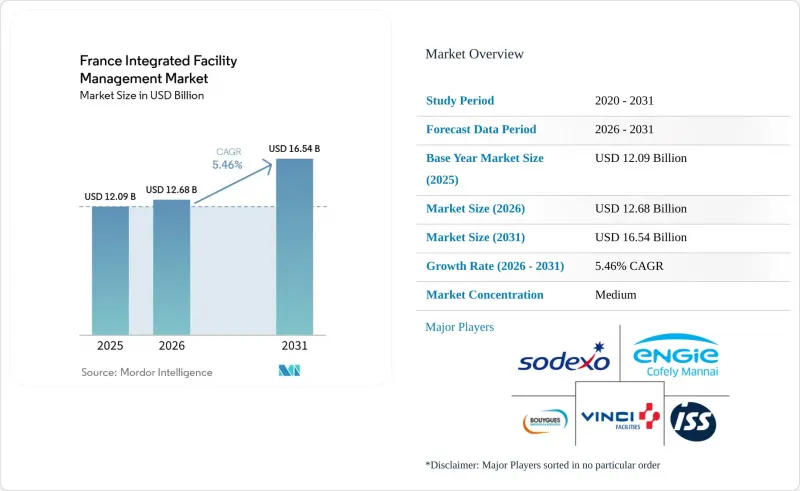
Mordor Intelligence에 의하면, 프랑스의 통합 시설 관리 시장 규모는 2025년 120억 9,000만 달러로 평가되었고, 2026년에는 126억 8,000만 달러로 추정되고, 2031년까지 165억 4,000만 달러에 이를 것으로 예측되며, 2026-2031년 CAGR 5.46%로 성장할 전망입니다.
본 보고서는 서비스 유형별(하드 시설 관리(자산 관리, MEP·HVAC 서비스 등), 소프트 시설 관리(사무 지원 및 보안, 청소 서비스, 케이터링 서비스 등)) 및 최종 사용자별(상업, 호텔 및 리조트, 의료, 시설 및 공공 인프라 등)로 분류되어 있습니다. 시장 전망은 금액(달러) 기준으로 제시되어 있습니다.
프랑스의 통합 시설 관리 시장 동향 및 인사이트
공공 인프라 분야의 아웃소싱형 통합 서비스 수요 증가
프랑스의 공공 부문은 9,000만 m² 규모의 정부 소유 부동산을 보유하고 있으며, 여전히 내부 팀이나 단편적인 계약에 크게 의존하고 있는 수천 개의 지자체 및 공공시설을 관리하고 있습니다. 제3차 부령에서는 1,000제곱미터를 초과하는 제3차 산업용 건물에 대해 2030년까지 에너지 소비량을 40%, 2040년까지 50% 감축할 것을 의무화하고 있으며, 연간 OPERAT 보고서를 제출해야 하며, 위반 시 법인당 최대 7,500유로(8,475달러)의 벌금이 부과될 수 있습니다. 이러한 의무는 통합된 모니터링 및 보고 도구가 없으면 관리하기 어려우므로, 프랑스의 통합 시설 관리 시장에서 점점 더 많은 공공 조달 담당자들이 일괄 계약을 선택하고 있습니다. 2030년 목표에 대한 2026년 12월 검증 단계에 따라, 규제 요건은 장기적인 계획 수립보다는 적극적인 조달 활동으로 변화하고 있습니다. 또한, 규정을 준수하지 않는 건물이 공식 등록부에 등재될 경우, 지자체 지도자들은 대중의 주목을 받을 위험에 직면하게 되므로, 프랑스의 통합 시설 관리(IFM) 시장에서는 운영 비용 부담에 더해 정치적 위험도 아웃소싱 결정에 영향을 미치고 있습니다.
의료시설에서의 성과 연계형 계약으로의 전환 가속화
프랑스의 병원들은 기존의 P1-P2-P3 유지보수 체계에서 기술 서비스와 에너지 보장을 결합한 ‘Marche Public Global de Performance(종합 성과 계약)’로 전환하고 있습니다. 2025년 니스 대학병원(CHU de Nice)의 파스퇴르 병원에서 실시된 입찰에서는 3,000만 유로(3,390만 달러) 규모의 계약 대상에 공조, 전기, 소방 시스템이 포함되었으며, 에너지 및 환경 성능이 낙찰 기준의 15%를 차지했습니다. 2026년 1월, 마르티그 종합병원(Centre Hospitalier de Martigues)은 에콴 서비스 바티몽 에 인프라스트럭처(Equans Services Batiments et Infrastructures)에 746만 4,341유로(840만 달러) 상당의 108개월간 에너지 성과 계약을 수주했습니다. CPOM(종합적 시설 관리) 체계는 EHPAD(노인 요양 시설) 및 기타 의료시설 전반에 걸쳐 예산 규율을 지속적으로 강화하고 있으며, 이를 통해 프랑스의 통합 시설 관리(IFM) 시장에서 보다 장기적이고 통합적인 서비스 모델이 지원되고 있습니다. 단순히 '최선을 다하는' 유지보수 서비스를 제공하는 데 그치지 않고, 계약상 비용 절감을 보장할 수 있는 공급업체는 프랑스 IFM 시장에서 더 긴 계약 기간과 높은 고객 유지율을 확보할 가능성이 높을 것입니다.
구조적인 HVAC 및 MEP 기술자 부족이 하드 FM 제공을 제약하고 있습니다.
프랑스의 통합 시설 관리 시장은 기술 인력의 구조적 불일치 문제에 직면해 있습니다. 이 분야에서는 매년 1만 5,000명의 새로운 공조·난방·급배수(CVC) 기술자가 필요하지만, 양성 프로그램을 통해 배출되는 졸업생은 고작 8,000명에 그치고 있기 때문입니다. 이로 인해 퇴직자를 고려하기 전 단계에서 연간 7,000명의 인력 부족이 발생하고 있으며, 현직 CVC 기술자의 약 30%는 이미 55세 이상입니다. BACS 준수 및 저GWP 냉매에 관한 규제로 인해 디지털 제어에 대한 지식, 프로토콜 숙련도, 최신 F-Gaz 인증이 요구되게 되면서 이 문제는 더욱 심각해지고 있습니다. 따라서 프랑스의 IFM 시장에서 하드 FM 제공업체들은 채용 비용 상승과 인력 확보의 어려움에 직면하고 있음에도 불구하고, 에너지 효율과 가동률에 대한 성과를 보장해야할 것으로 요구받고 있습니다. 원격 진단 및 AI를 활용한 모니터링에 대한 조기 투자는 사이트별 기술자 투입량을 줄이고, 서비스 제공업체가 계약 이행 능력을 유지하는 데 도움이 되므로 현실적인 해결책으로 자리 잡고 있습니다.
부문별 분석
2025년, 프랑스의 통합 시설 관리(IFM) 시장에서 소프트 FM이 64.61%의 점유율을 차지했습니다. 이는 공공기관, 의료시설, 기업 시설에서의 청소, 급식, 경비, 안내, 사무 지원에 대한 수요 규모를 반영한 것입니다. 프랑스의 IFM 시장에서는 팬데믹 이후의 위생 프로토콜이 다양한 고객 범주에서 서비스 명세서에 지속적으로 반영되고 있기 때문에 소프트 FM이 계속해서 지지를 받고 있습니다. 또한, 유연한 업무 공간의 확대에 따라 번들형 소프트웨어 서비스의 대상 범위도 넓어졌습니다. 2026년에는 프랑스 전역에 140만 제곱미터 이상의 플렉스 오피스 공간이 존재할 것이며, 그중 85만 제곱미터가 일드프랑스 지역에 위치해 있습니다. 또한, 단일 공급업체가 올인클루시브형 운영 모델에 따라 접수, 청소, 케이터링, 업무 공간 조정을 일괄적으로 제공할 수 있게 됨에 따라, 운영형 오피스 모델에서도 서비스 내용에 변화가 나타나고 있습니다. 보안 및 해충 방제는 소프트 FM 내에서 여전히 소규모 사업 분야이지만, 영업 시간이 긴 고객사로부터 상시 모니터링과 더 높은 서비스 연속성이 요구됨에 따라 그 범위를 점차 확대해 나가고 있습니다.
하드 시설 관리 시장은 연평균 성장률(CAGR) 6.22%로 확대될 것으로 예상되며, 이는 2031년까지 프랑스 통합 시설 관리(IFM) 서비스별 시장 규모 성장률 중 가장 높은 수준이 될 것입니다. 프랑스의 통합 시설 관리 업계에서 이러한 가속화가 나타나는 이유는 BACS 법령, 제3차 산업 법령, 그리고 2026년 RE2020 확대 조치 모두가 소프트웨어 전문 모델로는 제공할 수 없는 보다 고도화된 기술적 대응을 요구하고 있기 때문입니다. 2024년 OPERAT 평가에 따르면, 많은 의무 대상 기업들이 2030년 목표 달성을 위한 로드맵에서 여전히 뒤처져 있으며, 이로 인해 개보수의 시급성이 높아지고 다기술 계약으로의 전환 일정이 단축되고 있습니다. 고객들은 설치, 유지보수, 계측, 보고를 단일 공급업체에 맡기려는 경향이 강해지고 있으므로, 사내에 MEP 엔지니어링, 센서 도입 역량 및 보고 역량을 갖춘 공급업체가 이 업무를 수주하는 데 있어 유리한 입장에 있습니다. 그 결과, 양을 중시하는 수요보다 복잡성을 중시하는 수요가 더 빠르게 증가하고 있으며, 이로 인해 프랑스 IFM 시장 전체의 서비스 구성이 서서히 변화하고 있습니다.
기타 혜택 :
- Excel 형식 시장 예측(ME) 시트
- 3개월간의 애널리스트 지원
자주 묻는 질문
목차
제1장 서론
제2장 분석 방법
제3장 주요 요약
제4장 시장 구도
제5장 시장 규모 및 성장률 예측
제6장 경쟁 구도
제7장 시장 기회 및 향후 전망
AJY 26.06.24According to Mordor Intelligence, the france integrated facility management market size is expected to increase from USD 12.09 billion in 2025 to USD 12.68 billion in 2026 and reach USD 16.54 billion by 2031, growing at a CAGR of 5.46% over 2026-2031.
This report is Segmented by Service Type (Hard Facility Management [Asset Management, MEP and HVAC Services, and More], and Soft Facility Management [Office Support and Security, Cleaning Services, Catering Services, and More]), and End User (Commercial, Hospitality, Healthcare, Institutional and Public Infrastructure, and More). The Market Forecasts are Provided in Terms of Value (USD).
France Integrated Facility Management Market Trends and Insights
Rising Demand for Outsourced Integrated Services in Public Infrastructure
France's public sector owns 90 million m2 of government real estate and manages thousands of municipal and institutional sites that still depend heavily on in-house teams or fragmented contracts. The Tertiary Decree requires 40% energy consumption cuts by 2030 and 50% by 2040 for tertiary buildings above 1,000 m2, with annual OPERAT reporting and penalties that can reach EUR 7,500 (USD 8,475), per legal entity for non-compliance. Those obligations are difficult to manage without centralized monitoring and reporting tools, which is pushing more public buyers toward bundled contracts in the France integrated facility management market. The December 2026 verification milestone against 2030 targets is turning a regulatory requirement into active procurement rather than a long-range planning exercise. Municipal leaders also face public visibility risk when non-compliant buildings appear on official registers, so outsourcing decisions are being shaped by political exposure as well as operating cost pressure in the France integrated facility management (IFM) market.
Accelerating Shift to Performance-Based Contracts in Healthcare Facilities
French hospitals are moving away from legacy P1-P2-P3 maintenance structures and toward Marche Public Global de Performance contracts that combine technical services with energy guarantees. A 2025 tender at CHU de Nice, Hopital Pasteur covered HVAC, electrical, and fire systems under a EUR 30 million contract (USD 33.9 million), with energy and environmental performance carrying 15% of award criteria. In January 2026, Centre Hospitalier de Martigues awarded a 108-month energy performance contract worth EUR 7,464,341 (USD 8.4 million), to Equans Services Batiments and Infrastructures. The CPOM framework continues to reinforce budget discipline across EHPADs and other healthcare settings, which supports longer and more integrated service models in the France integrated facility management market. Providers that can contractually guarantee savings instead of offering only best-effort maintenance are likely to secure longer tenures and better retention in the France IFM market.
Structural HVAC And MEP Skills Shortage Constraining Hard FM Delivery
The France integrated facility management market faces a structural mismatch in technical labor because the sector needs 15,000 new CVC technicians each year while training programs produce only 8,000 graduates. That leaves a yearly deficit of 7,000 profiles before accounting for retirements, and nearly 30% of active CVC technicians are already older than 55 years. The problem is becoming more acute because BACS compliance and low-GWP refrigerant rules now require digital controls knowledge, protocol familiarity, and updated F-Gaz certification. Hard FM providers are therefore being asked to guarantee energy and uptime outcomes while facing higher hiring costs and tighter staffing availability in the France IFM market. Early investment in remote diagnostics and AI-assisted monitoring is becoming a practical response because it reduces technician intensity per site and helps providers protect contract delivery capacity.
Other drivers and restraints analyzed in the detailed report include:
- Growth of Smart Buildings Enabling Predictive FM Via IoT Sensors
- Heightened Regulatory Pressure on Energy Efficiency Targets
- Escalating Public Sector Payroll Costs From CNRACL Employer Contribution Increases
For complete list of drivers and restraints, kindly check the Table Of Contents.
Segment Analysis
Soft facility management held 64.61% of the France integrated facility management market share in 2025, which reflects the scale of cleaning, catering, security, reception, and office support demand across institutional, healthcare, and corporate sites. The France IFM market has continued to favor Soft FM because post-pandemic hygiene protocols remain embedded in-service specifications across many client categories. Flexible workspace expansion also widened the addressable base for bundled soft services, with more than 1.4 million m2 of flex office space in France in 2026 and 850,000 m2 located in Ile-de-France. Operated office models are also changing service content because a single provider may now deliver reception, cleaning, catering, and workplace coordination under an all-inclusive operating model. Security and pest control remain smaller lines within Soft FM, but they are gaining scope as clients with longer operating hours ask for constant monitoring and higher service continuity.
Hard facility management is projected to expand at 6.22% CAGR, representing the fastest France integrated facility management (IFM) market size growth by service type through 2031. The France integrated facility management industry is seeing this acceleration because the BACS Decree, the Tertiary Decree, and the 2026 RE2020 expansion all require deeper technical delivery than a soft-only model can provide. The 2024 OPERAT assessment showed that many obligated companies were still behind the path needed for the 2030 target, which keeps retrofit urgency high and shortens conversion timelines for multi-technical contracts. Providers with in-house MEP engineering, sensor deployment capability, and reporting competence are better placed to win this work because clients increasingly want one provider to install, maintain, measure, and report. The result is that complexity-weighted demand is rising faster than volume-led demand, which is gradually changing service mix across the France IFM market.
List of Companies Covered in this Report:
- VINCI Facilities
- ENGIE Cofely
- Sodexo S.A.
- ISS A/S
- Bouygues Energies & Services
- Atalian Global Services
- Derichebourg Multiservices
- Elior Group
- Samsic Facility
- Apleona GmbH
- Dalkia Groupe EDF
- CBRE Group Inc.
- Compass Group plc
- Serco Group plc
- JLL Integrated Facilities Management
- Cushman & Wakefield plc
- BNP Paribas Real Estate Property Management
- GSF Groupe
- Groupe Penelope
- SPIE Facilities
Additional Benefits:
- The market estimate (ME) sheet in Excel format
- 3 months of analyst support
TABLE OF CONTENTS
1 INTRODUCTION
- 1.1 Study Assumptions and Market Definition
- 1.2 Scope of the Study
2 RESEARCH METHODOLOGY
3 EXECUTIVE SUMMARY
4 MARKET LANDSCAPE
- 4.1 Market Overview
- 4.2 Market Drivers
- 4.2.1 Rising Demand for Outsourced Integrated Services in Public Infrastructure
- 4.2.2 Accelerating Shift to Performance-Based Contracts in Healthcare Facilities
- 4.2.3 Growth of Smart Buildings Enabling Predictive FM via IoT Sensors
- 4.2.4 Heightened Regulatory Pressure on Energy Efficiency Targets
- 4.2.5 Rapid Expansion of Data Centers Requiring Specialized FM
- 4.2.6 Emerging "Hotelization" Trend in Office Spaces Driving Soft FM Bundling
- 4.3 Market Restraints
- 4.3.1 Shortage of Skilled HVAC and MEP Technicians
- 4.3.2 Margin Squeeze from Rising Labor Costs Post 2025 Pension Reforms
- 4.3.3 Cybersecurity Risks in Connected Building Management Systems
- 4.3.4 Fragmented Procurement Practices in Municipal Bodies
- 4.4 Industry Value Chain Analysis
- 4.5 Regulatory Landscape
- 4.6 Technological Outlook
- 4.7 Porter's Five Forces Analysis
- 4.7.1 Threat of New Entrants
- 4.7.2 Bargaining Power of Suppliers
- 4.7.3 Bargaining Power of Buyers
- 4.7.4 Threat of Substitutes
- 4.7.5 Competitive Rivalry
- 4.8 Impact of Macroeconomic Factors on the Market
5 MARKET SIZE AND GROWTH FORECASTS (VALUE)
- 5.1 By Service Type
- 5.1.1 Hard Facility Management
- 5.1.1.1 Asset Management
- 5.1.1.2 MEP and HVAC Services
- 5.1.1.3 Fire Systems and Safety
- 5.1.1.4 Other Hard Facility Management Services
- 5.1.2 Soft Facility Management
- 5.1.2.1 Office Support and Security
- 5.1.2.2 Cleaning Services
- 5.1.2.3 Catering Services
- 5.1.2.4 Other Soft Facility Management Services
- 5.1.1 Hard Facility Management
- 5.2 By End User Industry
- 5.2.1 Commercial
- 5.2.2 Hospitality
- 5.2.3 Institutional and Public Infrastructure
- 5.2.4 Healthcare
- 5.2.5 Industrial and Process Sector
- 5.2.6 Other End-User Industries
6 COMPETITIVE LANDSCAPE
- 6.1 Market Concentration
- 6.2 Strategic Moves
- 6.3 Market Share Analysis
- 6.4 Company Profiles (includes Global Level Overview, Market Level Overview, Core Segments, Financials as available, Strategic Information, Market Rank/Share, Products and Services, Recent Developments)
- 6.4.1 VINCI Facilities
- 6.4.2 ENGIE Cofely
- 6.4.3 Sodexo S.A.
- 6.4.4 ISS A/S
- 6.4.5 Bouygues Energies & Services
- 6.4.6 Atalian Global Services
- 6.4.7 Derichebourg Multiservices
- 6.4.8 Elior Group
- 6.4.9 Samsic Facility
- 6.4.10 Apleona GmbH
- 6.4.11 Dalkia Groupe EDF
- 6.4.12 CBRE Group Inc.
- 6.4.13 Compass Group plc
- 6.4.14 Serco Group plc
- 6.4.15 JLL Integrated Facilities Management
- 6.4.16 Cushman & Wakefield plc
- 6.4.17 BNP Paribas Real Estate Property Management
- 6.4.18 GSF Groupe
- 6.4.19 Groupe Penelope
- 6.4.20 SPIE Facilities
7 MARKET OPPORTUNITIES AND FUTURE OUTLOOK
- 7.1 White-space and Unmet-Need Assessment