

|
시장보고서
상품코드
2064361
AI 기반 수술 모니터 시장 : 점유율 분석, 업계 동향과 통계, 성장 예측(2026-2031년)AI-Powered Surgical Monitor - Market Share Analysis, Industry Trends & Statistics, Growth Forecasts (2026 - 2031) |
||||||
 Mordor Intelligence
Mordor Intelligence에 의하면, AI 기반 수술 모니터 시장 규모는 2025년 2억 4,820만 달러, 2026년 2억 8,362만 달러에서 2031년까지 5억 8,729만 달러로 확대되어 2026년부터 2031년까지 연평균 복합 성장률(CAGR)은 15.67%를 나타낼 것으로 예측됩니다.
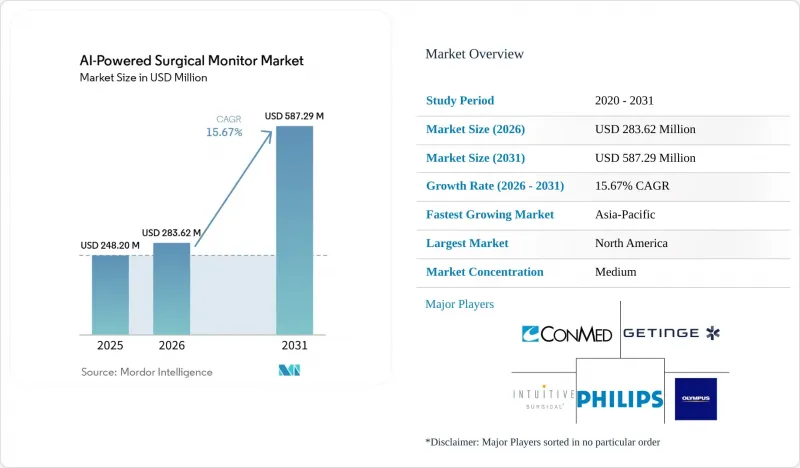
본 보고서는 제품 유형(독립형, 통합형 시각화, 또는 통합, AI 가이드), 디스플레이(LED LCD, OLED, Mini-LED/MicroLED), 해상도(HD, Full HD, 4K, 8K), 용도(복강경 수술, 내시경 검사, 관절경 검사, 이비인후과, 뇌신경외과, 정형외과, 심혈관외과, 로봇 수술), 최종 사용자(병원, 당일 수술센터, 클리닉), 지역(북미, 유럽, 아시아태평양, 중동 및 아프리카, 남미)에 따라 분류되어 있습니다. 금액은 달러로 표시됩니다.
전 세계 AI 기반 수술 모니터 시장 동향 및 인사이트
저침습 수술 및 영상 유도 수술 건수 증가
AI 기반 수술 모니터 시장은 최소 침습 수술 및 영상 유도 수술의 구조적 증가에 힘입어 성장하고 있습니다. 이는 수술 시작부터 종료까지 외과의사의 수술 시야가 모니터를 통해 확인되기 때문입니다. 이로 인해 밝기, 명암비, 지연 시간, 영상 안정성은 단순한 부수적인 하드웨어 기능이 아니라 임상 워크플로의 일부가 되었습니다. MedPAC 보고서에 따르면, 2024년 미국의 외래수술센터(ASC) 6,436곳에서 640만 건의 수술이 시행되었으며, 메디케어 수급자 1,000명당 수술 건수는 전년 대비 3.4% 증가했습니다. 이는 AI 기반 수술 모니터 시장을 뒷받침하는 수술 건수의 기반이 여전히 확대되고 있음을 보여줍니다. 2026년 1월 『Frontiers in Surgery』지에 게재된 연구에 따르면, AI를 활용한 물체 감지 기술을 통해 중요한 림프절을 2초 이내에 식별할 수 있는 외과의사의 비율이 4.67%에서 42.99%로 증가한 것으로 밝혀졌습니다. 이는 화면 기반 AI 지원이 측정 가능한 수술 중 성과와 연관되어 있음을 보여줍니다. 이러한 성과와의 연관성 덕분에 조달에 관한 논의가 보다 임상적인 관점으로 전환되면서, 장비 중심의 논의에서 멀어지고 있습니다. 이로 인해 대학병원이나 첨단 외과 센터에서 장비 교체 결정이 신속하게 이루어지고 있습니다. 그 결과, AI 기반 수술 모니터 시장은 수술 건수 증가와, 영상의 품질이 수술의 안정성에 직접적인 영향을 미칩니다는 인식이 확산되고 있는 점 모두로부터 혜택을 보고 있습니다.
수술 중 감지 및 워크플로우 자동화를 위한 임베디드 AI
AI 기반 수술 모니터 시장이 확대되고 있는 배경에는 임베디드 AI가 단일 작업의 실험 단계에서 벗어나 실제 수술 중에 임상적으로 활용 가능한 속도로 작동하는 멀티태스킹 시스템으로 전환된 점도 한 요인으로 꼽힙니다. 2025년 10월, 『Frontiers in Oncology』지는 복강경 간 수술 지능형 수술 보조 시스템이 19.2 fps에서 기구 및 장기 인식 정확도 89%를 달성했으며, 외부 검증 코호트에서 AP50 95.2%를 기록했다고 보고했습니다. 이는 실시간 화면 상에서의 지원으로의 전환을 촉진하는 것입니다. 이는 AI 기반 수술 모니터 시장에 있어 중요한 의미를 지닙니다. 엣지 기반 컴퓨팅을 통해 클라우드 대역폭에 대한 의존도가 낮아지기 때문에 병원은 IT 시스템의 전면적인 개편을 기다리지 않고도 첨단 디스플레이 시스템을 도입할 수 있게 되기 때문입니다. 따라서 모니터는 단순히 표시 장치일 뿐만 아니라 컴퓨팅의 엔드포인트 역할도 수행하게 되면서, 이로 인해 병원에서 기술 사양을 정의하는 방식이 변화하고 있습니다. 조달 팀은 기존의 표시 기능 외에도 오버레이 실행, 데이터 처리, 소프트웨어 확장성에 대한 지원을 요구하고 있습니다. 이러한 변화로 인해 향후 알고리즘을 호스팅할 수 있는 플랫폼의 장기적인 가치가 높아지고, 확장 가능한 하드웨어 및 소프트웨어 아키텍처를 갖춘 공급업체 시장 입지가 강화될 것입니다.
높은 초기 투자 비용과 수술실과의 복잡한 통합
AI 기반 수술 모니터 시장은 많은 의료 시스템에서 여전히 도입 속도가 더딘 상태입니다. 그 이유는 AI 연산 기능과 수술실 연결 기능을 갖춘 완전히 통합된 시각화 솔루션에는 매우 높은 초기 비용이 들기 때문입니다. 이 과제는 하이브리드 수술실에서 단일 환경 내에서 여러 영상 모달리티, 로봇 수술 영상, 라우팅 시스템에 대한 대응이 요구되는 경우 더욱 심각해집니다. 2025년 7월 『Frontiers in Digital Health』에 게재된 논문에 따르면, 조사 대상인 의료기기 제조업체의 75%가 현행 상호운용성 기준에 따른 인간-기계 인터페이스(HMI) 요건이 불충분하다고 지적했으며, 87.5%는 알려지지 않은 네트워크 참여자와 위험 관리 문서를 공유하지 않는다고 응답했습니다. 이는 거버넌스 및 책임에 대한 우려가 기술적 복잡성을 가중시키고 있음을 보여줍니다. 그 결과, AI 기반 수술 모니터 시장은 단순한 교체 시장처럼 기능하지 않습니다. 왜냐하면 대규모 시스템의 경우 대개 장기적인 서비스 계약이나 시간이 오래 걸리는 위원회 심사가 수반되기 때문입니다. 벤더들은 기존 플랫폼을 대체하기 위해 운영 효율성, 합병증 감소, 또는 치료 과정 전반의 경제성에 관한 보다 강력한 실증 자료를 필요로 하고 있습니다. 그 실증 결과가 다양한 수술 및 의료 시스템에서 보다 일관성을 갖추게 될 때까지는 예산이 부족한 의료 기관에서는 자본 규율로 인해 도입 속도가 계속 둔화될 것입니다.
부문별 분석
2025년 기준으로 통합형 AI 시각화 시스템은 AI 기반 수술 모니터 시장 규모의 70.02%를 차지하고 있으며, 이는 병원들이 여전히 공급업체 간의 조정을 줄이고 서비스 의무를 일원화하는 통합 아키텍처를 선호하고 있음을 보여줍니다. AI 기반 수술 모니터 시장에서 이러한 시스템이 선호되는 이유는 이미지 관리, AI 처리 및 다중 소스 라우팅 기능이 개별 하드웨어 계층이 아닌 단일 플랫폼을 통해 제공될 수 있기 때문입니다. 올림푸스는 2026년 3월 미국에서 ‘VISERA ELITE III’를 출시했습니다. 이 플랫폼은 True 4K 및 3D 이미징, 협대역 이미징, 마젠타 모드에서의 형광 유도 수술, 연속 자동 초점 기능은 물론, 올림푸스의 VaultStream 및 LiveStream 포털과의 통합 기능을 결합한 것으로, 통합 시스템이 소프트웨어의 역할을 어떻게 확장하고 있는지를 반영하고 있습니다. AI 기반 수술 모니터 시장에서는 이 형식이 계속해서 선호되고 있습니다. 이는 수술 운영 시간이나 서비스에 대한 설명 책임이 중시되는 상황에서 조달 담당자들이 통합된 시스템 구성을 위험이 낮은 것으로 간주하는 경향이 있기 때문입니다. 또한, 대규모 병원에서 도입된 실적도 통합 플랫폼을 뒷받침하고 있습니다. 이러한 시설에서는 공통된 영상 인프라가 필요한 여러 전문 분야의 수술실을 운영하고 있을 가능성이 높기 때문입니다.
AI 지원 수술실 통합 디스플레이 플랫폼은 2031년까지 연평균 성장률(CAGR) 16.05%를 나타낼 것으로 예측되며, AI 기반 수술 모니터 업계에서 가장 빠르게 성장하고 있는 제품 카테고리입니다. 이는 하이브리드 수술실 구축에 있어 여러 실시간 데이터 소스를 처리할 수 있는 단일 디스플레이 플랫폼에 대한 수요가 증가하고 있기 때문입니다. AI 기반 수술 모니터 시장에서 이 카테고리가 확대되고 있는 이유는 로봇에서 전송되는 영상, 내비게이션 입력 및 이미지 오버레이가 별도의 화면이나 중복되는 라우팅 하드웨어 없이도 공존해야 하기 때문입니다. 독립형 AI 지원 모니터는 완전한 통합에 높은 비용이 드는 소규모 당일 수술센터(ASC) 및 전문 클리닉을 위해 여전히 제공되고 있으며, AI 안내 디스플레이 플랫폼은 실시간 오버레이와 로봇 인터페이스가 가장 긴밀하게 연동되는 최첨단 분야로 자리매김하고 있습니다. AI 기반 수술 모니터 업계 전반에서 기능의 차별화가 중요시되기 전부터, IEC 60601 전기 안전 규격이나 ISO 13485 품질 관리 규격과 같은 기본 요건이 공급업체의 인증 기준을 계속해서 형성해 왔습니다.
2025년에는 LED 백라이트가 탑재된 LCD 패널이 매출의 56.46%를 차지했습니다. 이는 여전히 AI 기반 수술 모니터 시장을 주도하고 있는 대규모 도입 실적, 낮은 도입 비용, 그리고 폭넓은 호환성을 반영한 것입니다. 많은 병원에서는 기존의 영상 배선 시스템과 호환되며, 새로운 발광 기술로 인한 고가의 가격 책정 없이 일상적인 수술 수요를 충족시키기 위해 LED 백라이트가 탑재된 LCD 시스템을 계속해서 도입하고 있습니다. AI 기반 수술 모니터 시장에서 의료 기관이 최고 수준의 명암비 성능보다 신뢰성, 서비스에 대한 익숙함, 예산 관리를 우선시하는 교체 주기에서는 여전히 LED가 우위를 점하고 있습니다. 그렇긴 하지만, 동일한 수술에서 AI 오버레이, 형광 신호, 암시야 이미징이 함께 사용되는 경우, 기존 LCD 기술의 한계가 더욱 두드러지게 나타납니다. 이것이 바로 AI 기반 수술 모니터 시장에서 LED 시스템의 대량 도입 기반을 단번에 배제하는 것이 아니라, 프리미엄층에 대한 수요를 꾸준히 창출하고 있는 이유입니다.
OLED 시장은 2031년까지 연평균 성장률(CAGR) 15.47%를 기록하며 성장할 것으로 전망됩니다. 이는 픽셀 단위의 광 제어 기능이, 높은 명암비 분리에 의존하는 형광 유도 수술 및 조직 산소화 오버레이를 지원하기 위함입니다. Hypervision Surgical사의 FDA 승인을 받은 HYPERSNAP 시스템은 AI 기반 분석 기능을 갖춘 초분광 영상 기술을 적용하여, 60fps를 넘는 속도로 작동합니다. 이는 더 높은 표시 충실도가 요구되는 까다로운 이미지 환경의 전형적인 사례를 보여줍니다. EIZO는 2026년 4월, Mini-LED 백라이트, 2,000개 이상의 로컬 디밍 존, 1,000,000:1의 명암비, IP45 등급의 전면 패널 보호 기능을 탑재한 제품을 출시했습니다. 한편, LG는 2025년 11월, 자동 페일오버 입력 전환 기능과 워크플로우 프리셋을 탑재한 31.5인치 4K Mini-LED 수술 모니터를 발표했습니다. 이 모든 것은 AI 기반 수술 모니터 시장에서 Mini-LED가 표준 LED와 프리미엄 OLED 사이의 실용적인 가교 역할을 하고 있음을 보여줍니다. 그 결과, AI 기반 수술 모니터 시장에서는 LED가 시장 규모를 유지하고, 미니 LED가 중상위 프리미엄층 수요를 확대하며, OLED가 화질에 가장 민감한 수술에 대응하는 등 3단계의 기술 계층이 형성되고 있습니다.
지역별 분석
2025년, 북미는 AI 기반 수술 모니터 시장 점유율의 43.56%를 차지했으며, 최첨단 로봇 수술 인프라, 탄탄한 외래 환자 기반, 수술 중 AI에 대한 조기 규제 승인이 맞물려 여전히 최대의 지역 기여자로서의 위상을 유지했습니다. 이 지역의 AI 기반 수술 모니터 시장은 AI 및 머신러닝에 기반한 실시간 영상 증강 기술에 대한 FDA의 새로운 제품 코드에 힘입어 성장하고 있으며, 이는 2025년 7월 Hypervision Surgical사의 HYPERSNAP 승인에 처음으로 적용되었습니다. MedPAC 보고서에 따르면, 2024년 현재 미국에는 6,436곳의 ASC(외래수술센터(ASC))가 있으며, 640만 건의 수술이 시행되고 있는데, 이는 영상 시스템 업그레이드를 가속화할 수 있는 외래 진료 채널의 규모를 뒷받침하는 것입니다. 캐나다에서는 대규모 병원 시스템을 통해 수요가 발생하지만, 공공 조달 주기로 인해 갱신 시기가 늦어질 가능성이 있습니다. 멕시코에서는 여전히 주요 도시의 민간 병원 네트워크에 집중되어 있으며, 전국적인 확대보다는 특정 대상을 겨냥한 프리미엄 도입이 선호되고 있습니다.
유럽은 로봇 수술 건수가 많고 규제 준수 기준이 엄격하기 때문에 보다 탄탄한 품질 관리 및 문서화 인프라를 갖춘 공급업체에 유리하게 작용하여, AI 기반 수술 모니터 시장의 주요 거점으로 자리매김하고 있습니다. 인튜이티브사는 2025년 7월, 다빈치 5가 CE 마크를 획득했다고 발표했습니다. 또한, 이 회사는 유럽 내 다빈치 수술 건수가 2025년에 21% 증가해 110만 건을 넘어섰다고 보고했는데, 이는 고성능 시각화 수요에 대한 해당 지역의 수술 건수 규모를 보여주는 것입니다. 칼 스트루츠(Karl Storz)는 2025년 11월, 자사의 OR1 플랫폼이 전 세계 12,000개 이상의 수술실에 도입되었으며, 연구 파트너들과 함께 ‘SurgicalAIHubGermany’를 추진하고 있다고 발표했습니다. 이는 유럽의 유서 깊은 벤더가 대규모 도입 기반을 바탕으로 소프트웨어 기능을 심화시키고 있음을 보여줍니다. 따라서 해당 지역의 AI 기반 수술 모니터 시장은 강력한 임상 수요와, 진입 장벽을 높이고 경험이 풍부한 공급업체를 중심으로 한 시장 통합을 촉진하는 규제 환경이 결합되어 있습니다.
아시아태평양의 AI 기반 수술 모니터 시장 규모는 2031년까지 연평균 성장률(CAGR) 17.89%로 확대될 것으로 예상되며, 일본, 중국, 한국, 인도가 각각 서로 다르지만 상호 보완적인 도입 경로를 밟는 가운데, 이 지역이 가장 빠르게 성장하는 시장으로 부상할 전망입니다. 일본의 AI 기반 수술 모니터 시장은 PMDA(의약품 및 의료기기 종합기구)가 수술 중 AI 활용을 장려하고 있는 점과, 이러한 도구가 실제 수술 현장에서 효과적으로 작동함을 입증하는 임상 검증의 혜택을 받고 있습니다. NEDO(신에너지·산업기술종합개발기구)는 2026년 3월, 수술에 특화된 생성형 AI 시스템을 개발하여, 게이오기주쿠 대학병원에서 진행된 위암 수술 생중계에서 임상 수준의 수술 중 대화 성능을 입증했다고 발표했습니다. 이는 AI 지원형 수술 시각화 분야의 참고 시장으로서 일본의 역할을 강화하는 것입니다. 메드트로닉은 2026년 4월, 일본에서 Hugo 로봇 플랫폼 및 기존 복강경 수술 장비와 함께 사용할 수 있는 ‘Touch Surgery’ 생태계를 출시했습니다. 이는 해당 공급업체가 일본을 AI 기반 수술 영상 워크플로우의 중요한 상용화 거점으로 삼고 있음을 시사합니다. 중국은 병원의 현대화와 1급 도시권에서의 4K 영상 수요를 통해 시장 규모를 확대하고 있는 반면, 인도는 기업형 병원의 확장과 파트너십 주도형 기술 도입을 통해 기여하고 있습니다. 한국은 국내 로봇 생태계가 새로운 수술 플랫폼 전반에 걸쳐 호환 가능한 시각화 및 오버레이 시스템에 대한 수요를 창출하고 있어, 성장의 새로운 동력을 얻고 있습니다.
기타 혜택:
- 엑셀 형식 시장 예측(ME) 시트
- 3개월간의 애널리스트 지원
자주 묻는 질문
목차
제1장 서론
제2장 조사 방법
제3장 주요 요약
제4장 시장 구도
제5장 시장 규모와 성장 예측
제6장 경쟁 구도
제7장 시장 기회와 향후 전망
JHS 26.06.23According to Mordor Intelligence, the aI-Powered surgical monitor market size is projected to expand from USD 248.20 million in 2025 and USD 283.62 million in 2026 to USD 587.29 million by 2031, registering a CAGR of 15.67% between 2026 to 2031.
This report is Segmented by Product Type (Standalone, Integrated Visualization, or Integration, AI-Guidance), Display (LED LCD, OLED, Mini-LED/MicroLED), Resolution (HD, Full HD, 4K, 8K), Application (Laparoscopy, Endoscopy, Arthroscopy, ENT, Neurosurgery, Orthopedic, CV Surgery, Robotic), End User (Hospitals, Ascs, Clinics), and Geography (North America, Europe, APAC, MEA, South America). Value in USD.
Global AI-Powered Surgical Monitor Market Trends and Insights
Rising Minimally Invasive and Image-Guided Surgery Volumes
The AI-powered surgical monitor market is benefiting from the structural rise of minimally invasive and image-guided surgery because the surgeon's operative field is viewed through a monitor from start to finish. This makes brightness, contrast, latency, and image stability part of clinical workflow rather than secondary hardware features. MedPAC reported that U.S. ambulatory surgical centers performed 6.4 million surgical procedures in 2024 across 6,436 facilities, while procedure volume per 1,000 Medicare beneficiaries increased 3.4% year over year, which shows the procedural base supporting the AI-powered surgical monitor market is still broadening. A January 2026 study in Frontiers in Surgery found that AI-assisted object detection increased the share of surgeons identifying critical lymph nodes within 2 seconds from 4.67% to 42.99%, which links screen-based AI support to measurable intraoperative performance. That type of outcome linkage is making procurement discussions more clinical and less equipment-centered, which supports faster replacement decisions in academic hospitals and advanced surgical centers. As a result, the AI-powered surgical monitor market is gaining from both rising case volumes and growing belief that visualization quality can directly affect surgical consistency.
Embedded AI for Intraoperative Detection and Workflow Automation
The AI-powered surgical monitor market is also moving forward because embedded AI has shifted from single-task experiments toward multi-task systems that can run at clinically usable speeds during live surgery. In October 2025, Frontiers in Oncology reported that the Intelligent Surgical Assistant for laparoscopic liver surgery reached 89% instrument and organ recognition accuracy at 19.2 fps and delivered an AP50 of 95.2% on an external validation cohort, which supports the move toward real-time on-screen assistance. This matters for the AI-powered surgical monitor market because edge-based compute reduces dependence on cloud bandwidth, which allows hospitals to adopt advanced display systems without waiting for a full IT overhaul. The monitor is therefore becoming a compute endpoint as well as a display surface, and that is changing how hospitals define technical specifications. Procurement teams are beginning to ask for support for overlay execution, data handling, and software extensibility, in addition to conventional display measures. That shift raises the long-term value of platforms that can host future algorithms, which strengthens the commercial position of vendors with scalable hardware and software architectures.
High Capital Cost and Complex OR Integration
The AI-powered surgical monitor market still faces slower conversion in many health systems because a fully integrated visualization suite with AI compute and OR connectivity can carry a very high upfront cost. This challenge is amplified when hybrid operating rooms require support for multiple imaging modalities, robotics feeds, and routing systems inside one environment. A July 2025 paper in Frontiers in Digital Health found that 75% of surveyed medical device manufacturers cited inadequate human-machine interface requirements in current interoperability standards, while 87.5% would not share risk-management documentation with unknown network participants, which shows how governance and liability concerns add to technical complexity. The result is that the AI-powered surgical monitor market does not operate like a simple replacement market, because large systems often come with long service obligations and lengthy committee review. Vendors need stronger proof on operating efficiency, complication reduction, or total episode economics to displace installed platforms. Until that proof becomes more consistent across procedures and health systems, capital discipline will continue to slow adoption in facilities with stretched budgets.
Other drivers and restraints analyzed in the detailed report include:
- ASC Migration Lifts Demand for Compact Visualization Suites
- Regulatory Legitimization of Real-Time AI Video Augmentation
- OR Video Governance and Cybersecurity Burden
For complete list of drivers and restraints, kindly check the Table Of Contents.
Segment Analysis
Integrated AI Visualization Systems held 70.02% of the AI-powered surgical monitor market size in 2025, which shows that hospitals still prefer consolidated architectures that reduce vendor coordination and centralize service obligations. In the AI-powered surgical monitor market, these systems are favored because imaging management, AI processing, and multi-source routing can be delivered through a single platform rather than separate hardware layers. Olympus launched VISERA ELITE III in the United States in March 2026, and the platform combined True 4K and 3D imaging, Narrow Band Imaging, fluorescence-guided surgery in Magenta Mode, continuous auto-focus, and integration with Olympus VaultStream and LiveStream portals, which reflects how integrated systems are broadening their software role. The AI-powered surgical monitor market continues to reward this format because procurement teams often view a unified stack as lower risk when surgical uptime and service accountability matter. The installed base in larger hospitals also supports integrated platforms because these facilities are more likely to run multi-specialty ORs that need a common imaging backbone.
AI-enabled OR Integration Display Platforms are forecast to grow at 16.05% CAGR through 2031, making them the fastest-expanding product category in the AI-powered surgical monitor industry because hybrid OR builds increasingly need one display fabric to handle multiple live data sources. In the AI-powered surgical monitor market, this category is gaining because robotic feeds, navigation inputs, and imaging overlays must coexist without forcing separate screens and duplicate routing hardware. Standalone AI-enabled monitors still serve smaller ASCs and specialty clinics where full integration is too costly, and AI-guidance display platforms remain the frontier category where real-time overlays and robotic interfaces are most tightly linked. Across the AI-powered surgical monitor industry, baseline requirements such as IEC 60601 electrical safety and ISO 13485 quality management continue to shape vendor qualification before feature differentiation becomes relevant.
LED-backlit LCD panels accounted for 56.46% of revenue in 2025, which reflects the large installed base, lower acquisition cost, and broad compatibility that still shape the AI-powered surgical monitor market. Many hospitals continue to rely on LED-backlit LCD systems because they fit existing video chains and meet everyday surgical needs without the premium pricing attached to newer emissive technologies. The AI-powered surgical monitor market still gives LED an advantage in replacement cycles where facilities prioritize reliability, service familiarity, and budget discipline over top-end contrast performance. Even so, the technology ceiling of conventional LCD becomes more visible when AI overlays, fluorescence signals, and dark-field imaging are used in the same procedure. This is why the AI-powered surgical monitor market is steadily creating room for premium tiers rather than removing the volume base of LED systems all at once.
OLED is projected to grow at 15.47% CAGR through 2031 because per-pixel light control supports fluorescence-guided surgery and tissue-oxygenation overlays that depend on strong contrast separation. Hypervision Surgical's FDA-cleared HYPERSNAP system uses hyperspectral imaging with AI-powered analytics and operates at more than 60 fps, which underlines the type of demanding image environment that benefits from higher display fidelity. EIZO launched the CuratOR EX3245H in April 2026 with a Mini-LED backlight, more than 2,000 local dimming zones, a 1,000,000:1 contrast ratio, and IP45 front-panel protection, while LG introduced a 31.5-inch 4K Mini-LED surgical monitor in November 2025 with automated failover input switching and workflow presets, which together show how Mini-LED is being positioned as a practical bridge between standard LED and premium OLED in the AI-powered surgical monitor market. As a result, the AI-powered surgical monitor market is developing a three-tier technology ladder where LED retains scale, Mini-LED broadens mid-premium demand, and OLED addresses the most image-sensitive procedures.
Geography Analysis
North America held 43.56% of the AI-powered surgical monitor market share in 2025, which kept it as the largest regional contributor because it combines advanced robotic surgery infrastructure, a deep outpatient base, and early regulatory acceptance of intraoperative AI. The AI-powered surgical monitor market in the region is supported by the FDA's new product code for AI and machine learning based real-time video augmentation, first applied to Hypervision Surgical's HYPERSNAP clearance in July 2025. MedPAC reported that the United States had 6,436 ASCs and 6.4 million ASC procedures in 2024, which reinforces the scale of the outpatient channel that can accelerate visualization upgrades. Canada adds demand through large hospital systems, although public procurement cycles can extend refresh timing. Mexico remains more concentrated in private hospital networks in major cities, which favors targeted premium deployments rather than broad national rollout.
Europe remains a major center for the AI-powered surgical monitor market because robotic surgery volumes are high and regulatory compliance standards are strict enough to favor vendors with deeper quality and documentation infrastructure. Intuitive said in July 2025 that da Vinci 5 received CE Mark, and the company also reported that European da Vinci procedures grew 21% in 2025 and exceeded 1.1 million, which indicates strong regional procedure depth for high-end visualization demand. KARL STORZ stated in November 2025 that its OR1 platform was installed in more than 12,000 ORs globally and that the company was advancing SurgicalAIHubGermany with research partners, which shows how established European vendors are deepening software capabilities around a large installed base. The AI-powered surgical monitor market in the region, therefore, combines strong clinical demand with a compliance environment that raises entry barriers and supports consolidation around experienced vendors.
Asia-Pacific is projected to expand at 17.89% CAGR in the AI-powered surgical monitor market size through 2031, making it the fastest-growing regional arena as Japan, China, South Korea, and India move along different but complementary adoption paths. The AI-powered surgical monitor market in Japan is benefiting from PMDA-backed momentum for intraoperative AI and from clinical demonstrations that show these tools can operate in live surgical settings. NEDO announced in March 2026 that it had developed a surgery-focused generative AI system and demonstrated clinical-grade intraoperative dialogue performance during live gastric cancer surgery at Keio University Hospital, which strengthens Japan's role as a reference market for AI-supported surgical visualization. Medtronic launched the Touch Surgery ecosystem in Japan in April 2026 for use with the Hugo robotic platform and conventional laparoscopic setups, which signals that suppliers are treating Japan as an important commercialization base for AI-enabled surgical video workflows. China adds scale through hospital modernization and demand for 4K imaging in tier-1 networks, while India contributes through corporate hospital expansion and partnership-led technology adoption. South Korea adds another layer of growth because its domestic robotics ecosystem creates demand for compatible visualization and overlay systems across newer surgical platforms.
- Barco NV
- Brain Lab
- Caresyntax Corp.
- Conmed
- EIZO Corporation
- FSN Medical Technologies
- FUJIFILM
- Getinge
- Hypervision Surgical Ltd.
- Intuitive Surgical, Inc.
- Karl Storz
- Koninklijke Philips
- LG Electronics Inc.
- Medtronic
- NDS Surgical Imaging
- Novanta Inc.
- Olympus
- Proprio, Inc.
- Richard Wolf
- Siemens Healthineers
- Sony Group
- STERIS
Additional Benefits:
- The market estimate (ME) sheet in Excel format
- 3 months of analyst support
TABLE OF CONTENTS
1 Introduction
- 1.1 Study Assumptions & Market Definition
- 1.2 Scope of the Study
2 Research Methodology
3 Executive Summary
4 Market Landscape
- 4.1 Market Overview
- 4.2 Market Drivers
- 4.2.1 Rising Minimally Invasive and Image-Guided Surgery Volumes
- 4.2.2 4K And 3D Upgrade Cycle in Hybrid Operating Rooms
- 4.2.3 ASC Migration Lifts Demand for Compact Visualization Suites
- 4.2.4 Embedded AI For Intraoperative Detection and Workflow Automation
- 4.2.5 Regulatory Legitimization of Real-Time AI Video Augmentation
- 4.2.6 Need For Multi-Modal Overlays Across Robotics and Navigation
- 4.3 Market Restraints
- 4.3.1 High Capital Cost and Complex OR Integration
- 4.3.2 Legacy Interoperability Across Towers and Video Protocols
- 4.3.3 Liability and Reimbursement Ambiguity for AI-Guided Decisions
- 4.3.4 OR Video Governance and Cybersecurity Burden
- 4.4 Value / Supply-Chain Analysis
- 4.5 Regulatory Landscape
- 4.6 Technological Outlook
- 4.7 Porter's Five Forces Analysis
- 4.7.1 Threat of New Entrants
- 4.7.2 Bargaining Power of Suppliers
- 4.7.3 Bargaining Power of Buyers
- 4.7.4 Threat of Substitutes
- 4.7.5 Industry Rivalry
5 Market Size & Growth Forecasts
- 5.1 By Product Type
- 5.1.1 AI-enabled Standalone Surgical Monitors
- 5.1.2 Integrated AI Visualization Systems
- 5.1.3 AI-enabled OR Integration Display Platforms
- 5.1.4 AI-guidance Display Platforms
- 5.2 By Display Technology
- 5.2.1 LED-backlit LCD
- 5.2.2 OLED
- 5.2.3 Mini-LED and MicroLED
- 5.3 By Resolution
- 5.3.1 HD
- 5.3.2 Full HD
- 5.3.3 4K Ultra HD
- 5.3.4 8K Ultra HD
- 5.4 By Application
- 5.4.1 Laparoscopy
- 5.4.2 Endoscopy
- 5.4.3 Arthroscopy
- 5.4.4 ENT Surgery
- 5.4.5 Neurosurgery
- 5.4.6 Orthopedic Surgery
- 5.4.7 Cardiovascular Surgery
- 5.4.8 Robotic-assisted Surgery
- 5.5 By End User
- 5.5.1 Hospitals
- 5.5.2 Ambulatory Surgical Centers
- 5.5.3 Specialty Clinics
- 5.6 By Geography
- 5.6.1 North America
- 5.6.1.1 United States
- 5.6.1.2 Canada
- 5.6.1.3 Mexico
- 5.6.2 Europe
- 5.6.2.1 Germany
- 5.6.2.2 United Kingdom
- 5.6.2.3 France
- 5.6.2.4 Italy
- 5.6.2.5 Spain
- 5.6.2.6 Rest of Europe
- 5.6.3 Asia-Pacific
- 5.6.3.1 China
- 5.6.3.2 Japan
- 5.6.3.3 India
- 5.6.3.4 Australia
- 5.6.3.5 South Korea
- 5.6.3.6 Rest of Asia-Pacific
- 5.6.4 Middle East & Africa
- 5.6.4.1 GCC
- 5.6.4.2 South Africa
- 5.6.4.3 Rest of Middle East & Africa
- 5.6.5 South America
- 5.6.5.1 Brazil
- 5.6.5.2 Argentina
- 5.6.5.3 Rest of South America
- 5.6.1 North America
6 Competitive Landscape
- 6.1 Market Concentration
- 6.2 Market Share Analysis
- 6.3 Company Profiles (includes Global level Overview, Market-level Overview, Core Segments, Financials, Strategic Information, Market Rank/Share, Products & Services, Recent Developments)
- 6.3.1 Barco NV
- 6.3.2 Brainlab AG
- 6.3.3 Caresyntax Corp.
- 6.3.4 CONMED Corporation
- 6.3.5 EIZO Corporation
- 6.3.6 FSN Medical Technologies
- 6.3.7 FUJIFILM Holdings Corporation
- 6.3.8 Getinge AB
- 6.3.9 Hypervision Surgical Ltd.
- 6.3.10 Intuitive Surgical, Inc.
- 6.3.11 KARL STORZ SE & Co. KG
- 6.3.12 Koninklijke Philips N.V.
- 6.3.13 LG Electronics Inc.
- 6.3.14 Medtronic plc
- 6.3.15 NDS Surgical Imaging
- 6.3.16 Novanta Inc.
- 6.3.17 Olympus Corporation
- 6.3.18 Proprio, Inc.
- 6.3.19 Richard Wolf GmbH
- 6.3.20 Siemens Healthineers AG
- 6.3.21 Sony Group Corporation
- 6.3.22 STERIS plc
7 Market Opportunities & Future Outlook
- 7.1 White-space & Unmet-need Assessment


