

|
시장보고서
상품코드
2064426
수면 중 이갈이 치료 시장 : 시장 점유율 분석, 업계 동향 및 통계, 성장 예측(2026-2031년)Sleeping Bruxism Treatment - Market Share Analysis, Industry Trends & Statistics, Growth Forecasts (2026 - 2031) |
||||||
 Mordor Intelligence
Mordor Intelligence에 의하면, 수면 중 이갈이 치료 시장 규모는 2025년 6억 3,956만 달러로 평가되었고, 2026년에는 6억 8,335만 달러로 추정되고, 2031년까지 9억 8,195만 달러에 이를 것으로 예측되며, 2026-2031년 CAGR 7.52%로 성장할 전망입니다.
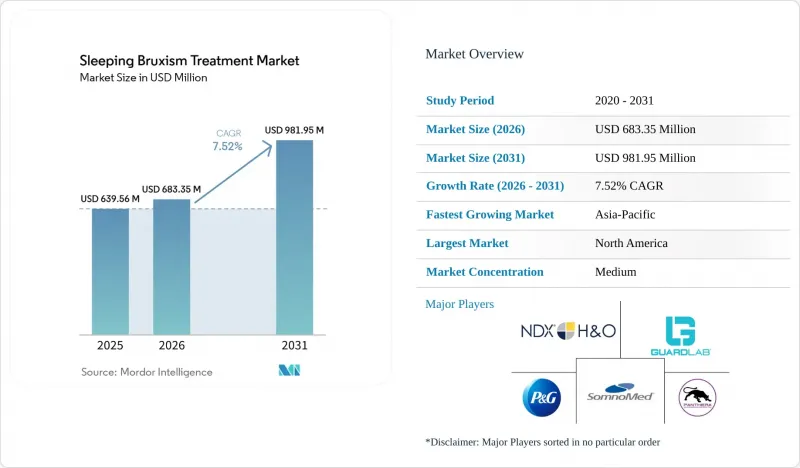
본 보고서는 치료법별(치과용 기구, 약물 요법 및 주사 요법, 기타), 제품 유형별(마우스 가드, 기타), 환자층별(성인, 소아), 최종 사용자별(치과, 병원 및 다학제 수면 센터, 기타), 지역별(북미, 유럽, 아시아태평양, 기타)별로 분류되어 있습니다. 시장 전망은 금액(달러) 기준으로 제시되어 있습니다.
세계의 수면 중 이갈이 치료 시장 동향 및 인사이트
OSA와 중복되는 수면 중 이갈이 진단 증가
다직종 협력을 통한 수면 워크플로우 내에서의 이갈이와 수면무호흡증(OSA) 진단 통합은 환자가 수면 이갈이 치료 시장에 진입하는 방식을 변화시키고 있습니다. 345명의 OSA 환자를 대상으로 한 수면 다원검사 데이터에 따르면, 13.6%에서 수면 중 이갈이가 동반되었으며, 이 하위 집단에서는 주간 졸림이 심하고 렘 수면도 감소한 것으로 나타났습니다. 에 따르면, 105명의 OSA 환자를 대상으로 한 연구에서 37.1%의 사례에서 수면 중 이갈이가 관찰되었으며, EMG로 측정된 근긴장도는 AUC 0.9를 나타냈습니다. 이는 수면 환경에서 병용 선별 검사에 웨어러블 EMG를 활용하는 것이 타당함을 뒷받침하는 것입니다. 병발 진단을 받은 환자는 단일 질환용 나이트가드보다는 이중 용도의 하악 전돌 장치나 병용 치료 계획을 선택하는 경향이 강하기 때문에 이는 상업적으로 중요한 의미를 지닙니다. 또한, 문헌은 AASM(미국 수면 의학 학회)과 관련된 진단 체계에 점점 더 기반을 두고 있으며, 이는 특히 북미에서 수면 의학의 기준이 수면 중 이갈이 치료 시장의 협력 의사들의 행동을 계속해서 형성해 나갈 것임을 시사합니다. 이러한 치료 경로가 확대됨에 따라, 기도 관리와 치아 보호를 모두 담당할 수 있는 의료 제공업체가 수면 중 이갈이 치료 시장에서 더 큰 점유율을 확보할 가능성이 높을 것으로 보입니다.
맞춤형 구강 내 장치와 디지털 치의학으로의 전환
디지털 제조 기술은 수면 중 이갈이 치료 시장 전반에 걸쳐 맞춤형 구강 내 장치의 비용, 속도, 제공 모델을 혁신하고 있습니다. CAD/CAM 밀링, 구강 내 스캔, 적층 조형 기술을 통해 납기 기간이 단축되어, 원격으로 모델을 제공하는 것이 이전보다 훨씬 수월해졌습니다. SomnoMed는 2025년까지의 제조 투자를 통해 생산 리드타임을 20일 이상에서 10일 이하로 단축하고, 생산 능력을 40% 이상 확대했다고 보고했으며, 이를 통해 경쟁사 제품에서 자사 제품으로의 사용자 전환력을 강화했습니다. Panthera의 디지털 제조 나일론 장비는 FDA 510(k) 승인, CE 마크, HCPCS 청구 지원을 획득하여 보험 환급 적합성이 향상되었으며, 전액 본인 부담 환자층을 넘어 상업적 시장 범위를 확대되고 있습니다. 2026년 체계적 문헌고찰에 따르면, 연구 규모는 여전히 제한적이었으나, 디지털 스프린트는 기존 아크릴 스프린트에 비해 증상의 중증도를 완화하는 경향이 있는 것으로 나타났습니다. 그 결과, 수면 중 이갈이 치료 시장은 기존에 여러 차례 내원이 필요했던 업무 흐름에 대한 의존도를 낮추고, 보다 신속한 맞춤형 제작에 대응할 수 있게 되어가고 있습니다.
진단의 미비와 보편적으로 인정된 치료 기준의 부재
보편적으로 채택된 임상 프로토콜이 존재하지 않기 때문에 수면 중 이갈이 치료 시장 전반에 걸쳐 진단과 일관된 치료가 여전히 제한되고 있습니다. 31건의 체계적 문헌고찰을 종합한 결과, 구강 내 장치, 약물 요법, 바이오피드백에 관한 근거는 여전히 일관성이 없으며, 명확한 표준 치료법을 정의하기에는 이르지 못했다고 결론지었습니다. 이러한 세분화로 인해, 초진 시 일반 치과의사, 수면 전문의 또는 구강안면통 전문의 중 누구에게 진료를 받느냐에 따라, 같은 환자라도 서로 다른 진단명이나 치료법을 권고받게 됩니다. 확정 진단의 골드 스탠다드는 여전히 수면 다원 검사이지만, 비용이나 접근성 문제로 인해 그 적용은 전문의의 진료 환경으로 제한되어 있습니다. 따라서 많은 환자는 확정 진단이 아닌, ‘이갈이 가능성이 있다’ 또는 ‘이갈이가 의심된다’는 범주로 관리되고 있습니다. ICSD-3나 AASM과 같은 참조 시스템은 유용한 틀을 제공하지만, 전문의가 아닌 현장에서는 여전히 일상적인 활용이 제한적입니다. 이로 인해 환자의 전원 시기가 지연되고, 치료의 일관성이 저하되어, 수면 중 이갈이 치료 시장의 일부가 그 역학적 잠재력에 미치지 못하는 상태에 머물러 있습니다.
부문별 분석
2025년 기준으로, 치과용 기기는 치료법별 매출의 42.68%를 차지했으며, 수면 중 이갈이 치료 시장에서 여전히 중심적인 위치를 차지하고 있습니다. 맞춤형 나이트 가드, 미시간·스프린트, 하악 전돌 장치는 확립된 치과 의료 시스템에서 일반적으로 첫 번째로 선택되는 치료 방식과 부합하기 때문에 여전히 핵심 제품으로 자리 잡고 있습니다. 이러한 제품들이 시장을 선도하고 있는 배경에는 클리닉 네트워크 전체에서 해당 제품들을 대규모로 생산 및 유통하는 확립된 연구소 공급망도 반영되어 있습니다. 행동 치료와 물리치료는 2031년까지 연평균 성장률(CAGR) 8.22%를 나타낼 것으로 예측되며, 수면 중 이갈이 치료 시장에서 가장 빠르게 성장하고 있는 치료 방식이 될 것입니다. 이러한 성장은 모든 환자에게 기기 착용이라는 장벽을 부과하지 않으면서도 증상으로 인한 부담을 줄일 수 있는 비침습적 치료로의 광범위한 전환을 반영하고 있습니다. 따라서 수면 중 이갈이 치료 산업은 예방, 습관 관리, 지지 요법을 보다 균형 있게 조합하는 방향으로 전환되고 있습니다.
IAPD(국제소아치과의학회)의 2024년 소아 이갈이에 관한 합의문에서는 심리사회적 요인이 존재하는 경우, CBT(인지행동치료)와 고유수용감각 접근법을 지지하고 있으며, 이러한 입장은 보다 광범위한 치료 프로토콜의 설계에 영향을 미치기 시작하고 있습니다. 약물 요법과 주사 요법은 저작근 비대나 턱관절 장애(TMD)를 동반한 환자에게 여전히 효과적이지만, 보툴리눔툭신(보톡스)가 발작 빈도를 줄이는 데 어떤 역할을 하는지에 대해서는 여전히 논란의 여지가 있습니다. 2024년에 실시된 9건의 무작위 대조 임상시험을 대상으로 한 체계적 문헌고찰에 따르면, 보툴리눔툭신(보톡스)가 처음 3-16주 동안 통증과 근전도(EMG) 활동을 개선했으나, 그 효과는 3.5개월 후에는 약해지는 것으로 나타났습니다. 기기를 활용한 모니터링 및 바이오피드백은 아직 상용화의 초기 단계에 있지만, 임상적 검증이 진행됨에 따라 수면 중 이갈이 치료 산업 내에서 해당 분야의 입지가 점차 확고해지고 있습니다. 또한, 보호, 재훈련, 모니터링을 통합한 종합적인 치료 프로토콜에 대해 환자가 비용을 지불할 의사가 있는 프리미엄 케어 현장에서는 병용 요법에 대한 관심도 높아지고 있습니다.
2025년 수면 중 이갈이 치료 시장 규모에서 마우스 가드는 45.17%를 차지했으며 가장 큰 제품 카테고리가 되었습니다. 소프트, 하드, 듀얼 라미네이트(이중 적층) 설계는 보철 전문의들에게 친숙하며, 주요 치과 기공소 네트워크를 통해 제조할 수 있기 때문에 여전히 널리 사용되고 있습니다. 경질 아크릴 소재의 미시간 스타일 마우스 가드나 플랫 플레인 안정화 스프린트는 반복적인 착용 과정을 통해 내구성이 뛰어난 교합 보호 기능을 제공하기 때문에 혼합 용도 분야에서 여전히 주류를 이루고 있습니다. 듀얼 라미네이트 및 하이브리드 설계는 내구성과 편안함을 동시에 향상시키려는 것으로, 이는 치료 지속에 있어 일반적인 장애 요인을 직접 해결해 준다는 점에서 주목을 받고 있습니다. 독일의 다기관 공동 연구에 따르면, Sprint 착용 후 발생한 호흡 장애로 인해 치료 지속률이 10분의 1 수준으로 떨어진 것으로 나타났으며, 이는 제품의 착용감이 실제 사용에 얼마나 직접적인 영향을 미치는지 여부가 밝혀진 것입니다.
스마트 기기 및 바이오피드백 기기는 2031년까지 연평균 성장률(CAGR) 7.92%를 나타낼 것으로 예측되며, 수면 중 이갈이 치료 시장에서 가장 빠르게 성장하고 있는 제품 부문입니다. 이러한 성장은 센서를 활용한 모니터링의 보급과, 단순히 수동적으로 치아를 보호하는 데 그치지 않고 추가적인 기능을 갖춘 제품의 매력에 기인합니다. 센서가 내장된 구강 내 장치나 웨어러블 EMG 시스템은 단순한 보호 기능을 넘어 측정, 피드백, 원격 추적 관리로 치료의 방향을 전환하고 있습니다. 이것이 바로 기존 마우스피스가 여전히 판매량의 대부분을 차지하고 있음에도 불구하고, 수면 중 이갈이 치료 시장에서 프리미엄 제품의 개발이 증가하고 있는 이유 중 하나입니다. 주사제나 경구용 약물은 장치 착용 지침을 충분히 준수하지 못하는 환자나 특유의 통증과 관련된 요구를 가진 환자에게 여전히 도움이 되고 있지만, 수면 중 이갈이 치료 시장 전체에서 볼 때, 장치를 중심으로 한 치료를 대체하기보다는 추가적인 수익을 창출하는 데 그치고 있습니다.
지역별 분석
2025년 기준으로 북미는 수면 중 이갈이 치료 시장의 37.24%를 차지했으며, 가장 규모가 큰 지역 부문으로 자리매김하고 있습니다. 이 지역은 비교적 충실한 치과 보험 혜택, 광범위한 맞춤형 기기의 활용, OSA(폐쇄성 수면무호흡증)와 이갈이에 대한 복합 치료 솔루션에 대한 적극적인 노력의 혜택을 누리고 있습니다. 미국은 대규모 치과 유통망과 보다 발전된 수면 의료 생태계를 모두 갖추고 있어, 해당 지역의 매출에서 큰 비중을 차지하고 있습니다. 또한, 진단은 다학제적 협력을 통한 수면 의료 현장으로 점차 전환되고 있으며, 이에 따라 치료법 선택에 있어 수면 검사실과 수면 전문의의 역할이 커지고 있습니다. 이러한 상황으로 인해 북미 시장은 상업적으로 성숙한 상태를 유지하면서도, 고급 기기의 혁신과 재택 간호 확대에 활용할 여지를 남겨두고 있습니다.
아시아태평양은 2031년까지 연평균 성장률(CAGR) 9.16%로 확대될 것으로 예측되며, 수면 중 이갈이 치료 시장에서 가장 높은 지역 성장률을 보일 것으로 전망됩니다. 지역 내 성장세는 고르지 않은데, 호주는 SomnoMed의 아시아태평양 매출의 80% 이상을 차지하고 있지만, 2026 회계연도 상반기에는 경쟁사와 경제적인 압박에도 직면해 있습니다. 중국, 일본, 인도는 여전히 보급률이 낮은 시장으로, 진단이 제한적이거나 치료가 여전히 보수적인 상태입니다. 따라서 광범위한 수면 중 이갈이 치료 시장 전체에서 치료를 받지 못한 환자층이 여전히 다수 남아 있습니다. 치과 인프라 구축이 진전되고 소비자의 의료비 지출이 증가하고 있는 점이 해당 지역의 향후 성장 궤도를 지속적으로 뒷받침하고 있습니다.
유럽은 여전히 2위 지역 시장으로, 솜노메드는 2026년 상반기 프랑스, 스웨덴, 독일, 노르웨이, 핀란드에서의 보험 급여 확대에 따라 유럽 매출이 17% 증가한 3,270만 호주 달러(2,130만 달러)에 달했다고 보고했습니다. 독일은 상당한 환자 수와 체계적인 보상 및 청구 채널이 결합되어 있어 주목할 만한 수요 중심지로 두각을 나타내고 있습니다. 중동 및 아프리카와 남미는 현재로서는 규모가 작지만, 치과 의료 인프라와 인지도 향상에 힘입어 두 지역 모두 서서히 발전하고 있습니다. 브라질의 임상 연구 활동과 GCC(걸프협력회의) 회원국들의 지속적인 치과 의료 투자는 고급 치과 장비 공급업체들에게 향후 시장 진출 기회를 제공합니다. 이 지역들에서는 여전히 비용상의 제약이 존재하여, 그로 인해 치료 건수는 기초 역학 데이터가 시사하는 수준보다 낮습니다.
기타 혜택
- 엑셀 형식 시장 예측(ME) 시트
- 3개월간의 애널리스트 지원
자주 묻는 질문
목차
제1장 서론
제2장 조사 방법
제3장 주요 요약
제4장 시장 구도
제5장 시장 규모 및 성장 예측
제6장 경쟁 구도
제7장 시장 기회 및 향후 전망
AJY 26.06.24According to Mordor Intelligence, the sleeping bruxism treatment market size is expected to increase from USD 639.56 million in 2025 to USD 683.35 million in 2026 and reach USD 981.95 million by 2031, growing at a CAGR of 7.52% over 2026-2031.
This report is Segmented by Treatment Modality (Dental Appliances, Pharmacological and Injectable Therapy, and More), Product Type (Mouth Guards, and More), Patient Type (Adults, Pediatric), End User (Dental Clinics, Hospitals and Multidisciplinary Sleep Centers, and More), and Geography (North America, Europe, Asia-Pacific, and More). The Market Forecasts are Provided in Terms of Value (USD).
Global Sleeping Bruxism Treatment Market Trends and Insights
Rising Diagnosis of Sleep Bruxism with OSA Overlap
The convergence of bruxism and OSA diagnosis inside multidisciplinary sleep workflows is changing how patients enter the sleep bruxism treatment market. Polysomnography data from 345 OSA patients showed that 13.6% had concurrent sleep bruxism, and this subgroup also had higher daytime sleepiness and reduced REM sleep. A separate study of 105 OSA patients found sleep bruxism in 37.1% of cases, and EMG-measured muscle tone produced an AUC of 0.9, which supports the use of wearable EMG for co-screening in sleep settings. This matters commercially because co-diagnosed patients are more likely to move toward dual-use mandibular advancement devices or combined treatment plans instead of single-condition night guards. The literature is also increasingly anchored to AASM-linked diagnostic framing, which suggests sleep medicine standards will continue to shape prescriber behavior in the sleep bruxism treatment market, especially in North America. As these care pathways widen, providers that can address both airway management and tooth protection are likely to capture more of the sleep bruxism treatment market.
Shift Toward Custom Oral Appliances and Digital Dentistry
Digital fabrication is changing the cost, speed, and delivery model of custom oral appliances across the sleep bruxism treatment market. CAD/CAM milling, intraoral scanning, and additive manufacturing are shortening turnaround times and making remote fulfillment models more viable than before. SomnoMed reported that manufacturing investments through 2025 reduced production turnaround from more than 20 days to under 10 days and expanded capacity by more than 40%, which strengthened its ability to convert users from competing products. Panthera's digitally manufactured nylon appliances carry FDA 510(k) clearance, CE marking, and HCPCS billing support, which improves reimbursement fit and broadens their commercial reach beyond fully self-pay patients. A 2026 systematic review found that digital splints tended to reduce symptom severity more than conventional acrylic splints, although the trials were still limited in size. The result is a sleep bruxism treatment market that is becoming less dependent on the older multi-visit workflow and more responsive to faster custom production.
Underdiagnosis and No Universally Accepted Care Standard
The absence of a universally adopted clinical protocol continues to limit diagnosis and consistent treatment across the sleep bruxism treatment market. An overview of 31 systematic reviews concluded that the evidence base for oral appliances, pharmacological options, and biofeedback remained too heterogeneous to define a clear standard of care. That fragmentation means the same patient can receive different labels and different therapy recommendations depending on whether the first visit is with a general dentist, a sleep physician, or an orofacial pain specialist. Polysomnography remains the gold standard for definitive diagnosis, but cost and access still confine it to specialist settings, so many patients are managed under possible or probable bruxism categories rather than confirmed diagnosis. Reference systems such as ICSD-3 and AASM provide a useful framework, but routine use outside specialist practice remains limited. This slows patient conversion, weakens treatment consistency, and keeps part of the sleep bruxism treatment market below its epidemiological potential.
Other drivers and restraints analyzed in the detailed report include:
- Adult Stress and Anxiety Burden Sustaining Treatment Demand
- Smart Oral Appliances and Biofeedback Moving into Premium Care
- High Out-of-Pocket Costs and Patchy Reimbursement
For complete list of drivers and restraints, kindly check the Table Of Contents.
Segment Analysis
Dental appliances held 42.68% of treatment modality revenue in 2025, which kept them at the center of the sleep bruxism treatment market. Custom-fitted night guards, Michigan splints, and mandibular advancement devices remain the core products because they align with familiar first-line practice patterns in established dental systems. Their lead also reflects the established laboratory supply chain that manufactures and distributes these products at scale across clinic networks. Behavioral and physical therapy is projected to grow at an 8.22% CAGR through 2031, making it the fastest-rising treatment approach in the sleep bruxism treatment market. That growth reflects a broader shift toward non-invasive care that can reduce symptom burden without introducing a device-wear barrier for every patient. The sleep bruxism treatment industry is therefore moving toward a more balanced mix of protection, habit management, and supportive care.
The IAPD's 2024 consensus on pediatric bruxism supports CBT and proprioceptive approaches when psychosocial factors are present, and that position is starting to influence wider protocol design. Pharmacological and injectable therapy remains relevant for patients with masseteric hypertrophy or TMD comorbidity, but the role of botulinum toxin in reducing episode frequency is still debated. A 2024 systematic review of 9 randomized trials found that botulinum toxin improved pain and EMG activity over the first 3 to 16 weeks, but the benefit weakened by 3.5 months. Device-assisted monitoring and biofeedback remain early in commercialization, yet clinical validation is giving that segment a clearer position inside the sleep bruxism treatment industry. Combination therapy is also drawing more interest in premium care settings where patients are willing to pay for broader protocols that unite protection, retraining, and monitoring.
Mouth guards accounted for 45.17% of the sleep bruxism treatment market size in 2025, which made them the largest product category. Soft, hard, and dual-laminate designs remain widely used because they are familiar to prescribers and can be produced across major dental laboratory networks. Hard acrylic Michigan-style guards and flat-plane stabilization splints continue to dominate prescribed use because they provide durable occlusal protection across repeated wear cycles. Dual-laminate and hybrid designs are gaining attention because they try to combine durability with better comfort, and that directly addresses a common adherence barrier. In a German multicenter study, respiratory impairment from a splint reduced adherence by a factor of 10 after insertion, which shows how directly product comfort affects actual use.
Smart and biofeedback devices are projected to grow at a 7.92% CAGR through 2031, making them the fastest-growing product segment in the sleep bruxism treatment market. Their growth reflects the spread of sensor-based monitoring and the appeal of products that do more than passively shield teeth. Sensor-embedded intraoral devices and wearable EMG systems are moving treatment toward measurement, feedback, and remote follow-up rather than simple protection alone. This is one reason the sleep bruxism treatment market is seeing more premium product development, even while conventional guards still dominate volumes. Injectable and oral drug products still serve patients with poor appliance adherence or distinct pain-related needs, but they add incremental revenue rather than replacing appliance-led care across the sleep bruxism treatment market.
Geography Analysis
North America held 37.24% of the sleep bruxism treatment market share in 2025, making it the largest regional segment. The region benefits from relatively strong dental insurance access, broad custom appliance use, and active work on dual-use OSA and bruxism solutions. The United States anchors most regional revenue because it combines a large dental channel with a more developed sleep medicine ecosystem. Diagnosis is also shifting toward multidisciplinary sleep settings, which increases the role of sleep laboratories and sleep physicians in therapy selection. That mix keeps North America commercially mature while still leaving room for premium device innovation and home-based care expansion.
Asia-Pacific is projected to expand at a 9.16% CAGR through 2031, giving it the fastest regional growth within the sleep bruxism treatment market size. Growth across the region is uneven, with Australia contributing more than 80% of SomnoMed's APAC revenue while also facing competitive and economic pressure in the first half of FY26. China, Japan, and India remain underpenetrated markets where diagnosis is still limited or treatment remains conservative. That leaves a large untreated patient pool across the broader sleep bruxism treatment market. Rising dental infrastructure and consumer health spending continue to support the region's forward growth path.
Europe remains the second-largest regional segment, and SomnoMed reported 17% revenue growth in Europe to AUD 32.7 million (USD 21.3 million) in the first half of FY26 as reimbursement expanded in France, Sweden, Germany, Norway, and Finland. Germany stands out as a notable demand center because the market combines meaningful patient volume with structured reimbursement and billing channels. The Middle East, Africa, and South America remain smaller today, but both regions are developing gradually as dental infrastructure and awareness improve. Brazil's clinical research activity and the GCC's ongoing dental investment support future entry opportunities for premium appliance suppliers. These regions still face cost constraints, which keep treated volumes below the level suggested by underlying epidemiology.
- 3D Sleep
- Aesyra SA
- ALIGNERCO
- Brux Night Guard
- Cheeky
- Crown World Dental Lab
- Glidewell
- Grind Relief Pro
- GuardLab
- JS Dental Lab
- National Dentex Labs
- Panthera Dental
- Prestige Consumer Healthcare
- Sentinel Mouthguards
- SleepGuard
- Slow Wave Inc.
- Smile Brilliant
- SomnoMed Limited
- SportingSmiles
- S4S Dental Laboratory
- Procter & Gamble
Additional Benefits:
- The market estimate (ME) sheet in Excel format
- 3 months of analyst support
TABLE OF CONTENTS
1 Introduction
- 1.1 Study Assumptions & Market Definition
- 1.2 Scope of the Study
2 Research Methodology
3 Executive Summary
4 Market Landscape
- 4.1 Market Overview
- 4.2 Market Drivers
- 4.2.1 Rising Diagnosis of Sleep Bruxism with OSA Overlap
- 4.2.2 Shift Toward Custom Oral Appliances and Digital Dentistry
- 4.2.3 Adult Stress and Anxiety Burden Sustaining Treatment Demand
- 4.2.4 Growth of Direct-To-Consumer Custom Night Guard Channels
- 4.2.5 Smart Oral Appliances and Biofeedback Moving into Premium Care
- 4.2.6 Dual-Use OSA Plus Bruxism Appliances Opening New Treatment Pathways
- 4.3 Market Restraints
- 4.3.1 Underdiagnosis And No Universally Accepted Care Standard
- 4.3.2 High Out-of-Pocket Costs and Patchy Reimbursement
- 4.3.3 Low-Cost OTC Guards Commoditizing the Category
- 4.3.4 Limited Long-Term Adherence to Appliance and Behavioral Therapy Use
- 4.4 Value / Supply-Chain Analysis
- 4.5 Regulatory Landscape
- 4.6 Technological Outlook
- 4.7 Porter's Five Forces Analysis
- 4.7.1 Threat of New Entrants
- 4.7.2 Bargaining Power of Suppliers
- 4.7.3 Bargaining Power of Buyers
- 4.7.4 Threat of Substitutes
- 4.7.5 Industry Rivalry
5 Market Size & Growth Forecasts
- 5.1 By Treatment Modality
- 5.1.1 Dental Appliances
- 5.1.1.1 Mouth Guards
- 5.1.1.1.1 Custom-Fitted Night Guards
- 5.1.1.1.2 OTC Boil-and-Bite Guards
- 5.1.1.2 Occlusal Splints
- 5.1.1.2.1 Michigan Splints
- 5.1.1.2.2 Stabilization Splints
- 5.1.1.2.3 Anterior Deprogrammers / NTI-tss
- 5.1.1.3 Mandibular Advancement and Dual-Use Sleep Appliances
- 5.1.1.1 Mouth Guards
- 5.1.2 Pharmacological and Injectable Therapy
- 5.1.2.1 Botulinum Toxin Type A
- 5.1.2.2 Muscle Relaxants
- 5.1.2.3 Anxiolytics and Sedative-Hypnotics
- 5.1.3 Behavioral and Physical Therapy
- 5.1.3.1 Cognitive Behavioral Therapy and Stress Management
- 5.1.3.2 Sleep Hygiene and Relaxation Training
- 5.1.3.3 Physiotherapy and TMJ Support
- 5.1.4 Device-Assisted Monitoring and Biofeedback
- 5.1.4.1 EMG Biofeedback Devices
- 5.1.4.2 Smart Oral Appliances
- 5.1.4.3 Home Sleep Monitoring Devices
- 5.1.5 Combination Therapy
- 5.1.1 Dental Appliances
- 5.2 By Product Type
- 5.2.1 Mouth Guards
- 5.2.1.1 Soft
- 5.2.1.2 Hard
- 5.2.1.3 Dual-Laminate / Hybrid
- 5.2.2 Occlusal Splints
- 5.2.2.1 Michigan Splints
- 5.2.2.2 Flat-Plane Stabilization Splints
- 5.2.2.3 Anterior Bite Planes / NTI-tss
- 5.2.3 Smart and Biofeedback Devices
- 5.2.3.1 Headband-Based Biofeedback
- 5.2.3.2 Sensor-Embedded Oral Appliances
- 5.2.4 Injectable and Oral Drug Products
- 5.2.4.1 Botulinum Toxin Type A
- 5.2.4.2 Oral Prescription Drugs
- 5.2.1 Mouth Guards
- 5.3 By Patient Type
- 5.3.1 Adults
- 5.3.1.1 Younger Adults
- 5.3.1.2 Middle-Aged Adults
- 5.3.1.3 Older Adults
- 5.3.2 Pediatric
- 5.3.1 Adults
- 5.4 By End User
- 5.4.1 Dental Clinics
- 5.4.2 Hospitals and Multidisciplinary Sleep Centers
- 5.4.3 Home Care Settings
- 5.4.4 Specialty Sleep and Neurology Centers
- 5.5 By Geography
- 5.5.1 North America
- 5.5.1.1 United States
- 5.5.1.2 Canada
- 5.5.1.3 Mexico
- 5.5.2 Europe
- 5.5.2.1 Germany
- 5.5.2.2 United Kingdom
- 5.5.2.3 France
- 5.5.2.4 Italy
- 5.5.2.5 Spain
- 5.5.2.6 Rest of Europe
- 5.5.3 Asia-Pacific
- 5.5.3.1 China
- 5.5.3.2 Japan
- 5.5.3.3 India
- 5.5.3.4 Australia
- 5.5.3.5 South Korea
- 5.5.3.6 Rest of Asia-Pacific
- 5.5.4 Middle East & Africa
- 5.5.4.1 GCC
- 5.5.4.2 South Africa
- 5.5.4.3 Rest of Middle East & Africa
- 5.5.5 South America
- 5.5.5.1 Brazil
- 5.5.5.2 Argentina
- 5.5.5.3 Rest of South America
- 5.5.1 North America
6 Competitive Landscape
- 6.1 Market Concentration
- 6.2 Market Share Analysis
- 6.3 Company Profiles (includes Global level Overview, Market-level Overview, Core Segments, Financials, Strategic Information, Market Rank/Share, Products & Services, Recent Developments)
- 6.3.1 3D Sleep
- 6.3.2 Aesyra SA
- 6.3.3 ALIGNERCO
- 6.3.4 Brux Night Guard
- 6.3.5 Cheeky
- 6.3.6 Crown World Dental Lab
- 6.3.7 Glidewell
- 6.3.8 Grind Relief Pro
- 6.3.9 GuardLab
- 6.3.10 JS Dental Lab
- 6.3.11 National Dentex Labs
- 6.3.12 Panthera Dental
- 6.3.13 Prestige Consumer Healthcare Inc.
- 6.3.14 Sentinel Mouthguards
- 6.3.15 SleepGuard
- 6.3.16 Slow Wave Inc.
- 6.3.17 Smile Brilliant
- 6.3.18 SomnoMed Limited
- 6.3.19 SportingSmiles
- 6.3.20 S4S Dental Laboratory
- 6.3.21 The Procter & Gamble Company
7 Market Opportunities & Future Outlook
- 7.1 White-space & Unmet-need Assessment


