|
시장보고서
상품코드
2114871
수면장애 치료 시장 : 점유율 분석, 업계 동향과 통계, 성장 예측(2026-2031년)Sleep Disorders Treatment - Market Share Analysis, Industry Trends & Statistics, Growth Forecasts (2026 - 2031) |
||||||
 Mordor Intelligence
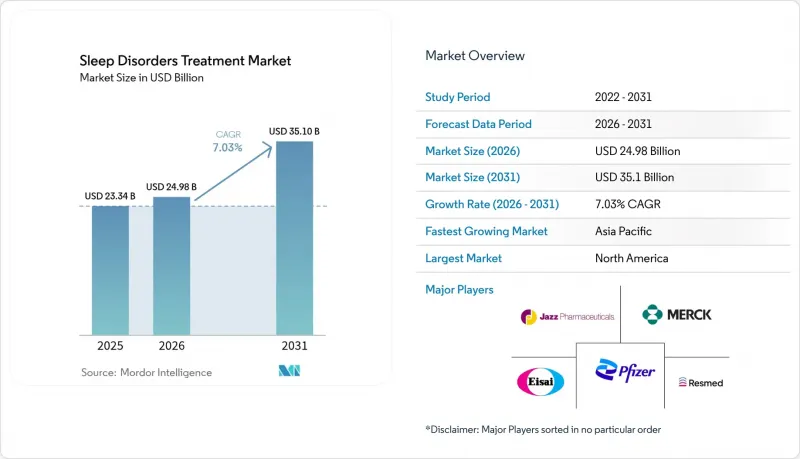
Mordor Intelligence에 의하면, 수면장애 치료 시장 규모는 2025년에 233억 4,000만 달러로 평가되었고 2026년 249억 8,000만 달러에서 2031년까지 351억 달러에 이를 것으로 예측되며, 예측 기간(2026-2031년) CAGR은 7.03%를 나타낼 전망입니다.
본 보고서는 약물 분류별(벤조디아제핀계, 비벤조디아제핀계, 이중 오렉신 수용체 길항제 등), 질환 유형별(불면증, 수면 무호흡 증후군 등), 유통 채널별(병원 약국, 소매 약국 등), 지역별(북미, 유럽,아시아태평양, 중동 및 아프리카, 남미)별로 분류되어 있습니다. 시장 예측은 금액(달러) 기준으로 제시되어 있습니다.
전 세계 수면장애 치료 시장 동향 및 인사이트
고령화, 비만, 그리고 정신 건강상의 스트레스 요인으로 인해 불면증 및 수면무호흡증후군의 전 세계적 부담이 증가
추정 3,000만-9,000만 명의 미국인이 폐쇄성 수면무호흡증(OSA)을 앓고 있지만, 공식적으로 진단받은 사람은 고작 600만 명에 불과하며, 이는 치료되지 않은 수요가 막대하게 존재하며, 이것이 수면장애 치료 시장을 지탱하고 있음을 보여줍니다. 비만의 확산은 OSA의 발병률을 높이고 있으며, 2024년 12월 FDA가 틸제파티드를 승인함으로써 비만을 동반한 OSA 환자를 위한 최초의 약물 치료의 길이 열렸고, 대사 조절 개선과 호흡 기능 개선이 연계되었습니다. 팬데믹 기간 동안의 불안과 우울증으로 인해 모든 주요 지역에서 만성 불면증이 증가했으나, DORA(직접 작용형 호흡 지원 요법)는 정신과 환자 집단에서 87.5%의 반응률을 보여, 새로운 작용기전에 대한 임상의들의 신뢰를 강화하고 있습니다. 레스메드(ResMed)는 현재 2,800만 대의 클라우드 연결 기기를 모니터링하며, 200억 밤 분량의 수면 데이터를 수집하고 있습니다. 이러한 데이터는 독자적인 AI 엔진에 공급되어, 개인 맞춤형 치료 조정을 실시간으로 확대되고 있습니다. 고령층에서는 2024년 8월 FDA 승인을 받은 ‘SleepioRx’와 같은 비침습적이고 디지털로 제공되는 프로그램에 대한 선호도가 높아지고 있습니다. 이러한 프로그램은 지속적인 유효성을 유지하면서 약물 복용 부담을 줄여줍니다.
선별 검사 및 인식 제고 프로그램 강화가 진단율 향상을 가속화
시스템 전반에 걸친 선별 검사 프로토콜을 통해 1차 진료 및 일반 소비자 대상 환경에서의 검출률이 향상되고 있습니다. Samsung Electronics와 스탠포드 메디슨의 제휴를 통해 스마트폰에 알고리즘을 활용한 수면무호흡 선별 기능이 탑재되면서, 검사실에서의 다중수면검사(폴리솜노그래피)에서 가정 내 선별 검사로의 전환이 진행되고 있습니다. 2024년 2월, FDA는 EnsoData사의 맥박 산소 포화도 측정 AI 플랫폼을 승인하여, 자원이 제한된 환경에서도 저렴한 비용으로 OSA(폐쇄성 수면무호흡증) 위험을 파악할 수 있게 되었습니다. 2024년 9월, 일본에서 10년 만에 불면증 치료제 ‘QUVIVIQ’가 승인되었습니다. 이에 앞서, 성인의 20%가 치료받지 못한 수면장애로 고통받고 있음을 강조하는 전국적인 미디어 캠페인이 전개되었으며, 의사를 대상으로 한 인식 제고 활동도 촉진되었습니다. Sleep Cycle 등의 스타트업 기업들은 2025년 6월, 스마트폰을 활용한 무호흡 선별 검사의 유효성을 검증하기 위한 임상시험을 시작했으며, 전문 클리닉이 없는 지방 지역 사회에도 서비스를 제공할 수 있는 가능성이 열렸습니다. ResMed사의 ‘NightOwl’ 자가 검사가 FDA 승인을 받음에 따라, 소비자 직접 판매(DTC) 경로에 의료 등급의 지원이 추가되어 치료 시작까지의 시간이 단축되고 수면장애 치료 시장이 확대되었습니다.
장기적인 수면제 치료에 따른 안전성 우려 및 의존 위험
규제 당국은 기존의 수면제에 대한 감독을 강화하고 적응증 확대를 억제하는 한편, 더 안전한 대안을 권장하고 있습니다. 2024년 3월, FDA는 반다(Vanda)사의 시차 적응 보조제 ‘HETLIOZ’에 대해 완전 답변 요청서(CRL)를 발부하며, 수면 의학 분야에서 모호한 위험-이익 프로파일을 용인하지 않겠다는 입장을 밝혔습니다. 벤조디아제핀 계열 약물이나 Z 계열 약물의 경우, 수면 중 운전 등 복잡한 행동의 발생률이 높다는 보고가 계속되고 있어, 비약물 요법이나 DORA(직접 작용형 렘 수면 조절 요법)에 기반한 접근법을 우선시하는 지침 개정이 진행되고 있습니다. 미국 수면의학회(American Academy of Sleep Medicine)의 2024년판 ‘다리 저림 증후군’ 관련 지침에서는 충동 조절 장애 및 악화 위험을 줄이기 위해 도파민 작용제 대신 칼슘 채널 리간드를 권장하고 있습니다. 실세계 데이터를 통해 달리드렉산트의 중대한 이상반응 발생 빈도가 낮은 것으로 확인되었으며, 북미, 유럽, 아시아태평양 지역의 규제 당국은 적응증 확대를 승인할 때 이러한 연구 결과를 근거로 제시하고 있습니다. 이와 병행하여, 귀 미주신경 자극 요법은 약물을 사용하지 않고도 임상적으로 유의미한 수면의 질 향상을 가져오고 있으며, 위험을 회피하려는 환자에게 약물을 사용하지 않는 대안을 제공하는 동시에 수면장애 치료 시장의 다양화를 촉진하고 있습니다.
부문 분석
2025년, 임상의들이 벤조디아제핀 계열 약물에 대한 내성과 그보다 높은 안전성 사이의 균형을 고려한 결과, 비벤조디아제핀 계열 약물은 수면장애 치료 시장의 32.06%를 차지했습니다. 이러한 기반에도 불구하고, DORA(도파민 작용제)는 연평균 성장률(CAGR) 9.52%로 성장하고 있으며, 만성 불면증에 대한 오렉신계 요법이 지침에서 1차 선택 약물로 자리매김함에 따라 기존 시장 점유율을 잠식할 것으로 예측됩니다. 실제 환경에서의 의약품 안전성 모니터링 결과, 인지 기능에 미치는 잔여 영향이 적고 의존성 징후도 낮은 것으로 확인되었으며, 이러한 조합 덕분에 보험사들은 DORA를 우선 급여 대상에 포함하도록 권장받고 있고, 그 결과 수면장애 치료 시장의 판매량 증가가 촉진되고 있습니다.
2차 선택 약물군은 여전히 중요한 위치를 차지하고 있습니다. 벤조디아제핀계 약물은 신속한 효과가 필수적인 급성 및 중증 불면증에 계속해서 사용되고 있지만, 의사들은 의존성을 줄이기 위해 처방 기간에 상한선을 두고 있습니다. 적응증 외로 사용되는 항우울제는 기분 장애를 동반하는 복합성 불면증에 대응하고 있으며, 한편 멜라토닌 수용체 작용제는 신경 발달에 대한 안전성이 속효성보다 더 중요시되는 소아 분야에서 주류를 이루고 있습니다. 개발 파이프라인의 모멘텀은 오렉신 관련 분야에 집중되어 있습니다. 다케다 제약의 오베폴렉스턴과 알카메스사의 알릭솔렉스턴은 1일 1회 경구 투여가 가능하고, 현재 옥시바트의 여러 번 투여 요법을 단순화할 가능성이 있습니다. 이러한 요인들이 복합적으로 작용함에 따라, 약물 치료 분야의 수면장애 치료 시장 규모는 2031년까지 지속적인 성장 궤도를 유지할 것으로 전망됩니다.
지역별 분석
북미는 2025년 수면장애 치료 시장의 42.35%를 차지했습니다. 이는 획기적인 치료법을 신속하게 승인하는 정교한 보험 제도와 수면이 심혈관 및 대사 건강에 미치는 영향에 대한 일반 대중의 높은 인식에 힘입은 것입니다. 틸제파티드와 여러 DORA(획기적인 신약)에 대한 FDA의 승인은 규제 당국이 새로운 작용기전에 대해 긍정적인 태도를 보이고 있음을 보여줍니다. Sleepio의 라이선스 비용 지원이나 CPAP 구독 모델 등 고용주 주도의 웰니스 복리후생 덕분에 예방적 수면 관리가 정착되고 있습니다. ResMed의 2025 회계연도 3분기 매출은 8% 증가한 13억 달러를 기록했습니다. 이는 전자 차트 워크플로우와 통합된 클라우드 연결 기기에 대한 견조한 수요를 반영한 것으로, 이를 통해 치료 순응도가 강화되고 하류 단계에서의 입원 건수가 감소하고 있습니다.
아시아태평양은 2031년까지 연평균 성장률(CAGR)이 8.22%로 가장 빠르게 성장하는 지역입니다. 중국에만 1억 7,250만 명의 불면증 환자가 있으며, 2025년 5월 DAYVIGO 승인을 계기로 제품의 현지화 및 광범위한 보험 적용 협상이 가속화되고 있습니다. 2024년 9월 일본에서 ‘QUVIVIQ’가 승인됨에 따라 10년 만에 새로운 불면증 치료제가 시장에 등장했고, 임상의들을 대상으로 한 교육 캠페인이 재개되면서 처방량이 증가했습니다. 한국에서 진행 중인 달리도렉산트의 3상 임상시험은 이 지역 규제 당국의 적극적인 태도를 뒷받침하고 있으며, 한편 대학에서는 츠쿠바 대학에서 개발이 진행 중인 광감수성 수면 유도 분자 등의 기초 연구가 가속화되고 있습니다. 중산층의 소득 증가와 수면 검사실 현대화를 위한 정부의 이니셔티브이 고급 제품의 지속적인 보급을 뒷받침하고 있으며, 아시아태평양은 수면장애 치료 시장의 판매량 및 수익 확대의 원동력이 되고 있습니다.
유럽에서는 국민건강보험 제도와 유럽의약품청(EMA)을 통한 조율된 규제 절차를 배경으로 꾸준한 성장을 유지하고 있습니다. 이돌시아(Idolcia)의 ‘QUVIVIQ’는 선구자적인 역할을 수행하며, EU 전역의 상호인정 제도를 활용하여 머크(Merck)의 ‘벨소무라(Versomra)’와 에자이(Eisai)의 ‘데이비고(Davigo)’가 시장에 진입하기 전에 시장 점유율을 확보했습니다. 또한, 공공 조달에서는 안전성과 의료경제적 이점이 입증된 의약품을 우선하는 가격·수량 계약이 중시되고 있습니다. 영국 국민건강서비스(NHS)가 ‘Sleepio’ 시스템을 전체적으로 무상으로 도입한 것은 디지털 치료제가 대규모 공공 의료 시스템에 침투하여 비용 절감을 촉진할 수 있음을 보여주는 좋은 사례이며, 유럽 대륙 전체에서 유사한 모델이 전개될 가능성을 내포하고 있습니다. 스위스의 ‘Sleep House Bern’과 같은 다직종 협력 클리닉에서는 신속한 분류 절차를 시범적으로 도입하고 있으며, 이는 유럽의 수면 관리 제공에 있어 새로운 기준이 될 가능성이 있습니다. 이러한 동향들이 맞물리면서, 도입 기반이 성숙해졌음에도 불구하고 수면장애 치료 시장에서 유럽의 기여도는 견조하게 유지되고 있습니다.
기타 혜택:
- 엑셀 형식 시장 예측(ME) 시트
- 3개월간의 애널리스트 지원
자주 묻는 질문
목차
제1장 서론
제2장 조사 방법
제3장 주요 요약
제4장 시장 구도
제5장 시장 규모와 성장 예측
제6장 경쟁 구도
제7장 시장 기회와 향후 전망
JHS 26.08.26According to Mordor Intelligence, the sleep disorder treatment market size was valued at USD 23.34 billion in 2025 and estimated to grow from USD 24.98 billion in 2026 to reach USD 35.10 billion by 2031, at a CAGR of 7.03% during the forecast period (2026-2031).
This report is Segmented by Drug Class (Benzodiazepines, Non-Benzodiazepines, Dual Orexin Receptor Antagonists, and More), Disorder Type (Insomnia, Sleep Apnea, and More), Distribution Channel (Hospital Pharmacies, Retail Pharmacies, and More), and Geography (North America, Europe, Asia-Pacific, The Middle East and Africa, and South America). The Market Forecasts are Provided in Terms of Value (USD).
Global Sleep Disorders Treatment Market Trends and Insights
Rising Global Burden of Insomnia & Sleep Apnea Driven by Ageing, Obesity and Mental-Health Stressors
An estimated 30 million to 90 million Americans live with OSA, yet only 6 million have been formally diagnosed, illustrating a deep pool of untreated need that sustains the sleep disorder treatment market. The obesity epidemic intensifies OSA incidence, and December 2024 FDA clearance of tirzepatide created the first pharmacologic pathway for obese OSA patients, linking metabolic control to respiratory improvement. Pandemic-era anxiety and depression elevated chronic insomnia across every major region, with DORAs showing 87.5% response rates in psychiatric populations and reinforcing clinician confidence in newer mechanisms. ResMed now monitors 28 million cloud-connected devices and captures 20 billion nights of sleep data that feed proprietary AI engines, scaling personalised therapy adjustments in real time. Among older adults, preference is shifting to non-invasive, digitally delivered programs such as SleepioRx-cleared by FDA in August 2024-which reduce pill burden while maintaining durable efficacy.
Enhanced Screening and Public-Awareness Programs Accelerating Diagnosis Rates
System-wide screening protocols are raising detection in primary care and consumer settings. Samsung's collaboration with Stanford Medicine embeds algorithmic sleep-apnea screening in smartphones, signalling a move from laboratory polysomnography to home-based triage. In February 2024 the FDA cleared EnsoData's pulse-oximetry AI platform, enabling lower-cost identification of OSA risk in resource-limited environments. Japan's first insomnia drug approval in a decade-QUVIVIQ in September 2024-followed national media campaigns that highlighted untreated sleep disorders affecting 20% of adults and spurred physician education. Start-ups such as Sleep Cycle launched clinical studies in June 2025 to validate smartphone-based apnea screening, potentially reaching rural communities lacking specialty clinics. FDA clearance of ResMed's NightOwl home test adds medical-grade support to direct-to-consumer pathways, shortening time-to-therapy and expanding the sleep disorder treatment market.
Safety Concerns and Dependency Risks Associated with Long-Term Hypnotic Pharmacotherapy
Regulators are tightening oversight of traditional hypnotics, curbing label expansions and encouraging safer alternatives. In March 2024 the FDA issued a complete-response letter to Vanda's HETLIOZ jet-lag supplement, signalling unwillingness to tolerate vague benefit-risk profiles in sleep medicine. Benzodiazepines and Z-drugs continue showing higher incidences of complex behaviours such as sleep-driving, prompting guideline revisions that prioritise non-pharmacologic or DORA-based approaches. American Academy of Sleep Medicine 2024 guidance on restless-legs syndrome substitutes calcium-channel ligands for dopamine agonists to cut impulse-control disorders and augmentation risks. Real-world data confirm daridorexant's lower serious adverse-event frequency; regulators across North America, Europe and APAC cite these findings when green-lighting wider indications. In parallel, auricular vagus-nerve stimulation has produced clinically meaningful sleep-quality gains without pharmacology, offering a drug-free refuge for risk-averse patients and reinforcing diversification within the sleep disorder treatment market.
Other drivers and restraints analyzed in the detailed report include:
- Launch of Novel Pharmacological Classes Expanding Therapeutic Options
- Continuous Innovation in Device-Based and Digital Therapeutics Improving Outcomes & Adherence
- High Cost of Branded Drugs and Advanced Devices Limiting Access in Low- and Middle-Income Regions
For complete list of drivers and restraints, kindly check the Table Of Contents.
Segment Analysis
Non-benzodiazepines held 32.06% of the sleep disorder treatment market in 2025 as clinicians balanced familiarity with improved safety over benzodiazepines. Despite that anchor, DORAs are growing at 9.52% CAGR and are forecast to erode historical share as guidelines elevate orexin-based therapy to first-line status for chronic insomnia. Real-world pharmacovigilance confirms fewer residual cognitive effects and lower dependency signals, a combination that encourages payers to include DORAs on preferred tiers, thereby reinforcing volume growth within the sleep disorder treatment market.
Second-line classes remain relevant. Benzodiazepines are preserved for acute, severe insomnia when rapid onset is critical, though physicians now cap prescription lengths to mitigate dependence. Off-label antidepressants satisfy complex insomnia with comorbid mood disturbance, while melatonin receptor agonists dominate paediatric niches where neurodevelopmental safety outweighs speed. Pipeline momentum stays concentrated in orexin biology: Takeda's oveporexton and Alkermes' alixorexton promise once-daily oral dosing that could simplify current multi-dose oxybate regimens. These forces together keep the sleep disorder treatment market size for pharmacologic segments on a durable expansion path through 2031.
Complete Report Scope:
- By Drug Class
- Benzodiazepines
- Non-benzodiazepines
- Dual Orexin Receptor Antagonists
- Antidepressants
- Melatonin Receptor Agonists
- Other Drug Class
- By Disorder Type
- Insomnia
- Sleep Apnea
- Narcolepsy
- Circadian Rhythm Disorders
- Other Disorder Types
- By Distribution Channel
- Hospital Pharmacies
- Retail Pharmacies
- Online Pharmacies
- Sleep Clinics
- Geography
- North America
- United States
- Canada
- Mexico
- Europe
- Germany
- United Kingdom
- France
- Italy
- Spain
- Rest of Europe
- Asia-Pacific
- China
- Japan
- India
- Australia
- South Korea
- Rest of Asia-Pacific
- Middle East & Africa
- GCC
- South Africa
- Rest of Middle East & Africa
- South America
- Brazil
- Argentina
- Rest of South America
- North America
Geography Analysis
North America commanded 42.35% of the sleep disorder treatment market in 2025, supported by sophisticated payer systems that fast-track breakthrough therapies and by high public awareness of sleep's impact on cardiometabolic health. FDA approvals for tirzepatide and multiple DORAs exemplify the regulator's openness to novel mechanisms. Employer-driven wellness benefits, including subsidised Sleepio licences and CPAP subscription models, are normalising proactive sleep management. ResMed's Q3 FY2025 revenue climbed 8% to USD 1.3 billion, reflecting robust demand for cloud-connected devices that integrate with electronic health-record workflows, thereby reinforcing adherence and reducing downstream hospitalisations.
Asia-Pacific is the fastest rising territory at 8.22% CAGR through 2031. China alone hosts 172.5 million insomnia sufferers, catalysing product localisation and broad-based formulary negotiations following DAYVIGO's approval in May 2025. Japan's September 2024 endorsement of QUVIVIQ broke a decade-long drought in novel insomnia therapies, sparking renewed clinician education campaigns and boosting prescription volume. South Korea's Phase 3 daridorexant trial underscores regional regulatory momentum, while universities accelerate fundamental research, such as light-sensitive somnogen molecules under development at University of Tsukuba. Rising middle-class income and government initiatives to modernise sleep labs underpin sustained premium adoption, making Asia-Pacific the engine for volume and revenue expansion of the sleep disorder treatment market.
Europe maintains steady growth on the back of universal coverage and coordinated regulatory processes through the European Medicines Agency. Idorsia's first-mover role with QUVIVIQ exploited EU-wide mutual recognition to build share before Merck's Belsomra and Eisai's Dayvigo entered, and public procurement emphasises price-volume agreements that favour drugs with proven safety and health-economic benefits. The UK National Health Service's system-wide rollout of Sleepio free of charge exemplifies how digital therapeutics can penetrate large public systems and drive cost offsets, potentially unlocking similar models continent-wide. Multidisciplinary clinics such as Switzerland's Sleep House Bern pilot fast triage pathways that could set new standards for European sleep-care delivery. Collectively, these trends keep Europe's contribution to the sleep disorder treatment market resilient despite mature baseline adoption.
- Dr Reddy's Laboratories
- Merck
- Viatris (Mylan)
- Pfizer
- Sanofi
- Takeda Pharmaceutical Co.
- Teva Pharmaceutical Industries
- Transcept Pharmaceuticals
- Vanda Pharmaceuticals
- Zydus Lifesciences
- Eisai
- Jazz Pharmaceuticals
- Resmed
- Koninklijke Philips
- Fisher & Paykel Healthcare
- Sommetrics Inc.
- Minerva Neurosciences
- Neurocrine Biosciences
- Avadel Pharmaceuticals
- Currax Pharmaceuticals
- Arena Pharmaceuticals
- SomnoMed Limited
Additional Benefits:
- The market estimate (ME) sheet in Excel format
- 3 months of analyst support
TABLE OF CONTENTS
1 Introduction
- 1.1 Study Assumptions & Market Definition
- 1.2 Scope of the Study
2 Research Methodology
3 Executive Summary
4 Market Landscape
- 4.1 Market Overview
- 4.2 Market Drivers
- 4.2.1 Rising Global Burden of Insomnia & Sleep Apnea Driven by Ageing, Obesity and Mental-Health Stressors
- 4.2.2 Enhanced Screening and Public-Awareness Programs Accelerating Diagnosis Rates
- 4.2.3 Launch Of Novel Pharmacological Classes (Dual-Orexin Antagonists, Next-Gen GABA Modulators) Expanding Therapeutic Options
- 4.2.4 Continuous Innovation in Device-Based and Digital Therapeutics Improving Outcomes & Adherence
- 4.2.5 AI-Powered Sleep-Data Analytics Enabling Earlier, Personalised Interventions
- 4.2.6 Employer And Insurer-Led Sleep-Wellness Initiatives Widening Reimbursement Coverage
- 4.3 Market Restraints
- 4.3.1 Safety Concerns and Dependency Risks Associated with Long-Term Hypnotic Pharmacotherapy
- 4.3.2 High Cost of Branded Drugs and Advanced Devices Limiting Access in Low- And Middle-Income Regions
- 4.3.3 Poor Patient Adherence to CPAP Therapy and Behavioural Regimens Undermining Efficacy
- 4.3.4 Boom In Unregulated OTC/Nutraceutical Sleep Aids Diverting Patients from Evidence-Based Care
- 4.4 Regulatory Landscape
- 4.5 Porter's Five Forces Analysis
- 4.5.1 Threat of New Entrants
- 4.5.2 Bargaining Power of Buyers/Consumers
- 4.5.3 Bargaining Power of Suppliers
- 4.5.4 Threat of Substitute Products
- 4.5.5 Intensity of Competitive Rivalry
5 Market Size & Growth Forecasts (Value, USD)
- 5.1 By Drug Class
- 5.1.1 Benzodiazepines
- 5.1.2 Non-benzodiazepines
- 5.1.3 Dual Orexin Receptor Antagonists
- 5.1.4 Antidepressants
- 5.1.5 Melatonin Receptor Agonists
- 5.1.6 Other Drug Class
- 5.2 By Disorder Type
- 5.2.1 Insomnia
- 5.2.2 Sleep Apnea
- 5.2.3 Narcolepsy
- 5.2.4 Circadian Rhythm Disorders
- 5.2.5 Other Disorder Types
- 5.3 By Distribution Channel
- 5.3.1 Hospital Pharmacies
- 5.3.2 Retail Pharmacies
- 5.3.3 Online Pharmacies
- 5.3.4 Sleep Clinics
- 5.4 Geography
- 5.4.1 North America
- 5.4.1.1 United States
- 5.4.1.2 Canada
- 5.4.1.3 Mexico
- 5.4.2 Europe
- 5.4.2.1 Germany
- 5.4.2.2 United Kingdom
- 5.4.2.3 France
- 5.4.2.4 Italy
- 5.4.2.5 Spain
- 5.4.2.6 Rest of Europe
- 5.4.3 Asia-Pacific
- 5.4.3.1 China
- 5.4.3.2 Japan
- 5.4.3.3 India
- 5.4.3.4 Australia
- 5.4.3.5 South Korea
- 5.4.3.6 Rest of Asia-Pacific
- 5.4.4 Middle East & Africa
- 5.4.4.1 GCC
- 5.4.4.2 South Africa
- 5.4.4.3 Rest of Middle East & Africa
- 5.4.5 South America
- 5.4.5.1 Brazil
- 5.4.5.2 Argentina
- 5.4.5.3 Rest of South America
- 5.4.1 North America
6 Competitive Landscape
- 6.1 Market Concentration
- 6.2 Market Share Analysis
- 6.3 Company Profiles (includes Global-level Overview, Market-level Overview, Core Segments, Financials, Strategic Information, Market Rank/Share, Products & Services, Recent Developments)
- 6.3.1 Dr Reddy's Laboratories
- 6.3.2 Merck & Co.
- 6.3.3 Viatris (Mylan)
- 6.3.4 Pfizer Inc.
- 6.3.5 Sanofi SA
- 6.3.6 Takeda Pharmaceutical Co.
- 6.3.7 Teva Pharmaceutical Industries
- 6.3.8 Transcept Pharmaceuticals
- 6.3.9 Vanda Pharmaceuticals
- 6.3.10 Zydus Lifesciences
- 6.3.11 Eisai Co., Ltd.
- 6.3.12 Jazz Pharmaceuticals
- 6.3.13 ResMed Inc.
- 6.3.14 Koninklijke Philips N.V.
- 6.3.15 Fisher & Paykel Healthcare
- 6.3.16 Sommetrics Inc.
- 6.3.17 Minerva Neurosciences
- 6.3.18 Neurocrine Biosciences
- 6.3.19 Avadel Pharmaceuticals
- 6.3.20 Currax Pharmaceuticals
- 6.3.21 Arena Pharmaceuticals
- 6.3.22 SomnoMed Limited
7 Market Opportunities & Future Outlook
- 7.1 White-space & Unmet-Need Assessment