

|
시장보고서
상품코드
2064429
미국의 외래 전자건강기록(EHR) : 시장 점유율 분석, 업계 동향 및 통계, 성장 예측(2026-2031년)United States Ambulatory Electronic Health Record (EHR) - Market Share Analysis, Industry Trends & Statistics, Growth Forecasts (2026 - 2031) |
||||||
 Mordor Intelligence
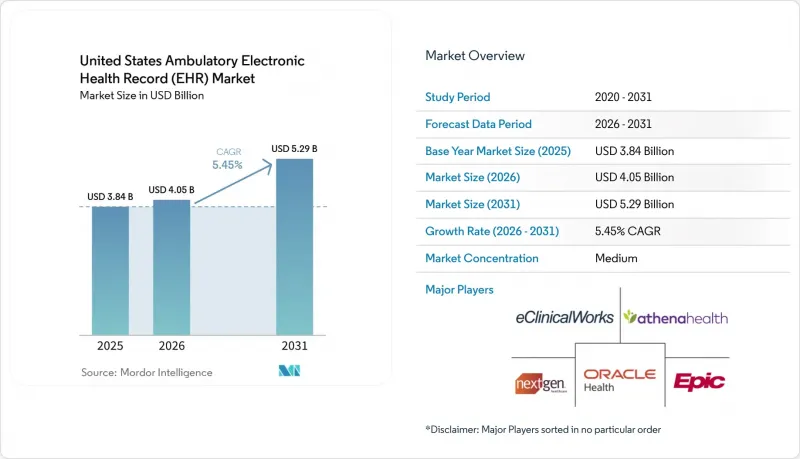
Mordor Intelligence에 의하면, 미국의 외래 전자건강기록(EHR) 시장 규모는 2025년 38억 4,000만 달러로 평가되었습니다. 2026년에는 40억 5,000만 달러로 확대되어 2026-2031년 CAGR은 5.45%를 나타내, 2031년까지 52억 9,000만 달러에 이를 것으로 예측됩니다.
본 보고서는 제공 형태(클라우드 기반, On-Premise형, 하이브리드형), 기능(진료 관리, 환자 관리, 전자 처방, 의뢰 관리 등), 진료 규모(소규모, 중규모, 대규모 그룹), 소유 형태(병원 소유, 의료 시스템 제휴, 독립 외래 센터)별로 분류되어 있습니다. 예측치는 금액(달러)으로 표시되어 있습니다.
미국의 외래 전자건강기록(EHR) 시장 동향 및 인사이트
외래 진료로의 전환과 ASC의 확대가 구조적 수요를 견인
미국의 외래 전자건강기록(EHR) 소프트웨어 시장은 수술이 지속적으로 외래 시설로 전환되고 있는 덕분에 꾸준한 지지를 얻고 있습니다. 『Medical Care Research and Review』지의 조사를 바탕으로 한 2026년 Penn LDI 조사 업데이트에 따르면, 팬데믹 이후 외래 수술이 연평균 6%씩 증가하고 있으며, 수술의 65% 이상이 이미 입원 시설 밖에서 이루어지고 있는 것으로 밝혀졌습니다. MedPAC은 2026년 3월 보고서에서 메디케어 인증 ASC(외래수술센터(ASC))가 2024년에 2.2% 증가해 6,436개 시설이 되었으며, 같은 해 메디케어 수급자 1인당 ASC 수술 건수가 3.5% 증가했다고 보고했습니다. CMS는 2026년 ‘입원 한정 목록’에서 285건의 수술을 삭제하고, ASC 대상 목록에 271건의 수술을 추가함으로써 이러한 전환을 뒷받침하고 있으며, 이로 인해 외래 기록 시스템이 대응해야 할 외래 사례의 범위가 확대될 것입니다. MedPAC 보고서에 따르면, 정형외과, 순환기내과 및 다학제적 통증 관리 분야에서 시술 건수 증가세가 가속화되고 있으며, 이에 따라 미국의 외래 전자건강기록(EHR) 소프트웨어 시장에서 각 전문 분야에 특화된 문서화, 일정 관리 및 승인 워크플로우에 대한 필요성이 높아지고 있습니다.
클라우드 네이티브로의 전환 주기가 벤더의 경제 구조를 재편하고 있습니다.
미국의 외부 EHR 소프트웨어 시장은 기존 On-Premise 시스템에서 적극적으로 전환함에 따라 재편되고 있습니다. ONC의 HTI-1 최종 규정에서는 인증된 의료 IT가 FHIR US Core 프로파일을 통해 USCDI v3를 지원해야 할 의무가 부과되어 있으며, 이에 따라 최신 API 지원은 선택적 기능 확장이 아닌 제품의 기본 요건이 되었습니다. 클라우드 아키텍처는 기존 도입 환경에서 흔히 발생하는 지연이 수반되는 로컬 업그레이드 주기가 필요하지 않으며, 상호 운용성이나 규정 준수 사항의 변경 사항을 신속하게 반영할 수 있으므로 정기적인 표준 규격 업데이트에 적합합니다. Oracle 헬스는 OCI 네이티브 외래 환자 EHR 및 Clinical AI Agent를 통해 이러한 방향성을 더욱 강화하고 있습니다. 이 기능들은 새로운 AI 기능을 클라우드 인프라 옵션에 직접 연결해 줍니다. 데이터 이식성이 규정 준수 요건으로 자리 잡음에 따라 전환 장벽은 더욱 낮아지고 있으며, 미국 외 지역 EHR 소프트웨어 시장에서 시스템 업데이트 추세는 앞으로도 지속될 것으로 예측됩니다.
사이버 보안 및 서비스 중단 위험이 고위험 부문에서의 클라우드 도입을 주춤하게 만들고 있습니다.
사이버 보안은 미국의 외부 EHR 소프트웨어 시장에서 여전히 가장 뚜렷한 운영상의 제약 요인으로 남아 있습니다. IBM의 보고서에 따르면, 2025년 의료 분야에서 발생하는 정보 유출의 평균 비용은 742만 달러에 달했으며, 평균적인 정보 유출의 수명 주기는 279일에 이르는 것으로 나타났습니다. 이로 인해 의료 분야는 14년 연속으로 비용이 가장 많이 드는 부문이 되었습니다. 2025년 7월 『JAMA Network Open』에 게재된 연구에 따르면, Epic을 이용 중인 병원의 34%가 2024년 7월 CrowdStrike의 서비스 중단 기간 동안 예약, 검사 결과, 처방전 갱신, 보안 메시징과 관련된 중단을 포함한 감지 가능한 서비스 장애를 경험했습니다. 이러한 사례들은 위험이 랜섬웨어에 그치지 않고, 외래 진료의 기본적인 업무를 중단시킬 가능성이 있는 보다 광범위한 인프라 및 제3자 시스템 장애도 포함된다는 점을 보여줍니다. 따라서 소규모 의료기관이나 독립 의료 서비스 제공업체들은 앞으로도 보안 측면에서 공급업체를 엄격하게 평가할 것이며, 그 결과 미국의 외래 환자 EHR 소프트웨어 시장에서 공급업체 교체 시기가 늦어질 가능성이 있습니다.
부문별 분석
2025년 기준으로 클라우드 기반 솔루션은 미국의 외래 전자건강기록(EHR) 소프트웨어 시장 규모의 84.3%를 차지했으며, 2031년까지 연평균 성장률(CAGR) 6.4%를 나타낼 것으로 전망됩니다. 이 지표는 대체 주기가 아직 진행 중이며 완료되지 않았음을 나타냅니다. 클라우드 서비스가 지지를 얻고 있는 이유는 분산된 외래 진료 거점 전체에서 규정 업데이트, 상호 운용성 변경 및 정기적인 소프트웨어 릴리스 관리를 용이하게 하기 때문입니다. ONC의 HTI-1 규정과 CMS의 사전 승인 프레임워크는 모두 FHIR 기반의 데이터 교환을 대규모 현지 프로젝트가 아닌 일상적인 제품 기능으로 제공할 수 있는 플랫폼을 권장하고 있습니다. 이로 인해 구매자가 규정 준수 위험과 노후화된 기술 부채를 저울질할 때, 클라우드 공급업체에게는 실질적인 우위가 생깁니다.
미국의 외래 전자건강기록(EHR) 소프트웨어 시장에서는 학술 단체, 연구 관련 시설 및 계약 주기가 긴 조직들 사이에서 On-Premise 기반의 비중이 여전히 낮은 임베디드니다. 일부 대규모 시스템의 경우, 핵심 기록은 엄격하게 관리된 상태로 유지하면서 분석, 상호운용성 계층 또는 AI 도구를 호스팅 환경으로 이전하는 하이브리드 설계를 계속해서 채택할 것입니다. 그렇긴 하지만, AI 기능은 클라우드 인프라로 점차 이전되고 있으며, Oracle Health는 OCI 네이티브 외래 환자 EHR 로드맵을 통해 이러한 연동을 명확히 보여주고 있습니다. 그 결과, 클라우드의 성장은 진료 규모와 관계없이 광범위하게 이루어지는 반면, On-Premise 수요는 신규 확장이라기보다는 지연되었던 시스템 업데이트에 기인할 가능성이 높을 것입니다. 외래 전자건강기록(EHR) 소프트웨어 업계에서 제공 형태 선택은 호스팅 선호도와 마찬가지로, 규정 준수 대비 및 자동화 기능 이용 가능 여부에도 영향을 받게 되었습니다.
2025년 기준으로, 진료소 관리 부문은 22.2%의 점유율을 차지하며 미국 외래 전자건강기록(EHR) 소프트웨어 시장에서 가장 큰 기능 블록이 되었습니다. 이 직책은 외래 진료의 경제적 운영에 있어 예약 관리, 청구, 코딩 지원 및 보험 청구 후속 조치가 수행하는 일상적인 역할을 반영하고 있습니다. 접수처의 실수나 보험금 지급 거절 문제는 현금 흐름에 즉각적인 영향을 미치기 때문에 외래 의료 서비스 제공업체들은 여전히 이러한 도구를 수익 유출을 막는 첫 번째 방어선으로 여기고 있습니다. 또한, 이 부문은 거점 간 일관된 관리 업무가 필요한 ASC(외래수술센터(ASC))나 다거점 외래 그룹의 부상으로 인해 혜택을 보고 있습니다. 이에 따라, 더욱 고도화된 임상 기능과 AI 기능이 확대되는 상황에서도 진료 관리의 중요성은 여전히 핵심적인 위치를 차지하고 있습니다.
환자 관리 시장은 2031년까지 연평균 성장률(CAGR) 6.5%를 나타낼 것으로 예측되며, 이는 미국의 외래 환자 전자의무기록(EHR) 소프트웨어 시장의 기능별 부문 중 가장 높은 성장률입니다. 이러한 성장은 품질 보고 요건의 강화, 지역 주민의 건강 상태 추적, 그리고 가치 기반 계약에서 발생하는 의료 서비스의 공백을 메워야 할 필요성과 밀접한 관련이 있습니다. 2026년 의사 보수 일정 규정 및 지속적인 상호운용성 촉진 요건에 따라, ACO(의료 제공업체 연합) 기준을 준수하는 외래 진료소에서는 보다 일관된 데이터 수집이 필수적입니다. 의뢰 관리와 전자 처방전은 규정 준수 및 진료 조율 모두 외래 진료 워크플로우 전반에 걸쳐 정확한 데이터가 유통되는 데 달려 있기 때문에 앞으로도 중요할 것으로 보입니다. 따라서 외래 전자건강기록(EHR) 소프트웨어 업계는 재무, 임상 및 보고 기능을 하나의 연동된 기록 내에 통합한 플랫폼으로 전환하고 있습니다.
기타 혜택 :
- 엑셀 형식 시장 예측(ME) 시트
- 3개월간의 애널리스트 지원
자주 묻는 질문
목차
제1장 서론
제2장 조사 방법
제3장 주요 요약
제4장 시장 구도
제5장 시장 규모 및 성장 예측
제6장 경쟁 구도
제7장 시장 기회 및 향후 전망
KTH 26.06.24According to Mordor Intelligence, the united states ambulatory electronic health record (EHR) market size is expected to grow from USD 3.84 billion in 2025 to USD 4.05 billion in 2026 and is forecast to reach USD 5.29 billion by 2031 at 5.45% CAGR over 2026-2031.
This report is Segmented by Delivery Mode (Cloud-Based, On-Premise, Hybrid), Functionality (Practice Management, Patient Management, E-Prescribing, Referral Management, and More), Practice Size (Small, Mid-Size, Large Group), and Ownership (Hospital-Owned, Health-System Affiliated, Independent Ambulatory Centers). Forecasts are Provided in Terms of Value (USD).
United States Ambulatory Electronic Health Record (EHR) Market Trends and Insights
Outpatient Care Shift and ASC Expansion Drive Structural Demand
The United States ambulatory EHR software market is gaining durable support from the continued shift of surgery into outpatient settings. A 2026 Penn LDI research update, based on a study in Medical Care Research and Review, found that outpatient surgery grew 6% annually after the pandemic and that more than 65% of surgeries were already being performed outside inpatient settings. MedPAC reports in March 2026 that Medicare-certified ASCs increased 2.2% to 6,436 facilities in 2024 and that ASC procedures per fee-for-service Medicare beneficiary rose 3.5% in the same year. CMS is reinforcing that shift by removing 285 procedures from the inpatient-only list for 2026 and adding 271 procedures to the ASC covered list, which expands the outpatient case mix that ambulatory records systems must support. MedPAC also shows faster procedure growth in orthopedics, cardiology, and multispecialty pain management, which raises the need for specialty-specific documentation, scheduling, and authorization workflows inside the United States ambulatory EHR software market.
Cloud-Native Replacement Cycle Reshapes Vendor Economics
The United States ambulatory EHR software market is also being reshaped by an active migration away from legacy on-premise systems. The ONC HTI-1 final rule requires certified health IT to support USCDI v3 through FHIR US Core profiles, which makes modern API support a basic product requirement rather than an optional enhancement. Cloud architectures are better aligned with recurring standards updates because they can push interoperability and compliance changes without the slower local upgrade cycle common in older deployments. Oracle Health reinforces that direction with its OCI-native ambulatory EHR and Clinical AI Agent, which connect new AI functionality directly to cloud infrastructure choices. As data portability becomes a compliance expectation, switching friction should keep easing and replacement activity should continue to move through the United States ambulatory EHR software market.
Cybersecurity And Outage Exposure Slow Cloud Adoption Among At-Risk Segments
Cybersecurity remains the clearest operating restraint in the United States ambulatory EHR software market. IBM reports that the average healthcare breach cost reached USD 7.42 million in 2025 and that the average breach lifecycle extended to 279 days, which kept healthcare as the costliest sector for the 14th consecutive year. A July 2025 study in JAMA Network Open found that 34% of Epic-using hospitals experienced detectable service disruption during the July 2024 CrowdStrike outage, including interruptions tied to scheduling, lab results, prescription refills, and secure messaging. These events show that risk does not stop with ransomware and also includes wider infrastructure and third-party failures that can interrupt basic ambulatory operations. Smaller and independent providers will therefore keep assessing vendors through a strong security lens, which can slow replacement timing inside the United States ambulatory EHR software market.
Other drivers and restraints analyzed in the detailed report include:
- Value-Based Care Reporting Pressure Drives Certified EHR Upgrades
- Ambient AI Embeds Into EHR Workflows At A Sector-Defining Pace
- High Implementation And Migration Costs Persist As A Barrier
For complete list of drivers and restraints, kindly check the Table Of Contents.
Segment Analysis
Cloud-based solutions held 84.3% of the United States ambulatory EHR software market size in 2025 and are projected to grow at a 6.4% CAGR through 2031. That lead shows the replacement cycle is still active rather than complete. Cloud delivery is gaining support because it makes regulatory updates, interoperability changes, and recurring software releases easier to manage across distributed ambulatory sites. The ONC HTI-1 rule and the CMS prior authorization framework both favor platforms that can deliver FHIR-based exchange as a routine product function instead of a major local project. This gives cloud vendors a practical advantage when buyers weigh compliance risk against aging technology debt.
The United States ambulatory EHR software market still keeps a smaller on-premise base among academic groups, research-linked settings, and organizations with long legacy contract cycles. Some larger systems will continue using hybrid designs where core records remain tightly governed while analytics, interoperability layers, or AI tools shift into hosted environments. Even so, AI capability is moving closer to cloud infrastructure, and Oracle Health makes that link clear through its OCI-native ambulatory EHR roadmap. As a result, cloud growth should remain broad across practice tiers, while on-premise demand is more likely to come from delayed replacement than from fresh expansion. In the ambulatory EHR software industry, delivery choices now depend on compliance readiness and automation access as much as on hosting preference.
Practice management held 22.2% share in 2025, which made it the largest functionality block in the United States ambulatory EHR software market. That position reflects the daily role of scheduling, billing, coding support, and claims follow-up in outpatient economics. Ambulatory providers still treat these tools as the first defense against revenue leakage because front-office errors and denial issues affect cash flow quickly. The segment also benefits from the rise of ASCs and multi-site outpatient groups, which need consistent administrative routines across locations. This keeps practice management central even as more advanced clinical and AI functions expand.
Patient management is projected to grow at a 6.5% CAGR through 2031, the fastest rate among functionality segments in the United States ambulatory EHR software market. Growth is tied to stronger quality reporting demands, population health tracking, and the need to close care gaps within value-based contracts. The 2026 Physician Fee Schedule rule and ongoing Promoting Interoperability requirements make more consistent data capture unavoidable for ACO-aligned ambulatory practices. Referral management and e-prescribing should remain important because compliance and care coordination both depend on clean data moving across the ambulatory workflow. The ambulatory EHR software industry is therefore shifting toward platforms that combine financial, clinical, and reporting functions within one connected record.
List of Companies Covered in this Report:
- AdvancedMD
- Athenahealth
- Azalea Health Innovations, Inc.
- CompuGroup Medical US
- CureMD Healthcare
- DrChrono by EverHealth
- eClinicalWorks
- Elation Health, Inc.
- Epic Systems
- Greenway Health
- Infor-Med, Inc. (Praxis EMR)
- Medical Information Technology, Inc. (MEDITECH)
- Modernizing Medicine, Inc. (ModMed)
- Nextech Systems, LLC
- NextGen Healthcare
- Oracle Health
- Practice Fusion, Inc.
- Tebra Technologies, Inc.
- Veradigm
Additional Benefits:
- The market estimate (ME) sheet in Excel format
- 3 months of analyst support
TABLE OF CONTENTS
1 Introduction
- 1.1 Study Assumptions & Market Definition
- 1.2 Scope of the Study
2 Research Methodology
3 Executive Summary
4 Market Landscape
- 4.1 Market Overview
- 4.2 Market Drivers
- 4.2.1 Outpatient Care Shift and ASC Expansion
- 4.2.2 Cloud-Native Replacement Cycle
- 4.2.3 Value-Based Care Reporting Pressure
- 4.2.4 Ambient AI and Specialty Workflow Upgrades
- 4.2.5 Prior-Authorization API Readiness
- 4.2.6 FHIR, USCDI, and TEFCA Interoperability Refresh
- 4.3 Market Restraints
- 4.3.1 Cybersecurity and Outage Exposure
- 4.3.2 High Implementation and Migration Costs
- 4.3.3 Workflow Disruption and Staff Training Burden
- 4.3.4 API Monetization and Integration Overages
- 4.4 Value-Chain Analysis
- 4.5 Regulatory Landscape
- 4.6 Technological Outlook
- 4.7 Porter's Five Forces Analysis
- 4.7.1 Threat of New Entrants
- 4.7.2 Bargaining Power of Buyers
- 4.7.3 Bargaining Power of Suppliers
- 4.7.4 Threat of Substitutes
- 4.7.5 Intensity of Competitive Rivalry
5 Market Size & Growth Forecasts (Value, USD)
- 5.1 By Delivery Mode
- 5.1.1 Cloud-based Solutions
- 5.1.2 On-premise Solutions
- 5.1.3 Hybrid Solutions
- 5.2 By Functionality
- 5.2.1 Practice Management
- 5.2.2 Patient Management
- 5.2.3 E-Prescribing
- 5.2.4 Referral Management
- 5.2.5 Population Health Management
- 5.2.6 Others
- 5.3 By Practice Size
- 5.3.1 Small Group Practices
- 5.3.2 Mid-size Group Practices
- 5.3.3 Large Group Practices
- 5.4 By Ownership
- 5.4.1 Hospital-owned Ambulatory Centers
- 5.4.2 Health-system Affiliated Physician Groups
- 5.4.3 Independent Ambulatory Centers
6 Competitive Landscape
- 6.1 Market Concentration
- 6.2 Market Share Analysis
- 6.3 Company Profiles (includes Global level Overview, Market level overview, Core Segments, Financials as available, Strategic Information, Market Rank/Share for key companies, Products & Services, and Recent Developments)
- 6.3.1 AdvancedMD, Inc.
- 6.3.2 athenahealth, Inc.
- 6.3.3 Azalea Health Innovations, Inc.
- 6.3.4 CompuGroup Medical US
- 6.3.5 CureMD Healthcare
- 6.3.6 DrChrono by EverHealth
- 6.3.7 eClinicalWorks, LLC
- 6.3.8 Elation Health, Inc.
- 6.3.9 Epic Systems Corporation
- 6.3.10 Greenway Health, LLC
- 6.3.11 Infor-Med, Inc. (Praxis EMR)
- 6.3.12 Medical Information Technology, Inc. (MEDITECH)
- 6.3.13 Modernizing Medicine, Inc. (ModMed)
- 6.3.14 Nextech Systems, LLC
- 6.3.15 NextGen Healthcare, Inc.
- 6.3.16 Oracle Health
- 6.3.17 Practice Fusion, Inc.
- 6.3.18 Tebra Technologies, Inc.
- 6.3.19 Veradigm LLC
7 Market Opportunities & Future Outlook
- 7.1 White-space & Unmet-need Assessment


