|
시장보고서
상품코드
2122198
외래 EHR : 시장 점유율 분석, 업계 동향과 통계, 성장 예측(2026-2031년)Ambulatory EHR - Market Share Analysis, Industry Trends & Statistics, Growth Forecasts (2026 - 2031) |
||||||
 Mordor Intelligence
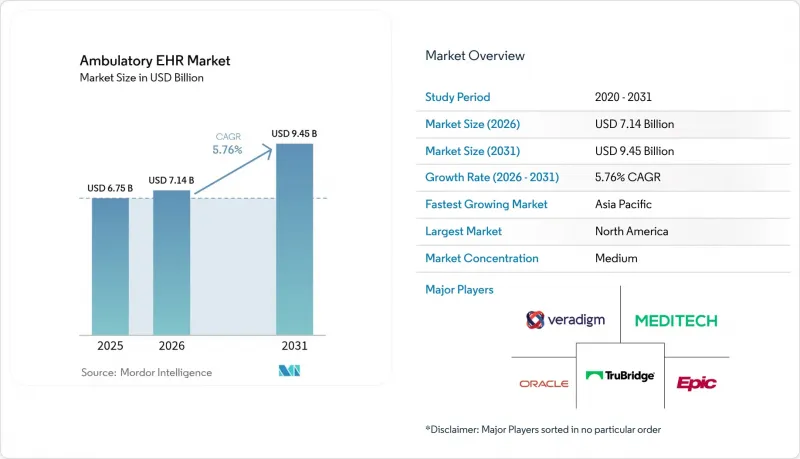
Mordor Intelligence에 따르면 2026년 외래 EHR 시장 규모는 71억 4,000만 달러로 추정되고 있으며, 2025년 67억 5,000만 달러에서 확대하며, 2031년에는 94억 5,000만 달러에 달할 것으로 예측됩니다.
2026-2031년까지의 연평균 성장률(CAGR)은 5.76%에 달할 것으로 전망됩니다.
이 보고서는 용도별(진료소 관리, 환자 관리 등), 제공 방식별(클라우드 기반 솔루션 등), 진료소 규모별(대규모 진료소, 중규모 진료소, 소규모 진료소), 최종사용자별(병원 소유 외래 진료 센터 등), 지역별(북미, 유럽, 아시아태평양 등)로 분류되어 있습니다. 시장 전망은 금액(달러) 기준으로 제시되어 있습니다.
전 세계 외래 EHR 시장의 동향 및 인사이트
정부의 인센티브와 규정 준수 의무가 시장 확대를 견인
EHR 정책에 있으며, 현재는 보상보다 처벌이 더 무겁게 작용하고 있습니다. '21세기 치료법(21st Century Cures Act)'에 따라 정보 제공을 방해하는 의료 서비스 제공자는 메디케어 지급액의 최대 5% 삭감, 공유 절감 프로그램(Shared Savings Program)에서 제명, 평판 하락 등의 위험에 직면하게 됩니다. 2025년 ‘품질 지급 프로그램(Quality Payment Program)’에서는 보다 상세한 전자 임상 품질 보고를 요구하는 7가지 새로운 품질 지표가 도입됩니다. CMS는 또한 환자가 접근할 수 있도록 FHIR 호환 API를 의무화하고 있으며, 이 요건은 이미 디지털 헬스 기업의 73%가 충족하고 있지만, 여전히 높은 도입 비용이라는 부담이 존재합니다. 그 결과, 외래 EHR 시장은 도입이 지연되고 있는 진료소나 소규모 전문 클리닉에서 발생하는 규정 준수를 위한 시스템 업데이트 주기의 혜택을 누리고 있습니다.
클라우드 전환의 추진력을 상쇄하는 강화되는 보안 요건
클라우드 환경은 하드웨어 비용을 절감하고 업데이트를 가속화하지만, 그 대가로 공격 표면을 확대시킵니다. HHS(미국 보건복지부) 시민권국은 2024년에 626건의 중대한 정보 유출 사고를 기록했으며, 4,170만 명이 영향을 받았습니다. 사고의 74%는 해킹에 의한 것이었으며, 네트워크 서버가 주요 침입 경로였습니다. 2024년 2월 발생한 체인지 헬스케어(Change Healthcare)에 대한 랜섬웨어 공격은 미국 보험 청구 처리의 절반을 마비시켰으며, 집중형 데이터 처리가 초래하는 체계적 위험을 여실히 드러냈습니다. 의료 서비스 제공업체들은 현재 공급업체와의 계약에서 다단계 인증, 지속적인 모니터링, 제로 트러스트 아키텍처를 필수 조건으로 요구하고 있으며, 이를 통해 주요 플랫폼에 대한 채택률을 높이는 고수익 보안 서비스 계층이 지원되고 있습니다.
사이버 보안 취약성이 클라우드 배포 속도를 제약
체인지 헬스케어(Change Healthcare)에서 발생한 ALPHV 랜섬웨어 침해 사고는 미국 진료소의 80%에 수익 손실을 초래하고 2,200만 달러의 몸값 지불을 강요했으나, 그럼에도 불구하고 수 주에 걸친 지불 지연이 발생했습니다. 이러한 사태를 계기로 분산 원장 기반의 데이터 저장 및 멀티클라우드 페일오버 전략을 요구하는 목소리가 높아지고 있지만, 소규모 의료 서비스 제공업체의 경우 이를 완전히 도입하기 위한 예산이나 인력이 부족한 경우가 많습니다. 그 결과, 일부 기관은 클라우드 전환을 미루고 단계적인 하이브리드 아키텍처를 선택하고 있으며, 이로 인해 외래 EHR 시장 전체의 성장세가 둔화되고 있습니다.
부문 분석
진료 관리 모듈은 2025년에 외래 EHR 시장 점유율의 24.18%를 차지하며, 이는 청구, 예약 관리 및 수혜 자격 확인에서 이 모듈이 수행하는 중요한 역할을 반영합니다. 그러나 인구 헬스케어를 위한 외래 EHR 시장 규모는 예방적 만성질환 관리 감독에 대한 보상을 제공하는 위험 기반 상환 제도의 지원을 받아 2031년까지 연평균 성장률(CAGR) 6.32%로 확대될 것으로 예측됩니다. 각 벤더사는 현재 AI를 활용한 위험 계층화를 인구 헬스케어 대시보드에 통합하고 있으며, 이를 통해 소규모 의료 기관에서도 인력을 증원하지 않고도 복잡한 환자 집단을 관리할 수 있게 되었습니다. 현재 소개 관리 툴은 ‘신뢰할 수 있는 교환 프레임워크 및 공통 합의(TEFCA)’를 통해 의료정보교환 시스템과 통합되어, 네트워크 전반에 걸친 환자 여정을 파악할 수 있게 되었습니다. 심장 종양학에서 피부과에 이르기까지 다양한 전문 모듈이 대규모 코드 재작성 없이도 활성화할 수 있는 AI 지원 애드온으로 등장하고 있으며, 이는 플랫폼 벤더들에게 새로운 수입원이 되고 있습니다.
환자 집단 관리 대시보드는 환자 1인당 월 15달러에서 110달러에 달하는 ‘고급 1차 진료 관리(APCM)’ 보상 제도로부터 직접적인 혜택을 받고 있습니다. 위험 기반의 아웃리치 및 후속 조치 프로토콜을 실행하는 진료소에서는 거의 즉각적인 투자 회수가 기대되므로, 이 애플리케이션 분야는 외래 EHR 시장에서 업그레이드의 가장 큰 원동력이 되고 있습니다. 클라우드 호스팅을 통해 인프라 비용이 절감됨에 따라 단일 거점의 의사 그룹조차도 과거에는 기업 시스템으로만 제한되었던 분석 엔진에 합리적인 가격으로 접근할 수 있게 되어, 예측 기간 중 시장 보급이 더욱 확대될 전망입니다.
2025년에는 외래 EHR 시장 규모의 77.12%를 클라우드 호스팅형 도입이 차지하며, 이 부문은 연평균 성장률(CAGR) 6.09%로 확대될 전망입니다. Epic, Oracle, athenahealth의 퍼블릭 클라우드 인스턴스는 종량제 요금제,지속적인 버전 업데이트, 턴키식의 분석 기능을 제공하고 있지만, 2024년에 발생한 랜섬웨어 사건으로 인해 고객들은 공동 책임 조항을 면밀히 검토하고, 외부 침투 테스트를 실시하며, 계약에 사이버 배상 책임 특약 조항의 추가를 요구할 수밖에 없게 되었습니다. 온프레미스형 솔루션은 데이터 주권에 대한 수요가 높은 일부 의료기관, 특히 임상 연구 데이터를 관리하는 대학 부속 의료 그룹에게는 여전히 중요한 선택지로 남아 있습니다. 하지만 클라우드 보안 대책이 성숙해짐에 따라 그 점유율은 점차 축소될 것입니다.
핵심 의료 기록의 로컬 사본을 보유하면서 클라우드 분석의 확장성을 추구하는 대규모 의료 시스템 사이에서 하이브리드 모델이 급속히 보급되고 있습니다. 이 아키텍처는 단일 장애 지점(SPOF)의 위험을 완화하고 신속한 재해 복구를 가능하게 합니다. 또한 진료 현장에서의 ‘엣지 AI’ 추론을 지원하여 의사결정 지원 툴의 지연 시간을 줄여줍니다. 이러한 구조적 변화는 ‘승자 독식’ 추세를 강화하며, 검증된 클라우드 보안 실적, 높은 상호 운용성, 그리고 글로벌 규모를 갖춘 벤더에게 유리하게 작용하고 있습니다.
지역별 분석
북미는 2025년 매출의 39.88%를 차지하고 있으며, 시장이 디지털화에서 최적화로 전환됨에 따라 연평균 성장률(CAGR) 5.44%로 성장할 전망입니다. 새로운 CMS(미국 의료보험서비스센터) 규정에 따라 180일간의 EHR(전자건강기록) 보고 기간과 eCQM(전자 품질관리 지표) 제출 범위의 확대가 의무화됨에 따라 의료 제공자들은 사후 추가 모듈을네이티브 상호 운용이 가능한 대안으로 교체할 수밖에 없게 되었습니다. AI 도입은 특히 활발하여, 30개 이상의 의료 시스템이 대규모로 앰비언트 리스닝(Ambient Listening)을 도입하고 있으며, 이를 통해 의사의 문서 작성 시간이 단축되고 시스템 업데이트에 대한 ROI(투자 수익률)가 향상되고 있습니다. 미국의 소규모 진료소 역시 장기적인 진료 조정 활동에 대한 보상이 지급되는 코드를 통해 새로운 인센티브를 얻고 있으며, 지방 주에서도 시장에 진입하는 기업이 증가하고 있습니다.
아시아태평양은 인도, 호주, 일본을 주축으로 연평균 성장률(CAGR) 6.96%를 기록하며 가장 빠르게 성장하고 있는 지역입니다. 인도의 ‘아유슈만 바라트 디지털 미션’에는 5억 6,800만 건의 의료 계정이 등록되었지만, 통신 환경의 불안정성과 언어의 다양성으로 인해 실제로 EHR이 활용되고 있는 경우는 극히 일부에 그치고 있습니다. 네트워크 업그레이드와 장비 조달에 대한 정부의 보조금 지원으로 이러한 격차를 해소하려는 움직임이 시작되고 있습니다. 중국과 한국은 AI 기반 의료 분석에 적극적인 지원을 하고 있으며, 머신러닝 파이프라인이 통합된 클라우드형 외래 진료 시스템에 대한 새로운 수요를 창출하고 있습니다. 이러한 동향에 따라 예측 기간 중 해당 지역은 외래 EHR 시장에서 가장 큰 증분 수입원이 될 전망입니다.
유럽은 5.80%의 연평균 성장률(CAGR)을 보이고 있으며, 국경을 초월한 데이터 공유를 중시하는 독일, 프랑스, 북유럽 국가들의 국가 e-헬스 계획에 힘입고 있습니다. GDPR 준수에 따라 엄격한 접근 제어와 감사 로그 기록이 의무화됨에 따라 견고한 개인정보 보호 체계를 갖춘 확립된 공급업체를 선정하는 조달 경향이 강화되고 있습니다. 중동 및 아프리카는 6.28%의 연평균 성장률(CAGR)로 그 뒤를 잇고 있으며, 사우디아라비아와 UAE의 원격의료 프로그램이 환자 생성 데이터를 외래 기록에 직접 통합함으로써 성장을 촉진하고 있습니다. 남미는 연평균 성장률(CAGR) 5.92%로 성장하고 있으며, 브라질이 공중보건 보고 포털과 연동되는 클라우드 네이티브형 EHR에 대한 투자를 주도하고 있습니다. 신흥 시장 전체에서는 인프라 격차가 여전히 제약 요인으로 작용하고 있습니다. 그럼에도 불구하고 멀티테넌트형 퍼블릭 클라우드 배포과 모바일 우선 프론트엔드가 비용 효율적인 대안이 되어 외래 EHR 시장의 장기적인 전망을 지원하고 있습니다.
기타 혜택:
- 엑셀 형식의 시장 예측(ME) 시트
- 3개월간의 애널리스트 지원
자주 묻는 질문
목차
제1장 서론
제2장 조사 방법
제3장 개요
제4장 시장 구도
제5장 시장 규모와 성장 예측
제6장 경쟁 구도
제7장 시장 기회와 향후 전망
KSA 26.09.04According to Mordor Intelligence, ambulatory EHR market size in 2026 is estimated at USD 7.14 billion, growing from 2025 value of USD 6.75 billion with 2031 projections showing USD 9.45 billion, growing at 5.76% CAGR over 2026-2031.
This report is Segmented by Application (Practice Management, Patient Management, and More), by Delivery Mode (Cloud-Based Solutions and More), by Practice Size (Large Practices, Medium-Sized Practices, Small Practices), by End-User (Hospital-Owned Ambulatory Centers and More), and Geography (North America, Europe, Asia-Pacific, and More). The Market Forecasts are Provided in Terms of Value (USD).
Global Ambulatory EHR Market Trends and Insights
Government Incentives & Compliance Mandates Drive Market Expansion
Penalties now outweigh rewards in EHR policy. Under the 21st Century Cures Act, providers that block information risk up to a 5% Medicare payment cut, potential removal from the Shared Savings Program, and reputational harm. The 2025 Quality Payment Program introduces seven new quality measures that demand deeper electronic clinical-quality reporting. CMS also requires FHIR-enabled APIs for patient access, a rule already met by 73% of digital-health firms but still burdened by high implementation fees. As a result, the ambulatory EHR market benefits from a compliance-driven replacement cycle among laggard practices and smaller specialty clinics.
Cloud Migration Momentum Offset by Escalating Security Imperatives
Cloud environments lower hardware costs and speed updates, yet they expand the attack surface. The HHS Office for Civil Rights logged 626 significant breaches in 2024, affecting 41.7 million individuals; hacking accounted for 74% of incidents and network servers were the prime vector. The February 2024 Change Healthcare ransomware attack, which disrupted half of U.S. claims traffic, underscored the systemic risks of centralized data processing. Providers now demand multi-factor authentication, continuous monitoring, and zero-trust architectures as non-negotiables in vendor contracts, supporting a higher-margin security-services layer that adds stickiness to leading platforms.
Cyber-Security Vulnerabilities Constrain Cloud Adoption Velocity
The ALPHV ransomware breach at Change Healthcare triggered revenue losses for 80% of U.S. physician practices and required a USD 22 million ransom payment, yet still produced multi-week payment delays. Such events spur calls for distributed-ledger data storage and multi-cloud fail-over strategies, but smaller providers often lack the budgets or staff to implement them fully. As a result, some organizations postpone cloud migrations, opting for incremental hybrid architectures that slow overall ambulatory EHR market growth trajectory.
Other drivers and restraints analyzed in the detailed report include:
- Value-Based Care Integration Accelerates Interoperability Demands
- AI-Powered Clinical Documentation Transforms Workflow Economics
- Infrastructure Disparities Limit Emerging-Market Penetration
For complete list of drivers and restraints, kindly check the Table Of Contents.
Segment Analysis
Practice-management modules captured 24.18% of the ambulatory EHR market share in 2025, reflecting their vital role in billing, scheduling, and eligibility checks. However, the ambulatory EHR market size for population-health management is projected to expand at 6.32% CAGR through 2031, spurred by risk-based reimbursement that rewards proactive chronic-care oversight. Vendors now embed AI-driven risk stratification into population dashboards, enabling small groups to manage complex patient panels without adding staff. Referral-management tools now integrate with health-information exchanges via the Trusted Exchange Framework and Common Agreement, positioning them to capture cross-network patient journeys. Specialty modules ranging from cardio-oncology to dermatology are emerging as AI-ready add-ons that can be switched on without major code rewrites, laying fresh revenue tracks for platform vendors.
Population-health dashboards benefit directly from Advanced Primary Care Management reimbursements that scale from USD 15 to USD 110 per patient per month. Clinics that demonstrate risk-based outreach and follow-up protocols see near-immediate return on investment, making this application segment the strongest pull for upgrades inside the ambulatory EHR market. As cloud hosting trims infrastructure costs, even single-site physician groups gain affordable access to analytics engines once reserved for enterprise systems, deepening market diffusion over the forecast horizon.
Cloud-hosted deployments accounted for 77.12% of the ambulatory EHR market size in 2025, and the segment is set to advance at a 6.09% CAGR. Public-cloud instances from Epic, Oracle, and athenahealth offer consumption-based pricing, rolling version updates, and turnkey analytics, but 2024's ransomware events forced customers to scrutinize shared-responsibility clauses, conduct external penetration tests, and demand cyber-liability riders in contracts. On-premise solutions remain relevant to a minority of providers with heightened data-sovereignty needs, particularly academic medical groups that manage clinical-research data. Still, their share will keep eroding as cloud security controls mature.
Hybrid models are rising quickly among large health systems that want the elasticity of cloud analytics while retaining a local copy of core health records. This architecture mitigates single-point-of-failure risk and enables rapid disaster-recovery options. It also supports "edge-AI" inference at the point of care, reducing latency for decision support tools. These structural shifts reinforce a winner-takes-most dynamic that favors vendors with proven cloud security track records, deep interoperability credentials, and global scale.
Complete Report Scope:
- By Application
- Practice Management
- Patient Management
- E-Prescribing
- Referral Management
- Population Health Management
- Others
- By Delivery Mode
- Cloud-based Solutions
- On-premise Solutions
- Hybrid Solutions
- By Practice Size
- Large Practices
- Medium-sized Practices
- Small Practices
- By End-User
- Hospital-owned Ambulatory Centers
- Independent Ambulatory Centers
- Health-system Affiliated Physician Groups
- By Geography
- North America
- United States
- Canada
- Mexico
- Europe
- Germany
- United Kingdom
- France
- Italy
- Spain
- Rest of Europe
- Asia-Pacific
- China
- India
- Japan
- Australia
- South Korea
- Rest of Asia-Pacific
- Middle East and Africa
- GCC
- South Africa
- Rest of Middle East and Africa
- South America
- Brazil
- Argentina
- Rest of South America
- North America
Geography Analysis
North America accounted for 39.88% of 2025 revenue and will grow at 5.44% CAGR as the market transitions from digitization to optimization. New CMS rules mandate a 180-day EHR-reporting window and expanded eCQM submissions, compelling providers to replace bolt-on modules with natively interoperable alternatives. AI uptake is particularly robust; more than 30 health systems have deployed ambient listening at scale, shaving physician documentation time and elevating the ROI calculus for system refreshes. Smaller U.S. practices gain fresh incentives from codes that reimburse longitudinal care-coordination activities, widening market participation across rural states.
Asia-Pacific is the fastest-growing region at 6.96% CAGR, underpinned by India, Australia, and Japan. India's Ayushman Bharat Digital Mission registered 568 million health accounts, yet only a fraction translates to active EHR utilization because of patchy connectivity and language diversity. Government subsidies for network upgrades and device procurement are beginning to bridge this gap. China and South Korea aggressively subsidize AI-based medical analytics, creating green-field demand for cloud-hosted ambulatory systems that ship with built-in machine-learning pipelines. These trends position the region as the largest incremental revenue pool for the ambulatory EHR market during the forecast period.
Europe shows a 5.80% CAGR, supported by national e-health plans in Germany, France, and the Nordics that emphasize cross-border data sharing. GDPR compliance imposes rigid access controls and audit logging, tilting procurement toward established vendors with robust privacy frameworks. Middle East & Africa follow at 6.28% CAGR, helped by telemedicine programs in Saudi Arabia and the UAE that funnel patient-generated data directly into ambulatory records. South America is growing 5.92% CAGR, with Brazil leading investments in cloud-native EHRs that integrate with public-health reporting portals. Infrastructure gaps remain a constraint throughout emerging markets. Still, multi-tenant public-cloud deployments and mobile-first front ends offer cost-effective workarounds, bolstering long-run prospects for the ambulatory EHR market.
- AdvancedMD
- Athenahealth
- Azalea Health Innovations, Inc.
- CompuGroup Medical SE & Co. KGaA
- CureMD.com, Inc.
- eClinicalWorks
- Epic Systems
- EverHealth Solutions Inc.
- Greenway Health
- Infor-Med, Inc. (Praxis EMR)
- Kareo
- Medhost
- Medical Information Technology
- Modernizing Medicine, Inc. (ModMed)
- NextGen Healthcare
- Oracle
- PointClickCare Technologies Inc.
- Practice Fusion, Inc.
- TruBridge, Inc.
- Veradigm Inc.
Additional Benefits:
- The market estimate (ME) sheet in Excel format
- 3 months of analyst support
TABLE OF CONTENTS
1 Introduction
- 1.1 Study Assumptions & Market Definition
- 1.2 Scope of the Study
2 Research Methodology
3 Executive Summary
4 Market Landscape
- 4.1 Market Overview
- 4.2 Market Drivers
- 4.2.1 Government incentives & compliance mandates
- 4.2.2 Accelerated shift to cloud-hosted EHRs
- 4.2.3 Value-based-care push for interoperable data
- 4.2.4 Specialty-specific AI modules boosting upgrades
- 4.2.5 Integration of telehealth workflows into EHR platforms
- 4.2.6 Reimbursement for remote monitoring & outpatient data capture
- 4.3 Market Restraints
- 4.3.1 Cyber-security & privacy breach concerns
- 4.3.2 Uneven infrastructure in emerging economies
- 4.3.3 Complex multi-jurisdiction regulatory compliance
- 4.3.4 Rising pay-per-use API costs for third-party integrations
- 4.4 Technological Outlook
- 4.5 Porter's Five Forces Analysis
- 4.5.1 Threat of New Entrants
- 4.5.2 Bargaining Power of Buyers
- 4.5.3 Bargaining Power of Suppliers
- 4.5.4 Threat of Substitutes
- 4.5.5 Intensity of Competitive Rivalry
5 Market Size & Growth Forecasts (Value)
- 5.1 By Application
- 5.1.1 Practice Management
- 5.1.2 Patient Management
- 5.1.3 E-Prescribing
- 5.1.4 Referral Management
- 5.1.5 Population Health Management
- 5.1.6 Others
- 5.2 By Delivery Mode
- 5.2.1 Cloud-based Solutions
- 5.2.2 On-premise Solutions
- 5.2.3 Hybrid Solutions
- 5.3 By Practice Size
- 5.3.1 Large Practices
- 5.3.2 Medium-sized Practices
- 5.3.3 Small Practices
- 5.4 By End-User
- 5.4.1 Hospital-owned Ambulatory Centers
- 5.4.2 Independent Ambulatory Centers
- 5.4.3 Health-system Affiliated Physician Groups
- 5.5 By Geography
- 5.5.1 North America
- 5.5.1.1 United States
- 5.5.1.2 Canada
- 5.5.1.3 Mexico
- 5.5.2 Europe
- 5.5.2.1 Germany
- 5.5.2.2 United Kingdom
- 5.5.2.3 France
- 5.5.2.4 Italy
- 5.5.2.5 Spain
- 5.5.2.6 Rest of Europe
- 5.5.3 Asia-Pacific
- 5.5.3.1 China
- 5.5.3.2 India
- 5.5.3.3 Japan
- 5.5.3.4 Australia
- 5.5.3.5 South Korea
- 5.5.3.6 Rest of Asia-Pacific
- 5.5.4 Middle East and Africa
- 5.5.4.1 GCC
- 5.5.4.2 South Africa
- 5.5.4.3 Rest of Middle East and Africa
- 5.5.5 South America
- 5.5.5.1 Brazil
- 5.5.5.2 Argentina
- 5.5.5.3 Rest of South America
- 5.5.1 North America
6 Competitive Landscape
- 6.1 Market Concentration
- 6.2 Competitive Benchmarking
- 6.3 Market Share Analysis
- 6.4 Company Profiles (includes Global level Overview, Market level overview, Core Segments, Financials as available, Strategic Information, Market Rank/Share for key companies, Products & Services, and Recent Developments)
- 6.4.1 AdvancedMD, Inc.
- 6.4.2 athenahealth Inc.
- 6.4.3 Azalea Health Innovations, Inc.
- 6.4.4 CompuGroup Medical SE & Co. KGaA
- 6.4.5 CureMD.com, Inc.
- 6.4.6 eClinicalWorks, LLC
- 6.4.7 Epic Systems Corporation
- 6.4.8 EverHealth Solutions Inc.
- 6.4.9 Greenway Health LLC
- 6.4.10 Infor-Med, Inc. (Praxis EMR)
- 6.4.11 Kareo, Inc.
- 6.4.12 MEDHOST, Inc.
- 6.4.13 Medical Information Technology, Inc. (Meditech)
- 6.4.14 Modernizing Medicine, Inc. (ModMed)
- 6.4.15 NextGen Healthcare, Inc.
- 6.4.16 Oracle Corporation
- 6.4.17 PointClickCare Technologies Inc.
- 6.4.18 Practice Fusion, Inc.
- 6.4.19 TruBridge, Inc.
- 6.4.20 Veradigm Inc.
7 Market Opportunities & Future Outlook
- 7.1 White-space & Unmet-need Assessment