

|
시장보고서
상품코드
2064446
연중성 알레르기성 비염 시장 : 시장 점유율 분석, 업계 동향 및 통계, 성장 예측(2026-2031년)Perennial Allergic Rhinitis - Market Share Analysis, Industry Trends & Statistics, Growth Forecasts (2026 - 2031) |
||||||
 Mordor Intelligence
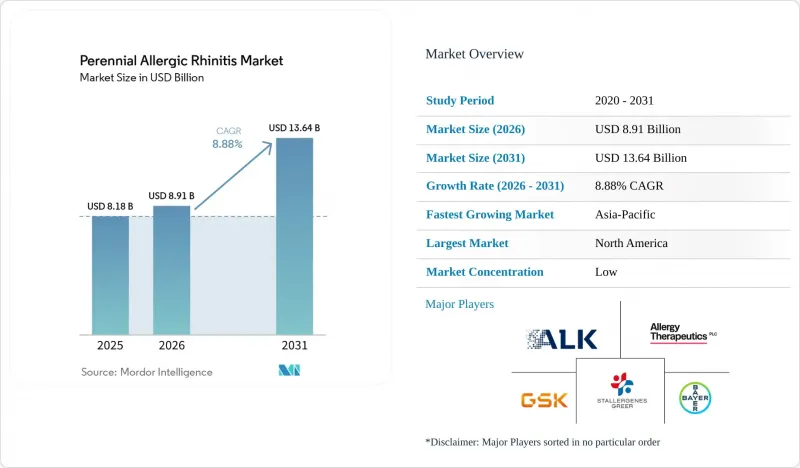
Mordor Intelligence에 의하면, 연중성 알레르기성 비염 시장 규모는 2025년에 81억 8,000만 달러로 평가되었고, 2026년에 89억 1,000만 달러로 추정되며, 2031년까지 136억 4,000만 달러에 이를 것으로 예측됩니다.
2026-2031년 연평균 성장률(CAGR) 8.88%로 성장할 것으로 전망됩니다.
본 보고서는 유발 알레르겐별(집먼지진드기, 반려동물 비듬, 곰팡이, 바퀴벌레 및 쥐), 치료 분류별(대증요법, 질환 수정 요법, 생물학적 제제), 투여 경로별(경구, 비강 내, 설하, 피하), 환자층별(소아, 성인, 고령자), 유통 채널별(병원, 소매, 온라인), 지역별(북미, 유럽, 아시아태평양, 중동 및 아프리카, 남미)로 분류되어 있습니다. 예측치는 금액(달러)으로 표시되어 있습니다.
세계의 연중성 알레르기성 비염 시장 동향 및 인사이트
실내 알레르겐에 대한 감작이 증가함에 따라 연중 지속적인 수요가 발생하고 있습니다.
연중성 알레르기성 비염 시장은 계절성 꽃가루에 비해 피하기 어려운 실내 알레르겐의 지속적인 존재 덕분에 혜택을 보고 있습니다. 집먼지진드기는 특정 온도 및 습도 조건에서 번식하며, 전 세계 인구의 4-6%에 영향을 미치고 있으며, 습도가 높은 지역에서는 감작률이 60-80%에 달할 전망입니다. 유럽에서는 알레르기성 비염 환자의 49%가 집먼지진드기에 과민반응을 보이며, 이것이 연중 발생하는 주요 유발 요인으로 꼽히고 있습니다. 도시 지역의 주거 동향이나 반려동물의 비듬 등이 알레르기 유발 물질에 대한 노출을 더욱 악화시켜, 효과적인 치료법에 대한 안정적인 수요를 창출하고 있습니다.
집먼지진드기에 대한 면역요법의 확대가 PAR의 질병 경과 조절 표준 치료를 재정의합니다.
집먼지진드기에 대한 면역요법이 주류 치료법으로 자리 잡으면서, 연중성 알레르기성 비염 시장은 변화하고 있습니다. 2025년 2월, 미국 FDA는 위약에 비해 22%의 개선 효과를 보인 임상시험 결과를 바탕으로, 5세에서 11세 소아를 대상으로 한 ODACTRA를 승인했습니다. 마찬가지로, ACARIZAX도 유럽 21개국에서 승인을 받아 적용 범위를 확대되고 있습니다. 실제 임상 데이터에 따르면, 면역요법은 약물 사용량을 37.7% 줄이고, 환자의 비염 유형을 지속성 비염에서 간헐성 비염으로 전환시키는 것으로 나타났습니다. 또한, 개정된 천식 지침에서도 조절이 잘 되지 않는 천식에 대한 추가 치료법으로 집먼지진드기 SLIT를 권장하고 있어, 종합적인 기도 관리에서 그 역할이 더욱 강화되고 있습니다.
연중 발생하는 질환의 경우, 면역요법의 장기화와 복약 순응도 저하가 두드러지게 나타납니다.
연중성 알레르기성 비염 시장에서는 치료 순응도와 관련된 과제에 직면해 있습니다. 이는 집먼지진드기에 대한 면역요법이 3-5년에 걸쳐 연중 치료가 필요하며, 더 짧은 기간의 계절성 치료에 비해 환자의 치료 피로를 유발하기 때문입니다. 네덜란드의 연구에 따르면, 1년 이상 치료를 지속한 환자는 66.7%에 그쳤으며, 18.3%는 의욕 부족이나 실무상의 문제로 인해 치료를 중단했습니다. 또한, 2년 이내에 치료를 중단한 환자들은 지속적인 면역학적 효과를 얻지 못했습니다. 스페인에서 환자 250명을 대상으로 진행된 PROACAROS 3상 임상시험 등 개발 프로그램은 이러한 과제를 해결하는 것을 목표로 하고 있으며, 피험자 모집은 2025년 12월까지 완료될 전망입니다.
부문별 분석
2025년 기준으로 집먼지진드기 시장은 매출의 57.12%를 차지했으며, 2031년까지 연평균 성장률(CAGR) 8.90%로 성장할 것으로 전망됩니다. 이로 인해, 연중성 알레르기성 비염 시장에서 가장 규모가 크고 가장 빠르게 성장하고 있는 부문이 됩니다. 이러한 우위는 가장 흔한 실내 알레르겐이라는 점에 더해, 주요 면역요법 제품의 주된 대상이 되고 있다는 사실에서 비롯되며, 현재는 소아 의료 부문으로 확대되고 있습니다. 임상적 증거는 집먼지진드기에 대한 감작과 만성 코막힘 및 지속적인 증상 간의 연관성을 보여주고 있으며, 이는 대증요법과 질환 수정 요법 모두에서 그 핵심적인 역할을 뒷받침하고 있습니다.
증상 완화 요법은 연중 내내 비강용 코르티코스테로이드와 항히스타민제가 사용되고 있는 점을 배경으로, 2025년에는 매출의 71.7%를 차지했습니다. 중등도에서 중증의 경우, 고정 용량의 비강 제제가 점점 더 선호되고 있으며, 일상적인 관리에서 그 역할이 강화되고 있습니다. 질환 수식 요법은 규모는 작지만, 면역 반응에 작용함으로써 장기적인 이점을 가져다주며, 만성 염증을 동반한 중증 사례에서 지지를 얻고 있습니다.
지역별 분석
2025년, 북미는 전 세계 매출의 38.47%를 차지했으며, 연중성 알레르기성 비염 시장에서 가장 규모가 큰 지역 기여 요인으로서의 위상을 유지했습니다. 미국은 치료에 대한 폭넓은 접근성, 높은 진단율, 진료 프로토콜에 비강 내 코르티코스테로이드, 항히스타민제, 집먼지진드기 면역요법이 정착됨에 따라 이러한 우위를 주도하고 있습니다. 캐나다에서는 아카리자크스의 승인 외에도, 만성 질환 관리에 있어 비강 내 코르티코스테로이드 및 알레르겐 면역요법에 대한 지원이 이러한 상황을 보완하고 있습니다. 유럽은 지침 개정, 각국에서의 면역요법 적극 도입, 영국에서 중등도 내지 중증의 집먼지진드기 알레르기에 대한 보험 급여 확대 등에 힘입어 계속해서 주요 수익원으로 자리 잡고 있습니다.
아시아태평양은 2031년까지 연평균 성장률(CAGR) 9.66%를 기록하며 성장할 것으로 예상되며, 연중성 알레르기성 비염 시장에서 가장 빠르게 성장하는 지역이 될 전망입니다. 이 지역의 높은 습도는 일년내내 진드기의 번식을 촉진하여 시장 확대를 위한 강력한 기반을 마련하고 있습니다. 일본이 그 대표적인 예로, 연중성 알레르기성 비염의 유병률은 24.5%에 달하며, 보험 적용을 통해 집먼지진드기 SLIT 정제가 사용되고 있습니다. 동남아시아와 중국에서도 높은 감작률이 확인되고 있으며, 미진단 사례가 큰 성장 기회로 대두되고 있습니다. 해당 지역에서는 높은 노출 위험, 인식 제고, 치료 경로의 확대가 맞물려 지속적인 성장을 이끌고 있습니다.
중동 및 아프리카와 남미는 시장 규모는 작지만, 완만한 성장 가능성을 지니고 있습니다. 만안 지역에서는 집먼지진드기가 가장 흔한 실내 알레르겐이며, 사우디아라비아 가정에서는 77.8%의 유병률을 보이고 있습니다. 또한, 냉난방이 가동되는 공간에서는 지속적인 노출이 발생하고 있습니다. 남미도 비슷한 상황이며, 따뜻하고 습도가 높은 환경이 알레르겐의 높은 농도를 부추기고 있습니다. 선별 검사 및 의사의 인식이 향상됨에 따라, 이러한 지역에서는 치료를 받는 환자층이 확대될 것으로 예상되며, 실내 알레르기 질환에 대한 대처에 대한 새로운 수요가 부각될 것으로 보입니다.
기타 혜택
- 엑셀 형식 시장 예측(ME) 시트
- 3개월간의 애널리스트 지원
자주 묻는 질문
목차
제1장 서론
제2장 조사 방법
제3장 주요 요약
제4장 시장 구도
제5장 시장 규모 및 성장 예측
제6장 경쟁 구도
제7장 시장 기회 및 향후 전망
AJY 26.06.24According to Mordor Intelligence, the perennial allergic rhinitis market size is projected to be USD 8.18 billion in 2025, USD 8.91 billion in 2026, and reach USD 13.64 billion by 2031, growing at a CAGR of 8.88% from 2026 to 2031.
This report is Segmented by Trigger Allergen (HDM, Pet Dander, Mold, Cockroach/Rodent), Treatment Class (Symptomatic, Disease-Modifying, Biologics), Route (Oral, Intranasal, Sublingual, Subcutaneous), Patient Group (Pediatric, Adult, Geriatric), Distribution Channel (Hospital, Retail, Online), and Geography (North America, Europe, Asia-Pacific, MEA, South America). Forecasts Provided in Value (USD).
Global Perennial Allergic Rhinitis Market Trends and Insights
Rising Indoor Allergen Sensitization Creates Permanent, Year-Round Demand
The perennial allergic rhinitis market benefits from the persistent presence of indoor allergens, which are harder to avoid compared to seasonal pollen. House dust mites thrive in specific temperature and humidity conditions, affecting 4-6% of the global population, with sensitization rates as high as 60-80% in humid regions. In Europe, 49% of allergic rhinitis patients are sensitized to house dust mites, making it the leading perennial trigger. Urban housing trends and pet dander further exacerbate allergen exposure, creating a consistent demand for effective treatments.
Expansion of House Dust Mite Immunotherapy Redefines PAR's Disease-Modifying Standard of Care
The perennial allergic rhinitis market is evolving as house dust mite immunotherapy becomes a mainstream treatment. In February 2025, the US FDA approved ODACTRA for children aged 5 to 11, following a trial showing a 22% improvement over placebo. Similarly, ACARIZAX gained approval across 21 European countries, expanding its reach. Real-world evidence shows immunotherapy reduces medication use by 37.7% and transitions patients from persistent to intermittent rhinitis. Updated asthma guidelines also endorse house dust mite SLIT as an add-on for uncontrolled asthma, reinforcing its role in comprehensive airway management.
Long Immunotherapy Duration and Adherence Drop-Off Are Amplified in Perennial Disease
The perennial allergic rhinitis market faces adherence challenges as house dust mite immunotherapy requires year-round treatment for 3-5 years, leading to patient fatigue compared to shorter seasonal regimens. A Dutch study reported that only 66.7% of patients continued treatment beyond one year, with 18.3% discontinuing due to motivational or logistical issues. Additionally, patients stopping before two years failed to achieve sustained immunological benefits. Development programs, such as the PROACAROS Phase III trial involving 250 patients in Spain, aim to address these gaps, with recruitment expected to conclude by December 2025.
Other drivers and restraints analyzed in the detailed report include:
- Higher Diagnosis of Rhinitis-Asthma Overlap Compounds PAR's Per-Patient Treatment Burden
- Pediatric Expansion of SLIT Tablet Eligibility Is Structurally Consequential for Perennial Disease
- Reimbursement and Supervision Frictions for Advanced Therapies Constrain Disease-Modifying PAR Market Potential
For complete list of drivers and restraints, kindly check the Table Of Contents.
Segment Analysis
In 2025, House Dust Mite accounted for 57.12% of the revenue and is projected to grow at an 8.90% CAGR through 2031, making it the largest and fastest-growing segment in the perennial allergic rhinitis market. Its dominance stems from being the most common indoor allergen and the focus of leading immunotherapy products, now expanding into pediatric care. Clinical evidence links house dust mite sensitization to chronic nasal obstruction and persistent symptoms, reinforcing its central role in both symptomatic and disease-modifying therapies.
Symptomatic Pharmacotherapy held 71.7% of the revenue in 2025, driven by year-round reliance on intranasal corticosteroids and antihistamines. Fixed-combination intranasal products are increasingly preferred for moderate-to-severe cases, reinforcing their role in routine management. Disease-modifying therapies, while smaller in scale, offer long-term benefits by addressing immune responses and are gaining traction in severe cases with chronic inflammation.
Geography Analysis
In 2025, North America accounted for 38.47% of global revenue, maintaining its position as the largest regional contributor in the perennial allergic rhinitis market. The United States drives this dominance with extensive treatment access, high diagnosis rates, and established use of intranasal corticosteroids, antihistamines, and house dust mite immunotherapy in care protocols. Canada complements this with approvals for Acarizax and support for intranasal corticosteroids and allergen immunotherapy in managing persistent diseases. Europe remains a key revenue contributor, supported by updated guidelines, active immunotherapy adoption across countries, and reimbursement progress in the UK for moderate-to-severe house dust mite conditions.
Asia-Pacific is projected to grow at a 9.66% CAGR through 2031, making it the fastest-growing region in the perennial allergic rhinitis market. The region's humid climates promote year-round mite proliferation, creating a strong base for market expansion. Japan exemplifies this with a 24.5% prevalence of perennial allergic rhinitis and insurance-backed use of house dust mite SLIT tablets. Southeast Asia and China also show high sensitization rates, with underdiagnosed cases presenting significant growth opportunities. The region combines heavy exposure, rising awareness, and expanding treatment pathways, driving sustained growth.
The Middle East, Africa, and South America are smaller markets but show potential for gradual growth. In the Gulf region, house dust mites are the most common indoor allergen, with a 77.8% prevalence in Saudi homes, while air-conditioned spaces sustain exposure. South America shares similar conditions, with warm, humid environments supporting high allergen burdens. As screening and physician awareness improve, these regions are expected to see an expanding treated patient base, highlighting emerging demand for addressing indoor allergen diseases.
- ALK-Abello
- Allergy Therapeutics plc
- Bayer
- Dr. Reddy's Laboratories
- Eli Lilly and Company
- FAES Farma S.A.
- Glenmark Pharmaceuticals
- GlaxoSmithKline
- Haleon
- Hikma Pharmaceuticals
- Hisamitsu Pharmaceutical
- Inmunotek S.L.
- Kenvue Inc.
- Opella / Sanofi Consumer Healthcare
- Perrigo Company
- Regeneron Pharmaceuticals
- Stallergenes Greer
- Teva Pharmaceutical Industries
- Torii Pharmaceutical
- Viatris
Additional Benefits:
- The market estimate (ME) sheet in Excel format
- 3 months of analyst support
TABLE OF CONTENTS
1 Introduction
- 1.1 Study Assumptions & Market Definition
- 1.2 Scope of the Study
2 Research Methodology
3 Executive Summary
4 Market Landscape
- 4.1 Market Overview
- 4.2 Market Drivers
- 4.2.1 Rising Indoor Allergen Sensitization
- 4.2.2 Preference for Intranasal Corticosteroids and Combination Sprays
- 4.2.3 Expansion of House Dust Mite Immunotherapy
- 4.2.4 Higher Diagnosis of Rhinitis-Asthma Overlap
- 4.2.5 Pediatric Expansion of SLIT Tablet Eligibility
- 4.2.6 Biomarker-Led Identification of Local Allergic Rhinitis
- 4.3 Market Restraints
- 4.3.1 Long Immunotherapy Duration and Adherence Drop-Off
- 4.3.2 OTC and Generic Price Pressure
- 4.3.3 Mixed-Rhinitis Misclassification
- 4.3.4 Reimbursement and Supervision Frictions for Advanced Therapies
- 4.4 supply / Value Chain Analysis
- 4.5 Regulatory Landscape
- 4.6 Technological Outlook
- 4.7 Reimbursement Landscape
- 4.8 Porter's Five Forces Analysis
- 4.8.1 Threat of New Entrants
- 4.8.2 Bargaining Power of Suppliers
- 4.8.3 Bargaining Power of Buyers
- 4.8.4 Threat of Substitutes
- 4.8.5 Competitive Rivalry
5 Market Size & Growth Forecasts (Value, USD)
- 5.1 By Trigger Allergen
- 5.1.1 House Dust Mite
- 5.1.2 Pet Dander
- 5.1.3 Mold
- 5.1.4 Cockroach and Rodent Allergens
- 5.2 By Treatment Class
- 5.2.1 Symptomatic Pharmacotherapy
- 5.2.1.1 Oral Antihistamines
- 5.2.1.2 Intranasal Corticosteroids
- 5.2.1.3 Combination Nasal Sprays
- 5.2.1.4 Decongestants
- 5.2.1.5 Leukotriene Receptor Antagonists
- 5.2.2 Disease-Modifying Therapy
- 5.2.3 Advanced Biologics
- 5.2.1 Symptomatic Pharmacotherapy
- 5.3 By Route of Administration
- 5.3.1 Oral
- 5.3.2 Intranasal
- 5.3.3 Sublingual
- 5.3.4 Subcutaneous
- 5.4 By Patient Group
- 5.4.1 Pediatric
- 5.4.2 Adult
- 5.4.3 Geriatric
- 5.5 By Distribution Channel
- 5.5.1 Hospital Pharmacies
- 5.5.2 Retail Pharmacies
- 5.5.3 Online Pharmacies
- 5.6 By Geography
- 5.6.1 North America
- 5.6.1.1 United States
- 5.6.1.2 Canada
- 5.6.1.3 Mexico
- 5.6.2 Europe
- 5.6.2.1 Germany
- 5.6.2.2 United Kingdom
- 5.6.2.3 France
- 5.6.2.4 Italy
- 5.6.2.5 Spain
- 5.6.2.6 Rest of Europe
- 5.6.3 Asia-Pacific
- 5.6.3.1 China
- 5.6.3.2 India
- 5.6.3.3 Japan
- 5.6.3.4 South Korea
- 5.6.3.5 Australia
- 5.6.3.6 Rest of Asia-Pacific
- 5.6.4 Middle East and Africa
- 5.6.4.1 GCC
- 5.6.4.2 South Africa
- 5.6.4.3 Rest of Middle East and Africa
- 5.6.5 South America
- 5.6.5.1 Brazil
- 5.6.5.2 Argentina
- 5.6.5.3 Rest of South America
- 5.6.1 North America
6 Competitive Landscape
- 6.1 Market Concentration
- 6.2 Market Share Analysis
- 6.3 Company Profiles (includes Global level Overview, Market level overview, Core Segments, Financials as available, Strategic Information, Market Rank/Share for key companies, Products & Services, and Recent Developments)
- 6.3.1 ALK-Abello A/S
- 6.3.2 Allergy Therapeutics plc
- 6.3.3 Bayer AG
- 6.3.4 Dr. Reddys Laboratories Ltd.
- 6.3.5 Eli Lilly and Company
- 6.3.6 FAES Farma S.A.
- 6.3.7 Glenmark Pharmaceuticals Ltd.
- 6.3.8 GSK plc
- 6.3.9 Haleon
- 6.3.10 Hikma Pharmaceuticals PLC
- 6.3.11 Hisamitsu Pharmaceutical Co., Inc.
- 6.3.12 Inmunotek S.L.
- 6.3.13 Kenvue Inc.
- 6.3.14 Opella / Sanofi Consumer Healthcare
- 6.3.15 Perrigo Company plc
- 6.3.16 Regeneron Pharmaceuticals, Inc.
- 6.3.17 Stallergenes Greer
- 6.3.18 Teva Pharmaceutical Industries Ltd.
- 6.3.19 Torii Pharmaceutical Co., Ltd.
- 6.3.20 Viatris Inc.
7 Market Opportunities & Future Outlook
- 7.1 White-space & Unmet-need Assessment


