

|
시장보고서
상품코드
2064495
인쇄 카톤 시장 : 시장 점유율 분석, 업계 동향 및 통계, 성장 예측(2026-2031년)Printed Cartons - Market Share Analysis, Industry Trends & Statistics, Growth Forecasts (2026 - 2031) |
||||||
 Mordor Intelligence
Mordor Intelligence에 의하면, 인쇄 카톤 시장 규모는 2025년에 4,176억 1,000만 달러로 평가되었고, 2026-2031년 CAGR 6.19%로 성장을 지속할 전망이며, 2031년까지 5,987억 1,000만 달러에 이를 것으로 예측됩니다.
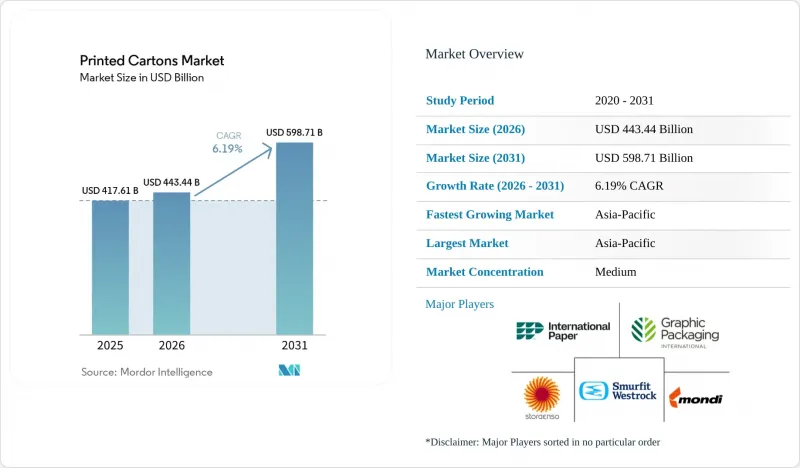
본 보고서는 제품 유형별(접이식 상자, 인쇄 상자, 경질 조립식 상자), 인쇄 기술별(오프셋 인쇄, 플렉소 인쇄, 디지털 인쇄, 그라비아 인쇄, 기타), 최종 사용자별(식음료, 가정용품 및 공업 제품, 퍼스널케어 및 화장품, 담배, 기타), 지역별로 분류되어 있습니다. 시장 전망은 금액(달러) 기준으로 제시되어 있습니다.
세계의 인쇄 카톤 시장 동향 및 분석
플라스틱에서 재활용 가능한 섬유 기반 포장재로 전환
인쇄 카톤 시장은 플라스틱에서 섬유계 포장으로의 전환이라는 구조적 변화로 인해 가장 큰 호재를 누리고 있습니다. 유럽에서는 2025년에 종이 및 골판지의 재활용률이 82%를 기록했으며, 이에 따라 2차 섬유 공급이 개선되어 많은 골판지 용도에서 버진 원료와의 비용 격차가 줄어들었습니다. EU의 ‘포장 및 포장 폐기물 규정’은 2025년 2월에 발효되어 2026년 8월부터 적용이 시작되며, 브랜드 소유주들에게 재활용 가능한 포장을 시장에 출시하도록 압력을 강화하고 있습니다. 이러한 전환은 단순한 원자재 대체에 그치지 않습니다. 이는 각 브랜드 업체들이 인쇄된 섬유 골판지 상자가 많은 플라스틱 대체품보다 뛰어난 그래픽 품질과 진열대에서의 가시성을 제공한다는 점을 인식하고 있기 때문입니다. 그루 벨(Glu-Bell)사가 2027년까지 모든 치즈 소분 포장을 접이식 골판지 상자로 전환하여 연간 4,200톤의 플라스틱을 감축할 계획인 것은 지속가능성을 위한 노력이 시장 전반에 걸쳐 인쇄된 접이식 골판지 상자에 대한 뚜렷하고 가시적인 수요를 이끌고 있음을 보여줍니다.
의약품 일련번호 부여 및 무단 개봉 방지 용기 요건
인쇄 카톤 시장은 골판지 포장을 보다 기술적이고 지속적인 분야로 발전시킨 의약품 규정 준수 규제의 혜택도 누리고 있습니다. 미국에서는 DSCSA(의약품 안전 추적법)의 요건에 따라, 규제 대상 포장에 고유 식별 및 정확한 인쇄 위치 설정을 지원할 수 있는 골판지 수요가 증가하고 있습니다. 유럽에서도 처방약 상자에는 고유 식별자와 위조 방지 기능이 요구되고 있으며, 이에 따라 일관된 판지 품질, 정밀한 가공, 신뢰성 높은 인쇄 성능에 대한 수요가 높아지고 있습니다. 이러한 규제로 인해 제약 포장 분야에서 계약 유지는 가변 데이터 처리 능력과 밀접하게 연관되어 있으므로, 각 컨버터 업체들은 디지털 및 하이브리드 워크플로로 전환해야 하는 상황에 직면해 있습니다. 그 결과, 의약품용 골판지 상자에는 더 높은 기술적 요건과 더 긴 인증 주기가 요구되게 되었으며, 이는 인쇄 카톤 시장에서 프리미엄 가격 책정과 보다 안정적인 수요를 뒷받침하고 있습니다.
원자재 및 에너지 비용의 변동
원자재 및 에너지 가격의 급등은 인쇄 카톤 시장 내 컨버터들에게 여전히 가장 시급한 압박 요인으로 작용하고 있습니다. 북미의 컨테이너보드 가격은 2026년 1분기에 톤당 50달러(순가) 상승했으며, 생산자들은 2026년 6월에 톤당 50-70달러 범위 내에서 추가적인 가격 인상을 계획하고 있습니다. 유럽에서는 2026년 초 천연가스 가격이 1MWh당 68유로(1MWh당 77달러)를 넘어섬에 따라, 지역 전체의 판지 생산 비용이 상승했습니다. 비통합형 가공업체는 장기 펄프 계약, 자사 공장을 통한 생산 능력, 혹은 에너지 헤지 같은 보호 수단이 부족하기 때문에 가장 큰 부담을 안고 있습니다. 이러한 압박은 인쇄 카톤 시장의 재편을 가속화하고 있습니다. 왜냐하면 소규모 사업자는 이익률이나 고객 점유율을 훼손하지 않으면서 반복되는 비용 변동을 흡수할 능력이 부족하기 때문입니다.
부문별 분석
2025년 기준으로 접이식 상자는 인쇄 상자 시장 규모의 43.36%를 차지했으며, 골판지 상자나 경질 상자를 크게 앞지르며 가장 큰 제품 유형으로 자리매김하고 있습니다. 이러한 우위는 식품, 의약품, 화장품 및 다양한 소비재 용도에 적합한 인쇄 품질, 재활용성, 구조적 유연성을 모두 갖추고 있다는 점에 기인합니다. 인쇄 카톤 시장에서 접이식 골판지 상자는 헬스케어 및 뷰티 부문에서는 1차 포장재로, 식음료 부문에서는 2차 포장재로, 또한 옴니채널 유통에서는 소매용 포장재로 사용되고 있습니다. 해당 부문은 2031년까지 연평균 성장률(CAGR) 6.84%로 확대될 것으로 예상되며, 현재 시장 구조에서 가장 규모가 크고 가장 빠르게 성장하고 있는 부문입니다. 이러한 경향은 인쇄 카톤 시장 전체에서 단일 소재 섬유 포장재로의 광범위한 전환, 소매점 내 진열 효과 향상, 의약품 포장 사양의 고도화를 반영한 것입니다.
골판지 상자는 내압성, 적재 강도, 비용 관리가 가장 중요한 운송량이 많은 용도나 산업용 분야에서 여전히 핵심적인 역할을 수행하고 있습니다. 또한, 특히 아시아태평양 및 남미 지역에서 소포 처리량과 창고 업무의 확대에 따라 인쇄 카톤 시장 공급업체들에게 잠재 고객 기반이 지속적으로 확대되고 있어, 전자상거래 네트워크의 확대로 인한 혜택도 누리고 있습니다. 경질 골판지는 수량 기준으로는 여전히 가장 작은 카테고리이지만, 고급 화장품, 프리미엄 주류, 하이엔드 전자기기 등의 부문에서는 뛰어난 질감과 구조적 강성 덕분에 고가화를 뒷받침하고 있어 확고한 입지를 유지하고 있습니다. 제품 유형간 경쟁 구도도 변화하고 있습니다. 이는 마이크로플루트 골판지가, 과거에는 접이식 상자가 더 확고한 입지를 차지하고 있던 디스플레이 및 매장 진열용 포장 분야로 진출하고 있기 때문입니다. 이러한 역할의 중복으로 인해, 인쇄 카톤 산업의 각 변환업체들은 단순히 생산량만으로 경쟁하는 것이 아니라, 디자인 역량, 원재료 선정, 인쇄기의 유연성을 높여야 하는 상황에 직면해 있습니다.
지역별 분석
아시아태평양은 2025년에 인쇄 카톤 시장 점유율의 39.14%를 차지한 것으로 평가되었으며, 2031년까지 연평균 성장률(CAGR) 7.13%로 성장할 것으로 전망되어, 가장 규모가 크고 가장 빠르게 성장하는 지역 시장이 되고 있습니다. 중국은 일회용 플라스틱에 대한 규제가 소매 및 전자상거래 채널 전반에 걸쳐 접이식 골판지 및 골판지 제품에 대한 수요를 뒷받침하고 있기 때문에 여전히 핵심적인 위치를 차지하고 있습니다. 현지 주요 공급업체들의 생산 능력 확충 역시, 국내 수요가 단기적인 무역 흐름뿐만 아니라 장기적인 공급 대응을 통해 충족되고 있음을 보여줍니다. 인도는 조직형 소매업, FMCG(일용소비재)의 확대, 포장 규제로 인해 더 많은 브랜드 소유주들이 섬유 기반 형태로 전환하고 있어, 이는 또 다른 주요 성장 요인이 되고 있습니다. 일본, 한국, 호주, 뉴질랜드에서는 고부가가치 골판지, 디지털 인쇄의 도입, 추적성 및 프리미엄 브랜드의 이미지 제고를 지원하는 포장 형태를 중심으로 한 독자적인 수요 구성이 나타나고 있습니다.
북미와 유럽은 합쳐서 아시아태평양을 제외한 인쇄 카톤 시장에서 가장 큰 가치 원천을 차지하고 있습니다. 북미에서는 전자상거래 물류 처리의 성장, 소매업체의 포장 규격에 대한 기준 강화, 일련번호 부여 및 위조 방지 포장에 대응한 의약품용 상자 수요가 성장의 견인차 역할을 하고 있습니다. 유럽의 전망은 PPWR(플라스틱 포장 규제)에 따른 재활용 가능성에 관한 규정과, 포장 디자인과 생산자의 비용 결과를 점점 더 밀접하게 연결시키는 EPR(확대 생산자 책임) 제도에 의해 형성되고 있습니다. 2026-2027년 영국에서 도입될 단계적 폐기물 처리 요금 제도는 골판지 상자 설계 결정이 단순한 지속가능성에 대한 선택의 문제가 아니라, 얼마나 빠르게 재무적 결정으로 변화하고 있는지를 보여주고 있습니다. 독일은 그 규모, 재활용에 대한 노력, 다국적 포장재 구매 기업들과의 연계 덕분에 여전히 주요 거점으로 자리 잡고 있지만, 비용 중심의 생산 측면에서는 동유럽의 저비용 가공 거점의 중요성이 계속해서 커지고 있습니다.
남미, 중동 및 아프리카는 전체 규모는 작지만, 지역별 생산 능력 확대와 카테고리별 성장 여지가 있어 인쇄 카톤 시장에게 있어 전략적으로 중요한 지역으로 남아 있습니다. 브라질은 식음료 수출, 조직형 소매업의 성장, 폭넓은 FMCG(일용소비재) 포장 기반을 통해 남미 수요를 뒷받침하고 있습니다. 2026년 3월 스마핏 웨스트록이 에콰도르의 칼토마나비를 인수한 것은 주요 공급업체들이 여전히 남미를 골판지 산업의 활발한 성장 거점으로 보고 있음을 보여줍니다. 중동 및 아프리카에서는 걸프 연안 국가들이 소매용 현대식 포장에 대한 투자를 확대하고 있는 반면, 아프리카 일부 지역에서는 의약품의 추적성 및 규정 준수 요건으로 인해 사양이 더 높은 골판지 상자에 대한 수요가 증가하고 있습니다.
기타 혜택
- 엑셀 형식 시장 예측(ME) 시트
- 3개월간의 애널리스트 지원
자주 묻는 질문
목차
제1장 서론
제2장 조사 방법
제3장 주요 요약
제4장 시장 구도
제5장 시장 규모 및 성장 예측
제6장 경쟁 구도
제7장 시장 기회 및 향후 전망
AJY 26.06.26According to Mordor Intelligence, the printed cartons market size was USD 417.61 billion in 2025 and is forecast to reach USD 598.71 billion by 2031 at a CAGR of 6.19% during 2026-2031.
This report is Segmented by Product Type (Folding Cartons, Printed Corrugated Cartons, and Rigid Setup Cartons), Printing Technology (Lithographic Printing, Flexographic Printing, Digital Printing, Gravure Printing, and More), End-User (Food and Beverage, Household and Industrial Goods, Personal Care and Cosmetics, Tobacco, and More), and Geography. The Market Forecasts are Provided in Terms of Value (USD).
Global Printed Cartons Market Trends and Insights
Shift From Plastic to Recyclable Fiber Packaging
The printed cartons market is seeing its strongest structural push from the shift away from plastic to fiber-based packaging. Europe recorded a 82% recycling rate for paper and cardboard in 2025, improving the availability of secondary fiber and reducing the cost gap with virgin grades in many carton applications. The EU Packaging and Packaging Waste Regulation entered into force in February 2025 and became applicable in August 2026, raising pressure on brand owners to place recyclable packaging on the market. This shift is not only about material replacement because brands are also finding that printed fiber cartons offer stronger graphic quality and better shelf visibility than many plastic alternatives. Groupe Bel's plan to move all cheese-portion packs to folding cartons by 2027, eliminating 4,200 tonnes of plastic each year, shows how sustainability commitments are driving significant, visible demand for printed folding cartons across the market.
Pharmaceutical Serialization and Tamper-Evident Carton Requirements
The printed cartons market is also benefiting from pharmaceutical compliance rules that have elevated carton packaging to a more technical, recurring category. In the United States, DSCSA requirements have increased the need for cartons that can support unique identification and reliable print placement for regulated packs. In Europe, prescription medicine cartons also require a unique identifier and tamper-evident features, which strengthens demand for consistent board quality, precise converting, and dependable print performance. These rules are pushing converters toward digital and hybrid workflows because variable-data handling is now closely tied to contract retention in pharmaceutical packaging. The result is that pharmaceutical cartons carry higher technical requirements and longer qualification cycles, which supports premium pricing and more stable demand in the printed cartons market.
Raw Material and Energy Cost Volatility
Raw material and energy inflation remains the most immediate pressure point for converters in the printed cartons market. North American containerboard prices rose by USD 50 per tonne net in Q1 2026, and producers followed with another planned round of increases in June 2026 in the USD 50-70 per tonne range. In Europe, natural gas prices moved above EUR 68 per MWh (USD 77 per MWh) in early 2026, raising the cost base for paperboard production across the region. Non-integrated converters bear the heaviest burden because they lack protection from long-term fiber contracts, internal mill capacity, or energy hedging. This pressure is feeding consolidation in the printed cartons market because smaller operators are less able to absorb repeated cost swings without losing margin or customer share.
Other drivers and restraints analyzed in the detailed report include:
- Premiumization and Shelf-Ready Branding Demand
- E-Commerce And Omnichannel Secondary Packaging Demand
- Competition from Flexible Packaging Formats
For complete list of drivers and restraints, kindly check the Table Of Contents.
Segment Analysis
Folding cartons accounted for 43.36% of the printed cartons market size in 2025, making them the largest product type by a clear margin over corrugated cartons and rigid cartons. Their leadership stems from a blend of print quality, recyclability, and structural flexibility that suits food, pharmaceuticals, cosmetics, and many consumer goods applications. In the printed cartons market, folding cartons are used as primary packs in healthcare and beauty, secondary packs in food and beverage, and retail-ready packs in omnichannel distribution. The same segment is projected to expand at a 6.84% CAGR through 2031, making it the largest and fastest-growing category in the current market structure. That pattern reflects a broader shift toward mono-material fiber packaging, stronger retail presentation, and upgrades to pharmaceutical packaging specifications across the printed cartons market.
Corrugated cartons still hold a central role in shipping-heavy and industrial applications where crush resistance, stacking strength, and cost control matter most. They are also benefiting from the expansion of e-commerce networks, especially in Asia-Pacific and South America, where parcel volumes and warehousing activity continue to widen the addressable base for printed cartons market suppliers. Rigid cartons remain the smallest category by volume, but they preserve a strong position in luxury cosmetics, premium spirits, and high-end electronics where tactile quality and structural stiffness support higher unit pricing. Competition between product types is also shifting because micro-flute corrugated formats are moving into display and shelf-ready roles that once sat more firmly with folding cartons. That overlap is pushing converters in the printed cartons industry to sharpen design capability, substrate selection, and press flexibility rather than compete only on output volume.
Geography Analysis
Asia-Pacific held 39.14% of the printed cartons market share in 2025 and is projected to grow at a 7.13% CAGR through 2031, making it the largest and fastest-growing regional market. China remains the anchor because its restrictions on single-use plastics have supported demand for folding cartons and corrugated products across retail and e-commerce channels. Capacity additions by large local suppliers also show that domestic demand is being met by a long-term supply response rather than solely by short-term trade flows. India adds another major layer of growth, as organized retail, FMCG expansion, and packaging regulations are pushing more brand owners toward fiber-based formats. Japan, South Korea, Australia, and New Zealand have distinct demand mixes centered on higher-value cartons, digital printing adoption, and packaging formats that support traceability and premium brand presentation.
North America and Europe together represent the largest value pool outside Asia-Pacific in the printed cartons market. North America is being driven by e-commerce fulfillment growth, tighter retailer packaging specifications, and the need for pharmaceutical cartons that support serialization and tamper-evident packaging. Europe's outlook is shaped by recyclability rules under PPWR and by EPR systems that increasingly tie packaging design to cost outcomes for producers. The United Kingdom's move toward modulated disposal fees in 2026-2027 shows how quickly carton design decisions are becoming financial decisions rather than optional sustainability choices. Germany remains a large national center because of its scale, recycling discipline, and links to multinational packaging buyers, while lower-cost converting locations in Eastern Europe continue to gain relevance for cost-sensitive production.
South America and Middle East and Africa are smaller in total size, but they remain strategically important to the printed cartons market because they offer space for regional capacity expansion and category-specific growth. Brazil anchors South American demand through food and beverage exports, organized retail growth, and a broad FMCG packaging base. Smurfit Westrock's acquisition of Cartomanabi in Ecuador in March 2026 showed that major suppliers still see South America as an active corrugated growth platform. In Middle East and Africa, Gulf markets are investing in modern retail-ready packaging, while pharmaceutical traceability and compliance demands are raising the need for higher-specification cartons in parts of Africa.
- Smurfit Westrock plc
- Graphic Packaging Holding Company
- International Paper Company
- Mayr-Melnhof Karton AG
- Stora Enso Oyj
- Mondi plc
- Huhtamaki Oyj
- Rengo Co., Ltd.
- Nippon Paper Industries Co., Ltd.
- Oji Holdings Corporation
- Parksons Packaging Ltd.
- TCPL Packaging Limited
- Sonoco Products Company
- Edelmann GmbH
- Colbert Packaging Corporation
- Keystone Folding Box Co., Inc.
Additional Benefits:
- The market estimate (ME) sheet in Excel format
- 3 months of analyst support
TABLE OF CONTENTS
1 INTRODUCTION
- 1.1 Study Assumptions and Market Definition
- 1.2 Scope of the Study
2 RESEARCH METHODOLOGY
3 EXECUTIVE SUMMARY
4 MARKET LANDSCAPE
- 4.1 Market Overview
- 4.2 Market Drivers
- 4.2.1 Shift From Plastic to Recyclable Fiber Packaging
- 4.2.2 Premiumization and Shelf-Ready Branding Demand
- 4.2.3 E-commerce and Omnichannel Secondary Packaging Demand
- 4.2.4 Pharmaceutical Serialization and Tamper-Evident Carton Requirements
- 4.2.5 PFAS-Free Barrier Board Innovation Unlocking Food Applications
- 4.2.6 SKU Proliferation Favoring Short-Run Digital Cartons
- 4.3 Market Restraints
- 4.3.1 Raw Material and Energy Cost Volatility
- 4.3.2 Competition From Flexible Packaging Formats
- 4.3.3 EPR Fee Modulation Penalizing Hard-to-Recycle Structures
- 4.3.4 Barrier-Coating Qualification and Recyclability Trade-Offs
- 4.4 Industry Value Chain Analysis
- 4.5 Regulatory Landscape
- 4.6 Technological Outlook
- 4.7 Porter's Five Forces Analysis
- 4.7.1 Threat of New Entrants
- 4.7.2 Bargaining Power of Suppliers
- 4.7.3 Bargaining Power of Buyers
- 4.7.4 Threat of Substitutes
- 4.7.5 Competitive Rivalry
5 MARKET SIZE AND GROWTH FORECASTS (VALUE)
- 5.1 By Product Type
- 5.1.1 Folding Cartons
- 5.1.2 Printed Corrugated Cartons
- 5.1.3 Rigid Setup Cartons
- 5.2 By Printing Technology
- 5.2.1 Lithographic Printing
- 5.2.2 Flexographic Printing
- 5.2.3 Digital Printing
- 5.2.4 Gravure Printing
- 5.2.5 Other Printing Technologies
- 5.3 By End-User Industry
- 5.3.1 Food and Beverage
- 5.3.2 Healthcare/Pharmaceuticals
- 5.3.3 Personal Care and Cosmetics
- 5.3.4 Electrical and Electronics
- 5.3.5 Household and Industrial Goods
- 5.3.6 Tobacco
- 5.3.7 E-commerce and Retail-ready Packaging
- 5.3.8 Other End-User Industries
- 5.4 By Geography
- 5.4.1 North America
- 5.4.1.1 United States
- 5.4.1.2 Canada
- 5.4.1.3 Mexico
- 5.4.2 South America
- 5.4.2.1 Brazil
- 5.4.2.2 Argentina
- 5.4.2.3 Rest of South America
- 5.4.3 Europe
- 5.4.3.1 Germany
- 5.4.3.2 United Kingdom
- 5.4.3.3 France
- 5.4.3.4 Italy
- 5.4.3.5 Spain
- 5.4.3.6 Russia
- 5.4.3.7 Rest of Europe
- 5.4.4 Asia-Pacific
- 5.4.4.1 China
- 5.4.4.2 Japan
- 5.4.4.3 South Korea
- 5.4.4.4 India
- 5.4.4.5 Australia and New Zealand
- 5.4.4.6 Rest of Asia-Pacific
- 5.4.5 Middle East and Africa
- 5.4.5.1 Middle East
- 5.4.5.1.1 Saudi Arabia
- 5.4.5.1.2 United Arab Emirates
- 5.4.5.1.3 Turkey
- 5.4.5.1.4 Rest of Middle East
- 5.4.5.2 Africa
- 5.4.5.2.1 South Africa
- 5.4.5.2.2 Nigeria
- 5.4.5.2.3 Rest of Africa
- 5.4.5.1 Middle East
- 5.4.1 North America
6 COMPETITIVE LANDSCAPE
- 6.1 Market Concentration
- 6.2 Strategic Moves
- 6.3 Market Share Analysis
- 6.4 Company Profiles (includes Global level Overview, Market level overview, Core Segments, Financials as available, Strategic Information, Market Rank/Share for key companies, Products and Services, and Recent Developments)
- 6.4.1 Smurfit Westrock plc
- 6.4.2 Graphic Packaging Holding Company
- 6.4.3 International Paper Company
- 6.4.4 Mayr-Melnhof Karton AG
- 6.4.5 Stora Enso Oyj
- 6.4.6 Mondi plc
- 6.4.7 Huhtamaki Oyj
- 6.4.8 Rengo Co., Ltd.
- 6.4.9 Nippon Paper Industries Co., Ltd.
- 6.4.10 Oji Holdings Corporation
- 6.4.11 Parksons Packaging Ltd.
- 6.4.12 TCPL Packaging Limited
- 6.4.13 Sonoco Products Company
- 6.4.14 Edelmann GmbH
- 6.4.15 Colbert Packaging Corporation
- 6.4.16 Keystone Folding Box Co., Inc.
7 MARKET OPPORTUNITIES AND FUTURE OUTLOOK
- 7.1 White-Space and Unmet-Need Assessment


