|
시장보고서
상품코드
2064535
미국의 제네릭 의약품 : 시장 점유율 분석, 업계 동향 및 통계, 성장 예측(2026-2031년)United States Generic Drugs - Market Share Analysis, Industry Trends & Statistics, Growth Forecasts (2026 - 2031) |
||||||
 Mordor Intelligence
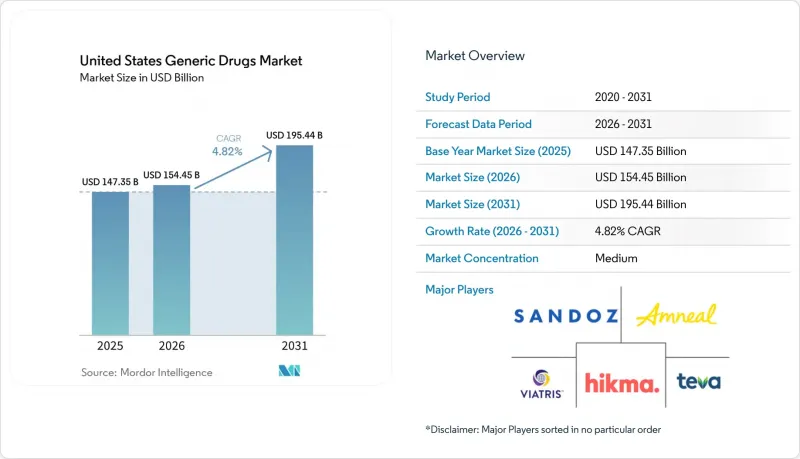
Mordor Intelligence에 의하면, 미국의 제네릭 의약품 시장 규모는 2025년에 1,473억 5,000만 달러로 평가되었습니다. 2026년에 1,544억 5,000만 달러에서 2031년까지 1,954억 4,000만 달러에 이를 것으로 예측되며, 2026-2031년 CAGR은 4.82%를 나타낼 전망입니다.
본 보고서는 브랜드 상태(무브랜드, 브랜드 제네릭), 분자 유형(저분자, 바이오시밀러), 치료 분야(순환기, 중추신경계, 내분비, 종양학, 호흡기, 항감염제, 기타), 투여 경로(경구, 주사, 외용, 흡입, 기타), 유통 채널(소매, 병원, 온라인, 전문 약국)에 따라 분류되어 있습니다. 예측치는 금액(달러) 기준으로 제시되어 있습니다.
미국의 제네릭 의약품 시장 동향 및 인사이트
심혈관·대사계 및 중추신경계(CNS) 브랜드에서 특허 만료의 물결 : 블록버스터 제품공급량이 급격히 증가
미국의 제네릭 의약품 시장의 단기 파이프라인은 심혈관 및 중추신경계 치료제 분야에서 새로운 특허 만료 물결에 힘입어 성장하고 있습니다. 이러한 분자들은 대규모 만성 질환 치료 분야에 속해 있기 때문에 독점권이 만료되면 제네릭 의약품의 진입으로 인해 단기간 내에 처방량이 매우 크게 변화할 가능성이 있습니다. 이러한 효과는 지불 기관의 규정이 이미 신속한 대체 처방을 권장하고 있거나, 처방자가 해당 치료제 군에 정통한 경우에 더욱 두드러집니다. 이러한 상황에서는 기한 내에 신청을 완료하고, 생산 할당량을 확보하며, 시장이 포화 상태에 이르기 전에 조기에 유통망을 구축할 수 있는 기업에게 신약 출시의 중요성이 더욱 커집니다. 또한, 이는 경구용 고형제 및 관련 공급망 전반의 설비 가동률을 뒷받침하는 요소로, 이 요인은 단일 제품 사건에 그치지 않는 광범위한 영향을 미칩니다. 미국의 제네릭 의약품 시장에서 이는 예측 기간 전반에 걸쳐 가장 뚜렷한 단기 판매량 증가의 원동력으로 작용할 것입니다.
순비용 절감을 위한 대체에 대한 지불자의 압력 : 자발적인 전환을 넘어선 의무화 강화
민간 보험사, 약국 급여 관리자 및 공공 프로그램은 사전 승인, 처방약 목록의 계층화, 단계별 편집 규칙을 통해 순비용 절감을 위한 대체 처방을 지속적으로 추진하고 있습니다. 이는 제네릭 의약품 및 바이오시밀러의 보급이 제품의 접근성뿐만 아니라 보험급여 제도의 설계에도 크게 좌우되게 되었기 때문에 중요한 의미를 지닙니다. 미국에서는 2026년 3월 기준으로 아달리무맙 바이오시밀러가 아달리무맙 시장 전체의 60%를 차지하고, 우스테키누맙 바이오시밀러도 27%의 점유율에 달해, 지불 주체의 의향이 일치할 경우 보급이 얼마나 빠르게 진행될 수 있는지를 보여주었습니다. 해당 보고서에 따르면, 종양학, 안과 및 페그필글라스팀 바이오시밀러는 면역학이나 인슐린 분야보다 빠르게 보급되고 있으며, 이는 임상적 대체제가 이미 수용된 분야에서 지불 주체의 경제적 이점이 가장 크다는 것을 의미합니다. 미국의 제네릭 의약품 시장에서 이러한 수요의 견인력 덕분에, 출시부터 실질적인 판매량 확보에 이르기까지의 기간이 단축됩니다. 또한, 현재의 사이클에서 상업 접근 팀이 규제 대응과 거의 동등한 중요성을 가질 수 있는 이유도 이를 통해 입증됩니다.
지속적인 다원적 공급에 따른 가격 침식 : 투자 수익률을 억제하는 구조적 이익 압박 요인
가격 하락은 미국의 제네릭 의약품 시장에서 여전히 가장 뿌리 깊은 구조적 제약 요인으로 남아 있습니다. 이는 성숙한 시장에서는 여러 경쟁사가 진입하면 가격 결정력이 급속히 약화되기 때문입니다. 그렇게 되면 판매량 증가가 매출 증가로 동일 비율로 이어지지 않는 경우가 많아, 출시 당시에는 매력적으로 보였던 신청 안건의 수익성이 떨어지게 됩니다. 이 문제는 대체가 용이하고 상업적 차별화가 제한적인 범용 경구용 고형 제형에서 가장 심각합니다. 산도자는 2025년 순매출을 78억 달러, 환율 변동 영향을 제외한 성장률을 2%로 보고했는데, 이는 가격 압박이 여전히 심한 상황에서도 대규모 판매량이 여전히 완만한 매출 성장세를 이끌어낼 수 있음을 보여줍니다. 이러한 환경은 기업들이 복잡한 제네릭 의약품이나 바이오시밀러로 눈을 돌리게 하지만, 모든 기업이 이러한 전환을 신속하게 추진할 수 있는 자본이나 기술 기반을 갖추고 있는 것은 아닙니다. 그 결과, 미국의 제네릭 의약품 시장에서는 제품 출시의 성공과 마찬가지로 경영의 규율이 중요시되고 있습니다.
부문별 분석
2025년, 미국의 제네릭 의약품 시장에서 무브랜드 제네릭의 점유율은 82.31%를 차지했으며, 이는 미국의 전체 조제 채널에 대체 규정이 얼마나 확고하게 정착되어 있는지를 보여줍니다. 지불자, 의료 제공업체, 약국은 이미 대규모의 저비용 대체품을 전제로 조직화되어 있기 때문에 이 부문은 계속해서 미국의 제네릭 의약품 시장의 기본적인 사업 핵심을 이루고 있습니다. 민간 건강보험과 정부 프로그램은 수십년동안 이러한 제품을 중심으로 처방 목록을 운영해 왔기 때문에 수요는 특정 치료 분야에 집중되지 않고 광범위한 분야에 걸쳐 있습니다. 따라서 새로운 경쟁사가 등장하여 분자 수준의 가격이 하락하더라도, 무브랜드 제품 포트폴리오는 시장을 안정시키는 역할을 합니다. 또한, 대형 제조업체들이 폭넓은 제품 포트폴리오를 단순한 대량 판매 사업이 아닌 방어적 자산으로 계속 취급하고 있는 이유도 바로 여기에 있습니다.
브랜드 제네릭 부문은 규모는 작지만, 2031년까지 연평균 성장률(CAGR) 5.38%를 나타낼 것으로 예측되며, 이 부문에서 가장 빠르게 성장하는 기회로 꼽히고 있습니다. 이러한 성장은 승인된 제네릭 의약품의 출시, 제형 재설계, 의료기기와 연동된 제형, 그리고 완전한 상품화를 지연시키는 기타 제품 변형들에 의해 뒷받침되고 있습니다. 실제로, 브랜드 제네릭은 경쟁이 제한적이고 유통 채널에서의 인지도가 높은 상황에서 시장에 진출할 경우, 단기간 내에 수익 기회를 창출할 수 있습니다. 여러 제조업체가 시장에 진입하여 가격이 재조정되면, 그 기간은 짧아지지만, 독점권 상실 일정에 맞추어 출시 시기를 조정할 수 있는 기업에게는 여전히 중요합니다. 따라서 미국의 제네릭 의약품 업계에서는 브랜드 제네릭을 영구적인 시장 점유율의 원천이라기보다는 기간 한정적인 수익 기회로 보고 있습니다. 미국의 제네릭 의약품 시장에서는 이로 인해 양극화된 구조가 형성되고 있습니다. 즉, 판매량은 무브랜드 제품에 집중되는 반면, 단기적인 수익 기회는 종종 브랜드 제품 형태에서 발생합니다.
2025년에는 저분자 제네릭 의약품이 시장의 85.24%를 차지했으며, 이는 정제, 캡슐제 및 기타 일반적인 제형이 오랫동안 시장을 주도해 왔음을 반영합니다. 이러한 점유율 덕분에 미국의 제네릭 의약품 시장은 만성 질환의 처방 패턴과 밀접하게 연계된, 대규모이자 견고한 판매량 기반을 갖추고 있습니다. 심혈관 대사, 중추신경계(CNS), 내분비, 항감염 치료 분야에서 많은 단기 신제품 출시가 여전히 이 시장 부문에서 이루어지고 있습니다. 또한, 이 부문은 확립된 제조 시스템, 약국의 폭넓은 재고 보유 경향, 그리고 경험이 풍부한 신청자들이 충분히 이해하고 있는 규제 절차 등의 이점도 누리고 있습니다. 그럼에도 불구하고, 이 분야는 신청이 집중되고 다양한 출처의 경쟁이 급속도로 격화되고 있는 상황에서 가장 큰 압박에 직면해 있습니다.
바이오시밀러는 2031년까지 연평균 성장률(CAGR) 7.52%를 나타낼 것으로 예측되며, 미국의 제네릭 의약품 시장에서 분자 유형별로는 가장 강력한 성장 동력이 될 전망입니다. 확대되고 있는 바이오시밀러의 기회는 이미 상용화 속도에서도 드러나고 있으며, 2026년 3월까지 20가지 분자 유형에 걸친 92개의 FDA 승인 바이오시밀러가 출시되었으며, 미국 내에서는 67건이 출시되었습니다. 삼성바이오에피스는 또한 2025년 말부터 2026년 초에 걸쳐 FDA가 발표한 지침안 및 개정안이 비교 유효성 요건과 미국 외 지역의 비교 대상 제품 사용에 대해 보다 유연한 입장을 보이고 있으며, 이로 인해 향후 프로그램의 개발 기간이 단축될 가능성이 있다고 지적했습니다. 그렇긴 하지만, 개발에는 여전히 막대한 비용이 소요되고 기술적인 선별 과정도 필요하기 때문에 모든 생물학적 제제의 독점권이 만료된다고 해서 즉시 바이오시밀러가 시장에 출시되는 것은 아닙니다. 미국의 제네릭 의약품 업계는 바이오시밀러 사용자 부담금 및 시장 출시 계획의 틀 속에서 여전히 중요한 실행상의 난관에 직면해 있습니다. 그럼에도 불구하고, 미국의 제네릭 의약품 시장은 저분자 의약품을 중심으로 한 시장에서 저분자 의약품과 바이오의약품이 공존하는 대체 시장으로 꾸준히 전환되고 있습니다.
기타 혜택 :
- 엑셀 형식 시장 예측(ME) 시트
- 3개월간의 애널리스트 지원
자주 묻는 질문
목차
제1장 서론
제2장 조사 방법
제3장 주요 요약
제4장 시장 구도
제5장 시장 규모 및 성장 예측
제6장 경쟁 구도
제7장 시장 기회 및 향후 전망
KTH 26.06.24According to Mordor Intelligence, the united states generic drugs market size is projected to be USD 147.35 billion in 2025, USD 154.45 billion in 2026, and reach USD 195.44 billion by 2031, growing at a CAGR of 4.82% from 2026 to 2031.
This report is Segmented by Brand Status (Unbranded, Branded Generics), Molecule Type (Small Molecule, Biosimilars), Therapeutic Area (Cardiovascular, CNS, Endocrine, Oncology, Respiratory, Anti-Infectives, Other), Route of Administration (Oral, Injectable, Topical, Inhalation, Other), and Distribution Channel (Retail, Hospital, Online, Specialty Pharmacy). Forecasts are Provided in Terms of Value (USD).
United States Generic Drugs Market Trends and Insights
Patent-Loss Wave in Cardiometabolic and CNS Brands: Blockbuster Volume Multiplies Rapidly
The near-term pipeline for the United States generic drugs market is being supported by a new cluster of patent-loss events in cardiometabolic and CNS therapies. These molecules sit inside large chronic treatment pools, so generic entry can shift very high prescription volumes in a short period once exclusivity ends. The effect is stronger when payer rules already favor rapid substitution and when prescribers are familiar with the underlying therapy class. This setup raises launch importance for companies that can file on time, secure manufacturing slots, and build early channel availability before markets become crowded. It also supports capacity utilization across oral solids and related supply networks, which makes this driver broader than a single product event. For the United States generic drugs market, this remains the clearest short-cycle volume trigger during the first half of the forecast period.
Payer Pressure for Low-Net-Cost Substitution: Mandates Intensify Beyond Voluntary Switching
Commercial insurers, pharmacy benefit managers, and public programs continue to push lower-net-cost substitution through prior authorization, formulary tiering, and step-edit rules. This matters because generic and biosimilar uptake now depends as much on reimbursement design as on product availability. In the United States, adalimumab biosimilars held 60% of the combined adalimumab market in March 2026, and ustekinumab biosimilars reached 27% share, showing how quickly uptake can move once payer alignment improves. The same reports also show that oncology, ophthalmology, and pegfilgrastim biosimilars have moved faster than immunology and insulin, which means payer economics are strongest where clinical substitution is already accepted. For the United States generic drugs market, this demand pull lowers the time between launch and meaningful volume capture. It also reinforces why commercial access teams matter almost as much as regulatory execution in the current cycle.
Persistent Multi-Source Price Erosion: A Structural Margin Drain That Suppresses Investment Return
Price erosion remains the most persistent structural restraint in the United States generic drugs market because mature molecules lose pricing power quickly after several competitors enter. Once that happens, volume growth often fails to translate into revenue growth at the same rate, which weakens returns on filings that looked attractive at launch. The problem is most severe in commodity oral solids, where substitution is easy and commercial differentiation is limited. Sandoz reported USD 7.8 billion in net sales for 2025 with 2% constant-currency growth, which illustrates how large volumes can still produce modest top-line momentum when price pressure remains intense. This environment pushes companies toward complex generics and biosimilars, but not every firm has the capital or technical base to make that transition at speed. The result is a United States generic drugs market in which operating discipline matters as much as launch success.
Other drivers and restraints analyzed in the detailed report include:
- Faster ANDA Review under GDUFA III: First-Cycle Rates Signal a Persistent Gap
- Expansion of Complex Injectables and Device-Linked Generics: Margin Recovery Vehicle for Generic Manufacturers
- PBM Specialty-Generic Markups Distorting Uptake: A Market Efficiency Failure with Policy Implications
For complete list of drivers and restraints, kindly check the Table Of Contents.
Segment Analysis
Unbranded generics held 82.31% of the United States generic drugs market share in 2025, which shows how firmly substitution rules are embedded across U.S. dispensing channels. This segment remains the basic operating core of the United States generic drugs market because payers, providers, and pharmacies are already organized around lower-cost substitution at scale. Commercial health plans and government programs have built decades of formulary behavior around these products, so demand is broad rather than concentrated in a few therapeutic classes. That gives unbranded portfolios a stabilizing role even when molecule-level pricing weakens after new competition arrives. It also explains why large manufacturers continue to treat broad portfolio coverage as a defensive asset rather than just a volume business.
The branded generic segment is smaller, but it is forecast to grow at 5.38% CAGR through 2031, which makes it the faster-moving opportunity in this split. Growth is being supported by authorized generic launches, reformulations, device-linked presentations, and other product variations that delay full commoditization. In practice, branded generics can create a short earnings window when a product enters the market with limited competition and stronger channel recognition. That window narrows once multiple producers enter and pricing resets, but it still matters for firms that can sequence launches around the loss-of-exclusivity calendar. The United States generic drugs industry is therefore treating branded generics less as a permanent share pool and more as a timed profitability event. Within the United States generic drugs market, this creates a two-speed structure in which volume sits with unbranded products while near-term margin opportunities often emerge in branded formats.
Small molecule generics accounted for 85.24% of the market in 2025, which reflects the long-standing dominance of tablets, capsules, and other familiar prescription formats. This share gives the United States generic drugs market a large and resilient volume base that is closely tied to chronic-disease prescribing patterns. Many near-term launches in cardiometabolic, CNS, endocrine, and anti-infective therapy still flow through this part of the market. The segment also benefits from established manufacturing systems, broad pharmacy stocking behavior, and a regulatory pathway that is well understood by experienced filers. Even so, the category faces its heaviest pressure in molecules that attract dense filing activity and rapid multi-source competition.
Biosimilars are projected to grow at 7.52% CAGR through 2031, making them the strongest growth engine by molecule type in the United States generic drugs market. The expanding biosimilar opportunity is already visible in the commercialization pace, with 92 FDA-cleared biosimilars across 20 molecules and 67 U.S. launches by March 2026. Samsung Bioepis also noted that the FDA's draft and revised guidance in late 2025 and early 2026 signaled greater flexibility around comparative efficacy expectations and non-U.S. comparator use, which could shorten development timelines for future programs. That does not mean every biologic loss-of-exclusivity event will have an immediate biosimilar response, because development remains expensive and technically selective. The United States generic drugs industry still faces a meaningful execution threshold under the biosimilar user fee and launch planning framework. Even so, the United States generic drugs market is steadily shifting from a small-molecule story toward a mixed small-molecule and biologics substitution story.
List of Companies Covered in this Report:
- Accord Healthcare, Inc.
- Alvogen, Inc.
- Amneal Pharmaceuticals
- ANI Pharmaceuticals
- Apotex
- Aurobindo Pharma
- Cipla
- Dr. Reddy's Laboratories
- Fresenius
- Glenmark Pharmaceuticals
- Hikma Pharmaceuticals
- Lupin
- Par Pharmaceutical, an Endo company
- Pfizer Inc. (Hospira sterile injectables)
- Sandoz Group AG
- Sun Pharmaceuticals Industries
- Teva Pharmaceutical Industries
- Torrent Pharmaceuticals Limited
- Viatris
- Zydus Lifesciences Limited
Additional Benefits:
- The market estimate (ME) sheet in Excel format
- 3 months of analyst support
TABLE OF CONTENTS
1 Introduction
- 1.1 Study Assumptions & Market Definition
- 1.2 Scope of the Study
2 Research Methodology
3 Executive Summary
4 Market Landscape
- 4.1 Market Overview
- 4.2 Market Drivers
- 4.2.1 Patent-Loss Wave in Cardiometabolic and CNS Brands
- 4.2.2 Payer Pressure for Low-Net-Cost Substitution
- 4.2.3 Faster ANDA Review Under GDUFA III
- 4.2.4 Expansion of Complex Injectables and Device-Linked Generics
- 4.2.5 Model-Integrated Evidence in Bioequivalence Packages
- 4.2.6 U.S.-Manufacturing Prioritization for Domestic Supply
- 4.3 Market Restraints
- 4.3.1 Persistent Multi-Source Price Erosion
- 4.3.2 Nitrosamine Testing and Reformulation Burden
- 4.3.3 PBM Specialty-Generic Markups Distorting Uptake
- 4.3.4 Retail Pharmacy Closures Reducing Substitution Throughput
- 4.4 Value Chain Analysis
- 4.5 Regulatory Landscape
- 4.6 Technological Outlook
- 4.7 Porter's Five Forces Analysis
- 4.7.1 Threat of New Entrants
- 4.7.2 Bargaining Power of Buyers
- 4.7.3 Bargaining Power of Suppliers
- 4.7.4 Threat of Substitutes
- 4.7.5 Competitive Rivalry
5 Market Size & Growth Forecasts (Value, USD)
- 5.1 By Brand Status
- 5.1.1 Unbranded Generics
- 5.1.2 Branded Generics
- 5.2 By Molecule Type
- 5.2.1 Small Molecule Generics
- 5.2.2 Biosimilars
- 5.3 By Therapeutic Area
- 5.3.1 Cardiovascular
- 5.3.2 Central Nervous System
- 5.3.3 Endocrine and Metabolic
- 5.3.4 Oncology
- 5.3.5 Respiratory
- 5.3.6 Anti-infectives
- 5.3.7 Other Therapeutic Areas
- 5.4 By Route of Administration
- 5.4.1 Oral
- 5.4.2 Injectable
- 5.4.3 Topical and Dermal
- 5.4.4 Inhalation
- 5.4.5 Other Routes of Administration
- 5.5 By Distribution Channel
- 5.5.1 Retail Pharmacies
- 5.5.2 Hospital Pharmacies
- 5.5.3 Online Pharmacies
- 5.5.4 Specialty Pharmacies
6 Competitive Landscape
- 6.1 Market Concentration
- 6.2 Market Share Analysis
- 6.3 Company Profiles (includes Global level Overview, Market level overview, Core Segments, Financials as available, Strategic Information, Market Rank/Share for key companies, Products & Services, and Recent Developments)
- 6.3.1 Accord Healthcare, Inc.
- 6.3.2 Alvogen, Inc.
- 6.3.3 Amneal Pharmaceuticals, Inc.
- 6.3.4 ANI Pharmaceuticals, Inc.
- 6.3.5 Apotex Inc.
- 6.3.6 Aurobindo Pharma Limited
- 6.3.7 Cipla Limited
- 6.3.8 Dr. Reddy's Laboratories Limited
- 6.3.9 Fresenius Kabi AG
- 6.3.10 Glenmark Pharmaceuticals Limited
- 6.3.11 Hikma Pharmaceuticals PLC
- 6.3.12 Lupin Limited
- 6.3.13 Par Pharmaceutical, an Endo company
- 6.3.14 Pfizer Inc. (Hospira sterile injectables)
- 6.3.15 Sandoz Group AG
- 6.3.16 Sun Pharmaceutical Industries Limited
- 6.3.17 Teva Pharmaceutical Industries Ltd.
- 6.3.18 Torrent Pharmaceuticals Limited
- 6.3.19 Viatris Inc.
- 6.3.20 Zydus Lifesciences Limited
7 Market Opportunities & Future Outlook
- 7.1 White-space & Unmet-need Assessment