|
시장보고서
상품코드
2065428
GPU 및 AI 가속기용 실리콘 관통 전극(TSV) : 시장 점유율 분석, 산업 동향 및 통계 데이터, 성장 예측(2026-2031년)Through-Silicon Via (TSV) For GPU And AI Accelerators - Market Share Analysis, Industry Trends & Statistics, Growth Forecasts (2026 - 2031) |
||||||
 Mordor Intelligence
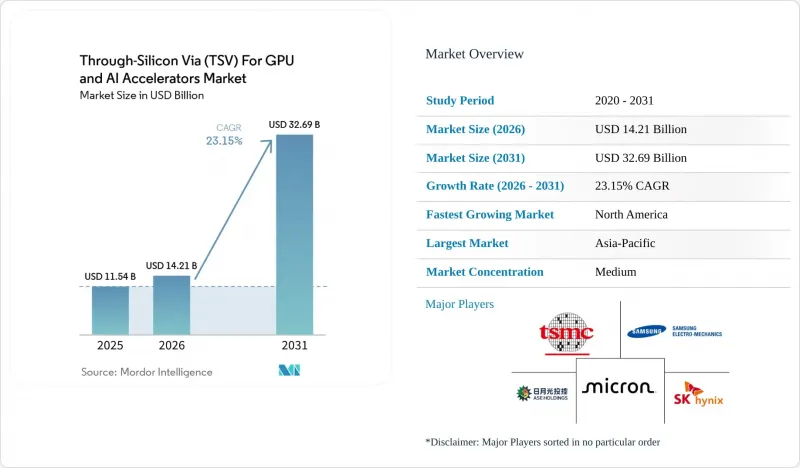
Mordor Intelligence에 의하면, GPU 및 AI 가속기용 실리콘 관통 전극(TSV) 시장 규모는 2025년에 115억 4,000만 달러로 평가되었습니다. 2026년 142억 1,000만 달러에서 2031년까지 326억 9,000만 달러에 이를 것으로 예상되며, 예측 기간(2026-2031년) CAGR은 23.15%를 나타낼 전망입니다.
본 보고서는 아키텍처(2.5D TSV(인터포저 방식), 3D TSV(다이 스태킹 방식)), 용도(HBM 메모리 스택, GPU 로직·메모리 통합, AI 가속기/HPC용 GPU, 치플렛 기반 GPU 아키텍처), 지역(북미, 유럽, 아시아태평양, 남미, 중동 및 아프리카)별로 분류되어 있습니다. 시장 전망은 금액(달러) 기준으로 제시되어 있습니다.
세계의 GPU 및 AI 가속기용 실리콘 관통 전극(TSV) 시장 동향 및 인사이트
AI GPU에서 HBM3 및 그 이후 세대의 주류화
HBM3E 및 HBM4를 통해 TSV 밀도 목표가 패키지당 10만 비아 이상으로 상향 조정되었으며, 이에 따라 패키징의 비용 구조와 공정 범위가 재정의되고 있습니다. SK하이닉스는 2 Tbit/s를 초과하는 대역폭을 구현한 12층 HBM4 샘플을 검증했으며, 2025년 하반기에 양산을 시작했습니다. 2026년에 발표된 NVIDIA의 Rubin GPU는 288 GB의 HBM4를 탑재하고 있으며, 16층 스택 구조를 채택하고 있습니다. 이는 Samsung Electronics가 기존의 8층 HBM2와 동등한 720µm프로파일을 유지하는 12층 3D-TSV 패키지를 시연함에 따라, 기존 서버의 Z축 높이 제한 범위 내에 들어갈 수 있게 되었기 때문입니다. 각 메모리 제조업체들은 현재 베이스 다이의 로직 공정을 최첨단 로직 파운드리 업체에 외주하고 있으며, 이로 인해 TSV 정렬 허용 오차 및 구리-구리 본딩 요건이 더욱 엄격해지고 있습니다. 각 공급업체들이 신뢰성이 높은 고종횡비 비아를 제공하기 위해 경쟁하는 가운데, 이러한 변화로 인해 GPU 및 AI 가속기용 실리콘 관통 전극(TSV) 시장은 급속히 확대되고 있습니다.
고급 인터포저가 필요한 치플렛 기반 GPU 설계의 확대
모놀리식 GPU를 치플릿으로 분해함으로써 다이 수율이 향상되고, 제품 혁신이 가속화됩니다. AMD의 MI300A는 5nm 연산 타일, 6nm I/O 타일 및 HBM3를 단일 CoWoS-S 인터포저에 통합하여 5TB/s를 초과하는 메모리 대역폭을 실현하고 있습니다. 인텔은 ‘Foveros Direct’를 통해 10µm 미만의 하이브리드 본딩 피치를 실현함으로써, 전압 조정기와 로직 층의 수직 적층을 가능하게 했습니다. 삼성이 공동 주도하는 ‘Universal Chiplet Interconnect Express’ 규격에서는 2024년에 개방형 다이 간 PHY가 공개되면서, 인터포저에 대한 접근이 더욱 비독점화되었습니다. 이러한 발전으로 인해 대형 실리콘 인터포저에 대한 수요가 확대되면서, GPU 및 AI 가속기용 실리콘 관통 전극(TSV) 시장이 활성화되고 있습니다.
고밀도 TSV 제조 시 수율 문제
TSV의 종횡비는 현재 10 : 1을 초과하고, 직경은 5µm 미만으로, 에칭, 충전 및 노출 공정에 큰 부담이 가해지고 있습니다. IEEE의 조사에 따르면, TSV로 인한 응력이 트랜지스터의 임계값에 변화를 일으켜, 실리콘 면적을 줄이기 위해 키프아웃 존을 사용해야만 하는 상황이 발생하고 있습니다. Chipmetrics사의 인라인 보이드 감지 기술을 통해, 열 사이클 후 구리 보이드로 인해 발생할 수 있는 잠재적 결함이 확인되었습니다. 애플라이드 머티리얼즈는 구리를 손상시키지 않고 유전체 잔류물을 제거하여 단기 수율을 향상시키는 플라즈마 습식 TSV 노출 모듈을 발표했습니다. 이러한 대책이 본격화되기 전까지는 GPU 및 AI 가속기용 실리콘 관통 전극(TSV)의 생산량이 여전히 결함 밀도에 의해 제약을 받는 상황이 지속될 것입니다.
부문별 분석
2.5D TSV 인터포저 부문은 성숙한 설계 규칙과 확립된 기판 생태계의 뒷받침을 받아, 2025년 GPU 및 AI 가속기용 실리콘 관통 전극(TSV) 시장 점유율의 68%를 차지했습니다. TSMC의 CoWoS-S는 2,700 mm²에 육박하는 인터포저를 지원하며, 하나의 기판 위에 여러 개의 GPU 칩렛과 8개 이상의 HBM 큐브를 탑재할 수 있습니다. 삼성의 ‘I-CubeE’는 실리콘 브리지와 팬아웃 재배선 층을 결합함으로써 대면적 인터포저의 비용을 절감하고 있습니다. 이러한 검증된 기법을 통해 높은 테이프아웃 속도와 예측 가능한 수율이 확보됨에 따라, 예측 기간 초반에는 GPU 및 AI 가속기용 실리콘 관통 전극(TSV) 시장에서 해당 부문의 규모가 유지될 것으로 전망됩니다.
3D 다이 스태킹은 2025년 시장 규모의 불과 32%에 불과했지만, 하이브리드 구리 본딩을 통해 4µm 미만의 수직 피치가 가능해짐에 따라 연평균 성장률(CAGR) 23.56%로 성장하고 있습니다. 인텔의 ‘Foveros Direct’와 삼성의 ‘X-Cube’는 미세 피치의 구리-구리 접합을 목표로 하고 있으며, 이를 통해 비아의 기생 성분을 줄이고 로직 간 경로를 단축합니다. TSMC의 SoIC는 1µm 미만의 피치를 구현할 것으로 예상되며, 향후 GPU의 SRAM-on-logic 스택에 유용할 것입니다. 장비의 수율이 향상됨에 따라, 3D 기술은 초광대역 메모리 패브릭과 연계되어 GPU 및 AI 가속기용 실리콘 관통 전극(TSV) 시장 점유율을 점차 확대해 나갈 것으로 예측됩니다.
지역별 분석
2025년, 아시아태평양은 GPU 및 AI 가속기용 실리콘 관통 전극(TSV) 시장에서 매출 점유율 62%를 차지하며 시장을 주도했습니다. 이는 대만과 한국에서 TSMC, 삼성, SK하이닉스의 클러스터 제조, 첨단 패키징 및 HBM 생산이 주도한 결과입니다. 일본에 위치한 TSMC의 구마모토 R&D 센터는 기판 및 소재 파트너사와 동일한 거점에 집약되어 있어, CoWoS 로드맵 업데이트를 위한 공급 주기를 단축하고 있습니다. 도쿄 일렉트론은 본딩 장비 도입을 가속화하고 지역 생태계를 강화하기 위해 2025년 연구개발비를 2,500억 엔(16억 1,000만 달러)으로 확대했습니다. 수출 규제로 인한 역풍으로 인해, 중국이 첨단 리소그래피 기술을 확보하는 능력은 제한받고 있으며, 국내 TSV 생산 능력도 제약을 받고 있어 GPU 및 AI 가속기용 실리콘 관통 전극(TSV) 시장에서 중국의 점유율도 제한적입니다.
북미의 예상 연평균 성장률(CAGR)은 24.15%이며, 이는 하이퍼스케일러 수요와 정부 보조금에 힘입어 견인되고 있습니다. TSMC의 애리조나주 멀티팹 캠퍼스에서는 미국산 GPU 고객을 위해 CoWoS 라인을 확보하고 있는 반면, 암콜의 피오리아 공장은 미국 내 OSAT(위탁 반도체 제조) 대안을 제시하고 있습니다. 인텔은 ‘CHIPS’법의 지원을 받아 오하이오주와 애리조나주에서 사업 확장을 추진하고 있으며, 자사용 및 일반용 3D 패키징 생산량 증가가 예상됩니다. 미국 내 데이터센터 인프라에 대한 투자가 증가하고 있으며, AI 가속기가 가장 빠르게 성장하는 지출 부문으로 부상함에 따라 국내 수요는 더욱 확대되고 있습니다.
유럽은 430억 유로(약 464억 4,000만 달러) 규모의 EU 칩 법 기금 덕분에, 규모는 작지만 시장 점유율을 확대되고 있습니다. 이 기금은 웨이퍼 레벨 본딩 및 RDL 인터포저의 시범 생산 라인에 자금을 지원하고 있습니다. ST마이크로일렉트로닉스, 전 세계 파운드리 업체들, IMEC은 이종 통합 테스트 라인에서 협력하고 있지만, 현지에서 HBM을 공급받을 수 없기 때문에 유럽의 GPU 설계자들은 여전히 아시아의 메모리 공급업체에 의존할 수밖에 없는 상황이 계속되고 있습니다. 남미, 중동 및 아프리카는 여전히 미미한 존재에 그치고 있으며, TSV(관통 전극) 생산 능력을 갖추지 못한 기존의 백엔드 공정만을 보유하고 있습니다.
기타 혜택 :
- 엑셀 형식 시장 예측(ME) 시트
- 3개월간의 애널리스트 지원
자주 묻는 질문
목차
제1장 서론
제2장 분석 방법
제3장 주요 요약
제4장 시장 구도
제5장 시장 규모 및 성장률 예측
제6장 경쟁 구도
제7장 시장 기회 및 향후 전망
KTH 26.06.29According to Mordor Intelligence, the through-Silicon via for GPU and AI accelerators market size was valued at USD 11.54 billion in 2025 and estimated to grow from USD 14.21 billion in 2026 to reach USD 32.69 billion by 2031, at a CAGR of 23.15% during the forecast period (2026-2031).
This report is Segmented by Architecture (2. 5D TSV Interposer-Based, and 3D TSV Die Stacking), Application (HBM Memory Stacks, GPU Logic-Memory Integration, AI Accelerators and HPC GPUs, and Chiplet-Based GPU Architectures), and Geography (North America, Europe, Asia-Pacific, South America, and Middle East and Africa). The Market Forecasts are Provided in Terms of Value (USD).
Global Through-Silicon Via (TSV) For GPU And AI Accelerators Market Trends and Insights
Mainstream Adoption of HBM3 and Beyond in AI GPUs
HBM3E and HBM4 are lifting TSV density targets above 100,000 vias per package, which redefines packaging cost structures and process windows. SK hynix validated 12-layer HBM4 samples exceeding 2 Tbit-s bandwidth and plans mass production in late 2025. NVIDIA's Rubin GPU, disclosed in 2026, integrates 288 GB of HBM4 and relies on 16-layer stacks that still fit existing server z-height limits because Samsung demonstrated a 12-layer 3D-TSV package that maintains the 720 µm profile of legacy 8-layer HBM2. Memory vendors are now outsourcing base-die logic to leading-edge logic foundries, increasing TSV alignment tolerances and copper-to-copper bonding requirements. These changes are rapidly scaling the Through-Silicon Via market for GPU and AI accelerators as suppliers race to deliver reliable, high-aspect-ratio vias.
Growth of Chiplet-Based GPU Designs Requiring Advanced Interposers
Disaggregating monolithic GPUs into chiplets improves die yield and speeds product refreshes. AMD's MI300A combines 5 nm compute tiles, 6 nm IO tiles, and HBM3 on a single CoWoS-S interposer and delivers over 5 TB-s memory bandwidth. Intel pushed sub-10 µm hybrid-bond pitch with Foveros Direct, enabling vertically stacked voltage regulators and logic layers. The Universal Chiplet Interconnect Express standard, co-led by Samsung, published an open die-to-die PHY in 2024, making interposer access less proprietary. These advances expand demand for large silicon interposers, boosting the Through-Silicon Via market for GPU and AI accelerators.
Yield Challenges in High-Density TSV Fabrication
TSV aspect ratios now exceed 10:1 with diameters below 5 µm, stressing etch, fill, and reveal steps. IEEE research showed that TSV-induced stress shifts transistor thresholds, forcing the use of keep-out zones that erode silicon area. Chipmetrics' inline void detection identified latent failures caused by copper voiding after thermal cycling. Applied Materials released a plasma-wet TSV reveal module that strips dielectric residue without copper damage to raise near-term yields. Until such fixes mature, production output for Through-Silicon Via for GPU and AI accelerators market devices remains gated by defect density.
Other drivers and restraints analyzed in the detailed report include:
- Increasing Capital Investments in 2.5D and 3D Packaging Facilities
- Government Incentives for Domestic Semiconductor Supply Chains
- Thermal Management Limitations in Stacked GPU Modules
For complete list of drivers and restraints, kindly check the Table Of Contents.
Segment Analysis
The 2.5D TSV interposer segment held 68% of the Through-Silicon Via market share for GPU and AI accelerators in 2025, driven by mature design rules and established substrate ecosystems. TSMC's CoWoS-S supports interposers approaching 2,700 mm2, accommodating multiple GPU chiplets and eight or more HBM cubes on one substrate. Samsung's I-CubeE blends silicon bridges with fan-out redistribution layers to lower the cost for large-area interposers. These proven routes ensure high tape-out velocity and predictable yield, sustaining the segment's scale in the Through-Silicon Via market for GPU and AI accelerators during the early forecast years.
3D die-stacking, though only 32% of the 2025 value, is growing at 23.56% CAGR as hybrid copper bonding enables sub-4 µm vertical pitch. Intel's Foveros Direct and Samsung's X-Cube target fine-pitch copper-to-copper joints that trim via parasitics and shorten interlogic paths. TSMC's SoIC promises sub-1 µm pitch, useful for SRAM-on-logic stacks in future GPUs. As equipment yields improve, the 3D route is expected to capture incremental Through-Silicon Via market share for the GPU and AI accelerator market, tied to ultrahigh-bandwidth memory fabrics.
Geography Analysis
Asia-Pacific dominated the Through-Silicon Via for GPU and AI accelerators market in 2025 with a 62% revenue share, driven by TSMC, Samsung, and SK Hynix's cluster fabrication, advanced packaging, and HBM output in Taiwan and South Korea. TSMC's Kumamoto R&D center in Japan co-locates substrate and materials partners, tightening supply cycles for CoWoS roadmap updates. Tokyo Electron scaled 2025 R&D spend to JPY 250.0 billion (USD 1.61 billion) to accelerate the release of bonding equipment and reinforce the regional ecosystem. Export-control headwinds limit China's ability to secure advanced lithography, constraining domestic TSV capacity and limiting its local share of the Through-Silicon Via market for GPU and AI accelerators.
North America's forecast CAGR of 24.15% is driven by hyperscaler demand and government subsidies. TSMC's multi-fab Arizona campus reserves CoWoS lines for U.S. GPU customers, while Amkor's Peoria plant brings an OSAT alternative onshore. Intel's CHIPS-backed Ohio and Arizona expansions promise captive and merchant 3D packaging volumes. The increasing investments in U.S. data-center infrastructure, with AI accelerators emerging as the fastest-growing spend category, are further amplifying domestic demand.
Europe captures a modest but rising share thanks to the EUR 43 billion (approximately USD 46.44 billion) EU Chips Act pool, which finances pilot lines for wafer-level bonding and RDL interposers. STMicroelectronics, GlobalFoundries, and IMEC collaborate on heterogeneous integration test lines, but the absence of a local HBM supply continues to push European GPU designers to Asian memory vendors. South Am, the Middle East End Africa remain marginal, hosting only legacy back-end operations without TSV capacity.
- Taiwan Semiconductor Manufacturing Company Limited (TSMC)
- Samsung Electronics Co., Ltd.
- Micron Technology, Inc.
- SK hynix Inc.
- ASE Technology Holding Co., Ltd.
- Intel Corporation
- Amkor Technology, Inc.
- JCET Group Co., Ltd.
- Powertech Technology Inc.
- Siliconware Precision Industries Co., Ltd.
- United Microelectronics Corporation
- GLOBALFOUNDRIES Inc.
- Broadcom, Inc.
- Cadence Design Systems, Inc.
- Synopsys, Inc.
- Lam Research Corporation
- Applied Materials, Inc.
- Tokyo Electron Limited
- Onto Innovation Inc.
- EVG (EV Group)
Additional Benefits:
- The market estimate (ME) sheet in Excel format
- 3 months of analyst support
TABLE OF CONTENTS
1 INTRODUCTION
- 1.1 Study Assumptions and Market Definition
- 1.2 Scope of the Study
2 RESEARCH METHODOLOGY
3 EXECUTIVE SUMMARY
4 MARKET LANDSCAPE
- 4.1 Market Overview
- 4.2 Market Drivers
- 4.2.1 Mainstream Adoption of HBM3 and Beyond in AI GPUs
- 4.2.2 Growth of Chiplet-Based GPU Designs Requiring Advanced Interposers
- 4.2.3 Increasing Capital Investments in 2.5D/3D Packaging Facilities
- 4.2.4 Government Incentives for Domestic Semiconductor Supply Chains
- 4.2.5 Emerging Hybrid Bonding TSV Techniques for Performance Boost
- 4.2.6 Rising Demand for Energy-Efficient Data Center Accelerators
- 4.3 Market Restraints
- 4.3.1 Yield Challenges in High-Density TSV Fabrication
- 4.3.2 Thermal Management Limitations in Stacked GPU Modules
- 4.3.3 Supply Chain Vulnerabilities to Specialty TSV Equipment
- 4.3.4 Availability of Alternative Advanced Packaging
- 4.4 Impact of Macroeconomic Factors on the Market
- 4.5 Industry Value Chain Analysis
- 4.6 Regulatory Landscape
- 4.7 Technological Outlook
- 4.8 Porter's Five Forces Analysis
- 4.8.1 Bargaining Power of Suppliers
- 4.8.2 Bargaining Power of Buyers
- 4.8.3 Threat of New Entrants
- 4.8.4 Threat of Substitutes
- 4.8.5 Intensity of Competitive Rivalry
5 MARKET SIZE AND GROWTH FORECASTS (VALUE)
- 5.1 By Architecture
- 5.1.1 2.5D TSV (Interposer-based)
- 5.1.2 3D TSV (Die stacking)
- 5.2 By Application
- 5.2.1 HBM Memory Stacks
- 5.2.2 GPU Logic-Memory Integration
- 5.2.3 AI Accelerators / HPC GPUs
- 5.2.4 Chiplet-based GPU Architectures
- 5.3 By Geography
- 5.3.1 North America
- 5.3.1.1 United States
- 5.3.1.2 Canada
- 5.3.1.3 Mexico
- 5.3.2 Europe
- 5.3.2.1 United Kingdom
- 5.3.2.2 Germany
- 5.3.2.3 France
- 5.3.2.4 Rest of Europe
- 5.3.3 Asia-Pacific
- 5.3.3.1 China
- 5.3.3.2 Japan
- 5.3.3.3 India
- 5.3.3.4 South Korea
- 5.3.3.5 Rest of Asia-Pacific
- 5.3.4 South America
- 5.3.5 Middle East and Africa
- 5.3.1 North America
6 COMPETITIVE LANDSCAPE
- 6.1 Market Concentration
- 6.2 Strategic Moves
- 6.3 Market Share Analysis
- 6.4 Company Profiles (includes Global Level Overview, Market Level Overview, Core Segments, Financials as available, Strategic Information, Market Rank/Share, Products and Services, Recent Developments)
- 6.4.1 Taiwan Semiconductor Manufacturing Company Limited (TSMC)
- 6.4.2 Samsung Electronics Co., Ltd.
- 6.4.3 Micron Technology, Inc.
- 6.4.4 SK hynix Inc.
- 6.4.5 ASE Technology Holding Co., Ltd.
- 6.4.6 Intel Corporation
- 6.4.7 Amkor Technology, Inc.
- 6.4.8 JCET Group Co., Ltd.
- 6.4.9 Powertech Technology Inc.
- 6.4.10 Siliconware Precision Industries Co., Ltd.
- 6.4.11 United Microelectronics Corporation
- 6.4.12 GLOBALFOUNDRIES Inc.
- 6.4.13 Broadcom, Inc.
- 6.4.14 Cadence Design Systems, Inc.
- 6.4.15 Synopsys, Inc.
- 6.4.16 Lam Research Corporation
- 6.4.17 Applied Materials, Inc.
- 6.4.18 Tokyo Electron Limited
- 6.4.19 Onto Innovation Inc.
- 6.4.20 EVG (EV Group)
7 MARKET OPPORTUNITIES AND FUTURE OUTLOOK
- 7.1 White-Space and Unmet-Need Assessment