

|
시장보고서
상품코드
2065450
병원 운영 분야 인공지능 시장 : 시장 점유율 분석, 업계 동향 및 통계, 성장 예측(2026-2031년)Artificial Intelligence In Hospital Operations - Market Share Analysis, Industry Trends & Statistics, Growth Forecasts (2026 - 2031) |
||||||
 Mordor Intelligence
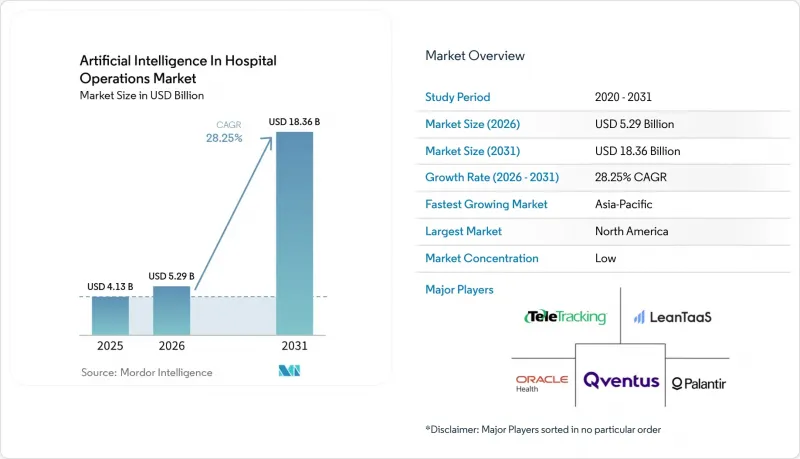
병원 운영 분야 인공지능(AI) 시장 규모는 2025년에 41억 3,000만 달러로 평가되었고, 2026년에 52억 9,000만 달러로 추정되고, 2031년까지 183억 6,000만 달러에 이를 것으로 예측됩니다.
2026-2031년 연평균 성장률(CAGR) 28.25%로 성장할 것으로 전망됩니다.
본 보고서는 제공 형태별(소프트웨어, 서비스, 하드웨어), 이용 사례별(환자 흐름, 인력 관리, 수익 주기, 커맨드 센터, 수술 전후 관리, 자산·병실 운영), 기술별(머신러닝, 자연어 처리, 생성형 AI, 컴퓨터 비전, 규칙 기반 최적화), 도입 형태별(클라우드, 온프레미스, 하이브리드), 지역별(북미, 유럽, 기타)로 분류되어 있습니다. 시장 예상치는 금액(달러)으로 표시되어 있습니다.
세계의 병원 운영 분야 인공지능(AI) 시장 동향 및 인사이트
인력 부족과 업무 부담이 자동화를 촉진하고 있습니다.
병원 운영 분야 인공지능 시장은 만성적인 인력 부족을 배경으로 지지를 넓혀가고 있습니다. 이러한 상황에 따라 병원에서는 인력 배치, 일정 관리, 일상적인 사무 업무의 자동화를 추진하고 있으며, 환자 안전과 노동 환경의 안정성이라는 명확한 성과가 기대되고 있습니다. 듀크 헬스(Duke Health)는 GE 헬스케어의 커맨드 센터형 인력 배치 도구를 활용하여 최대 14일 후의 인력 수요 예측에서 95%의 정확도를 달성하는 동시에, 임시 인력 활용을 50% 줄였습니다. 이를 통해 물리적 공간을 확장하지 않고도 연간 500명의 환자를 수용할 수 있는 여력을 확보했습니다. 이로 인해 의료 제공업체들이 업무용 AI를 평가하는 방식이 바뀌었습니다. 왜냐하면, 도구는 더 이상 처리 능력뿐만 아니라 인재의 이직률, 초과근무, 업무 부담의 균형과 같은 관점에서도 평가받게 되었기 때문입니다. 『Systems』 저널의 2025년 연구에 따르면, 참여형 거버넌스 모델 내에서 사용된 AI 기반 근무표 작성 시스템 덕분에 간호사의 이직 압박과 근무 배정 관련 갈등이 완화된 것으로 밝혀졌습니다. 이는 알고리즘의 품질과 마찬가지로 도입의 질도 중요하다는 견해를 뒷받침하는 것입니다. 그 결과, ‘병원 운영에 활용되는 인공지능’ 시장에 진출하는 병원들은 거버넌스 체계의 구축 현황, 업무 흐름의 재설계, 그리고 직원의 수용도를 조달 과정의 핵심 기준으로 삼고 있습니다.
환자 흐름, 병상 회전율, 응급실 처리 능력을 개선해야 하는 압박
'병원 운영에서의 인공지능' 시장은 환자 흐름 악화에 따른 비용 증가에 힘입어 성장하고 있습니다. 이는 응급실, 입원 병동, 그리고 퇴원 팀이 모두 병목 현상을 조기에 파악하는 데 달려 있기 때문입니다. 2025년 『JMIR Medical Informatics』지에 게재된 연구에 따르면, 머신러닝 모델은 평균 절대 오차를 불과 2.45로 억제하면서 응급실 대기 환자 수를 예측할 수 있는 것으로 나타났습니다. 이를 통해 병원은 혼잡이 심화되기 전에 인력 배치와 병상 배정을 조정할 수 있는 시간을 더 많이 확보할 수 있게 됩니다. 2025년 파리에서 개최된 IEOM Society 회의에서 발표된 디지털 트윈 관련 연구에 따르면, 부서별로 분절되어 있던 병상 관리를 자원 통합 전략으로 대체한 결과, 필요한 총 병상 수가 53.7% 감소하고 환자의 대기 시간이 63.9% 단축된 것으로 보고되었습니다. 이러한 결과는 병원이 더 이상 AI를 단순한 일정 조정에만 활용하는 것이 아니라, 조직 전체 차원에서 병상, 직원, 환자의 이동이 어떻게 조정되는지를 재설계하는 데 활용하고 있음을 보여주며, 이는 매우 중요합니다. 가동률이 높은 시스템의 경우, 다음 병목 현상은 계획의 미비점이 아니라 병상 부족인 경우가 많기 때문에 공급업체들은 입원 일수를 단축하고 퇴원 결정을 신속하게 내릴 수 있는 도구로 초점을 옮겨가고 있습니다.
도입 및 유지 비용의 높음
병원 운영 분야 인공지능(AI) 시장은 여전히 큰 도입 장벽에 직면해 있습니다. 그 이유는 병원이 소프트웨어, 시스템 통합, 데이터 준비, 교육 및 워크플로우 재설계에 자금을 투자하지 않으면 대규모의 이점을 얻을 수 없기 때문입니다. 『Journal of Medical Artificial Intelligence』 저널의 2025년 연구에 따르면, 병원에 AI를 도입할 경우 순가치가 플러스로 전환되기까지 4-5년 동안 순가치가 마이너스 상태를 유지하는 것으로 밝혀졌으며, 이는 이미 재정적 압박에 직면해 있는 의료기관의 의사결정을 더욱 어렵게 만드는 요인이 되고 있습니다. 2025년 『Journal of Medical Artificial Intelligence』지에 발표된 43개의 의료 시스템을 대상으로 한 조사에 따르면, 응답자의 47%가 AI 도구 개발 또는 도입에 있어 상위 두 가지 장벽 중 하나로 재정적 우려를 꼽았으며, 이는 77%를 차지한 ‘도구의 성숙도’에 이어 두 번째로 높은 비율을 기록했습니다. 이러한 상황으로 인해, 수년에 걸친 투자 회수 여지가 좁고 도입 팀 규모도 작은 지역 의료, 지방 및 안전망 의료 현장에서 AI 도입이 가장 더디게 진행되고 있습니다. 또한, 단계적 도입, 측정 가능한 이정표, 그리고 위험이 낮은 도입 경로를 제공할 수 있는 ‘병원 운영 분야 인공지능’ 시장 내 공급업체들에게 유리하게 작용하고 있습니다.
부문별 분석
2025년 기준으로 병원 운영 분야 인공지능 시장에서 소프트웨어가 72.31%를 차지했으나, 서비스 부문은 2031년까지 연평균 성장률(CAGR) 29.38%로 확대될 것으로 전망됩니다. 이는 도입 지원의 중요성이 커지고 있음에도 불구하고, 수익 기반이 여전히 플랫폼 주도로 이루어지고 있음을 보여줍니다. 병원 측은 초기 투자 비용 절감, 신속한 도입, 그리고 기존 전자건강기록(EHR) 및 워크플로 시스템과의 사전 구축된 통합을 선호하기 때문에 구독형 소프트웨어가 여전히 주요 구매 모델로 자리 잡고 있습니다. Qventus사의 2026년 보고서에 따르면, 의료 시스템 분야에서 EHR 공급업체가 필요한 기능을 개발할 때까지 기다리겠다는 의향은 2025년 52%에서 2026년에는 22%로 감소했습니다. 이는 독립 소프트웨어 공급업체가 대형 플랫폼보다 더 신속하게 가치를 제공할 수 있다면, 여전히 의미 있는 시장 진입 기회가 있음을 시사합니다. 이에 따라 소프트웨어는 ‘병원 운영 분야 인공지능(AI)’ 시장에서 계속해서 중심적인 위치를 차지하고 있지만, 동시에 사용 편의성, 통합 속도, 그리고 측정 가능한 워크플로우 개선과 같은 측면에서의 기준도 높아지고 있습니다.
서비스 분야의 성장이 가속화되고 있는 이유는 병원 측이 프로세스 재설계, 교육 및 변경 관리를 거치지 않고 도구를 도입할 경우 업무용 AI가 우수한 성과를 내는 경우가 드물다는 점을 인식했기 때문입니다. 이는 ‘병원 운영에 활용되는 인공지능’ 업계가 단순한 소프트웨어 조달에서 더 광범위한 운영 모델 구축으로 전환되고 있는 분야 중 하나입니다. 의료 서비스 제공업체들은 인력 배치 워크플로우를 재설계하고, 에스컬레이션 규칙을 수립하며, 분산된 데이터를 정리하고, 새로운 지휘 체계 프로세스를 중심으로 현장 팀을 통합할 수 있는 도입 파트너를 점점 더 필요로 하고 있습니다. 병원이 AI를 통해 환자 흐름, 퇴원 순서, 수술 전후 관리, 또는 여러 부서에 걸친 수익 주기의 업무 흐름을 한 번에 관리하고자 할 때, 이러한 요구는 더욱 커집니다. 하드웨어는 전략적 중요성 측면에서 여전히 가장 비중이 낮은 계층이지만, 가상 간호 및 스마트 룸의 도입이 시범 프로그램의 범위를 넘어 확대됨에 따라 엣지 디바이스, 실내 센서, 실시간 위치 정보 인프라의 보다 광범위한 활용으로부터 혜택을 누리게 될 것입니다.
2025년 기준으로 ‘수익 사이클 및 관리 업무의 자동화’는 병원 운영 분야 인공지능 시장에서 25.24%를 차지했으며, 이는 병원 내 청구 처리의 복잡성, 코딩량, 청구 거절 관리, 그리고 사전 승인에 따른 부담이 크다는 점을 반영하고 있습니다. 코딩이나 청구 처리 워크플로는 자연어 처리 및 규칙 기반 자동화에 가장 적합한 구조화된 반복적 작업을 생성하기 때문에 이 이용 사례는 다른 분야보다 빠르게 성숙해졌습니다. 옵텀이 2025년에 ‘Integrity One’(Clinical Language Intelligence 탑재)을 출시한 것은 각 벤더들이 개별적이고 제한적인 업무를 각각 최적화하는 대신, 진료 현장에서 최종 코딩에 이르기까지의 업무 전반을 자동화하는 통합형 수익 사이클 플랫폼을 구축하고 있음을 보여줍니다. 따라서 병원 운영 분야의 AI 시장에 진출하는 많은 조직에게 수익 창출 주기는 여전히 기본적인 진입점으로 남아 있습니다.
‘지휘 센터 및 운영 의사결정 지원’은 2031년까지 연평균 성장률(CAGR)이 29.52%를 나타낼 것으로 예측되는 가장 빠르게 성장하는 이용 사례입니다. 이는 병원이 인력 배치, 병상 관리, 환자 처리 능력, 퇴원 절차를 동시에 조정할 수 있는 단일 운영 계층을 점점 더 필요로 하고 있기 때문입니다. GE 헬스케어의 보고서에 따르면, 이 회사의 커맨드 센터 플랫폼은 현재 전 세계 약 500개 병원에서 운영되고 있으며, 운영상의 비효율성을 줄임으로써 최대 12배의 ROI와 4,000만 달러의 비용 절감을 실현할 수 있다고 합니다. 환자 흐름 및 병상 수용 능력 관리, 그리고 인력 관리와 인력 배치의 최적화는 모두 실시간 운영 상황의 가시화와 신속한 개입에 의존하고 있기 때문에 여전히 가장 중요한 활용 사례 중 하나로 꼽히고 있습니다. 또한, 의료기관이 AI의 활용 범위를 수술실 블록의 가동률 관리에서 수술 전 준비 및 진료 예약으로 확대함에 따라, 수술 전후 관리 및 시술 업무 분야에서도 그 기세가 더욱 거세지고 있습니다. LeanTaaS는 2025년, 업스트림 진료 워크플로우와 하류 수술 조정을 연계하는 ‘iQueue for Surgical Clinics’를 출시하며 이러한 변화를 뒷받침했습니다.
지역별 분석
2025년, 북미는 ‘병원 운영 분야 인공지능’ 시장의 43.24%를 차지했으며, 이 지역은 계속해서 전 세계 공급업체들에게 주요 수익 기반이 되고 있습니다. 미국이 이 분야에서 선도적인 위치를 차지하고 있는 것은 대규모 병원의 디지털화와 업무 가시화 및 비용 관리를 평가하는 지불 모델이 결합되어 있기 때문입니다. 단기적으로 가장 강력한 촉진요인은 CMS TEAM 프로그램입니다. 이 프로그램에 따라 현재 선정된 188개 시장의 745개 병원이 에피소드 단위 책임제의 적용 대상이 되었으며, 이에 따라 퇴원, 급성기 후 관리 및 치료 연계 조정에 대한 수요가 직접적으로 증가하고 있습니다. 이러한 환경은 다른 대부분의 지역보다 더 일찍 지휘 센터, 인력, 수익 주기에 AI 도입을 확대하는 데 박차를 가하고 있습니다. 캐나다에서는 클라우드 기반의 환자 흐름 관리 도구 및 인력 관리 도구의 도입이 진행되고 있지만, 멕시코에서는 의료 기관 간 IT 체계에 차이가 있어 디지털화 진척도는 여전히 초기 단계에 머물러 있습니다.
유럽은 병원 운영 분야 인공지능(AI) 시장에서 여전히 2위 지역 클러스터로 자리 잡고 있으며, 영국과 독일이 도입의 중심지 역할을 하고 있습니다. WHO 유럽지역사무국은 2026년 보고서에서 EU의 의료 시스템이 ‘EU AI법’과 각국의 전략에 힘입어 AI 도입 준비에서 뚜렷한 추진력을 보이고 있는 반면, 지역 간 큰 격차와 전략적 분야에서 비EU 공급업체에 대한 의존도 증가라는 문제에도 직면해 있다고 지적했습니다. 이러한 상황은 유럽에서 도입이 진행되고 있는 한편, 거버넌스에 대한 기대가 더욱 높아지고 있으며, 인프라 관리에 대한 감시도 강화되고 있음을 의미합니다. 벤더의 입장에서 볼 때, 유럽은 막대한 수요를 지니고 있는 반면, 다른 많은 지역에 비해 투명성, 검증, 데이터 거버넌스 측면에서 더 엄격한 대응이 요구됩니다.
아시아태평양은 병원 운영 분야 인공지능 시장에서 가장 빠르게 성장하고 있는 지역으로, 2026-2031년 연평균 성장률(CAGR) 29.53%를 나타낼 것으로 전망됩니다. 이는 중국과 인도에서 새로운 병원 건설이 AI 기반 설계 옵션을 가능하게 하고 있다는 점이 배경에 있습니다. 호주에서는 이미 이 커맨드 센터의 확장이 이루어지고 있으며, GE 헬스케어는 2026년 3월 멜버른의 3개 병원에서 ‘ORA 커맨드 센터’ 운영을 시작했습니다. 이 지역의 성장에는 단 하나의 요인만 있는 것은 아닙니다. 새로운 병원 인프라를 구축하고 있는 국가가 있는 반면, 확대되는 민간 의료 네트워크나 대규모 3차 의료 시스템에 AI를 도입하고 있는 국가도 있기 때문입니다. 중동 및 아프리카에서는 전반적으로 도입이 초기 단계에 있지만, 걸프 지역 국가들의 정부 주도의 AI 투자로 인해 도입이 급속히 진행되는 지역이 나타나고 있습니다. 그 예로, 2025년에 Oracle, 클리블랜드 클리닉, G42가 제휴하여 UAE를 거점으로 하는 세계 AI 기반 의료 제공 플랫폼을 구축한 것을 들 수 있습니다. 남미는 여전히 지역별로는 가장 규모가 작은 시장이지만, 브라질에서는 Rede Mater Dei de Saude가 Amazon Bedrock AgentCore를 기반으로 수익 주기 워크플로우에 12개의 AI 에이전트를 활용하는 등 성과가 나타나기 시작하고 있습니다.
기타 혜택 :
- 엑셀 형식 시장 예측(ME) 시트
- 3개월간의 애널리스트 지원
자주 묻는 질문
목차
제1장 서론
제2장 조사 방법
제3장 주요 요약
제4장 시장 구도
제5장 시장 규모 및 성장 예측
제6장 경쟁 구도
제7장 시장 기회 및 향후 전망
AJY 26.06.26According to Mordor Intelligence, the artificial intelligence in hospital operations market size is projected to be USD 4.13 billion in 2025, USD 5.29 billion in 2026, and reach USD 18.36 billion by 2031, growing at a CAGR of 28.25% from 2026 to 2031.
This report is Segmented by Offering (Software, Services, Hardware), Use Case (Patient Flow, Workforce Management, Revenue Cycle, Command Center, Perioperative, Asset/Room Ops), Technology (Machine Learning, NLP, Generative AI, Computer Vision, Rules-Based Optimization), Deployment (Cloud, On-Premise, Hybrid), and Geography (North America, Europe, and More). Forecasts in Value (USD).
Global Artificial Intelligence In Hospital Operations Market Trends and Insights
Workforce Shortages and Administrative Burden Push Automation
The Artificial Intelligence in Hospital Operations market is gaining support from chronic workforce strain, which is pushing hospitals to automate staffing, scheduling, and routine administrative work with a clearer return tied to patient safety and labor stability. Duke Health, using GE HealthCare command-center staffing tools, achieved 95% forecasting accuracy for staffing needs up to 14 days in advance and cut temporary labor use by 50%, which created capacity for 500 additional patients each year without adding physical space. This has changed how providers judge operational AI, because tools are now being measured against retention, overtime, and workload balance rather than only against throughput. A 2025 study in Systems found that an AI-enabled rostering system used within a participatory governance model reduced nursing turnover pressure and shift-allocation conflict, which supports the view that deployment quality matters as much as algorithm quality. As a result, hospitals entering the Artificial Intelligence in Hospital Operations market are treating governance readiness, workflow redesign, and staff acceptance as core procurement criteria.
Pressure to Improve Patient Flow, Bed Turnover, and ED Throughput
The Artificial Intelligence in Hospital Operations market is also being lifted by the cost of poor patient flow, because emergency departments, inpatient units, and discharge teams all depend on earlier visibility into bottlenecks. A 2025 study in JMIR Medical Informatics showed that machine learning models could forecast emergency department waiting counts with a mean absolute error as low as 2.45, which gives hospitals more time to adjust staffing and bed allocation before congestion builds. A 2025 digital-twin study presented at the IEOM Society Paris conference reported a 53.7% reduction in total bed requirements and a 63.9% decline in patient waiting times when pooled-resource strategies replaced compartmentalized bed management. These results matter because they show that hospitals are no longer using AI only to improve scheduling at the margin, they are using it to redesign how beds, staff, and patient movement are coordinated across the enterprise. In high-occupancy systems, this is also shifting vendor focus toward tools that shorten length of stay and accelerate discharge decisions, since the next limit is often bed scarcity rather than weak planning.
High Implementation and Maintenance Cost
The Artificial Intelligence in Hospital Operations market still faces a meaningful adoption barrier because hospitals must fund software, integration, data preparation, training, and workflow redesign before benefits appear at scale. A 2025 study in the Journal of Medical Artificial Intelligence found that hospital AI adoption can remain net-value negative for 4 to 5 years before turning net-value positive, which compresses decision making for providers already under financial strain. A 2025 JAMIA study covering 43 health systems found that 47% named financial concerns as one of the top 2 barriers to AI tool development or deployment, second only to tool maturity at 77%. This slows adoption most in community, rural, and safety-net settings, where the margin for multiyear payback is narrower and implementation teams are smaller. It also favors vendors in the Artificial Intelligence in Hospital Operations market that can offer phased rollouts, measurable milestones, and lower-risk deployment pathways.
Other drivers and restraints analyzed in the detailed report include:
- TEAM Bundled-Payment Rollout Raises Demand for Discharge and Episode Orchestration
- Cloud, Interoperability, and Command-Center Digitization Improve Implementation Feasibility
- Cybersecurity, Privacy, and Governance Risk
For complete list of drivers and restraints, kindly check the Table Of Contents.
Segment Analysis
Software accounted for 72.31% of the Artificial Intelligence in Hospital Operations market in 2025, while services is projected to expand at a 29.38% CAGR through 2031, which shows that the revenue base is still platform-led even as deployment support gains importance. Subscription software remains the core buying model because hospitals prefer lower upfront capital needs, faster rollout, and pre-built integration with existing EHR and workflow systems. Qventus reported in 2026 that willingness among health systems to wait for an EHR vendor to build a needed feature fell from 52% in 2025 to 22% in 2026, which suggests that independent software vendors still have a meaningful window if they can deliver value faster than the large platforms. That keeps software at the center of the Artificial Intelligence in Hospital Operations market, but it also raises the standard for usability, integration speed, and measurable workflow gains.
Services is growing faster because hospitals have learned that operational AI rarely performs well when the tool is installed without process redesign, training, and change management. This is one area where the Artificial Intelligence in Hospital Operations industry is shifting from simple software procurement toward broader operating model work. Providers increasingly need implementation partners that can redesign staffing workflows, build escalation rules, clean fragmented data, and align local teams around new command-center processes. That need becomes stronger when hospitals want AI to manage patient flow, discharge sequencing, perioperative coordination, or revenue cycle workflows across multiple departments at once. Hardware remains the smallest offering layer in strategic importance, but it should benefit from wider use of edge devices, room sensors, and real-time location infrastructure as virtual nursing and smart-room deployments scale beyond pilot programs.
Revenue Cycle and Administrative Automation held 25.24% of the Artificial Intelligence in Hospital Operations market size in 2025, which reflects the scale of billing complexity, coding volume, denial management, and prior authorization burden inside hospitals. This use case has matured earlier than others because coding and claims workflows generate structured, repetitive tasks that fit natural language processing and rules-driven automation well. Optum's 2025 launch of Integrity One, powered by Clinical Language Intelligence, shows how vendors are building integrated revenue cycle platforms that automate work from point of care through final coding rather than optimizing one narrow task at a time. That is why revenue cycle remains the default entry point for many organizations entering the Artificial Intelligence in Hospital Operations market.
Command Center and Operational Decision Support is the fastest-growing use case, with a 29.52% CAGR projected through 2031, because hospitals increasingly want a single operational layer that can coordinate staffing, bed management, throughput, and discharge activity at the same time. GE HealthCare reported that its command-center platform now operates in nearly 500 hospitals globally and can deliver up to a 12x ROI and USD 40 million in savings by reducing operational inefficiency. Patient Flow and Bed Capacity Management and Workforce Management and Staffing Optimization remain among the largest adjacent use cases because both depend on live operational visibility and rapid intervention. Perioperative and Procedural Operations is also gaining momentum as providers extend AI from operating room block utilization into pre-surgical coordination and clinic scheduling. LeanTaaS supported that shift in 2025 when it launched iQueue for Surgical Clinics to connect upstream clinic workflows with downstream surgical coordination.
Geography Analysis
North America held 43.24% of the Artificial Intelligence in Hospital Operations market share in 2025, which keeps the region as the main revenue base for global vendors. The United States drives this position because it combines large-scale hospital digitization with payment models that reward operational visibility and cost control. The strongest near-term catalyst is the CMS TEAM program, which now places 745 hospitals across 188 selected markets under episode accountability and directly raises demand for discharge, post-acute, and care-transition orchestration. This environment supports earlier scaling of command-center, workforce, and revenue cycle AI than in most other regions. Canada continues to move through cloud-based patient flow and workforce tools, while Mexico remains earlier in the digitization curve because hospital IT capacity is less consistent across providers.
Europe remains the second-largest regional cluster for the Artificial Intelligence in Hospital Operations market, with the United Kingdom and Germany acting as the leading adoption centers. WHO Europe reported in 2026 that EU health systems showed clear momentum in AI readiness, supported by the EU AI Act and national strategies, while also facing large regional disparities and increasing dependence on non-EU suppliers in strategic domains. That combination means European adoption is moving forward, but it is doing so under tighter governance expectations and stronger scrutiny of infrastructure control. For vendors, Europe offers meaningful demand but also requires more discipline around transparency, validation, and data governance than many other regions.
Asia-Pacific is the fastest-growing region in the Artificial Intelligence in Hospital Operations market, with a 29.53% CAGR forecast for 2026-2031, supported by greenfield hospital construction in China and India that allows more AI-native design choices. Australia already shows this command-center expansion, with GE HealthCare launching its ORA Command Center across 3 Melbourne hospitals in March 2026. The region is not growing for one single reason, since some countries are building new hospital infrastructure while others are layering AI onto expanding private health networks and large tertiary systems. In the Middle East and Africa, adoption is earlier overall, but sovereign AI investment in the Gulf is creating faster pockets of uptake, illustrated by the 2025 Oracle, Cleveland Clinic, and G42 partnership to build a global AI-based healthcare delivery platform anchored in the UAE. South America remains the smallest regional base, though Brazil is beginning to show proof points, including Rede Mater Dei de Saude's use of 12 AI agents in revenue cycle workflows on Amazon Bedrock AgentCore.
- ABOUT Healthcare
- Artisight
- Ascom
- care.ai
- Dedalus
- Epic Systems
- GE Healthcare
- HealthCare Logic
- Kontakt.io
- LeanTaaS
- Microsoft
- Oracle Health
- Palantir Technologies
- Koninklijke Philips
- Qventus
- Siemens Healthineers
- symplr
- TeleTracking
- WellStack
Additional Benefits:
- The market estimate (ME) sheet in Excel format
- 3 months of analyst support
TABLE OF CONTENTS
1 Introduction
- 1.1 Study Assumptions & Market Definition
- 1.2 Scope of the Study
2 Research Methodology
3 Executive Summary
4 Market Landscape
- 4.1 Market Overview
- 4.2 Market Drivers
- 4.2.1 Workforce Shortages and Administrative Burden Push Automation
- 4.2.2 Pressure to Improve Patient Flow, Bed Turnover, and ED Throughput
- 4.2.3 Value-Based Care and Margin Pressure Raise ROI for Predictive Operations AI
- 4.2.4 Cloud, Interoperability, and Command-Center Digitization Improve Implementation Feasibility
- 4.2.5 TEAM Bundled-Payment Rollout Raises Demand for Discharge and Episode Orchestration
- 4.2.6 Tightening Staffing-Governance Pressure Boosts AI Scheduling and Virtual Nursing
- 4.3 Market Restraints
- 4.3.1 High Implementation and Maintenance Cost
- 4.3.2 Cybersecurity, Privacy, and Governance Risk
- 4.3.3 Data Quality and Workflow Fragmentation Weaken Model Trust
- 4.3.4 Frontline Resistance to Centralized Command-Center Workflows
- 4.4 Value Chain Analysis
- 4.5 Regulatory Landscape
- 4.6 Technological Outlook
- 4.7 Porter's Five Forces
- 4.7.1 Threat of New Entrants
- 4.7.2 Bargaining Power of Suppliers
- 4.7.3 Bargaining Power of Buyers
- 4.7.4 Threat of Substitutes
- 4.7.5 Intensity of Competitive Rivalry
5 Market Size & Growth Forecasts (Value, USD)
- 5.1 By Offering
- 5.1.1 Software
- 5.1.2 Services
- 5.1.3 Hardware
- 5.2 By Use Case
- 5.2.1 Patient Flow and Bed Capacity Management
- 5.2.2 Workforce Management and Staffing Optimization
- 5.2.3 Revenue Cycle and Administrative Automation
- 5.2.4 Command Center and Operational Decision Support
- 5.2.5 Perioperative and Procedural Operations
- 5.2.6 Asset, Room, and Ancillary Operations
- 5.3 By Technology
- 5.3.1 Machine Learning
- 5.3.2 Natural Language Processing
- 5.3.3 Generative AI and Agentic AI
- 5.3.4 Computer Vision and Ambient Intelligence
- 5.3.5 Rules-based Optimization and Simulation
- 5.4 By Deployment Model
- 5.4.1 Cloud
- 5.4.2 On-premise
- 5.4.3 Hybrid
- 5.5 By Geography
- 5.5.1 North America
- 5.5.1.1 United States
- 5.5.1.2 Canada
- 5.5.1.3 Mexico
- 5.5.2 Europe
- 5.5.2.1 Germany
- 5.5.2.2 United Kingdom
- 5.5.2.3 France
- 5.5.2.4 Italy
- 5.5.2.5 Spain
- 5.5.2.6 Rest of Europe
- 5.5.3 Asia-Pacific
- 5.5.3.1 China
- 5.5.3.2 India
- 5.5.3.3 Japan
- 5.5.3.4 South Korea
- 5.5.3.5 Australia
- 5.5.3.6 Rest of Asia-Pacific
- 5.5.4 Middle East and Africa
- 5.5.4.1 GCC
- 5.5.4.2 South Africa
- 5.5.4.3 Rest of Middle East and Africa
- 5.5.5 South America
- 5.5.5.1 Brazil
- 5.5.5.2 Argentina
- 5.5.5.3 Rest of South America
- 5.5.1 North America
6 Competitive Landscape
- 6.1 Market Concentration
- 6.2 Market Share Analysis
- 6.3 Company Profiles (includes Global level Overview, Market level overview, Core Segments, Financials as available, Strategic Information, Market Rank/Share for key companies, Products & Services, and Recent Developments)
- 6.3.1 ABOUT Healthcare
- 6.3.2 Artisight
- 6.3.3 Ascom
- 6.3.4 care.ai
- 6.3.5 Dedalus
- 6.3.6 Epic Systems
- 6.3.7 GE HealthCare
- 6.3.8 HealthCare Logic
- 6.3.9 Kontakt.io
- 6.3.10 LeanTaaS
- 6.3.11 Microsoft
- 6.3.12 Oracle Health
- 6.3.13 Palantir Technologies
- 6.3.14 Philips
- 6.3.15 Qventus
- 6.3.16 Siemens Healthineers
- 6.3.17 symplr
- 6.3.18 TeleTracking
- 6.3.19 WellStack
7 Market Opportunities & Future Outlook
- 7.1 White-space & unmet-need assessment


