|
시장보고서
상품코드
2065497
GPU 서버 시장 : 시장 점유율 분석, 업계 동향 및 통계, 성장 예측(2026-2031년)GPU Server - Market Share Analysis, Industry Trends & Statistics, Growth Forecasts (2026 - 2031) |
||||||
 Mordor Intelligence
Mordor Intelligence에 의하면, GPU 서버 시장 규모는 2025년에 552억 3,000만 달러로 평가되었고, 2026년 657억 2,000만 달러로 추정되고, 2031년까지 1,864억 3,000만 달러에 이를 것으로 예측되며, 예측 기간(2026-2031년) CAGR은 23.19%를 나타낼 전망입니다.
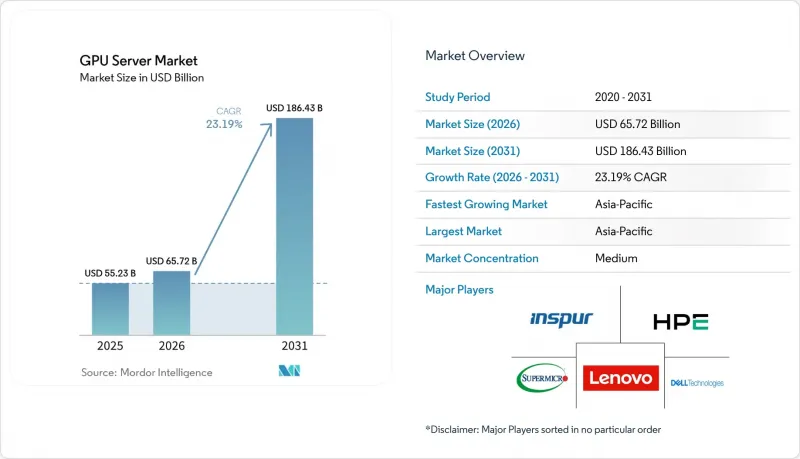
본 보고서는 도입 형태별(데이터센터, 엣지), 워크로드별(AI 훈련, AI 추론 등), 구성별(싱글 GPU, 멀티 GPU), 폼 팩터별(랙, 블레이드 등), GPU 통합 방식별(PCIe 기반, SXM/NVLink 기반 등), 최종 사용자별(클라우드 서비스 제공업체, 기업, 정부 및 연구기관 등), 지역별로 분류되어 있습니다. 시장 전망은 금액(달러) 기준으로 제시되어 있습니다.
세계의 GPU 서버 시장 동향 및 인사이트
하이퍼스케일 데이터센터의 AI 훈련 역량에 대한 수요 급증
하이퍼스케일 사업자들은 매개변수 수가 1조 개를 넘는 최첨단 모델을 훈련하기 위해 10만 대 이상의 가속기를 포함한 클러스터를 구축하고 있습니다. 이러한 규모를 실현하기 위해서는 전용 변전소 및 대용량 상호 연결에 대한 투자가 필요합니다. 메타는 약 60만 대의 H100급 GPU 운영을 목표로 하고 있는 반면, 마이크로소프트는 2026 회계연도 800억 달러 규모의 계획 중 수십억 달러를 수냉식 랙에 투자할 방침입니다. 10-20년에 걸친 전력 구매 계약을 통해 캠퍼스당 50-100메가와트의 전력이 확보되어 있습니다. 유럽연합(EU)과 중동의 자율 AI 정책은 기밀성이 높은 훈련 데이터의 현지 호스팅을 의무화함으로써 수요의 추가적인 확대를 촉진하고 있습니다. 이러한 움직임들이 맞물리면서 훈련 역량의 기반이 강화되었고, GPU 서버의 수주 전망이 향후 수년 동안까지 확대되고 있습니다.
생성형 AI 붐이 GPU 서버의 교체 주기를 앞당기고 있습니다.
기업들은 기존의 4년이라는 서버 수명 주기를 불과 2년으로 단축하고, 챗봇, 코드 어시스턴트, 멀티모달 컨텐츠 도구를 실행하기 위해 CPU를 많이 사용하는 노드를 GPU 가속기로 교체하고 있습니다. 델은 2025 회계연도에 GPU 서버 수주가 2배로 증가했다고 보고했으며, HPE도 AI 최적화 시스템 매출이 35% 증가했다고 발표했습니다. NVIDIA의 ‘Blackwell’ 및 AMD의 ‘MI300’ 제품군의 등장으로, 각각 와트당 성능이 2-3배 향상됨에 따라 불과 2년 전에 도입된 하드웨어를 폐기해야 할 경제적 근거가 생겨났습니다. 또한 기업들은 멀티모달 모델을 지원하기 위해 대용량 메모리가 필요하며, 이로 인해 최신 GPU가 탑재된 서버 구매가 촉진되고 있습니다.
첨단 패키징용 기판 공급망의 제약
TSMC의 CoWoS 생산 능력은 2025년에 50% 확대되었으나, 여전히 수주량이 공급량을 상회하고 있어 수주 대기 목록은 2026년 상반기까지 이어지고 있습니다. SK하이닉스는 HBM3 생산 라인을 풀가동하고 있어, 엔비디아와 AMD는 주력 제품공급을 제한할 수밖에 없는 상황입니다. 미국의 중국에 대한 패키징 장비 수출 규제는 생산이 대만과 한국에 집중되는 결과를 초래하여, 위험을 더욱 가중시키고 있습니다. 이러한 공급 부족으로 인해 기업용 납품이 최대 9개월 지연되고, 데이터센터 확장이 정체되는 한편, OEM 제조업체의 수익 전망도 불투명해지고 있습니다.
부문별 분석
2025년, 엣지 도입은 GPU 서버 시장 점유율에서 미미한 비중을 차지하는 데 그쳤습니다. 그러나 이 부문은 연평균 성장률(CAGR) 23.59%라는 견조한 성장이 예상되며, 기준 연도에 매출의 88.21%를 차지했던 데이터센터의 우위가 점차 약화될 것으로 전망됩니다. 이러한 성장의 주요 원동력은 10밀리초 미만의 응답 시간과 로컬 데이터 처리를 우선시하는 5G 기반 수익화 모델의 도입이며, 이에 따라 변화하는 시장 상황에서 엣지 도입의 중요성이 점점 더 커지고 있습니다. 이러한 성장세에도 불구하고, 2031년까지는 데이터센터로의 도입이 GPU 서버 시장의 주된 기반이 될 것으로 예측됩니다. 이는 주로, 고부하 계산 작업을 처리하기 위해 홀당 수천 대의 GPU에 의존하는 하이퍼스케일 학습 클러스터가 존재하기 때문입니다.
그렇긴 하지만, 첨단 분야는 특히 한국, 일본, 인도 등의 인구 밀집 도시권에서 더욱 빠르게 확대되고 있습니다. 이러한 지역에서는 이용 가능한 부동산이 제한적이라는 점이나 사용자와의 근접성이 요구된다는 등의 과제에 직면해 있어, 엣지 도입이 보다 현실적인 해결책이 되고 있습니다. 현재 시장에서는 두 가지 서로 다른 공급망이 등장하고 있습니다. 하나는 엣지 용도를 위해 견고한 케이스에 탑재된 저전력 싱글 GPU 노드이며, 다른 하나는 핵심 데이터센터 캠퍼스를 위해 설계된 16개의 GPU를 탑재한 수냉식 랙입니다. 이러한 차별화는 GPU 서버 시장을 주도하는 다양한 요구 사항과 용도를 여실히 보여주고 있습니다.
AI 추론 부문의 매출은 연평균 성장률(CAGR) 23.99%로 증가할 것으로 예상되며, 이는 GPU 서버 시장 전체의 성장률을 크게 상회하고, 훈련 부문의 성장률마저 능가할 전망입니다. 2025년에는 훈련이 총 수익의 53.47%를 차지한 것으로 평가되었으며, ChatGPT와 같은 도구에서 하루당 처리되는 추론 쿼리 수는 이미 훈련의 에포크 수를 크게 웃돌고 있습니다. 이러한 변화는 기업과 소비자가 다양한 업무에서 AI 기반 솔루션에 대한 의존도를 높여감에 따라, 실제 용도에서 추론 기능에 대한 수요가 증가하고 있음을 여실히 보여주고 있습니다. AI 모델의 성숙화는 이러한 추세의 주요 촉진요인입니다. 멀티모달 기반 모델이 한 번 학습되면, 의료와 금융부터 소매, 엔터테인먼트에 이르기까지 다양한 산업 분야에서 수천 개의 고객용 용도를 개발할 수 있게 됩니다.
이러한 용도에서는 원활하고 효율적인 사용자 경험을 제공하기 위해 저지연 추론이 필요합니다. 이러한 증가하는 수요에 부응하기 위해 각 하드웨어 벤더들은 INT8 및 FP8 연산에 특화되어 최적화된 가속기 SKU를 출시하고 있으며, 이들 제품은 FP16 트레이닝 카드에 비해 와트당 처리량이 2-3배 향상되었습니다. 이러한 하드웨어 기술의 발전 덕분에, 보다 효율적이고 비용 대비 효율이 높은 추론 처리가 가능해졌습니다. 그 결과, 추론과 관련된 GPU 서버 시장 부문은 금세기 말까지 훈련 관련 매출을 넘어설 것으로 예상되며, 이는 시장 역학의 큰 전환을 나타낼 뿐만 아니라 AI 생태계 내에서의 우선순위 변화를 여실히 보여주고 있습니다.
지역별 분석
아시아태평양은 2025년에 GPU 서버 시장 점유율의 67.63%를 차지한 것으로 평가되었으며, 2031년까지 연평균 성장률(CAGR) 24.19%를 나타낼 것으로 전망됩니다. 화웨이의 ‘Ascend 910C’ 출하가 상징하듯이, 중국이 국산 GPU로의 전환을 추진하고 있는 점이 H200 수입 감소분을 부분적으로 상쇄하고 있습니다. 인도의 데이터센터 건설 계획은 1기가와트 대를 돌파했으며, Yotta사는 2027년까지 GPU 홀의 용량을 3배로 확대하기 위해 20억 달러를 투자하기로 결정했습니다. 일본은 ‘후가쿠’의 후속 모델이 될 엑사스케일급 슈퍼컴퓨터에 1,000억 엔(6억 9,000만 달러)을 배정하며, AI 및 기후 연구 분야에서 GPU를 활용한 성능 향상에 중점을 두고 있습니다. 한국은 국내산 HBM3와 수입 GPU를 결합한 국가 AI 컴퓨팅 백본 구축에 5,000억 원(3억 7,500만 달러)을 예산으로 편성했습니다.
북미는 2025년 매출의 약 20%를 차지했으며, 그 배경에는 메타, 마이크로소프트, 구글이 2026년까지 AI 인프라에 2,000억 달러 이상을 투자하겠다고 약속한 점이 있습니다. 버지니아주 북부의 송전망 제약으로 인해 상호 연결 대기 시간이 길어지고 있으며, 그 결과 신규 건설은 재생에너지를 공급할 수 있는 중서부 및 산악 지대로 이동하고 있습니다. 미국에서도 엣지 구축이 진행되고 있지만, 가입자 1인당 도입률은 아시아태평양에 뒤처져 있습니다.
2025년 유럽은 매출의 약 10%를 차지했습니다. kW시당 평균 0.30유로(0.32달러)에 달하는 높은 전기 요금과 엄격한 탄소 규제가 확장을 억제하고 있는 반면, 이러한 요인들은 수냉 기술의 도입을 촉진하는 요인이 되기도 합니다. 사업자들은 더 저렴한 수력발전을 찾아 스칸디나비아 시장으로 무게중심을 옮기고 있는 반면, EU 내 국가 주도의 AI 규정이 지역 내 GPU 수요를 최저 수준으로 유지하고 있습니다. 남미, 중동 및 아프리카의 합계 점유율은 5% 미만에 그치고 있지만, 사우디아라비아와 아랍에미리트가 국가 주도의 AI 클러스터에 자금을 지원하고 있어, 예측 기간 후반에는 해당 지역의 점유율을 끌어올릴 가능성이 있습니다.
기타 혜택 :
- 엑셀 형식 시장 예측(ME) 시트
- 3개월간의 애널리스트 지원
자주 묻는 질문
목차
제1장 서론
제2장 조사 방법
제3장 주요 요약
제4장 시장 구도
제5장 시장 규모 및 성장 예측
제6장 경쟁 구도
제7장 시장 기회 및 향후 전망
LSH 26.06.24According to Mordor Intelligence, the gPU server market size was valued at USD 55.23 billion in 2025 and estimated to grow from USD 65.72 billion in 2026 to reach USD 186.43 billion by 2031, at a CAGR of 23.19% during the forecast period (2026-2031).
This report is Segmented by Deployment (Data Center, Edge), Workload (AI Training, AI Inference, and More), Configuration (Single GPU, and Multi-GPU), Form Factor (Rack, Blade, and More), GPU Integration (PCIe-Based, SXM/NVLink-based, and More), End-User (Cloud Service Providers, Enterprise, Government and Research Institutions, and More), and Geography. The Market Forecasts are Provided in Terms of Value (USD).
Global GPU Server Market Trends and Insights
Surging Demand for AI Training Capacity in Hyperscale Data Centers
Hyperscale operators are rolling out clusters containing more than 100,000 accelerators to train frontier models with parameter counts exceeding 1 trillion, a scale that requires investment in dedicated substations and high-capacity interconnects. Meta aims to operate roughly 600,000 H100-class GPUs, while Microsoft's USD 80 billion fiscal-2026 plan steers billions toward liquid-cooled racks. Power-purchase agreements stretching 10-20 years are locking in 50-100 megawatts per campus. Sovereign AI policies in the European Union and the Middle East are driving incremental demand by requiring local hosting of sensitive training data. Collectively, these moves lift the base of training capacity, extending multi-year visibility for GPU server orders.
Generative AI Boom Driving GPU Server Refresh Cycles
Enterprises have trimmed the traditional four-year server life cycle to barely two, swapping CPU-heavy nodes for GPU accelerators to run chatbots, code assistants, and multimodal content tools. Dell reported a doubling of GPU server bookings in fiscal 2025, and HPE posted 35% growth in AI-optimized systems. The debut of NVIDIA's Blackwell and AMD's MI300 families, each offering 2-3X the performance per watt, creates a financial case for retiring hardware installed just 2 years ago. Enterprises also need larger memory footprints to support multimodal models, driving purchases of servers equipped with the latest GPUs.
Supply Chain Constraints for Advanced Packaging Substrates
CoWoS capacity at TSMC expanded by 50% in 2025 yet remained oversubscribed, with booking queues stretching into the first half of 2026. SK Hynix kept HBM3 lines fully allocated, forcing NVIDIA and AMD to ration flagship parts. U.S. curbs on shipments of packaging equipment to China compound the risk by centralizing production in Taiwan and South Korea. The shortfall delays enterprise deliveries by up to 9 months, stalling data center buildouts and compressing revenue visibility for OEMs.
Other drivers and restraints analyzed in the detailed report include:
- Deployment of Large-Language-Model Inference at the Network Edge
- Shift Toward Liquid-Cooled High-Density Racks
- Escalating TCO Due to Soaring Data-Center Power Tariffs
For complete list of drivers and restraints, kindly check the Table Of Contents.
Segment Analysis
Edge installations accounted for a modest slice of the GPU server market share in 2025. However, this segment is projected to grow at a robust CAGR of 23.59%, gradually reducing the dominance of data centers, which commanded 88.21% of the revenue in the base year. This growth is primarily driven by the adoption of 5G-enabled monetization models that prioritize sub-10-millisecond response times and local data processing, making edge installations increasingly relevant in the evolving market landscape. Despite this growth, data-center deployments are expected to remain the cornerstone of the GPU server market through 2031. This is largely due to hyperscale training clusters that rely on thousands of GPUs per hall to handle intensive computational tasks.
Nevertheless, the edge segment is expanding faster, particularly in regions such as South Korea, Japan, and densely populated metropolitan areas in India. These regions face challenges such as limited real estate availability and the need for user proximity, making edge installations a more viable solution. The market is witnessing the emergence of two distinct supply chains: low-power single-GPU nodes housed in rugged enclosures for edge applications, and 16-GPU liquid-cooled racks designed for core data center campuses. This differentiation highlights the diverse requirements and applications driving the GPU server market forward.
AI inference revenue is projected to climb at a 23.99% CAGR, significantly outpacing the broader GPU server market and surpassing the growth rates of training. In 2025, training accounted for 53.47% of total revenue; however, the volume of daily inference queries for tools such as ChatGPT had already exceeded the number of training epochs by a substantial margin. This shift highlights the growing demand for inference capabilities in real-world applications, as businesses and consumers increasingly rely on AI-driven solutions for a range of tasks. The maturation of AI models is a key driver of this trend. Once a multimodal foundation model is trained, it enables the development of thousands of customer-facing applications across various industries, ranging from healthcare and finance to retail and entertainment.
These applications require low-latency inference to deliver seamless, efficient user experiences. In response to this growing demand, hardware vendors have introduced accelerator SKUs specifically optimized for INT8 and FP8 arithmetic, which deliver 2-3X the throughput per watt compared to FP16 training cards. These advancements in hardware technology are enabling more efficient and cost-effective inference operations. As a result, the GPU server market segment associated with inference is expected to surpass training revenue before the end of the decade, marking a significant shift in market dynamics and highlighting the evolving priorities within the AI ecosystem.
Geography Analysis
Asia-Pacific dominated the GPU server market share at 67.63% in 2025 and is projected to record a 24.19% CAGR to 2031. China's pivot to domestic GPUs, illustrated by Huawei's Ascend 910C shipments, partially offsets curtailed H200 imports. India's data-center pipeline broke the 1 gigawatt mark, with Yotta committing USD 2 billion to triple GPU hall capacity by 2027. Japan earmarked JPY 100 billion (USD 690 million) for an exascale successor to Fugaku, emphasizing GPU acceleration for AI and climate research. South Korea budgeted KRW 500 billion (USD 375 million) to build a national AI compute backbone, pairing domestic HBM3 with imported GPUs.
North America accounted for roughly 20% of 2025 revenue, underpinned by Meta, Microsoft, and Google pledging over USD 200 billion in AI infrastructure funding through 2026. Grid constraints in Northern Virginia lengthen interconnect queues, steering new construction into the Midwest and Mountain regions where renewable capacity is available. The U.S. also incubates edge deployments, though regional uptake lags Asia-Pacific on a per-subscriber basis.
Europe captured about 10% of revenue in 2025. High power tariffs averaging EUR 0.30 (USD 0.32) per kilowatt-hour and stringent carbon rules temper expansion, yet they also catalyze the adoption of liquid cooling. Operators pivot to Scandinavian markets for cheaper hydro power, while sovereign AI requirements inside the EU keep a baseline of in-region GPU demand. South America, the Middle East, and Africa remained sub-5% combined; however, Saudi Arabia and the United Arab Emirates are funding sovereign AI clusters that could lift regional share in the late forecast years.
- Dell Technologies Inc.
- Hewlett Packard Enterprise Company
- Lenovo Group Limited
- Super Micro Computer Inc.
- Inspur Group Co. Ltd.
- Huawei Technologies Co. Ltd.
- GIGABYTE Technology Co. Ltd.
- ASUSTeK Computer Inc.
- NVIDIA Corporation
- Advanced Micro Devices Inc.
- International Business Machines Corporation
- Fujitsu Limited
- Atos SE
- Penguin Computing Inc.
- TYAN Computer Corporation
- H3C Technologies Co. Ltd.
- BOXX Technologies LLC
- Lambda Labs Inc.
- NEC Corporation
- Sugon Information Industry Co. Ltd.
Additional Benefits:
- The market estimate (ME) sheet in Excel format
- 3 months of analyst support
TABLE OF CONTENTS
1 INTRODUCTION
- 1.1 Study Assumptions and Market Definition
- 1.2 Scope of the Study
2 RESEARCH METHODOLOGY
3 EXECUTIVE SUMMARY
4 MARKET LANDSCAPE
- 4.1 Market Overview
- 4.2 Market Drivers
- 4.2.1 Surging Demand for AI Training Capacity in Hyperscale Data Centers
- 4.2.2 Generative AI Boom Driving GPU Server Refresh Cycles
- 4.2.3 Rising Adoption of GPU-Accelerated Databases in FinTech and Retail
- 4.2.4 Government-Funded Exascale HPC Programs
- 4.2.5 Deployment of Large-Language-Model Inference at the Network Edge
- 4.2.6 Shift Toward Liquid-Cooled High-Density Racks
- 4.3 Market Restraints
- 4.3.1 Supply Chain Constraints for Advanced Packaging Substrates
- 4.3.2 Escalating TCO Due to Soaring Data-Center Power Tariffs
- 4.3.3 Geopolitical Export Controls on High-End GPUs
- 4.3.4 Skills Gap in Parallel Programming for Heterogeneous Systems
- 4.4 Impact of Macroeconomic Factors on the Market
- 4.5 Industry Value Chain Analysis
- 4.6 Regulatory Landscape
- 4.7 Technological Outlook
- 4.8 Porter's Five Forces Analysis
- 4.8.1 Bargaining Power of Suppliers
- 4.8.2 Bargaining Power of Buyers
- 4.8.3 Threat of New Entrants
- 4.8.4 Threat of Substitutes
- 4.8.5 Intensity of Competitive Rivalry
5 MARKET SIZE AND GROWTH FORECASTS (VALUE)
- 5.1 By Deployment
- 5.1.1 Data Center
- 5.1.2 Edge
- 5.2 By Workload
- 5.2.1 AI Training
- 5.2.2 AI Inference
- 5.2.3 HPC
- 5.2.4 Visualization
- 5.3 By Configuration
- 5.3.1 Single GPU
- 5.3.2 Multi-GPU (2-4)
- 5.4 By Form Factor
- 5.4.1 Rack
- 5.4.2 Blade
- 5.4.3 Modular
- 5.5 By GPU Integration
- 5.5.1 PCIe-based
- 5.5.2 SXM / NVLink-based
- 5.5.3 OAM-based
- 5.6 By End-User
- 5.6.1 Cloud Service Providers (Hyperscalers)
- 5.6.2 Enterprise
- 5.6.3 Government and Research Institutions
- 5.6.4 Telecom / Edge Operators
- 5.7 By Geography
- 5.7.1 North America
- 5.7.1.1 United States
- 5.7.1.2 Canada
- 5.7.1.3 Mexico
- 5.7.2 Europe
- 5.7.2.1 United Kingdom
- 5.7.2.2 Germany
- 5.7.2.3 France
- 5.7.2.4 Rest of Europe
- 5.7.3 Asia-Pacific
- 5.7.3.1 China
- 5.7.3.2 Japan
- 5.7.3.3 India
- 5.7.3.4 South Korea
- 5.7.3.5 Rest of Asia-Pacific
- 5.7.4 South America
- 5.7.5 Middle East and Africa
- 5.7.1 North America
6 COMPETITIVE LANDSCAPE
- 6.1 Market Concentration
- 6.2 Strategic Moves
- 6.3 Market Share Analysis
- 6.4 Company Profiles (includes Global Level Overview, Market Level Overview, Core Segments, Financials as available, Strategic Information, Market Rank/Share, Products and Services, Recent Developments)
- 6.4.1 Dell Technologies Inc.
- 6.4.2 Hewlett Packard Enterprise Company
- 6.4.3 Lenovo Group Limited
- 6.4.4 Super Micro Computer Inc.
- 6.4.5 Inspur Group Co. Ltd.
- 6.4.6 Huawei Technologies Co. Ltd.
- 6.4.7 GIGABYTE Technology Co. Ltd.
- 6.4.8 ASUSTeK Computer Inc.
- 6.4.9 NVIDIA Corporation
- 6.4.10 Advanced Micro Devices Inc.
- 6.4.11 International Business Machines Corporation
- 6.4.12 Fujitsu Limited
- 6.4.13 Atos SE
- 6.4.14 Penguin Computing Inc.
- 6.4.15 TYAN Computer Corporation
- 6.4.16 H3C Technologies Co. Ltd.
- 6.4.17 BOXX Technologies LLC
- 6.4.18 Lambda Labs Inc.
- 6.4.19 NEC Corporation
- 6.4.20 Sugon Information Industry Co. Ltd.
7 MARKET OPPORTUNITIES AND FUTURE OUTLOOK
- 7.1 White-Space and Unmet-Need Assessment