

|
시장보고서
상품코드
2065522
GPU 엑셀러레이터 카드 시장 : 시장 점유율 분석, 업계 동향 및 통계, 성장 예측(2026-2031년)GPU Accelerator Card - Market Share Analysis, Industry Trends & Statistics, Growth Forecasts (2026 - 2031) |
||||||
 Mordor Intelligence
GPU 엑셀러레이터 카드 시장 규모는 2025년 291억 8,000만 달러로 평가되었고, 2026년에는 352억 3,000만 달러로 추정되고, 2031년까지 748억 6,000만 달러에 이를 것으로 예상되며, 2026-2031년 CAGR 20.74%로 성장할 전망입니다.
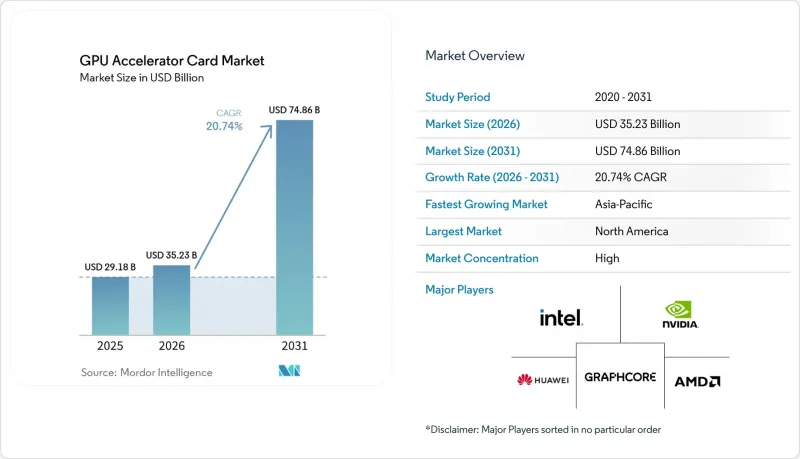
본 보고서는 폼 팩터별(PCIe 애드인 카드, SXM/메자닌, OAM), 메모리 유형별(HBM, GDDR), 냉각 방식별(패시브, 액티브), 도입 형태별(데이터센터/서버, 워크스테이션, 엣지/임베디드), 산업 분야별(클라우드 서비스 제공업체, 엔터프라이즈 IT, 정부·연구기관, 미디어 및 엔터테인먼트 등) 및 지역별로 분류되어 있습니다. 시장 전망은 금액(달러) 기준으로 제시되어 있습니다.
세계의 GPU 엑셀러레이터 카드 시장 동향 및 분석
AI 및 머신러닝 훈련 워크로드의 폭발적인 증가
모델 파라미터 수는 1조 8,000억 개에서 10조 개 이상으로 급증하고 있으며, 10만 대 이상의 가속기를 갖춘 클러스터와 GPU당 400 Gbps를 초과하는 상호 연결 패브릭이 필요합니다. 미국 국립 연구소의 최첨단 시스템에는 현재 2만 8,000대 이상의 NVIDIA H100 유닛이 통합되어 있으며, 각 하이퍼스케일러 기업들은 2025년에 AI 용량 확장에 700억 달러 이상을 투자했습니다. 트레이닝 작업에는 90%에 가까운 지속적인 가동률이 요구되며, 이로 인해 총 소유 비용(TCO)에 대한 예상치가 재검토되어 수년 단위의 장기적인 하드웨어 조달 계획이 확정되고 있습니다. 1회 실행당 1억 달러를 초과하는 사전 학습 비용으로 인해 시장 진입은 자본 집약적 기업으로 제한되고 있으며, 그 결과 GPU 엑셀러레이터 카드 시장 전체 수요가 견조한 추세를 보이고 있습니다. 이러한 상황으로 인한 수요 압박이 프리미엄 제품공급 제약을 초래하고 있어, 출하량이 증가하고 있음에도 불구하고 평균 판매 가격은 높은 수준을 유지하고 있습니다.
클라우드 게임 및 스트리밍 플랫폼의 급속한 확산
클라우드 게임의 매출액은 2025년에 85억 달러에 달할 전망이며, 주요 플랫폼들은 현재 4K 해상도, 240 fps, 40밀리초 미만의 지연 시간을 목표로 하고 있습니다. 서비스 제공업체들은 가동률이 3대 1로 변동하는 저녁 시간대의 급격한 트래픽 급증에 직면함에 따라, 많은 사업자들이 야간 유휴 자원을 생성형 AI의 추론 처리에 할당하여 자산 활용률을 35%에서 65%로 높이고 있습니다. 50밀리초 미만의 지연 시간 요건을 충족하려면 최종 사용자로부터 20밀리초 이내 거리에 엣지 데이터센터를 구축해야 하므로, 원격 제어가 가능한 소형 패시브 냉각 방식 가속기에 대한 수요가 증가하고 있습니다. 경쟁이 치열한 e스포츠 타이틀이 클라우드 스트리밍으로 전환됨에 따라, 1밀리초의 지연조차도 고객 이탈의 위험 요인이 되고 있으며, GPU 엑셀러레이터 카드 시장의 교체 주기가 가속화되고 있습니다.
첨단 기판 분야의 지속적인 공급망 제약
아지노모토 빌드업 필름사의 기판은 2027년까지 주문이 완전히 마감되어 있으며, 리드타임은 52주에 달할 전망입니다. NVIDIA, AMD, Intel은 대만과 한국의 동일한 공급업체 그룹으로부터 수년에 걸친 물량 할당을 확보하고 있어, 소규모 신규 업체들 시장 진입을 가로막고 있습니다. 2024년 대만 지진은 이 노드의 취약점을 여실히 드러냈습니다. 생산이 6주간 중단되면서 전 세계 일정이 분기 분량만큼 더 지연되었기 때문입니다. 기판은 기판의 부품 명세서(BOM)에서 최대 5분의 1을 차지하기 때문에 가격 급등은 최종 제품인 카드에 직접적인 영향을 미치며, GPU 엑셀러레이터 카드 시장에 역풍이 되고 있습니다.
부문별 분석
OAM 모듈은 2026-2031년 연평균 성장률(CAGR) 21.34%를 기록할 전망이며, PCIe 애드인 카드형 GPU 가속기 시장은 2025년 매출의 52%를 차지했습니다. OAM을 통해 하이퍼스케일러는 1.4 MW를 소비하는 72개의 가속기를 42U 랙에 수용할 수 있으며, PCIe 제품과 비교해 설치 면적을 40% 줄일 수 있습니다. Meta와 동종 업계 경쟁사들은 700W GPU를 지원하는 직접 액체 냉각 방식의 OAM 설계를 표준화하여, 이를 통해 전력 효율을 25% 향상시켰습니다. 반면, 기업들은 PCIe의 핫스왑 지원이라는 유연성을 중시하고 있으며, 이는 여전히 여러 대의 서버를 한 번에 업그레이드하는 기업의 조달 주기의 기반이 되고 있습니다.
이러한 효율의 차이는 대규모 환경에서 부동소수점 연산당 비용을 대폭 낮추는 결과로 이어집니다. 따라서 하이퍼스케일 시설에서의 OAM 도입 대수는 앞으로도 계속 증가할 것으로 보입니다. 그러나 중소규모 조직들은 700W 액체 냉각 루프에 맞추어 랙을 재구축하는 것을 주저하고 있어, GPU 엑셀러레이터 카드 시장은 여전히 양극화되어 있습니다. 주로 NVIDIA의 DGX 시스템에 탑재된 SXM 모듈은 28%의 시장 점유율을 차지하고 있으며, 개방형 표준보다 독자적인 NVLink 대역폭을 중시하는 사용자들 사이에서 틈새 수요를 계속 유지해 나갈 것으로 보입니다.
HBM은 2025년 매출의 84%를 차지했으며, 여전히 경쟁 우위의 핵심 요소로 자리 잡고 있으며, GPU 엑셀러레이터 카드 시장 점유율은 SK하이닉스, 삼성, 마이크론공급에 힘입어 유지되고 있습니다. 각 HBM3e 스택은 현재 1.15 TB/s의 대역폭을 제공하며, 최상위급 디바이스는 8개 이상의 스택을 조합하여 총 8 TB/s의 대역폭을 실현하고 있습니다. 모델 크기가 무어의 법칙에 따른 성능 향상률을 웃도는 속도로 계속 확대되고 있기 때문에 구매자들은 GDDR6에 비해 8배나 비싼 프리미엄 가격을 기꺼이 지불하고 있습니다.
GDDR을 탑재한 카드는 GB당 비용이 피크 대역폭보다 더 중요하게 여겨지는 워크스테이션 및 엣지 추론 분야에서 계속해서 사용되고 있으며, 16%의 점유율을 유지하고 있습니다. HBM4는 2027년에 출시될 예정이며, 스택당 2 TB/s를 달성할 것으로 예상되어 병목 현상 완화가 기대되지만, 초기에는 단가가 더욱 상승할 가능성이 있습니다. 2028년에 한국과 미국의 신규 생산 능력이 양산 규모에 도달할 때까지는 HBM 공급이 GPU 엑셀러레이터 카드 시장 전체의 성장을 제약할 것으로 보입니다.
지역별 분석
북미는 3,000억 달러를 넘는 하이퍼스케일러의 투자에 힘입어 2025년 매출의 46%를 차지했습니다. 그러나 해당 지역의 연평균 성장률(CAGR)은 19.8%로 평균보다 낮을 것으로 전망됩니다. 이는 주로 전력망 상호 연결에 따른 지연이나 전력 사용 허가 취득과 관련된 문제로 인해 데이터센터의 추가 확장이 주춤하고 있기 때문입니다. 캐나다에서는 수력발전을 주요 에너지원으로 삼고 있는 각 주가 새로운 데이터센터 건설을 위해 총 80억 달러 규모의 투자를 유치하고 있습니다. 한편, 중국에 대한 첨단 GPU 판매를 제한하는 미국의 수출 규제로 인해, 초과 수요가 국내로 전환되고 있습니다. 이러한 수요 전환으로 인해 해당 지역의 GPU 가격이 높은 수준을 유지하고 있습니다.
아시아태평양은 연평균 성장률(CAGR) 21.82%를 나타낼 것으로 예측되며, 이는 각 지역 중 가장 높은 성장률입니다. 일본은 AI 연구 인프라에 4조 엔(260억 달러)을 배정했으며, 인도는 1,030억 7,000만 루피(12억 4,000만 달러) 규모의 프로젝트를 통해 GPU 1만 대를 추가하고, 싱가포르는 5억 달러를 투자해 50 PFLOPS 달성을 목표로 하고 있습니다. 수출 규제의 영향을 받지 않는 중국의 국내 공급업체들은 2025년에 80억 달러 상당의 가속기를 출하했습니다. 한편, HBM 공급 분야에서 한국의 우위는 GPU 엑셀러레이터 카드 시장에서 이 지역의 전략적 중요성을 확고히 하고 있습니다.
유럽은 독일, 이탈리아, 스페인의 엑사스케일 시스템에 대한 EuroHPC 투자를 바탕으로 2025년에 18%의 점유율을 차지했습니다. 2028년까지 전력 사용 효율(PUE)을 1.3 미만으로 유지하고, 재생에너지 조달 비율을 80% 이상으로할 것을 의무화하는 새로운 지침에 따라, 에너지 효율이 높은 GPU에 대한 수요가 증가하고 있습니다. 또한, 프랑스에서는 10 PF-일을 초과하는 훈련 작업에 대해 탄소 회계가 의무화되어 있으며, 이로 인해 확립된 보고 인프라를 갖춘 하이퍼스케일러가 유리한 입장에 있습니다. 남미, 중동 및 아프리카는 브라질, 아랍에미리트, 사우디아라비아의 정부계 펀드 투자를 바탕으로 총 8%의 점유율을 차지했습니다. 송전망의 용량 제한과 전문 인력 부족으로 인해 단기적인 성장은 제약을 받고 있지만, 장거리 케이블의 업그레이드와 모듈형 원자력 발전 시범 사업을 통해 2028년 이후에는 잠재적 수요가 창출될 가능성이 있습니다.
기타 혜택 :
- 엑셀 형식 시장 예측(ME) 시트
- 3개월간의 애널리스트 지원
자주 묻는 질문
목차
제1장 서론
제2장 조사 방법
제3장 주요 요약
제4장 시장 구도
제5장 시장 규모 및 성장 예측
제6장 경쟁 구도
제7장 시장 기회 및 향후 전망
AJY 26.06.26According to Mordor Intelligence, the gPU accelerator card market size is expected to increase from USD 29.18 billion in 2025 to USD 35.23 billion in 2026 and reach USD 74.86 billion by 2031, growing at a CAGR of 20.74% over 2026-2031.
This report is Segmented by Form Factor (PCIe Add-In Cards, SXM/Mezzanine, and OAM), Memory Type (HBM, and GDDR), Cooling (Passive, Aand Active), Deployment (Data Center/Server, Workstation, and Edge/Embedded), Industry Vertical (Cloud Service Providers, Enterprise IT, Government and Research, Media and Entertainment, and More), and Geography. The Market Forecasts are Provided in Terms of Value (USD).
Global GPU Accelerator Card Market Trends and Insights
Explosive Growth in AI And Machine Learning Training Workloads
Model parameter counts have jumped from 1.8 trillion to over 10 trillion, requiring clusters with more than 100,000 accelerators and interconnect fabrics exceeding 400 Gbps per GPU. Frontier systems at U.S. national laboratories now integrate more than 28,000 NVIDIA H100 units, while hyperscalers each spent over USD 70 billion expanding AI capacity in 2025. Training jobs demand sustained utilization near 90%, reshaping total cost-of-ownership assumptions and locking in long multi-year hardware pipelines. Pre-training costs exceeding USD 100 million per run have narrowed participation to capital-intensive firms, thereby fortifying demand across the GPU accelerator card market. The resulting pressure keeps premium parts supply-constrained, sustaining high average selling prices even as volumes climb.
Surging Adoption of Cloud Gaming and Streaming Platforms
Cloud gaming revenues hit USD 8.5 billion in 2025, and leading platforms now target 4 K at 240 fps with sub-40 ms latency. Providers confront sharp evening peaks that create three-to-one utilization swings, so many routes idle overnight capacity toward generative AI inference to lift asset use from 35% to 65%. Latency budgets under 50 ms require edge data centers within 20 ms of end users, driving demand for compact, passively cooled accelerators that tolerate remote operation. As competitive esports titles migrate to cloud delivery, every millisecond of delay becomes a risk of customer churn, accelerating refresh cycles in the GPU accelerator card market.
Persistent Supply Chain Constraints in Advanced Substrates
Ajinomoto Build-up Film substrates remain fully booked through 2027, stretching lead times to 52 weeks. NVIDIA, AMD, and Intel hold multiyear allocations from the same pool of Taiwanese and Korean suppliers, crowding out smaller entrants. The 2024 Taiwan earthquake highlighted the fragility of this node, as it paused production for 6 weeks and lengthened global scheduling by another quarter. Because substrates form up to one-fifth of a board's bill of materials, price spikes ripple directly to end cards, creating a headwind for the GPU accelerator card market.
Other drivers and restraints analyzed in the detailed report include:
- Accelerated Enterprise Roll-Outs of Generative AI Applications
- Rising Demand for High-Performance Computing in Academia and Government
- High Total Cost of Ownership of Datacenter GPU Infrastructure
For complete list of drivers and restraints, kindly check the Table Of Contents.
Segment Analysis
OAM modules posted a 21.34% CAGR from 2026 to 2031, while the PCIe add-in card GPU accelerator market commanded 52% of revenue in 2025. OAM lets hyperscalers pack 72 accelerators drawing 1.4 MW into a 42U rack, shrinking floor space 40% compared with PCIe equivalents. Meta and its peers standardized on direct-liquid-cooled OAM designs that handle 700-W GPUs, enhancing power efficiency by 25%. In contrast, enterprises prize PCIe's hot-swappable flexibility, which still anchors procurement cycles for firms upgrading a few servers at a time.
The efficiency delta translates into materially lower cost per floating-point operation at massive scale, so OAM's installed base will keep climbing in hyperscale facilities. Yet the GPU accelerator card market remains bifurcated because smaller organizations hesitate to rebuild racks around 700-W liquid-cooling loops. SXM modules, embedded primarily in NVIDIA's DGX systems, hold a 28% share and will maintain niche demand among users who value proprietary NVLink bandwidth over open standards.
HBM attained 84% of 2025 revenue and remains the fulcrum of competitive positioning, with the GPU accelerator card market share segment anchored by supply from SK Hynix, Samsung, and Micron. Each HBM3e stack now delivers 1.15 TB/s, and top devices couple eight or more stacks for 8 TB/s aggregate bandwidth. Model sizes keep rising faster than Moore's law gains, so buyers willingly pay the 8x premium over GDDR6.
GDDR-backed cards continue to serve workstations and edge inference, where cost per GB trumps peak bandwidth, retaining a 16% share. HBM4 is scheduled for 2027 and promises 2 TB/s per stack, potentially easing the bottleneck but likely at even higher unit costs initially. Until fresh capacity in South Korea and the United States reaches volume scale in 2028, HBM supply will constrain overall growth in the GPU accelerator card market.
Geography Analysis
North America accounted for 46% of 2025 revenue, driven by hyperscaler outlays exceeding USD 300 billion. However, the regional compound annual growth rate (CAGR) is projected at a below-average 19.8%, primarily due to delays in grid interconnections and challenges in obtaining power permits, which are slowing further datacenter buildouts. In Canada, hydro-powered provinces have attracted investments totaling USD 8 billion for the construction of new data halls. Meanwhile, the U.S. export regime, which restricts the sale of advanced GPUs to China, has redirected excess demand domestically. This redirection has helped maintain elevated GPU prices in the region.
Asia-Pacific is set to grow at 21.82% CAGR, the fastest among regions. Japan allocated JPY 4 trillion (USD 26 billion) to AI research infrastructure, India's INR 103.07 billion (USD 1.24 billion) mission will add 10,000 GPUs, and Singapore targets 50 PFLOPS with a USD 500 million buildout. China's domestic vendors, shielded from export restrictions, shipped USD 8 billion worth of accelerators in 2025, while South Korea's dominance in HBM supply cements the area's strategic heft in the GPU accelerator card market.
Europe captured 18% share in 2025, helped by EuroHPC investments in exascale systems across Germany, Italy, and Spain. New directives requiring power-usage effectiveness below 1.3 and 80% renewable sourcing by 2028 drive demand for energy-efficient GPUs. France also requires carbon accounting for training jobs above 10 PF-days, which privileges hyperscalers with established reporting infrastructure. South America and the Middle East and Africa collectively held 8% share, backed by sovereign wealth fund commitments in Brazil, the United Arab Emirates, and Saudi Arabia. Limited grid capacity and specialist workforce shortages curb near-term acceleration, yet long-distance cable upgrades and modular nuclear pilots could unlock latent demand post-2028.
- NVIDIA Corporation
- Advanced Micro Devices, Inc.
- Intel Corporation
- Huawei Technologies Co., Ltd. (Ascend Series)
- Graphcore Ltd.
- Tenstorrent Inc.
- Qualcomm Technologies, Inc.
- Samsung Electronics Co., Ltd.
- Alibaba Group Holding Limited (T-Head)
- Baidu, Inc. (Kunlun)
- Cerebras Systems Inc.
- Advanced Micro Devices, Inc. (Xilinx VCK, Radeon Instinct)
- Giga Computing Technology Co., Ltd.
- Mellanox Technologies Ltd. (NVIDIA Networking)
- Broadcom Inc.
- ASUStek Computer Inc.
- Dell Technologies Inc.
- Hewlett Packard Enterprise Company
- Lenovo Group Limited
- Super Micro Computer, Inc.
- Inspur Group Co., Ltd.
Additional Benefits:
- The market estimate (ME) sheet in Excel format
- 3 months of analyst support
TABLE OF CONTENTS
1 INTRODUCTION
- 1.1 Study Assumptions and Market Definition
- 1.2 Scope of the Study
2 RESEARCH METHODOLOGY
3 EXECUTIVE SUMMARY
4 MARKET LANDSCAPE
- 4.1 Market Overview
- 4.2 Market Drivers
- 4.2.1 Explosive Growth in AI and Machine Learning Training Workloads
- 4.2.2 Surging Adoption of Cloud Gaming and Streaming Platforms
- 4.2.3 Accelerated Enterprise Roll-outs of Generative AI Applications
- 4.2.4 Rising Demand for High-Performance Computing in Academia and Government
- 4.2.5 EU Sustainability Rules Accelerating Procurement of Energy-Efficient GPUs
- 4.2.6 Open Accelerator Module (OAM) Standard Enabling Multi-Vendor Interoperability
- 4.3 Market Restraints
- 4.3.1 Persistent Supply Chain Constraints in Advanced Substrates
- 4.3.2 High Total Cost of Ownership of Datacenter GPU Infrastructure
- 4.3.3 HBM Capacity Bottlenecks Limiting Board-Level Memory Expansion
- 4.3.4 Export-Control Restrictions Curtailing Cross-Border GPU Shipments
- 4.4 Impact of Macroeconomic Factors on the Market
- 4.5 Industry Value Chain Analysis
- 4.6 Regulatory Landscape
- 4.7 Technological Outlook
- 4.8 Porter's Five Forces Analysis
- 4.8.1 Bargaining Power of Suppliers
- 4.8.2 Bargaining Power of Buyers
- 4.8.3 Threat of New Entrants
- 4.8.4 Threat of Substitutes
- 4.8.5 Intensity of Competitive Rivalry
5 MARKET SIZE AND GROWTH FORECASTS (VALUE)
- 5.1 By Form Factor
- 5.1.1 PCIe Add-In Cards
- 5.1.2 SXM / Mezzanine
- 5.1.3 OAM
- 5.2 By Memory Type
- 5.2.1 HBM
- 5.2.2 GDDR
- 5.3 By Cooling
- 5.3.1 Passive
- 5.3.2 Active
- 5.4 By Deployment
- 5.4.1 Data Center / Server
- 5.4.2 Workstation
- 5.4.3 Edge / Embedded
- 5.5 By Industry Vertical
- 5.5.1 Cloud Service Providers
- 5.5.2 Enterprise IT
- 5.5.3 Government and Research
- 5.5.4 Media and Entertainment
- 5.5.5 Automotive / Edge AI
- 5.6 By Geography
- 5.6.1 North America
- 5.6.1.1 United States
- 5.6.1.2 Canada
- 5.6.1.3 Mexico
- 5.6.2 Europe
- 5.6.2.1 United Kingdom
- 5.6.2.2 Germany
- 5.6.2.3 France
- 5.6.2.4 Rest of Europe
- 5.6.3 Asia-Pacific
- 5.6.3.1 China
- 5.6.3.2 Japan
- 5.6.3.3 India
- 5.6.3.4 South Korea
- 5.6.3.5 Rest of Asia Pacific
- 5.6.4 South America
- 5.6.5 Middle East and Africa
- 5.6.1 North America
6 COMPETITIVE LANDSCAPE
- 6.1 Market Concentration
- 6.2 Strategic Moves
- 6.3 Market Share Analysis
- 6.4 Company Profiles (includes Global Level Overview, Market Level Overview, Core Segments, Financials as available, Strategic Information, Market Rank/Share, Products and Services, Recent Developments)
- 6.4.1 NVIDIA Corporation
- 6.4.2 Advanced Micro Devices, Inc.
- 6.4.3 Intel Corporation
- 6.4.4 Huawei Technologies Co., Ltd. (Ascend Series)
- 6.4.5 Graphcore Ltd.
- 6.4.6 Tenstorrent Inc.
- 6.4.7 Qualcomm Technologies, Inc.
- 6.4.8 Samsung Electronics Co., Ltd.
- 6.4.9 Alibaba Group Holding Limited (T-Head)
- 6.4.10 Baidu, Inc. (Kunlun)
- 6.4.11 Cerebras Systems Inc.
- 6.4.12 Advanced Micro Devices, Inc. (Xilinx VCK, Radeon Instinct)
- 6.4.13 Giga Computing Technology Co., Ltd.
- 6.4.14 Mellanox Technologies Ltd. (NVIDIA Networking)
- 6.4.15 Broadcom Inc.
- 6.4.16 ASUStek Computer Inc.
- 6.4.17 Dell Technologies Inc.
- 6.4.18 Hewlett Packard Enterprise Company
- 6.4.19 Lenovo Group Limited
- 6.4.20 Super Micro Computer, Inc.
- 6.4.21 Inspur Group Co., Ltd.
7 MARKET OPPORTUNITIES AND FUTURE OUTLOOK
- 7.1 White-Space and Unmet-Need Assessment


