|
시장보고서
상품코드
2065532
이탈리아의 통합 시설 관리 시장 : 시장 점유율 분석, 업계 동향 및 통계, 성장 예측(2026-2031년)Italy Integrated Facility Management - Market Share Analysis, Industry Trends & Statistics, Growth Forecasts (2026 - 2031) |
||||||
 Mordor Intelligence
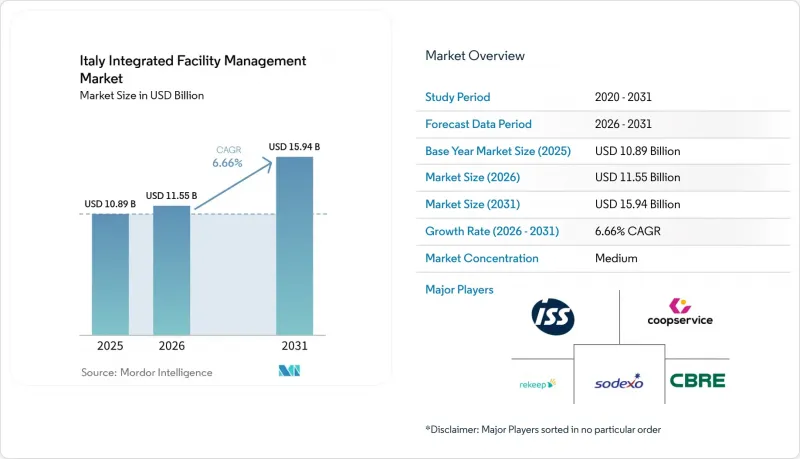
Mordor Intelligence에 의하면, 이탈리아의 통합 시설 관리 시장 규모는 2025년 108억 9,000만 달러로 평가되었고, 2026년 115억 5,000만 달러로 추정되고, 2031년까지 159억 4,000만 달러로 확대될 전망이며, 2026-2031년 연평균 복합 성장률(CAGR)은 6.66%를 나타낼 전망입니다.
본 보고서는 서비스 유형별(하드 시설 관리(자산 관리, MEP 및 HVAC 서비스 등), 소프트 시설 관리(사무 지원 및 보안, 청소 서비스, 케이터링 서비스 등)) 및 최종 사용자별(상업시설, 호스피탈리티, 공공기관 및 공공 인프라, 의료시설 등)로 분류되어 있습니다. 시장 전망은 금액(달러) 기준으로 제시되어 있습니다.
이탈리아의 통합 시설 관리 시장 동향 및 인사이트
단일 서비스 아웃소싱에서 통합형 FM으로의 전략적 전환
이탈리아의 통합 시설 관리 시장은 구조적인 전환기를 맞이하고 있습니다. 2025년 1월 현재, 통합 계약이 FM 총수익에서 차지하는 비중은 여전히 26%에 그쳤는데, 이는 기존의 단일 서비스에 대한 지출이라는 광범위한 기반이 여전히 통합 대상으로 남아 있기 때문입니다. 이 점은 중요합니다. 계약이 세분화되어 있으면 공급업체 수가 너무 많고, 운영상의 접점이 지나치게 많으며, 또한 구매자가 복잡한 부동산 포트폴리오 전체에 걸쳐 측정 가능한 서비스 성과를 요구할 때 설명 책임이 불충분해지기 때문입니다. 밀라노 공과대학교(Politecnico di Milano)의 조사 결과도 이러한 방향성을 뒷받침하고 있으며, 분산된 멀티벤더형 FM 모델은 통합형 구조에 비해 총소유비용(TCO)이 높아질 가능성이 있는 것으로 나타났습니다. 이를 통해 재무 부서와 운영 책임자 모두에게 서비스 번들화를 추진할 수 있는 더 강력한 근거가 마련됩니다. 이러한 변화는 더 이상 단순한 비용 절감에 그치지 않습니다. 왜냐하면 공공 및 민간 구매자들은 성과 대시보드, 자산 가시화, 서비스 우선순위 지정, 감사 대응이 가능한 보고서를 단일 상업적 프레임워크 하에서 하나공급업체가 관리해 주기를 점점 더 요구하고 있기 때문입니다. 이에 따라 이탈리아 통합 시설 관리 시장의 입찰 양상은 변화하고 있습니다. 소프트 서비스, 기술 서비스, 디지털 도구, 검증 기법을 결합할 수 있는 공급업체는 이전에는 별도의 조달 로트로 나뉘어 있던 계약을 수주하는 데 있어 더 유리한 입장에 있기 때문입니다. 장기적으로는 이로 인해 계약 기간이 연장되고 계약 유지율이 향상되며, 대규모 사업자와 좁은 의미의 서비스 라인에 얽매여 있는 기업 간의 격차가 더욱 벌어질 것입니다.
ESG 요건을 수반하는 에너지 효율 규제 강화
에너지 효율에 관한 규제는 이탈리아의 통합 시설 관리 시장에서 수요의 직접적인 원천으로 자리 잡고 있습니다. 이는 공공시설과 비주거용 건축물 모두에서 규제가 자발적인 개선에서 의무적인 조치로 전환되었기 때문입니다. 지침 2023/1791에 따르면, 공공기관은 2021년을 기준으로 최종 에너지 소비량을 연평균 1.9% 감축해야 할 의무가 있으며, 또한, 총 2억 900만 m²의 공공 건축물 연면적 중 공공기관 전체가 차지하는 부분에 대해 연평균 3%의 개보수 목표가 적용됩니다. 2024년 8월에 시행된 이탈리아의 CAM 규정은 새로운 요건을 추가하고 있습니다. 이에 따라 B등급 이상의 자동화, BEMS 통합, BIM에 기반한 계약 관리, 그리고 최초 계약 시 검증된 연간 1차 에너지 소비량의 최소 10% 감축이 의무화되었으며, 이에 따라 기술적 역량은 더 이상 선택적 부가 서비스로 취급되지 않고 입찰 요건에 포함되게 되었습니다. ENEA의 2025년 건축물 에너지 인증 보고서는 이 문제에 더욱 시급성을 더하고 있습니다. 이탈리아의 공공 주택 건축물 중 56%가 여전히 에너지 등급 F 또는 G로 분류되어 있어, 국내 건축물 재고에 남아 있는 개보수 부담이 얼마나 큰지를 보여주기 때문입니다. 실제로 이를 통해 하드 FM 제공업체는 공공 자산 전반에 걸쳐 보다 명확하고 지속적인 업무 파이프라인을 확보할 수 있을 뿐만 아니라, 시설 관리와 측정된 에너지 성과를 연계하는 성과 연계형 계약의 정당성도 강화됩니다. 또한, 이탈리아의 통합 시설 관리 시장이 역량 중심형으로 변화하고 있는 이유도 바로 여기에 있습니다. 왜냐하면 조달 과정에서 개별 서비스 가격의 저렴함보다 에너지 절약 실적 입증, 시스템 통합, 그리고 규정 준수 관리가 더욱 중요시되게 되었기 때문입니다.
세분화되고 가격에 민감한 시장이 경쟁을 저해합니다.
이탈리아의 통합 시설 관리 시장에서 주요 제약 요인 중 하나는 이 부문의 상당 부분이 여전히 분산된 지역 간 경쟁을 통해 운영되고 있으며, 가격이 여전히 가장 중요한 선정 기준이라는 점입니다. 이로 인해, 더 높은 수준의 역량에 대한 투자에 대한 타당성이 약화되고 있습니다. 이러한 환경에서는 많은 기업이 대규모 통합 업무에 필요한 디지털 플랫폼, 인증 시스템 및 고도의 엔지니어링 역량을 구축하지 않고도 여전히 소규모 계약을 수주할 수 있습니다. 밀라노 공과대학의 조사에 따르면, 시스템의 분절화는 이탈리아 FM(시설 관리) 현장에서 ICT 도입의 가장 흔한 장애물 중 하나인 것으로 나타났습니다. 이는 기술 자체가 이용 가능하더라도, 조직의 복잡성이 계속해서 변화를 저해하고 있음을 의미합니다. 이는 서비스의 질에 직접적인 영향을 미칩니다. 왜냐하면, 초기 가격에 지나치게 좌우되는 계약의 경우, BEMS(빌딩 에너지 관리 시스템) 도입, 스마트 계량, 인증을 받은 에너지 관리, 그리고 지속적인 데이터 검증을 수행할 여지가 줄어들기 때문입니다. 공공 부문 조달 담당자들은 일부 입찰 구조에서 기술적 품질을 더욱 중시하는 방향으로 대응하기 시작했으나, 이러한 변화는 전국적으로 아직 고르지 못하며, 가격 중심의 구매 관행을 완전히 대체하기에는 이르지 못하고 있습니다. 이러한 균형이 더 광범위하게 변화하기 전까지는 이탈리아의 통합 시설 관리 시장은 고도로 발달한 최상위층과 비용 중심의 중간층으로 나뉘는 ‘양극화’ 경향을 계속 보일 것입니다.
부문별 분석
2025년 기준으로 소프트 시설 관리(FM)는 이탈리아 통합 시설 관리(IFM) 시장 점유율의 53.7%를 차지했으나, 하드 FM은 2031년까지 연평균 성장률(CAGR) 7.4%로 성장할 것으로 전망됩니다. 소프트 FM이 여전히 큰 점유율을 차지하고 있는 이유는 행정, 의료, 기업 임차인 분야에서 아웃소싱의 일반적인 출발점으로 계속 자리 잡고 있기 때문입니다. 이러한 분야에서는 청소, 위생 관리, 안내 데스크, 포터 업무, 일상적인 지원 서비스 등이 조직 외부에 위탁되는 첫 번째 대상이 되는 경우가 많기 때문입니다. 하드 FM의 성장세가 빠른 이유는 에너지 규제, 규정 준수 의무, 그리고 이탈리아 건물의 노후화로 인해 기술적 유지보수가 더 이상 미룰 수 있는 자본적 결정이 아니라 지속적인 운영상의 필요성으로 변화하고 있기 때문입니다. 공공 건축물의 연간 3% 개보수 목표와 공공기관 전반에 걸친 광범위한 에너지 절약 요건은 학교, 병원 및 기타 국유 시설에서 기술 서비스에 대한 수요 기반을 더욱 명확히 함으로써 이러한 변화를 뒷받침하고 있습니다. 하드 FM 분야에서는 가동률, 에너지 효율, 법규 준수와 가장 밀접하게 관련된 자산 관리 및 MEP(기계·전기·배관) 서비스가 여전히 중심적인 위치를 차지하고 있지만, 커넥티드 빌딩 인프라가 보급됨에 따라 방화, 방재 시스템 및 보안 시스템의 중요성이 높아지고 있습니다.
하드 FM은 예측 기간 동안 역량 주도형 조달로부터 가장 큰 혜택을 볼 것으로 예상되는 이탈리아 IFM 시장 규모의 일부이기도 합니다. 의료 및 공공기관의 구매자들은 계약 사양 및 서비스 감사에서 높은 위생 기준을 지속적으로 유지하고 있기 때문에 청소 및 관리 서비스에 대한 수요는 여전히 안정적입니다. 또한, 접근 제어, 모니터링, 기술 시스템이 단일 운영 모델 내에서 관리되는 사례가 늘어나면서 업무 인계가 줄어들고, 시설 성능에 대한 설명 책임이 강화됨에 따라 보안 서비스도 성장세를 보이고 있습니다. 이에 따라 이탈리아 IFM 업계의 서비스 패키지 구성 방식도 변화하고 있습니다. 소프트 FM 사업자가 더 광범위한 IFM 경쟁사들로부터 계약 범위를 지키고자 한다면, 더 강력한 디지털 연계 및 보고 도구가 필요하기 때문입니다. Consip FM4는 콜센터 지원, 자산 대장, 거버넌스 도구, 실시간 모니터링을 단순한 부가 기능이 아닌 계약 이행의 일부로 통합함으로써 이러한 변화를 뒷받침하고 있습니다. 밀라노 공과대학교(Politecnico di Milano)의 학술 연구 결과도 이러한 방향성을 뒷받침하고 있으며, 건물 관리 시스템과 연동된 IoT 데이터가 시설 관리(FM)의 효율성을 높일 수 있음을 보여주고 있습니다. 물론, 많은 조직에서는 기술 자체보다 내부 체제 정비에 여전히 어려움을 겪고 있는 것이 현실입니다.
기타 혜택 :
- 엑셀 형식 시장 예측(ME) 시트
- 3개월간의 애널리스트 지원
자주 묻는 질문
목차
제1장 서론
제2장 조사 방법
제3장 주요 요약
제4장 시장 구도
제5장 시장 규모 및 성장 예측
제6장 경쟁 구도
제7장 시장 기회 및 향후 전망
LSH 26.06.24According to Mordor Intelligence, the italy integrated facility management market size is projected to expand from USD 10.89 billion in 2025 and USD 11.55 billion in 2026 to USD 15.94 billion by 2031, registering a CAGR of 6.66% between 2026 to 2031.
This report is Segmented by Service Type (Hard Facility Management [Asset Management, MEP and HVAC Services, and More], and Soft Facility Management [Office Support and Security, Cleaning Services, Catering Services, and More]), and End User (Commercial, Hospitality, Institutional and Public Infrastructure, Healthcare, and More). The Market Forecasts are Provided in Terms of Value (USD).
Italy Integrated Facility Management Market Trends and Insights
Strategic Shift from Single Service Outsourcing to Integrated FM
The Italy integrated facility management market is moving through a structural conversion phase because integrated contracts still accounted for only 26% of total FM revenue in January 2025 and that leaves a broad base of legacy single-service spending open to consolidation. This matters because fragmented contracting creates too many vendors, too many operating interfaces, and too little accountability when buyers need measurable service results across complex estates. Research from Politecnico di Milano supports that direction, showing that fragmented multi-vendor FM models can carry a higher total cost of ownership than integrated structures, which gives both finance teams and operating leaders a stronger case for service bundling. The shift is no longer limited to basic cost reduction, because public and private buyers increasingly want one provider to manage performance dashboards, asset visibility, service sequencing, and audit-ready reporting under one commercial framework. That is changing the shape of bidding in the Italy integrated facility management market, since providers that can combine soft services, technical services, digital tools, and verification methods are better placed to capture contracts that previously sat across separate procurement lots. Over time, this should lift contract duration, improve retention, and widen the gap between scale operators and firms that remain tied to narrowly defined service lines.
Increasing Energy Efficiency Regulations with ESG Mandates
Energy efficiency rules are becoming a direct source of demand in the Italy integrated facility management market, because regulation has moved from voluntary improvement toward mandatory action in both public and non-residential buildings. Directive 2023/1791 requires a 1.9% annual reduction in final energy consumption for public entities against a 2021 baseline, and it extends the 3% annual renovation target across public entities that together cover an estimated 209 million m2 of public building surface. Italy's August 2024 CAM rules add another layer, because they require class B or higher automation, BEMS integration, BIM-based contract management, and at least 10% verified annual primary energy savings in first contracts, which means technical competence is now built into tender compliance rather than treated as an optional service add-on. ENEA's 2025 building energy certification reporting adds urgency, since 56% of Italian public residential buildings were still rated in energy class F or G, showing the depth of the retrofit burden that remains in the national building stock. In practice, this gives Hard FM providers a clearer and more durable work pipeline across public assets, while also strengthening the case for outcome-based contracts that link facility management with measured energy results. It also explains why the Italy integrated facility management market is becoming more capability-led, because procurement now rewards proof of savings, system integration, and compliance management more than low standalone service pricing.
Fragmented And Price-Sensitive Market Dampening Competition
A major constraint on the Italy integrated facility management market is that a large share of the sector still operates through fragmented regional competition, where price remains the first screening tool and that weakens the business case for deeper capability investment. In that environment, many firms can still win smaller contracts without building the digital platforms, certification systems, and engineering depth that are needed for larger integrated mandates. Politecnico di Milano research also shows that fragmentation of systems is one of the most common barriers to ICT adoption in Italian FM settings, which means organizational complexity continues to slow change even when the technology itself is available. This has a direct effect on service quality, because contracts shaped too heavily by upfront price leave less room for BEMS installation, smart metering, certified energy management, and ongoing data verification. Public buyers are starting to respond by placing more weight on technical quality in some tender structures, yet that shift is still uneven across the country and has not fully displaced price-led buying behaviour. Until that balance changes more widely, the Italy integrated facility management market will keep showing a two-speed pattern, with a sophisticated top tier and a cost-driven middle layer.
Other drivers and restraints analyzed in the detailed report include:
- Growing Adoption of Smart Building IoT Platforms
- Post-Pandemic Demand for Hygiene and Sanitation Services
- Digital Transformation Capabilities Limiting Flexibility
For complete list of drivers and restraints, kindly check the Table Of Contents.
Segment Analysis
Soft Facility Management (FM) held 53.7% of the Italy integrated facility management (IFM) market share in 2025, while Hard FM is forecast to grow at a 7.4% CAGR through 2031. Soft FM stayed larger because it remains the usual starting point for outsourcing in public administration, healthcare, and corporate occupier settings, where cleaning, hygiene, reception, porterage, and routine support services are often the first scopes to move outside the organization. Hard FM is rising faster because energy rules, compliance obligations, and the age profile of Italian buildings are turning technical maintenance into a continuous operating need rather than a delayed capital decision. The 3% annual public-building renovation target and the broader energy reduction requirements across public entities support that shift by giving technical services a clearer demand base across schools, hospitals, and other state-owned estates. Within Hard FM, asset management and MEP services remain central because they sit closest to uptime, energy efficiency, and statutory compliance, while fire safety and security systems are gaining relevance as connected building infrastructure becomes more common.
Hard FM is also part of the Italy IFM market size that stands to benefit most from capability-led procurement during the forecast period. Cleaning and janitorial services still carry steady demand, because healthcare and institutional buyers continue to keep hygiene standards high inside contract specifications and service audits. Security services are also gaining ground as access control, surveillance, and technical systems are more often managed inside one operating model, which reduces handoffs and improves accountability for site performance. This is changing how the Italy IFM industry packages service bundles, because Soft FM operators now need stronger digital coordination and reporting tools if they want to protect contract scope against broader IFM rivals. Consip FM4 has reinforced that shift by making call-center support, asset registries, governance tools, and real-time monitoring part of contract execution rather than optional overlays. Academic work from Politecnico di Milano also supports the direction of travel, showing that IoT data linked to building management systems can improve FM efficiency, even if many organizations still struggle more with internal readiness than with the technology itself.
List of Companies Covered in this Report:
- Rekeep SpA
- Coopservice Societa Cooperativa per Azioni
- ISS Facility Services S.r.l.
- Sodexo S.A.
- CBRE Group, Inc.
- Compass Group PLC
- Apleona GmbH
- Dussmann Stiftung & Co. KGaA
- Euro & Promos Facility Management S.p.A.
- PFE S.p.A.
- GSA Gruppo Servizi Associati S.p.A.
- Servizi Italia S.p.A.
- Atalian Global Services Italia S.p.A.
- Engie Italia S.p.A.
- Johnson Controls International plc
- Savills plc
- Siram Veolia S.p.A.
- Elmet S.r.l.
- NAZCA Facility Management S.r.l.
- Olly Services S.r.l.
Additional Benefits:
- The market estimate (ME) sheet in Excel format
- 3 months of analyst support
TABLE OF CONTENTS
1 INTRODUCTION
- 1.1 Study Assumptions and Market Definition
- 1.2 Scope of the Study
2 RESEARCH METHODOLOGY
3 EXECUTIVE SUMMARY
4 MARKET LANDSCAPE
- 4.1 Market Overview
- 4.2 Market Drivers
- 4.2.1 Strategic Shift from Single Service Outsourcing to Integrated FM
- 4.2.2 Increasing Energy Efficiency Regulations with ESG Mandates
- 4.2.3 Growing Adoption of Smart Building IoT Platforms
- 4.2.4 Post-Pandemic Demand for Hygiene and Sanitation Services
- 4.2.5 Public Infrastructure Privatization and PNRR-Linked Investment
- 4.2.6 Rising Demand for Outsourced Non-Core Services in the Public Sector
- 4.3 Market Restraints
- 4.3.1 Fragmented and Price-Sensitive Market Dampening Competition
- 4.3.2 High Market Entry and Lifecycle Expenses for IFM Platforms
- 4.3.3 Digital Transformation Capabilities Limiting Flexibility
- 4.3.4 Insufficient Labor Coverage
- 4.4 Industry Value Chain Analysis
- 4.5 Regulatory Landscape
- 4.6 Technological Outlook
- 4.7 Impact of Macroeconomic Factors on the Market
- 4.8 Porter's Five Forces Analysis
- 4.8.1 Threat of New Entrants
- 4.8.2 Bargaining Power of Suppliers
- 4.8.3 Bargaining Power of Buyers
- 4.8.4 Threat of Substitutes
- 4.8.5 Competitive Rivalry
5 MARKET SIZE AND GROWTH FORECASTS (VALUE)
- 5.1 By Service Type
- 5.1.1 Hard Facility Management
- 5.1.1.1 Asset Management
- 5.1.1.2 MEP and HVAC Services
- 5.1.1.3 Fire Systems and Safety
- 5.1.1.4 Other Hard FM Services
- 5.1.2 Soft Facility Management
- 5.1.2.1 Office Support and Security
- 5.1.2.2 Cleaning Services
- 5.1.2.3 Catering Services
- 5.1.2.4 Other Soft FM Services
- 5.1.1 Hard Facility Management
- 5.2 By End User
- 5.2.1 Commercial
- 5.2.2 Hospitality
- 5.2.3 Institutional and Public Infrastructure
- 5.2.4 Healthcare
- 5.2.5 Industrial and Process Sector
- 5.2.6 Other End-user Industries
6 COMPETITIVE LANDSCAPE
- 6.1 Market Concentration
- 6.2 Strategic Moves
- 6.3 Market Share Analysis
- 6.4 Company Profiles (includes Global Level Overview, Market Level Overview, Core Segments, Financials as available, Strategic Information, Market Rank/Share, Products and Services, Recent Developments)
- 6.4.1 Rekeep SpA
- 6.4.2 Coopservice Societa Cooperativa per Azioni
- 6.4.3 ISS Facility Services S.r.l.
- 6.4.4 Sodexo S.A.
- 6.4.5 CBRE Group, Inc.
- 6.4.6 Compass Group PLC
- 6.4.7 Apleona GmbH
- 6.4.8 Dussmann Stiftung & Co. KGaA
- 6.4.9 Euro & Promos Facility Management S.p.A.
- 6.4.10 PFE S.p.A.
- 6.4.11 GSA Gruppo Servizi Associati S.p.A.
- 6.4.12 Servizi Italia S.p.A.
- 6.4.13 Atalian Global Services Italia S.p.A.
- 6.4.14 Engie Italia S.p.A.
- 6.4.15 Johnson Controls International plc
- 6.4.16 Savills plc
- 6.4.17 Siram Veolia S.p.A.
- 6.4.18 Elmet S.r.l.
- 6.4.19 NAZCA Facility Management S.r.l.
- 6.4.20 Olly Services S.r.l.
7 MARKET OPPORTUNITIES AND FUTURE OUTLOOK
- 7.1 White-Space and Unmet-Need Assessment