

|
시장보고서
상품코드
2065550
SAP 전사적 자원 계획(ERP) 시장 : 시장 점유율 분석, 업계 동향 및 통계, 성장 예측(2026-2031년)SAP Enterprise Resource Planning - Market Share Analysis, Industry Trends & Statistics, Growth Forecasts (2026 - 2031) |
||||||
 Mordor Intelligence
Mordor Intelligence에 의하면, SAP 전사적 자원 계획(ERP) 시장 규모는 2025년에 92억 3,000만 달러로 평가되었고, 2026년 100억 2,000만 달러로 평가되었고, 2031년까지 172억 8,000만 달러에 이를 것으로 예측되며, 예측 기간(2026-2031년) CAGR은 11.52%를 나타낼 전망입니다.
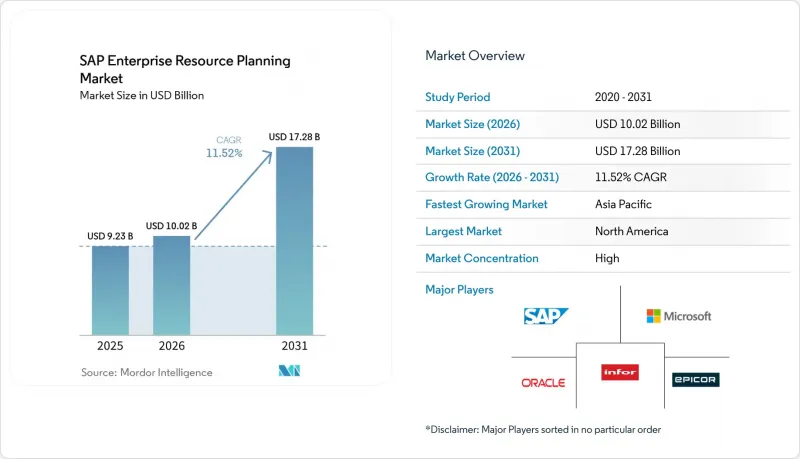
본 보고서는 도입 모델별(온프레미스, 클라우드, 하이브리드), 조직 규모별(대기업 및 중소기업), 업종별(제조, 소매, 은행, 금융서비스 및 보험(BFSI), 의료, 에너지 및 유틸리티, 통신 등), 모듈별(재무 관리, SCM, HCM, 고객 관계 관리 등) 및 지역별로 분류되어 있습니다. 시장 전망치는 금액(달러)으로 표시되어 있습니다.
세계의 SAP 기업 자원 계획(ERP) 시장 동향 및 인사이트
실시간 비즈니스 분석에 대한 수요 증가
기업에서는 매일 밤 생성되던 배치 보고서를 대신해, 수익 유출이나 재고 이상을 몇 초 만에 시각화해 주는 인메모리형 대시보드가 도입되고 있습니다. S/4HANA Private Edition에 탑재된 새로운 SAP Joule 기능을 통해 재무 팀은 단 한 번의 프롬프트 입력만으로 유효 기간이 만료된 가격표를 업데이트할 수 있게 되었으며, 몇 분 걸리던 작업이 몇 초로 단축되었습니다. 사전 구성된 소매 및 자산 관리용 데이터 제품을 통해, 원시 거래 데이터에서 AI 지원 모델로 가는 과정이 더욱 단축됩니다. Oracle의 경쟁 데이터 에이전트는 ERP 데이터를 인사 정책 및 공급업체 계약과 연동함으로써, 자율적인 예측이 단순한 신기함이 아니라 이미 필수 요건임을 고객에게 보여주고 있습니다. 따라서 예측 및 처방적 인사이트를 둘러싼 경쟁으로 인해 업그레이드 주기가 단축되면서, SAP 기업 자원 계획(ERP) 시장에서는 두 자릿수 성장이 지속되고 있습니다.
‘클라우드 퍼스트’ 디지털 전환 전략의 가속화
데이터센터 임대 계약 만료, 하이퍼스케일러가 제공하는 인센티브, 그리고 이사회 차원의 지시에 따라 기업들은 당초 로드맵보다 훨씬 빠른 시점에 클라우드 도입을 서둘러야 하는 상황에 처해 있습니다. 아르스트롬사의 4주간 공장 도입 사례는 클린 코어 방식의 S/4HANA 퍼블릭 클라우드 구축이 레거시 시스템의 업그레이드 기간을 수개월 단축할 수 있을 뿐만 아니라, 도입 첫날부터 Joule이 탑재된 AI를 활용할 수 있음을 입증했습니다. RAK Ceramics가 55개 법인을 S/4HANA 프라이빗 클라우드로 이전하기로 한 결정은 다각화된 제조업체들 사이에서도 이와 같은 시급성이 존재함을 보여줍니다. Microsoft Azure의 99.95% SLA 옵션은 미션 크리티컬 워크로드의 가동 시간과 관련된 마지막 우려 사항을 해소해 줍니다. 이러한 요인들이 복합적으로 작용하여, 보다 광범위한 SAP 기업 자원 계획(ERP) 시장에서 클라우드 구독 서비스가 10% 중반대의 견실한 성장세를 유지하고 있습니다.
기존 사용자에게 있어 ECC에서 S/4HANA로의 전환 비용이 높다는 점
알 후타임(Al-Futtim)사와 같은 16테라바이트 규모의 마이그레이션 사례는 수십 년에 걸친 맞춤형 코드와 집계 데이터를 이전하는 데 수백만 달러의 비용과 오랜 주말이 소요된다는 사실을 여실히 보여주고 있습니다. 자동화 도구가 도입되었음에도 불구하고, 30시간에 달하는 시스템 중단은 여전히 흔히 발생합니다. 현재 자본은 클린코어(Clean Core)를 통한 재설계, 데이터 정제 및 변경 관리 프로그램에 투입되고 있으며, 이로 인해 혁신을 위한 업무에 할당되어야 할 자금이 전용되고 있습니다. 레트로핏 비용이 높은 수준을 유지하는 한, 일부 중견 기업들은 업그레이드를 미루게 되어 SAP ERP 시장의 단기적인 성장세가 둔화될 것입니다.
부문별 분석
클라우드는 2025년에 SAP 기업 자원 계획(ERP) 시장의 48.20% 점유율을 차지한 것으로 평가되었으며, 2031년까지 연평균 성장률(CAGR) 14.20%를 나타낼 것으로 전망됩니다. 'GROW with SAP'와 같은 멀티테넌트형 SaaS 서비스는 정액제 번들 요금제로 중견 기업들의 관심을 끌고 있는 반면, 대형 제조업체들은 하이퍼스케일러의 SLA에 연계된 프라이빗 클라우드 버전을 채택하고 있습니다. 온프레미스 방식은 엄격한 데이터 상주 요건이 적용되는 국방 및 공공 부문 고객들 사이에서 여전히 자리 잡고 있으며, 하이브리드 환경은 과도기적인 수단으로서 유지되고 있습니다. 클라우드 네이티브를 도입하면 Joule 에이전트나 사전 설정된 데이터 제품에 신속하게 접근할 수 있어, 레거시 스택에 비해 우위가 더욱 강화되고 있습니다.
고객들은 인프라 관리를 Azure, AWS 또는 Alibaba Cloud로 이전함으로써 총 소유 비용이 감소했다고 보고하고 있습니다. '클린 코어' 정책에 따라 분기별 릴리스 주기에서 중단 지점이 줄어들어 가동 시간과 감사성이 향상되고 있습니다. 반면, 하이브리드 환경에서는 이중 통합 계층이나 일관성 없는 사용자 경험으로 인해 어려움을 겪는 경우가 많습니다. 하이퍼스케일러들이 소버린 클라우드 리전을 추가함에 따라 규제 장벽이 더욱 완화되면서, 클라우드 시장 점유율 확대를 촉진하는 동시에 SAP 기업 자원 계획(ERP) 시장의 성장을 지속시키고 있습니다.
2025년에는 다국적 사업 전개, 복잡한 기업 간 상계 처리, 그리고 도입 모듈 수 증가로 인해 대기업이 매출의 63.40%를 차지했습니다. 대기업은 여전히 SAP ERP 시장 규모의 주요 수익원, 2031년까지 연평균 성장률(CAGR) 15.90%를 기록하며 중소기업이 대기업을 능가하는 성장을 이룰 것으로 전망됩니다. 'GROW with SAP'는 미리 정의된 산업별 프로세스와 로우코드 기반의 확장성을 제공하여, 중견 기업의 CFO가 맞춤형 ABAP 코드를 사용하지 않고도 예측 기반의 현금 흐름에 대한 인사이트를 얻을 수 있도록 지원합니다.
인도네시아와 베트남에서 이 솔루션을 조기에 도입한 기업들은 퍼블릭 클라우드 버전으로 전환한 후, 결산 처리의 신속화와 수익성 향상을 주요 성과로 꼽고 있습니다. 세계 템플릿의 경우, 연결 결산, 무역 규정 준수 엔진, 제조 실행 시스템과의 긴밀한 연동이 요구되기 때문에 절대적인 지출액 측면에서는 여전히 대기업이 주도적인 위치를 차지하고 있습니다. 그러나 중견 시장에서의 성장세가 전체 잠재 시장 규모를 확대하고 있으며, 이는 SAP 기업 자원 계획(ERP) 시장의 장기적인 건전성을 뒷받침하고 있습니다.
지역별 분석
북미는 2025년에도 35.90%의 점유율을 유지했습니다. 이는 포춘 500대 기업의 ERP 개편과 클라우드의 조기 도입이 원동력이 되고 있습니다. Azure의 새로운 99.95% SLA 덕분에, 생명이나 미션에 필수적인 시스템의 가동 시간에 대한 우려가 해소되어, 클라우드 전환이 더욱 가속화되고 있습니다. 유럽에서는 GDPR(EU 개인정보보호규정) 및 지속가능성 관련 규제가 프라이빗 클라우드와 클린 코어 전략을 촉진하고 있지만, 한편으로는 디지털 주권에 대한 우려로 인해 멀티테넌트 도입이 주춤하고 있습니다. 프랑스와 독일에서 정부가 주도하는 소버린 클라우드는 규정 준수와 혁신을 양립시킴으로써 이러한 우려를 완화하고 있습니다.
아시아태평양은 인도가 SAP의 AI 허브로 부상하고, 숙련된 인재 공급원이 급속히 확대되고 있는 것을 배경으로, 13.80%라는 가장 높은 연평균 성장률(CAGR)을 보일 것으로 전망됩니다. 일본과 호주의 소버린 클라우드 정책은 현지 하이퍼스케일러와 SAP 간의 협력 영역을 촉진하여 공공 부문 수요를 불러일으키고 있습니다. 중국은 여전히 복잡한 상황에 놓여 있으며, 합작 기업들은 세계 모회사와의 일관성을 유지하면서 현지화 규정을 충족하기 위해 S/4HANA 프라이빗 클라우드를 도입하고 있습니다.
중동 및 아프리카에서는 시장의 성숙도에 차이가 나타납니다. 사우디아라비아의 ‘비전 2030’에 대한 투자와 아랍에미리트(UAE)의 대규모 민간 부문 프로젝트를 통해 퍼블릭 클라우드 기반 ERP가 예산의 주류를 차지하고 있습니다. 남아프리카공화국의 국영 기업은 까다로운 운영 환경 속에서도 선택적 데이터 마이그레이션이 성공할 수 있음을 입증하고 있습니다. 인프라 부족과 컨설턴트 인력 부족이 소규모 경제국들의 발목을 잡고 있지만, 광업 및 통신 대기업들이 주도하는 핵심 프로젝트들이 SAP 기업 자원 계획(ERP) 시장의 향후 확대를 위한 초석이 되고 있습니다.
기타 혜택 :
- 엑셀 형식 시장 예측(ME) 시트
- 3개월간의 애널리스트 지원
자주 묻는 질문
목차
제1장 서론
제2장 조사 방법
제3장 주요 요약
제4장 시장 구도
제5장 시장 규모 및 성장 예측
제6장 경쟁 구도
제7장 시장 기회 및 향후 전망
LSH 26.06.24According to Mordor Intelligence, the sAP enterprise resource planning market size was valued at USD 9.23 billion in 2025 and estimated to grow from USD 10.02 billion in 2026 to reach USD 17.28 billion by 2031, at a CAGR of 11.52% during the forecast period (2026-2031).
This report is Segmented by Deployment Model (On-Premise, Cloud, and Hybrid), Organization Size (Large Enterprises and SMEs), Industry Vertical (Manufacturing, Retail, BFSI, Healthcare, Energy and Utilities, Telecommunications, and More), Module (Financial Management, SCM, HCM, Customer Relationship Management, and More), and Geography. The Market Forecasts are in Value (USD).
Global SAP Enterprise Resource Planning Market Trends and Insights
Growing Demand for Real-Time Business Analytics
Enterprises are replacing nightly batch reports with in-memory dashboards that surface profit leaks and inventory anomalies in seconds. New SAP Joule skills inside S/4HANA Private Edition let finance teams extend expiring price lists with a single prompt, cutting multi-minute tasks to seconds. Pre-configured retail and asset-management data products further shorten the path from raw transactions to AI-ready models. Oracle's rival data agents now bind ERP data to HR policies and supplier contracts, showing customers that autonomous forecasting is table stakes rather than a novelty. The race for predictive and prescriptive insights is therefore compressing upgrade horizons and sustaining double-digit expansion in the SAP Enterprise Resource Planning market.
Acceleration of Cloud-First Digital Transformation Strategies
Expiring data-center leases, hyperscaler incentives, and board-level mandates are pushing firms to cloud deployments well ahead of earlier roadmaps. A four-week factory deployment by Ahlstrom demonstrated that a clean-core S/4HANA Public Cloud roll-out can beat legacy upgrade timelines by months while unlocking Joule-powered AI from day one. RAK Ceramics' decision to move 55 legal entities to S/4HANA Private Cloud echoes the same urgency among diversified manufacturers. Microsoft's 99.95% SLA option in Azure removes the final objection to uptime for mission-critical workloads. Together, these factors sustain a robust mid-teens growth clip for cloud subscriptions inside the broader SAP Enterprise Resource Planning market.
High Migration Costs From ECC to S/4HANA For Legacy Users
Sixteen-terabyte conversions like Al-Futtaim's spotlight the millions of dollars and long weekends needed to migrate decades of custom code and data aggregates. Even with automated tooling, 30-hour outages remain common. Capital now flows into clean-core redesigns, data scrubbing, and change-management programs, diverting funds from innovation workstreams. As long as retrofit costs stay elevated, some mid-market firms defer upgrades, tempering near-term expansion of the SAP Enterprise Resource Planning market.
Other drivers and restraints analyzed in the detailed report include:
- Integration of AI and Machine Learning Add-Ons Within SAP
- Rise of Composable ERP Architecture Among Large Enterprises
- Skill Shortage of Certified SAP Consultants In Emerging Regions
For complete list of drivers and restraints, kindly check the Table Of Contents.
Segment Analysis
Cloud captured 48.20% SAP Enterprise Resource Planning market share in 2025 and is forecast to post a 14.20% CAGR to 2031. Multitenant SaaS offerings such as GROW with SAP lure mid-market firms with fixed-price bundles, while large manufacturers embrace Private Cloud editions tied to hyperscaler SLAs. On-premises persists in defense and public-sector accounts with strict data-residency rules, keeping hybrid footprints alive as a stepping stone. Cloud-native deployments enjoy quicker access to Joule agents and pre-configured data products, reinforcing their advantage over legacy stacks.
Customers report lower total ownership once infrastructure management shifts to Azure, AWS, or Alibaba Cloud. Clean-core policies mean fewer breakpoints during quarterly release cycles, improving uptime and auditability. Hybrid estates, by contrast, often juggle double integration layers and inconsistent user experiences. As hyperscalers add sovereign-cloud regions, regulatory barriers ease further, driving incremental share gains for cloud and sustaining the expansion of the SAP Enterprise Resource Planning market.
Large enterprises accounted for 63.40% of revenue in 2025 thanks to multi-country rollouts, complex intercompany eliminations, and broader module counts. They remain the revenue anchor of the SAP Enterprise Resource Planning market size, but small and medium enterprises will outpace them at a 15.90% CAGR through 2031. GROW with SAP provides predefined industry processes and low-code extensibility, enabling mid-market CFOs to obtain predictive cash flow insights without bespoke ABAP code.
Early adopters in Indonesia and Vietnam cite faster closings and improved profitability after moving to public-cloud editions. Large enterprises still dominate absolute spend because global templates require consolidation, trade-compliance engines, and deep manufacturing execution tie-ins. Yet mid-market momentum expands the total addressable base, underpinning the long-term health of the SAP Enterprise Resource Planning market.
Geography Analysis
North America retained a 35.90% share in 2025, driven by Fortune 500 ERP refreshes and early cloud adoption. Azure's new 99.95% SLA removes objections to uptime for life-and-mission-critical installations, spurring further cloud migrations. Europe's GDPR and sustainability mandates are driving private-cloud and clean-core strategies, even as digital sovereignty concerns slow multitenant adoption. Government-backed sovereign clouds in France and Germany soften that stance, aligning compliance with innovation.
Asia-Pacific is forecast to record the fastest 13.80% CAGR, buoyed by India's emergence as SAP's AI hub and rapid skills-pipeline expansion. Sovereign-cloud policies in Japan and Australia encourage local hyperscaler-SAP zones, unlocking public-sector demand. China remains a nuanced play, with joint ventures adopting S/4HANA Private Cloud to stay aligned with global parents while satisfying localization rules.
Middle East and Africa exhibit mixed maturity. Vision 2030 investments in Saudi Arabia and large private-sector projects in the United Arab Emirates move public-cloud ERP into mainstream budgets. South Africa's state-owned enterprises prove that selective data transitions can succeed even under tight operational windows. Infrastructure gaps and consultant shortages restrain smaller economies, but anchor projects by mining and telecom majors seed future expansion of the SAP Enterprise Resource Planning market.
- SAP SE
- Oracle Corporation
- Microsoft Corporation
- Infor Inc.
- Epicor Software Corporation
- Unit4 N.V.
- IFS AB
- The Sage Group plc
- Workday Inc.
- QAD Inc.
- Acumatica Inc.
- SYSPRO (Pty) Ltd.
- Deltek Inc.
- Ramco Systems Limited
- TOTVS S.A.
- Kingdee International Software Group Company Limited
- Yonyou Network Technology Co., Ltd.
- Priority Software Ltd.
- Plex Systems Inc.
- Cegid Group SA
Additional Benefits:
- The market estimate (ME) sheet in Excel format
- 3 months of analyst support
TABLE OF CONTENTS
1 INTRODUCTION
- 1.1 Study Assumptions and Market Definition
- 1.2 Scope of the Study
2 RESEARCH METHODOLOGY
3 EXECUTIVE SUMMARY
4 MARKET LANDSCAPE
- 4.1 Market Overview
- 4.2 Market Drivers
- 4.2.1 Growing demand for real-time business analytics
- 4.2.2 Acceleration of cloud-first digital transformation strategies
- 4.2.3 Integration of AI and machine learning add-ons within SAP S/4HANA
- 4.2.4 Rise of composable ERP architecture among large enterprises
- 4.2.5 Sustainability compliance modules driving upgrades
- 4.2.6 Industry-cloud bundles tailored for mid-market niches
- 4.3 Market Restraints
- 4.3.1 High migration costs from ECC to S/4HANA for legacy users
- 4.3.2 Skill shortage of certified SAP consultants in emerging regions
- 4.3.3 Cyber-resilience concerns around multi-tenant deployments
- 4.3.4 Vendor lock-in anxiety amid hyperscaler partnerships
- 4.4 Impact of Macroeconomic Factors on the Market
- 4.5 Industry Value Chain Analysis
- 4.6 Regulatory Landscape
- 4.7 Technological Outlook
- 4.8 Porter's Five Forces Analysis
- 4.8.1 Threat of New Entrants
- 4.8.2 Bargaining Power of Buyers
- 4.8.3 Bargaining Power of Suppliers
- 4.8.4 Threat of Substitutes
- 4.8.5 Competitive Rivalry
5 MARKET SIZE AND GROWTH FORECASTS (VALUE)
- 5.1 By Deployment Model
- 5.1.1 On-premise
- 5.1.2 Cloud
- 5.1.3 Hybrid
- 5.2 By Organization Size
- 5.2.1 Large Enterprises
- 5.2.2 Small and Medium Enterprises
- 5.3 By Industry Vertical
- 5.3.1 Manufacturing
- 5.3.2 Retail and Consumer Goods
- 5.3.3 BFSI
- 5.3.4 Healthcare
- 5.3.5 Energy and Utilities
- 5.3.6 Telecommunications
- 5.3.7 Rest of Industry Verticals
- 5.4 By Module
- 5.4.1 Financial Management
- 5.4.2 Supply Chain Management
- 5.4.3 Human Capital Management
- 5.4.4 Customer Relationship Management
- 5.4.5 Production Planning and Execution
- 5.4.6 Analytics and Business Intelligence
- 5.4.7 Other Modules
- 5.5 By Geography
- 5.5.1 North America
- 5.5.1.1 United States
- 5.5.1.2 Canada
- 5.5.1.3 Mexico
- 5.5.2 South America
- 5.5.2.1 Brazil
- 5.5.2.2 Argentina
- 5.5.2.3 Rest of South America
- 5.5.3 Europe
- 5.5.3.1 Germany
- 5.5.3.2 United Kingdom
- 5.5.3.3 France
- 5.5.3.4 Italy
- 5.5.3.5 Spain
- 5.5.3.6 Russia
- 5.5.3.7 Rest of Europe
- 5.5.4 Asia-Pacific
- 5.5.4.1 China
- 5.5.4.2 Japan
- 5.5.4.3 India
- 5.5.4.4 South Korea
- 5.5.4.5 Australia
- 5.5.4.6 Rest of Asia-Pacific
- 5.5.5 Middle East
- 5.5.5.1 Saudi Arabia
- 5.5.5.2 United Arab Emirates
- 5.5.5.3 Turkey
- 5.5.5.4 Rest of Middle East
- 5.5.6 Africa
- 5.5.6.1 South Africa
- 5.5.6.2 Nigeria
- 5.5.6.3 Rest of Africa
- 5.5.1 North America
6 COMPETITIVE LANDSCAPE
- 6.1 Market Concentration
- 6.2 Strategic Moves
- 6.3 Market Share Analysis
- 6.4 Company Profiles (includes Global Level Overview, Market Level Overview, Core Segments, Financials as available, Strategic Information, Market Rank/Share, Products and Services, Recent Developments)
- 6.4.1 SAP SE
- 6.4.2 Oracle Corporation
- 6.4.3 Microsoft Corporation
- 6.4.4 Infor Inc.
- 6.4.5 Epicor Software Corporation
- 6.4.6 Unit4 N.V.
- 6.4.7 IFS AB
- 6.4.8 The Sage Group plc
- 6.4.9 Workday Inc.
- 6.4.10 QAD Inc.
- 6.4.11 Acumatica Inc.
- 6.4.12 SYSPRO (Pty) Ltd.
- 6.4.13 Deltek Inc.
- 6.4.14 Ramco Systems Limited
- 6.4.15 TOTVS S.A.
- 6.4.16 Kingdee International Software Group Company Limited
- 6.4.17 Yonyou Network Technology Co., Ltd.
- 6.4.18 Priority Software Ltd.
- 6.4.19 Plex Systems Inc.
- 6.4.20 Cegid Group SA
7 MARKET OPPORTUNITIES AND FUTURE OUTLOOK
- 7.1 White-space and Unmet-Need Assessment


